Categories
Smile CSR Education Partners In Change Partnerships

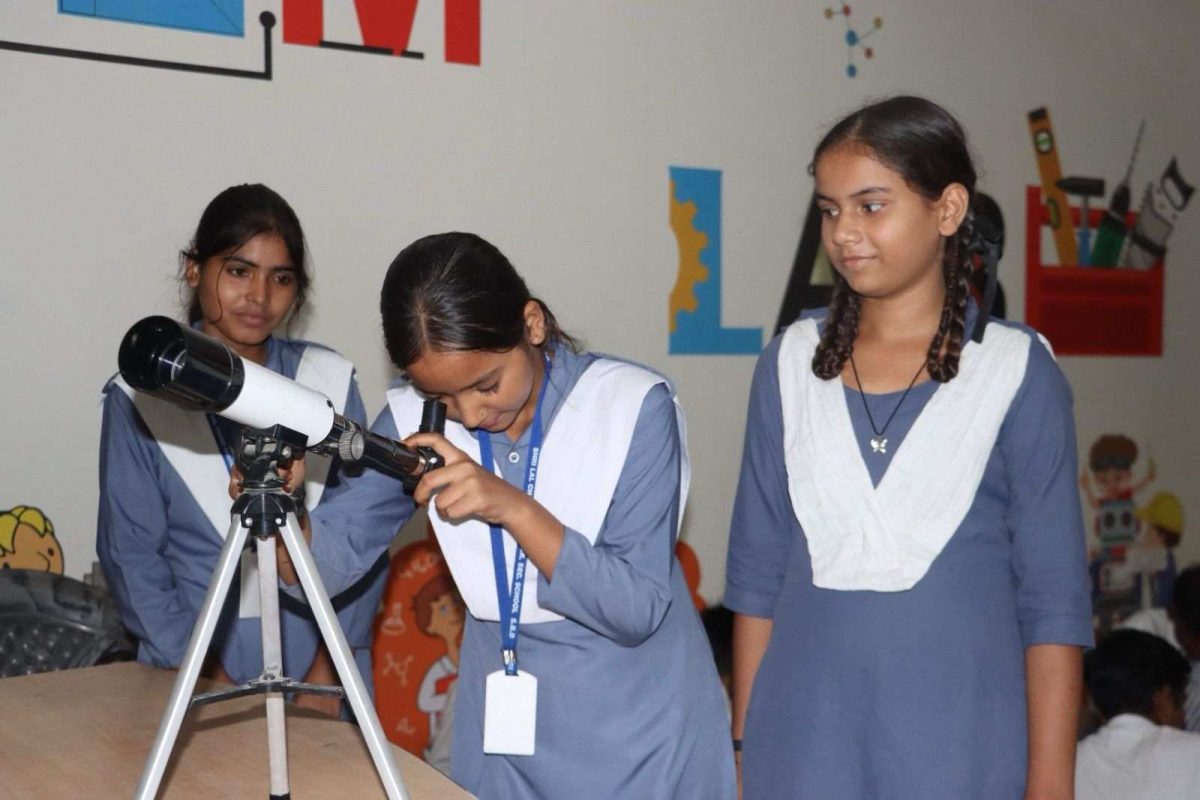
STEM Education: Preparing Children for the Next Space Age

Summary

  • India’s space economy is expanding
  • STEM education – Science, technology, engineering and mathematics equip children with problem-solving, innovation and critical-thinking skills.
  • Inclusive STEM education can help bridge gaps in technology, infrastructure and opportunity.
  • CSR can accelerate STEM access.
  • Only by giving every child access to STEM education today can help create the diverse and skilled talent to help India’s technology economy

India’s space story is entering a new chapter. What was once largely associated with government-led missions is increasingly becoming a broader ecosystem of private enterprises, start-ups, research institutions and young innovators. As India looks towards a future shaped by advanced technology, human spaceflight, satellite applications and a growing private space economy, one question becomes increasingly important: Who will build this future?

The answer cannot come from a small pool of students with access to the best schools, laboratories and technology. India’s space ambitions will need a much wider talent pipeline—one that includes children from rural communities, underserved schools and economically disadvantaged backgrounds.

This is where STEM education becomes critical.

India’s Space Ambitions Need a Stronger Talent Pipeline

India’s space ecosystem has expanded rapidly in recent years. According to the Press Information Bureau (PIB), the number of registered space start-ups has grown from just one in 2014 to around 440 in 2026. India’s space economy is currently valued at approximately USD 9 billion and is projected to reach USD 40–45 billion over the next decade. Private investment has also risen nearly six-fold, from USD 100.5 million in 2021–22 to USD 618.5 million by March 2026. 

The significance of these numbers extends beyond the space sector itself. They signal the emergence of new career pathways across satellite technology, electronics, robotics, data science, propulsion, engineering, telecommunications, Earth observation and other technology-driven fields.

The government has also strengthened the ecosystem through reforms that enable greater private participation. By mid-2026, 113 authorisations had been granted to 52 Non-Government Entities, including start-ups, for activities such as satellite operations, payload development and launch services. 

India is therefore not simply preparing to send more missions into space. It is building an economy around space technology. And this modern robust economy will require young people of India to be prepared to imagine, experiment, solve problems and create.

Why STEM Education Matters

STEM education is about developing the ability to ask questions, understand how things work, test ideas, learn from failure and find solutions.

These are precisely the skills that a technology-driven economy demands.

A child experimenting with a simple DIY model is learning more than a scientific concept. They are developing curiosity. A student programming a basic robot is learning computational thinking and problem-solving. A classroom activity involving measurement, design and construction brings mathematics and engineering into a tangible context.

This approach transforms learning from memorising answers to discovering possibilities.

For India’s emerging space economy, such capabilities are foundational. The country’s future requirements will span highly specialised areas such as

  • Spacecraft systems
  • Artificial intelligence
  • Robotics
  • Propulsion
  • Remote sensing
  • Materials science 
  • Satellite communications

But the pipeline for these careers begins much earlier. It begins with children developing confidence in science and technology.

The Space Dream Must Reach Rural India

India’s space ambitions can be truly transformative only when the opportunity to participate in them is inclusive.

A child in a remote village may have the same curiosity about the Moon as a child in an urban private school. What may differ is access—to a science laboratory, trained teachers, digital resources, experiential learning and exposure to technology.

This is where the conversation around STEM education in India must move beyond urban institutions and specialised programmes. Inclusive STEM education means ensuring that children from underserved communities encounter science not merely as a textbook subject, but as something they can explore and create with.

It means a student should be able to ask, “How does a satellite work?” and have the opportunity to build a model. It means a girl from a rural school should be able to see engineering, robotics or space science as possible career choices rather than distant professions meant for someone else.

The challenge is significant. 

Schools in India’s underserved communities continue to face gaps in infrastructure, digital access, teacher capacity and exposure to experiential learning. And addressing these gaps is essential, particularly when India wants its future technology workforce, to reflect the diversity and potential of its population.

Making Learning Experiential with STEM

The answer is not necessarily to replicate expensive urban laboratories everywhere. It is to create learning environments where children can experiment with the resources available to them.

Mobile STEM laboratories, DIY activity kits, digital classrooms, locally relevant learning materials and teacher training can help bring experiential education closer to underserved communities.

Teachers are central to this transformation. Technology cannot replace an inspired educator who knows how to turn a question into an investigation.

Training teachers in inquiry-based and activity-based learning can help classrooms become spaces where children are encouraged to ask why, how and what if. Such methods can strengthen scientific temperament while making learning more engaging and relevant.

This is also where organisations working at the grassroots can play a meaningful role by connecting educational policy and community-level implementation.

The Role of CSR in Building India’s STEM Future

The scale of India’s STEM challenge makes collaboration essential. Government programmes can establish policy direction and public infrastructure, while educational institutions can contribute knowledge and research. The private sector brings technology, expertise and resources.

This creates a significant opportunity for CSR education in India.

CSR for education in India can move beyond supporting conventional access to schooling and contribute to the quality and relevance of learning itself. Furthermore, investments in STEM laboratories, digital classrooms, teacher training, robotics and innovation programmes can help underserved schools prepare children for an increasingly technology-led economy. Such interventions become especially meaningful when they are designed for long-term capacity building rather than one-time exposure.

For example, a STEM lab creates greater impact when teachers are trained to use it effectively, students regularly engage with hands-on activities and learning is integrated into the broader school environment. CSR partnerships can therefore help bridge the gap between access to education and access to opportunity.

Building STEM Access Through the Grassroots

At Smile Foundation, this approach is reflected through efforts to make learning more experiential for children from underserved communities.

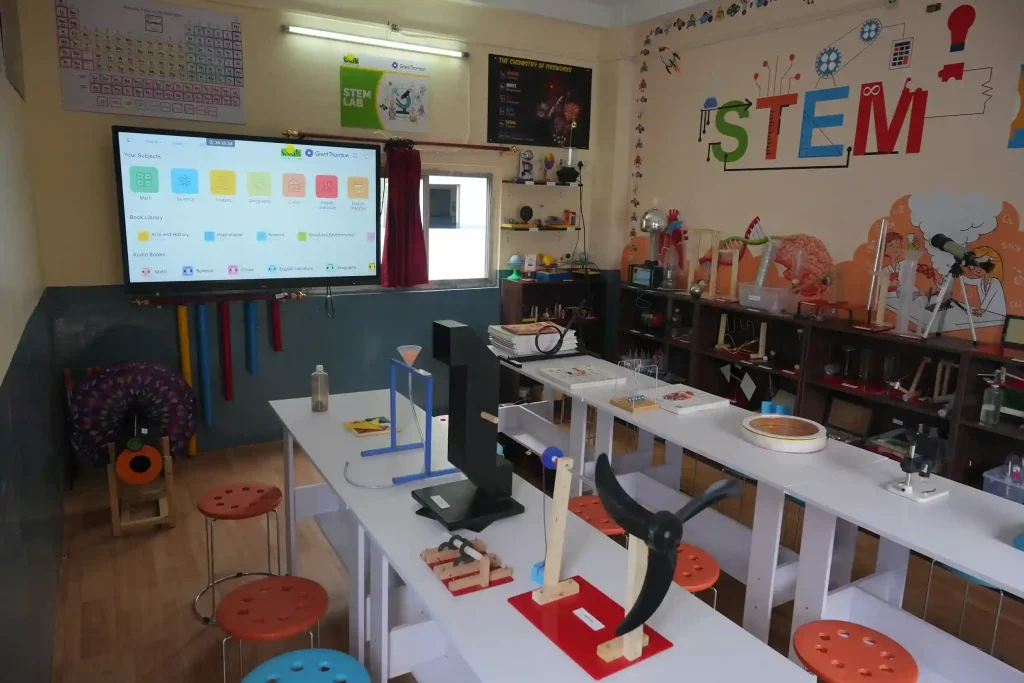
Through its education interventions, including Mission Education, Smile Foundation works with children and communities to strengthen access to quality learning. Its STEM-focused initiatives have included establishing STEM laboratories, providing DIY activity kits and supporting digital classrooms. Teacher capacity-building is also an important part of the approach, with training focused on inquiry-based and activity-based pedagogy, classroom management and child-centric teaching.

The larger objective is not simply to introduce technology into a classroom. It is to create an environment where children develop the confidence to engage with it.

That distinction matters.

Because the future of India’s space sector will not be built only by those who have access to sophisticated equipment today. It will be built by children who learn to question, imagine, experiment and persist.

Space-ready Generation with STEM education

India’s ambitions are already extending well beyond conventional satellite missions. The country is preparing for future human spaceflight, advanced launch systems, planetary exploration and the proposed Bharatiya Antariksh Station. The PIB notes that the space station is targeted for operationalisation by 2035, while Gaganyaan aims to build capabilities for human spaceflight. 

At the same time, India’s space capabilities are increasingly connected to everyday life; from navigation and communications to agriculture, infrastructure, disaster management and environmental monitoring. This means the impact of space technology will not remain confined to scientists and astronauts, it will increasingly shape the way communities live, work and solve problems.

And therefore, preparing children for this future, is not about expecting every child to become an astronaut. It is about ensuring that every child has the opportunity to become a problem-solver, innovator, engineer, researcher, entrepreneur or informed citizen in a technology-driven India.

Partnership for India’s STEM Education

India’s space story began with ambitious dreams and limited resources. Today, those dreams are evolving into a dynamic ecosystem of public institutions, private companies and start-ups.

But the next leap will require something even more valuable than technology: talent that is diverse, curious and widely distributed.

The child who looks at the night sky from a metropolitan city and the child who looks at it from a remote village are looking at the same universe. Their opportunities to explore it, however, should not be determined by where they were born.

CSR support for Inclusive STEM education in India can help close that gap.

If India wants its space economy to become a national success story, its investment must begin long before a child enters an engineering college. It must begin in the classroom—with curiosity, experimentation, access and the freedom to imagine.

Because India’s next space breakthrough may already be looking up at the sky and it is our responsibility to make sure that every child has the opportunity to reach for it.

Partner now!

FAQs

1. Why is STEM education important for India’s growing space economy?
STEM education develops critical thinking, problem-solving, creativity and scientific curiosity—skills essential for careers in India’s expanding space and technology ecosystem.

2. What is the role of STEM education in India’s future?
STEM education in India can prepare young learners for emerging fields including artificial intelligence, robotics, satellite technology, engineering, data science and space technology.

3. Why does India need inclusive STEM education?
Inclusive STEM education ensures that children from rural and underserved communities can access the knowledge, technology and learning opportunities needed to participate in India’s future economy.

4. How can STEM education benefit rural children in India?
Hands-on STEM learning, mobile laboratories, DIY kits, digital classrooms and trained teachers can help rural children develop scientific thinking and explore technology-related career possibilities.

5. How can CSR support STEM education in India?
CSR education in India can support STEM laboratories, digital infrastructure, teacher training, experiential learning, robotics programmes and innovation initiatives in underserved schools.

6. What is the connection between CSR education in India and India’s space ambitions?
CSR education in India can help create a wider and more inclusive talent pipeline by giving children early exposure to science, technology, engineering and mathematics.

7. How can organisations support STEM education in underserved communities?
Organisations can collaborate with schools, governments, corporates and communities to provide STEM infrastructure, teacher capacity-building, learning resources and experiential programmes.

8. How can STEM education prepare children for future careers?
STEM education helps children build curiosity, collaboration, analytical thinking, creativity and problem-solving skills that can support careers across space technology and India’s wider technology-driven economy.

Categories
In The Spotlight Insights Smile

Vedanta Delhi Half Marathon 2026: The Magic When a City Decides to Run Together

On the third Sunday of October, hours before Delhi properly wakes, the roads around Jawaharlal Nehru Stadium will fill with people who have voluntarily agreed to be uncomfortable. A few are chasing a personal best. Most are not. They are there because at some point in the preceding months, someone asked them to run, and instead of finding a reason to decline, they found a reason to say yes.

The Vedanta Delhi Half Marathon 2026, the twenty-first edition of the race, flags off on 18 October. Before we discuss what it does for a body, a company or a child in a Mission Education classroom, it is worth asking a simpler question: why does any of this exist at all?

A race that was invented twice

The marathon rests on a story that is almost certainly untrue.

Herodotus, writing within living memory of the Persian Wars, describes a professional courier named Pheidippides dispatched from Athens to Sparta, roughly 240 kilometres, to plead for reinforcements. He mentions no run from Marathon to Athens, no shout of victory, no collapse. Those details surface centuries later in Plutarch and Lucian, and are finally cemented in the popular imagination by Robert Browning’s 1879 poem. By the time the modern Olympics were revived in Athens in 1896 and Spyridon Louis won the first marathon to a stadium’s roar, the legend had hardened into infrastructure.

The distance is no less accidental. Twenty-six miles and 385 yards was fixed at the 1908 London Games so the race could begin on the lawns of Windsor Castle and finish in front of the royal box at White City. A number chosen for the sightlines of a watching family was ratified in 1921 and has governed the ambitions of millions ever since.

This is not a debunking. It is the point. The marathon endured neither because of Greece nor because of a monarchy. It endured because the distance turned out to be a near-perfect instrument for a specific human need — a long, public, entirely voluntary difficulty that anyone may choose, and that nobody can fake their way through.

From solitary suffering to civic festival

Run for a Cause - Vedanta Delhi Half Marathon 2026

For most of the twentieth century, distance running was a minority pursuit: thin men in singlets, watched by almost nobody. The shift came in the 1970s. Frank Shorter’s Olympic gold in 1972 put a marathon on American television; Jim Fixx’s The Complete Book of Running turned it into a phenomenon. And in 1976, Fred Lebow took the New York City Marathon out of its loops in Central Park and routed it through all five boroughs.

That was the true invention. The race stopped being an athletic event held near a city and became an event that happened to a city.

Chris Brasher — pacemaker for Roger Bannister’s four-minute mile — ran New York in 1979 and wrote in The Observer about a metropolis that had stopped to celebrate strangers. Two years later, he and John Disley staged the first London Marathon. Brasher’s most consequential innovation was not the course but the sponsorship form: the pledge sheet, the charity place, the idea that one person’s suffering could be converted into a public good. London is now the largest single-day fundraising event in the world, having crossed a billion pounds in charitable income in 2019.

India’s chapter opened with Procam International — Mumbai in 2004, Delhi in 2005. Two decades on, the Delhi race is a World Athletics Gold Label event, and its philanthropy platform has mobilised more than ₹88.6 crore for over 280 nonprofit organisations. Brasher’s inheritance, running down Kartavya Path.

What 21.1 kilometres actually does to a body

Here is what nobody tells a first-timer: the race is the least important part. The value sits almost entirely in the twelve to sixteen weeks that precede it.

A 2020 study in the Journal of the American College of Cardiology followed first-time marathoners through six months of ordinary, unglamorous training. Their arteries grew measurably more elastic. Blood pressure fell. The researchers estimated a reduction in “vascular age” of around four years. Tellingly, the largest gains went to the oldest and slowest participants — precisely the people least likely to think of themselves as athletes.

That finding lands with particular force in India. The ICMR-INDIAB study, published in The Lancet Diabetes & Endocrinology in 2023, estimated 101 million Indians living with diabetes, 136 million more with prediabetes, and 315 million with hypertension. These are not diseases of scarcity. They are diseases of chairs — of ninety-minute commutes, longer meetings, and a working culture that quietly treats the body as a container for the brain.

A half marathon is an unusually well-designed intervention against exactly this. It is long enough that you cannot bluff it: you must train, sleep, eat and ration your evenings. It is short enough that it does not demand the near-monastic commitment of the full 42.2 kilometres. Twenty-one kilometres asks for a rearranged life, not a surrendered one.

The mental arithmetic is just as real, and runners describe it more plainly than the literature does: a long, slow Sunday run is one of the very few hours left in the modern week that cannot be interrupted by a notification.

The quiet cure for a lonely city

In 2023 the World Health Organization declared loneliness a pressing global health threat, citing evidence that places chronic social isolation alongside far more famous risks. Between long commutes, gated verticality and the slow disappearance of the neighbourhood, urban India may be the frontier of it.

Which is why the second half of a marathon’s worth has nothing to do with cardiovascular function. For a few hours on a single Sunday, a city agrees to a set of extraordinary rules. Roads belong to pedestrians. Strangers hand you water. Volunteers stand for six hours to help people they will never see again. Someone reads your name off your bib and shouts it. There is almost no other civic occasion in which so many Indians cheer, sincerely and at volume, for people they do not know.

The Vedanta Delhi Half Marathon 2026 builds this into its structure: a Charity Corridor along the route carrying the names of fundraising nonprofits, cheering zones staffed by NGO communities, beneficiaries standing at the roadside watching people run in their name. For a morning, the city becomes an argument for itself.

Where a corporate team comes in — and why it is the icing

Everything described above is already worth doing on its own terms. A company that fields a team at the Vedanta Delhi Half Marathon 2026 has, before a single rupee changes hands, handed its employees a three-month reason to sleep properly and a shared vocabulary that has nothing to do with quarterly targets. Colleagues who train together at 5:30 am tend to discover one another as people. That is the cake — wellness that is measurable, team spirit that isn’t a workshop.

Running with Smile Foundation is the icing.

Smile Foundation runs more than 400 welfare projects across India: Mission Education classrooms, Smile on Wheels mobile healthcare units, STeP livelihood centres, and the Swabhiman programme for women’s health and empowerment — reaching over 15 lakh children and families every year. A corporate team’s contribution goes directly into that work, translating into classrooms staffed, clinic rounds run and young people trained for jobs that exist.

Teams come in four sizes — Team 10, Team 20, Team 50 and Team 80, at ₹2.20 lakh, ₹4 lakh, ₹9 lakh and ₹12.80 lakh respectively — with up to five additional runners available in any category. Two points of practical honesty are worth stating plainly. Race registration fees are separate from the team donation and are paid to the event promoter, Procam International. And under a 2014 Ministry of Corporate Affairs circular, participation in a one-time event does not itself qualify as CSR expenditure under Section 135 — though companies wishing to support Smile Foundation’s programmes through CSR funds can do so alongside their team.

For 2026, corporate registrations close on 18 September, team submissions on 25 September, and race fees are due by 30 September. Race day is 18 October 2026.

The only message worth carrying

Marathon in the city at sunrise

Whatever the historical truth of Pheidippides, the story has survived twenty-five centuries because we recognise something in it. A man running not for himself, but to carry news that mattered to everybody else.

On 18 October, tens of thousands of people will move through Delhi carrying a version of that same message on their chests. Some will run it in ninety minutes. Most will walk parts of it. It will make almost no difference to the value of what they are doing.

Categories
Health

World Mosquito Day 2026: The Science Behind Malaria and Why This Day Matters

Summary

  • World Mosquito Day 2026 highlights the continuing global burden of malaria, despite major advances in prevention, diagnosis and treatment.
  • Understanding how malaria spreads has transformed disease control, helping scientists develop mosquito-control measures, medicines, diagnostic tools and vaccines.
  • India has made significant progress against malaria, with cases and deaths falling sharply between 2015 and 2023, although vulnerable and hard-to-reach communities remain at risk.
  • Prevention starts at the community level, through mosquito nets, reducing breeding sites, awareness, early diagnosis and timely treatment.
  • Last-mile healthcare is critical, ensuring that people in underserved communities can access preventive information, testing and treatment without major geographical or financial barriers.

Every year on 20 August, World Mosquito Day reminds us that one of the world’s smallest creatures can have an enormous impact on human health. The day marks the significant discovery in 1897 by British doctor Sir Ronald Ross that female mosquitoes transmit malaria parasites to humans. Over a century later, mosquitoes continue to remain a major carrier of painful diseases, which can be fatal and affect millions of people around the world.

Mosquitoes are easy to ignore. They are tiny, familiar and often seen as little more than an irritating insect. But many mosquitoes can carry parasites, viruses and other organisms that cause serious diseases. And among that, malaria remains one of the most important examples. Although it is preventable and treatable, hundreds of thousands of people worldwide still die from it every year.

According to the World Health Organisation’s(WHO) latest malaria data, there were an estimated 282 million cases of malaria and 610,000 deaths across 80 countries in 2024. The numbers are a reminder that malaria is not simply a disease of the past but remains a major public health challenge, particularly for communities where healthcare, sanitation and disease-prevention services are difficult to access.

World Mosquito Day is therefore more than a day about an insect. It is an opportunity to understand how malaria spreads, why some communities are more vulnerable than others and what can be done to prevent it.

What is Malaria?

The science behind malaria is surprisingly complex, even though the starting point is a simple mosquito bite.

Malaria is a potentially life-threatening disease caused by tiny parasites of the Plasmodium family. These parasites are transmitted to people through the bites of infected female Anopheles mosquitoes. According to WHO, although malaria is mainly found in tropical countries, with the right prevention, it is both preventable and curable.

However, there is an important point to understand here — that not every mosquito spreads malaria. Malaria is mainly transmitted by certain species of female Anopheles mosquitoes. The female mosquito needs blood to help develop her eggs, which is why they bite humans and other animals. If they bite a person already carrying the malaria parasites, the parasites enter the mosquito, and eventually, when that mosquito later bites another person, they transmit the parasites.

Once inside the human body, the parasites travel to the liver and multiply.  They then enter red blood cells, which eventually burst, releasing more parasites into the bloodstream where they continue multiplying.

This repeated process is linked to the fever and chills experienced by many people with malaria.

In some cases, the infection can become severe. A person may develop confusion, seizures, difficulty breathing, severe weakness or organ failure. Without timely treatment, severe malaria can be fatal.

Some parasites can also remain hidden in the liver. Plasmodium vivax, for example, can remain dormant and later reactivate, causing another episode of malaria.

This is why malaria is not simply a matter of treating a fever; proper diagnosis and treatment are essential to clear the parasite from the body.

The WHO’s malaria guidance stresses the importance of early diagnosis and effective treatment. A person with suspected malaria should be tested and treated promptly rather than relying only on symptoms.

The Global Malaria Burden Remains Huge

The world has made significant progress against malaria, but the disease remains a major threat.

The WHO’s World Malaria Day 2026 data reports that there were 282 million malaria cases and 610,000 deaths in 2024. At the same time, there has been remarkable progress since 2000. WHO estimates that malaria interventions have helped avert approximately 2.3 billion cases and 14 million deaths since the beginning of the century.

This means that malaria control works. Bed nets, insecticide spraying, testing, medicines, vaccines and community health programmes have saved millions of lives.

What about India?

India has made considerable progress in reducing malaria.

According to the Government of India’s Ministry of Health and Family Welfare, malaria cases in India declined by 80.5% between 2015 and 2023, while malaria deaths fell by 78.38% during the same period. The government also reported that 122 districts recorded zero malaria cases in 2023.

These are significant achievements. India also exited the WHO’s High Burden to High Impact group in 2024, reflecting the country’s progress in malaria control.

However, elimination remains difficult. Malaria is not distributed evenly across India. Certain forested, tribal and hard-to-reach areas continue to face greater risks. Seasonal rainfall, stagnant water, environmental conditions and limited access to healthcare can all influence transmission.

India has historically carried a substantial share of the malaria burden in the South-East Asia Region, and prevention, early diagnosis and complete treatment remain essential.

Why Poverty Makes Mosquito-Borne Diseases Harder to Fight

A mosquito does not discriminate between rich and poor. But the risk of disease and the ability to recover from it are not equally distributed.

A family living in a crowded settlement may have fewer ways to prevent mosquito breeding. Poor drainage can leave standing water around homes. A household may not have proper window screens or may struggle to afford repellents. Someone working as a daily-wage labourer may also hesitate to visit a health centre because doing so means losing a day’s income.

This is where malaria becomes more than a medical problem; it becomes a development problem.

A person who becomes seriously ill may be unable to work. Children may miss school. Families may spend money travelling to hospitals or buying medicines. Repeated illness can therefore create an additional financial burden for households that are already struggling.

This is why malaria prevention must reach beyond hospitals. Communities need information, accessible healthcare, clean surroundings and systems that allow people to get tested and treated without facing major financial or geographical barriers.

Prevention Starts With the Environment

One of the simplest ways to reduce mosquito-borne disease is to reduce opportunities for mosquitoes to breed.

Mosquitoes need water to complete their life cycle. Stagnant water in containers, discarded tyres, drains, coolers and other places can provide breeding sites for some mosquito species.

This does not mean that every mosquito breeding site can be eliminated. But reducing stagnant water around homes and communities can help reduce mosquito populations.

Several measures can be adopted to prevent malaria, including insecticide-treated mosquito nets and indoor residual spraying in appropriate settings.

Why Awareness is as Important as Treatment

World Mosquito Day 2026

People cannot protect themselves from a disease they do not understand. This is why community awareness is an important part of malaria control. People need to know what malaria symptoms look like, when to seek medical help and why completing treatment matters.

At Smile Foundation, we have previously used our Smile on Wheels mobile healthcare programme to conduct malaria awareness activities in underserved communities. During our World Malaria Day 2023 campaign, our teams conducted awareness sessions across India on keeping surroundings clean, removing stagnant water, using mosquito repellents and seeking appropriate care when someone develops malaria.

This kind of work is particularly important in communities where healthcare facilities may be far away.

Taking Healthcare to the Last Mile

For many low-income families, the biggest challenge is not necessarily the absence of medical treatment but getting to that treatment. A health centre may be several kilometres away. Transport may be expensive. A worker may lose wages by spending a day at a hospital. These barriers can encourage people to delay care.

Our healthcare programme attempts to address this gap by taking primary healthcare services directly to underserved communities.

According to Smile Foundation’s 2024 healthcare impact report, our programme reached more than 12.89 lakh people across 16 states. Our network included 105 Smile on Wheels mobile healthcare units, three static clinics and more than 100 health camps. Our programme also conducts health-awareness activities, including information on vector-borne diseases such as malaria and filariasis.

More recently, we delivered 20 lakh healthcare treatments during the 2025–26 financial year, taking its cumulative number of treatments since 2006 to more than 70 lakh. Our 2026 healthcare update exhibits a model combining mobile healthcare, preventive engagement, digital solutions and efforts to strengthen access to primary care.

For mosquito-borne diseases, this last-mile approach matters. Prevention messages are most useful when they reach people where they live, and early treatment is most effective when healthcare is accessible.

Why World Mosquito Day Still Matters

World Mosquito Day may have started with a scientific discovery more than 100 years ago, but its message remains relevant.

It reminds us that some of the world’s biggest health challenges can come from something as small as a mosquito. It also shows how science can change the course of a disease. The discovery of how malaria is transmitted helped scientists develop better ways of preventing and controlling it. Today, vaccines, improved mosquito nets, medicines, testing and new technologies are taking that work further.

But science alone cannot eliminate malaria. A vaccine must reach a child. A mosquito net must reach a family. A diagnostic test must be available when someone develops a fever. A health worker must be able to reach a remote village. And a person who is sick must be able to afford and access treatment.

That is why World Mosquito Day 2026 is ultimately about people.

FAQs: World Mosquito Day 2026

1. What is World Mosquito Day 2026?
World Mosquito Day 2026 will be observed on 20 August to commemorate Sir Ronald Ross’s 1897 discovery that female mosquitoes transmit malaria parasites to humans. The day also raises awareness about malaria and other mosquito-borne diseases and the importance of prevention.

2. Why is World Mosquito Day important?
World Mosquito Day highlights the continuing public health impact of mosquito-borne diseases. It is also a reminder of how scientific discoveries have improved our ability to prevent, diagnose and treat diseases such as malaria.

3. Which mosquito spreads malaria?
Malaria is mainly transmitted through the bites of infected female Anopheles mosquitoes. Not every mosquito spreads malaria.

4. How does malaria spread?
When an infected female Anopheles mosquito bites a person, malaria parasites enter the bloodstream. They travel to the liver, multiply and then infect red blood cells, where they continue multiplying and cause malaria symptoms.

5. How can malaria be prevented?
Malaria prevention includes using insecticide-treated mosquito nets, indoor residual spraying where appropriate, reducing mosquito breeding sites, keeping surroundings clean, and seeking testing and treatment promptly when malaria is suspected.

6. What progress has India made in reducing malaria?
According to the figures cited in the blog, India’s malaria cases declined by 80.5% and malaria deaths by 78.38% between 2015 and 2023. However, malaria continues to pose a greater challenge in some forested, tribal and hard-to-reach areas.

7. Why is last-mile healthcare important in fighting malaria?
People in underserved communities may face long distances, transport costs and lost wages when seeking healthcare. Bringing healthcare services and malaria awareness closer to these communities can support earlier diagnosis, timely treatment and better prevention.

Categories
In The Spotlight Insights

World Humanitarian Day 2026: Honouring Aid Workers and the Spirit of Humanity

Summary

  • World Humanitarian Day 2026 pledges to protects dignity: Aid is about more than food and supplies. It helps people access healthcare, education, shelter and livelihoods while preserving their dignity.
  • Aid workers operate on the frontlines: Doctors, teachers, volunteers, drivers, community workers and field teams often work in difficult and uncertain conditions to support people affected by crises.
  • Disasters affect vulnerable communities disproportionately: Poverty, fragile housing, limited healthcare and lack of resources can make recovery much harder for already vulnerable families.
  • Recovery must go beyond immediate relief: Sustainable humanitarian response also supports healthcare, education, livelihoods and rehabilitation so communities can rebuild their lives.
  • Humanity continues after the crisis: World Humanitarian Day honours both those who provide support and the courage of communities who rebuild their lives after disaster.
World Humanitarian Day 2026

Every year on 19 August, the world observes World Humanitarian Day, a day dedicated to recognising the people who step forward when others are facing some of the most difficult moments of their lives. From conflicts and floods to earthquakes, disease outbreaks and displacement, humanitarian workers often arrive when normal systems have been disrupted, and people need help the most.

The United Nations describes the day as an opportunity to honour humanitarian workers and stand with people affected by crises around the world.

But humanitarian work is about much more than delivering food, medicines or emergency supplies. At its heart, it is about protecting human dignity when people are at their most vulnerable. It is about making sure that a person who has lost their home is not made to feel that they have lost their worth, that a child affected by a disaster can continue learning, and that a family facing an emergency knows that they are not alone.

As humanitarian crises become more frequent and complex, World Humanitarian Day 2026 is also a reminder of the enormous responsibility carried by those who work on the frontlines. It is a moment to recognise their courage, but also to understand why humanitarian action remains essential to building a more compassionate world.

When Crisis becomes Someone’s Everyday Reality

For many people, a disaster is something they see on the news. A flood, earthquake or conflict may appear on a television screen for a few minutes before everyday life continues. For the people living through it, however, the crisis does not end when the news cycle moves on.

A disaster can mean losing a home, a job, a school, important documents or a loved one. A flood can destroy crops that a family depends on for its income. An earthquake can leave children without schools. Conflict can force entire communities to leave their homes and search for safety elsewhere.

The first response is often about survival: finding food, clean water, shelter and medical care. But the needs do not end there. Once the immediate emergency is over, people have to rebuild their lives. Children need to return to school. Families need livelihoods. Communities need healthcare and safe infrastructure. People also need emotional support as they deal with loss and uncertainty.

This is where humanitarian workers play an important role as they help bridge the gap between an immediate emergency and the long, difficult process of recovery.

Who are the People behind the Humanitarian Action?

While humanitarian workers are often associated with large international organisations, humanitarian action happens at many levels. There is no set definition of who they are, but doctors, nurses, social workers, teachers, community volunteers, drivers, field coordinators, rescue workers and local organisations all contribute to the humanitarian response.

Many of them work in difficult conditions and travel through damaged roads, reach communities that are difficult to access or work for long hours in uncertain environments. Working under high pressure and difficult times, they often have to make quick decisions about what people need most urgently.

Yet humanitarian work is not only about responding quickly but also about listening.

People affected by disasters are not simply recipients of help. They have their own knowledge, experiences and priorities. Good humanitarian response therefore involves working with communities rather than simply doing things for them.

This is an important part of the spirit of humanity, to recognise that every person deserves dignity, regardless of their income, background or circumstances.

The Benefits of Educating Girls: What Research Says Happens to Entire Communities

Why Humanitarian Work is of Key Importance in India

India is reeling under extreme climatic conditions which often expose our lands and communities to different kinds of disasters, round the year. Floods, cyclones, earthquakes, droughts, landslides and other emergencies affect communities across the country having a double-jeopardy for vulnerable communities in hard-to-reach geographies.

The challenge is particularly serious for people who are already living with poverty. A disaster does not affect everyone equally. A family living in a fragile home or shanties, for example, may have fewer resources to recover after a flood or cyclone than a family with savings, insurance and a secure home. This means that humanitarian response must consider existing inequalities.

A family may need food and water immediately after a disaster, but it may also need help replacing lost documents, restoring a child’s education, accessing healthcare and finding a way to earn an income again.

Humanitarian action therefore cannot stop at relief. Recovery and rehabilitation are equally important.

Smile Foundation: From Immediate Relief to Rebuilding Lives

At Smile Foundation, we believe that humanitarian aid can go beyond immediate relief. Through our Disaster Response programme, we act on emergencies while also focusing on the longer-term needs of children and families affected by disasters.

Our disaster-response work has included responses to several major emergencies in India, including the Kashmir earthquake, the tsunami, floods in different parts of the country and Cyclone Fani in Odisha — where our approach has never been limited to immediate relief, but also supports affected communities through education, healthcare and livelihoods, as our primary responsibility is rebuilding their lives.

This approach is important because relief supplies can help a family survive today, but recovery support can help that family rebuild tomorrow.

Healthcare Cannot Wait During a Crisis

One of the biggest concerns during any disaster is healthcare. When roads are damaged, health centres are inaccessible, or families are forced to move, even basic medical care can become difficult to access.

Our healthcare initiatives, includingSmile on Wheels, have focused on bringing healthcare closer to underserved communities. Our work includes doorstep primary healthcare and efforts to reduce out-of-pocket healthcare expenses for vulnerable populations. Its reported 2022–23 impact included more than 10.5 lakh healthcare beneficiaries, with women and children making up 75% of those beneficiaries.

The importance of such services becomes even clearer during emergencies. After disasters, communities may face contaminated water, injuries, infections and the breakdown of normal healthcare systems. Providing medical care quickly can prevent a difficult situation from becoming a much bigger health crisis.

Children Need More Than Relief

Children are among those most affected when disasters disrupt everyday life. Schools may be damaged, families may lose their income, and children may be forced to move to temporary shelters. The loss of routine can affect their learning as well as their sense of safety.

For this reason, humanitarian response must also protect children’s education. Our disaster-response model has included support for children’s education alongside relief and rehabilitation. During its response to floods inJammu and Kashmir, for example, the organisation reported that education had come to a halt after schools were damaged and planned support for camp schools until educational infrastructure could be restored.

This is a reminder that humanitarian aid is not simply about keeping people alive during an emergency. It is also about helping them return to a life with stability, opportunity and hope.

Bihar scholarship girl

Humanity Does Not End When the Emergency Does

One of the biggest misunderstandings about humanitarian work is that it begins and ends with disaster relief. In reality, the hardest part can begin after the immediate emergency has passed.

News cameras leave. Relief camps begin to close. Donations may decline. But families still have to rebuild their homes, find work, send children back to school and recover from the emotional impact of what they have experienced.

This is why long-term rehabilitation matters. At Smile Foundation, our experience with disaster response reflects this idea. Our work has included not only emergency supplies but also efforts linked to education, healthcare and livelihoods. In response to the 2004 tsunami, for instance, we moved from immediate relief towards rehabilitation, including education for children, vocational training and support for people with disabilities.

Such an approach reminds us that recovery is not a single event but a journey.

Honouring Those Who Help Others Rebuild

On World Humanitarian Day 2026, we honour the people who choose to stand beside others during their darkest moments. We remember the field workers who travel into difficult areas, the healthcare workers who continue treating patients during emergencies, the volunteers who distribute essential supplies, and the community members who help their neighbours survive and recover.

But we should also remember the people at the centre of every humanitarian response—the families and communities who show remarkable courage in rebuilding their lives.

FAQs

1. What is World Humanitarian Day?
World Humanitarian Day 2026 is observed every year on 19 August to honour humanitarian workers and recognise the people affected by conflicts, disasters and other crises around the world. It also highlights the importance of humanitarian action and the principles of humanity, dignity and solidarity.

2. Why is World Humanitarian Day observed on 19 August?
19 August marks the anniversary of the 2003 bombing of the United Nations headquarters in Baghdad, Iraq, which killed 22 people, including the UN’s Special Representative for Iraq, Sergio Vieira de Mello. The day was established to honour humanitarian workers who have lost their lives while serving others.

3. Who are considered humanitarian workers?
Humanitarian workers include a wide range of people involved in crisis response, including doctors, nurses, teachers, social workers, rescue workers, drivers, community volunteers, field coordinators and staff of humanitarian organisations. Local communities and volunteers also play a vital role in humanitarian response.

4. Why is humanitarian work important during disasters?
Disasters can disrupt access to food, clean water, healthcare, shelter, education and livelihoods. Humanitarian workers help meet urgent needs while also supporting affected communities through recovery and rehabilitation.

5. Why does humanitarian response need to continue after an emergency?
The effects of a disaster often last long after immediate relief ends. Families may need help rebuilding homes, restoring livelihoods, accessing healthcare and returning children to school. Long-term recovery support helps communities regain stability and become more resilient.

6. How are children affected by humanitarian crises?
Children can lose access to education, healthcare, safe shelter and stable routines during conflicts and disasters. Displacement and loss can also affect their emotional wellbeing. Humanitarian programmes that combine immediate relief with education, healthcare and protection can help children recover and regain a sense of normalcy.

7. How can people support humanitarian work?
People can support humanitarian efforts by donating to credible organisations, volunteering where appropriate, sharing verified information and supporting long-term recovery initiatives. They can also contribute by understanding the needs and dignity of communities affected by crises rather than viewing them only as recipients of aid.

Categories
Gender Women Empowerment

Women’s Equality Day 2026: Why Economic Independence Is Key to True Equality in India 

Women’s Equality Day 2026 Summary

  • Financial inclusion is a starting point: Bank accounts, direct benefit transfers and access to credit can give women greater control over their finances and choices.
  • Economic agency goes beyond earning: Women need financial literacy, skills, affordable credit, asset ownership and meaningful access to markets to turn income into long-term independence.
  • Unpaid care work remains a major barrier: Disproportionate responsibility for household and caregiving work limits women’s time and ability to enter and remain in paid employment.
  • Work must be safe, accessible and fairly rewarded: Childcare, safe transport, flexible workplaces, equal pay and pathways to better-paid jobs are essential for sustained economic participation.
  • True equality means decision-making power: Economic independence is achieved when women can earn, save, own, borrow, invest and make financial decisions on equal terms.
Women's Equality Day 2026

For a woman, having a bank account in her own name can appear to be a small administrative detail. But for millions of women, it can represent something much larger: the ability to receive money directly, access credit, make decisions about how that money is spent, and most importantly, save

In India, women now have formal legal rights, greater access to education and a growing presence in public life, but equality continues to remain a challenge when economic dependence limits their choices.

The latest labour data illustrates both progress and the impending obstacles that we still need to cover as a country. India’s female labour force participation rate for those aged 15 and above rose from 41.3 per cent in 2023 to 42.0 per cent in 2024 under the current weekly status measure, while the 2025 annual PLFS put female LFPR at 40.0 per cent under usual status. The gap with men, whose LFPR stood at 79.1 per cent, remains substantial. Economic independence is not strictly only about earning an income. It is about having control over resources, choices and, ultimately, one’s own life. 

Building economic agency this Women’s Equality Day 2026

India’s financial inclusion architecture has expanded dramatically over the past decade owing to a series of policies. The Pradhan Mantri Jan Dhan Yojana (PMJDY), launched in 2014, sought to bring unbanked households into the formal financial system through basic bank accounts, debit cards, insurance, pensions and access to credit. By July 2026, 58.63 crore Jan-Dhan accounts had been opened, of which 32.68 crore, or 55.7 per cent, were held by women. 

For women, the importance of such an account is pertinent. Direct Benefit Transfers can put welfare payments directly into a woman’s account rather than routing them through intermediaries or other household members. Savings in an account controlled by the woman can provide a degree of financial security and bargaining power that cash held within a household may not. However, financial inclusion is not to be measured just by the number of accounts opened but mostly by ensuring that women actively use these accounts, understand financial products, and can access affordable credit. Essentially they should have sufficient financial and digital literacy to make independent decisions. 

This is where Self-Help Groups (SHGs) and Non-Governmental Organisations (NGOs) also become particularly significant. Through collective savings, credit, training and enterprise development, SHGs can transform financial access into economic activity. Under the Deendayal Antyodaya Yojana–National Rural Livelihoods Mission, around 92 lakh SHGs now cover more than 10 crore rural women. By July 2026, more than 3.46 crore SHG members had been enabled as ‘Lakhpati Didis’, defined by the programme as women earning a sustainable annual household income of at least ₹1 lakh through livelihoods or enterprises. 

Another key example is the Swabhiman programme, initiated in 2005 by the Smile Foundation that supports marginalised women in building sustainable livelihoods and greater economic independence. Its approach combines vocational training with digital and financial literacy, equipping women with practical skills to manage enterprises. Seed support, machinery, licensing guidance and enterprise mentoring further helps women establish micro-businesses, to strengthen their agency. 

Why earning is still not easy this Women’s Equality Day 2026

Programmes alone cannot dismantle the structures that keep women economically dependent. One of the most persistent barriers is unpaid care work. India’s Time Use Survey shows the enormous gender imbalance in household labour: in 2024, 77.7 per cent of women participated in unpaid domestic services for household members, compared with 24.6 per cent of men. Women also spent substantially more time on unpaid caregiving. This invisible labour has an economic cost. Time spent cooking, cleaning, collecting household supplies, caring for children or looking after elderly or sick family members is time that cannot simultaneously be spent in paid employment or training. As the ADB notes, unequal care responsibilities are a structural barrier to women’s participation in the formal economy. 

The problem therefore cannot be solved simply by telling women to join the workforce. Employment becomes a realistic option only when the conditions around employment change. This would mean affordable childcare, elder care, safe transport, sanitation and flexible working arrangements that can further determine whether a woman is able to take a job and, crucially, remain in it for longer. 

Asset ownership presents another challenge. A regular income can provide day-to-day financial independence, but ownership of land, a house or any other productive asset can offer longer-term security. Such assets can be used as collateral and provide protection during economic shocks, thus strengthening an individual’s bargaining position within the household. Yet women continue to face disadvantages in ownership. Furthermore, safety and mobility are also equally important. A job that requires travelling two hours through unsafe or poorly connected areas may be inaccessible to a woman even when the position itself is available.

Research has repeatedly linked transport and infrastructure constraints with women’s economic participation. While there have been some strides made in parts of the country, overall the safety issue needs attention especially in cities like Delhi to ensure easier mobility for women. 

women entrepreneurs

Focus on women-centred economies

The next phase of women’s empowerment requires financial inclusion programmes to be accompanied by financial literacy and affordable credit related opportunities to help build assets. SHGs also need stronger links to formal markets, technology, supply chains and larger enterprises so that women are not confined to low-return activities. Skill development must similarly be linked to actual demand. Training women for traditionally female occupations can reproduce existing economic inequalities if those occupations remain poorly paid and insecure. Expanding women’s access to technical trades, manufacturing, construction, digital services and entrepreneurship can widen the range of economic choices available to them.

The World Bank’s 2026 programme to reform India’s Industrial Training Institutes, for example, includes a commitment that at least 25 per cent of students will be women, recognising the importance of opening pathways into better-paid, traditionally male-dominated trades. Most importantly, care must be treated as economic infrastructure rather than a private responsibility belonging to women.

Public investment in childcare, elder care, safe transport and reliable basic services can free women’s time for paid work while simultaneously creating jobs in the care economy. Employers, too, must be part of this transformation. Equal pay, maternity protections, safe workplaces, flexible work arrangements and solid pathways into senior leadership roles are. necessary conditions for retaining women in the labour market and ensuring that economic participation translates into economic advancement. 

Women’s Equality Day is therefore an opportunity to ask a more fundamental question than whether women have been given access to the economy. It is whether they have the power to participate in it on equal terms. India has made significant gains through financial inclusion, collective enterprise, and women’s participation in paid work. But a bank account without control over money, employment without safety, skills without jobs, or income without ownership cannot constitute full economic independence.

True equality will only arrive when a woman’s ability to earn, save, own, borrow, invest and decide is not determined by her gender. Economic independence is thus, one of the foundations on which equality itself must be built.

FAQs: Women’s Equality Day 2026

1. Why is economic independence important for women’s equality?
Economic independence gives women greater control over their resources and choices. Having an income, savings, assets and access to financial services can strengthen a woman’s ability to make decisions about her life and household and provide greater security during financial shocks.

2. Is having a bank account enough to make a woman financially independent?
No. A bank account is an important first step, but meaningful financial inclusion also requires women to actively use financial services, understand financial products, access affordable credit and have control over the money in their accounts.

3. What are the biggest barriers to women’s economic participation in India?
Women continue to face several interconnected barriers, including unpaid care work, limited access to assets and credit, safety and mobility concerns, unequal access to skills and better-paid jobs, and workplace constraints such as inadequate childcare and inflexible working arrangements.

4. How does unpaid care work affect women’s employment?
Household chores and caregiving consume time that could otherwise be used for paid employment, education or skills development. Because women continue to carry a disproportionate share of unpaid care work, it can make entering the workforce difficult and can also affect their ability to remain and progress in employment.

5. How can Self-Help Groups help women become economically independent?
Self-Help Groups can help women build collective savings, access credit, develop skills and start or expand enterprises. Stronger connections to formal markets, technology, supply chains and larger businesses can further help women move from small-scale activities towards more sustainable and higher-value livelihoods.

6. What can governments and employers do to support women’s economic independence?
Governments can invest in childcare, elder care, safe transport, skills development, financial literacy and affordable credit while improving women’s access to assets and markets. Employers can support equal pay, safe workplaces, maternity protections, flexible work arrangements and pathways to leadership.

7. What does true economic independence for women look like?
True economic independence goes beyond simply having a job or earning an income. It means having the ability to earn, save, own, borrow, invest and make financial decisions without those choices being restricted because of gender.

Categories
Education Insights

Why Do Children Develop Maths Anxiety and How Can Parents and Teachers Help?

Summary

  • Maths anxiety can stem from fear of failure, negative beliefs, classroom pressure and cognitive overload.
  • In India, the high stakes attached to maths can intensify anxiety and influence children’s academic and career choices.
  • Parents and teachers can help by normalising mistakes, encouraging a growth mindset and making maths more relevant to everyday life.
  • Supportive classrooms, varied teaching methods and less emphasis on high-stakes testing can make maths more approachable.
  • Reducing maths anxiety requires a broader shift from marks and rote learning towards confidence, conceptual understanding and real-world problem-solving.

Haven’t we all experienced this: a palpable tension or a quiet dread that hangs over us for the Maths exam? For some, maths is a puzzle, and for some it’s a pleasure. For far too many, it’s a torment that follows them from primary school right through their teens, leaving a mark that lingers well into adulthood. It’s a deep-rooted fear that can derail a child’s confidence and prospects. Given the subject’s outsized influence on academic streams, college admissions and even societal status in India, maths anxiety is both common and consequential. What’s going wrong? Why does a subject as fundamental as mathematics inspire such fear and frustration, and what can we do, practically and urgently, to change that? 

Maths as Gatekeeper in India

This is not uniquely an Indian problem. Across the world, children wrestle with maths anxiety. But India’s version is especially sharp. Here, maths is a gatekeeper. You don’t just study it as a subject; your performance in maths determines which academic stream you can enter, which university you can consider, and sometimes, whether you’re deemed “smart” at all. 

Maths anxiety - Smile Foundation

Where It Starts

At its core, maths anxiety is a mix of emotional stress, negative beliefs and cognitive overload that strikes when a child faces mathematical tasks. In India, where even primary schoolers feel the pressure of board exams and coaching classes, it’s little wonder that maths anxiety can start frighteningly early.

Why Does Maths Anxiety Develop?

Cognitive and Emotional Triggers

Maths, more than many other subjects, demands intense concentration and working memory. When anxiety creeps in, it hogs that mental space, making even simple problems seem impossible. The belief that “some people are just not maths people” becomes a self-fulfilling prophecy, especially when parents or teachers echo it.

Social, Cultural and Systemic Factors

In India, performance in maths carries significant meaning. It’s seen as the ticket to science, engineering, medicine and, of course, often family pride. Girls, in particular, still battle stereotypes about mathematical ability. Meanwhile, with classroom sizes ballooning and teachers spread thin, many children are left behind. And what’s the result? A booming tuition industry where students hope to catch up, but often learn to fear failure more.

The Tuition Trap

When a teacher can’t reach every child in a crowded classroom, anxious students are sent to tuitions. Sadly, these extra classes may address symptoms, not causes. The core issue, i.e. the anxiety itself and the way maths is taught, often remains unsolved.

Spotting Maths Anxiety

Look for the child who avoids homework, dreads tests, gets emotional at the sight of numbers or repeats negative self-talk like “I’m just not good at maths.” These are not signs of laziness, but red flags for anxiety that needs attention, sooner rather than later.

The Cost

Beyond grades, maths anxiety narrows career choices, erodes self-esteem and can turn everyday tasks from budgeting to problem-solving into sources of stress well into adulthood. For a country that’s banking on a STEM-powered future, this is a crisis we cannot afford.

Central government schemes

How Can Parents Support?

It’s here that families can make a difference with empathy, encouragement and a change of attitude.

• Model a Positive Approach: Never state “I was never good at maths” or “You’re just not a numbers person.” Even offhand statements can sow the seeds of self-doubt.

• Normalise Struggle: Communicate to your youngster that error is part of learning. Reward effort, tenacity and imaginative problem solving, not just the right solution.

• Make Maths Real: Use shopping, cooking or even cricket scores in maths courses. Show your child numbers are everywhere, and frequently entertaining.

Talk to the Teachers: Don’t wait till the report card. Talk to your child’s teachers, describe what you’ve seen and ask how you can help your child’s learning style.

• Develop a Growth Mindset: Help your child understand that maths can be learned, not something they are born with or without.

• Don’t Overdo Tuitions: Opt for understanding if further support is needed, not rote drills. The aim is confidence, not marks.

What can teachers do?

Teachers are frequently the first line of protection against maths anxiety, but they are under great pressure too. However, successful methods for transforming the classroom environment include:

• Differentiated Instruction: Implement a variety of teaching techniques such as visual aids, hands-on exercises and real-life examples to accommodate different learning styles in large courses.

• Make mistakes: Treat mistakes as useful feedback, not as failures. Tell your students that even the top mathematicians make mistakes.

• Build a friendly environment: Encourage collaboration through group work and peer learning, not competitiveness and public ranking.

• Use Technology: Use technological gadgets and interactive platforms whenever possible to make abstract ideas concrete and engaging.

Understanding Stress: Instead of relying on summative testing, emphasise problem-solving and critical thinking, and use formative evaluations to gauge progress.

• Support for Change: Smaller class sizes, better resources and ongoing professional development for teachers. It’s important to help students, but the system needs to support instructors just as well.

Global Approaches

Internationally, countries like Finland and Singapore have tackled maths anxiety by emphasising understanding over speed, providing robust teacher training and reducing the pressure of high-stakes exams. While India’s context is unique, adapting some of these strategies, especially early intervention and a focus on conceptual clarity, could make a world of difference.

Mathematics Initiatives in Nepal (MIN) connects maths to everyday life, especially for underprivileged students, through free resources, workshops and Olympiad training.

Resolute Education emphasises computational thinking, digital skills, innovation, collaboration, and entrepreneurship. Through reusable robotics kits and design-based lessons, students develop problem-solving skills for real-world challenges. Programmes such as Engidea in Venezuela focus on comprehensive teacher training and ongoing support. Engidea’s makerspaces equip both students and teachers with real-world tech skills (robotics, 3D printing, coding) and foster a maker/STEAM culture.

India’s Efforts

Building Blocks (BB), an Indian app, uses over 425 interactive games to make maths fun for grades 1–8, especially in low-income communities. BB is accessible in nine languages, works offline, and is integrated with DIKSHA, India’s national digital education platform. The app has had a major impact, with over 6 million plays/downloads, helping children understand concepts through engaging visuals and gamified activities.

Revisiting the Maths syllabus in each grade would go a long way. Customising maths content for different streams would let students master the maths genuinely needed for their chosen fields, while also preparing them for a particular career without the burden of studying complicated maths concepts that they would not use in the future. It would make learning more meaningful and free time to develop a deeper understanding and real-world skills.

Changing the Equation

Maths anxiety is not inevitable. With conscious effort from parents and teachers and a willingness to rethink old habits, we can help children see maths as a challenge to be embraced, rather than being a threat to be feared. The sum of small changes, multiplied across millions of classrooms and homes, might just add up to a generational shift in how India approaches maths and the future itself.

FAQs

1. What is maths anxiety in children?
Maths anxiety is a feeling of fear, stress or discomfort that arises when a child has to solve mathematical problems or take part in maths-related activities. It can affect concentration, working memory, confidence and willingness to engage with the subject.

2. What causes maths anxiety in children?
Maths anxiety can develop for several reasons, including fear of making mistakes, negative experiences in the classroom, pressure to perform, high-stakes examinations, negative comments from adults and the belief that mathematical ability is something you are either born with or without.

3. How can parents tell if their child has maths anxiety?
Signs can include avoiding maths homework, becoming unusually upset before tests, freezing when faced with mathematical problems, complaining of stress around maths, losing confidence and repeatedly saying things such as “I’m bad at maths” or “I’m not a maths person.”

4. Can parents make maths anxiety worse without realising it?
Yes. Casual comments such as “I was never good at maths either” can unintentionally reinforce the idea that mathematical ability is fixed. Comparing children with siblings or classmates, focusing only on marks, or putting excessive pressure on performance can also increase anxiety.

5. How can parents help children overcome maths anxiety?
Parents can create a more positive environment by praising effort and persistence, treating mistakes as part of learning, avoiding negative language about maths, and using everyday activities such as shopping, cooking, games and sports to make mathematics feel practical and familiar.

6. What can teachers do to reduce maths anxiety?
Teachers can use varied teaching methods, encourage collaboration instead of competition, make mistakes part of the learning process, use formative assessment and connect mathematical concepts to real-life situations. Creating a classroom where students feel safe asking questions is particularly important.

7. Can maths anxiety be overcome?
Yes. Maths anxiety is not inevitable or permanent. With supportive teaching, positive reinforcement, opportunities to practise without fear of failure and a shift from rote learning towards conceptual understanding, children can gradually rebuild their confidence and develop a more positive relationship with mathematics.

Sources:

Categories
Gender Women Empowerment

The Crochet Skill Shobha Rani Put Away, and the Business She Built When She Found It Again

When Shobha Rani first learnt to the crochet skill, she was 12 years old. Her aunt taught her the craft, one loop and one pattern at a time. Like many skills picked up in childhood, crochet became part of her repertoire without necessarily becoming part of her plans. There was no business attached to it, no market to think about and no particular reason to imagine that something she made with yarn might one day become a livelihood.

Then family responsibilities took over.

Years passed, and the crochet work was put aside. The skill did not disappear, but it became dormant, waiting somewhere in the background while Shobha’s attention turned to other demands.

When she eventually returned to it, she found herself in an unfamiliar position. She knew how to crochet. What she did not yet know was how to turn that knowledge into an enterprise.

That distinction would shape the next chapter of her life.

Today, Shobha is the founder of Crochet Haven, an artisan enterprise in Solur village in Hoskote, Karnataka. She participates in exhibitions and melas, accepts bulk and corporate gifting orders and has completed her UDYAM registration. Her application for an Artisan ID is under process.

But the most significant change may not be found in the registration documents or the orders. It is in the way Shobha now understands her own ability.

She no longer sees crochet skill simply as a craft she learnt as a child. She sees it as a business.

Crochet Skill - Women Enterprise - Smile Foundation

Rediscovering the crochet skill, and seeing it differently

For artisans, the distance between making something and selling it can be surprisingly large.

A person may know how to produce something well but have little experience with pricing, customers, marketing or business planning. A craft can be valuable and still remain confined to the home because its maker does not know how to turn it into a sustainable source of income.

That was the position Shobha found herself in when she rediscovered crochet. She had the technical skill, but she lacked confidence, business knowledge and access to markets.

A Smile Foundation team encountered her work during a home visit and recognised its potential. Rather than treating crochet simply as a hobby or a traditional skill, the team helped Shobha consider what might happen if she approached it as an enterprise.

The support followed an enterprise development pathway. Through EDP training, continuous mentoring, business guidance and market linkages, Shobha began acquiring the knowledge that sits around a craft business but is not necessarily part of learning the craft itself.

There was a practical lesson in that process. Being good at making something is not the same as knowing how to build a business around it.

Shobha began to bridge that gap.

The change was partly commercial and partly psychological. She began to see her own work differently. Crochet was no longer only something she knew how to do. It was something that could be developed, marketed and sold.

That was the beginning of Crochet Haven.

Building a business beyond the craft of crochet skill itself

An artisan enterprise has to operate in two worlds at once.

There is the world of making: the yarn, the patterns, the hours spent producing something by hand and the knowledge that comes from practice. Then there is the world of business, where the same product has to find a buyer.

Shobha has increasingly moved between the two.

Crochet Haven now participates in exhibitions and melas, giving her an opportunity to take her products to customers beyond her immediate surroundings. The enterprise also takes bulk and corporate gifting orders, opening another route to the market and demonstrating that handmade products can find customers beyond individual retail purchases.

The business has also taken steps towards formalisation. Shobha has completed her UDYAM registration, while her Artisan ID application is currently under process.

These details may appear bureaucratic when set against the intimacy of handmade craft of crochet skill, but they represent an important stage in the development of a small enterprise. Formal registration can give an artisan business a clearer identity within the formal economy, while market access can help turn irregular sales into more structured commercial opportunities.

For Shobha, the process has been about learning how to operate a business without losing the skill at its centre.

Crochet remains the foundation. What has changed is everything around it.

The moment an entrepreneur becomes a teacher with crochet skill

There is a point in many enterprise stories when the focus shifts from the person building the business to the people who begin gathering around it.

For Shobha, that shift has already happened.

She has trained more than 20 emerging crochet enterprises. She also provides job-work opportunities to women on a work-order basis, creating additional livelihood opportunities connected to her own enterprise.

And she has taken on another role: skill trainer for new crochet entrepreneurs being incubated through Smile Foundation.

This is a significant development in her journey because it changes the nature of the knowledge she has acquired. The business experience she gained is no longer useful only to herself. It can now be passed on.

Shobha knows what it means to have a skill but not yet know what to do with it commercially. She knows what it means to build confidence around an ability that had previously been treated simply as a craft. She has experienced the process of finding markets and taking orders and of moving towards formal recognition as an enterprise.

Those experiences give her something different from technical expertise alone. They give her a perspective on the journey an emerging entrepreneur has to make.

The women she trains are therefore not simply learning crochet skill patterns. They are entering a space where a craft can be considered in relation to a business. The distinction matters because entrepreneurship requires a set of decisions that begin after the product itself has been made.

Who will buy it? Where will it be sold? How can the business take larger orders? What does it mean to formalise the enterprise? How can production expand without compromising the quality of the work?

Shobha has begun to navigate those questions herself. Now she is helping other women navigate them too.

From one enterprise of crochet skill to many

This is where Shobha’s story becomes different from a conventional account of women learning skills for employment.

The outcome is not only that one woman has established a business. Her enterprise has become a point from which other enterprises can develop.

The more than 20 emerging crochet skill enterprises she has trained represent one part of that expansion. The job-work opportunities she provides to women represent another. Her role as a trainer for new entrepreneurs adds a third.

Taken together, these activities suggest a multiplier effect: support that initially helped one entrepreneur develop her own enterprise is now being carried forward through her work with others.

It is an important dimension of livelihood development because economic opportunity does not always have to be created independently for every individual. Sometimes one functioning enterprise can create a small network around itself, through training, production, orders or shared knowledge.

Shobha’s enterprise is beginning to do that.

There is also something noteworthy about the direction of the knowledge. The girl who learnt crochet from her aunt at 12 has become a woman who teaches other aspiring entrepreneurs. What began as knowledge passed within a family has now become professional knowledge that Shobha can use to help other women develop businesses of their own.

The journey from learner to trainer is not simply a change in title. It represents a change in confidence and position.

She is no longer only asking whether her own skill has value.

She is helping other women understand the value of theirs.

What enterprise development can make possible

Stories about livelihoods are often reduced to a simple sequence: training leads to employment, which leads to income. Shobha’s experience is more complicated, and therefore more revealing.

The first resource was something she already possessed: a skill learnt in childhood.

What was missing was the confidence to see that skill as an economic opportunity, along with the knowledge and connections required to develop it into a business. Enterprise development through Smile Foundation’s women-entrepreneurship programme, Swabhiman helped fill those gaps through training, mentoring, business guidance and market linkages.

The result was not simply a return to crochet. It was a new relationship with the craft.

Shobha’s progress also illustrates why market access matters. An artisan can make dozens of beautiful products, but without customers, orders or routes to market, production alone cannot sustain an enterprise. Exhibitions, melas, bulk orders and corporate gifting have given Crochet Haven different ways of reaching buyers.

Formalisation is another part of that journey. UDYAM registration marks a step towards recognising the enterprise within a formal business framework, while the pending Artisan ID application could strengthen Shobha’s recognition as an artisan and potentially widen future opportunities.

None of these developments changes the fact that Crochet Haven is built on handmade work. They make it more possible for that work to function as a business.

A skill that came back with a different purpose

Shobha’s story began long before Crochet Haven had a name.

It began when a 12-year-old girl sat with her aunt and learnt how to crochet. For years afterwards, the skill remained largely unused as family responsibilities took precedence. When Shobha returned to it, she was not simply picking up an old hobby. She was trying to work out whether something she had learnt as a child could become part of her economic life.

With support, she began to answer that question.

She built an enterprise. She found markets. She formalised the business. She began taking larger and corporate orders. And then, perhaps most importantly, she began helping other women do something similar.

More than 20 emerging crochet enterprises have now been trained by her, while job-work arrangements create opportunities for women to participate in production. As a skill trainer for new crochet entrepreneurs being incubated through Smile Foundation, she is also passing on what she has learnt along the way.

That makes Crochet Haven more than the story of a woman returning to a forgotten craft of crochet skill. It is the story of what can happen when an old skill is given a new economic context, and when the person who benefits from that opportunity becomes capable of extending it to others.

For Shobha, the crochet hook has travelled a long way from the hands of the aunt who first taught her. It became something she put away, then something she rediscovered, then the foundation of a business. Now it is also part of how she teaches, trains and creates work for other women.

The enterprise is still growing. There are markets to develop, orders to fulfil and new entrepreneurs to train. But Shobha is no longer at the beginning of the journey, trying to decide whether her skill can become a livelihood.

She has already answered that question for herself.

The more interesting question now is how far that answer can travel.

Categories
Education Employee Engagement Partners In Change Partnerships Smile

CSR For Education Can Build Future-Ready Young Indians

Summary

  • Access is only the beginning: Child education in India must move beyond enrolment to learning, STEM, SEL and opportunity.
  • Philanthropy is growing: ₹10,380 crore was given philanthropically, with ₹4,166 crore going towards education.
  • STEM needs strong foundations: Technology creates greater impact when supported by foundational learning, teachers and connectivity.
  • Impact must be measurable: Across 67 tribal schools, 2,526 students saw the Class X pass rate rise from 56% to 95%.
  • Partnerships drive lasting change: CSR NGO partnerships can connect corporate resources with grassroots expertise to build sustained educational outcomes.

The child who reaches school is only the beginning

In a village in Jharkhand, a mother watches her daughter leave for school.

She knows what that uniform represents.

She earns between ₹200 and ₹250 a day as a farmer. Neither she nor her parents went to school. Education, for generations, had remained an aspiration that circumstances had rarely allowed her family to pursue. Yet, when she watches her daughter study, she sees a possibility that extends beyond the classroom.

A different life. A different choice. A different beginning.

Smile Foundation’s story of Sivani and her mother captures this quiet transformation that’s happening slowly across 27 states in India through Smile Foundation’s Mission Education. Many women like Sivani’s mother are simply aspiring to one thing : to see their daughter, achieve what they could not.

Thus, this point becomes a pivotal point when it comes to CSR interventions working towards educational development in India. At this juncture, the focus must begin, not with infrastructure or enrolment numbers, but with the question of what education makes possible.

Even today in some corners of India, a child is entering school and still struggling to learn. A classroom exists without adequate learning resources. Digital programmes have been introduced but without reliable connectivity. 

One must understand that access to education is  just the beginning of education. 

It is not its outcome.

And this distinction matters increasingly to India’s corporate philanthropy landscape.

India’s CSR Is Changing. So Is Education

India’s philanthropic landscape is expanding—not only in scale, but also in the range of people and institutions choosing to invest in social change. The Economic Times’ analysis of the EdelGive Hurun India Philanthropy List 2025 records ₹10,380 crore in philanthropic giving, an 85% increase over three years. Education emerged as the largest philanthropic cause, receiving ₹4,166 crore from 107 donors. 

For child education in India, this growing individual philanthropy is significant. It reflects a wider recognition that education is not simply an act of giving, but an investment in intergenerational opportunity. Increasingly, that same thinking is visible in corporate philanthropy, where partnerships are moving towards longer-term, more targeted interventions.

Smile Foundation’s corporate partnerships offer examples of this shift. Its collaboration with Bridgestone has supported the Bridgestone Saarthi Support Centres, with the initiatives reaching 72,500+ beneficiaries, nearly 95% of whom belong to the trucking community. The partnership demonstrates how corporate investment can respond to the interconnected health and wellbeing needs of a specific community. 

Similarly, Deutsche Bank’s partnership with Smile Foundation since 2022 supports engineering scholarships for young people, particularly girls, combining access to education with mentorship and continued support. It illustrates how CSR education can move beyond financial assistance towards creating pathways into higher education and future careers.

Together, these examples point towards an important evolution: individual philanthropy is growing in scale, while corporate philanthropy is becoming more strategic in its intent. For CSR programmes, the opportunity lies in building partnerships that understand education not as a single intervention, but as part of a larger ecosystem of capability, wellbeing and opportunity.

Thus, in the context of child education in India, the question is therefore no longer simply how much are we giving? It is increasingly to:  what lasting pathway can that investment create?

What Should CSR for Education Achieve?

Education can no longer be understood only as getting children into classrooms. The conversation has moved towards

  •  Foundational learning,
  •  Teacher capacity,
  •  Digital inclusion, 
  • STEM, 
  • Social-emotional learning, 
  • Life skills and 
  • Pathways to livelihoods.

This is especially relevant in underserved communities, where the barriers to education rarely exist in isolation. They intersect inside the life of one child.

And that is why the next phase of CSR for education in India needs to look beyond individual interventions and towards the ecosystem that allows learning to continue.

The STEM divide is real

Artificial intelligence. Coding. Robotics. Digital classrooms. STEM laboratories. Experiential learning. There is understandable excitement around the future of learning.

In this excitement, it is important to remember that children from underserved communities deserve access to these opportunities just as much as children anywhere else. 

But, there is a fundamental mistake we can make when talking about the digital and STEM divide: assuming that the gap begins with technology.

In fact, it begins much earlier.

The challenge is not to choose between basic educational needs and future-ready learning. It is to understand how one enables the other.

A child cannot fully benefit from a tablet if she does not have reliable access to learning, electricity, connectivity, teacher support or a stable environment in which to study. Similarly, introducing robotics to a child who is still struggling with foundational literacy and numeracy may create exposure without creating sustained learning.

This does not make digital or STEM interventions less valuable. It makes sequencing and integration important, proving the need of a  strong education ecosystem that progressively builds capability.

SEL Makes Learning Meaningful

There is another dimension of education that deserves greater attention in corporate philanthropy: social and emotional learning (SEL).

UNESCO describes SEL as helping learners understand and manage emotions, build relationships, demonstrate empathy, make responsible decisions and participate constructively in their communities. It places cognitive, social, emotional and relational development within a broader understanding of quality education.

That matters because education is not only about what a child knows.

It is also about how a child navigates what they know.

A child who learns mathematics acquires cognitive capability. A child who also learns to communicate, collaborate, manage frustration, recover from failure and make decisions develops capabilities that can determine how effectively that knowledge is eventually applied.

Furthermore, UNICEF’s work on social and emotional learning in early childhood similarly emphasises, the importance of developing children’s ability to understand emotions, build relationships and manage social interactions from an early age.  Research is also beginning to add evidence to this understanding.  A 2024 intervention study involving preschool children reported significant reductions in both externalising and internalising problem behaviours following an SEL intervention, with effect sizes of 0.744 and 0.653, respectively. 

Future-ready education must go beyond creating all-rounders; it must nurture the child wholly by building knowledge, confidence, resilience and skills they need to learn, adapt and thrive. 

Keep Children in Classrooms with Smile

Smile Foundation’s work extends beyond access to include foundational learning, teacher capacity building, STEM and digital learning, life skills, scholarships, health and nutrition and school-level interventions. The Mission Education’s 2024–25 data records 1.85 lakh+ beneficiaries, alongside 1,008 schools and 242 Mission Education Centres supported that year.

These numbers matter. Because keeping education going is not simply about keeping a child physically inside a classroom. It is about creating the conditions in which that child can remain, participate, learn and eventually imagine a future beyond immediate circumstances.

Smile Foundation’s education survey found that 56% of children and parents surveyed did not have access to smartphones, highlighting how quickly a technology-led education model can exclude the very children it intends to reach.

The strategy is simple to move from funding access to creating opportunity.

 The question is no longer only how many children entered a programme, received a device or attended a STEM session. These are important interventions, but they are the starting point—not the final measure of impact.

An outcome-led approach asks what changed for the child because of that investment.

  • Did foundational learning improve?
  •  Did teachers become better equipped?
  •  Did children participate more confidently in the classroom?
  •  Did they gain meaningful exposure to STEM and digital learning?
  •  Did they develop the social and emotional capabilities to communicate, collaborate and navigate setbacks?

Smile Foundation’s Mission Education’s work offers useful evidence of what this can look like on the ground.

1. From access to measurable learning

In 67 tribal schools in Adilabad, Telangana, additional academic support reached 2,526 Class X students. Across the intervention clusters, the overall pass percentage increased from 56% to 95%, with 2,349 students successfully passing their examinations. 

The intervention demonstrates why educational investment must be designed around learning progression, not merely participation. Reaching a child matters; helping that child move forward academically matters more.

2. From infrastructure to capability

Inputs create lasting value only when teachers are equipped to use them effectively.

Mission Education conducted 244 teacher-training sessions reaching 1,142 educators, covering experiential learning, inquiry-based pedagogy, classroom management and foundational learning. The programme also reported 10,000+ students showing improvement in FLN skills, with 2,500 students supported towards grade-appropriate learning outcomes.

This is an important lesson for CSR NGO partnerships as it shows how sustainable educational change is rarely created by a single asset. It is built by strengthening the people, practices and systems around the child.

3. From future-ready inputs to future-ready capabilities

The next step is to connect foundational learning with the capabilities children will need beyond school. Mission Education’s current priorities bring together FLN, STEM education, STEM on Wheels, socio-emotional learning and life skills, while its STEM interventions engage 22,000+ students across 32 STEM Lab locations.

This is where outcome-led education becomes truly meaningful.

The objective is not simply to introduce a child to technology or STEM. It is to help that child question, experiment, collaborate, solve problems, build confidence and eventually translate learning into opportunity.

Education - Smile Foundation

From Funding Education to Expanding Possibility

The education journey does not end when a child enters a classroom. It begins there. For education to create lasting opportunities, children need strong foundations, capable teachers, exposure to STEM and digital learning, and the social-emotional skills to communicate, adapt and persevere. 

Mission Education’s integrated approach reflects this continuum. And which is why exactly here,  CSR NGO partnerships can make the difference. Corporate resources can provide scale, expertise and innovation; grassroots NGOs can bring community understanding, implementation capability and the ability to translate investment into context-specific outcomes. 

Together, they can build interventions that respond to where a child begins while keeping sight of where she can go.  Furthermore, going forward one has to remember that today in 2026,, purpose of education CSR is not to create a collection of successful projects. It is to create a sustained pathway from access to learning, from learning to capability, and from capability to opportunity

Partner with Smile and make your CSR investment count beyond the project cycle. This is an opportunity to build CSR NGO partnerships  that invest in the whole child—not isolated intervention

Sources:

FAQs

1. Why is access alone not enough for child education in India?

Access is the starting point. Children also need foundational learning, capable teachers, digital and STEM exposure, SEL and pathways to future opportunities.

2. Why should CSR invest in education beyond infrastructure?

Infrastructure creates the platform for learning, but CSR for education must also strengthen teaching, learning outcomes and the wider ecosystem around the child.

3. Why does STEM education need strong foundations?

Children need foundational literacy, numeracy and teacher support to meaningfully engage with digital and STEM learning.

4. What does outcome-led education CSR mean?

It means measuring what changed for the child, not only how many children were reached or activities delivered.

5. What role does SEL play in future-ready education?

SEL develops communication, collaboration, resilience, decision-making and other capabilities that complement academic learning.

6. How can CSR NGO partnerships strengthen education?

They combine corporate resources and expertise with grassroots knowledge and implementation capacity to create context-driven, measurable impact.

7. How does Smile Foundation support child education in India?

Through Mission Education, Smile Foundation works across foundational learning, teacher capacity, STEM, digital learning, life skills, scholarships, health and nutrition.

8. How can corporates partner with an NGO for education?

Corporates can partner with an NGO for education to support sustained interventions with defined objectives, measurable outcomes and community-level impact.

Categories
Gender Smile Women Empowerment

From Waste Paper to Opportunity: How Rajni Built a Women-Led Enterprise in Bandhwari

In Bandhwari village, on the outskirts of Gurugram, a dumping ground had been growing for some time. For most people, it was probably the kind of thing that becomes part of the scenery: another pile of discarded material at the edge of a settlement, another sign of how quickly things are used and thrown away. Rajni looked at it differently, and eventually thought of Kagaz Kala. She began to wonder whether some of what was being discarded could be made useful again.

At the time, she was not thinking about building a business around recycling, or about creating livelihood opportunities for other women. She was 28, the mother of a two-and-a-half-year-old child, and thinking about a more personal question: what could she do for herself?

Rajni describes her marriage as a happy one, and her husband supported her plans. But she wanted an identity beyond her responsibilities at home. She wanted to work, learn something of her own and contribute through an activity that felt meaningful. The desire was not particularly grand. It was simply the desire to have something that belonged to her.

The first glimpse of what that might be came through a relative who was making paper-art products. Rajni watched her work and became curious about the craft. She began learning from her and then took her search online, using YouTube to find new designs and techniques. Soon, she was experimenting with waste paper and other recyclable materials herself.

Kagaz Kala - Rajni - Smile Foundation

The material around her became part of the learning process. Paper that might otherwise have been thrown away could be folded, shaped and turned into something useful or decorative. The growing dumping ground near the village gave the exercise a larger context. Rajni began to see the possibility of giving discarded paper another purpose.

What started as an experiment gradually became a small enterprise. She initially called it “Recycling Paper Technique”. Before the Covid-19 pandemic, she had also started a self-help group. With some initial financial support and encouragement from her husband, she continued developing her paper-art work, learning through practice and trying to sell what she made.

It was not an easy beginning. Some people in the village questioned what she was doing. There were doubts and objections, but Rajni continued. She kept learning, making and trying different products. Over time, the enterprise became more established, and this year it was given a new name: Kagaz Kala.

The name changed, but the idea at its centre remained the same: take something that is often overlooked and see what it can become.

What changed more substantially was the role the enterprise began to play in Rajni’s own life, and then in the lives of other women around her.

Kagaz Kala becomes something more

About a year and a half ago, Rajni rented a small house in Bandhwari. She wanted a dedicated place where she could work on her products rather than trying to fit the enterprise into the already crowded rhythms of domestic life.

The space soon began attracting other women from the village.

Some came because they wanted to learn paper art. Others came to spend time together, exchange ideas and do something outside their everyday household routines. Rajni began teaching them without charging a fee. As the group developed, she involved women in the production work as well, with the intention of creating opportunities for them to earn.

The activities expanded beyond paper. Rajni arranged crochet training so that women could learn another skill and have more than one possible avenue for livelihood.

Today, around 25 women are connected to the space. What began as Rajni’s personal workspace has gradually evolved into a women’s skill centre.

The change is easy to miss if it is described only in numbers. There is no large factory or formal training campus here. It is a small rented space in a village, built around a business that is still developing. Yet its significance lies in what has begun to happen inside it. Women have a place where they can learn a craft, practise what they have learnt, work alongside others and consider whether a skill might become a source of income.

For Rajni, that progression has been almost organic. She did not set out to establish a training centre when she first began making paper products. She wanted to build something of her own. But once she had acquired a skill, it became possible to share it. Once there was a workspace, it became possible for others to come and learn. And once other women began participating, the enterprise became something larger than the business Rajni had originally imagined.

That is one of the natural ways in which women’s entrepreneurship can create change. A livelihood opportunity does not necessarily stop with the person who starts a business. Skills can travel between people. A small enterprise can become a place where knowledge is exchanged. A woman who begins by learning for herself can eventually create an opportunity for someone else.

Rajni’s experience also shows why the language of women’s empowerment can sometimes be too broad to describe what actually happens on the ground. Financial independence is important, but it does not arrive fully formed. It can begin with the ability to learn a skill, access a workspace, meet other women doing similar work or understand that something made by hand has a value beyond the household.

The women connected to Kagaz Kala are at different points in that process. The source story does not suggest that all 25 women are employed by Rajni or that all of them are already earning a regular income. What it does show is that they now have access to a shared space where they can learn skills, participate in production and explore livelihood possibilities.

Turning a skill into a viable enterprise, Kagaz Kala

Rajni has already learnt how to make the products. The next challenge is making Kagaz Kala stronger as a business.

For small women-led enterprises, the craft itself is only one part of the equation. A good product still needs to find a customer. It needs to be presented well, packaged appropriately and made visible in a crowded market. The person running the enterprise may also need help with digital marketing, access to new markets and the formal processes that allow a small business to grow.

Rajni is now connected with Smile Foundation through its Women Entrepreneurship Development Programme, Swabhiman which is supporting her in areas including branding, packaging, market linkages, digital marketing and business formalisation.

These interventions may sound less tangible than teaching someone a craft, but they address a problem that many small enterprises face: knowing how to make something does not necessarily mean knowing how to build a sustainable business around it.

For Kagaz Kala, the ambition is to move from a small initiative towards a stronger enterprise that can create more regular livelihood opportunities for women in Bandhwari. Rajni hopes that the support will help her strengthen the business and reach more customers while continuing to involve women from the community.

Her journey therefore has another chapter ahead of it. The first chapter was about learning. The next was about creating. The one she is entering now is about making the enterprise sustainable.

The value of starting small with Kagaz Kala

There is something fitting about the material at the heart of Rajni’s work. Paper is easily discarded. Once something has been used, it can appear to have no further purpose. Rajni’s craft depends on seeing beyond that first impression.

Her enterprise has developed in much the same way.

What began as a woman’s desire to do something of her own became an experiment with paper. The experiment became a small business. The business created a workspace. The workspace attracted other women. The women began learning, sharing skills and participating in production. Gradually, the space became a skill centre.

None of these changes happened all at once.

Instead, there were a series of practical decisions: learning from a relative, teaching herself through YouTube, experimenting with waste materials, continuing despite criticism, renting a workspace and opening that space to other women.

That gradual progression is perhaps what makes the story more representative of how livelihoods are actually built.

Women’s entrepreneurship is often discussed in terms of large businesses, funding, formal employment and economic growth. But there is another economy beneath those headlines: women learning skills in small spaces, making products in their communities and figuring out, step by step, how those skills might translate into income.

Rajni’s story belongs to that world.

It also illustrates why support for women’s livelihoods cannot stop at training. Skills can provide a starting point, but women running small enterprises may also need help reaching markets, building a brand, understanding digital tools and formalising their businesses. The combination can determine whether an activity remains an occasional source of income or develops into something more sustainable.

Through its Swabhiman programme, Smile Foundation works with marginalised and socially excluded women through interventions that include health, nutrition, livelihoods and entrepreneurship development. The programme’s wider approach recognises that women’s empowerment is closely connected to their ability to build skills, strengthen livelihoods and participate more fully in their communities.

Rajni’s experience offers a grounded example of what that can mean.

She began with a fairly ordinary wish: to have something of her own. She found a skill, learnt it and practised until it became a business. Then, as other women began coming to her workspace, the opportunity she had created for herself began to extend beyond her.

Around 25 women are now connected to Kagaz Kala.

The enterprise is still growing, and there is no guarantee of what it will become. Rajni still has the practical work of finding markets, strengthening the business and creating more consistent opportunities for the women around her.

But there is already a change worth noticing.

A small workspace in Bandhwari has become a place where women can learn something new and consider what they might do with that knowledge. Waste paper has become the raw material for an enterprise. And one woman’s decision to build something of her own has created a space in which other women can begin to imagine building something of theirs.

Categories
CSR Employee Engagement

Employees are Back to School For A Cause 

Summary

  • Turn school memories into purposeful employee engagement.
  • Link activities to education and classroom support.
  • Use Pass the Baton to create shared purpose.
  • Enable employee volunteering with an NGO.
  • Make Independence Day a platform for children’s futures.

There was a time when Independence Day meant a crisp uniform, a small paper flag pinned to your shirt and the sound of the national anthem echoing across a school assembly. You may remember standing in neat rows with your classmates, waiting for the flag to go up. Perhaps you rehearsed a patriotic poem, participated in a march-past or spent the week colouring a tricolour drawing. For many of us, these are among the simplest memories of growing up.

But, somewhere between those school assemblies and where we are today, we grew up. We became employees/professionals,  found careers, built teams, took on responsibilities and started shaping lives beyond our own.

And perhaps that is why Independence Day can mean something different to us now.

As children, freedom may have meant being able to dream about becoming a doctor, teacher, sportsperson, entrepreneur or anything else we could imagine. As adults, we have experienced the opportunities that helped turn some of those dreams into reality.

The question now is: how can we help make those opportunities possible for someone else?

This is where purpose-led employee engagement can give Independence Day a deeper meaning.

Rather than limiting the occasion to flag-hoisting ceremonies and workplace celebrations, organisations can use it as an opportunity to connect employees with the freedoms that education, skills and opportunity can create.

Employee Engagements For A Cause

For organisations, Independence Day already carries a strong emotional foundation. Employees have their own memories of classrooms, teachers, family traditions and national celebrations, which can become a shared experience and a powerful employee engagement starting point.

Education offers a particularly natural connection.

Most professionals can identify someone who influenced their educational journey. Whether it was a teacher who encouraged them, a parent who prioritised their schooling, a mentor who opened a door or simply a classroom where they first discovered what they were capable of.

This creates a compelling organisational narrative: We had opportunities that helped us build our futures. How can we help create those opportunities for the next generation?

1. Freedom to Learn

One of the strongest employee engagement activities for Independence Day can begin with a simple question:

“What did education set you free to become?”

Employees can share a teacher who influenced them, a lesson that stayed with them, an educational opportunity they remain grateful for or a skill that changed the direction of their lives. These reflections can become an internal campaign, digital wall, employee storytelling series or team activity. 

Furthermore, employee participation can be linked to support for education programmes such as classroom learning resources, teacher capacity building, scholarships, digital learning or volunteering.

2. Back to Class, For a Cause

If Independence Day is about remembering where we came from, few places take us back further than the classroom. Through employee engagement activities with Smile, on Independence day employees could revisit the rituals they remember from school while sharing the dreams they once had as children.

This nostalgia can inspire collective action which can further improve participation to support child education interventions with classroom learning aids, teacher development or other education interventions.

The emotional thought behind the activity is simple: We once sat in classrooms dreaming about who we would become. Today, we can help another child dream bigger.

3. Pass the Baton

Independence is also about what one generation leaves for the next. The “Pass the Baton” concept can bring that idea into the workplace. Employees can share one lesson, value or opportunity they received from someone who shaped them—a teacher, parent, mentor or colleague.

Then comes the second question:

“What will you pass forward?”

The responses can form a collective employee installation, digital wall or internal campaign.

As teams share stories, discover common experiences and recognise the people who shaped their journeys, the activity becomes more than a reflection, it becomes a team-building experience rooted in gratitude, connection and shared purpose.

The initiative can culminate in supporting education interventions that equip children with the resources, encouragement and opportunities to build their futures.

4. One Hour for India’s Future

One Hour for India’s Future can be another interesting option for employee engagement activities with Smile, which can become an interactive one hour platform, where employees spend an hour engaging with children through reading, storytelling, STEM activities, digital literacy, communication workshops, mentoring or career conversations.

This allows employees to experience the organisation’s social impact directly rather than simply hearing about it, creating stronger value across stakeholders.

5. The Dream I Had at 10

Ask any adult this question,

“What did you want to become when you were 10?”

And the answers may be surprisingly universal: a pilot, teacher, scientist, cricketer, doctor, artist, entrepreneur or simply “something great”.

Then ask:

“What made you believe you could?”

A teacher. A parent. A book. A scholarship. A classroom. A mentor.

This can become an employee storytelling campaign where professionals share their childhood ambitions and the people or opportunities that helped them move towards those ambitions.

These stories can then be connected to children who are developing their own aspirations today. The objective is not to tell children what they should become. It is to create the conditions in which they can learn, explore and make informed choices about their futures.

The India We Will Build

Purpose-led employee engagement should not be measured only by the number of people who attended an event. These initiatives must become part of a year-round culture of purpose.

This Independence Day, let’s get together to tell a child to believe that their dreams are important. Let’s give children all the reasons to stay in school, learn from a capable teacher, access the right resources and imagine a future without having to limit their aspirations.

Let your organisation make a difference with Smile Foundation. 

 Celebrate Independence Day with our students from Mission Education where your employees reconnect with their stories and organisations activate their culture of purpose and CSR commitments.

This Independence Day, let us celebrate creating more opportunities for the generation that will inherit India from us.

Frequently Asked Questions (FAQs)

1. How can organisations make Independence Day employee engagement more meaningful?

Organisations can combine celebration with purpose through education-focused activities such as volunteering, storytelling, childhood games, mentoring, teacher-memory campaigns and classroom support.

2. What are some effective employee engagement activities for Independence Day?

Creative-led activities with students from Mission Education are meaningful ways to engage employees while supporting education.

3. How can employee engagement with an NGO support CSR goals?

Employee engagement with Smile Foundation NGO for education can connect employees directly with social-impact initiatives through volunteering, mentoring, fundraising, classroom support and education-focused activities aligned with CSR priorities.

4. Why is education a relevant theme for Independence Day?

Education can help children develop knowledge, confidence, skills and the ability to make informed choices about their futures. Supporting education can therefore contribute to a more empowered generation.

5. How can employee engagement activities support team building?

Shared experiences such as Pass the Baton allow employees to exchange personal stories, identify common values and collaborate around a shared social purpose, strengthening connection and team spirit.

6. What can employees do as part of an education-focused Independence Day activity?

Employees can participate in reading and storytelling, STEM activities, digital literacy, communication workshops, mentoring, career conversations, classroom challenges and other volunteering opportunities.

7. How can companies identify the best NGO for education partnerships?

When evaluating the best NGO for education, organisations should consider programme expertise, community reach, implementation capabilities, transparency, impact measurement and alignment with their CSR objectives.

8. Why partner with Smile Foundation for employee engagement?

Organisations can engage with Smile Foundation to create purpose-led employee experiences around education, enabling employees to reconnect with their own learning journeys while supporting opportunities for children to learn, grow and dream.

0%