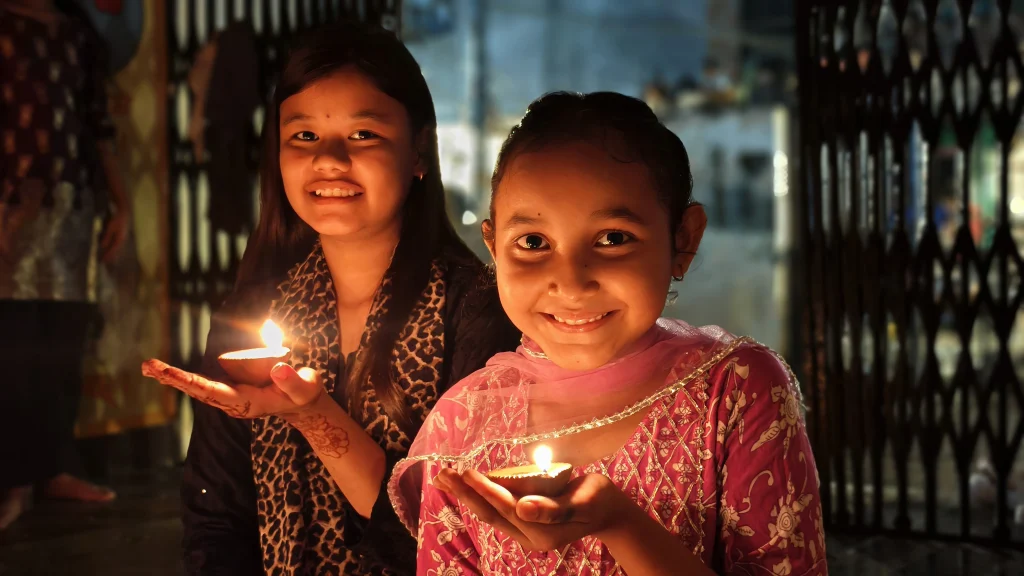


In a low-income neighbourhood of rural Haryana, Shyama adjusts the thread on her new sewing machine. When her husband lost work during the pandemic, she struggled to feed her three children. A local NGO’s counsellor taught her basic health and financial skills, then gave her a used sewing machine. Today Shyama makes clothes and even cloth masks, declaring “I have got back on my feet again”. Her story – a woman transforming adversity into opportunity – reflects the broader tide of change sweeping India. Across the country, millions of girls are finishing school and joining the workforce, and millions of women are starting tiny businesses and taking seats in village councils.
However, this progress has been neither uniform nor complete. Deep-rooted patriarchy, poverty, and illiteracy still hobble many lives. The facts bear this out. According to UNESCO, India’s female literacy in 2022 was only 70.3% (versus 84.7% for men), an improvement from a decade ago but still below the global female average (79%). Around 23 million Indian girls drop out of school when they begin menstruating, due to lack of sanitation and privacy in rural schools. One analysis warns that nearly one-third of young women still marry before 18, a practice unchanged from a decade ago.
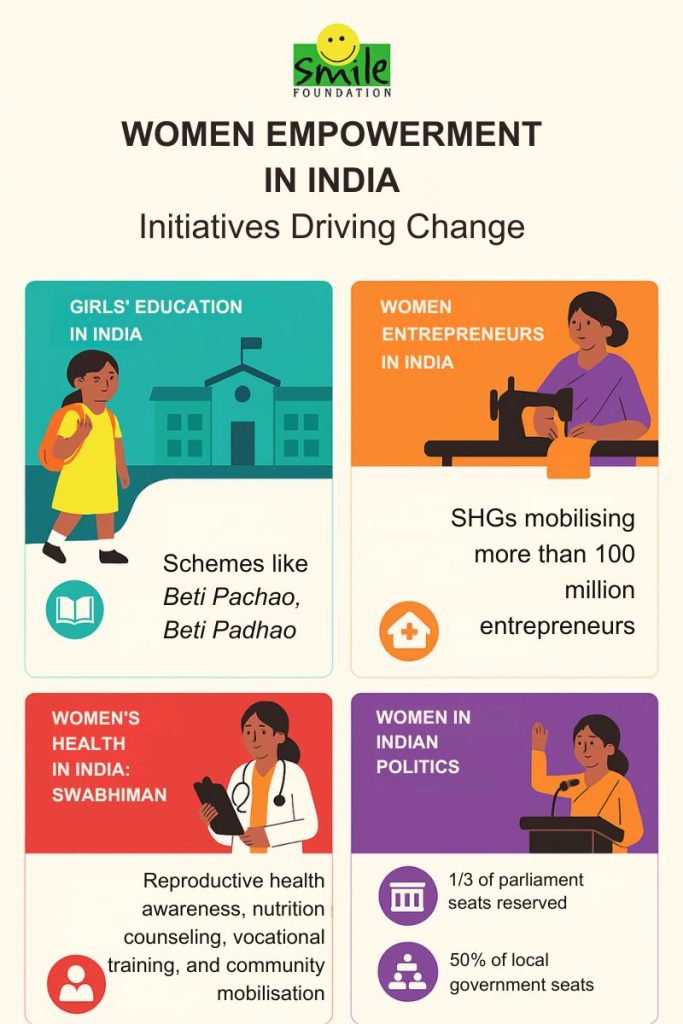
At the same time, sweeping policies and grassroots programmes have ignited change. Government campaigns like Beti Bachao, Beti Padhao (2015) and expansions of the Right-to-Education guarantee have helped normalise schooling for girls. An academic review notes that “more girls are going to school because of the Beti Bachao Beti Padhao campaign,” and in many areas the gross enrolment ratio of girls has caught up with or even surpassed that of boys.
The midday-meal scheme and scholarships for higher secondary girls have further encouraged families to educate daughters. Still, dropout and disparity remain stubborn. UNESCO reports that of India’s 77.7% literacy rate in 2022, only 70.3% of women were literate, leaving tens of millions of rural women still unable to read or write.
Education: Opening doors, changing minds
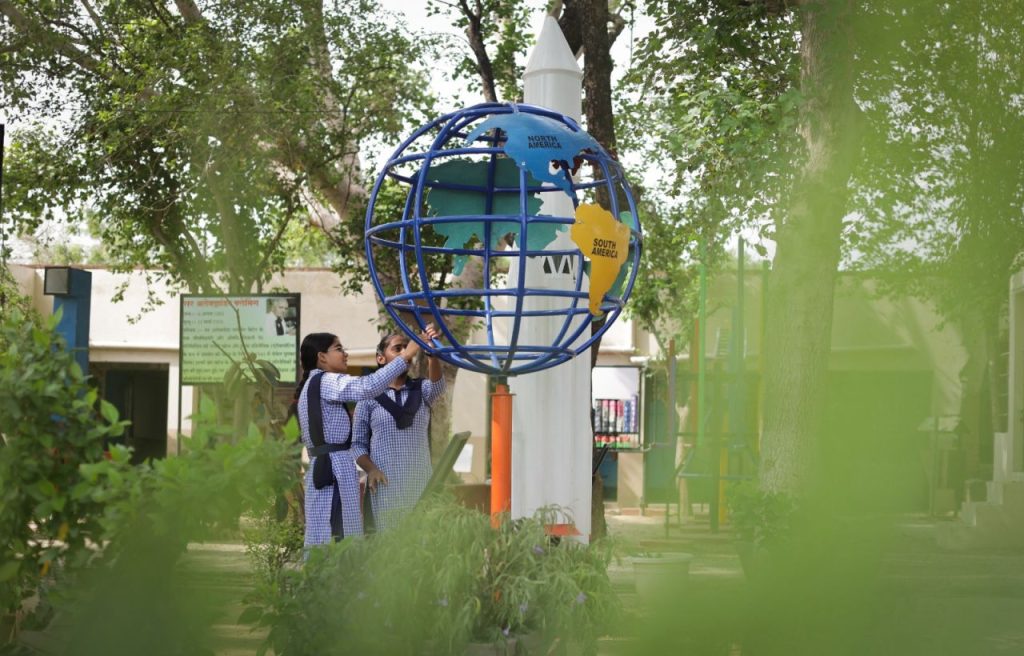
Over the past two decades, India has invested heavily in girls’ schooling. New classrooms and teachers have sprouted in even remote villages, and laws now mandate free education up to age 14. These changes show in the numbers. For example, the National Family Health Survey (2019–21) found that the share of women completing more than ten years of schooling has risen by over 5 percentage points from 2015. In some districts, girls outperform boys. Literacy rates in several Indian states now exceed those of males, especially at the primary level.
Government campaigns play a key role. Beti Bachao, Beti Padhao was launched to reverse sex-selection and promote girl-child education. Its soft-power message has had impact. Studies show that in areas where the programme ran, parents report greater willingness to send daughters to school.
The introduction of Kasturba Gandhi Balika Vidyalayas in backward areas provides safe boarding schools for marginalised girls, and state initiatives like Haryana’s Ladli scholarships pay families to keep daughters in school. Even cultural barriers have begun to shift. NGOs and governments now distribute sanitary pads and build school toilets so that girls need not skip class each month.
But numbers tell a mixed story. Although enrolment rates for girls are climbing, millions of girls still miss class. A UNICEF-CRY report notes that globally 129 million girls are out of school and India accounts for a significant share. Teenage pregnancy and child marriage remain major drop-out factors. According to NFHS-5, nearly 30% of Indian women were married before 18, a figure barely changed from the previous survey in 2015. And only about 90% of births now occur in institutions – a sign that many rural women still lack access to full antenatal education or may be denied maternal care due to family preferences.
The education story is also one of aspiration. Data from rural India suggest that when women’s literacy rises, daughters’ schooling improves too. Research on village council quotas shows that electing women leaders increased girls’ aspirations and educational attainment in those communities.
In one Punjab village, after a female sarpanch was elected, parents let daughters attend higher schooling for the first time. Similarly, female role models – India’s first woman president Droupadi Murmu (herself the first female graduate of her tribal village) or scientists like C.V. Raman’s daughter Anita – are now visible examples.
Behind these big trends are individual stories. Rinki, a young mother in Uttar Pradesh, married at 16 and had twins, yet returned to school via a distance-teaching programme and became a village teacher (her story circulated on NGO blogs). Nidhi, in Bihar, grew up with a teacher-father but lost him early; a local NGO recruited her to persuade families to send girls to school, and she even helped prevent three child marriages through grassroots outreach. These on-the-ground efforts embody the idea that education empowers women to break cycles of poverty.
New policies aim to sustain this progress
The 2020 National Education Policy promises universal foundational literacy, and explicitly emphasises girls’ education. Financial incentives like the Sukanya Samriddhi Yojana (which lets parents save in a special bank account for a girl child) and conditional cash transfers in some states reward families for keeping girls in school. Digital initiatives like free Wi-Fi at schools and smart classrooms have also reached rural areas. (However, the digital divide poses a barrier: only about 33% of women in India even use the Internet, so e-learning must still overcome gender gaps in access.)
Entrepreneurship and economic independence for women empowerment
For women in India, financial independence is a crucial step toward empowerment. In recent years the economy has begun to open new doors. Microcredit and self-help groups (SHGs) have spread widely. The National Rural Livelihood Mission has organised over 100 million rural women into roughly 9 million SHGs by 2024. These groups pool savings and give tiny loans for small businesses – sari-weaving, goat-rearing, tailoring – activities traditionally done by women. Government-led Rashtriya Mahila Kosh (Women’s Fund) has, by 2020, disbursed loans totaling ₹315 crores to dozens of rural institutions, reaching 741,000 women entrepreneurs.
More recently, national banking schemes have targeted female founders. The 2016 Stand-Up India scheme reserves lines of credit for SC/ST women entrepreneurs. Its growth has been dramatic. By late 2024 nearly 191,000 women-led accounts were opened, with some ₹43,984 crore sanctioned to women borrowers – up from only ~55,000 women’s accounts and ₹12,452 crore in 2018. These loans are used for enterprises big and small: a bakery in Punjab, a dairy in Tamil Nadu, a tech startup in Delhi. NBFCs and microfinance outfits also cater largely to women; for example, Mann Deshi Bank in Maharashtra lends mostly to village women, leading them to invest in farms or shops.
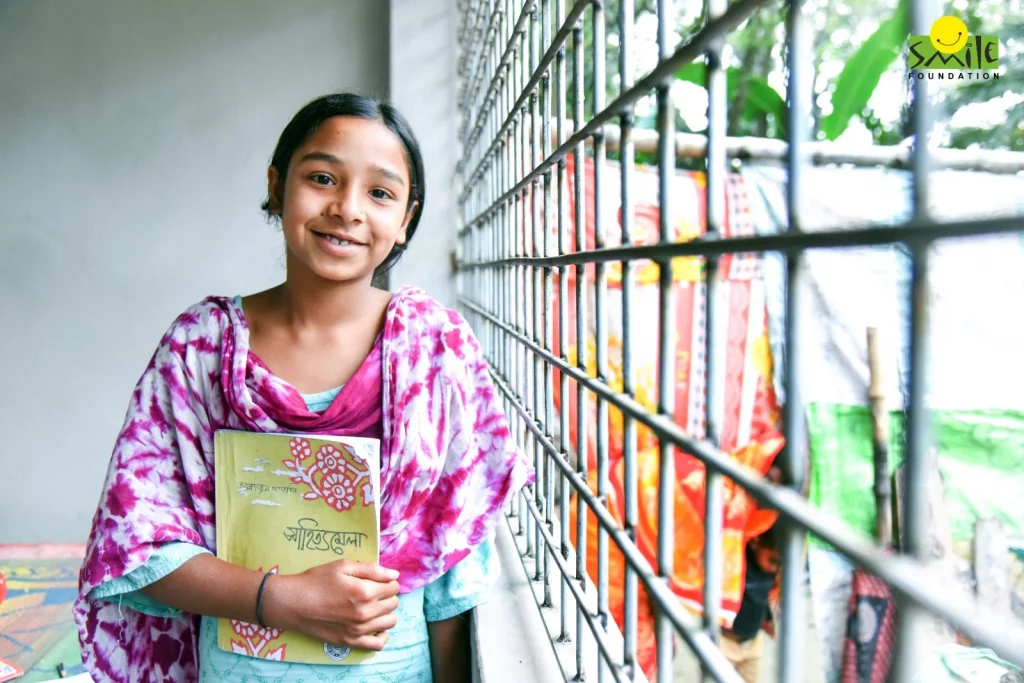
Meanwhile, outside the formal sector, a new entrepreneurial spirit is evident. In Bangalore, Yashoda (a mother of two) saw her cab-driver husband’s income vanish during the COVID lockdown. She joined Smile Foundation’s Entrepreneurship Development programme, where women learn skills like budgeting and marketing. With other trainees she launched a handmade cosmetics brand called Kadamba Naturals. By 2023 that cooperative of 15 women was selling herbal soaps online, each earning an extra ₹5,000–10,000 per month from home. Her story illustrates a wider fact. When women earn, they often plow profits into their families. Social enterprises like Okhai (a Gujarat-based NGO) have replicated this model: by training ~30,000 tribal women in embroidery crafts, Okhai helped many artisans roughly double their incomes to a few thousand rupees a month.
Government programmes support such grassroots efforts for women empowerment in India. In addition to loans, schemes like Mahila-e-Haat (an online marketplace for women’s products) and state-sponsored startup grants have appeared. State projects like Kerala’s Kudumbashree (one of the world’s largest women’s SHG networks) link literacy with livelihood: they run microenterprises from canteens to coir mats.
Under Skill India, thousands of young women have taken vocational courses in IT, healthcare or hospitality. However, despite all this, data suggest the economic inclusion of women remains low. Only 28% of ever-married women report paid work, down from 30% in 2005 – a stubborn stagnation even as more girls attend college. Many educated women still cite household responsibilities or lack of suitable jobs as barriers. In cities, women’s labour-force participation is only around 20% (compared to 50%+ for men), according to World Bank estimates.
Social norms often restrict women’s work outside the home and field jobs (agriculture, mining) remain male-dominated. When women do start businesses, they face hurdles in securing land, patents, or market access. Crime and harassment can deter traders in the evening markets. Digital platforms help some – smartphone apps allow women to sell handicrafts or produce online – but the digital divide is real. Rural women are half as likely as men to have used the internet, limiting their access to e-commerce.
Little ventures are gaining visibility
Women-run startups (often in food, textiles, or edtech) have begun attracting funding. Bengaluru’s She Taxi and Pune’s She Bus projects offer women drivers and conductors. Some tech incubators now specifically support women entrepreneurs. And credit bureaus now report better repayment by women borrowers, encouraging banks to lend more to them. The wage gap, though still large, has slightly narrowed in some sectors. As one GDP study points out, these initiatives are markers of women empowerment and economically could add an estimated $770 billion to India’s GDP by 2025 if all girls were educated and participating in the workforce.
Women empowerment starts with health, nutrition, and body autonomy
Women’s empowerment also depends on health and control over their own bodies. India has made impressive gains. Maternal mortality has fallen from 130 per 100,000 births in 2014–16 to 97 by 2018–20, hitting the National Health Policy target ahead of schedule. Institutional deliveries have climbed from 79% to 89% of births, thanks to cash incentives (Janani Suraksha Yojana) and free ambulance programmes. The proportion of pregnant women receiving four or more antenatal visits rose from 51% to 59%. Nearly all states now boast >90% hospital births, and even rural areas are at ~87%. These strides reflect intensified investments under the National Health Mission (RMNCH+A) and nutrition drives (like ICDS and Poshan Abhiyaan). In 2025, eight Indian states have achieved the UN goal of maternal mortality below 70, and the national average is on track to hit 70 by 2030.
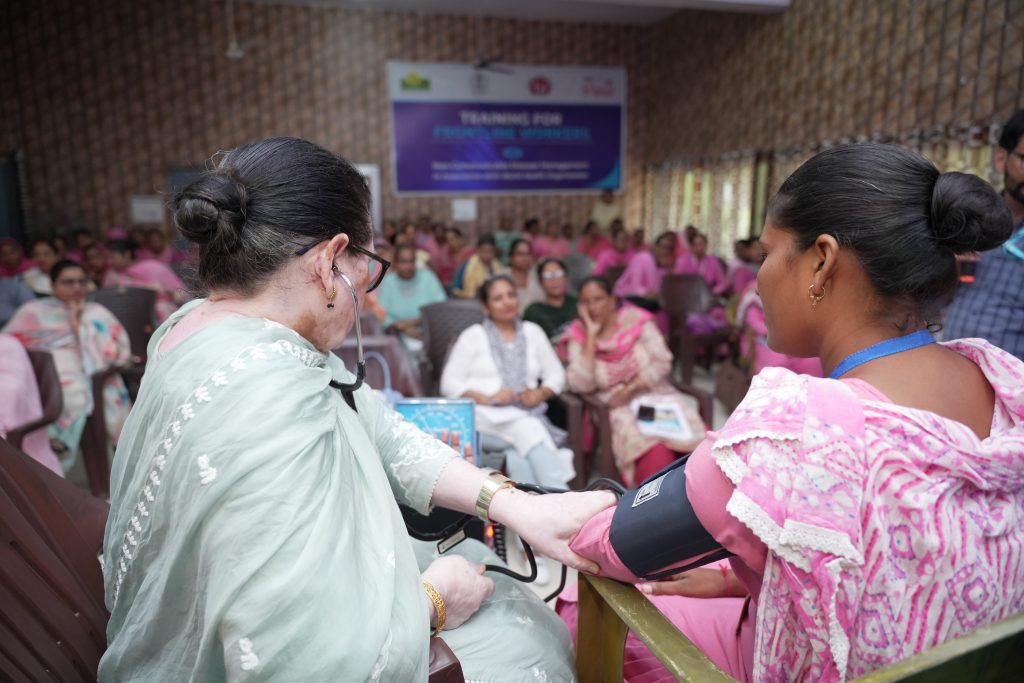
Nutrition and livelihood often overlap. In tribal Maharashtra, Ishwati (a widow with four children) struggled to feed her family on day-wages. With a small grant from Smile Foundation, she began cultivating vegetables on a plot behind her hut. Soon she organised neighbours into an SHG to expand the garden. “We used to go hungry in lockdown, now we eat greens every day,” she says. Her story highlights the link between health and empowerment. Access to nutrient-rich food, cooking fuel, and clean water is a basic right, and women are usually at the forefront of ensuring family nutrition. NGOs like Smile’s Swabhiman programme address these needs holistically alongside vocational training, we run health camps and nutrition education for women. For example, Swabhiman reports having sensitised over 76,000 women on reproductive and child health issues in 2023–24.
Government schemes also target women’s health. In addition to the maternity programmes above, the Pradhan Mantri Matritva Vandana Yojana (a cash support for pregnant women) has been scaled up, and the Janani Shishu Suraksha Karyakram offers free delivery and newborn care. Menstrual hygiene is finally getting attention. National campaigns now distribute low-cost sanitary pads and build school toilets (still, almost a quarter of adolescent girls lack safe menstrual products in rural areas). Family planning services have expanded, though nearly 60% of contraception users still rely on female sterilisation rather than shared responsibility.
Importantly, legal rights have strengthened. The Medical Termination of Pregnancy (MTP) Act was amended in 2021 to allow abortions on demand up to 24 weeks for most women – a victory for reproductive autonomy (though safe services and awareness gaps remain).
However, public health faces big challenges. Malnutrition still affects over 30% of under-five children (with mothers’ nutrition a key factor), and anemia in women remains pervasive. Gender-based violence is tragically common. Surveys find that around one in three married women have experienced spousal violence. While laws like the Protection of Women from Domestic Violence Act (2005) exist, enforcement and social stigma often lag. Maternal mental health is also under-addressed – many mothers face depression without support. The COVID-19 pandemic strained services and education (school closures set back young girls’ learning).
On the upside, recent years have seen more women in health professions and leadership. Women now make up a growing share of medical and nursing students. High-profile female doctors and health activists (such as K. Sujata or Rujuta Diwekar) have raised women’s health issues in public discourse. State governments are appointing female health officers in remote areas to improve trust with villagers. Access to digital technology holds promise like telemedicine and health apps could reach homes and youth, if the gender digital gap can be narrowed.
Politics and public power
Women empowerment is incomplete without political voice. Here too India has made structural reforms. In rural and urban local government, women’s representation has leapt. Since the 1990s one-third of all panchayat (village council) seats have been reserved for women, rotating each election. As a result, nearly 1.3 million of India’s 3.1 million local elected officials are women. Those female sarpanches have been found to spend more on water and education, and to change attitudes – research shows that girls in villages with reserved female leaders have higher educational aspirations. Many states (e.g. Bihar, Maharashtra, Jharkhand) even increased the quota to 50%.
At the state and national level, change has been slower but is stirring. Women currently hold only about 15% of seats in the Lok Sabha and 14% in the Rajya Sabha. In September 2023, Parliament passed a long-delayed law reserving one-third of seats in the Lok Sabha and in state assemblies for women. (Implementation awaits the next delimitation exercise, so the actual increase may only come by the early 2030s.) The new “Women’s Reservation Act” was hailed as historic, although debate continues over whether quotas alone can uproot patriarchal norms.
Women have also emerged as governors of major parties and states. The 2024 general election saw several women in top candidacy lists (PM Narendra Modi’s BJP fielded a record number), and for the first time, women voted in almost equal numbers to men. Figures like Mamata Banerjee, J. Jayalalithaa (deceased) and Mayawati have shown women can be powerful chief ministers; and for years Indira Gandhi and now Nirmala Sitharaman have been major national figures. But critics note that dynastic politics and male-dominated party hierarchies often limit genuine female leadership.
Civil society has played a vital role too. Groups like the Self Employed Women’s Association (SEWA) and Mahila Samakhya (rural education) empower women to lobby for their rights. The national and state election commissions train “women voter camps” to encourage female turnout. On the streets, women’s movements (from protests against sexual violence to campaigns for inheritance rights) have kept pressure on elites. Media and social media are amplifying women’s voices on issues from menstrual equity (the viral #Padwoman campaign) to street safety (the Delhi “Pink Auto” women-run cabs).
Still, India’s political empowerment of women is incomplete. International indices underline this. The World Economic Forum’s 2025 Gender Gap Report ranks India 131th out of 148 countries. It notes that while parity in educational attainment has nearly been achieved, economic participation and political empowerment lag far behind. In practice, women are underrepresented in senior bureaucracy, and their policy concerns (like domestic violence laws or maternity leave) often lack full political backing.
Challenges and the road ahead for women empowerment in India
India’s journey of empowerment is far from over. On one hand, the gains in education, health, entrepreneurship and local governance over the last 20–30 years are remarkable by historical standards. Millions of mothers like Shyama or entrepreneurs like Yashoda owe their new livelihoods to these trends. Girls who would have been kept at home now walk to class. Villages that never saw a female leader now elect women to run water pumps or gram sabhas.
Still many hurdles remain. The economy has not yet created enough jobs in areas where women can easily work. Social attitudes can change slowly. Surveys still find that a significant fraction of Indians (especially in patriarchal regions) believe a woman should tolerate some domestic violence or must get her husband’s permission to work. Caste and religion add layers of complexity. Dalit and minority women face additional discrimination, and their empowerment requires addressing social justice too.
Looking forward, experts urge a multi-pronged push. Literacy and skill-building must continue: implementing the new education policy fully, expanding vocational training in rural India, and closing the digital gender gap (only about one in four rural women are online). Health programmes need more funding. India’s female life expectancy still trails many countries, and mental health services for women are weak. Economists note that if India could close the gender gap in employment, women’s labour-force share could rise dramatically – a key to achieving the government’s goal of a $5-trillion economy by 2030.
Politically, the women’s reservation law could be a game-changer once implemented, but it will take years to translate into more policies for women unless accompanied by capacity-building and public support. Civil society and media will continue to play watchdog roles, as will international norms and the SDGs. On the streets, daily challenges like workplace harassment, safety in public, and family pressures are battles still being fought by each generation.
In sum, India’s women’s empowerment is a long arc with many actors: governments at all levels, NGOs like Smile Foundation, grassroots leaders, families and the women themselves. Their progress has been uneven and contested, but unmistakable. As one scholar notes, making women part of the growth story is not only a matter of justice but of national survival. The work continues – from Haryana’s looms to Delhi’s parliament – weaving an Indian society ever more inclusive of its women.
Sources: Cited data and quotes are drawn from government reports, international studies, and NGO accounts such as UNESCO, NFHS surveys, PIB press releases, and Smile Foundation publications. These analyses and case studies illustrate the complex social, economic, and policy factors shaping women’s empowerment in India.