

A company may have its headquarters in London, its largest operations in the United States and a growing presence in India. It may support education, healthcare or climate initiatives across all three markets. But does it have the same responsibilities towards society in each country?
Not quite. India has taken a distinctive approach to corporate social responsibility (CSR). Under Section 135 of the Companies Act, 2013, companies that meet specified financial thresholds are legally required to spend at least 2% of their average net profits on eligible CSR activities and report how the money is used. In the US and UK, corporate giving is largely voluntary, while the European Union places greater emphasis on sustainability reporting rather than mandating a fixed CSR contribution.
For multinational companies, understanding the CSR mandate in India vs other countries is more than a matter of compliance. It shapes how they plan their social investments, work with local communities and measure the impact of their contributions.
What does India’s CSR law require?
The CSR mandate in India vs other countries stands out because giving back to society is not left entirely to a company’s discretion. Under Section 135 of the Companies Act, 2013, qualifying companies are legally required to contribute towards social development. This makes India’s CSR framework distinct from countries where corporate giving is largely voluntary.
The law applies to companies that meet any one of these criteria in the immediately preceding financial year:
- Net worth of ₹500 crore or more
- Turnover of ₹1,000 crore or more
- Net profit of ₹5 crore or more
Companies that qualify must spend at least 2% of their average net profits over the three preceding financial years on eligible CSR activities. These include education, healthcare, poverty alleviation, environmental sustainability and rural development, among other areas listed under Schedule VII.
The responsibility also rests with the company’s Board, which must approve the CSR policy, oversee its implementation and disclose the expenditure in the annual report. Any unspent amount must be dealt with as prescribed under the law.
The framework has also evolved. In May 2026, the Ministry of Corporate Affairs allowed subscriptions to eligible zero coupon zero principal instruments on the Social Stock Exchange to count as CSR expenditure, subject to a limit of 10% of a company’s total CSR spending for that year. This creates another route for companies to support social projects through eligible not-for-profit organisations.
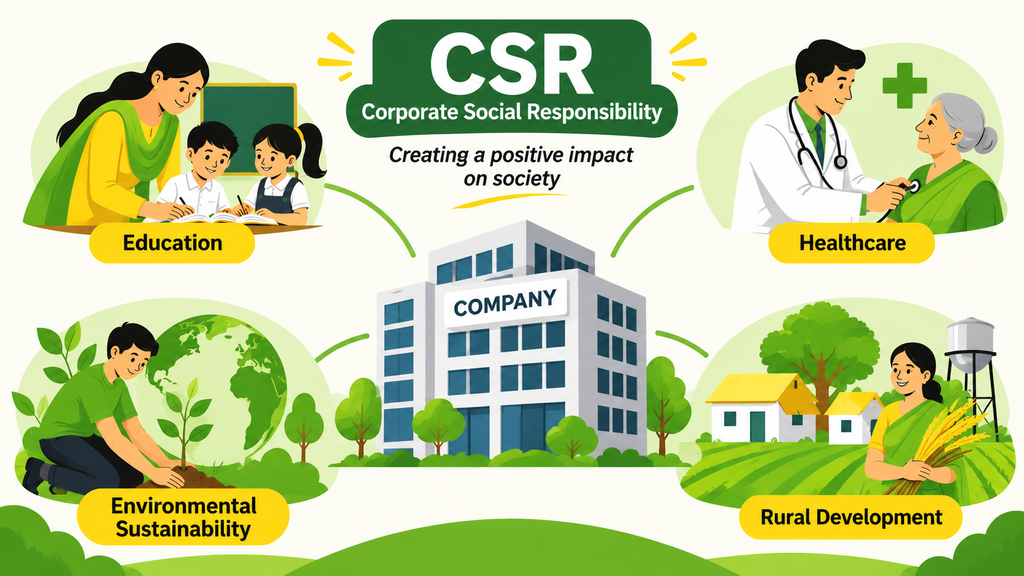
The law essentially helps ensure that social development receives more consistent support from businesses. It encourages companies to look beyond profits and take responsibility for the communities they operate in, while making their contributions more accountable through reporting and oversight.
How do the US, UK and EU approach CSR?
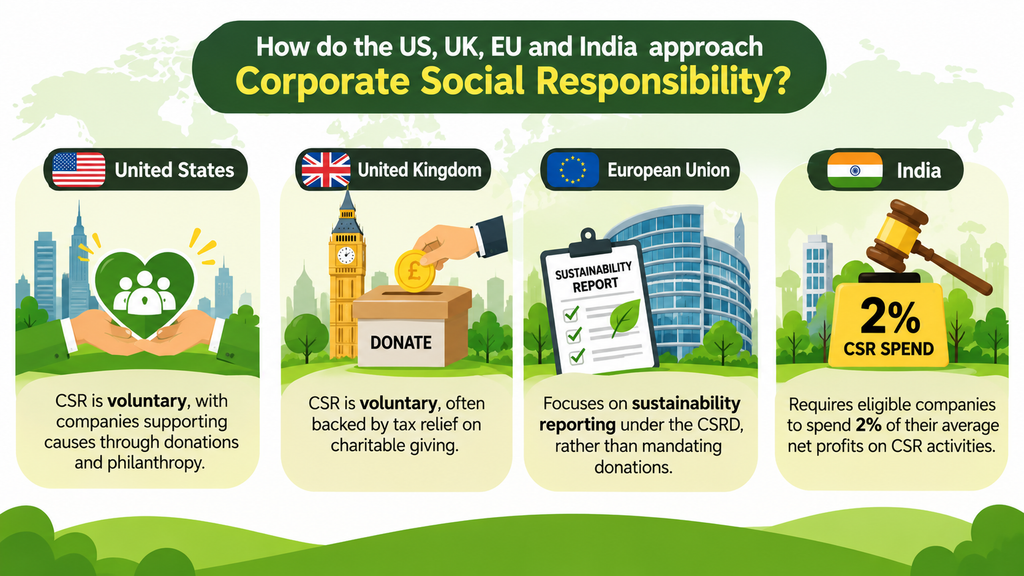
Not every country expects businesses to give back in the same way. While India has a legal requirement for qualifying companies to spend on CSR, the United States (US) and the United Kingdom (UK) rely largely on voluntary corporate giving. The European Union, meanwhile, focuses on sustainability reporting. Here’s how the CSR mandate in India vs other countries compares across these regions.
| Region | Is CSR spending mandatory? | How does the system work? |
| US | No | Companies choose how much to give and which causes to support. Tax rules govern deductions on eligible donations. |
| UK | No | Corporate giving is voluntary, with tax relief available on qualifying charitable donations. |
| EU | No fixed CSR spending requirement | Companies within the scope of sustainability reporting rules must disclose their environmental and social impact. |
| India | Yes | Qualifying companies must spend at least 2% of their average net profits over the previous three financial years on eligible CSR activities and report the expenditure. |
- US: Corporate giving is a choice
In the US, companies have the freedom to decide how much they give and which causes they support. Many contribute through charitable foundations, direct donations and employee volunteering programmes.
Giving around 1% of pre-tax profits is often used as a benchmark for corporate philanthropy, but it is not a legal requirement. Tax rules do, however, influence how businesses approach charitable donations. Changes introduced in 2026 mean that donations are deductible only to the extent that they exceed 1% of taxable income, subject to the existing 10% ceiling. This changes the tax treatment of giving, not the obligation to contribute. Read Section 170 of the US Internal Revenue Code to learn more.
- UK: How tax incentives encourage corporate giving
The UK also leaves corporate giving largely to a company’s discretion, but offers tax relief on qualifying charitable donations. Businesses support charities through donations, grants, partnerships and employee volunteering. Find out more about tax relief on corporate donations.
A contribution of around 1% of pre-tax profits is often cited as a giving benchmark, although companies are not legally required to meet it. The Charities Aid Foundation’s 2026 report found that FTSE 100 companies gave an average of 0.8% of their pre-tax profits to charity.
- EU: Why sustainability reporting matters
The European Union takes a different route. Rather than asking companies to contribute a fixed share of their profits to social causes, it focuses on making their sustainability performance more transparent.
Under the Corporate Sustainability Reporting Directive (CSRD), companies within its scope must report on their environmental and social impact, as well as sustainability-related risks to their business. The 2026 amendments narrowed the scope to companies with more than €450 million in net turnover and an average of more than 1,000 employees. This gives investors and other stakeholders a clearer picture of how businesses affect people and the environment.
Which other countries have mandatory CSR rules?
Even though CSR spending is voluntary in countries like the US, many companies still choose to support social causes, including in India. US-based businesses, for instance, partner with organisations such as Smile Foundation to contribute to communities here. The growing presence of Smile Foundation USA reflects how this support also extends across borders.
India is among a smaller group of countries that have gone a step further by making CSR a legal requirement. Mauritius, Indonesia and Nepal also have laws that ask businesses to contribute to social development, although the rules and spending requirements vary.
- In Mauritius, companies are required to contribute 2% of their previous year’s chargeable income to a CSR fund. The money supports social and community development initiatives, with a portion channelled through the government and the rest used for approved CSR activities. Read more about Mauritius’ CSR provisions.
- Indonesia follows a slightly different approach. Its Company Law requires businesses operating in or connected to natural resource sectors to undertake social and environmental responsibility. However, it does not set a fixed percentage of profits that companies must spend. Read the UN Environment Programme’s summary of Government Regulation No. 47 of 2012.
- In Nepal, medium and large industries are required to allocate at least 1% of their annual net profits to CSR. The law also asks businesses to prepare plans for this spending and report on the activities they carry out. Read Section 54 of Nepal’s Industrial Enterprises Act, 2020.
The examples of these few countries show that the CSR mandate in India and other countries is shaped by each country’s own laws and priorities. While some require a set financial contribution, others place the responsibility on specific industries or use different spending thresholds.
CSR Mandate in India vs Other Countries: What does this mean for multinational companies?
For multinational companies, global CSR contributions do not automatically fulfil their obligations in India. If an Indian subsidiary meets any of the financial thresholds under Section 135, it must meet the CSR requirements under Indian law, regardless of the contributions made by its global headquarters.
Companies can, however, align their global social impact goals with local needs. This means choosing eligible projects in India, allocating funds as required and reporting the expenditure separately.
“Sustained social impact depends on partnerships built around shared purpose, trust and measurable outcomes. I look forward to deepening engagement with corporates, philanthropies, institutions and development partners to create lasting change for underserved communities.” – Mr. John Sankey Sutherson, Country Director – Resources & Strategic Partnerships, Smile Foundation
Having the right local implementation partner can help companies turn these commitments into meaningful work on the ground. This is where organisations such as Smile Foundation can support businesses in planning and carrying out their CSR initiatives.
How Smile Foundation helps?
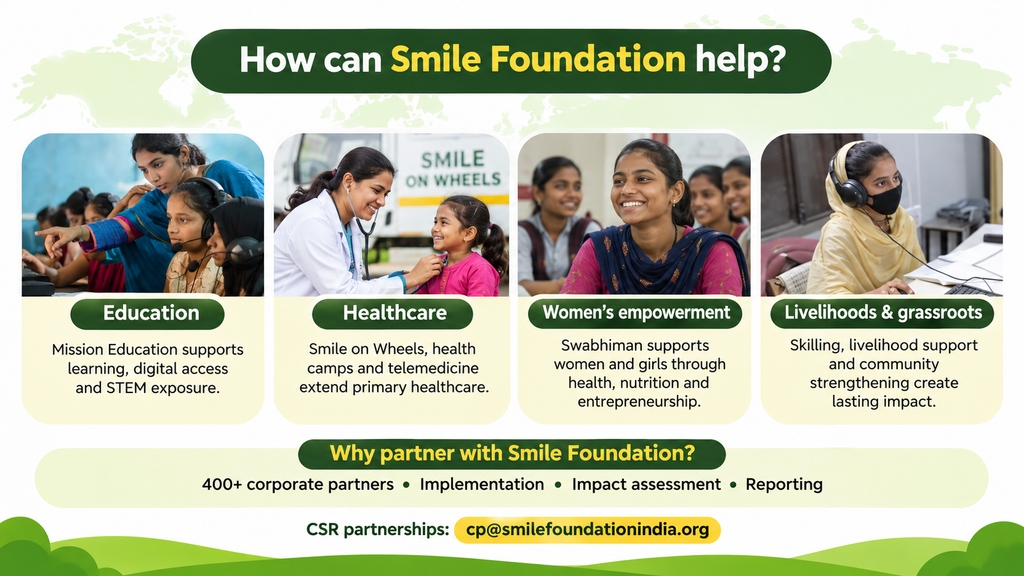
Smile Foundation works across several areas of social development, giving companies the opportunity to support causes that align with their CSR priorities. Its programmes include:
- Education: Through Mission Education, children from underserved communities receive support with school education, foundational learning, digital learning and STEM activities.
- Healthcare: Initiatives like Smile on Wheels take primary healthcare to communities with limited access to medical facilities, while health camps and telemedicine services help extend care further.
- Women’s empowerment: Through Swabhiman, women and adolescent girls receive support in healthcare, nutrition, entrepreneurship and financial literacy.
- Livelihoods: Programmes such as STeP and iTrain provide young people and workers with job-oriented skills, vocational training and opportunities to improve their livelihoods.
- Disaster response and grassroots development: Smile Foundation also responds to the needs of disaster-affected communities and works to strengthen grassroots organisations.
With over 400 corporate partners, Smile Foundation brings experience in developing and implementing CSR programmes across these areas. Its work also includes monitoring and evaluation, third-party impact assessments and reporting, helping corporate partners understand programme progress and the changes their investments support.
For companies navigating the CSR mandate in India vs other countries, the challenge is not just meeting regulatory requirements but translating CSR commitments into meaningful social impact. The right implementation partner can help bridge this gap.
Partner with Smile Foundation to turn your CSR commitments into meaningful community impact. To explore opportunities, write to cp@smilefoundationindia.org or visit the Smile Foundation website.
Frequently asked questions
- Is CSR spending mandatory in India?
Yes. Under Section 135 of the Companies Act, 2013, companies meeting any one of the prescribed financial thresholds must spend at least 2% of their average net profits on eligible CSR activities. - Which companies are required to spend 2% on CSR?
The requirement applies to companies with a net worth of ₹500 crore or more, turnover of ₹1,000 crore or more, or net profit of ₹5 crore or more in the preceding financial year. - Is corporate social responsibility mandatory in the US and UK?No. Both countries largely rely on voluntary corporate giving. Businesses can support charitable causes through donations and partnerships, with tax provisions offering relief on eligible contributions. Neither country has India’s mandatory 2% CSR spending rule.
- Does the European Union have a mandatory CSR spending requirement?
No. The EU focuses on sustainability reporting for companies within the scope of its rules. These requirements cover environmental and social impacts but do not prescribe a fixed percentage of profits for CSR spending. - Do multinational companies have to follow India’s CSR rules?Yes. An Indian subsidiary that meets the thresholds under Section 135 must comply with the country’s CSR requirements. Contributions made by its global headquarters do not automatically meet the subsidiary’s obligations.
- How can companies ensure their CSR programmes create impact?
Companies can work with experienced implementation partners, set clear programme goals, monitor progress and commission independent impact assessments. These steps help track outcomes, strengthen accountability and guide future CSR investments.
