Categories
Education Employee Engagement Partners In Change Partnerships Smile

CSR For Education Can Build Future-Ready Young Indians

Summary

  • Access is only the beginning: Child education in India must move beyond enrolment to learning, STEM, SEL and opportunity.
  • Philanthropy is growing: ₹10,380 crore was given philanthropically, with ₹4,166 crore going towards education.
  • STEM needs strong foundations: Technology creates greater impact when supported by foundational learning, teachers and connectivity.
  • Impact must be measurable: Across 67 tribal schools, 2,526 students saw the Class X pass rate rise from 56% to 95%.
  • Partnerships drive lasting change: CSR NGO partnerships can connect corporate resources with grassroots expertise to build sustained educational outcomes.

The child who reaches school is only the beginning

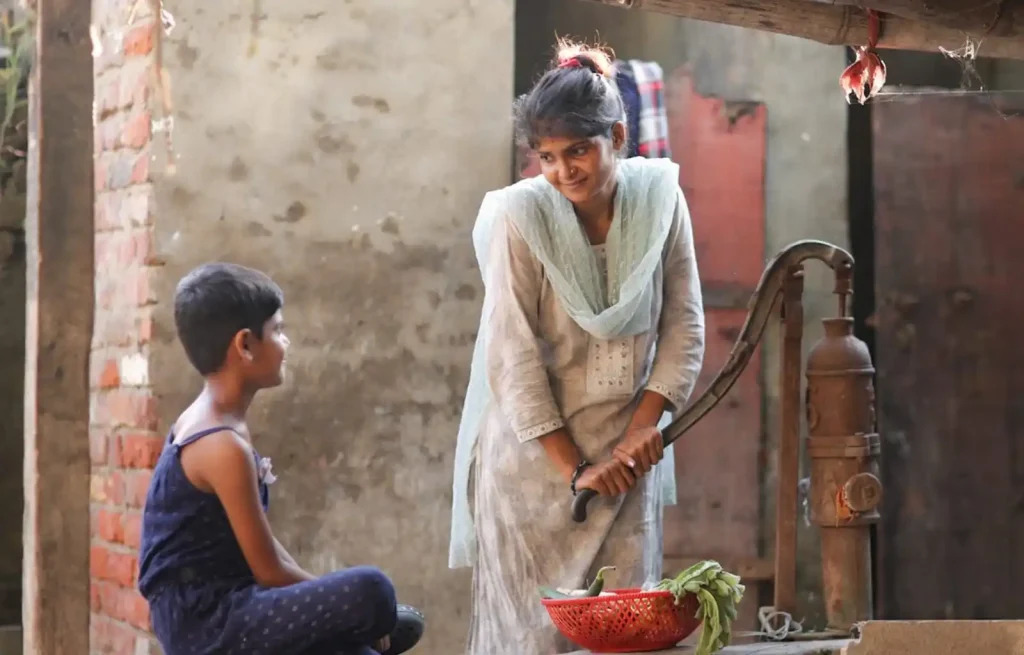
In a village in Jharkhand, a mother watches her daughter leave for school.

She knows what that uniform represents.

She earns between ₹200 and ₹250 a day as a farmer. Neither she nor her parents went to school. Education, for generations, had remained an aspiration that circumstances had rarely allowed her family to pursue. Yet, when she watches her daughter study, she sees a possibility that extends beyond the classroom.

A different life. A different choice. A different beginning.

Smile Foundation’s story of Sivani and her mother captures this quiet transformation that’s happening slowly across 27 states in India through Smile Foundation’s Mission Education. Many women like Sivani’s mother are simply aspiring to one thing : to see their daughter, achieve what they could not.

Thus, this point becomes a pivotal point when it comes to CSR interventions working towards educational development in India. At this juncture, the focus must begin, not with infrastructure or enrolment numbers, but with the question of what education makes possible.

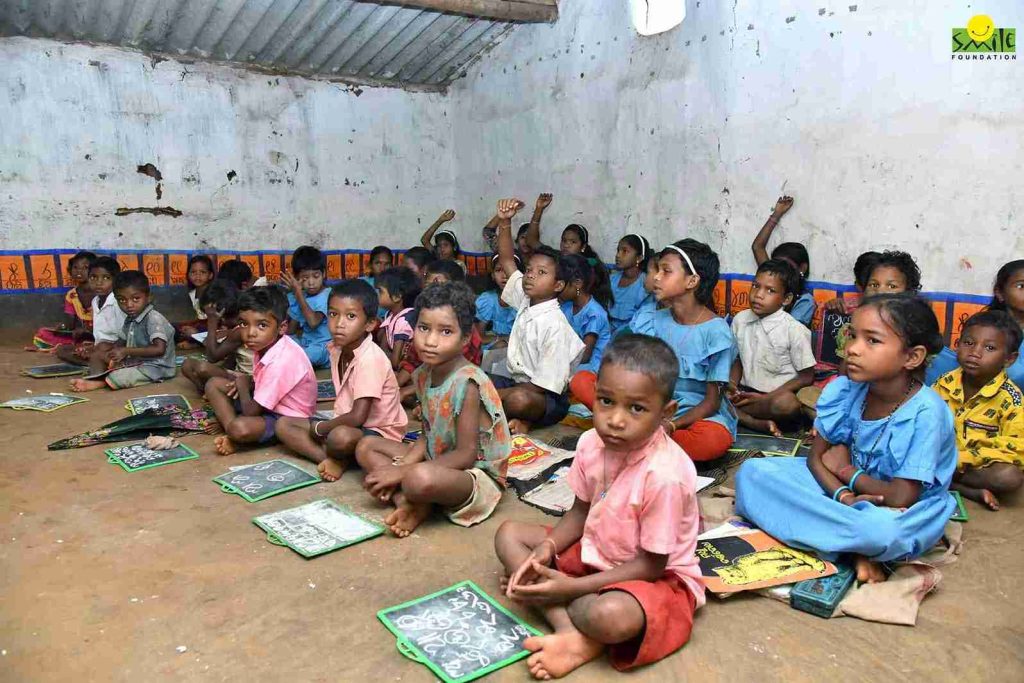
Even today in some corners of India, a child is entering school and still struggling to learn. A classroom exists without adequate learning resources. Digital programmes have been introduced but without reliable connectivity. 

One must understand that access to education is  just the beginning of education. 

It is not its outcome.

And this distinction matters increasingly to India’s corporate philanthropy landscape.

India’s CSR Is Changing. So Is Education

India’s philanthropic landscape is expanding—not only in scale, but also in the range of people and institutions choosing to invest in social change. The Economic Times’ analysis of the EdelGive Hurun India Philanthropy List 2025 records ₹10,380 crore in philanthropic giving, an 85% increase over three years. Education emerged as the largest philanthropic cause, receiving ₹4,166 crore from 107 donors. 

For child education in India, this growing individual philanthropy is significant. It reflects a wider recognition that education is not simply an act of giving, but an investment in intergenerational opportunity. Increasingly, that same thinking is visible in corporate philanthropy, where partnerships are moving towards longer-term, more targeted interventions.
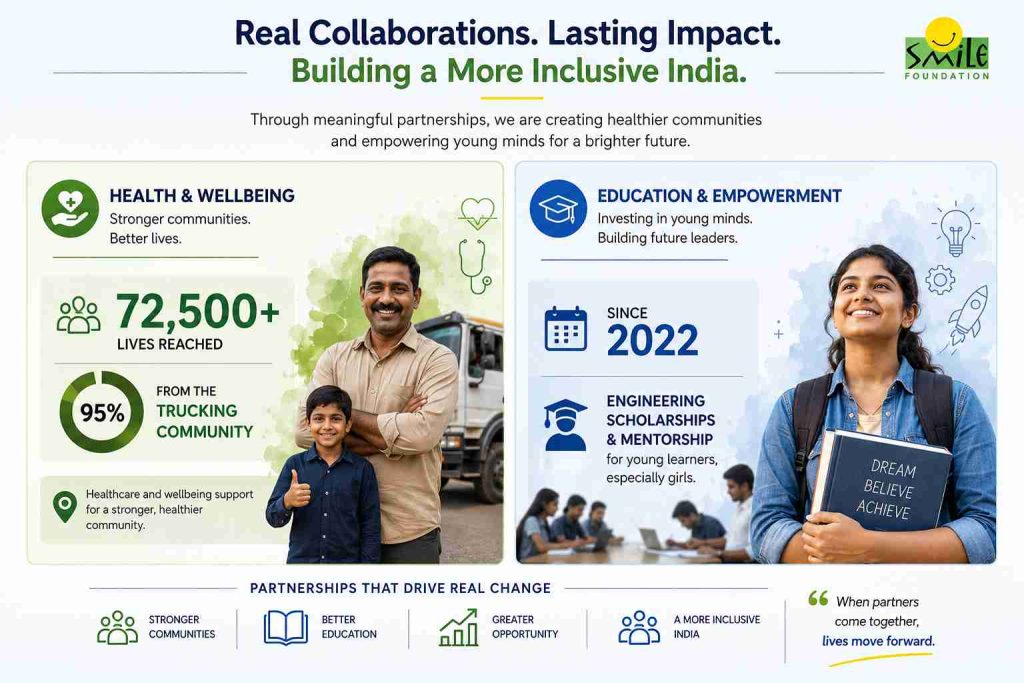
Smile Foundation’s corporate partnerships offer examples of this shift. Its collaboration with Bridgestone has supported the Bridgestone Saarthi Support Centres, with the initiatives reaching 72,500+ beneficiaries, nearly 95% of whom belong to the trucking community. The partnership demonstrates how corporate investment can respond to the interconnected health and wellbeing needs of a specific community. 

Similarly, Deutsche Bank’s partnership with Smile Foundation since 2022 supports engineering scholarships for young people, particularly girls, combining access to education with mentorship and continued support. It illustrates how CSR education can move beyond financial assistance towards creating pathways into higher education and future careers.

Together, these examples point towards an important evolution: individual philanthropy is growing in scale, while corporate philanthropy is becoming more strategic in its intent. For CSR programmes, the opportunity lies in building partnerships that understand education not as a single intervention, but as part of a larger ecosystem of capability, wellbeing and opportunity.

Thus, in the context of child education in India, the question is therefore no longer simply how much are we giving? It is increasingly to:  what lasting pathway can that investment create?
What Should CSR for Education Achieve?

Education can no longer be understood only as getting children into classrooms. The conversation has moved towards

  •  Foundational learning,
  •  Teacher capacity,
  •  Digital inclusion, 
  • STEM, 
  • Social-emotional learning, 
  • Life skills and 
  • Pathways to livelihoods.

This is especially relevant in underserved communities, where the barriers to education rarely exist in isolation. They intersect inside the life of one child.

And that is why the next phase of CSR for education in India needs to look beyond individual interventions and towards the ecosystem that allows learning to continue.

The STEM divide is real

Artificial intelligence. Coding. Robotics. Digital classrooms. STEM laboratories. Experiential learning. There is understandable excitement around the future of learning.

In this excitement, it is important to remember that children from underserved communities deserve access to these opportunities just as much as children anywhere else. 

But, there is a fundamental mistake we can make when talking about the digital and STEM divide: assuming that the gap begins with technology.

In fact, it begins much earlier.
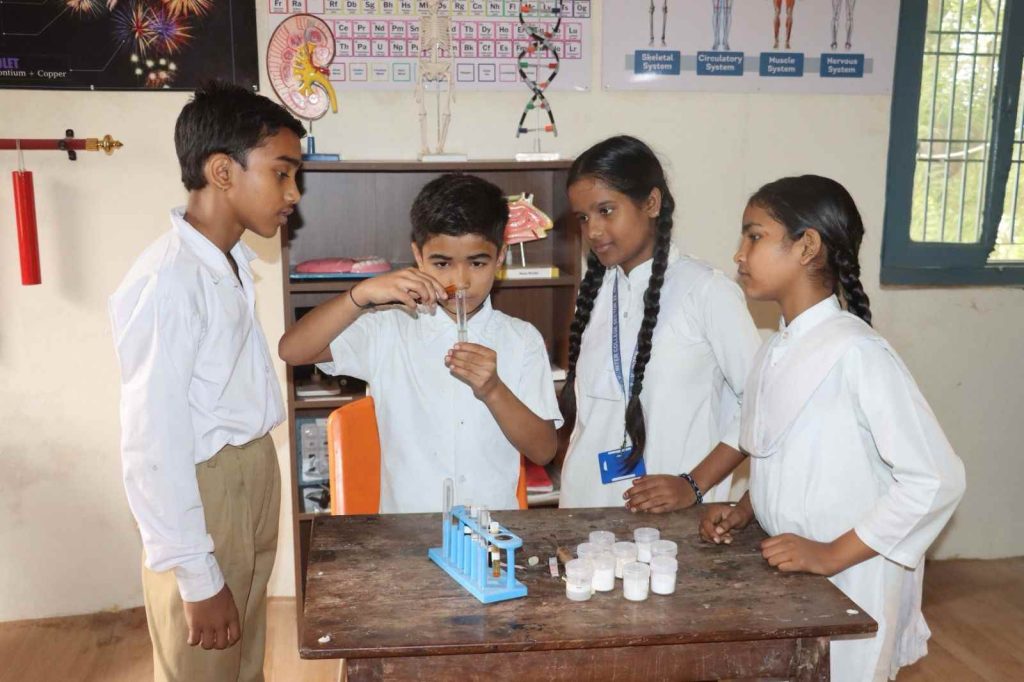
The challenge is not to choose between basic educational needs and future-ready learning. It is to understand how one enables the other.

A child cannot fully benefit from a tablet if she does not have reliable access to learning, electricity, connectivity, teacher support or a stable environment in which to study. Similarly, introducing robotics to a child who is still struggling with foundational literacy and numeracy may create exposure without creating sustained learning.

This does not make digital or STEM interventions less valuable. It makes sequencing and integration important, proving the need of a  strong education ecosystem that progressively builds capability.

SEL Makes Learning Meaningful

There is another dimension of education that deserves greater attention in corporate philanthropy: social and emotional learning (SEL).

UNESCO describes SEL as helping learners understand and manage emotions, build relationships, demonstrate empathy, make responsible decisions and participate constructively in their communities. It places cognitive, social, emotional and relational development within a broader understanding of quality education.

That matters because education is not only about what a child knows.

It is also about how a child navigates what they know.

A child who learns mathematics acquires cognitive capability. A child who also learns to communicate, collaborate, manage frustration, recover from failure and make decisions develops capabilities that can determine how effectively that knowledge is eventually applied.

Furthermore, UNICEF’s work on social and emotional learning in early childhood similarly emphasises, the importance of developing children’s ability to understand emotions, build relationships and manage social interactions from an early age.  Research is also beginning to add evidence to this understanding.  A 2024 intervention study involving preschool children reported significant reductions in both externalising and internalising problem behaviours following an SEL intervention, with effect sizes of 0.744 and 0.653, respectively. 

Future-ready education must go beyond creating all-rounders; it must nurture the child wholly by building knowledge, confidence, resilience and skills they need to learn, adapt and thrive. 

Keep Children in Classrooms with Smile

Smile Foundation’s work extends beyond access to include foundational learning, teacher capacity building, STEM and digital learning, life skills, scholarships, health and nutrition and school-level interventions. The Mission Education’s 2024–25 data records 1.85 lakh+ beneficiaries, alongside 1,008 schools and 242 Mission Education Centres supported that year.
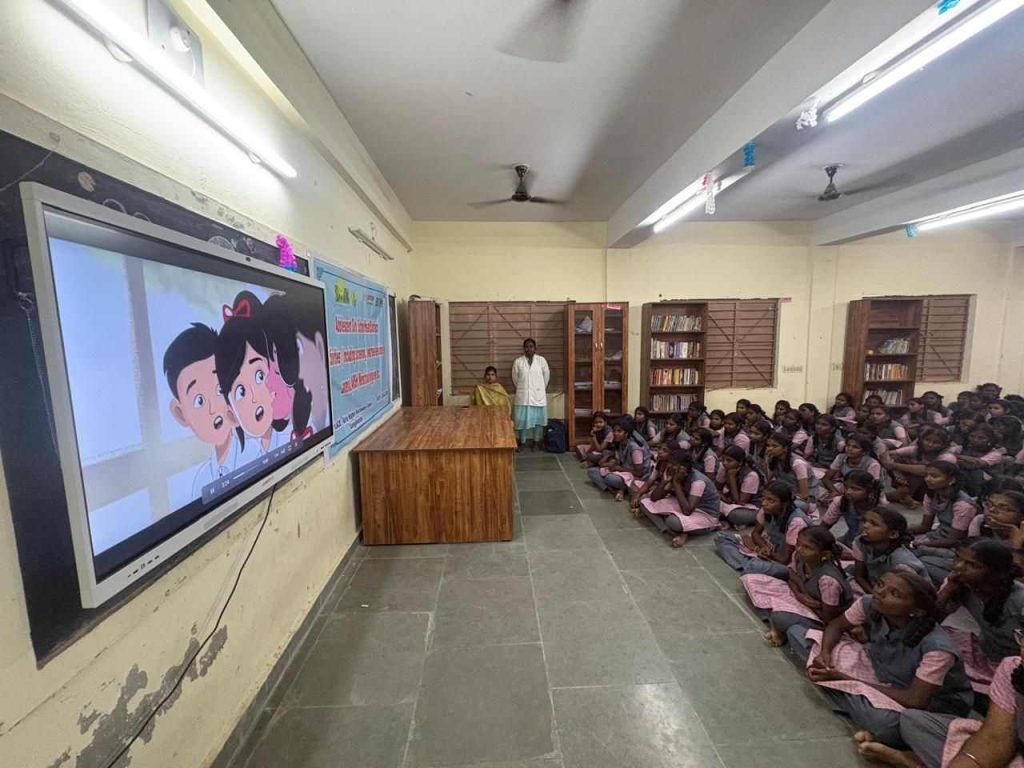
These numbers matter. Because keeping education going is not simply about keeping a child physically inside a classroom. It is about creating the conditions in which that child can remain, participate, learn and eventually imagine a future beyond immediate circumstances.

Smile Foundation’s education survey found that 56% of children and parents surveyed did not have access to smartphones, highlighting how quickly a technology-led education model can exclude the very children it intends to reach.

The strategy is simple to move from funding access to creating opportunity.

 The question is no longer only how many children entered a programme, received a device or attended a STEM session. These are important interventions, but they are the starting point—not the final measure of impact.

An outcome-led approach asks what changed for the child because of that investment.

  • Did foundational learning improve?
  •  Did teachers become better equipped?
  •  Did children participate more confidently in the classroom?
  •  Did they gain meaningful exposure to STEM and digital learning?
  •  Did they develop the social and emotional capabilities to communicate, collaborate and navigate setbacks?

Smile Foundation’s Mission Education’s work offers useful evidence of what this can look like on the ground.

1. From access to measurable learning

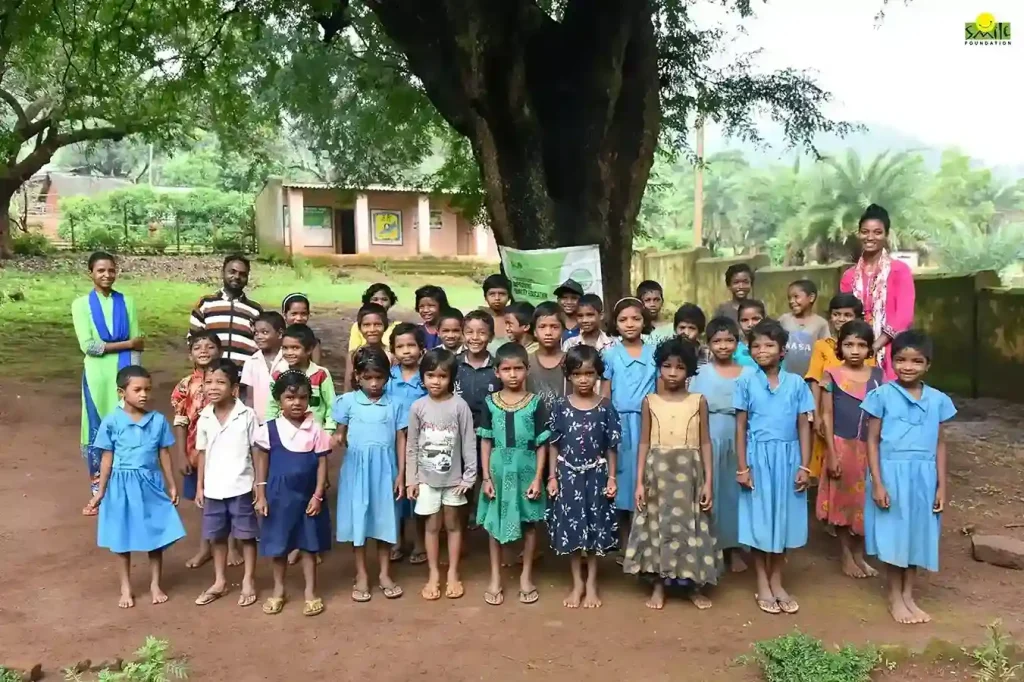
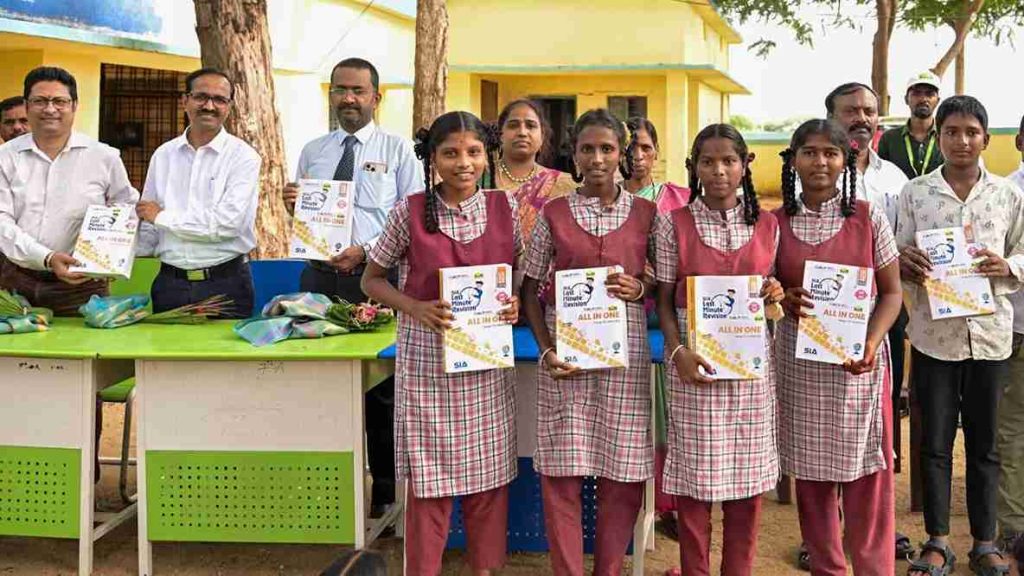
In 67 tribal schools in Adilabad, Telangana, additional academic support reached 2,526 Class X students. Across the intervention clusters, the overall pass percentage increased from 56% to 95%, with 2,349 students successfully passing their examinations. 

The intervention demonstrates why educational investment must be designed around learning progression, not merely participation. Reaching a child matters; helping that child move forward academically matters more.

2. From infrastructure to capability

Inputs create lasting value only when teachers are equipped to use them effectively.

Mission Education conducted 244 teacher-training sessions reaching 1,142 educators, covering experiential learning, inquiry-based pedagogy, classroom management and foundational learning. The programme also reported 10,000+ students showing improvement in FLN skills, with 2,500 students supported towards grade-appropriate learning outcomes.

This is an important lesson for CSR NGO partnerships as it shows how sustainable educational change is rarely created by a single asset. It is built by strengthening the people, practices and systems around the child.

3. From future-ready inputs to future-ready capabilities

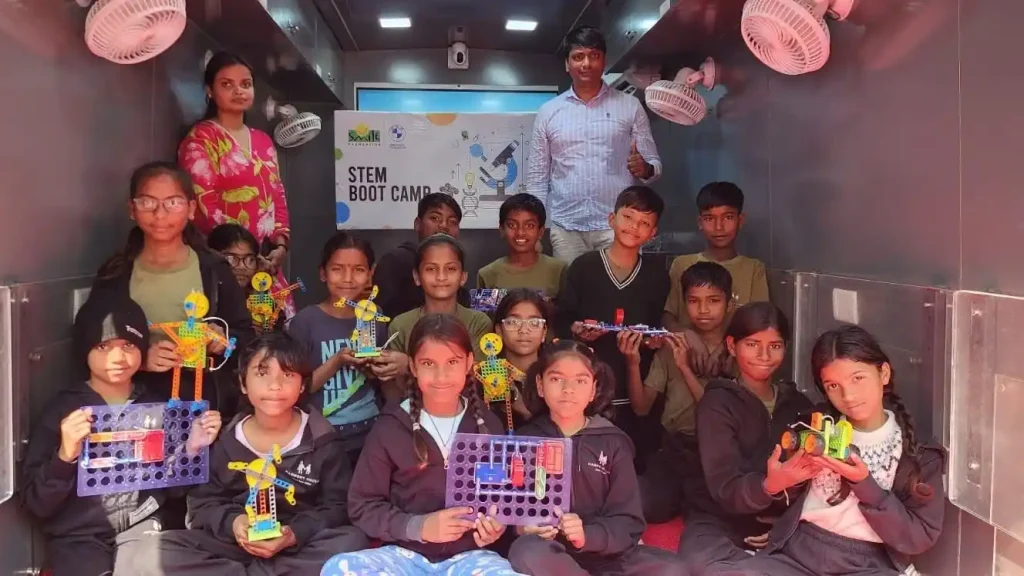
The next step is to connect foundational learning with the capabilities children will need beyond school. Mission Education’s current priorities bring together FLN, STEM education, STEM on Wheels, socio-emotional learning and life skills, while its STEM interventions engage 22,000+ students across 32 STEM Lab locations.

This is where outcome-led education becomes truly meaningful.

The objective is not simply to introduce a child to technology or STEM. It is to help that child question, experiment, collaborate, solve problems, build confidence and eventually translate learning into opportunity.
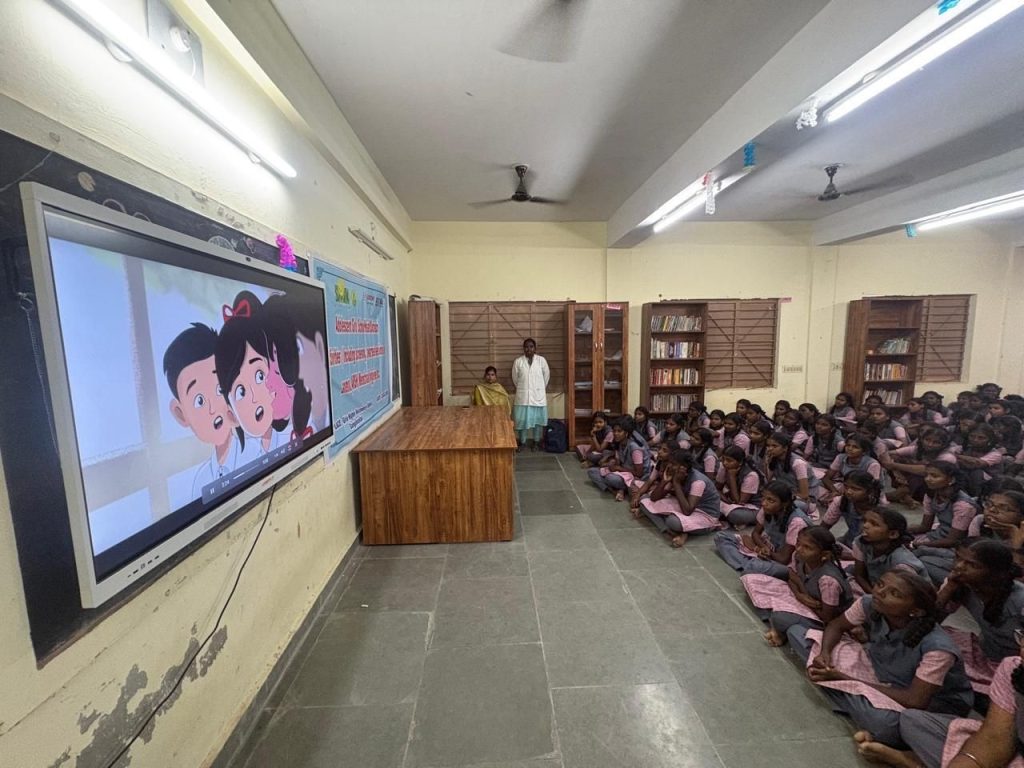
Education - Smile Foundation

From Funding Education to Expanding Possibility

The education journey does not end when a child enters a classroom. It begins there. For education to create lasting opportunities, children need strong foundations, capable teachers, exposure to STEM and digital learning, and the social-emotional skills to communicate, adapt and persevere. 

Mission Education’s integrated approach reflects this continuum. And which is why exactly here,  CSR NGO partnerships can make the difference. Corporate resources can provide scale, expertise and innovation; grassroots NGOs can bring community understanding, implementation capability and the ability to translate investment into context-specific outcomes. 

Together, they can build interventions that respond to where a child begins while keeping sight of where she can go.  Furthermore, going forward one has to remember that today in 2026,, purpose of education CSR is not to create a collection of successful projects. It is to create a sustained pathway from access to learning, from learning to capability, and from capability to opportunity

Partner with Smile and make your CSR investment count beyond the project cycle. This is an opportunity to build CSR NGO partnerships  that invest in the whole child—not isolated intervention

Sources:

FAQs

1. Why is access alone not enough for child education in India?

Access is the starting point. Children also need foundational learning, capable teachers, digital and STEM exposure, SEL and pathways to future opportunities.

2. Why should CSR invest in education beyond infrastructure?

Infrastructure creates the platform for learning, but CSR for education must also strengthen teaching, learning outcomes and the wider ecosystem around the child.

3. Why does STEM education need strong foundations?

Children need foundational literacy, numeracy and teacher support to meaningfully engage with digital and STEM learning.

4. What does outcome-led education CSR mean?

It means measuring what changed for the child, not only how many children were reached or activities delivered.

5. What role does SEL play in future-ready education?

SEL develops communication, collaboration, resilience, decision-making and other capabilities that complement academic learning.

6. How can CSR NGO partnerships strengthen education?

They combine corporate resources and expertise with grassroots knowledge and implementation capacity to create context-driven, measurable impact.

7. How does Smile Foundation support child education in India?

Through Mission Education, Smile Foundation works across foundational learning, teacher capacity, STEM, digital learning, life skills, scholarships, health and nutrition.

8. How can corporates partner with an NGO for education?

Corporates can partner with an NGO for education to support sustained interventions with defined objectives, measurable outcomes and community-level impact.
Categories
CSR Employee Engagement

Employees are Back to School For A Cause 

Summary

  • Turn school memories into purposeful employee engagement.
  • Link activities to education and classroom support.
  • Use Pass the Baton to create shared purpose.
  • Enable employee volunteering with an NGO.
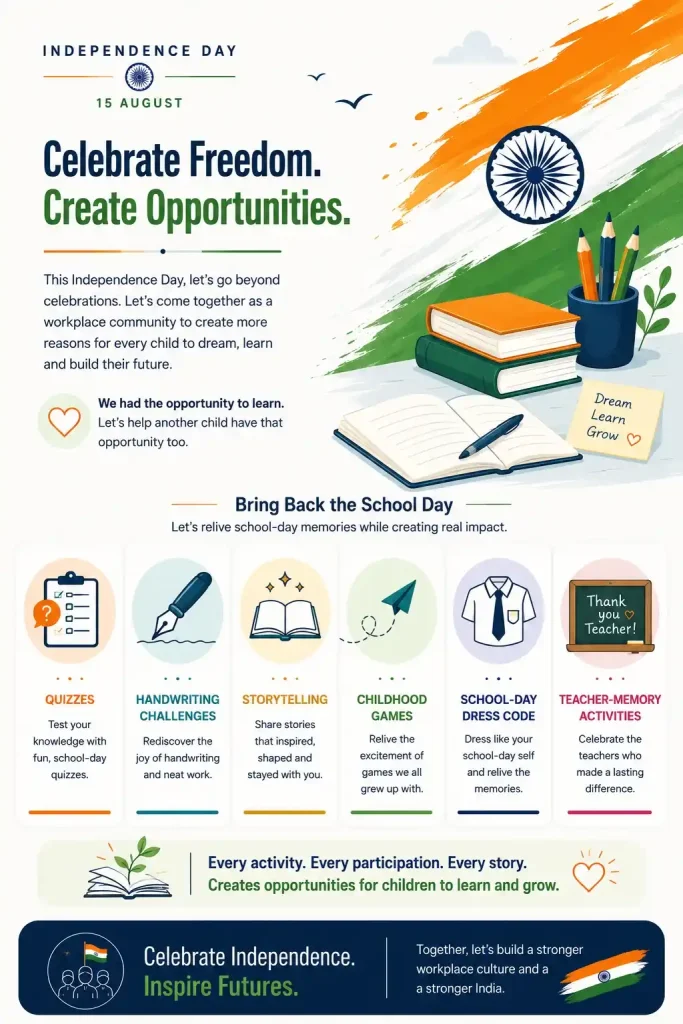
  • Make Independence Day a platform for children’s futures.

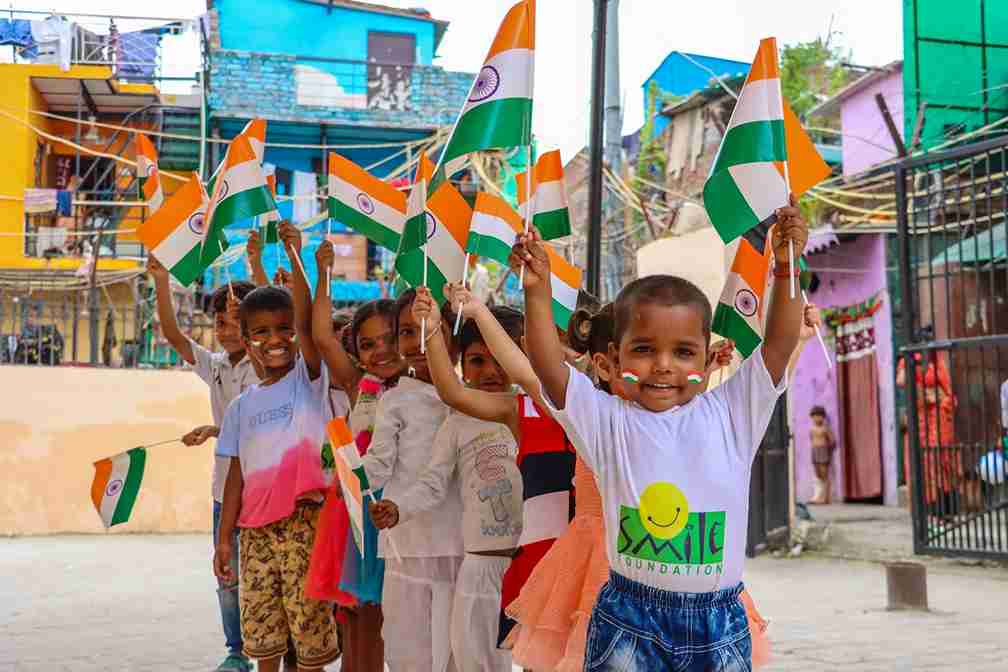
There was a time when Independence Day meant a crisp uniform, a small paper flag pinned to your shirt and the sound of the national anthem echoing across a school assembly. You may remember standing in neat rows with your classmates, waiting for the flag to go up. Perhaps you rehearsed a patriotic poem, participated in a march-past or spent the week colouring a tricolour drawing. For many of us, these are among the simplest memories of growing up.

But, somewhere between those school assemblies and where we are today, we grew up. We became employees/professionals,  found careers, built teams, took on responsibilities and started shaping lives beyond our own.

And perhaps that is why Independence Day can mean something different to us now.

As children, freedom may have meant being able to dream about becoming a doctor, teacher, sportsperson, entrepreneur or anything else we could imagine. As adults, we have experienced the opportunities that helped turn some of those dreams into reality.

The question now is: how can we help make those opportunities possible for someone else?

This is where purpose-led employee engagement can give Independence Day a deeper meaning.

Rather than limiting the occasion to flag-hoisting ceremonies and workplace celebrations, organisations can use it as an opportunity to connect employees with the freedoms that education, skills and opportunity can create.

Employee Engagements For A Cause

For organisations, Independence Day already carries a strong emotional foundation. Employees have their own memories of classrooms, teachers, family traditions and national celebrations, which can become a shared experience and a powerful employee engagement starting point.

Education offers a particularly natural connection.

Most professionals can identify someone who influenced their educational journey. Whether it was a teacher who encouraged them, a parent who prioritised their schooling, a mentor who opened a door or simply a classroom where they first discovered what they were capable of.

This creates a compelling organisational narrative: We had opportunities that helped us build our futures. How can we help create those opportunities for the next generation?

1. Freedom to Learn

One of the strongest employee engagement activities for Independence Day can begin with a simple question:

“What did education set you free to become?”

Employees can share a teacher who influenced them, a lesson that stayed with them, an educational opportunity they remain grateful for or a skill that changed the direction of their lives. These reflections can become an internal campaign, digital wall, employee storytelling series or team activity. 

Furthermore, employee participation can be linked to support for education programmes such as classroom learning resources, teacher capacity building, scholarships, digital learning or volunteering.

2. Back to Class, For a Cause

If Independence Day is about remembering where we came from, few places take us back further than the classroom. Through employee engagement activities with Smile, on Independence day employees could revisit the rituals they remember from school while sharing the dreams they once had as children.

This nostalgia can inspire collective action which can further improve participation to support child education interventions with classroom learning aids, teacher development or other education interventions.

The emotional thought behind the activity is simple: We once sat in classrooms dreaming about who we would become. Today, we can help another child dream bigger.

3. Pass the Baton

Independence is also about what one generation leaves for the next. The “Pass the Baton” concept can bring that idea into the workplace. Employees can share one lesson, value or opportunity they received from someone who shaped them—a teacher, parent, mentor or colleague.

Then comes the second question:

“What will you pass forward?”

The responses can form a collective employee installation, digital wall or internal campaign.

As teams share stories, discover common experiences and recognise the people who shaped their journeys, the activity becomes more than a reflection, it becomes a team-building experience rooted in gratitude, connection and shared purpose.

The initiative can culminate in supporting education interventions that equip children with the resources, encouragement and opportunities to build their futures.

4. One Hour for India’s Future

One Hour for India’s Future can be another interesting option for employee engagement activities with Smile, which can become an interactive one hour platform, where employees spend an hour engaging with children through reading, storytelling, STEM activities, digital literacy, communication workshops, mentoring or career conversations.

This allows employees to experience the organisation’s social impact directly rather than simply hearing about it, creating stronger value across stakeholders.

5. The Dream I Had at 10

Ask any adult this question,

“What did you want to become when you were 10?”

And the answers may be surprisingly universal: a pilot, teacher, scientist, cricketer, doctor, artist, entrepreneur or simply “something great”.

Then ask:

“What made you believe you could?”

A teacher. A parent. A book. A scholarship. A classroom. A mentor.

This can become an employee storytelling campaign where professionals share their childhood ambitions and the people or opportunities that helped them move towards those ambitions.

These stories can then be connected to children who are developing their own aspirations today. The objective is not to tell children what they should become. It is to create the conditions in which they can learn, explore and make informed choices about their futures.

The India We Will Build

Purpose-led employee engagement should not be measured only by the number of people who attended an event. These initiatives must become part of a year-round culture of purpose.

This Independence Day, let’s get together to tell a child to believe that their dreams are important. Let’s give children all the reasons to stay in school, learn from a capable teacher, access the right resources and imagine a future without having to limit their aspirations.

Let your organisation make a difference with Smile Foundation. 

 Celebrate Independence Day with our students from Mission Education where your employees reconnect with their stories and organisations activate their culture of purpose and CSR commitments.

This Independence Day, let us celebrate creating more opportunities for the generation that will inherit India from us.

Frequently Asked Questions (FAQs)

1. How can organisations make Independence Day employee engagement more meaningful?

Organisations can combine celebration with purpose through education-focused activities such as volunteering, storytelling, childhood games, mentoring, teacher-memory campaigns and classroom support.

2. What are some effective employee engagement activities for Independence Day?

Creative-led activities with students from Mission Education are meaningful ways to engage employees while supporting education.

3. How can employee engagement with an NGO support CSR goals?

Employee engagement with Smile Foundation NGO for education can connect employees directly with social-impact initiatives through volunteering, mentoring, fundraising, classroom support and education-focused activities aligned with CSR priorities.

4. Why is education a relevant theme for Independence Day?

Education can help children develop knowledge, confidence, skills and the ability to make informed choices about their futures. Supporting education can therefore contribute to a more empowered generation.

5. How can employee engagement activities support team building?

Shared experiences such as Pass the Baton allow employees to exchange personal stories, identify common values and collaborate around a shared social purpose, strengthening connection and team spirit.

6. What can employees do as part of an education-focused Independence Day activity?

Employees can participate in reading and storytelling, STEM activities, digital literacy, communication workshops, mentoring, career conversations, classroom challenges and other volunteering opportunities.

7. How can companies identify the best NGO for education partnerships?

When evaluating the best NGO for education, organisations should consider programme expertise, community reach, implementation capabilities, transparency, impact measurement and alignment with their CSR objectives.

8. Why partner with Smile Foundation for employee engagement?

Organisations can engage with Smile Foundation to create purpose-led employee experiences around education, enabling employees to reconnect with their own learning journeys while supporting opportunities for children to learn, grow and dream.

Categories
Education Health Livelihood Nutrition Partners In Change Smile Women Empowerment

Independence Day 2026: Freedom Is the Opportunity to Become More

Summary:

  • Building an inclusive India is our collective responsibility.
  • Freedom means education, health, dignity and opportunity.
  • The Barriers to Progress — Poverty, inequality, gender bias and limited opportunity remain interconnected.
  • True progress means ensuring growth reaches everyone.
  • Turning Challenges into Change — Education, healthcare, livelihoods and empowerment can break the cycle.
  • Why giving back matters on Independence Day

We often understand India’s freedom through the stories we inherited — the marches, the sacrifices, the prison cells and, finally, the raising of the Tricolour at the Red Fort, followed by Pandit Jawaharlal Nehru’s historic “Tryst with Destiny” speech — a profound reminder of the collective courage that shaped an independent India.

But Independence Day is also a reminder that the spirit of freedom must continue to evolve: towards collectively freeing ourselves from the social and economic barriers that hinder our country’s growth, inclusion and togetherness.

And so, 79 years into an independent India, there is an important question worth asking — not to diminish the freedom we achieved, but to deepen our understanding of what it means:

What does it mean to be truly free as a nation?

Our challenges today are no longer defined primarily by external forces. They are increasingly shaped by internal, ground-level realities that influence who gets to participate in India’s growth and who remains excluded from it.

So, when we speak of independence today, perhaps we must also ask:

  • What does freedom mean to a child who cannot access quality education?
  • What does it mean to a girl whose choices are shaped by her gender?
  • What does it mean to a family whose health emergency can push it deeper into poverty?
  • And what does freedom mean to a young person who has the ambition to build a better life, but not the skills or opportunities required to do so?

It is important to understand that political freedom has given us the right to shape our destiny. Social and economic freedom determines how many Indians have the opportunity to shape their own.

Progress Is Measured by Who Gets to Participate 

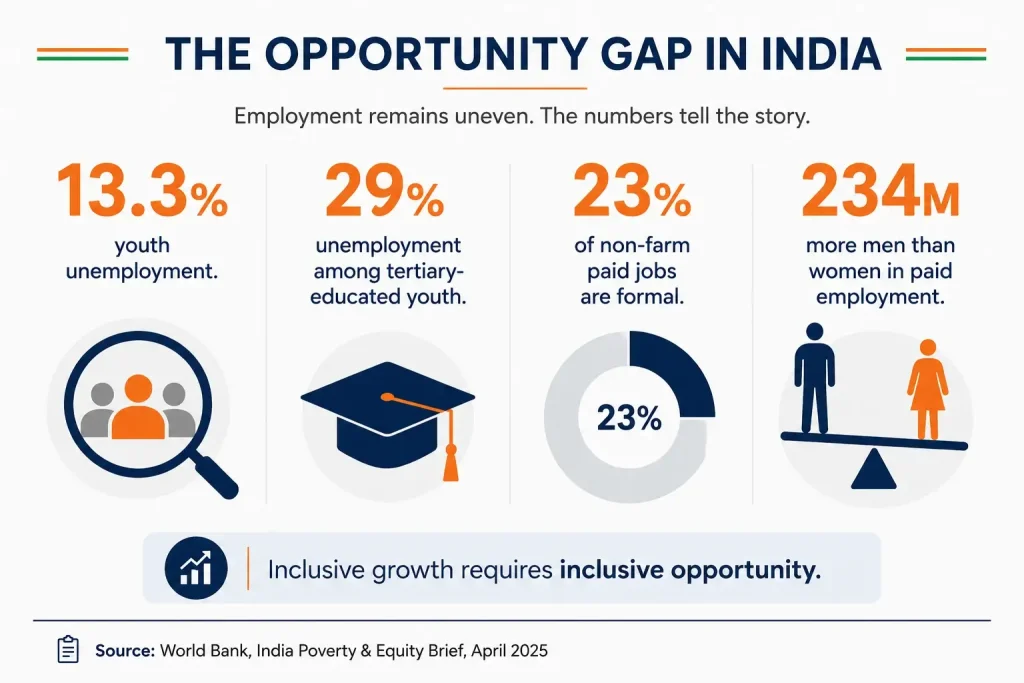
India has made significant development gains over the past decade. Extreme poverty, measured at less than $2.15 per day, declined from 16.2% in 2011–12 to 2.3% in 2022–23, lifting 171 million people above this line. Employment growth has outpaced the working-age population since 2021–22, while employment rates, particularly among women, have also been rising.

Yet development is not complete simply because headline indicators improve.

.

These realities point to a larger development question: how do we ensure that India’s economic progress translates into wider social opportunity?

India is changing rapidly. Our understanding of inclusive growth must evolve with it.

Freedom to Learn: The Foundation of Opportunity

For a child from a marginalised community, the freedom to imagine a life beyond the circumstances of their birth is one of the most fundamental forms of independence.

Yet, educational disadvantage rarely remains confined to the classroom.

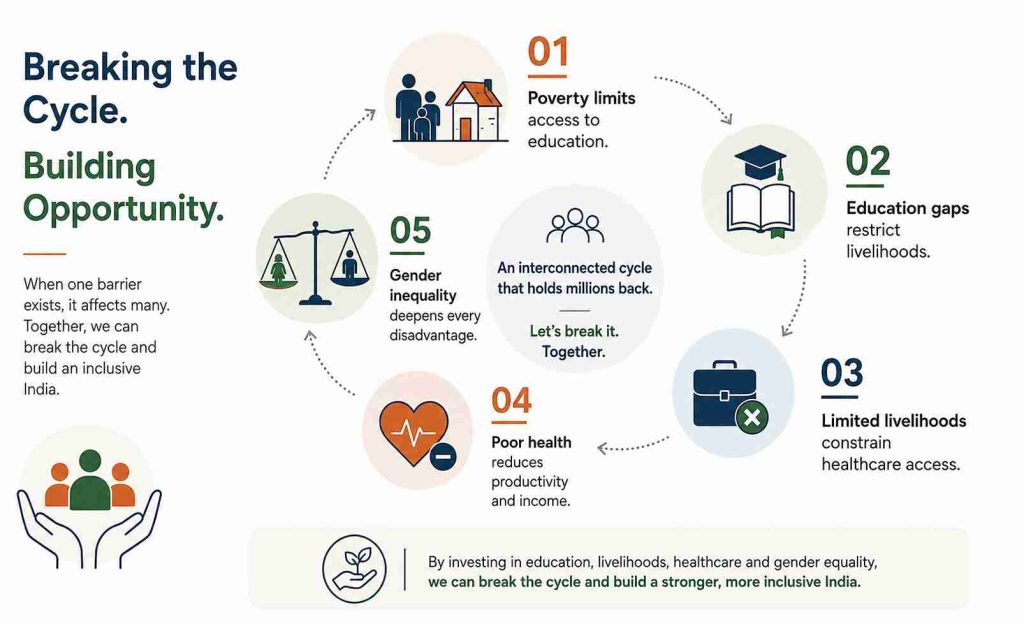
When poverty limits access to quality education, a child may fall behind in learning. That can affect their ability to pursue higher education, which can subsequently narrow their employment and earning potential. Lower household incomes can then affect the opportunities available to the next generation.

The result is a cycle in which disadvantage reproduces itself across generations.

Education, therefore, is not simply a social intervention. It is a foundational pathway to economic and social freedom.

Freedom to Be Healthy: Breaking the Poverty–Health Cycle

The same interdependence is visible in healthcare.

Freedom to be healthy means that illness should not determine whether a child can remain in school, whether a parent can continue working or whether a family is pushed deeper into financial insecurity.

Poor health can affect educational attainment and productivity. Lost income can make healthcare less affordable. Inadequate nutrition can affect a child’s development and ability to learn.

What begins as a health challenge can therefore become an education challenge, a livelihood challenge and, ultimately, a poverty challenge.

This interconnectedness is important to recognise because sustainable development cannot address these issues in isolation.

Freedom from Gender Bias: The Freedom to Determine One’s Future

For millions of women and girls, independence must also mean having the agency to determine the direction of their own lives.

Gender inequality is rarely a single barrier. Limited access to education can affect skills and employment. Limited economic independence can influence a woman’s ability to make decisions about her health, marriage and children’s education.

The consequences extend beyond the individual.

When women have fewer opportunities to participate in education and economic activity, families and communities also lose out on their knowledge, capabilities and economic contribution.

Gender equality, therefore, is not only a question of rights. It is fundamental to the country’s development potential.

Freedom to Work with Dignity

For India’s young population, freedom must also include the ability to translate aspiration into sustainable livelihoods.

A young person may have ambition, but ambition alone cannot create economic independence without relevant skills, career guidance and access to opportunity.

When employment remains insecure or inaccessible, households remain financially vulnerable. That vulnerability can influence spending on nutrition, healthcare and children’s education, reinforcing the very cycles that development seeks to break.

The problem, therefore, is not necessarily a lack of aspiration.

It is often the uneven distribution of opportunity.

The Challenges Are Connected. So Must Be the Solutions.

These challenges cannot be viewed as separate threads.

One barrier can reinforce another until an initial lack of opportunity becomes a cycle of deprivation.

Breaking this cycle requires us to reconsider what freedom means in a contemporary India.

It means creating the conditions in which people have the capabilities, resources and agency to participate in the country’s growth.

Celebrate Independence Day with a Purpose: Break the Cycle

If freedom is the opportunity to learn, to be healthy, to work with dignity and to shape one’s own future, then building an inclusive India requires sustained investment in the conditions that make these freedoms possible.

This is where grassroots action matters.

For more than two decades, Smile Foundation has worked with underserved communities across India, translating the larger objective of inclusive development into interventions that reach children, families, women and young people where they are.

As India moves towards its ambition of becoming the world’s third-largest economy by 2030,

The question is not only how fast the economy grows, but how widely the opportunities created by that growth are distributed?

Meaningful Ways to Celebrate Independence Day: Donate for Child Education

A classroom can open a door that circumstances might otherwise keep closed.

But meaningful education requires more than enrolment. It requires learning support, capable teachers, technology, nutrition, safe environments and the confidence to imagine a future beyond immediate limitations.

Through Shiksha Na Ruke, under Mission Education, Smile Foundation works with children from underserved communities to strengthen foundational learning, digital education, STEM and experiential learning, teacher capacity and school environments.

In 2024–25, the programme reached 1.85 lakh+ children, strengthened 1,000+ government schools, connected 68,000+ students to technology-enabled learning and provided 1,591 scholarships.

Behind every number is an individual possibility: a child receiving another opportunity to learn, question, explore and imagine.

This is why choosing to donate for child education on Independence Day can be understood as more than an act of giving. It is a contribution towards creating the conditions in which a child can exercise one of the most fundamental forms of freedom—the freedom to learn and determine what comes next.

Donate for Healthcare: Because Wellbeing Should Not Be a Privilege

  • A child who is frequently unwell may struggle to remain engaged in school.
  • A parent without access to timely healthcare may lose income.
  • A family facing repeated medical expenses may find it increasingly difficult to sustain spending on education.

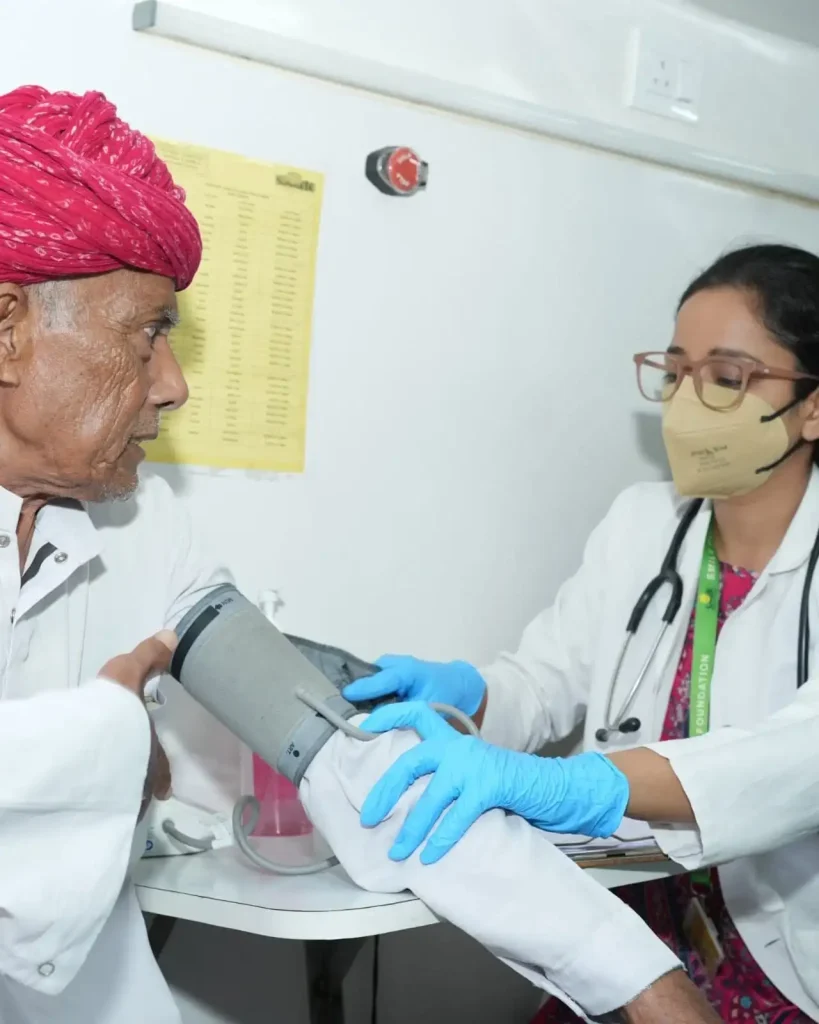
Smile Foundation’s healthcare interventions take essential healthcare closer to underserved communities, with an approach that includes preventive care, health awareness and access to services where distance, affordability or lack of information can become barriers.

The connection is fundamental:

When health improves, people’s capacity to learn, work and participate improves too.

Donate for Women’s Empowerment: Because Equality Enables Progress

The freedom to shape India’s future cannot be fully realised when women and girls continue to face barriers that restrict their choices.

Through Swabhiman, Smile Foundation works across women’s health, awareness, education and financial empowerment, recognising that sustainable change requires addressing interconnected needs rather than treating them as isolated concerns.

A woman who understands her health is better positioned to make informed decisions. A girl who remains in education has greater possibilities before her. A woman with greater economic independence has greater agency within her household and community.

These individual shifts can have intergenerational consequences.

When women have greater agency, families and communities are better positioned to make informed decisions around education, health and livelihoods.

Donate for Youth Livelihoods: Building India’s Future Workforce

Education creates possibilities, but young people also require pathways through which those possibilities can translate into sustainable livelihoods.

Through STeP, Smile Foundation supports youth development in India by equipping young people with employability skills, workplace readiness, and communication abilities, as well as providing opportunities to enter the workforce.

The significance of livelihood is ultimately about more than income.

It is about the confidence that comes with being able to say:

I have a skill. I can earn. I can contribute. I can decide what comes next.

Economic independence can strengthen a family’s capacity to invest in healthcare and education, helping create a positive cycle that counters intergenerational deprivation.

Why Giving Back Matters on Independence Day

Giving cannot resolve a complex social challenge overnight. But, it can contribute to the infrastructure of opportunity that enables change over time.

It can help support a classroom where a child develops confidence. It can contribute to healthcare access that prevents a family from falling deeper into hardship. It can support a girl’s education, a young person’s employability or the capacity of grassroots organisations to continue working within their communities.

Giving, at its most meaningful, is not simply about responding to need. It is about investing in possibility.

Celebrate Independence Day with Smile

Freedom was not given to us as a finished idea.

It was handed down as a responsibility.

Our responsibility is to ensure that the opportunities created by India’s growth reaches everyone equally.

  • Every child must learn.
  • Every girl is capable of making her decisions
  • A family that can access healthcare.
  • A young person who can earn with dignity.
  • A community that can find and sustain its own solutions.

These are not separate ambitions. Together, they represent a more complete understanding of freedom.

This year, celebrate Independence Day meaningfully by redefining and expanding, the meaning of freedom by supporting Smile Foundation in creating access to education, healthcare, livelihoods and opportunity—

Let’s Together Make freedom a lived opportunity for more Indians. 

FAQ’S

What are meaningful ways to celebrate Independence Day?
Meaningful ways to celebrate Independence Day include volunteering, supporting grassroots causes, donating towards child education, contributing to healthcare initiatives and learning about the social challenges that affect India’s development.

Why does giving back matter on Independence Day?
Giving back connects the celebration of India’s freedom with the responsibility of creating greater opportunity for communities that continue to face barriers in education, healthcare, livelihoods and social inclusion.

How can I donate for child education on Independence Day?
You can support a credible education-focused NGO such as Smile Foundation through its child education initiatives, which combine learning support with digital education, STEM, scholarships, teacher development, health and community engagement.

How can I celebrate Independence Day with a purpose?
You can celebrate Independence Day with a purpose by turning reflection into action—volunteering, donating, supporting a grassroots organisation or helping create opportunities in education, healthcare, women’s empowerment or livelihoods.

Why is child education important for India’s development?
Education strengthens children’s foundational learning, skills, confidence and future opportunities. When children from underserved communities receive meaningful educational support, it can help break intergenerational cycles of deprivation and expand their ability to participate in India’s social and economic growth.

Categories
Insights Smile

Child Development Begins with Empathy in Education

IN THIS ESSAY:

  • Empathy is a foundational life skill that shapes child development, emotional intelligence and responsible citizenship beyond academic success.
  • Children learn empathy through observation and experience, making classrooms, families and communities equally important learning environments.
  • Empathy in education challenges stereotypes, promotes gender equality, inclusion and respect for diverse perspectives from an early age.
  • Compassion extends beyond people to animals, nature and communities, nurturing socially responsible and environmentally conscious children.
  • Smile Foundation’s Child for Child programme transforms empathy into action by encouraging collaborative learning, community engagement and child-led change.

“Education is not only about preparing children for examinations. It is about preparing them for humanity.”

Empathy often begins with observation. Children notice differences long before they understand them.

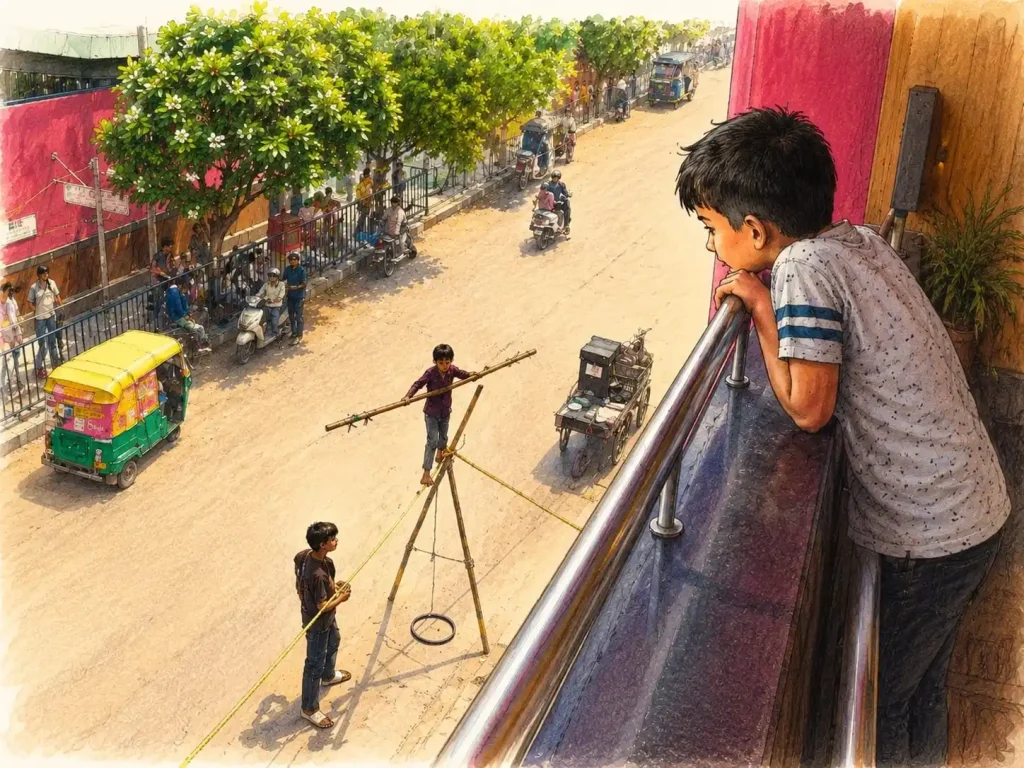
A young boy leans over the railing of a metro station, quietly watching another child balancing on a tightrope across a busy road. They appear to be the same age, yet they inhabit two very different worlds. One is enjoying his summer vacation outing with his family; the other is performing to earn a living.

Neither child says a word.

Yet, in that silent moment, a powerful question begins to take shape:

“What would life feel like if I were him?”

That simple act of wondering marks the beginning of empathy.

Long before children learn mathematics, science or grammar, they begin learning how to understand people. They observe expressions, notice differences, recognise emotions and slowly make sense of the world around them. These early experiences are fundamental to child development, shaping how children respond to inequality, kindness, inclusion and fairness throughout their lives.

Child Development Begins Beyond the Classroom

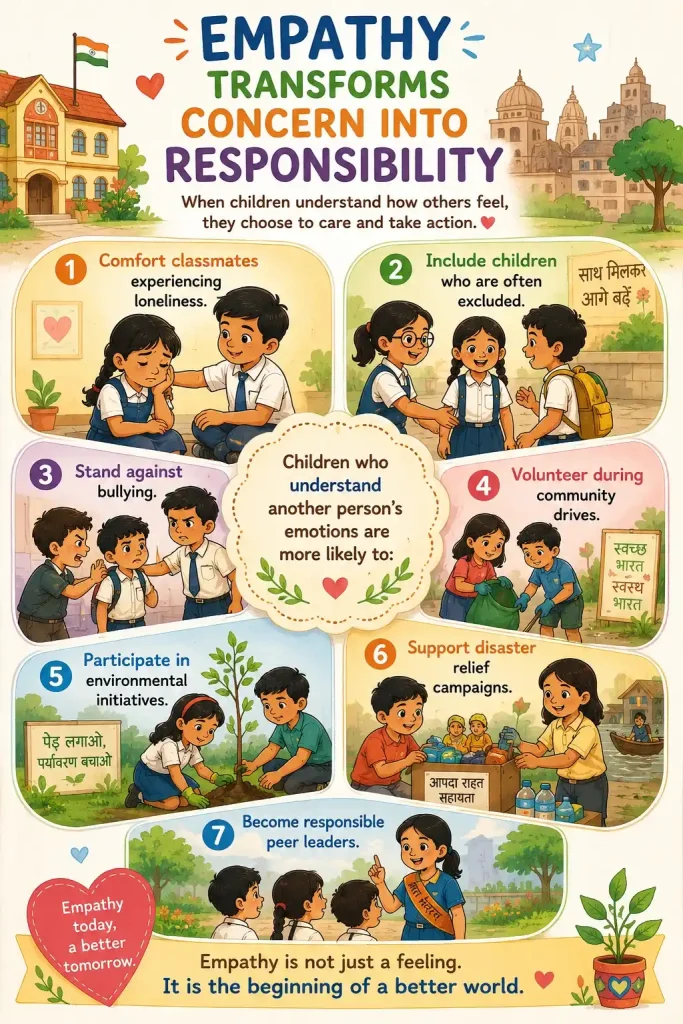
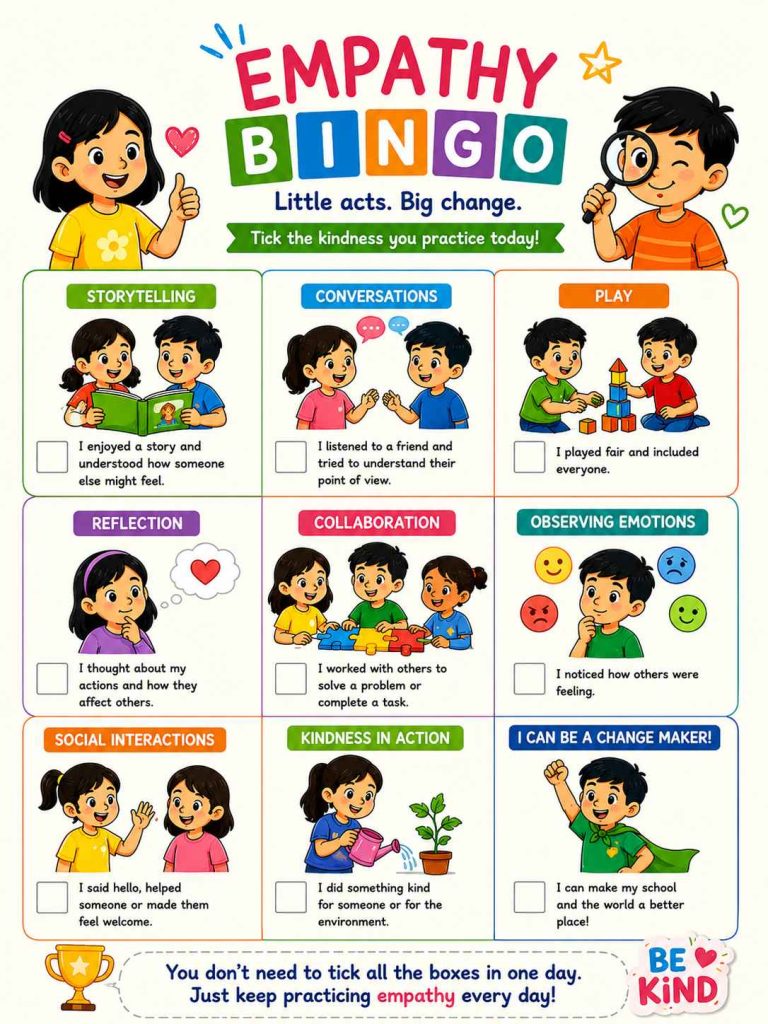
Empathy is often mistaken for kindness alone. In reality, it is a developmental life skill that grows through everyday experiences. Conversations with friends, collaborative play, storytelling, observing emotions and reflecting on different perspectives all contribute to healthy child development.

Children are not born understanding another person’s experiences. They develop this ability gradually through interactions with parents, teachers and peers. Every classroom discussion, playground disagreement and shared activity becomes an opportunity to strengthen empathy in education.

These qualities extend far beyond classroom relationships. They prepare children to become responsible citizens, collaborative leaders and compassionate members of society. 

Children Learn More by Watching Than by Being Told 

Children are extraordinary observers.

They notice who is left out during playtime.

They notice who receives help.

They also notice who cleans the classroom, who drives the school bus, who struggles to keep up and who is celebrated.

Every observation becomes an invisible lesson.

Without guidance, these moments may reinforce assumptions. With thoughtful conversations, however, they become opportunities for reflection.

Instead of simply teaching children what is right, schools can encourage them to ask deeper questions.

“How do you think your friend felt?”

What would you do if you were in that situation?”

These conversations help children move beyond judgement towards understanding. Empathy is rarely taught through instruction alone; it develops through experience, reflection and meaningful relationships.

Empathy in Education Builds Equality 

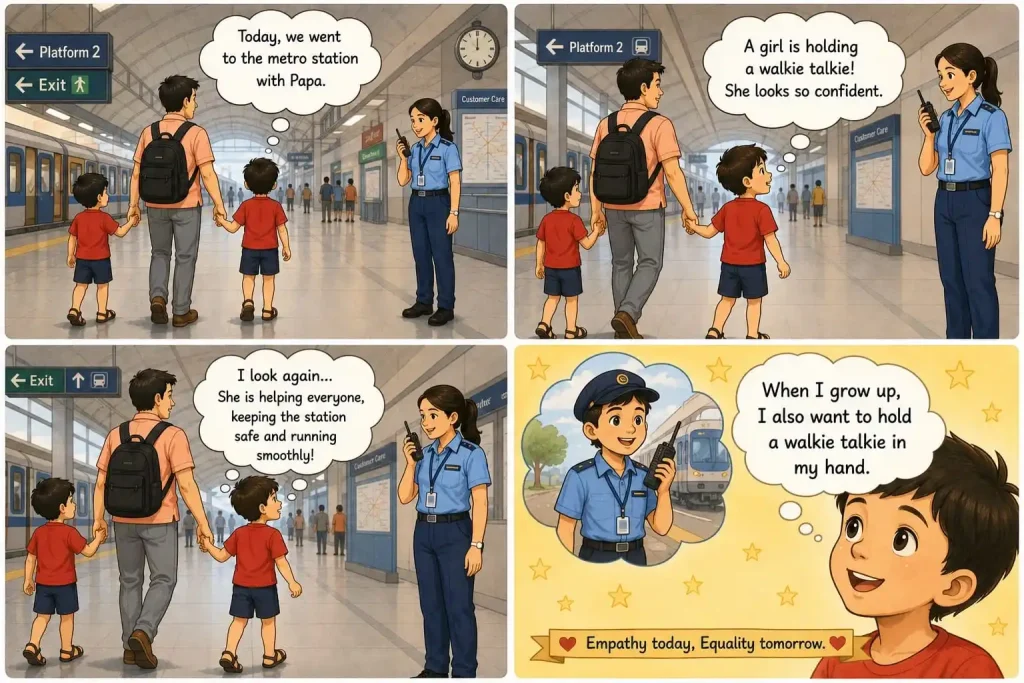
It was an ordinary metro commute day for two sons with their father, until something extraordinary caught the little boy’s attention.

Walking alongside them was a woman in a metro station uniform, confidently coordinating the platform. Every few moments, the static buzz of her walkie-talkie came alive as she guided passengers, responded to updates and kept the station running smoothly.

Though his father gently hurried him towards the arriving train, the little boy could not take his eyes off her. With every message that crackled through the walkie-talkie, his curiosity grew and his admiration deepened.

His thoughts that day were never, “Girls cannot do this.”

Instead, his eyes sparked with aspiration- “When I grow up, I want to hold a walkie talkie too”

In that moment he saw confidence. He saw leadership. He saw someone solving problems and helping hundreds of people every day.

“Children rarely begin with stereotypes; they begin with observation”. 

They watch the world with curiosity, absorbing what they see long before they understand the labels society assigns. Every such moment becomes an opportunity to shape their perspective—not through instruction, but through experience.

When children are encouraged to see people for their abilities rather than their gender, empathy becomes the foundation for equality. They learn that leadership is not defined by who someone is, but by what they are capable of doing.

Biases are rarely innate; they are learned through repeated social messaging.

Compassion Rarely Stops with People

Children often discover empathy long before they can define it.

A game shared on the playground teaches cooperation.

Resolving a disagreement teaches patience.

Flying a kite together teaches trust.

Play remains one of the most effective environments for child development, encouraging children to understand different personalities, communicate respectfully and celebrate one another’s successes.

These seemingly ordinary experiences quietly build emotional intelligence and social confidence.

As children learn to work together, they become comfortable with classmates from different cultures, languages and backgrounds. Inclusion becomes a habit rather than a policy.

Compassion Extends Beyond People 

Compassion learned in childhood often extends from people to animals and the environment.

The way a child treats an animal often reflects how they understand vulnerability.

A child who gently offers water to a thirsty stray dog is learning far more than kindness towards animals.

  • They are learning responsibility.
  • They are recognising that another living being has needs.
  • They are discovering that compassion requires action.

Research consistently suggests that children who demonstrate empathy towards animals often display stronger prosocial behaviours towards people as well, making compassion a habit that is rarely selective.

When children understand that every living being deserves dignity and care, they begin seeing the world through a broader moral lens.

Schools can nurture this understanding through activities such as nature walks, animal welfare discussions, environmental projects and community service initiatives.

These experiences encourage children to recognise that every act of kindness, however small, contributes to a more compassionate world.

The Child for Child programme by Smile Foundation builds on these very principles. It transforms schools into spaces where children become active participants in each other’s learning journeys.

This progression from understanding to action—is where schools create future changemakers.

Creating Schools Where Empathy Thrives with Smile

Empathy cannot be cultivated through a single value education lesson. It grows through consistent experiences that become part of a child’s everyday learning journey. This is where Child for Child, Smile Foundation’s flagship school engagement programme, transforms empathy in education from a concept into a lived experience.

Built on the belief that children are powerful agents of change, the programme creates opportunities for them to learn with and from one another. Through storytelling, reflective conversations, collaborative projects and experiential learning, children are encouraged to understand different realities, appreciate diverse perspectives and translate compassion into meaningful action.

Children learn far more from what adults consistently demonstrate than from what they occasionally say.

Every interaction becomes a lesson.

Every classroom becomes a community.

Every teacher becomes a role model.

Redefining What Success Looks Like

Schools proudly celebrate examination results, athletic achievements and university admissions.

These accomplishments deserve recognition.

Yet perhaps there are equally important questions every school should ask.

These are not distractions from education.

They are its highest purpose.

In a rapidly changing world shaped by artificial intelligence, technological advancement and global interconnectedness, empathy remains one uniquely human capability that will define responsible leadership.

Children who learn to understand others today will become the doctors who treat patients with dignity, the entrepreneurs who build inclusive workplaces, the scientists who innovate responsibly, the policymakers who design equitable systems and the teachers who inspire future generations.

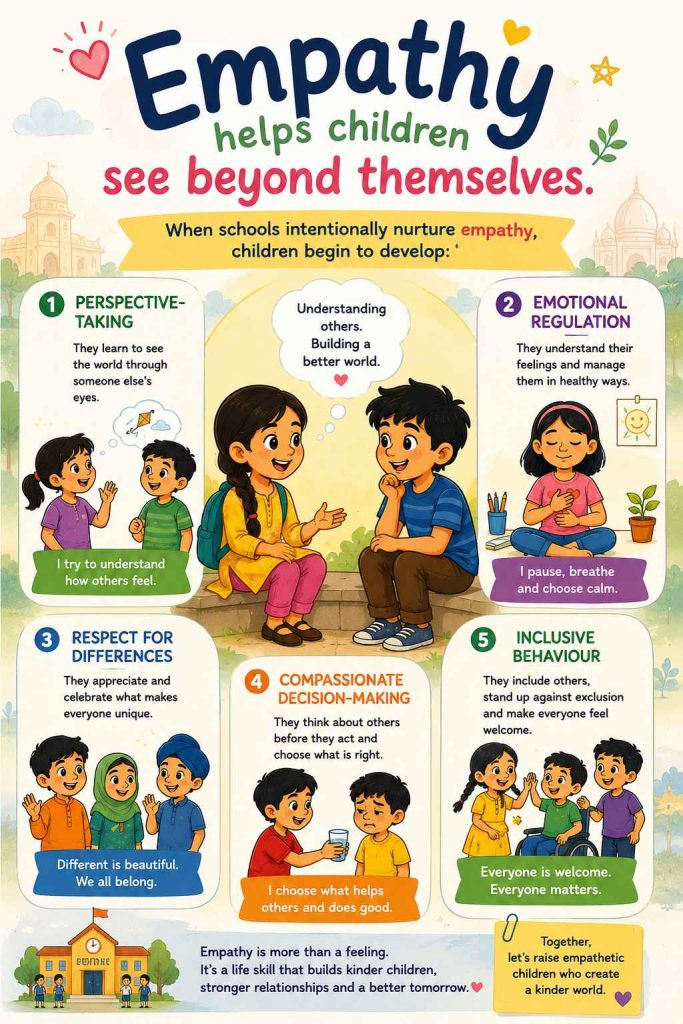
When schools intentionally create opportunities for children to observe, question, understand and act, they do far more than educate young minds. They help build a generation capable of seeing humanity before difference.

In the end, academic success may determine what children achieve.

Empathy will determine who they become.

SOURCES:

Frequently Asked Questions (FAQs)

1. Why is empathy important in child education?

Empathy helps children understand others’ emotions, develop positive relationships, improve communication skills and become responsible citizens. It is as essential to child development as academic learning.

2. How can schools teach empathy to children?

Schools can foster empathy through storytelling, reflective discussions, collaborative activities, community service, inclusive classrooms and experiential learning that encourages children to understand different perspectives.

3. What role does empathy play in child development?

Empathy strengthens emotional intelligence, problem-solving, teamwork and resilience. It helps children build meaningful relationships and make compassionate decisions throughout life.

4. Why should empathy be part of the school curriculum?

Empathy creates inclusive learning environments, reduces bullying, promotes respect for diversity and prepares children for responsible leadership in an interconnected world.

5. How does empathy promote equality in education?

By encouraging children to appreciate abilities rather than stereotypes, empathy helps break social and gender biases while promoting inclusion, fairness and equal opportunities.

6. What is the Child for Child programme by Smile Foundation?

Child for Child is Smile Foundation’s flagship school engagement programme that encourages children to become active changemakers through empathy, collaboration, community participation and experiential learning.

7. How can parents encourage empathy at home?

Parents can model compassionate behaviour, discuss emotions openly, encourage perspective-taking, involve children in acts of kindness and create opportunities for community engagement.

8. How does empathy prepare children for the future?

Alongside academic excellence, empathy equips children with emotional intelligence, collaboration, ethical decision-making and leadership skills needed to thrive in the future workplace and society.

Categories
Education Girl Child Smile

Christmas Giving That Empowers India’s Girls

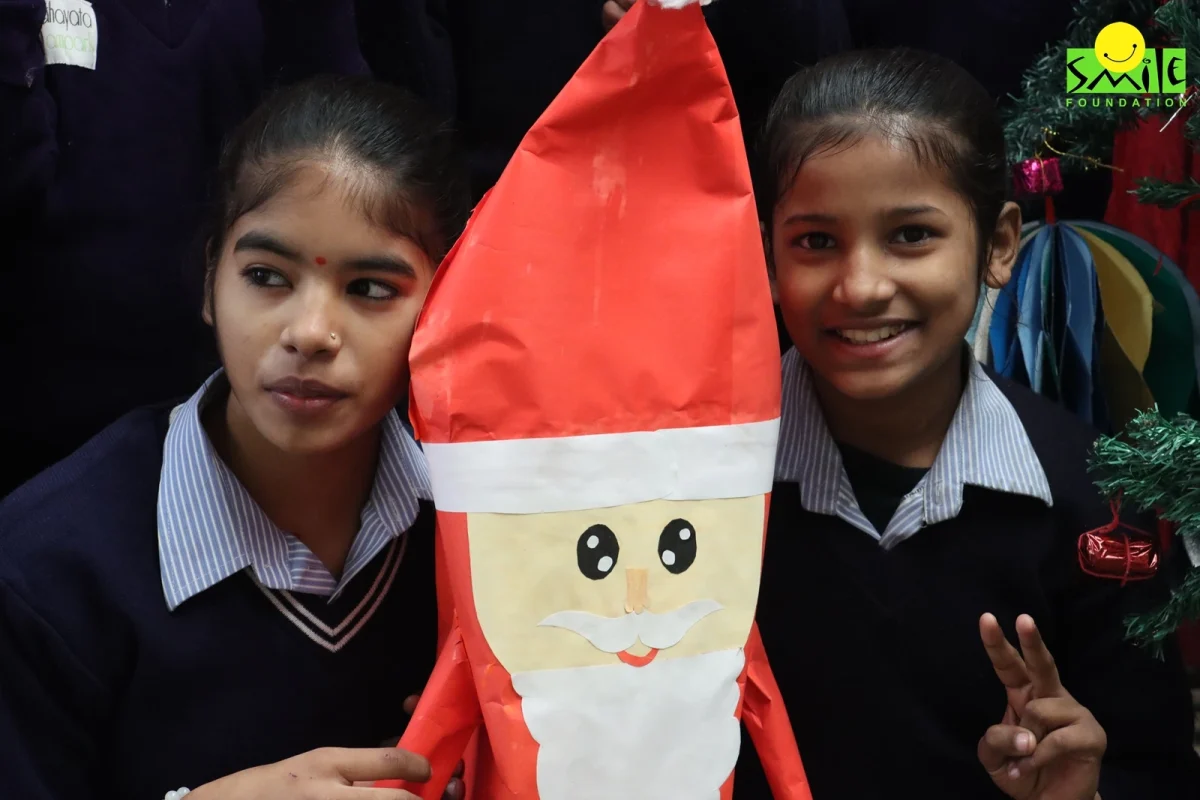
Christmas is that time of the year when the air carries the gentle hum of carols, evenings are wrapped in the warmth of chocolate milk and plum cake while the steers glow with lights that symbolise hope and new beginnings. For children, Christmas brings the joy of waiting for Santa Claus, of believing that their goodness shall be rewarded. 

Yet, for countless children across rural and underserved communities, especially girls, the season also mirrors a harsher reality. For them, Christmas often arrives with long and difficult journeys to schools through cold winter mornings– a struggle that can decide their fates of continuing the education or dropping out of the school.

Christmas Call to Strengthen Girl Child Education in India

Education is the cornerstone of empowerment, and every child deserves the gift of learning. However, girl child education in India continues to face systematic barriers rooted in gender inequality. As highlighted in UNESCO’s SDG 4 Scorecard 2025, while access and enrolment have improved- equitable education still remains uneven. India’s ranking in the Global Gender Gap Index further underscores the distance the country must travel to achieve true gender parity.

In this scenario, strengthening girl child education in India must go beyond enrolments. It demands sustained focus on retention, learning outcomes, trained teachers, safe infrastructure and dignity-driven school environments to ensure that their education is not just a seasonal hope, but a lasting promise which empowers every girl to learn, thrive and shape her own future.

Donate on Christmas, Make a difference

The festive season of Christmas begins with Thanksgiving around the world. It is an occasion where people express their gratitude for the blessings and sacrifices of the past year and celebrate by feasting with family and friends. Festivals often remind us to be grateful for the fortunes we are blessed with. Giving back to society and sharing our abundance with the ones deprived of it can be a great way to show our thankfulness to God.

Here’s a list of few Christmas Donation Ideas:

1.Donate for girl child education: When it comes to a poor family struggling for two square meals a day, education becomes their least concern. But education has the power to change lives, especially girl child education. You can give the precious gift of education to these under-privileged children and transform their lives.

Smile Foundation through its Shiksha Na Ruke initiative has been working relentlessly to make sure that poverty doesn’t deter education for a child. You can join hands with the Smile Foundation and donate online in a one-time or monthly payment mode to help educate a child and gift them a better future.

 2.  Donate educational gifts to poor kids: There are many poor and marginalized kids who are eager to read and write but cannot afford books or educational stationery. This Christmas, you can be their Santa Claus and buy them notebooks, pencils, erasers, crayons and other stationery which might not cost you much but would surely bring a big smile on these kids’ faces.

3. Share your Christmas Treat: Christmas is incomplete without a scrumptious and elaborate feast with friends and family. In case you are hosting one such Christmas feast and have cooked or arranged food that’s more than what you need, remember there are lots of hungry people you can feed. You can donate your extra food by finding the needy yourself or call the helpline numbers which provide assistance in this regard.

 4. Donate winter clothes to the homeless: Christmas time is winter time when many parts of the country experience extreme cold. In such climatic conditions, the homeless people and footpath dwellers suffer the most. You can donate bed sheets, blankets, shawls or any winter clothing to keep them warm and survive the chilly weather.

 5. Cook a special Christmas meal for poor kids:  Christmas is about sharing food, fun and festivities. You can take like-minded friends or family members and spend your Christmas at any orphanage, children’s home or old age home and cook a special meal for them. Believe us, the twinkle in their eyes and glee on their face would make the most cherished Christmas memories.

6. Be the Secret Santa to a needy person: Playing secret Santa and giving surprise gifts to colleagues has become part of Christmas celebrations in corporate offices in recent times. How about being a secret Santa to a person or family that expects it the least but needs it the most. For example, the watchman of your apartment, or the lift attendant in your office, the maid who works in your house or the delivery boy of your neighbourhood grocery store. If you know any specific requirement of a needy person in your vicinity or a community helper, which you can afford to fulfill, then go ahead and grant their wish. You’ll not just pleasantly surprise them but earn loads of sincere blessings.

Final Takeaway

A small act of charity by you could mean a world of difference to someone. Never stop being kind because kindness keeps the world going and has a positive impact on the self and society. Not just Christmas or any festival, let’s make kindness and compassion a way of life because as the common saying goes, “Service to Mankind is service to God.”

So set out with all your heart to donate, volunteer and serve others at every opportunity you can. Learn about Smile Foundation’s flagship programme, Mission Education and know what it is doing with respect to girl child education. Donate for girl child education today. Wish you a Merry Christmas!

Categories
Smile CSR Education Partners In Change

Storytelling drives child education in villages

Digital tools, slick storytelling formats and gamified content are reshaping what it means to learn in 21st-century India. In classrooms outfitted with smartboards or, more often, in makeshift learning spaces on mobile phones children are no longer passive recipients of knowledge. Teachers, too, are adjusting their roles, while parents navigate new expectations.

Yet for every student swept up in this transformation, many more are being left behind. Patchy internet, device shortages and an education system still tethered to rote learning mean that the promise of immersive, future-ready education remains elusive for millions.

India stands at a pivotal juncture: the digital age has cracked open new possibilities for learning. But unless policymakers, technologists and educators confront the structural inequities that persist, the gap between potential and reality may only deepen.

Child education in India: Is modern learning inclusive?

India’s education landscape is being reimagined. A new emphasis on progressive pedagogy is encouraging schools and parents to move beyond the narrow metrics of academic achievement, toward something more expansive — an education that fosters critical thinking, emotional intelligence, leadership and a sense of self in a fast-changing world.

In theory, this marks a long-overdue shift. But the bigger question looms: who is this transformation really reaching?

Across India’s rural heartlands, where over 1.26 million schools operate, the ambition is palpable. Government schemes from Sarva Shiksha Abhiyan to Samagra Shiksha and PM e‑Vidya promise inclusive classrooms, digital tools, library upgrades and skills for a future economy. The official narrative speaks of equity, access and innovation.

But the lived reality is more uneven. Patchy infrastructure, overstretched teachers and socio-economic barriers continue to hold back millions of children especially girls, first-generation learners, and those in remote areas. While some students absorb coding through tablets, others still struggle to access textbooks or electricity.

The gap isn’t just digital. It’s systemic.

Bridging it will require calls for deeper alignment between governments, corporate players and community-led organisations to ensure that modern education doesn’t just remain an urban privilege, but becomes a shared national asset. One where every child, regardless of geography or background, has a real shot at learning in a way that is inclusive, holistic and genuinely transformative.

The ground reality 

A key hurdle in rural education today lies not in ambition, but in infrastructure. According to recent reports, nearly 60% of government schools in rural India lack functional internet connectivity. One in three schools is still without even the most basic digital tools such as projectors or smart boards making it nearly impossible for modern teaching methods to take root. In these classrooms, the promise of digital learning remains just a promise, and not yet a reality.

Modern learning in rural schools

Children in rural India remain at a stark disadvantage that carries profound implications for the country’s future. By 2027, an estimated 69 million new jobs are expected to emerge globally. Without urgent and sustained intervention, a generation of children from less privileged communities risks being shut out of this evolving opportunity landscape.

Bridging this divide requires more than textbooks and classrooms. It calls for an education system that nurtures cognitive agility, emotional resilience and practical life skills — tools as essential as literacy in navigating the future. This is where modern educational tools come in, not as luxuries, but as vital instruments towards building a safer, more inclusive future for every child.

  1. Storytelling 

This has always been central to how children learn and remember. A 21st century classroom reimages this age-old method through digital storytelling – using videos, interactive flip books and gamified storytelling to explain complex concepts in simple and relatable ways

Research highlights that digital storytelling not only sparks creativity but also improves retention, motivation and deeper lesson engagement. For example, a story based history lesson enables children to “live through” events while a narrative driven science experiment can abstract concepts vividly. 

  1. Read-alouds and interactive content 

Read-aloud sessions were seen as a cornerstone of early child education which today have evolved into interactive digital formats. Today, children can listen to stories brought alive by AI-powered voices or choose how a character’s journey unfolds through interactive polls and clickable story paths. 

In India, where language diversity is vast, digital read-aloud tools also provide multilingual access, ensuring rural and urban children alike can learn in their mother tongue. This aligns with findings from the World Economic Forum (2024), which stresses rekindling curiosity through play-based and interactive tools that allow children to ask, explore and discover.

  1. Flip books and visual tools 

Traditional flip books and comics are being reinvested as microlearning modules. Imagine a child in a rural school accessing a digital flip book that demonstrates each step of a science experiment or a visual timeline that makes Indian history easy to understand and remember. 

Visual storytelling enables children to learn at their own pace, bridging the comprehension gap often caused by rigid textbook teaching. Child education in India, where students frequently encounter first-generation learning barriers, therefore, tools such as flip books can enhance discovery and quick grasping. 

  1. Digital tools and personalised leaning

The most transformative shift comes from personalised learning which is supported by digital platforms. Research states that adaptive learning does not promise equality in output but ensures adequacy that every child gains the competencies necessary to thrive, regardless of starting point. 

  • 75% of students feel more engaged in a personalised learning environment compared to just 30% in traditional ones.
  •  Personalised content recommendations boosted engagement by 60%
  1. Teachers driving change

Teachers equipped with the modern pedagogical skills, digital tools and activity based methods establish a closer relationship with their students. With constant classroom engagements the learning outcomes also boots, but also empowers teachers with confidence, adaptability and professional growth creating a strong future ready education ecosystem in India

 Learning with Smile

Child education in India faces persistent challenges of inequity, digital divides and limited access to quality learning environments. Smile Foundation, through its Mission Education programme is working to transform this landscape by aligning with the National Education Policy 2020 and global priorities such as Foundation Literacy and Numeracy (FLN), tech enabled learning and lifelong education. 

With over 1,20,00 children across 27 states, the foundation adopts a four-pronged approach-

  • Child centric
  • Teacher centric
  • Enabling learning environment
  • Community engagement 

To ensure that children not only access education but also benefit from holistic development.

Our mission is to build inclusive, engaging and technology‑enabled classrooms that nurture holistic learning. Through impact‑driven corporate partnerships, we believe child education in India can be reimagined, delivering opportunities that go far beyond textbooks, empowering every child to learn, grow and thrive.

Partner with Smile Foundation to co-create scalable and sustainable education models that empower every child to learn, thrive and be successful.

Sources 

Innovative Education Methods: Transforming Teaching and Learning

https://ace.edu/blog/innovative-education-methods-transforming-teaching-and-learning

Digital Storytelling: A Powerful Technology Tool for the 21st Century Classroom

https://www.researchgate.net/publication/249901075_Digital_Storytelling_A_Powerful_Technology_Tool_for_the_21st_Century_Classroom

Rural Education – Integral to India’s progress

https://www.ibef.org/blogs/rural-education-integral-to-india-s-progress

Annual Status of Education Report 2024

Bringing back curiosity: How digital tools can help us rethink education

https://www.weforum.org/stories/2024/06/bringing-back-curiosity-how-we-can-use-digital-tools-to-rethink-education
Categories
Smile CSR Education Girl Child Partners In Change Partnerships

Menstrual Hygiene and Girls’ Education: Why Awareness Matters More Than Ever

In this essay:

  1. Menstrual hygiene remains a major barrier to girls’ education in rural India, with stigma, poor awareness and inadequate sanitation contributing to school absenteeism.
  2. Menstrual Hygiene Day highlights the urgent need to normalise conversations around periods and ensure adolescent girls can manage menstruation with dignity and confidence.
  3. Lack of menstrual hygiene awareness and access to sanitary products continues to affect girls’ health, confidence and long-term educational opportunities across underserved communities.
  4. Strategic CSR–NGO partnerships can strengthen menstrual hygiene management through infrastructure support, menstrual literacy and improved access to safe hygiene products.
  5. Community-led menstrual hygiene programmes involving ASHA workers, peer educators and schools can help reduce stigma and improve health-seeking behaviour among girls.
  6. Smile Foundation’s Swabhiman initiative is promoting menstrual hygiene awareness, peer education and access to sanitary products to reduce school dropouts and strengthen girls’ confidence.

In a classroom in Odisha, Shalini stood up to answer a question. She had no idea her life was about to change. A red stain on her seat, a sign of her first period, brought giggles, whispers and then silence. No one had spoken to her about menstrual hygiene or menstruation before. Frightened and ashamed, she thought she was unwell. The next day, she begged her parents not to send her back to school. In that moment, her education and confidence began slipping away together.

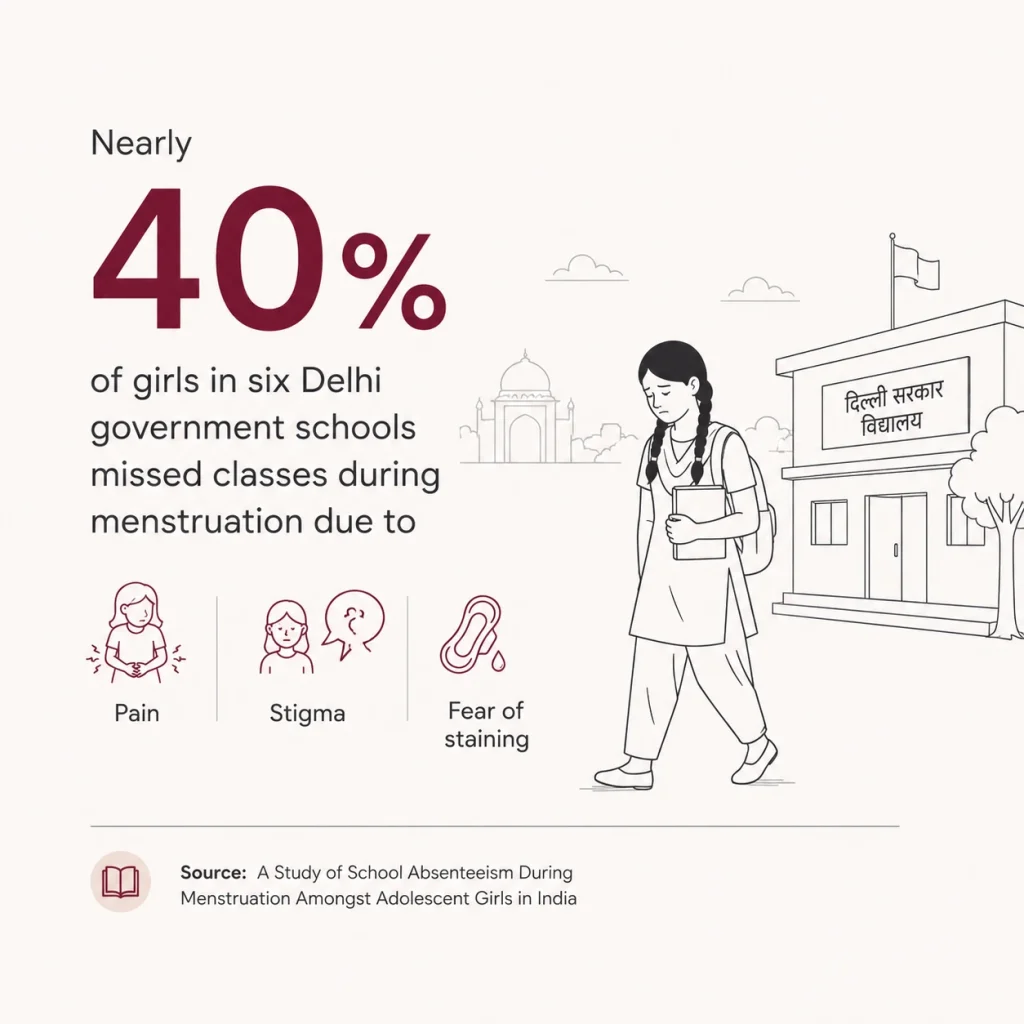
Shalini’s story reflects the harsh reality faced by countless girls across rural India, where lack of menstrual hygiene awareness, limited access to sanitary products and poor sanitation facilities continue to affect girls’ education. For many adolescent girls, periods become a reason to miss classrooms, fall behind in learning or eventually drop out of school altogether.

Menstrual hygiene is not only a health issue; it is deeply connected to dignity, confidence and equal access to education. Without safe spaces, awareness and support, millions of girls continue to navigate menstruation through silence, stigma and fear, limiting their potential long before they get the opportunity to realise it.

UNICEF & WATERAID INDIA STUDY (2015)*

The unspoken numbers

According to UNICEF India, over 253 million adolescents live in India, with nearly half being girls and 25% of them in rural areas. Despite several government-led menstrual hygiene initiatives, thousands of girls still drop out of school due to shame, pain, poor access to products and lack of supportive infrastructure.

Period absenteeism: Why?

Whether in rural villages or urban neighbourhoods, a girl’s first period often arrives unannounced and with fear. Her body undergoes unfamiliar changes, but in the absence of support and information, this moment becomes isolating. When compounded by poor infrastructure, stigma and silence, menstruation becomes not just a personal struggle, but an educational barrier.

  1. Social taboos 

Even today, in many parts of India, menstruating girls and women are subjected to regressive restrictions like being barred from entering temples, kitchens or even touching food on the grounds of being “impure.” These practices are reinforced by harmful myths, such as the belief that menstrual blood is toxic or that using sanitary pads causes infertility. As a result, many girls are pushed toward using cloth or other unhygienic alternatives compromising their health, dignity and confidence.

  1. Poor menstrual product access

In many rural communities, girls face limited access to safe menstrual products, clean cloth or private drying spaces. Adding to their troubles is the issue of no proper disposal facilities; they often resort to using ashes or rags as quiet acts of desperation that compromise their health and dignity. 

Menstrual hygiene in Indian women (15-24yrs)

Recent data reflects encouraging progress: 78% of women in India now use hygienic menstrual methods such as sanitary napkins, tampons or menstrual cups indicating growing awareness and improved access. However, among adolescent girls, only 42% rely exclusively on these hygienic practices*, with significant disparities persisting across states and districts. This gap underscores the urgent need for targeted interventions that address both availability and cultural barriers in underserved regions.

*Menstrual hygiene practices among adolescent women in rural India: a cross-sectional study

https://pmc.ncbi.nlm.nih.gov/articles/PMC9675161

  1. Paying the hidden cost of secrecy and infrastructure gaps

Many girls across rural India navigate their periods in secrecy by hiding pads in books, fearing stains, missing school events, and sometimes their yearly reviews as well because of menstruation. With no dustbins, running water or private toilets in schools, managing menstrual hygiene becomes near impossible. The result is a deafening mix of isolation, shame and lost days of learning. 

Menstrual health is a national priority

India has taken steps in the right direction. The Menstrual Hygiene Scheme (MHS), by the Ministry of Health and Family Welfare, offers subsidised sanitary napkins and peer counselling through ASHA workers. The Rashtriya Kishor Swasthya Karyakram (RKSK) promotes adolescent health, including menstrual awareness. The Suvidha Scheme by the Ministry of Chemicals and Fertilisers introduced biodegradable sanitary pads at ₹1, increasing affordability.

However, gaps persist. Many of these programmes struggle to reach India’s most marginalised girls. Product availability doesn’t always translate to product use, especially when surrounded by silence and stigma.

As a result, many adolescent girls navigate menstruation in isolation—confused, unprepared and unsupported. For countless girls, this social conditioning leads to school absenteeism, diminishing their confidence, academic continuity and long-term opportunities.

Addressing the gaps through strategic partnerships 

To bridge these challenges, strategic CSR–NGO partnerships are serving as catalytic agents. By combining grassroots reach with corporate scale, these collaborations have the potential to advance menstrual hygiene management as a systemic solution driving health equity, school retention and long-term social impact for adolescent girls across India.

Improving school infrastructure beyond brick and mortar

One major challenge for school girls from rural communities during menstruation is the lack of functional school infrastructure; poor washrooms, inadequate disposal, limited water and no privacy often lead to school dropouts.

What can be done

  • Support the development of gender sensitive washrooms with lockable doors, running water, disposable bins and incinerators. 
  • By partnering with NGOs, corporates can implement their CSR goals for women empowerment. Through impact dashboards, the projects can be tracked to identify the usage, maintenance, and overall the hygienic parameters required for young girls in home and schools. 

Culture stigma needs community solutions 

One of the most important issues that must be addressed immediately at a large scale is the lack of awareness about menstrual health amongst young girls and their communities. This becomes more concerning when the concerns of young girls are silenced due to vulture silence, shame and myths that often lead to fear, poor hygiene and isolation. 

What can be done

Corporates can support community based menstrual literacy programmes where they can collaborate with local organisations, ASHA workers and peer educators to increase awareness on menstrual hygiene. Furthermore, they can also educate the girls, teachers and community workers through culturally adapted IEC tools (flipbooks, comics, digital stories ) to challenge taboos and normalise conversations. 

Take the example of Shivani. Once hesitant and withdrawn, she found her footing through menstrual health sessions conducted by Smile Foundation’s Swabhiman programme. With accurate information and support, she gained not only knowledge, but also the confidence to speak up. Today, she serves as a peer educator empowering other adolescent girls in her community and promoting health-seeking behaviour.  

As part of its integrated approach to women’s health, Smile Foundation’s Swabhiman trains community-based volunteers as reproductive and menstrual health educators in underserved areas. This capacity-building intervention strategically addresses knowledge gaps, dismantles cultural taboos and promotes safe menstrual hygiene practices directly reducing school absenteeism and health risks among adolescent girls. By embedding peer-led advocacy into last-mile delivery, the initiative strengthens behavioural change at the community level while aligning with national adolescent health goals and SDG targets.

Making innovation accessible, affordable and adaptable 

As key drivers of social impact, CSR–NGO partnerships are well positioned to eliminate unhygienic menstrual practices such as the use of cloth, ash or sacks by co-developing and scaling access to affordable sanitary products tailored for rural adolescent girls. In light of growing environmental concerns, these partnerships must also prioritise innovation in biodegradable and reusable menstrual solutions, ensuring both adolescent health and ecological sustainability. Such an approach aligns with ESG goals and supports long-term, community-based health equity.

What can be done

  • Support women-led production units for biodegradable sanitary napkins or menstrual cups.
  • Collaborate on last mile distribution through workshops in local communities and schools, Anganwadis and frontline health workers.
  • Support impact evaluations to track product adoption, usage frequency, and behavioural shifts. 

For instance, through targeted workshops on menstrual hygiene, Smile Foundation’s Swabhiman programme ensures last-mile delivery of accurate, stigma-free education to adolescent girls in underserved communities. By promoting body literacy and safe hygiene practices, the initiative empowers girls with the confidence to stay in school, safeguard their health and become agents of change in their communities.

Her better health and future with Swabhiman

To commemorate Menstrual Hygiene Day 2026, Swabhiman is addressing menstrual hygiene as a critical enabler of uninterrupted education for adolescent girls in rural India. By training peer educators, frontline volunteers, and community health workers, Swabhiman delivers accurate, stigma-free menstrual literacy at the grassroots. It also facilitates access to sanitary products, promotes hygienic practices and advocates for safe, girl-friendly school sanitation infrastructure. This integrated approach reduces absenteeism and school dropouts caused by menstruation-related challenges. Aligned with national priorities and SDGs 4 and 5, Swabhiman empowers girls to manage menstruation with dignity transforming it from a source of shame into a gateway for continued learning and confidence.

A call to strategic CSR for menstrual hygiene in India

By investing in menstrual hygiene, CSR initiatives can move the needle on multiple fronts including school attendance, public health, gender empowerment and community resilience.

Smile Foundation invites partners committed to building inclusive, lasting impact. Let’s work together so that menstruation is no longer a reason for any girl to drop out but a moment where she steps into knowledge, dignity and power.

Categories
CSR Education Partnerships

STEM Today, Changemakers Tomorrow

Imagine a future where children across India learn to design, code, and build right from their homes. With the right support through CSR-led STEM education, this is not just a possibility – it’s within reach.

Drawing guidelines from the reports of UNESCO, McKinsey & Company, CSR programmes can trace the natural path of identifying barriers to forging lasting partnerships that deliver resources, mentorship and digital infrastructure. By promoting STEM education through corporate investments with developmental expertise, initiatives can be developed to create inclusive STEM education projects that effectively upskill underrepresented children in India. 

This collaboration ensures sustainable ecosystems where academia institutions, industry and community organisations co design curricula, facilitate internship and provide ongoing support. Ultimately, such synergy drives innovation, economic growth and social development by promoting equitable access to STEM education and careers. 

Bridging STEM gaps – Policy meets CSR

The Government of India has established a robust policy environment to strengthen STEM education, recognising its role in national development and global competitiveness. Key schemes include Rashtriya Avishkar Abhiyan, which integrates STEM learning with experiential methods in schools; Innovation in Science Pursuit for Inspired Research (INSPIRE) which nurtures scientific talent from an early age and Digital India which promotes digital literacy and e-learning tools, enhancing STEM access in rural and semi-urban areas. 

Additionally, initiatives like Atal Innovation Mission and PM eVIDYA support innovation labs, teacher training and digital content development. These programmes provide the policy infrastructure for corporate social responsibility initiatives to scale their impact through strategic public-private partnerships. 

However, despite several initiatives to make STEM education accessible in India, the gaps still exist. In low-resource communities, be it from Mumbai slums or remote Himalayan villages, many children look forward to learning, to questioning and to creating. But because of the lack of basic resources, trained teachers and hands on experiences their potential goes unrealised.

Why is STEM education vital?

STEM careers are poised for exceptional growth, driven by rapid technological advancement and the global push towards digitalisation, sustainability, and innovation. According to the U.S. Bureau of Labor Statistics and the World Economic Forum, STEM jobs are projected to grow by 6.9% between 2022 and 2032 outpacing non-STEM roles.

Fields like AI, data science, cybersecurity and renewable energy engineering could see growth of 30–45%, creating millions of high-quality, future-ready jobs. This surge not only promises economic opportunity but also the chance to shape a more resilient, equitable world. 

Thus, STEM education from an early age in countries like India holds the key to empowering children to dream, innovate, and thrive in a world that’s changing rather too quickly. At its core, it’s not about gadgets or code—it’s about levelling the playing field and expanding the horizon of what’s possible for every child.

STEM powers equal futures for every child

  1. Builds Blocks for STEM Equity

STEM education in India is a powerful enabler of inclusive growth, but its success hinges on foundational infrastructure. In remote regions, where electricity, internet connectivity, science kits and safe laboratories are scarce, these essentials are pillars of opportunity. Without them, the dream of inclusive, inquiry-led education remains out of reach for millions of children. Investing in this infrastructure is both an operational necessity and a moral imperative for building an equitable society.

  1. Empowers Local Learning Ecosystems

Technology belongs to everyone – a truth reflected in the way STEM education can unlock potential across the social fabric of India. To achieve this, the country must nurture ecosystems that welcome underserved children through:

  • Trained mentors who guide and inspire
  • Community-led robotics and science clubs that encourage collaboration
  • Peer networks of young innovators that foster belonging and shared learning

An inspiring example comes from IIT Bombay’s collaboration with Smile Foundation and GnaanU Education. Their STEM education workshop exposed children from low-resource communities to robotics, aero-modelling, 3D printing and sustainability. Young minds are filled with curiosity, confidence and the courage to imagine a future in technology-driven fields.

  1. Responsible Governance for Sustained Impact

STEM education in India must be anchored in ethical, accountable frameworks. This calls for partnerships between government bodies, NGOs and the private sector working together to monitor, evaluate and refine programmes. The goal is to ensure every child has the tools, guidance and opportunities to explore, experiment and thrive. When STEM education becomes truly inclusive, we sow seeds of confidence and belonging that can transform generations.

STEM education NEP 2020 and CSR: A shared vision for inclusive learning

The National Education Policy (NEP) 2020 places STEM education at the forefront of building an innovation-driven, equitable India. It champions inquiry-based, experiential learning, digital literacy and vocational skills – all critical to preparing young minds for the future. Achieving this vision requires demands committed action on the ground. Here, Corporate Social Responsibility (CSR) has a transformative role to play.

CSR as a strategic driver of NEP 2020 goals

  1. Enabling scalable education models

By supporting mobile STEM labs, digital classrooms and maker spaces, CSR initiatives can create flexible, replicable models that bring hands-on, experiential STEM education to children across diverse geographies.

  1. Advancing digital equity

CSR efforts that fund devices, internet connectivity and learning platforms empower low-resource communities, helping bridge the digital divide and ensuring every child has equal access to quality STEM education opportunities.

  1. Strengthening capacity-building for educators

Investing in teacher training, mentoring networks and innovative pedagogy equips educators to deliver dynamic, inclusive STEM learning, enabling alignment with NEP 2020’s vision of inquiry-based and technology-enabled education.

These efforts bridge systemic gaps, helping underserved learners thrive and contribute meaningfully to India’s knowledge economy.

CSR-NGO synergy: Catalysing equitable STEM education in India

STEM education in India is a cornerstone of the National Education Policy (NEP) 2020, envisioned as a pathway to an equitable and innovation-led future. Achieving this vision requires joint efforts by CSR leaders, NGOs and government bodies. Public-private partnerships play a vital role in strengthening educational infrastructure, digital access and foundational learning systems. Corporates, as co-creators, can help scale mobile STEM labs, maker spaces and digital classrooms that bring experiential learning to underserved communities, in line with NEP 2020.

Equally crucial is collaboration with trusted NGOs, ensuring that STEM initiatives are inclusive, locally relevant and grounded in real-world needs. Such partnerships enable tailored solutions from teacher capacity-building to community-led science clubs that nurture curiosity, confidence and innovation. By aligning CSR investments with NEP 2020 priorities, corporates can help build future-ready education models that empower every child to thrive in a technology-driven world.

NGOs as ecosystem enablers

In India’s pursuit of equitable STEM education, grassroots NGOs play an indispensable role in turning policy intent into meaningful action. For corporates aiming to make long-term, scalable impact through their CSR investments, partnering with NGOs in India is not just strategic, it is pivotal. Organisations like Smile Foundation act as ecosystem enablers, bridging the critical gap between national education priorities and ground-level realities through culturally rooted, community-led models.

At the core of Smile Foundation’s education initiative lies its impactful STEM intervention. We believe that every child regardless of geography or gender deserves access to quality, inquiry-led learning. Our multi-pronged approach ensures that the right tools, training and opportunities reach those who need them most.

  • Mobile STEM Laboratories
    These portable science labs bring practical, experiment-based learning directly to schools in underserved and remote areas. Equipped with interactive kits and DIY experiments, they make STEM tangible and exciting, especially for students with limited access to formal lab infrastructure.
  • Teacher Capacity Building
    Recognising the role of teachers, we conduct regular training programmes for rural educators, enabling them to adopt experiential pedagogies. These sessions empower teachers to deliver hands-on, inquiry-based STEM lessons that foster curiosity and critical thinking.
  • Gender-Inclusive Innovation Spaces
    Through initiatives like science clubs, innovation fairs and safe, inclusive learning zones, we actively encourage girls to explore and participate in STEM. These platforms are designed not only to build confidence but to challenge long-held stereotypes about gender and scientific ability.
  • Strengthening Foundations
    Through shared vision and efforts, we’ve established interactive smart classrooms and STEM labs. These interventions aim to create a dynamic and inclusive environment for foundational and advanced STEM learning.

Impact at Scale

0

STEM DIY kits

0

Number of students in STEM

0

Mobile STEM Labs Deployed

Impact at scale: More than just numbers

Through consistent, integrated implementation, Smile Foundation’s STEM education programmes have:

  • Improved student attendance, particularly in equity-challenged schools
  • Significantly increased the participation of girls in STEM activities
  • Enabled month-on-month capacity building for teachers in STEM pedagogy
  • Fostered a shift towards holistic, project-based learning frameworks

These outcomes underscore a simple yet powerful truth-

“ When corporates and NGOs co-create solutions rooted in empathy and aligned with national priorities, transformation is not only possible, it is scalable and sustainable”.

Partner for cross-sector collaboration

The future of STEM education in India rests in our collective hands. When corporates, NGOs and government bodies come together, we don’t just fund education - we shape futures. At Smile Foundation, we believe true impact begins with data-driven decisions and ends with empowered classrooms.

 Join us in co-creating a scalable, inclusive STEM ecosystem because every child deserves the best we can offer.

Sources- 

Building Purpose Beyond CSR, The STEM Labor Force: Scientists, Engineers, and Skilled Technical Workers, Future of Jobs Report 2025

Categories
Education

Caring about Learning Outcomes in Our Children

Education is not about preparing students for examinations or equipping them with specific skills. It is about igniting curiosity about the world, nurturing critical thinking, and fostering creativity. These objectives can be achieved by focusing on meaningful learning outcomes that enable students to apply their knowledge to real-world situations.

In times of today, innovation in classrooms has become essential to ensure that education remains relevant and effective. Therefore, creating an education system that prioritises learning outcomes can equip students with the tools needed to do their vey best in the 21st century.

Understanding Learning Outcomes

If you are unfamiliar with the term, you may wonder what learning outcomes are and how they differ from scores or grades. While learning outcomes relate to students’ performance and the extent of their learning, scores and grades are just one component. Learning outcomes encompass the specific knowledge, skills, attitudes, and behaviours that students are expected to demonstrate as a result of their educational experiences.

Traditionally, learning outcomes were associated with memorising concepts or rote learning. However, this approach is evolving to include a broader range of competencies. For example, digital literacy and emotional intelligence, which were previously overlooked, are now recognised as crucial. Assessing digital literacy should not be limited to students’ exam scores but should also consider their awareness and application of digital tools in real-world contexts.

By emphasising learning outcomes, education becomes goal-oriented and student-centred. The focus shifts from merely covering the curriculum to achieving specific, meaningful objectives that contribute to students’ overall development. By clearly defining and measuring learning outcomes, educators can tailor their teaching strategies to meet students’ diverse needs, ensuring that every child reaches their full potential.

Improving Learning Outcomes in Schools

Education is a continuous process and should not be confined to the classroom. However, schools play a crucial role in achieving learning outcomes by providing structured learning opportunities. Several strategies can enhance the quality of education and ensure students achieve meaningful outcomes:

  • Student-centred learning – Schools must design their curriculum and pedagogy to be student-focused rather than relying on a standardised approach. Since students’ needs vary due to multiple factors, personalised learning plans should be developed. Inquiry-based learning can also be adopted to stimulate curiosity among students.
  • Active learning – Rote learning or passive reading may help students retain some concepts and perform well in exams, but it does not equip them to apply their knowledge in real-life situations. A hands-on learning approach can promote critical thinking, creativity, and collaboration.
  • Formative assessment – Implementing formative assessment practices enables educators to monitor students’ progress and provide timely feedback. Regular assessments, such as quizzes, peer reviews, and self-assessments, help identify areas for improvement and guide teaching strategies.
  • Technology integration – Technological advancements have created dynamic learning environments and allow for individualised learning experiences. Technology should be integrated into classrooms, and teachers must be trained in modern teaching methods.
  • Parental involvement – While structured learning happens in schools, children spend most of their time at home with their families. Parents play a significant role in enhancing their children’s learning by creating opportunities through meaningful games, discussions, and interactions.

Learning Outcomes in India

When analysing the status of learning outcomes in India, a significant disparity emerges between students from affluent backgrounds and those from underprivileged communities. While the former benefit from modern teaching practices and well-equipped schools, the latter must make do with whatever is available in the public education system.

The latest ASER report highlights both progress and challenges in India’s learning outcomes. While enrolment rates and access to education have improved, learning levels remain a concern. For instance, a substantial proportion of primary school children struggle with basic reading and arithmetic. According to the ASER 2021 report, only 20.3% of children in Grade 3 could read a Grade 2-level text, and only 28.2% could perform basic arithmetic operations.

This situation underscores the urgent need for the public education system to focus on improving learning outcomes, particularly given the fast-changing global landscape and the necessity for innovative classroom interventions.

Learning Outcomes and India’s Future

Enhancing learning outcomes, particularly for the majority studying in public schools, can help India cultivate a skilled workforce and an empowered population. This can drive productivity and contribute to social and political transformation. Here’s how improved learning outcomes can shape India’s future:

  • Employability – In today’s knowledge-based economy, employers seek individuals with strong critical thinking, problem-solving abilities, and digital literacy. Students who achieve meaningful learning outcomes are better prepared to meet job market demands and secure fulfilling employment.
  • Quality of life – Education significantly impacts overall well-being. A strong focus on learning outcomes equips students to make informed decisions, overcome challenges, and contribute positively to society.
  • Social mobility – Improved learning outcomes can provide children with better opportunities as they grow, enabling them to break free from poverty and uplift their families.
  • Civic engagement – Well-educated individuals become responsible citizens who actively participate in democratic processes. Students who achieve meaningful learning outcomes are more likely to engage in community activities, volunteer work, and governance.

Conclusion

By prioritising meaningful learning outcomes, we can develop an education system that empowers students with the skills, knowledge, and attitudes required to succeed in the 21st century. Schools, educators, parents, and policymakers must collaborate to implement effective strategies that enhance learning outcomes and address students’ diverse needs.

Smile Foundation is committed to improving learning outcomes for children, particularly those from underserved communities, by enhancing access to quality education. Through our Mission Education programme, we provide holistic learning experiences that include digital education, teacher training, and life skills development. By establishing well-equipped learning centres, improving school infrastructure, and integrating technology into classrooms, Mission Education program’s goal is to ensure continuous learning through Shiksha Na Ruke fostering holistic, engaging and effective learning environment.

Our initiatives emphasise experiential learning, personalised teaching methods, and regular assessments to track student progress. Programmes such as Project Manzil in Rajasthan incorporate digital tools to enhance vocational training and academic performance. Additionally, we collaborate with educators to improve teaching methodologies, ensuring that children not only remain in school but also achieve meaningful learning outcomes that prepare them for future opportunities.

Categories
Smile CSR

TCS World 10K Bengaluru Marathon – A Good Run for Great Reasons

Many people might assume that marathons are only for the physically fit, and while fitness is crucial, marathons go beyond athleticism. They celebrate the spirit of trying something new, fostering discipline and resilience for personal growth. From children to senior citizens, everyone can join a marathon to experience the joy of personal achievement. Embracing inclusivity and the vibrant energy of Bengaluru, the TCS World 10K Bengaluru Marathon is set to take place on 27th April 2025. This event honours diversity and reflects the ever-refreshing spirit of the city.

The Youngest Race

The TCS World 10K Bengaluru marathon is the youngest race to receive the prestigious IAAF Gold Label, bringing the electrifying energy of India’s Silicon Valley to life. On race day, runners from across the city and around the world will gather in the early hours, donning their running gear and meaningful costumes. Amid perfect weather and scenic views, participants will run with unmatched enthusiasm and purpose.

Who Can Participate?

The TCS World 10K Bengaluru welcomes everyone—children aged 12 and above, senior citizens, individuals with disabilities, and corporate teams eager to champion social causes through this run.

Participants can choose from the following categories:

  • Open 10K
  • Majja Run
  • Silver’s Run
  • Champions with Disability
  • Virtual Run
  • World 10K

This inclusive approach allows each participant to run at their own pace, in their unique style, and for their chosen cause.

Corporate Partnerships: Running for a Cause

In today’s world, corporate engagement extends far beyond boardrooms. As businesses adopt a more conscious approach, it is essential for them to demonstrate their commitment to social causes and employee well-being. The TCS World 10K Bengaluru Marathon offers a perfect opportunity for corporate teams to come together, celebrate team spirit, and reinforce their dedication to making a difference.

Over the years, corporate participation in marathons has proven to enhance brand reputation and foster a culture of wellness within organisations. Employees benefit from improved mindsets and attitudes, contributing to a positive workplace environment. Events like these also encourage employees to prioritise their health, leading to better work-life balance.

For instance, the Airtel Delhi Half Marathon last year saw 34,000 runners, including teams from companies like Coca-Cola, Airtel, and Optum, highlighting the growing trend of corporate involvement in such events. These numbers underscore a shared commitment to excellence and social responsibility.

Driving Social Change at TCS World 10K Bengaluru Marathon

The TCS World 10K Bangalore has had a profound impact on social causes. As South India’s largest sporting philanthropy platform, it has raised an impressive ₹46.04 crores over 14 editions. This year, we encourage everyone to participate—register, choose a cause or NGO to support, and fundraise or donate. Every contribution counts, making a real difference in people’s lives.

Why Corporates Should Participate?
  1. Boost Corporate Social Responsibility (CSR)

Corporate Social Responsibility has evolved beyond financial donations. Today’s businesses are at the forefront of driving social change. By participating in the TCS World 10K Bengaluru Marathon, companies can visibly support NGOs, raise funds for meaningful causes, and demonstrate their commitment to giving back to society.

  1. Showcase Creativity and Uniqueness

The marathon is an excellent platform for brands to showcase their creativity. From logos on t-shirts to banners and event materials, companies can leave a lasting impression on a large audience. Your brand might just set a new trend!

  1. Enhance Employee Engagement and Morale

Transform race day into a team-building exercise. Participating as a group fosters team spirit and highlights the company’s empathy and responsibility towards both employees and the community. This, in turn, enhances reputation among customers and stakeholders.

  1. Promote Health and Well-being

Employee health is closely linked to productivity. Corporate participation in marathons demonstrates care for employee well-being by encouraging healthier lifestyles, leading to holistic personal and professional growth.

  1. Networking Opportunities

The TCS World 10K Bengaluru brings together businesses, non-profits, and communities, providing an open space for meaningful interactions. These connections can lead to lasting partnerships, benefiting both organisations and society.

  1. Attract Socially Conscious Talent

Marathons provide an opportunity for companies to showcase their social responsibility. Potential employees are drawn to businesses that align with their values, particularly those committed to social causes. Participating in the marathon helps attract and retain socially conscious talent.

Empower Education at TCS World 10K Bengaluru Marathon

The TCS World 10K Bengaluru Marathon is designed to be one of the most exciting and socially impactful events. It presents a valuable opportunity for corporate partnerships to drive meaningful and positive change.

Participating in the TCS World 10K Bengaluru Marathon with Smile Foundation offers a unique opportunity to combine athletic achievement with a significant social impact. Smile Foundation, a social development organisation in India, works across urban poor, rural, and tribal areas of India, addressing critical issues in education, health, and livelihoods.
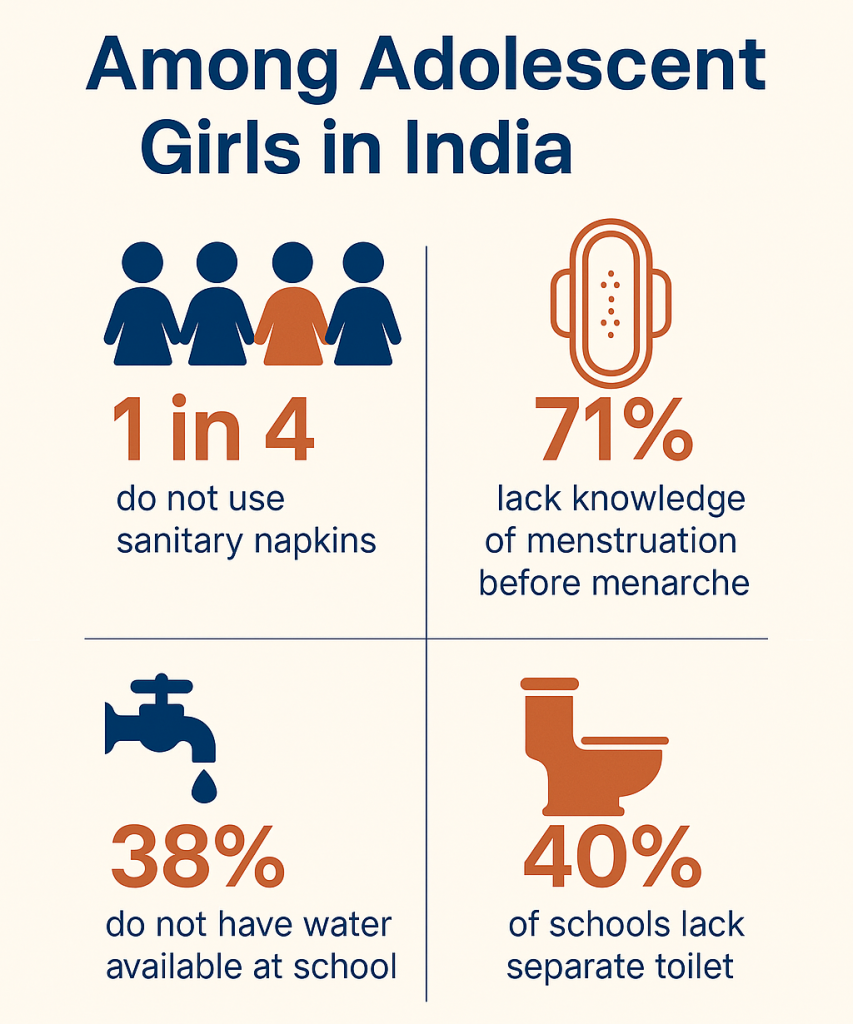
By partnering with Smile Foundation, corporates can directly contribute to the transformative education of underserved children through its flagship initiative,”Shiksha Na Ruke.” This programme, aligned with the United Nations Sustainable Development Goals (SDGs) and India’s National Education Policy (NEP) 2020, provides holistic learning experiences at Mission Education centres. These centres deliver academic instruction alongside comprehensive developmental support, fostering the overall growth of children.

Corporate participation in the marathon not only showcases social responsibility but also creates a lasting impact. Supporting Smile Foundation’s lifecycle approach ensures continuous educational support from early childhood through adolescence, empowering children to build solid foundations for future success and uplifting entire communities.
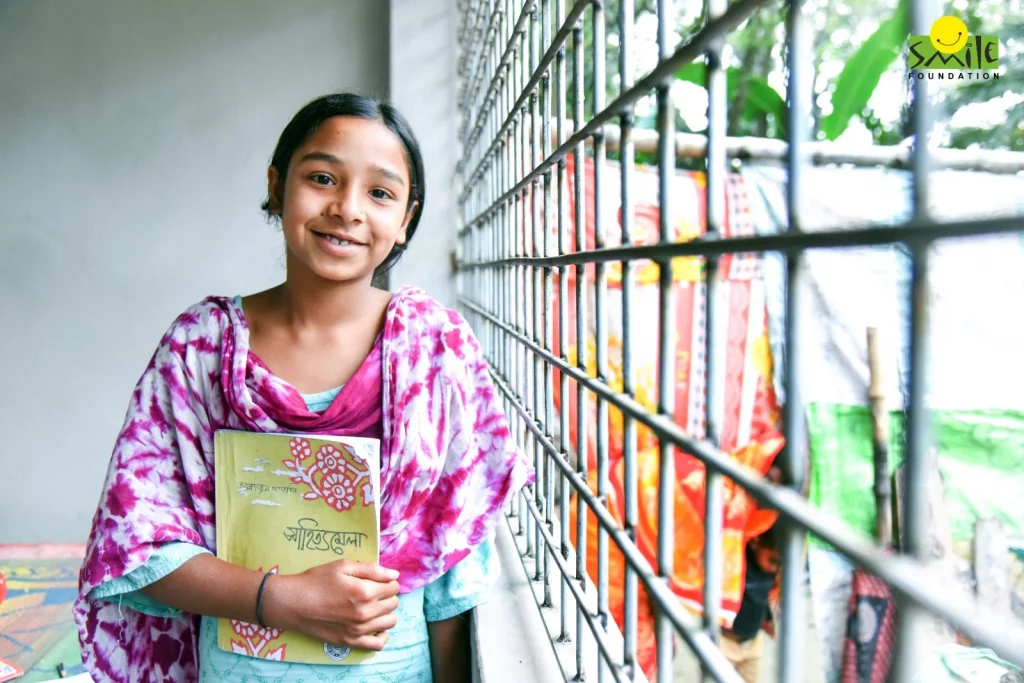
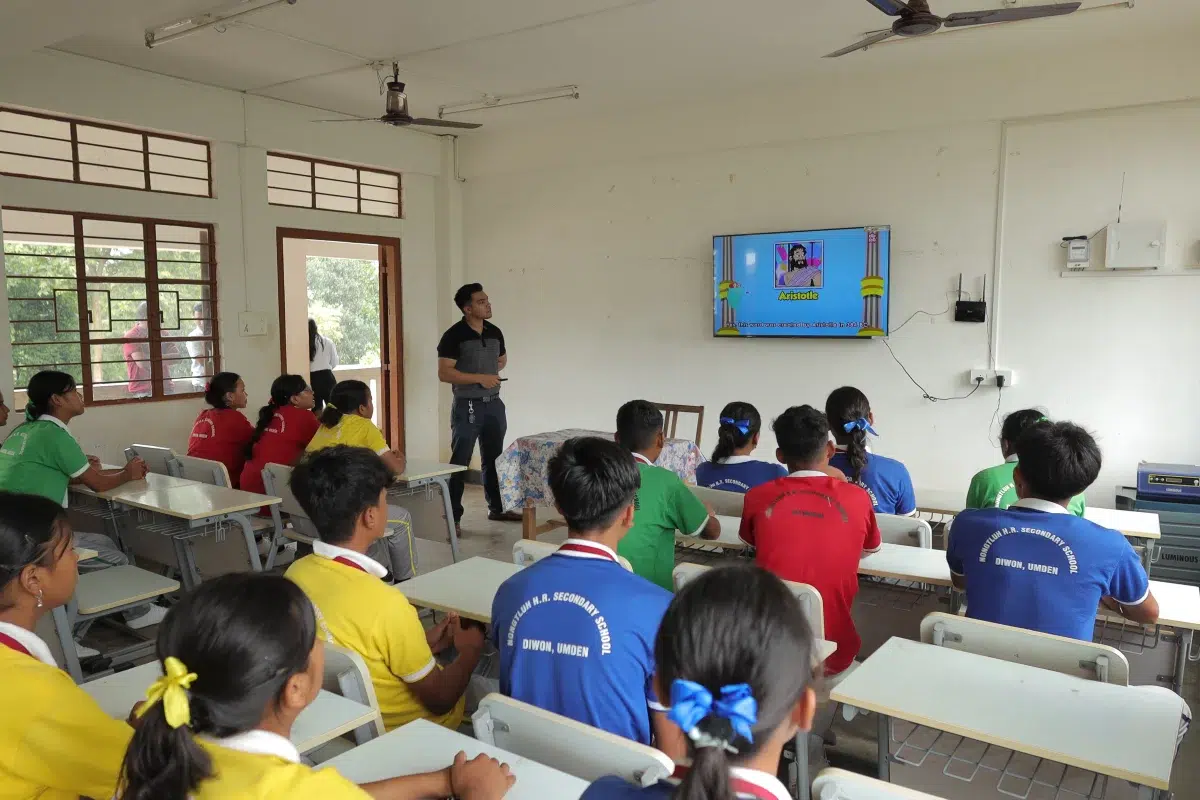
Running with Smile Foundation at the TCS World 10K Bengaluru Marathon transforms corporate efforts into meaningful change, demonstrating a commitment to fostering educational equity. If your corporate organisation also wishes to make a positive difference then run with Smile Foundation to support underserved children and turn every stride into a step towards a brighter future.

For more information contact- Prasoon Srivastava – prasoon@smilefoundation.email 

Kumari Surbhikumari.surbhi@smilefoundation.email

0%