

Summary
- Menstrual health goes beyond menstrual hygiene—it is a public health priority.
- Menstrual health in India requires more than products; it requires systems.
- 77.3% use hygienic menstrual methods, yet access remains unequal across India.
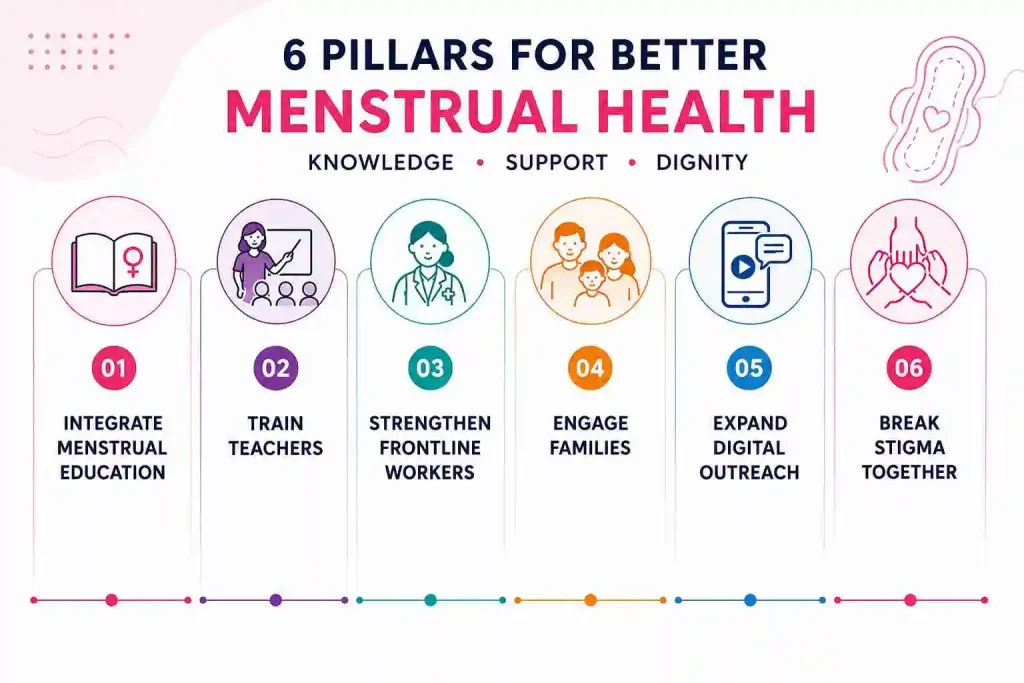
- Six pillars create the foundation for sustainable menstrual health.
- Strong CSR–NGO partnerships can transform last-mile women’s healthcare.
- Frontline workers are the backbone of menstrual health ecosystems.
- Awareness, WASH and healthcare together drive lasting menstrual health outcomes.
- Community-led solutions create sustainable impact for women’s health in India
India’s approach to menstrual health has evolved significantly over the past decade. What began as a focus on menstrual hygiene has expanded into a broader agenda encompassing public health, gender equality, education and women’s rights. Today, improving women’s health in India means creating an enabling ecosystem that combines awareness, healthcare, sanitation, dignity and community participation.
A major milestone was the introduction of the Menstrual Hygiene Management (MHM) Guidelines under the Swachh Bharat Mission (Gramin).
These guidelines moved the conversation beyond sanitary products to include
- Safe water
- Functional toilets
- Menstrual waste management
- Privacy
- Behaviour changes communication
The National Health Mission’s Menstrual Hygiene Scheme further strengthened this vision by empowering ASHAs to distribute affordable sanitary napkins while promoting menstrual awareness among rural adolescent girls.
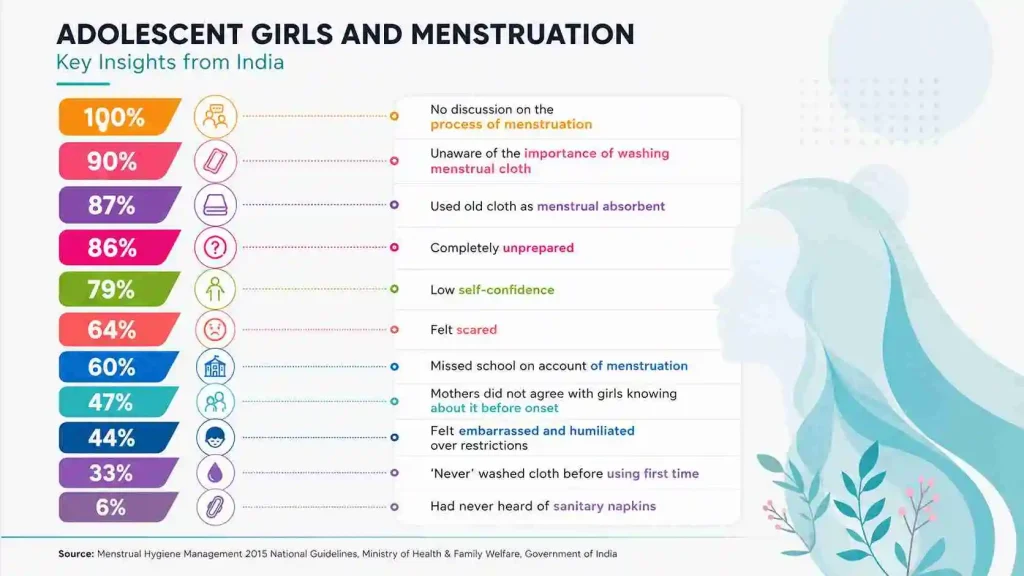
In contemporary times, the National Family Health Survey (NFHS-5) reports that 77.3% of women aged 15–24 years now use hygienic menstrual methods.
However, this progress is uneven.
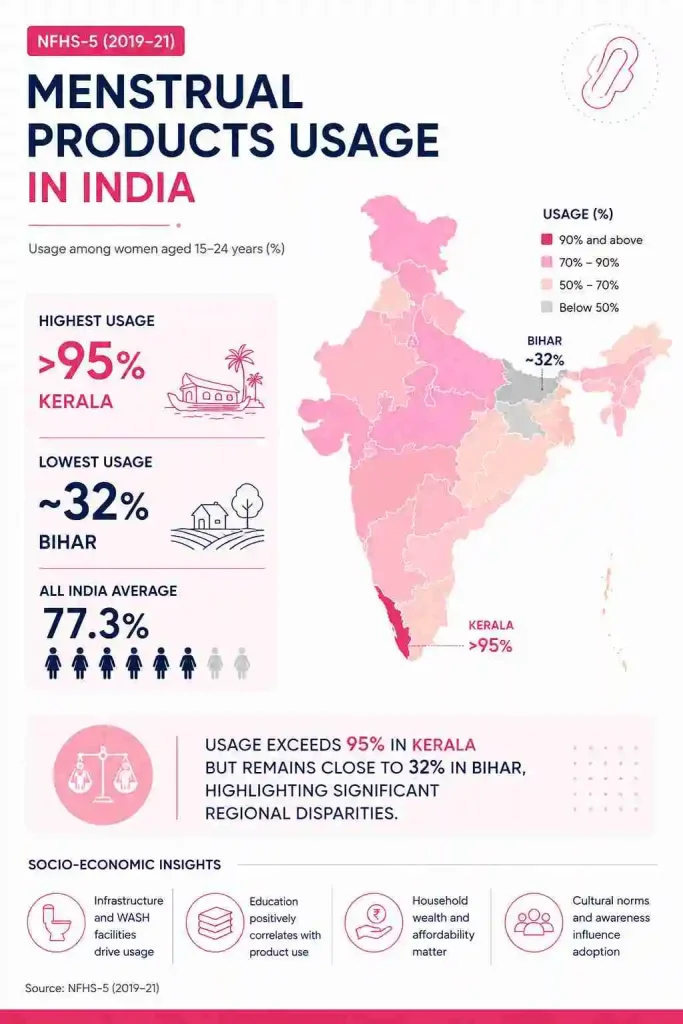
These numbers reveal an important truth: menstrual health cannot be solved through a single intervention. It requires multiple systems working together.
Experts increasingly recognise six interconnected pillars that collectively create an enabling ecosystem where every woman and girl can manage menstruation safely, confidently and with dignity.
These pillars also present an opportunity for governments, businesses, civil society and communities to create sustainable impact through collaborative action.
Pillar One: Knowledge and Menstrual Literacy Begins Before
Every confident menstrual journey begins with knowledge.
Yet for millions of girls, menstruation arrives before information does. Fear, embarrassment and misinformation continue to shape first experiences because conversations around periods remain confined within households or avoided altogether.
Early menstrual education helps girls understand their bodies, practise safe hygiene and seek healthcare when needed. WHO also recognises menstrual literacy as a foundational component of menstrual health.
Achieving this pillar requires collaboration beyond schools.
By investing in csr for menstrual health, a guided menstrual literacy can be generated for long-term behavioural change that extends beyond individual beneficiaries into families and communities.
Pillar Two: Access to Safe Menstrual Products Must Mean Access to Choice
Products are important—but products alone are not enough.
Although over three-quarters of young women now use hygienic menstrual methods nationally, access remains strongly influenced by geography, income and social inequality. Research published in Health Policy and Planning shows that women from poorer households and rural communities continue to experience lower access to hygienic menstrual products.
Women also have different needs. Some prefer disposable sanitary pads, while others may choose reusable cloth pads or menstrual cups depending on affordability, convenience and cultural acceptance.
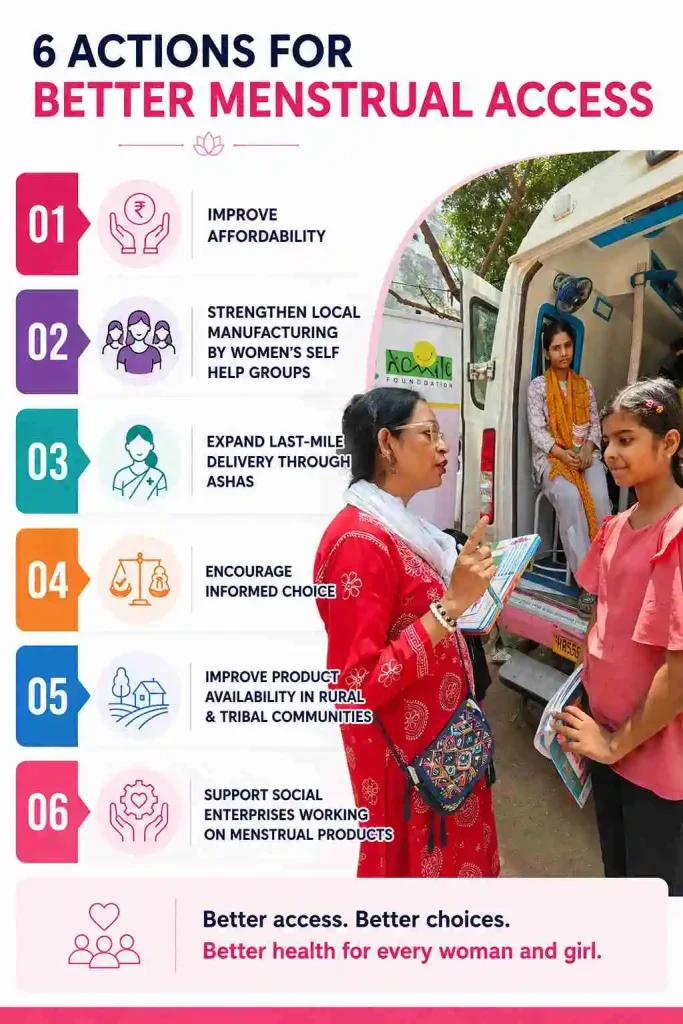
Collaborative partnerships between corporates, NGOs and local women’s collectives can strengthen sustainable supply chains while generating livelihoods for rural women.
Pillar Three: Water, Sanitation and Hygiene Infrastructure Enables Dignity
A sanitary pad cannot compensate for the absence of a clean toilet.
The Swachh Bharat Mission Menstrual Hygiene Management Guidelines emphasise that effective menstrual hygiene requires clean water, private toilets, soap, changing facilities and safe disposal systems.
Without this infrastructure, girls continue missing school, women struggle in workplaces and menstrual waste becomes an environmental challenge.

Infrastructure investments become significantly more effective when combined with community awareness and maintenance systems.
Pillar Four: Responsive Healthcare Makes Menstrual Health a Public Health Priority
Menstruation is more than a hygiene issue—it is a healthcare issue.
Many women continue living with untreated menstrual disorders, severe pain or anaemia because they lack access to healthcare services or do not recognise symptoms that require medical attention.
WHO recommends integrating menstrual health into reproductive healthcare through preventive, promotive and curative services.
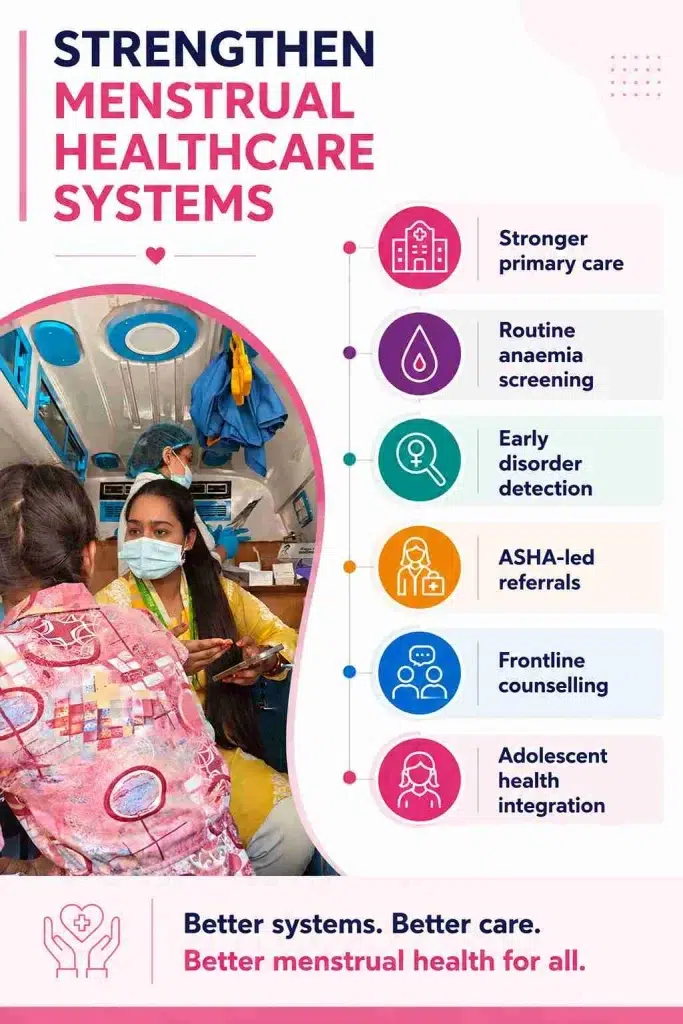
Healthcare systems become stronger when menstrual health is recognised as a routine part of women’s health rather than a separate issue.
Pillar Five: Dignity, Inclusion and Social Acceptance Matter as Much as Infrastructure
Even where products and toilets exist, stigma often remains.
Many girls continue facing restrictions at home, in schools and workplaces simply because menstruation is surrounded by silence and myths.
WHO identifies freedom from stigma and discrimination as an essential component of menstrual health.
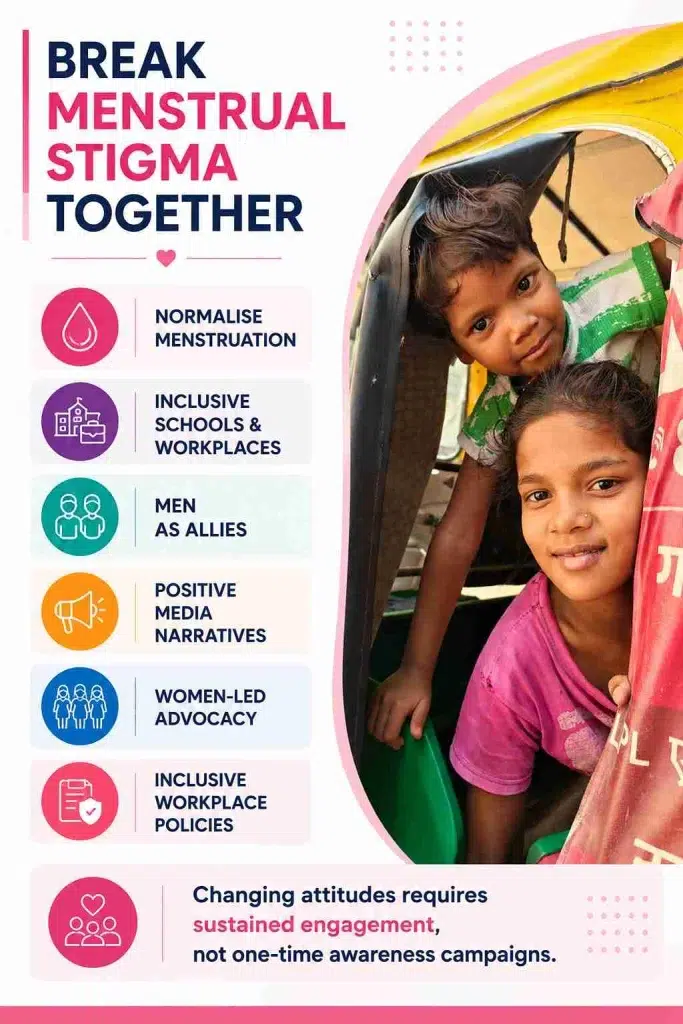
Pillar Six: Partnerships for Women’s Health Create Lasting Impact
No single organisation can transform menstrual health in India alone.
The greatest opportunity lies in building csr-ngo partnerships for women’s health that combine government systems, corporate CSR, healthcare providers and community institutions.
The National Health Mission’s Menstrual Hygiene Scheme already demonstrates how ASHAs serve as trusted last-mile workers distributing sanitary products and creating awareness. However, greater impact is possible when they are supported by Anganwadi Workers, Self Help Groups, Panchayats, Women’s Collectives and Civil Society Organisations.
Together, all the stakeholders strengthen health education, improve service delivery, promote behavioural change and ensure that interventions reach women beyond schools and urban centres.
For businesses, this systems approach offers an opportunity to move beyond transactional CSR towards long-term community development. Investing in community institutions rather than isolated activities creates measurable outcomes across health, education, gender equality and livelihoods.
Ultimately, the future of menstrual health in India will not be defined by the number of sanitary pads distributed. It will be measured by whether every woman and girl can experience menstruation with knowledge, dignity, safety, good health and equal opportunity.
Building the Future of Menstrual Health With Smile
India’s journey from menstrual hygiene to comprehensive menstrual health makes one thing clear—lasting change cannot be achieved through isolated interventions. It requires a systematic approach where all six pillars work in tandem, supported by strong, community-led partnerships.
- When menstrual health improves —> girls stay in school.
- When access to products expands—> women gain agency.
- When WASH infrastructure strengthens—> dignity becomes non-negotiable.
- When healthcare systems respond effectively—> menstrual health becomes a public health priority.
- When stigma reduces—> entire communities move towards inclusion and equality.
And at the centre of this transformation are frontline workers, community institutions and local ecosystems that ensure solutions reach the last mile. Strengthening these systems is where meaningful, scalable impact lies.
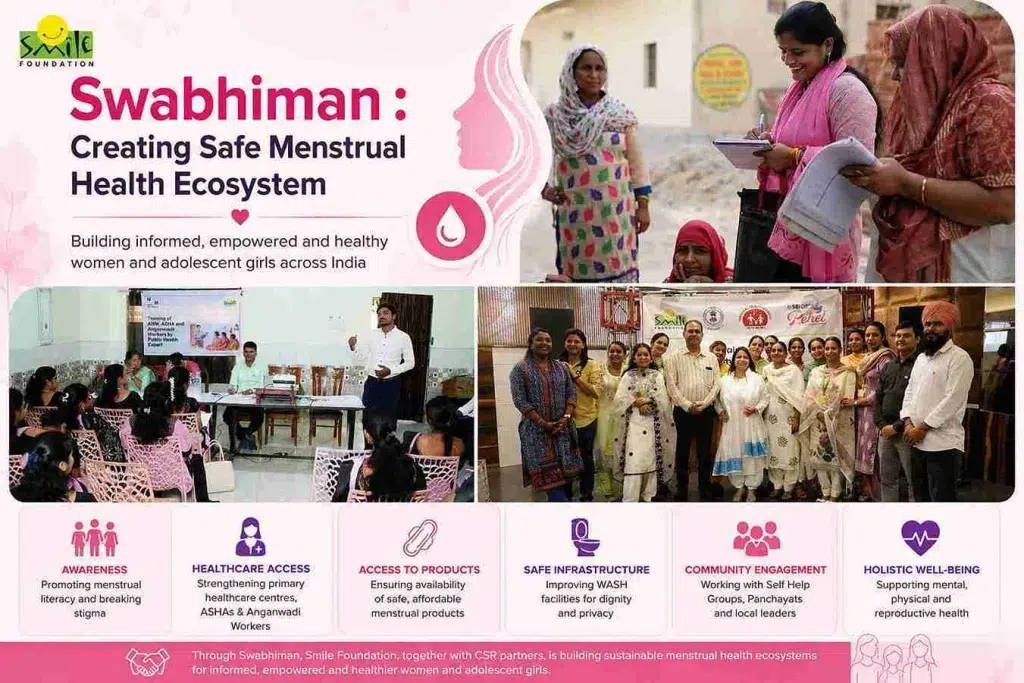
At Smile Foundation, we work at the intersection of health, education and community development—strengthening grassroots systems through partnerships with ASHAs, Anganwadi Workers, Self Help Groups, Panchayats and local organisations.
Through its Swabhiman programme, Smile Foundation is strengthening women’s health in India by supporting primary healthcare systems and working alongside Primary Health Centres (PHCs), Anganwadi Workers and ASHAs to build sustainable menstrual health ecosystems. Moving beyond product distribution, the intervention integrates menstrual health awareness, preventive healthcare, WASH infrastructure and community mobilisation to improve long-term health outcomes for women and adolescent girls.
By partnering with Smile Foundation, CSR partners can co-create scalable, evidence-led interventions that strengthen last-mile healthcare delivery, empower frontline workers and expand equitable access to menstrual health services. Together, we can build resilient communities, advance women’s health and create measurable, sustainable social impact through strategic CSR partnerships.
Sources
- Menstrual Hygiene Management, National Guidelines
- Menstrual hygiene practices among adolescent women in rural India: a cross-sectional study
- National Family Health Survey NFHS-6
- From Schools to Communities: A Critical Review of India’s Menstrual Health Policies
FAQs
1. Why is menstrual health important in India?
Improving menstrual health in India enhances education, women’s health, gender equality and community well-being.
2. What are the six pillars of menstrual health?
Menstrual literacy, safe products, WASH, healthcare, dignity and community partnerships form the six pillars of menstrual health.
3. How can CSR improve menstrual health?
CSR–NGO partnerships strengthen awareness, healthcare, WASH infrastructure and last-mile access to menstrual health services.
4. How do CSR–NGO partnerships strengthen women’s health in India?
By supporting community health systems, frontline workers and sustainable menstrual health programmes.
5. How is Smile Foundation improving menstrual health in India?
Through Swabhiman, Smile Foundation integrates awareness, healthcare, WASH and community partnerships to strengthen women’s health in India.
