Categories
CSR Smile

6 Pillars of Menstrual Health Ecosystem

IN THIS ESSAY

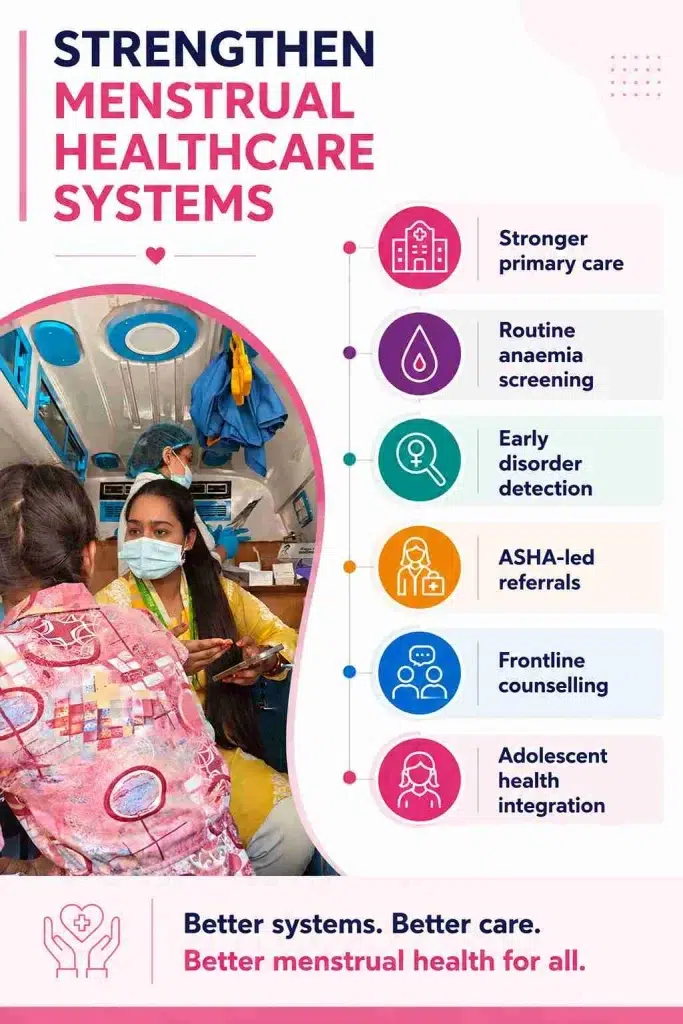
  • Menstrual health goes beyond menstrual hygiene—it is a public health priority.
  • Menstrual health in India requires more than products; it requires systems.
  • 77.3% use hygienic menstrual methods, yet access remains unequal across India.
  • Six pillars create the foundation for sustainable menstrual health.
  • Strong CSR–NGO partnerships can transform last-mile women’s healthcare.
  • Frontline workers are the backbone of menstrual health ecosystems.
  • Awareness, WASH and healthcare together drive lasting menstrual health outcomes.
  • Community-led solutions create sustainable impact for women’s health in India

India’s approach to menstrual health has evolved significantly over the past decade. What began as a focus on menstrual hygiene has expanded into a broader agenda encompassing public health, gender equality, education and women’s rights. Today, improving women’s health in India means creating an enabling ecosystem that combines awareness, healthcare, sanitation, dignity and community participation.

A major milestone was the introduction of the Menstrual Hygiene Management (MHM) Guidelines under the Swachh Bharat Mission (Gramin). 

These guidelines moved the conversation beyond sanitary products to include

  • Safe water
  • Functional toilets
  • Menstrual waste management
  • Privacy 
  • Behaviour changes communication

The National Health Mission’s Menstrual Hygiene Scheme further strengthened this vision by empowering ASHAs to distribute affordable sanitary napkins while promoting menstrual awareness among rural adolescent girls.

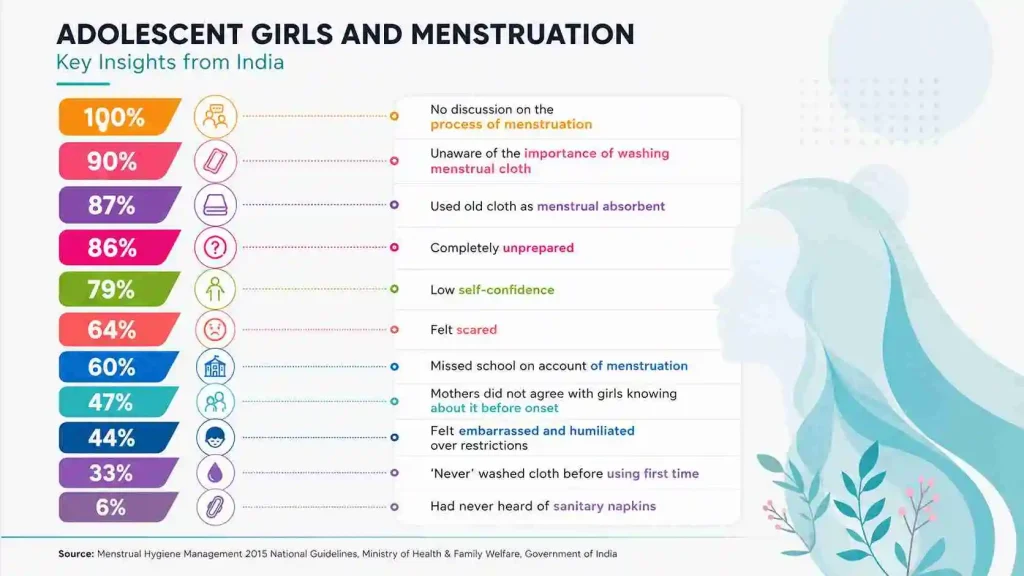
menstrual health and adolescent girls

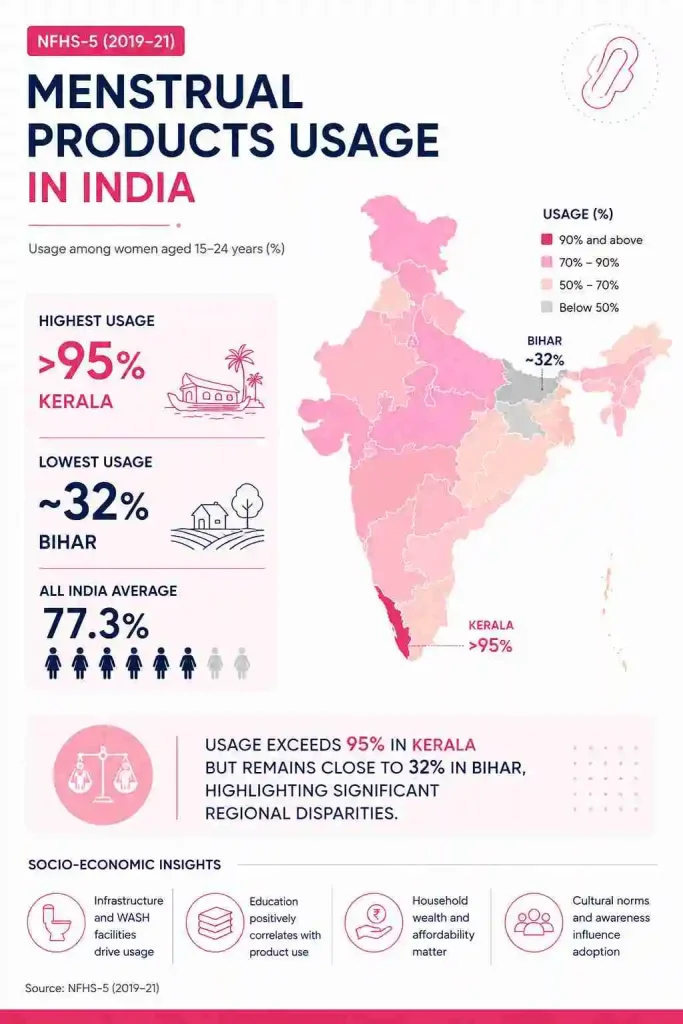
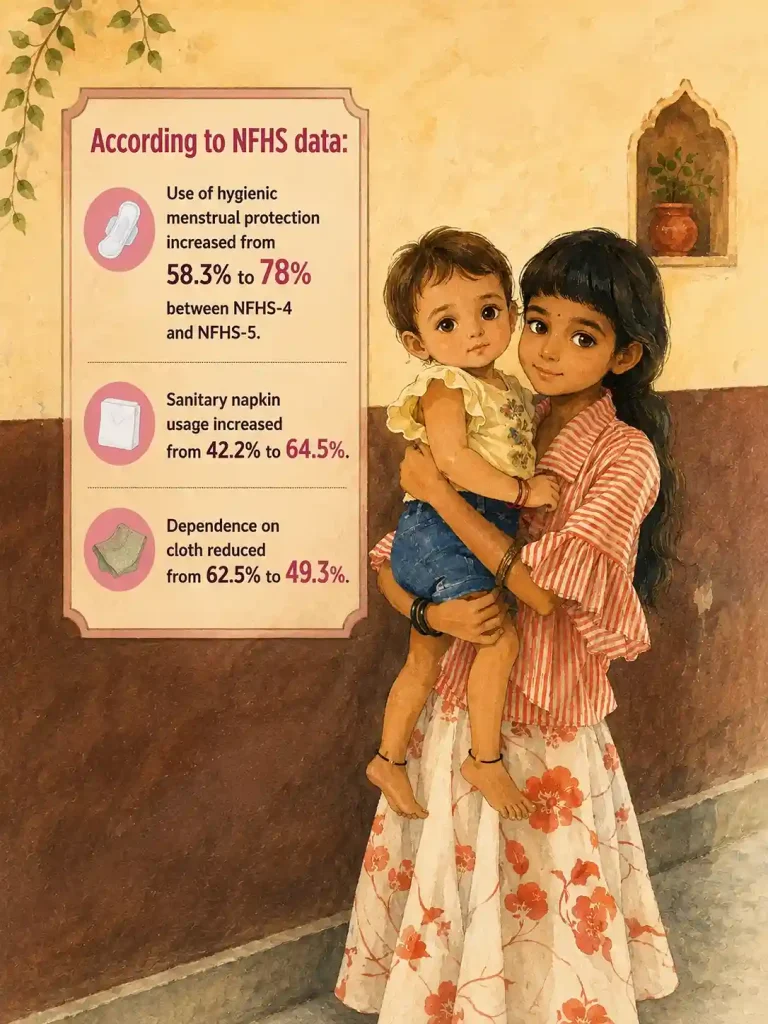
In contemporary times, the National Family Health Survey (NFHS-5) reports that 77.3% of women aged 15–24 years now use hygienic menstrual methods. 

However, this progress is uneven. 

menstrual health in india

These numbers reveal an important truth: menstrual health cannot be solved through a single intervention. It requires multiple systems working together.

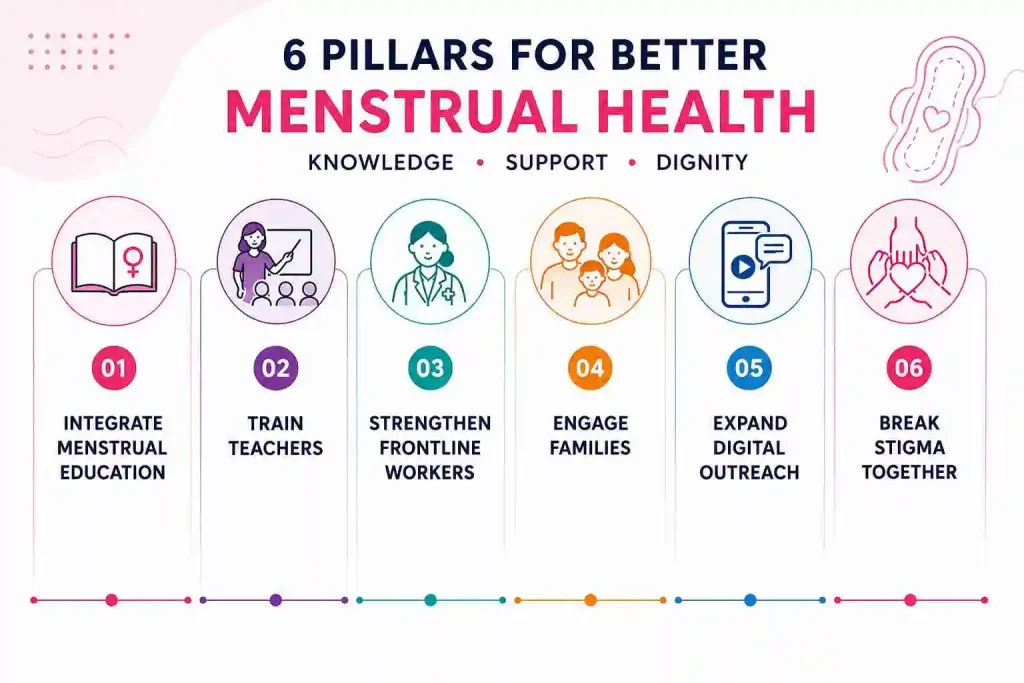
Experts increasingly recognise six interconnected pillars that collectively create an enabling ecosystem where every woman and girl can manage menstruation safely, confidently and with dignity.

 These pillars also present an opportunity for governments, businesses, civil society and communities to create sustainable impact through collaborative action.

Pillar One: Knowledge and Menstrual Literacy Begins Before

Every confident menstrual journey begins with knowledge.

Yet for millions of girls, menstruation arrives before information does. Fear, embarrassment and misinformation continue to shape first experiences because conversations around periods remain confined within households or avoided altogether.

Early menstrual education helps girls understand their bodies, practise safe hygiene and seek healthcare when needed. WHO also recognises menstrual literacy as a foundational component of menstrual health.

Achieving this pillar requires collaboration beyond schools.

6 pillars of menstrual health

By investing in csr for menstrual health,  a guided menstrual literacy can be generated for long-term behavioural change that extends beyond individual beneficiaries into families and communities.

Pillar Two: Access to Safe Menstrual Products Must Mean Access to Choice

Products are important—but products alone are not enough.

Although over three-quarters of young women now use hygienic menstrual methods nationally, access remains strongly influenced by geography, income and social inequality. Research published in Health Policy and Planning shows that women from poorer households and rural communities continue to experience lower access to hygienic menstrual products.

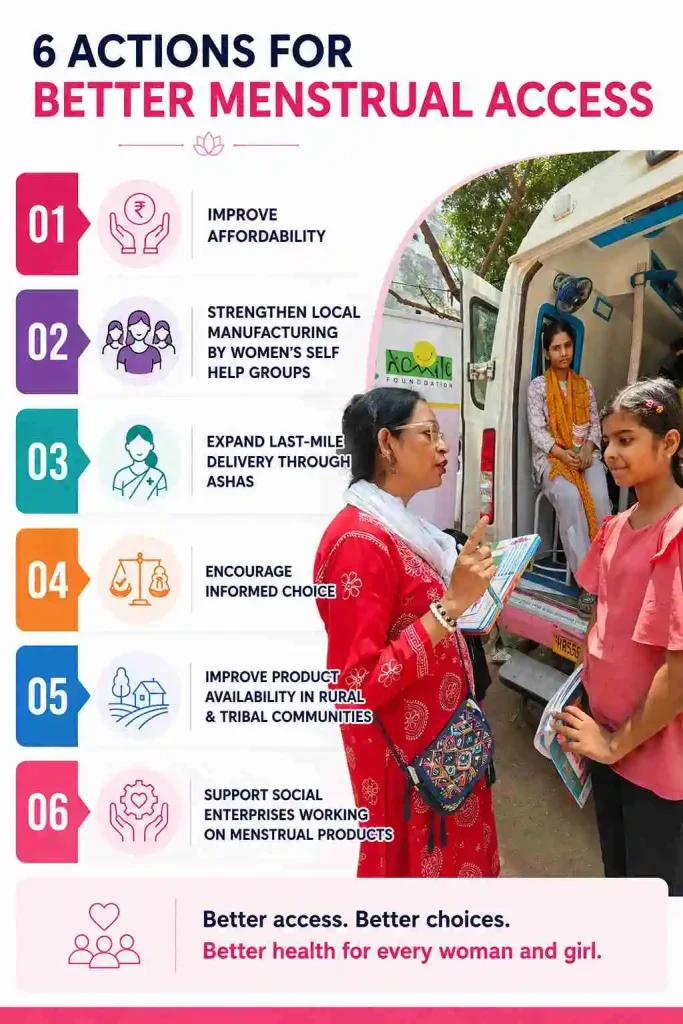
Women also have different needs. Some prefer disposable sanitary pads, while others may choose reusable cloth pads or menstrual cups depending on affordability, convenience and cultural acceptance.

menstrual hygiene in india 4

Collaborative partnerships between corporates, NGOs and local women’s collectives can strengthen sustainable supply chains while generating livelihoods for rural women.

Pillar Three: Water, Sanitation and Hygiene Infrastructure Enables Dignity

A sanitary pad cannot compensate for the absence of a clean toilet.

The Swachh Bharat Mission Menstrual Hygiene Management Guidelines emphasise that effective menstrual hygiene requires clean water, private toilets, soap, changing facilities and safe disposal systems.

Without this infrastructure, girls continue missing school, women struggle in workplaces and menstrual waste becomes an environmental challenge.

menstrual dignity for women in india

Infrastructure investments become significantly more effective when combined with community awareness and maintenance systems.

Pillar Four: Responsive Healthcare Makes Menstrual Health a Public Health Priority

Menstruation is more than a hygiene issue—it is a healthcare issue.

Many women continue living with untreated menstrual disorders, severe pain or anaemia because they lack access to healthcare services or do not recognise symptoms that require medical attention.

WHO recommends integrating menstrual health into reproductive healthcare through preventive, promotive and curative services.

save girl child menstrual health

Healthcare systems become stronger when menstrual health is recognised as a routine part of women’s health rather than a separate issue.

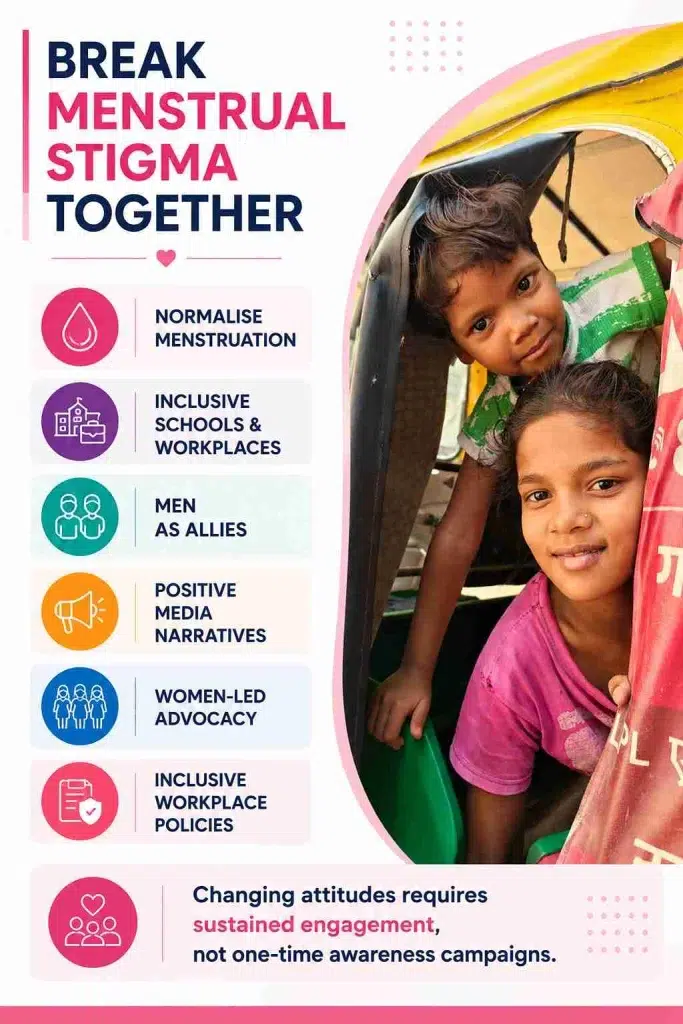
Pillar Five: Dignity, Inclusion and Social Acceptance Matter as Much as Infrastructure

Even where products and toilets exist, stigma often remains.

Many girls continue facing restrictions at home, in schools and workplaces simply because menstruation is surrounded by silence and myths.

WHO identifies freedom from stigma and discrimination as an essential component of menstrual health.

Pillar Six: Partnerships for Women’s Health Create Lasting Impact

No single organisation can transform menstrual health in India alone.

The greatest opportunity lies in building csr-ngo partnerships for women’s health that combine government systems, corporate CSR, healthcare providers and community institutions.

The National Health Mission’s Menstrual Hygiene Scheme already demonstrates how ASHAs serve as trusted last-mile workers distributing sanitary products and creating awareness. However, greater impact is possible when they are supported by Anganwadi Workers, Self Help Groups, Panchayats, Women’s Collectives and Civil Society Organisations.

Together, all the stakeholders strengthen health education, improve service delivery, promote behavioural change and ensure that interventions reach women beyond schools and urban centres.

For businesses, this systems approach offers an opportunity to move beyond transactional CSR towards long-term community development. Investing in community institutions rather than isolated activities creates measurable outcomes across health, education, gender equality and livelihoods.

Ultimately, the future of menstrual health in India will not be defined by the number of sanitary pads distributed. It will be measured by whether every woman and girl can experience menstruation with knowledge, dignity, safety, good health and equal opportunity. 

Building the Future of Menstrual Health With Smile

India’s journey from menstrual hygiene to comprehensive menstrual health makes one thing clear—lasting change cannot be achieved through isolated interventions. It requires a systematic approach where all six pillars work in tandem, supported by strong, community-led partnerships.

  • When menstrual health improves —> girls stay in school.
  • When access to products expands—> women gain agency. 
  • When WASH infrastructure strengthens—> dignity becomes non-negotiable. 
  • When healthcare systems respond effectively—> menstrual health becomes a public health priority. 
  • When stigma reduces—> entire communities move towards inclusion and equality.

And at the centre of this transformation are frontline workers, community institutions and local ecosystems that ensure solutions reach the last mile. Strengthening these systems is where meaningful, scalable impact lies.

At Smile Foundation, we work at the intersection of health, education and community development—strengthening grassroots systems through partnerships with ASHAs, Anganwadi Workers, Self Help Groups, Panchayats and local organisations.

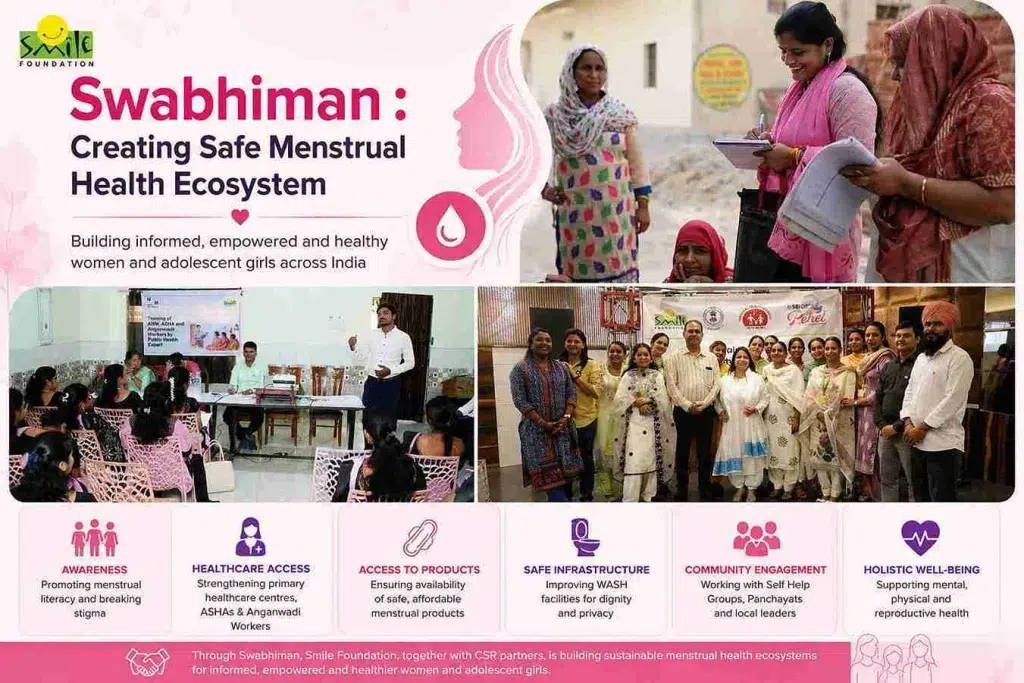
Through its Swabhiman programme, Smile Foundation is strengthening women’s health in India by supporting primary healthcare systems and working alongside Primary Health Centres (PHCs), Anganwadi Workers and ASHAs to build sustainable menstrual health ecosystems. Moving beyond product distribution, the intervention integrates menstrual health awareness, preventive healthcare, WASH infrastructure and community mobilisation to improve long-term health outcomes for women and adolescent girls.

By partnering with Smile Foundation, CSR partners can co-create scalable, evidence-led interventions that strengthen last-mile healthcare delivery, empower frontline workers and expand equitable access to menstrual health services. Together, we can build resilient communities, advance women’s health and create measurable, sustainable social impact through strategic CSR partnerships.

Sources

FAQs

1. Why is menstrual health important in India?

Improving menstrual health in India enhances education, women’s health, gender equality and community well-being.

2. What are the six pillars of menstrual health?

Menstrual literacy, safe products, WASH, healthcare, dignity and community partnerships form the six pillars of menstrual health.

3. How can CSR improve menstrual health?

CSR–NGO partnerships strengthen awareness, healthcare, WASH infrastructure and last-mile access to menstrual health services.

4. How do CSR–NGO partnerships strengthen women’s health in India?

By supporting community health systems, frontline workers and sustainable menstrual health programmes.

5. How is Smile Foundation improving menstrual health in India?

Through Swabhiman, Smile Foundation integrates awareness, healthcare, WASH and community partnerships to strengthen women’s health in India.

Categories
Insights Smile

Child Development Begins with Empathy in Education

IN THIS ESSAY:

  • Empathy is a foundational life skill that shapes child development, emotional intelligence and responsible citizenship beyond academic success.
  • Children learn empathy through observation and experience, making classrooms, families and communities equally important learning environments.
  • Empathy in education challenges stereotypes, promotes gender equality, inclusion and respect for diverse perspectives from an early age.
  • Compassion extends beyond people to animals, nature and communities, nurturing socially responsible and environmentally conscious children.
  • Smile Foundation’s Child for Child programme transforms empathy into action by encouraging collaborative learning, community engagement and child-led change.

“Education is not only about preparing children for examinations. It is about preparing them for humanity.”

child development 1

Empathy often begins with observation. Children notice differences long before they understand them.

A young boy leans over the railing of a metro station, quietly watching another child balancing on a tightrope across a busy road. They appear to be the same age, yet they inhabit two very different worlds. One is enjoying his summer vacation outing with his family; the other is performing to earn a living.

Neither child says a word.

Yet, in that silent moment, a powerful question begins to take shape:

“What would life feel like if I were him?”

That simple act of wondering marks the beginning of empathy.

Long before children learn mathematics, science or grammar, they begin learning how to understand people. They observe expressions, notice differences, recognise emotions and slowly make sense of the world around them. These early experiences are fundamental to child development, shaping how children respond to inequality, kindness, inclusion and fairness throughout their lives.

Child Development Begins Beyond the Classroom

Empathy is often mistaken for kindness alone. In reality, it is a developmental life skill that grows through everyday experiences. Conversations with friends, collaborative play, storytelling, observing emotions and reflecting on different perspectives all contribute to healthy child development.

Children are not born understanding another person’s experiences. They develop this ability gradually through interactions with parents, teachers and peers. Every classroom discussion, playground disagreement and shared activity becomes an opportunity to strengthen empathy in education.

emapthy in education 1

These qualities extend far beyond classroom relationships. They prepare children to become responsible citizens, collaborative leaders and compassionate members of society. 

Children Learn More by Watching Than by Being Told 

Children are extraordinary observers.

They notice who is left out during playtime.

They notice who receives help.

They also notice who cleans the classroom, who drives the school bus, who struggles to keep up and who is celebrated.

Every observation becomes an invisible lesson.

Without guidance, these moments may reinforce assumptions. With thoughtful conversations, however, they become opportunities for reflection.

Instead of simply teaching children what is right, schools can encourage them to ask deeper questions.

“How do you think your friend felt?”

What would you do if you were in that situation?”

These conversations help children move beyond judgement towards understanding. Empathy is rarely taught through instruction alone; it develops through experience, reflection and meaningful relationships.

Empathy in Education Builds Equality 

gender equality

It was an ordinary metro commute day for two sons with their father, until something extraordinary caught the little boy’s attention.

Walking alongside them was a woman in a metro station uniform, confidently coordinating the platform. Every few moments, the static buzz of her walkie-talkie came alive as she guided passengers, responded to updates and kept the station running smoothly.

Though his father gently hurried him towards the arriving train, the little boy could not take his eyes off her. With every message that crackled through the walkie-talkie, his curiosity grew and his admiration deepened.

His thoughts that day were never, “Girls cannot do this.”

Instead, his eyes sparked with aspiration- “When I grow up, I want to hold a walkie talkie too”

In that moment he saw confidence. He saw leadership. He saw someone solving problems and helping hundreds of people every day.

“Children rarely begin with stereotypes; they begin with observation”. 

They watch the world with curiosity, absorbing what they see long before they understand the labels society assigns. Every such moment becomes an opportunity to shape their perspective—not through instruction, but through experience.

When children are encouraged to see people for their abilities rather than their gender, empathy becomes the foundation for equality. They learn that leadership is not defined by who someone is, but by what they are capable of doing.

Biases are rarely innate; they are learned through repeated social messaging.

Compassion Rarely Stops with People

Children often discover empathy long before they can define it.

A game shared on the playground teaches cooperation.

Resolving a disagreement teaches patience.

Flying a kite together teaches trust.

Play remains one of the most effective environments for child development, encouraging children to understand different personalities, communicate respectfully and celebrate one another’s successes.

These seemingly ordinary experiences quietly build emotional intelligence and social confidence.

As children learn to work together, they become comfortable with classmates from different cultures, languages and backgrounds. Inclusion becomes a habit rather than a policy.

Compassion Extends Beyond People 

empathy in education in india 1

Compassion learned in childhood often extends from people to animals and the environment.

The way a child treats an animal often reflects how they understand vulnerability.

A child who gently offers water to a thirsty stray dog is learning far more than kindness towards animals.

  • They are learning responsibility.
  • They are recognising that another living being has needs.
  • They are discovering that compassion requires action.

Research consistently suggests that children who demonstrate empathy towards animals often display stronger prosocial behaviours towards people as well, making compassion a habit that is rarely selective.

When children understand that every living being deserves dignity and care, they begin seeing the world through a broader moral lens.

Schools can nurture this understanding through activities such as nature walks, animal welfare discussions, environmental projects and community service initiatives.

These experiences encourage children to recognise that every act of kindness, however small, contributes to a more compassionate world.

The Child for Child programme by Smile Foundation builds on these very principles. It transforms schools into spaces where children become active participants in each other’s learning journeys.

empathy

This progression from understanding to action—is where schools create future changemakers.

Creating Schools Where Empathy Thrives with Smile

Empathy cannot be cultivated through a single value education lesson. It grows through consistent experiences that become part of a child’s everyday learning journey. This is where Child for Child, Smile Foundation’s flagship school engagement programme, transforms empathy in education from a concept into a lived experience.

Built on the belief that children are powerful agents of change, the programme creates opportunities for them to learn with and from one another. Through storytelling, reflective conversations, collaborative projects and experiential learning, children are encouraged to understand different realities, appreciate diverse perspectives and translate compassion into meaningful action.

Child education smile foundatio

Children learn far more from what adults consistently demonstrate than from what they occasionally say.

Every interaction becomes a lesson.

Every classroom becomes a community.

Every teacher becomes a role model.

Redefining What Success Looks Like

Schools proudly celebrate examination results, athletic achievements and university admissions.

These accomplishments deserve recognition.

Yet perhaps there are equally important questions every school should ask.

empathy in child education

These are not distractions from education.

They are its highest purpose.

In a rapidly changing world shaped by artificial intelligence, technological advancement and global interconnectedness, empathy remains one uniquely human capability that will define responsible leadership.

Children who learn to understand others today will become the doctors who treat patients with dignity, the entrepreneurs who build inclusive workplaces, the scientists who innovate responsibly, the policymakers who design equitable systems and the teachers who inspire future generations.

When schools intentionally create opportunities for children to observe, question, understand and act, they do far more than educate young minds. They help build a generation capable of seeing humanity before difference.

In the end, academic success may determine what children achieve.

Empathy will determine who they become.

SOURCES:

Frequently Asked Questions (FAQs)

1. Why is empathy important in child education?

Empathy helps children understand others’ emotions, develop positive relationships, improve communication skills and become responsible citizens. It is as essential to child development as academic learning.

2. How can schools teach empathy to children?

Schools can foster empathy through storytelling, reflective discussions, collaborative activities, community service, inclusive classrooms and experiential learning that encourages children to understand different perspectives.

3. What role does empathy play in child development?

Empathy strengthens emotional intelligence, problem-solving, teamwork and resilience. It helps children build meaningful relationships and make compassionate decisions throughout life.

4. Why should empathy be part of the school curriculum?

Empathy creates inclusive learning environments, reduces bullying, promotes respect for diversity and prepares children for responsible leadership in an interconnected world.

5. How does empathy promote equality in education?

By encouraging children to appreciate abilities rather than stereotypes, empathy helps break social and gender biases while promoting inclusion, fairness and equal opportunities.

6. What is the Child for Child programme by Smile Foundation?

Child for Child is Smile Foundation’s flagship school engagement programme that encourages children to become active changemakers through empathy, collaboration, community participation and experiential learning.

7. How can parents encourage empathy at home?

Parents can model compassionate behaviour, discuss emotions openly, encourage perspective-taking, involve children in acts of kindness and create opportunities for community engagement.

8. How does empathy prepare children for the future?

Alongside academic excellence, empathy equips children with emotional intelligence, collaboration, ethical decision-making and leadership skills needed to thrive in the future workplace and society.

Categories
CSR Girl Child Partnerships Smile

Beyond the Pad: Reimagining Menstrual Health in India

As communication professionals, we often spend our days discussing impact through reports, presentations, programme frameworks and outcome indicators. We understand the vision of our partners, the objectives of our interventions and the theories that shape programme design.

But every now and then, it becomes necessary to step away from the comfort of data and enter the communities where those numbers find their meaning.

A recent visit to Sarhol, Gurugram, offered me that opportunity.

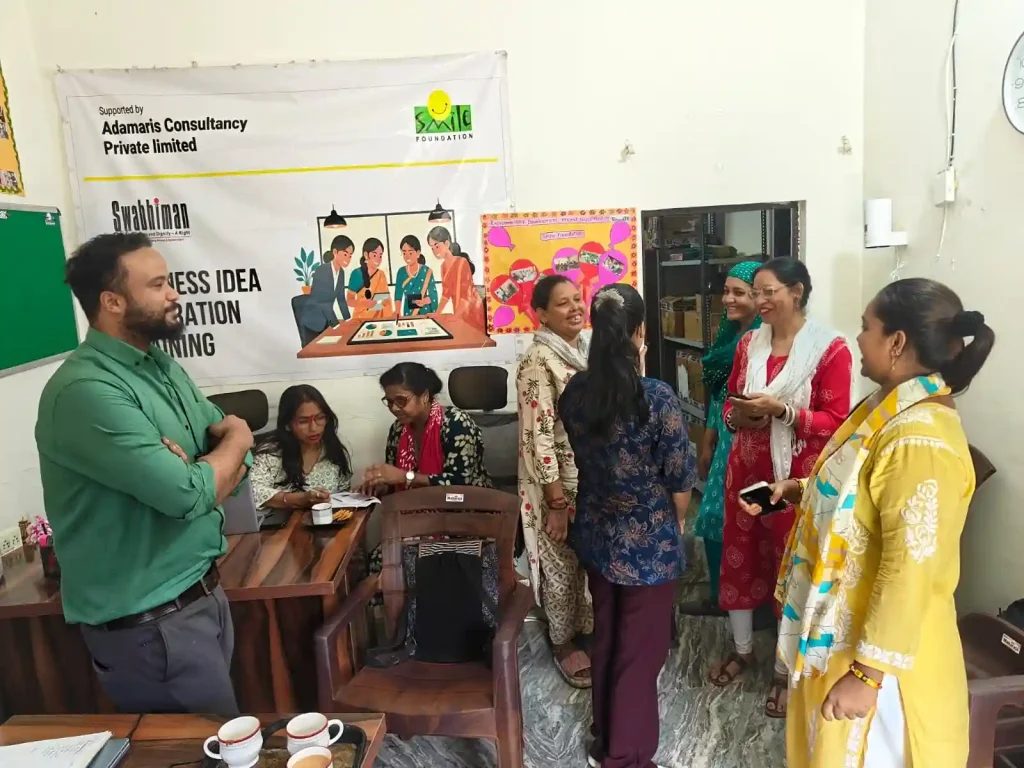
My purpose was to spend a day with the community mobilisers working with Smile Foundation’s Swabhiman programme and understand their role within the Pink Smile intervention, supported through CSR partnerships focused on improving menstrual hygiene in India.

I coordinated with Arsalan, the Community Health Officer at the Swabhiman Centre in Sarhol. By the time I arrived, the team had already begun preparing for the day ahead. The centre itself is modest, a small office tucked away on the first floor of a freshly painted building.

 Inside, however, exists something far more significant than its size suggests.

This is where community mobilisers Sonia, Farha, Savita, Manju and Dhanesh gather each morning alongside Nurse Sharmila and the whole team. Before stepping into the field, they discuss the day’s visits, review health concerns raised by women and adolescent girls, and prepare for outreach activities across the community.

A shared cup of tea, a briefing session, a list of households to visit and then the day begins.

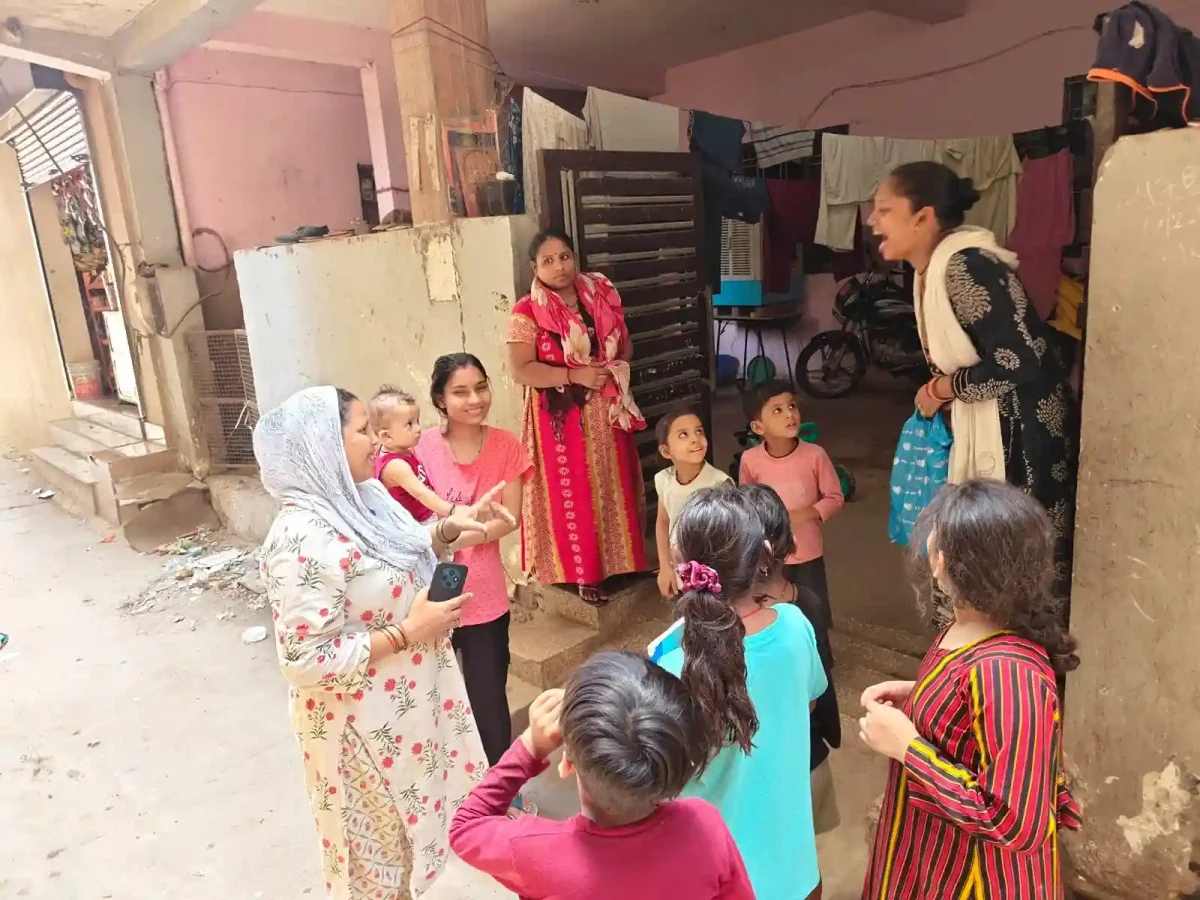
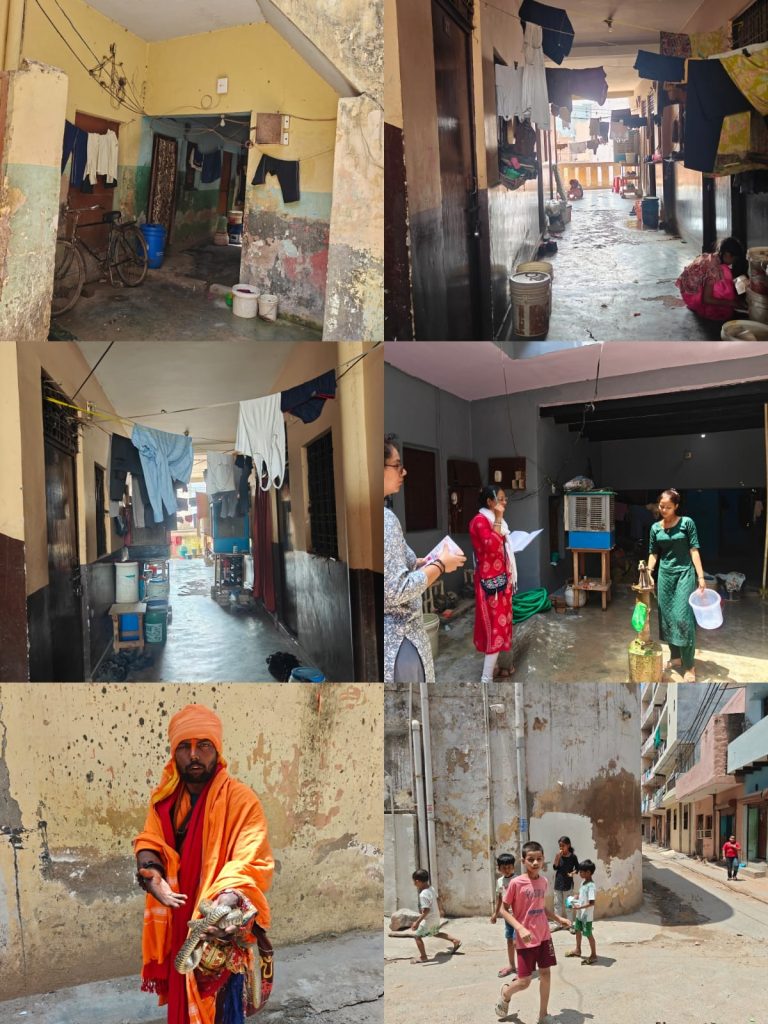
Soon, they disperse into the narrow lanes of Sarhol, carrying with them information, reassurance, guidance and often something far more powerful than any material resource: trust.

As I followed them through the community, one realisation became increasingly clear.

image
A Snaphot of Sarhol community

That after hearing the conversations around menstrual hygiene in India which unfolded in those narrow lanes of Sarhol, during the day, I knew it was impossible to write only about community mobilisers; those discussions revealed a much larger story of health, dignity and access.

The discussion around menstrual hygiene in India is wide and through this series “Beyond the Pad: Reimagining Menstrual Health in India”, we shall attempt to unravel its layers.

Writer’s reflection:  

I am a 30+ year old working woman, living in Gurugram. I am someone who is aware of her right to safe menstrual hygiene practices and has the privilege of accessing menstrual hygiene products with a simple click, sometimes within minutes.

Yet that day in Sarhol, a bustling urban slum community which is just 20 minutes from my home, I found myself confronting a very different reality.

Behind every discussion on menstrual health were multiple layers of beliefs, practices, restrictions and social norms that continue to shape the experiences of women and girls across India.

Over the years, significant efforts have rightly focused on improving access to menstrual hygiene products. This work must continue until every woman and girl in India can manage menstruation safely and hygienically. However, as we move forward in 2026, it is equally important to recognise that access alone cannot solve the challenges surrounding menstrual health.

Many of the barriers faced by the girl child in India today are rooted in:

  • stigma, 
  • misinformation, 
  • inadequate health education,
  • poor sanitation infrastructure,
  • restrictive social norms
  • limited access to supportive healthcare systems. 

These challenges continue to hinder the creation of a safe and enabling menstrual ecosystem for the girls of today and for the generations that will follow.

To truly understand menstrual health in India, we must acknowledge that 

“A sanitary pad is only one piece of a much larger puzzle” 

This realisation inspired the creation of this blog series – an exploration of the challenges, gaps, and solutions that can help strengthen menstrual health outcomes and advance menstrual dignity across India.

Because by now, the conversation must evolve.

  • Every girl should have access to menstrual hygiene products. 
  • Every girl should know how to use them safely and confidently. 

But most importantly, every girl should grow up in an environment where she does not fear, question, or feel ashamed of her body because of a natural biological process.

Through this series, we will explore:

• India’s Menstrual Health: From Access to Dignity

• The Six Dimensions of a Strong Menstrual Health Ecosystem

• Community Mobilisers: The Missing Link in Last-Mile Healthcare Delivery

• Taboos of India Around Menstrual Hygiene

Together, these conversations seek to answer an important question:

How do we move beyond menstrual access and build a future where every girl in India experiences menstruation with knowledge, confidence, safety and dignity?

And so, we begin with the first chapter of the series Beyond the Pad: Reimagining Menstrual Health in India”

Menstrual Health in India: From Access to Dignity

In this essay: 

  • Menstrual hygiene in India has progressed significantly, driven by government initiatives, NGOs, schools and CSR-supported programmes.
  • Access is only the beginning. Many adolescent girls still lack the knowledge, confidence and support needed to manage menstruation with dignity.
  • Girl child in India continue to face barriers such as stigma, misinformation, inadequate sanitation and limited healthcare access.
  • Urban-rural gaps persist, with many rural girls facing challenges related to affordability, availability, awareness and safe menstrual hygiene management.
  • Menstrual dignity requires an ecosystem approach, where education, healthcare, sanitation, community engagement and CSR partnerships work together to create lasting change.

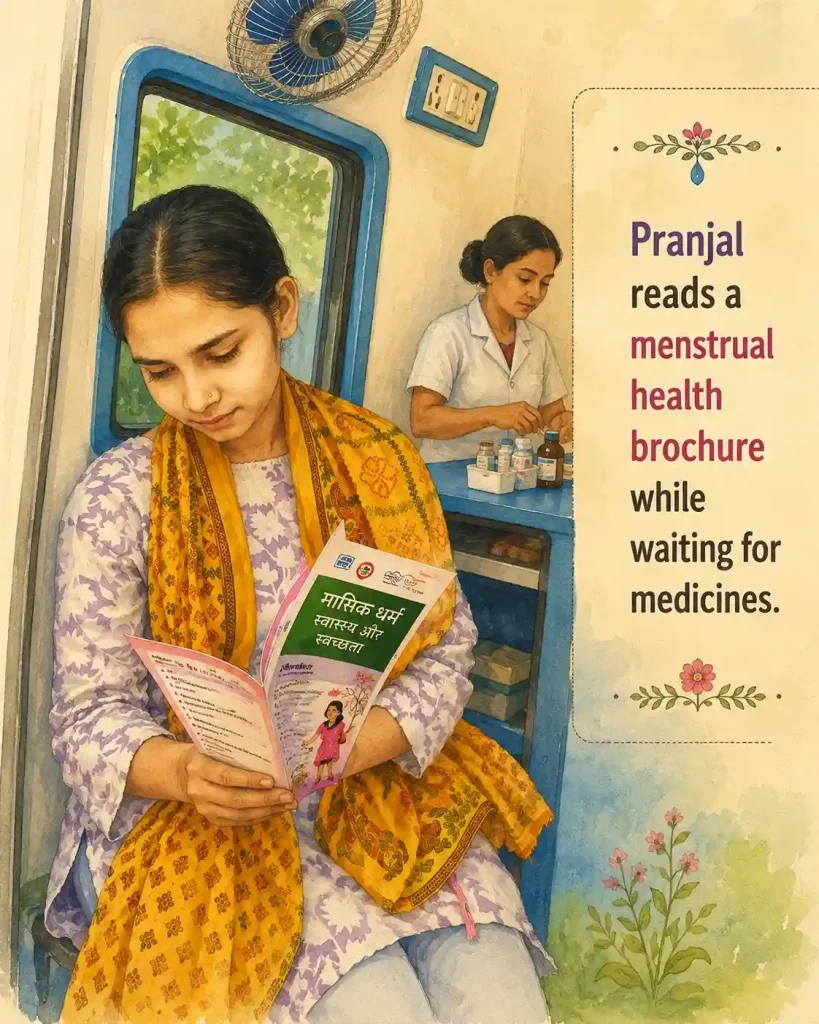
One moment she was sitting in class, and the next, she noticed a stain on her uniform. Confused and frightened, she thought something was wrong with her body. Her teacher quietly handed her a sanitary napkin and asked her to use it. The immediate problem was solved, but the questions remained unanswered.

Nobody explained why she was bleeding. Nobody told her what menstruation meant, how her body was changing or how often the sanitary napkin needed to be changed.

Later that evening, her elder sister showed her how to wear the pad.

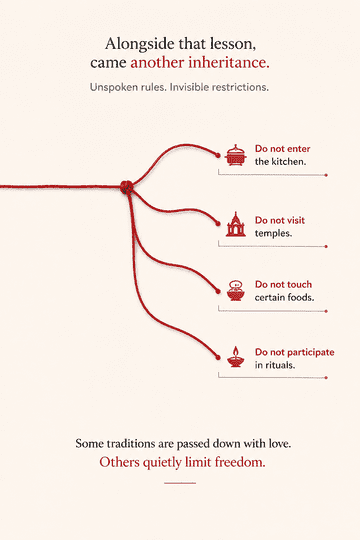
Inherited restrictions and unspoken rules

For Pranjal, menstruation arrived with access to a sanitary product, but not the dignity of understanding her own body. Her first lesson about womanhood was not about health. It was about restrictions. And for millions of girls across India, that remains the reality even today.

Menstrual Hygiene in India: Progress Worth Celebrating

India’s menstrual health journey – access to menstrual hygiene products, has undergone a remarkable transformation over the last decade.Furthermore, National surveys NHFS 5 and NHFS -6 indicate significant improvements in the adoption of hygienic menstrual practices among adolescent girls.

csr for girl child in india
2 young girls in Sarhol community, who are yet to get their periods. We must prepare menstrual ecosystems that caters to these growing girls on India

These figures reflect the collective efforts of government programmes, public health campaigns, civil society organisations, educational institutions, and CSR-supported interventions Menstruation, once confined almost entirely to private conversations, has gradually entered mainstream discussions around:

  • Public health
  • Education
  • Gender equality
  • Adolescent wellbeing
  • Water, sanitation and hygiene

And this progress certainly matters. Why?

Because-

  • Every girl who receives accurate information before periods is better prepared.
  • Every school that provides safe sanitation facilities supports attendance.
  • Every household that replaces silence with conversation contributes to dignity.

But now the question is no more about accessibility, the question is 

Can she manage menstruation safely, confidently, comfortably and with dignity?

Menstrual Health Challenge

The girl mentioned earlier, Pranjal, comes from a small town near Hardoi in Uttar Pradesh. During our conversation, an elderly relative accompanying her explained that Pranjal had travelled to Sarhol to support her elder sister through pregnancy and childbirth. Her sister is married and lives there with her husband.

What struck me most was not only Pranjal’s circumstance, but the way she described her first experience of menstruation. Her experience reflects a larger challenge that continues to persist across many parts of rural India. 

While progress has been made in improving menstrual hygiene awareness, gaps remain in the educational and social support systems that should prepare girls for menstruation before it begins. Far too many adolescent girls still enter this important stage of life with limited information, inadequate guidance and few opportunities to ask questions without fear or embarrassment.

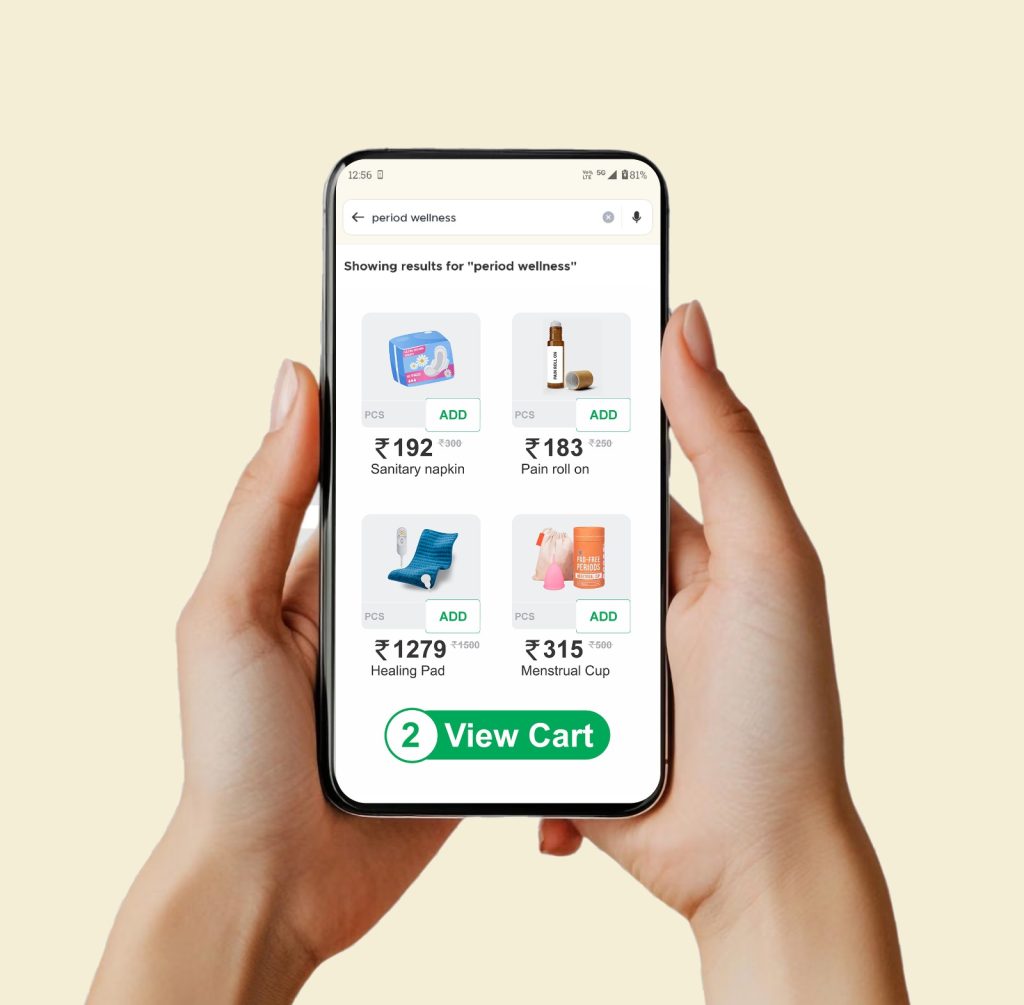
Pranjal’s story also highlights the stark contrast in menstrual product accessibility across India. As I write this, I do so with the assurance that if I were to get my period today, I could order sanitary pads or a range of menstrual hygiene products and have them delivered within minutes.

For many girls, however, particularly those living in underserved communities, menstrual hygiene products are not always available, affordable or easily accessible. 

The difference between these two realities reminds us that while India has made considerable progress in menstrual health, access remains deeply unequal, shaped by geography, awareness, income and social circumstances.

But then there are girls as age of 13, who when get their periods are lost about the multiple solutions that can keep them safe and healthy during menstruation 

Menstrual Access: Urban–Rural Usage Gap 

In urban areas, greater availability of menstrual products, higher levels of awareness, better sanitation infrastructure and increased exposure to health information have contributed to higher adoption of hygienic menstrual practices. In contrast, many rural girls continue to face barriers such as limited product availability, affordability concerns, inadequate disposal facilities and persistent social taboos surrounding menstruation.

The gap is not merely one of access but also of awareness. Many adolescent girls receive little or no menstrual education before their first period, relying on family members for information that may be influenced by myths and misconceptions. Consequently, some continue to use unhygienic materials such as old cloth, ash or rags, increasing their vulnerability to infections and absenteeism from school.

Bridging this urban–rural usage gap requires a comprehensive approach that combines affordable product access with menstrual literacy, community engagement, improved sanitation infrastructure and behaviour change communication to ensure that every girl can manage menstruation safely, confidently and with dignity.

The Swabhiman Approach

[dflip id=”17210″][/dflip]

We began this series with Pranjal’s story and a simple yet important question:

Is providing a sanitary pad enough?

The answer, quite clearly, is no.

While access to menstrual hygiene products remains a critical first step, building an inclusive menstrual hygiene ecosystem requires much more. 

It calls for the collective efforts of governments, schools, healthcare systems, communities, families, civil society organisations and corporate partners working together to ensure that every girl can manage menstruation safely, confidently and with dignity.

Through this series, we will journey into communities, listen to the experiences of adolescent girls, women, community mobilisers, health workers, parents and local stakeholders, and explore the realities that shape menstrual health across India.

Their stories reveal an important truth: menstruation is an ecosystem issue.

  • A girl may receive a sanitary napkin but still not understand her body.
  • She may know how to use a pad but still miss school because there is no functional toilet.
  • She may have access to healthcare services but hesitate to seek support because menstruation remains shrouded in silence.
  • She may possess information but continue to live within restrictive social norms that associate menstruation with impurity, shame or exclusion.

This is why menstrual wellbeing cannot be addressed through a single intervention.

Menstrual health begins with access, but menstrual dignity begins with acceptance, understanding, agency and support.  For India to become a truly menstrual-friendly nation, every girl must not only have access to menstrual products but also:

  • Accurate and age-appropriate menstrual education.
  • Safe water, sanitation and hygiene facilities.
  • Access to healthcare and reproductive health services.
  • Supportive schools and communities.
  • Families that replace silence with conversation.
  • Social environments that normalise menstruation rather than stigmatise it.

Most importantly, she must never be made to feel ashamed of a biological process that sustains human life itself.

Build Menstrual Ecosystems, Not Just Menstrual Interventions

Menstrual health outcomes improve when awareness, healthcare, infrastructure, nutrition, and community engagement work together. Through strategic CSR partnerships, organisations can help create sustainable menstrual health ecosystems that empower adolescent girls and women with knowledge, confidence, healthcare access and dignity.

Partner to strengthen community-led menstrual health programmes that go beyond product distribution and create lasting change for generations of girls across India.

Frequently Asked Questions (FAQs)

1. Why is menstrual hygiene important for the girl child in India?

Menstrual hygiene is essential for the health, education, confidence and overall wellbeing of adolescent girls. Proper menstrual hygiene management helps girls stay in school, prevent infections and participate fully in daily life.

2. What are the biggest menstrual health challenges facing girls in India?

Key challenges include lack of menstrual education, social stigma, inadequate sanitation facilities, limited access to menstrual products and insufficient healthcare support.

3. Is access to sanitary pads enough to improve menstrual health outcomes?

No. While access to menstrual products is critical, girls also need accurate information, supportive environments, healthcare services and safe sanitation infrastructure to manage menstruation with dignity.

4. How does menstrual hygiene affect education for girls?

Poor menstrual hygiene management can lead to absenteeism, reduced classroom participation and even school dropouts among adolescent girls, particularly in underserved communities.

5. What is the urban-rural gap in menstrual hygiene in India?

Urban girls generally have better access to menstrual products, healthcare information, and sanitation facilities, while many rural girls continue to face affordability, awareness and infrastructure challenges.

6. How can CSR contribute to menstrual hygiene for the girl child in India?

CSR initiatives can support menstrual health programmes through awareness campaigns, menstrual product distribution, school sanitation facilities, community outreach, healthcare services and behaviour change interventions.

7. Why are community mobilisers important for menstrual health programmes?

Community mobilisers act as trusted links between healthcare systems and communities. They provide information, address myths and misconceptions, encourage healthcare-seeking behaviour and support girls and women in managing menstrual health.

8. What does a strong menstrual health ecosystem look like?

A strong menstrual health ecosystem includes menstrual education, affordable product access, safe water and sanitation facilities, healthcare services, community support, gender-sensitive policies and sustained CSR investments that promote menstrual dignity.

Sources

Categories
CSR

World Environment Day 2026: Turning CSR into Climate Action

In this essay:

  • World Environment Day 2026 highlights the growing urgency of climate action as rising temperatures, biodiversity loss and water stress continue to impact communities worldwide.
  • The intensifying El Niño conditions are expected to worsen heatwaves, environmental degradation and climate vulnerabilities across regions in 2026.
  • Businesses and CSR leaders have a critical role in supporting sustainability through renewable energy adoption, environmental conservation and climate-resilient community programmes.
  • Employee engagement initiatives linked to environmental action can strengthen workplace participation while creating measurable social and ecological impact.
  • Collective action involving governments, corporates, employees and communities is essential to address the escalating climate crisis effectively.

Global warming, deforestation, declining water levels and biodiversity loss are urgent realities affecting communities across the world. There is little doubt that 2026 has become a wake-up call for many, as El Niño-driven temperature rises have already triggered unusually early summers and extreme heat conditions in several regions. With El Niño expected to intensify further in the coming months with 90% certainty, the global climate crisis is likely to deepen significantly.

This World Environment Day, it is critical to recognise the urgent call made by António Guterres for immediate climate action. Reducing dependence on fossil fuels, accelerating renewable energy adoption, protecting vulnerable communities and strengthening early warning systems are not optional priorities but urgent global necessities. Meaningful progress, however, will only be possible through strong collective action across governments, businesses and communities.

El Niño Is Turning Up the Global Heat

According to the UNDP Adaptation Platform, India is highly vulnerable to climate change because a large share of its population depends on climate-sensitive sectors such as agriculture, forestry and fisheries for livelihoods. More than 800 million Indians live in rural areas, many of whom face increasing risks from declining crop yields, land degradation, water scarcity and climate-related health impacts. 

1. Extreme Heat and Rising Temperatures

  • India is witnessing more frequent and intense heatwaves.
  • Several Indian cities recorded temperatures close to 50°C during recent heatwave events.
  • Extreme heat is affecting public health, labour productivity, agriculture and urban infrastructure.

2. Water Scarcity and Declining Water Resources

  • Climate change is disrupting rainfall patterns and increasing water stress.
  • Water resources have been identified as one of India’s most vulnerable sectors under climate change.
  • Rising temperatures and erratic precipitation are expected to intensify water shortages across both rural and urban regions.

3. Threat to Agriculture and Food Security

  • Agriculture remains one of India’s most climate-sensitive sectors.
  • Climate change is expected to reduce crop productivity through heat stress, changing rainfall patterns and land degradation.
  • Millions of rural households dependent on farming face growing livelihood risks.

4. Biodiversity Loss, Deforestation and Ecosystem Degradation

  • Forests, ecosystems and biodiversity are under increasing pressure from climate change and unsustainable land use.
  • Degraded ecosystems reduce India’s natural ability to absorb carbon and protect communities from floods, droughts and other disasters.
  • Biodiversity loss is increasingly linked to food security and economic stability.
climate change in india

Together, these challenges highlight a critical reality: climate change is no longer only an environmental issue. It is now a social, economic, and developmental challenge that demands coordinated action across sectors.

Role of CSR on World Environment Day

As climate risks continue to grow, businesses are increasingly recognising the importance of integrating sustainability into their long-term strategies.

Across India and globally, corporates are investing more actively in environmental sustainability initiatives through Corporate Social Responsibility (CSR) programmes. According to CSRBox estimates for 2022–23, nearly 23% of corporate CSR funding in India was directed towards environment-related projects.

This shift reflects a broader understanding that environmental responsibility is not only beneficial for communities and ecosystems, but also essential for building resilient businesses and future-ready organisations.

Employee Engagement Can Power Climate Action

Alongside CSR investments, employee engagement initiatives on world environment day are emerging as a powerful way for organisations to promote sustainability internally while creating meaningful social impact externally.

Activities such as:

  • Tree plantation drives
  • Community cleanliness campaigns
  • Best-out-of-waste workshops
  • Mud pottery sessions
  • Recycled paper poster-making initiatives

help organisations foster environmental awareness and encourage employees to actively participate in sustainability efforts.

These initiatives strengthen employee morale, promote collaboration, reduce workplace stress and build a culture of shared responsibility towards environmental protection.

At the same time, they reinforce an organisation’s commitment to sustainability — an increasingly important factor for reputation, stakeholder trust and long-term business value.

Environmental Impact Through Collaboration

Addressing climate change requires participation from every sector of society. Governments, businesses, NGOs and communities must work together to create scalable and sustainable environmental solutions.

World Environment Day presents an opportunity for organisations to contribute towards long-term environmental restoration and climate resilience.

Collaborative sustainability initiatives can help: 

  • Promote environmental stewardship
  • Encourage responsible consumption practices
  • Strengthen biodiversity conservation efforts
  • Build climate-conscious workplaces
  • Inspire collective community action

Ultimately, sustainable environmental action is about ensuring future generations continue to experience clean air, healthy ecosystems, green landscapes and access to natural resources.

Climate Change in India

World Environment Day 2026 Is a Call to Act

World Environment Day 2026 should not remain limited to annual campaigns or awareness messages. The growing climate crisis demands sustained action, stronger accountability and long-term commitment from all stakeholders.

From individual lifestyle changes to large-scale CSR investments and employee engagement programmes, every effort contributes towards building a more sustainable future.

The need of the hour is clear: move from conversation to implementation, from intention to action and from short-term initiatives to long-term environmental responsibility.

Sources:

Climate Change Adaptation 

5 Things to Watch in Climate and Environment in 2026

World Environment Day 2026: FAQs

1. What is the theme of World Environment Day 2026?

World Environment Day 2026 focuses on accelerating climate action, environmental restoration and sustainable practices to combat rising global environmental challenges.

2. Why is World Environment Day 2026 important for businesses?

World Environment Day 2026 encourages businesses to strengthen CSR initiatives, adopt sustainable operations and contribute towards climate resilience and environmental protection.

3. How can CSR programmes support environmental sustainability?

CSR programmes can support afforestation, renewable energy adoption, water conservation, waste management, biodiversity protection and climate awareness campaigns within communities.

4. What role does employee engagement play in environmental initiatives?

Employee engagement helps organisations build a culture of sustainability by encouraging participation in volunteering drives, tree plantation activities, recycling campaigns and green workplace practices.

5. How is El Niño linked to climate change concerns in 2026?

El Niño is expected to intensify global temperatures and extreme weather events in 2026, increasing risks related to heatwaves, droughts, floods and food insecurity.

6. What are some effective employee engagement activities for World Environment Day 2026?

Organisations can conduct sustainability workshops, eco-volunteering drives, clean-up campaigns, green office challenges, climate awareness sessions and community plantation initiatives.

7. Why should companies align CSR strategies with climate action?

Aligning CSR with climate action helps businesses address environmental risks, strengthen ESG commitments, improve stakeholder trust and contribute towards long-term sustainable development goals.

8. How can organisations create long-term environmental impact beyond World Environment Day?

Companies can build sustained impact through year-round sustainability policies, employee-led green initiatives, responsible supply chains, renewable energy investments and partnerships with environmental organisations.


Categories
Education Girl Child Partners In Change Partnerships Smile

She Can Fly: How Cause Related Marketing Can Keep Girls in School?

In this essay: 

  • Girl child education in India continues to face barriers beyond enrolment.
  • Sanitation, social stigma and lack of infrastructure still affect girls’ learning continuity.
  • Cause related marketing is helping brands create measurable educational impact.
  • Purpose-led partnerships can build safer and more inclusive classrooms for girls.
  • Campaigns by Whisper, Amara, Lakshita and Nike Foundation highlight the power of cause marketing.
  • Supporting girls’ education helps reduce generational poverty and strengthen communities.

Education for all is a universally accepted vision, yet the reality continues to remain uneven. Across the globe, female literacy still progresses at a slower pace, with the global average standing at 87.74%. 

In India, the challenges surrounding girl child education continue to extend beyond academics and enrolment figures. One such struggle reflects in Nikhita and Bhagyashree’s mother’s story

Today she works as a labourer to ensure that her daughters do not face the same reality she once did. As a young girl, she too wanted to study, but financial constraints and early marriage forced her to discontinue her education. Currently, her daughters study at Smile Foundation’s Mission Education centre, alongside many girls who walk into classrooms carrying not only books, but also the aspirations of their mothers who believe education can protect their daughters from child labour, illiteracy, trafficking and early marriage.

Girl child education in india

However, understanding girl child education in India requires recognising that education and accessible education are not the same. Education is often discussed through enrolment numbers, literacy rates and policy reforms. But these questions remain— 

  • Do girls from underserved and rural communities feel safe to attend school?
  • Can they continue learning consistently ?
  • Can they remain in school without social, infrastructural or economic barriers forcing them to drop out?

When girls are unable to continue their education, the impact extends beyond individual loss, as it affects workforce participation, community development, economic growth and intergenerational progress. 

Rural Reality: Why Dropping Out of School Continues ?

India has made significant progress in improving education with increased enrolments and number of schools, however retention continues to remain one of the biggest challenges, especially for girls hailing from tribal and marginalised communities.

Source NITI AAYOG, 2026*

Infrastructure gaps and social norms continue to influence many girls’ educational continuity. Factors like –

  • Inadequate sanitation
  • Lack of electricity 
  • Limited digital access 
  • Insufficient educational resources such as functional toilers for adolescent girls 

All these become a reason for irregular attendance and eventual drop out. `

Yet, while these challenges are deeply rooted, they are not impossible to overcome. 

This is where cause related marketing (CRM)  partnerships can redefine collaborative action by combining brand building goals with principals and examples of awareness, accessibility and sustained community support. 

Beyond Profit: Can Cause Marketing Drive Social Change?

Consumers today increasingly support brands that stand for a larger social purpose. Today businesses are increasingly being evaluated not only by the products they sell, but also by the social impact they create. This shift has made cause related marketing partnerships an important part of modern business. 

Across industries, brands are now focussing to support causes rather than transactional communication; the intention– to make a measurable community impact and build a stronger relationship with their consumer’s ethos. 

1. Whisper – #KeepGirlsinSchool Campaign 

Addressed menstrual hygiene as a barrier to girl child education in India by improving awareness, access and confidence. The initiative has played a pivotal role in shifting conversation from stigma to school retention, helping girls to continue learning with dignity.

2. Amara Organics Periods Care- Smile Foundation #Swabhiman

Cause related marketing ngo in india

Amara’s cause marketing partnership with Smile Foundation helped create an environment where women and adolescent girls could speak openly about menstrual health without hesitation or stigma. Beyond awareness, the initiative encourages confidence, dignity and informed understanding – helping participants challenge long-held taboos and take a positive step towards healthier and more empowered futures.

3. Lakshita for education with Mission Education

Hosted by Lakshita on Children’s Day, the workshop gave children from Smile Foundation an opportunity to explore creativity through fabric design and sustainable crafting. As they transformed leftover fabric into journals and bangles, the experience encouraged hands-on learning, self-expression and sustainability awareness, while helping children discover possibilities for learning beyond traditional classrooms.

CRM Partenrships for Girl child education

4. Nike Foundation- Girl Effect Initiative

The Nike Foundation’s Girls Effect Initiative positions adolescent girls as drivers of social and economic progress. Through storytelling and community engagement, the campaign highlights how investing in girls’ education can transform families, livelihoods and communities. 

Brands Must Act Now for Girl Child Education

Girl child education challenges

 Source NITI AAYOG, 2026*

These are not distant developmental concerns anymore, but a daily reality that many young girls are facing across India. As conversations around ESG, equity and social impact grow, businesses today have an opportunity to move beyond awareness and contribute towards solutions that directly improve educational continuity for girls. 

Through cause related marketing partnership, with NGOs like Smile Foundation, brands can support the continuity of girl child education by partnering for targeted actionable intervention areas that create long term impact creating classrooms where 

girls feel  safe> included > encouraged to continue learning. 

menstrual hygiene day crm

Cause Marketing That Helps Girls Stay in School

India’s education challenges cannot be solved through policies alone. In the context of the abovementioned Niti Aayog report 2026, we must also acknowledge that India’s education ecosystem has witnessed progress. A result of policy-driven efforts have improved access to learning across the country.

However, challenges such as difficult geographical terrains, limited school infrastructure, teacher shortages and social barriers around adolescent girls’ education continue to affect learning in many communities.  

“Today, the opportunity before us is not just to improve education access, but to strengthen an ecosystem where every child can learn with dignity, equality and inclusion.”

Girl child education She Can Fly

Create Inclusive Learning Spaces with Smile 

Brands through CRM partnerships with Smile can transform schools into safer and more inclusive ecosystems for girls. Beyond improving infrastructure, brands can create real access to education through- 

  • Quality classrooms support 
  • Hygiene and health support 
  • Educational tools 
  • Stronger community awareness 

When girls are empowered to continue learning safely and confidently, they move closer towards building independent, dignified and self reliant communities. 

FAQs

1. What is cause related marketing in education?

Cause related marketing is a partnership between brands and social organisations where businesses support social causes like girl child education while engaging consumers through purpose-driven campaigns.

2. Why is girl child education still a challenge in India?

Many girls continue to face barriers such as poverty, inadequate sanitation, early marriage, infrastructure gaps and limited access to safe learning environments.

3. How can cause marketing help girls stay in school?

Cause marketing partnerships can support sanitation facilities, safe classrooms, digital learning access, educational resources and community awareness initiatives that improve educational continuity for girls.

4. What is the “She Can Fly” initiative about?

She Can Fly by Smile Foundation highlights how collaborative efforts between brands and nonprofits can help create inclusive educational ecosystems where girls can learn safely and confidently.

5. Why are safe schools important for girls’ education?

Safe schools with proper sanitation, hygiene facilities and supportive learning environments reduce dropout risks and encourage girls to continue their education consistently.

6. How do CRM partnerships create long-term educational impact?

CRM partnerships combine brand influence, community engagement and social investment to support sustainable educational access and awareness at scale.

7. Why should businesses invest in girl child education?

Investing in girl child education contributes towards stronger communities, workforce participation, gender equality and long-term economic development.

8. How is Smile Foundation supporting girls’ education in India?

Through initiatives like Mission Education, She Can Fly, Engineering Scholarships for girls and community-based interventions, Smile Foundation works towards improving accessibility, inclusive learning and educational continuity for girls from underserved communities across India.

Sources: 

Categories
CSR Livelihood Partnerships Skill Development

CSR for Livelihood: Power India’s Quick Commerce Workforce

IN THIS ESSAY:

  1. India’s post-globalisation economic growth has created new livelihood opportunities across digital commerce, logistics and retail sectors.
  2. The rapid rise of quick commerce is transforming India’s employment landscape, especially across tier II and tier III cities.
  3. Expanding warehousing, logistics and delivery ecosystems are increasing demand for skilled youth workforce participation.
  4. Millions of rural and underserved youth still face barriers such as weak digital literacy, limited vocational training and lack of organised employment exposure.
  5. CSR-led youth livelihood programmes can bridge the employability gap by aligning skill development with emerging industry demands.
  6. Smile Foundation’s STeP programme equips underserved youth with vocational, digital and workplace readiness skills for sustainable employment.
  7. Industry-aligned training in retail operations, supply chain management, customer relations and digital services can prepare youth for quick commerce careers.
  8. Collaborative CSR partnerships can help transform India’s economic expansion into inclusive and sustainable youth livelihood growth.

India’s economic expansion has gone through profound changes. India before and after globalisation tells two different stories. The 1991 Liberalisation, Privatisation and Globalisation (LPG) reforms opened India to global markets, investment and new industries transforming the country from a restricted economy into one of the world’s fastest growing economies. Over the decades, this growth has expanded technology, manufacturing, retail and digital services, creating new livelihood opportunities for India’s youth, especially from marginalised communities. 

However, India still has a long way to go and in this evolving economic landscape, CSR partnerships and youth livelihood programmes must continue investing in youth from underserved communities preparing them for new-age livelihood opportunities across logistics, digital operations and delivery ecosystem because India’s youth have the potential to become the driving force behind the country’s future growth. 

But they need sustained support, access to livelihood opportunities and the right skill development ecosystem that enables them to realise their potential and build a future with dignity and stability.

Quick Commerce Can Create Livelihood for India’s Youth

India’s quick commerce ecosystem is rapidly transforming the country’s economic and employment landscape. With major players like Amazon, Flipkart and Blinkit expanding into tier II and tier III cities, the sector is creating new livelihood opportunities for the youth of India. 

Recently, a giant e-commerce platform has announced the expansion of its rapid delivery services across 100 cities reflecting the growing demands for hyperlocal delivery and digital retail infrastructure. Furthermore, India’s quick commerce market has projected US$ 65–70 billion valuation by 2030, which means the sector that can see a rise in the demand are: 

  • warehousing
  • logistics
  • retail operations 
  • delivery services

Thus, creating strong opportunities for CSR initiatives for youth livelihood programmes, to equip underserved youth with employability, digital and vocational skills aligned to emerging industries. 

CSR for Livelihood Programme

India’s economic transformation over the last three decades has reshaped the country into one of the world’s fastest growing digital and consumer economies. From a nation once navigating economic uncertainty in the early 1990s, today India is driving global conversations around technology, digital commerce, manufacturing and last mile delivery innovation. 

The rapid expansion of quick commerce platforms across metropolitan cities along with tier II and tier III cities reflects the changing economic landscape and signals the new era of livelihood opportunities for the youth of India.

  • E-commerce, 
  • Quick commerce
  • Logistics
  • Digital services 

reflecting a globally connected economy creating :  

New business opportunities → employment avenues→ entrepreneurial ecosystems across metropolitan and emerging cities of India. 

CSR initiatives

Rural Youth Employment in India: Ground Reality

India has the largest youth population in the world with nearly 65% of its population below the age of 35. By 2036, the country is projected to have almost 345 million youth, making India’s demographic strength one of its greatest economic advantages. 

However, for many young people from the rural, tribal and socio-economically challenged communities, access to dignified employment continues to remain difficult. While industries are expanding rapidly, structural and educational barriers continue to prevent millions of youth from accessing sustainable livelihood opportunities.

According to the Youth in India 2022 report:

  1. Rural youth participation in informal labour and agriculture remained significantly higher than urban youth. 
  1. With the agriculture field employing the largest share of the rural workforce. 
  1. Nearly 25% of Indian youth aged between 15 and 29 were not in employment, education or training (NEET),– highlighting that 1 in 4 young people were neither studying nor earning, increasing long-term economic vulnerability.
CSR Livelihood

Quick Commerce As Livelihood Engine for India’s Youth

The rise of quick commerce is no longer only transforming consumer behaviour and logistics infrastructure, but is also opening new livelihood opportunities for India’s youth.

From warehousing and inventory management to customer support, delivery operations and digital commerce coordination, the sector is creating employment pathways that can help underserved communities move towards financial independence, stability and dignity.

However, meaningful and long-term impact cannot be achieved through industry expansion alone. It requires collective efforts where businesses, CSR partnerships and youth livelihood programmes work together to bridge the gap between opportunity and employability, ensuring that young people are equipped with the skills, exposure and confidence needed to participate in India’s evolving economy

Smile Foundation’s STeP is equipping youth of marginalised communities to create a sustainable future through :

  • Industry-aligned vocational training, 
  • Professional skills 
  • Workplace readiness 
Youth Development

STeP: Support Youth with Quick Commerce Skills 

As India’s digital economy continues to grow, many youth of tribal communities and rural areas, still remain disconnected from opportunities due to limited access to skills, exposure and employability support. 

Through STeP, youth are equipped with industry-relevant 21st century skills that help them move towards stable livelihoods, financial independence and a more secure future. Smile Foundation’s STeP (Smile Twin e-Learning Programme) is focused on empowering underserved youth with industry-relevant skills that help them access sustainable livelihood opportunities and organised employment. Supported through a network of 400+ partners, the programme has equipped thousands of young people with employability-focused training aligned with evolving industry demands. 

Last year alone, over 9,000 youth received skill training, 5,500 were successfully placed and 96% of enrolled participants earned STeP certification, while many also benefited from career counselling sessions and industry exposure visits that strengthened workplace readiness.

As India’s quick commerce, logistics and e-commerce sectors continue expanding rapidly, STeP is helping youth build skills aligned to these emerging employment ecosystems.

Quick Commerce Skills: Empower Youth With Livelihood 

  1. Retail & Customer Relationship Management

Youth are trained in communication, customer interaction, teamwork and workplace behaviour, helping them prepare for customer-facing roles in retail stores, quick commerce operations and service industries.

  1. Logistics & Supply Chain Operations

With warehousing and delivery networks expanding rapidly, STeP helps youth build practical operational skills in inventory handling, fulfillment processes and logistics coordination required in today’s growing supply chain ecosystem.

step
  1. IT-Enabled Services & Digital Skills

The programme strengthens digital readiness through computer literacy, digital communication and technology-enabled workplace training, enabling youth to access opportunities in e-commerce, backend operations and digital support services.

  1. Soft Skills & Employability Training

Beyond technical learning, STeP focuses on building confidence, English communication, interview preparedness, professional behaviour and problem-solving skills that help underserved youth transition more confidently into organised employment.

Meaningful Employment

As India moves towards becoming a global economic powerhouse, the true measure of progress will lie in ensuring that underserved youth are not left behind, but are empowered to contribute meaningfully towards the nation’s livelihood, productivity and future growth. 

Millions of youth from rural, tribal and underserved communities still struggle with school dropouts, weak digital literacy, limited vocational training, migration barriers, financial instability and lack of exposure to organised industries. For young women especially, restricted mobility, caregiving responsibilities and limited access to formal employment ecosystems continue to affect workforce participation. 

Build Youth Livelihood Opportunities: Partner Now 

CSR partnerships and youth development initiatives can become powerful catalysts for change.

By supporting

  • skill development
  • workplace readiness 
  • digital exposure through industry-aligned livelihood programmes

businesses and NGOs can help build a stronger, future-ready workforce capable of participating in India’s growing digital economy. 

Every warehouse, delivery hub and retail network needs skilled talent. Partner with Smile Foundation livelihood programme to transform India’s economic expansion into inclusive growth of youth from underserved communities.

FAQs

1. Why are youth livelihood programmes important in India today?

Youth livelihood programmes help underserved youth gain employability, digital and vocational skills required to access opportunities in emerging sectors such as quick commerce, logistics and e-commerce.

2. How can CSR partnerships support youth development?

CSR partnerships can support youth development by investing in skill training, digital literacy, workplace readiness and livelihood programmes aligned with industry demand.

3. What employment challenges do rural youth face in India?

Rural youth often face barriers such as limited education access, weak digital literacy, school dropouts, migration challenges and lack of exposure to organised employment sectors.

4. Why is CSR for youth development becoming increasingly important?

As India’s economy becomes more technology-driven, CSR for youth development helps prepare underserved communities with industry-relevant skills for sustainable livelihoods.

5. How is quick commerce creating livelihood opportunities?

Quick commerce is generating employment across logistics, warehousing, retail operations, customer support and digital commerce services, creating new livelihood opportunities for youth.

6. What role do NGOs play in youth livelihood programmes?

NGOs help bridge employability gaps by providing vocational training, career guidance, digital literacy and workplace readiness support to underserved youth.

7. How does Smile Foundation’s STeP programme support youth development?

The STeP programme equips underserved youth with vocational training, communication skills, digital literacy and employability support aligned with emerging industries.

8. How can youth development contribute to India’s economic growth?

A skilled and employable youth population strengthens productivity, workforce participation and economic resilience, helping India build a more inclusive and sustainable economy.

Sources:

  1. Youth in India, 2022
  2. India’s Growing Focus on Youth and Sports
  3. The Economic situation in 1900-91 chapter 1
  4. Amazon to take ‘Now’ rapid-delivery service to 100 cities in India
Categories
Smile CSR Health Partnerships

Closing the Access Gap in Rural Healthcare in India through CSR

A few months ago, a story surfaced across social media — of Kamla Devi in Himachal Pradesh — crossing rivers on foot to vaccinate an infant. It stood as a powerful testament to the commitment of India’s frontline health workers. But if you look closely, beneath this inspiring image lies a more complex truth: in many parts of rural healthcare in India, access to even basic services continues to depend on extraordinary human effort rather than dependable systems.

image

This duality defines India’s healthcare journey. 

On one hand, the country has made measurable progress. Through initiatives such as the National Health Mission (NHM), India has expanded its healthcare workforce by over 12 lakh between FY 2021–24 and administered more than 220 crore COVID-19 vaccine doses. Improvements in maternal and child health indicators, alongside programmes like Ayushman Bharat and the TB Mukt Bharat Abhiyan, signal a system steadily advancing towards wider coverage.

WhatsApp Image 2026 03 26 at 12.29.46 PM 3

However, the immediate challenge still remains: ensuring these services effectively reach the most remote communities, while simultaneously strengthening state healthcare systems to sustain delivery and meet the targets of the Sustainable Development Goals (SDGs) and Universal Health Coverage (UHC).

Thus, within this context, it becomes pertinent to first examine what “accessible healthcare” truly means in India, particularly within the realities of rural healthcare in India. 

The recent Health Parliament discussions brought forth a nuanced understanding of the multi-layered challenges spanning geography, infrastructure, workforce and trust that continue to shape access at the last mile.

Exploring the dimensions of accessibility in depth, this blog will also examine how corporate social responsibility (CSR) has evolved into a strategic enabler for taking quality healthcare to the last mile across India. Through sustained corporate partnerships with NGOs such as Smile Foundation, with over two decades of experience and more than 400 collaborations, growing efforts have been made to bridge the gap between policy intent and lived access.

Programmes like Smile on Wheels, Smile on Boat, Pink Smile, Swabhiman and physiotherapy initiatives for the trucker community exemplify how targeted, community-based interventions can translate systemic goals into tangible healthcare outcomes on the ground.

image

Accessible Healthcare: What does it mean in Rural India? 

In policy discussions and boardroom conversations, the phrase “last-mile healthcare delivery” is frequently used to highlight the measure of India’s healthcare system’s success. However, this term demands special attention, when last mile healthcare delivery has to be done in the corners of rural India. 

Should accessibility to healthcare be only limited to geographical limitations of the country? Should accessibility of healthcare services only mean the distance between a patient and the nearest health facility? Or does it extend to a more complex interplay of time, cost, awareness and the social confidence required to seek medical assistance. 

These questions were brought into sharp focus during a recent Health Parliament dialogue organised by leading public health stakeholders, under the guidance of Rajendra Pratap Gupta, Founder of Health Parliament and senior sector experts, including Prof. (Dr.) Narendra Kumar Arora, Executive Director of INCLEN; Dr. Barnwal, Chief Executive Officer of National Health Authority of India; Professor K. Reddy, eminent public health expert; Mr. Mathew Cherian from CARE; Mr. Harish Iyer from the Bill & Melinda Gates Foundation; and Dr. Girish N. Rao, noted public health specialist.

Redefining Geographical Accessibility through CSR-Led Healthcare Delivery

At its most visible level, accessibility is about geography. India’s vast and diverse terrains – its mountains, forests and riverine belts create natural barriers that healthcare systems have to navigate through. As highlighted by Mr. Mathew Cherian, “the limited availability of quality healthcare within accessible distances” continues to define rural India”. 

But what does “accessible distance” mean and how does it play a crucial role in India’s healthcare system? 

WhatsApp Image 2026 03 26 at 12.29.46 PM 2

Accessible distance cannot be only measured in kilometers between a village and a health facility. It is defined by the time taken, the terrain navigated, the cost incurred and the physical ability of the patience to make that journey. Mr. Cherian also highlighted that even today for many and especially the elderly of the vulnerable communities, a few kilometers journey to the nearest healthcare facility can be a significant disruption in their survival lifestyle. 

Addressing these challenges, Dr. Rashmi Ardey, Director Programmes Health of Smile Foundation highlights that “collaborative efforts must be invested in ensuring that accessibility is patient-centric”. She emphasised that quality healthcare in rural India must be designed as a continuum of care across the life-cycle – from antenatal and early childhood to adolescent, reproductive and elderly health. 

Accessibility to healthcare must go beyond proximity, but about consistent, comprehensive and human centered services. In today’s time, Mobile Medical Units are playing a pivotal role in delivering curated care, screenings (eye, non-communicable diseases and cancer), anemia management, follow up care and referral support directly to the underserved communities. 

“Mobile Medical Units (MMUs) challenge the idea that patients must travel to healthcare — healthcare must travel to them”.  – Dr. Rashmi Ardey

Infrastructure Accessibility: India Needs Performance Driven Healthcare

India’s investments in healthcare infrastructure have been substantial, yet their effectiveness remains uneven. The persistence of understaffed and under-equipped facilities has given rise to what may be termed “passive infrastructure” systems that exist without delivering consistent value.

In light of the discussions at the Health Parliament, Ms. Sarita Pradhan, Head of Swabhiman, our intervention for women’s health and livelihood drew attention to a persistent and challenging gap in India’s rural healthcare system – the disconnect between infrastructure creation and actuarial service delivery.

“Health discussions are not effective if they do not yield results”. – Ms. Sarita Pradhan

Advocating for a strong public health leadership, structured monitoring and evaluation system, along with the use of real time data to guide decision making, Ms.Pradhan emphasises on collaborative efforts for making rural healthcare systems functional, accountable and continuously monitored to ensure real impact.

She also states that targeted interventions for adolescent girls, early childhood care and women’s reproductive health through data driven governance and collaborative efforts ensures females who are the minority groups within vulnerable communities access continuity of care at the community level. 

By working within the community, she states that Swabhiman compliments the public system by combining awareness, on-ground engagement and service delivery- transforming passive infrastructure into active, accessible healthcare for marginalised women and their communities. 

Human Resource Accessibility: Strengthening the Frontline

Healthcare delivery ultimately rests on human capacity. Accessibility, therefore, is not determined solely by infrastructure, but by the competence and responsiveness of those delivering care.

Today facilities may exist, but the shortage of trained healthcare professionals in remote areas continues to limit service delivery. Furthermore, this issue is not only numerical, but also one of retention in remote settings. 

As Dr. Rashmi Ardey highlights, “strengthening frontline workers particularly in digital competencies is critical in an evolving healthcare ecosystem”.  She also states that face to face interactions with medical professionals satisfies a crucial element that helps in building trust – the “touch and feel” care; especially important for the elderly populations, who are still not well versed with digital tools. 

Furthermore, Mr. Harish Iyer’s observations at the Health Parliament further deepened the conversation around human resource readiness in a digitised healthcare ecosystem. He underscored that the integration of digital health tools can only be effective when frontline workers are adequately trained — not just in operating technology, but in interpreting and applying it within real-world community settings.

He also highlighted that disease surveillance systems, increasingly driven by digital platforms, still rely heavily on human intervention for accurate data collection, validation and response. Without skilled personnel on the ground, even the most advanced systems risk becoming underutilised.

Thus, strengthening frontline capacity is not optional — it is foundational and its future must not be solely a public system’s responsibility, but collaborative efforts must be invested in building a workforce that can seamlessly integrate technology with human judgement, ensuring both efficient service delivery and responsive public health systems.

Economic Accessibility: From Coverage to Comprehension

While infrastructure and workforce challenges often dominate the discourse, the economic condition of individuals remains one of the most decisive barriers to healthcare access in rural healthcare in India. For many households, seeking medical care is not just a health decision, it is a financial calculation. 

Loss of daily wages, cost of travel, diagnostic expenses and medication collectively discourage timely care seeking. As a result, illnesses are often delayed, under treated or ignored until they become critical. A loop where poverty and poor health get intertwined with each other. 

Thus, addressing this grave challenge, the discussions at the Health Parliament brought forward the importance of strengthening financial protection mechanisms, particularly through Universal Health Coverage – a foundational requirement for equitable and inclusive growth of the nation.

WhatsApp Image 2026 03 26 at 12.29.46 PM 1 1

To ensure healthcare is more accessible, Professor K. Reddy, eminent public health expert stated that “Universal Health Coverage should offer both service coverage and financial protection” – this dual focus will ensure that affordability and availability will go hand in hand”  

Reinforcing this Dr. Ardey, Smile Foundation states that “Universal Health Coverage which includes preventive and promotive care is the only way forward”. UHC coverage must move beyond financial coverage to a more holistic life cycle approach to healthcare.

At the implementation level, Dr. Barnwal, Chief Executive Officer, National Health Authority of India noted that “health coverage in India has reached approximately 65% of socially vulnerable populations,” signalling progress, yet also indicating the remaining gap in universal inclusion while, Ms. Pradhan pointed out that “reducing out-of-pocket expenses is important for expanding service coverage,” but financial protection alone is insufficient without effective execution and awareness.

And this is where CSR partnerships with NGOs in India like Smile Foundation can help in bridging an essential gap in India’s rural healthcare, by not just being a supportive functionary, but a critical bridge between policy intent and on ground execution. Highlighted by Mr. Satnam Singh, Senior General Manager of Health at Smile Foundation, he states that CSR partnerships with credible NGO partners can create measurable impact. 

WhatsApp Image 2026 03 26 at 12.29.46 PM

Socio-cultural Accessibility: The Role of Trust in Healthcare Utilisation

One of the most overlooked issues of accessibility to quality healthcare in rural India is the social cultural factors. The presence of healthcare services does not automatically translate into their utilisation, as a critical barrier lies in trust. Rural communities tend to prefer familiar and relationship driven interactions over impersonal or purely digital interfaces. 

This perspective was reinforced by Dr. Gupta’s analysis of health determinants, where he showed how only 10–20% of health outcomes are influenced by clinical care, while a significant proportion is shaped by environmental factors (24%), food systems (20%), genetics (20%) and individual behaviour (10–15%).

image 1

Weak community engagement further limits acceptance of healthcare systems, creating a gap between availability and actual usage. In this context, accessibility extends beyond physical reach — it becomes psychological and relational. Without trust, even well-designed interventions risk remaining underutilised.

Therefore, the only way forward is to ensure that healthcare does not operate in isolation or just as a responsibility of the public healthcare system. Building trust, influencing behaviour and engaging communities are central to improving outcomes, making socio-cultural accessibility a critical lever in achieving meaningful healthcare access.

Partner with Us: Deliver Healthcare that Reaches

Achieving accessible healthcare within rural healthcare infrastructure and system in India, requires a system-level shit–from integrating geography, infrastructure, workforce readiness, affordability and trust into a cohesive delivery model. 

As the Health Parliament discussions highlighted, that access is not a single variable but a factor which shapes the continuity of the real world conditions. And this is exactly, where CSR partnerships with Smile Foundation can move beyond compliance to strategic interventions for building affordable, accessible and equitable last-mile healthcare delivery mechanisms while also strengthening the implementation ecosystem and generating measurable and sustainable social impact – ensuring that no life suffers because of inadequate or untimely care. 

Partner with Smile Foundation to co create action driven healthcare solutions that reach the last door, of the last mile.

Sources:

Brave Nurse Crosses Flooded Stream In Himachal Pradesh To Vaccinate Baby

Achievements under National Health Mission (2021-24): A Milestone in Improving India’s Public Health Outcomes

Categories
CSR Partners In Change Partnerships Smile Women Empowerment

Addressing Mental Health Challenges: A Shared Responsibility

Is mental health a universal concern, or has it, too, been divided along socio-economic lines? While mental health is frequently discussed in urban circles, rural communities in India remain largely excluded from these conversations. This is especially concerning given the rising prevalence of mental health challenges among women in rural and economically disadvantaged urban areas.

A staggering 45 million women in India continue to live in poverty. If we consider how many of them struggle with untreated mental health conditions—due to lack of awareness, affordability, and access to carethe urgency of intervention becomes undeniable. In this scenario, corporate-NGO partnerships have the potential to play a transformative role in complementing government efforts to improve women’s mental well-being.

Mental Health: A Critical Concern for Rural Women

Rural women remain particularly vulnerable due to limited awareness, financial instability, restrictive social roles, and domestic violence. The situation is further compounded by deep-rooted social stigmas, where symptoms of mental illness are often misinterpreted—sometimes even leading to women being ostracized or accused of being “witches” due to their unusual behavior.

For many rural women, mental health care is an unfamiliar concept, yet they are expected to continue with their daily responsibilities while battling anxiety, depression, and other psychological challenges.

A study by Gawai and Tendulkar in rural Maharashtra revealed that many married women lack awareness of mental health and remain unaware of the services available to them. This highlights an urgent need to integrate mental health support within rural healthcare systems.

Strengthening Mental Healthcare Services in Rural India

The Indian government has taken a proactive approach by expanding mental health services through the  District Mental Health Programme (DMHP) under the National Mental Health Programme (NMHP). Currently implemented in 767 districts, this initiative focuses on:

  • Suicide prevention services
  • Workplace stress management
  • Life skills training in schools and colleges
  • Accessible counselling and medication
  • Emergency care at district hospitals, community health centres, and primary health centres
  • 10-bed inpatient facilities at the district level

While these initiatives offer a strong foundation, a collaborative approach is needed to ensure mental health services are adapted to rural India’s unique socio-cultural landscape. Corporate partnerships with NGOs can help bridge these gaps by promoting community-led solutions that integrate mental well-being into women’s daily lives.

Building a Holistic Mental Health Ecosystem for Rural Women

1. Shifting Perceptions

Mental health support must extend beyond treating disorders—it should focus on building emotional resilience. Awareness campaigns should equip rural women with the tools to recognize stressors, seek help early, and embrace a more balanced, self-sufficient life.

2. Community-Based Medical Interventions

Given the diverse languages, traditions, and customs across India, trained medical staff who understand the cultural complexities of rural communities are essential. Investing in local mental health professionals, community counsellors, and peer-led support groups can make interventions more accessible and impactful.

A Call to Action: Strengthening Mental Health Infrastructure

This year, India’s Union Budget has reaffirmed its commitment to empowering women through education, financial inclusion, and healthcare support. However, achieving long-term impact requires a multi-stakeholder approach. CSR initiatives can play a pivotal role in supporting and expanding mental health interventions by focusing on:

  • Reducing stigma through awareness campaigns
  • Enhancing medical interventions to prevent associated health complications
  • Training community-based mental health professionals
  • Developing infrastructure for long-term support and recovery

The World Health Organization (WHO) highlights the need to engage informal networks in accelerating mental health outreach. Corporate-NGO collaborations, such as those led by Smile Foundation, can be instrumental in scaling community-based mental health programmes for rural women.

Our flagship women empowerment initiative, Swabhiman, is dedicated to improving healthcare access, financial independence, and childcare for women across India. By strengthening healthcare infrastructure in underserved areas, Swabhiman prioritizes antenatal and postnatal care, ensuring equitable access to essential services in collaboration with Anganwadis and grassroots organizations.

A key focus is the training of healthcare professionals, enhancing maternal health outcomes and driving policy advocacy for women’s well-being. Additionally, Swabhiman promotes financial independence through entrepreneurship training, equipping women with the skills to build sustainable livelihoods. Through community-based healthcare centres, we raise awareness, reduce maternal mortality, and support long-term empowerment.

Recognizing the deep connection between mental health and overall well-being, Swabhiman also works towards addressing mental health challenges faced by rural women. By identifying early triggers and providing the right support, we aim to ensure that women receive the care they need before concerns escalate, fostering a healthier, more resilient future. Partner with us to help rural women of India live a holistically healthy – life and environment.

Categories
Education CSR

Brands Empower Underserved Children Holistically- How?

Over the last few years, consumers between 18-24 years have become inclined to engage with brands that support social change. Taking the cue, most of the brands in today’s market have rigorously reformed themselves from a business platform to a social change maker. Through CSR initiatives on the one hand, to cause marketing promotion on the other, brands have aligned with social development goals and are showcasing their support towards social causes, while sensitising and spreading awareness in the society.

Social Cause Campaigns by brands in India 

  • Good News Is Gender-Free: Prega News

“Good News Is Gender-Free” campaign by Prega News aims to challenge and change the cultural norms surrounding gender reveal celebrations. It aims to dismantle traditional gender norms by emphasising that the value and joy of new life should not be measured by gender. It encourages a societal shift towards a more gender-neutral perspective, celebrating the child rather than their gender.

  • Stop the Test by Dove 

Dove’s “Stop the Beauty Test” campaign challenges unrealistic beauty standards by exposing the discriminatory practices of beauty industry tests. It promotes inclusivity and self-acceptance, supporting social causes related to body positivity and diversity. Dove’s initiative cares for a more equitable representation of beauty, aligned with values of empowerment and solidarity.

  • Vivo For Education 

Vivo donated resources and technology for school children, enhancing remote learning capabilities during the pandemic. The campaign highlights Vivo’s dedication to bridging educational gaps and ensuring continued learning opportunities amid challenging times.

Be it breaking unrealistic beauty standards for women in society or supporting the education of underserved children, brands through their campaigns are striving to initiate a food for thought to their consumers, as well as are playing a significant role in serving the underserved communities. 

By taking inspiration from the UN Sustainable Development Goals, brands have restructured their CSR initiatives as well as marketing promotions. The dialogue is focussed more on the fact that growth is not just fuelled by financial support, but also through a change in perspective; brands are ensuring that they come forward to support the government’s initiatives and social stakeholders like NGOs to empower those in need.

Smile’s Lifecycle Approach

As India is a prominent player in the global economy, we need to recognise the potential embedded within our young population.

With a significant proportion of our population being young, our collective goal must be to build an environment where every child can thrive. This includes ensuring that all children, particularly those from underserved communities, receive the education and skills necessary to uplift themselves, their families and our nation.

In light of this, Smile Foundation provides basic education and healthcare to underserved children. Our mission extends to nurturing these children and their communities through a comprehensive “Lifecycle Approach” aimed at encouraging holistic development and sustainable progress.

Children from disadvantaged backgrounds in India encounter numerous obstacles from birth. Poor neonatal and maternal care often compromises their health and cognitive development, laying a weak foundation for their educational journey. In rural areas, limited access to quality education and scarce resources create additional barriers for children. This includes a shortage of qualified teachers and inadequate facilities.

Financial difficulties often force children to leave school prematurely, a situation exacerbated by parental migration for work or cultural biases that prioritise boys’ education over girls’.

These challenges extend beyond education to include inadequate nutrition and healthcare. In regions where basic amenities are scarce, achieving the health and mindset required to thrive becomes increasingly difficult. This creates a cycle of poverty that hinders communities from making sustainable progress.

Smile Foundation tackles these challenges by collaborating with various social stakeholders to design and implement impactful educational and livelihood programmes tailored to the specific needs of underserved communities.

At the heart of our mission is the principle of “sustainable livelihood,” which underscores our commitment to creating lasting change through holistic development.

Our Initiatives and their Scope and impact

Our innovative “Life-Cycle Approach” empowers over 1.5 million children and families annually across 2,000 villages in 25 states. Through programs focused on education, health, women’s empowerment and grassroots support, we build resilience and foster opportunities within marginalised communities.

Key programmes include Mission Education, which aligns with the National Education Policy to improve

  • foundational literacy,
  • numerical skills
  • and STEM literacy.

Our Smile On Wheels (SOWs) initiative delivers mobile healthcare services, offering comprehensive medical care and free medications directly to communities. The Swabhiman programme emphasises maternal, menstrual and neonatal health, promoting essential health management and hygiene practices.

Skilling and entrepreneurships programmes – STeP and Swabhiman, are designed to empower youth and women respectively, with the skills needed for economic independence. These initiatives help uplift individuals’ economic and societal status, paving the way for greater self-sufficiency and community development.

Partner with Us for Cause Marketing

Every contribution, whether large or small, is instrumental in building a more inclusive and compassionate world. By partnering with Smile Foundation for CSR initiatives or promotions, brands can transform lives and empower communities.

Each success story—from a child achieving literacy to a woman starting her own business—shows that every individual can do wonders when given the right opportunities.

CSR initiatives or Cause Marketing with Smile Foundation represents more than a charitable endeavour; signifies a future where every child and community has the opportunity to succeed.

Let’s collaborate to drive lasting change and empower underserved communities, ensuring a future of dignity and opportunity for all.

Categories
Smile

SIFFCY’s Cannes Film Festival Showcase- Captivating Cinema for Kids

No matter how old you are today, the movies you adored in your childhood continue to hold a special place in your heart. They pop up in conversations and remain constant favorites on your watch list. This is the magnetic power of good cinema; it ensnares you, weaving itself into the fabric of your memories. Today as the world gathers in France for the Cannes Film Festival, the spotlight shines on the Smile International Film Festival for Children and Youth (SIFFCY) by Smile Foundation.

WhatsApp Image 2024 05 21 at 5.21.36 PM 1

Our festival director, Jitendra Mishra, is our ambassador at Cannes, who is zestfully advocating for children’s content in the ever-changing digital landscape and fostering meaningful connections between children and the world of cinema.

SIFFCY- A Pandora’s Box of Cinema for Children

Representing good cinema for children and youth, SIFFCY (Smile International Film Festival for Children & Youth) stands as a flagship endeavor by Smile Foundation, an Indian social organization working with children and their families. Launched in 2015, its primary aim is to engage, encourage, educate, and empower young individuals through the medium of meaningful cinema.

The festival achieves this through screening of value-based films, interactive sessions, capacity-building activities, and related workshops. It has set a high standard in its category and gained recognition as a highly esteemed international film festival dedicated to young audiences. 

Held in New Delhi, the weeklong event attracts children and youth across the nation along with numerous national and international industry professionals, jurors, and filmmakers. Following its Delhi edition, the festival travels to various parts of the country, extending its reach to audiences residing in remote locations, small towns, and villages across India.

Lights, Camera, Development: Children’s Cinema Matters 

There is no doubt that movies are a source of inspiration and motivation. It intrigues the mind to think beyond the “what ifs”s, it allows us to feel emotions vividly. The intrinsic relationship between movies and humans is always special, which is why it gets even more important to discuss the role of cinema in a child’s journey of development from an early age

In light of the increasing availability of various entertainment platforms such as OTT, many people ponder whether it’s advisable to entirely restrict children from accessing them. This dilemma arises from the challenge of effectively filtering content, which can be complex and may lead to overlap. However, there’s a pertinent question to consider: Is isolating children from the realm of cinema truly a sustainable and efficacious solution?

Many parents feel that to ensure the healthy growth of their children, it is wise to keep their children away from movies. However, experts believe that by doing this, parents hamper the normal development of their children, while taking away the learning opportunities a movie can offer to their children. 

What do children learn from movies? 

Like a coin, movies too have two sides- One, children can learn good habits from the movies and be positively impacted whereas, on the other side, children can pick up negative habits like using tobacco, engaging in violent stunts and using foul language. Therefore, it is important to introduce children to movies that showcase and celebrate the goodness of human life. 

Classic children’s movies like “The Lion King,” “Finding Nemo,” and “Harry Potter” not only entertain but also educate about friendship, bravery, and the importance of acceptance. These timeless tales serve as moral compasses, guiding children through complex emotions and ethical dilemmas. A poignant scene depicting empathy or resilience can inspire a child to act with compassion and courage in their own lives, for instance, the selfless acts of characters like Matilda, I am Kalam or Forrest Gump can instill values of empathy and determination in young viewers.

Furthermore, animated classics such as “Toy Story” and “Frozen” transport children to fantastical worlds where anything is possible, nurturing their creativity and problem-solving skills. While, films like “Coco” and “Moana” celebrate cultural heritage and identity, promoting cultural diversity and also teach children to respect and embrace inclusivity.

Smile International Film Festival Celebrates Global Children Cinema

At Cannes Film Festival 2024, Smile Foundation holds a significant presence as we champion children’s cinema through SIFFCY, while celebrating the profound influence of children’s films on shaping young perspectives. 

Over the past decade, the Smile International Film Festival for Children and Youth (SIFFCY) has brought the best of global and indigenous children cinema to India. Every year over 500,000 children attend SIFFCY- both online and offline mode, where they enjoy screening of interesting children’s movies and participate in discussions with filmmakers to understand the versatile world of storytelling.

This year, SIFFCY’24, in collaboration with the European Union, screened at 100 locations nationwide. Celebrating the beautiful artistic relationship between India and Europe, this festival promoted the spirit of empowering young minds through good cinema and film-related workshops. The discussions and experiences of the panelists gave children an opportunity to learn about different cultures, lives and experiences through films, while also developing the creative pursuit of cinematic art.

Our presence at the Cannes Film Festival and SIFFCY’s essence is to remind everyone that movies are powerful tools for child development, offering a window into the world and shaping values, attitudes, and behaviors. By engaging with diverse cinematic experiences, children not only learn about themselves and others but also contribute towards shaping a society and making it more compassionate and inclusive.

0%