The 35th Smile Twin e-Learning Programme (STeP) centre was launched at Medahally on Monday.
An initiative of Smile Foundation, the centre will focus on making the urban underprivileged youth employment-ready in the service and retail sector.
The centre was inaugurated by Dr Jessy Fenn, Project Manager, Bosch India Foundation. Smile Twin e-Learning Programme (STeP) is a national level initiative of Smile Foundation.
The programme aims at preparing urban underprivileged youths with skills in English proficiency, basic computer education, retail management, personality development and various soft skills for enhancing their prospects of employment in fast emerging retail, service and BPOs sectors. Speaking about the association, Vikram Singh Verma, COO, Smile Foundation said, “STeP is an effort towards creating a pool of independent youth living with dignity from the underprivileged section through skill enhancement in tandem with market requirements. Smile Foundation, through this programme, has trained 13,735 youth and placed 9,849 of them in over 140 leading retail and service brands across India.”
The event took off well with lighting of lamp by Pankaja, Deputy Director, Department of Women and Child Development, Government of Karnataka. Pankaja was present as the guest of honour for the event. She addressed the programme by applauding Smile Foundation, Bosch India and Vidyaranya for helping the marginalised youth in getting employed and thus putting them on path of sustainable empowerment.
The course curriculum for Smile Twin e-Learning Programme (STeP) has been developed by a leading International Management Institute, New Delhi) except the computer course, which is certified by Microsoft. The course material is reviewed and updated from time to time.
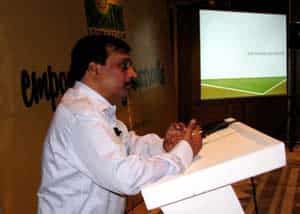
Twenty-six Non Profit Organizations (NGOs) were trained in various sessions to build up their own sustainability during a two-day grassroots NGOs meet, organized by Smile Foundation at Tivoli Garden Resort Hotel in New Delhi.
The meet, aptly called as “Empowering Grassroots” was held on April 9, 10 in which grass root-level NGO founders from Uttar Pradesh, Madhya Pradesh, Rajasthan, Delhi, Chandigarh and Jammu & Kashmir participated.
The interactive sessions were presided over by various well known trainers, and Smile Foundation’s COO Mr. Vikram Singh Verma delivered the keynote address on the first day of the meet. Talking about the sessions and the event, he said, “Smile Foundation underscores the fact that helping is not simply a matter of dispersing money; but making a long-term commitment and casting a hard eye on results. We aim to identify, handhold and build capacities of genuine grassroots NGOs to achieve accountability, sustainability scalability and leadership.”
The NGOs discussed their problems, hurdles, initiation and innovation in the work in their respective fields. One of the NGO founders from Jammu and Kashmir said he started by teaching kids who used to accompany their labour parents to the place of their work and that is how Ankur Vidyala happened. Innovative ideas like selling newspapers and raising lakhs of rupees by another NGO was also applauded by everyone.
Taking about the event, Verma said, “Smile wants all these grassroots NGOs to be adept in their communication skills so that they can showcase their credibility and get the maximum benefit from philanthropists.”
In an interactive session, speaker, Ms. Sweta Luthra, CEO of Orange Cup Solutions shared how fundraising by NGOs can be “fun raising” and the various other ways in which effective communication could be the road to a good resource mobilization. Psychological hurdles such as people do not want to associate themselves with NGOs as they do not want to be termed as ‘poor’, alienation of kids from their family after getting education from NGOs; were also talked about.
Swatantra Gupta, National Manager (Resources ) Smile Foundation, during the most important part of the session, taught these NGOs that how they can involve local support for sustainable fundraising and better fund utilization to be self sustainable. He also explained about the 5C model for building organizational competencies of these grass root NGOs.
NGOs, such as Jupiter Academy, Nai Disha, Inna Raja, Ankur Vidyalya and Arohan, who are co-partners with Smile Foundation, had their own presentations and queries, and qualified trainers tried to provide solutions to those queries. The event was also important for partners so that they could get a feel of the people they interact with on a daily basis.
Smile Foundation, which is into four main sections of the society- education, health, livelihood and empowerment of women – wants holistic approach towards the problems associated with all the above mentioned issues. Talking about the same, Mr. Verma said, “We invest in not just a child’s education but in his health, his mother’s health and his livelihood so that generations can be taken care of by investing a particular amount of money.”
For the people, who want to do some charity, Ms Luthra had an important message: “They should not be concerned as to what happens with their money after it is being donated. A person should give away to a credible NGO like they give to a corporate house so that impact is deep rooted,” suggested Ms Luthra.
This year Smile Foundation is actively working to cover 500 more grassroots NGOs under the Empowering Grassroots programme, Santanu Mishra, Co Founder & Executive Trustee, Smile Foundation, said.
Smile Foundation has so far built the capacities of 500 grassroots NGOs under Empowering Grassroots programme in last two years. By 2015, the aim is to reach out to 5000 similar NGOs across India, he added.
Talking about the thought behind Empowering Grassroots during an interaction program held in New delhi during 10-11 April, Mr. Mishra, said, “The objective behind Empowering Grassroots is to enable the grassroots NGOs to become well governed and sustainable in the local areas itself.”
He added, “When grassroots NGOs are able to involve the civil society in the process of development, this will lead to good governance as well as scaling up of existing good work.”
NEW DELHI: Smile Foundation conducted a two-day capacity building programme during 10-11 April 2013 for grassroots NGOs in order to enable and equip them to participate in the process of social change at the local level effectively.
The programme held at Tivoli Garden, Chattarpur, Mehrauli, New Delhi. Interactive session included 26 selected NGOs from Uttar Pradesh, Madhya Pradesh, Rajasthan Delhi, Chandigarh and Jammu & Kashmir. Selected NGOs working in the area of child education and women empowerment participated and shared their experience. Representative from INDIACSR (www.indiascr.in), Indian Society of Blood Transfusion and Immunohaematology (ISBTI), Jupiter Academy, Nai Disha-Delhi, Inna Raja, Nipun, Ankur Vidyalya, Arohan, Rasta participated in the programme.
The two-day event saw tailor-made sessions on key aspects; involving local support for sustainable fundraising, better fund utilization, meeting the expectations of donors, communicating with the stakeholders, leadership and the practice of good governance etc.
Aptly titled ‘Empowering Grassroots’, the programme focused on facilitating the NGOs at the grassroots to become self-sustained as well as bring excellence in their functioning.
Mr. Vikram Singh Verma, Chief Operating Officer, Smile Foundation said INDIACSR, “Smile Foundation see itself not a Funding Agency, but as a National Development Organization that not only to supports but helps to build capacities at the grassroots so that they eventually become self sustainable.”
Addressing the inaugural session Mr. Verma, said, “Smile Foundation underscores the fact that helping is not simply a matter of dispersing money; but of making a long-term commitment and casting a hard eye on results.”
We aim to identify, handhold and build capacities of genuine grassroots NGOs to achieve accountability, sustainability, scalability and leadership. We make an effort to broad base investment in order to maximise its reach and optimize returns by approaching and strengthening a large number of like-minded individuals and organisations globally.”, he added.
Ms. Shweta Luthra, CEO-Orange Cup Solutions, gave a presentation on “communication and brand building for sustainability of NGO”, was appreciated by the participants.
The two-day programme also offered the participating NGOs an opportunity to share their experience and challenges with one another. Many interesting insights were shared during the sessions, starting from various innovative methods of engaging people towards supporting a good cause to the methodology of communicating and showcasing the real work to a wide section of the privileged society.
Smile Foundation is a national level development organization reaching out to more than 200,000 underprivileged children, women and youth through more than 185 welfare projects across 25 states of India on issues of education, healthcare, livelihood, and empowerment of women and girl children.
New Delhi: The richie-rich club of India may be lagging behind their Western counterparts when it comes to charity donations, but philanthropy in the country is gaining momentum through a different route, experts say.
As per US-based business magazine Forbes’ annual rankings of the world’s richest people, there a total of 55 billionaire in India, making it the fifth biggest country in terms of number of people with at least one billion dollar networth.
However, India lags behind many of its Western peers when it comes to charitable donations by the rich citizens.
According to the latest India Philanthropy Report by global consultancy firm Bain and Company, the wealthy Indians shelled out 3.1 percent of their total income on charitable donations in 2011, compared to 2.3 per cent in 2010.
Despite a year-on-year rise, the figure is low in comparison to many other countries. The affluent people in the US give as much as 9.1 per cent of their income in donations.
According to non-profit organisation Smile Foundation India Co-Founder & Executive Trustee Santanu Mishra, many of the rich Indians have off late started thinking about charity and giving back to the society, though in a small way.
Most of the newly rich individuals acquired such level of resources for the first time in life which had not been passed on to them from previous generations in comparison to their western peers,” Mishra said. “Hence their priority is to enjoy these hard earned resources first and get it utilised for their children,” he said, while adding that Indians have traditionally been more inclined to religious donations, rather than social issues.
The experts also say that one of the big barriers to philanthropic giving in India has been the NGOs lacking in terms of scale of operations, among other issues. However, a significant charitable momentum is building in India, said Arpan Sheth, Bain & Company partner in Mumbai and author of its India Philanthropy report.
“Two-thirds of all surveyed expect to increase donations in the next five years, with two in five saying they will increase giving by over 20 per cent in that period,” he said. Traditionally, philanthropic activities in India have included building religious places and funding universities.
Besides, most of the country’s big conglomerates, such as Ambanis, Tatas and Birlas, have their trusts for charitableneeds and the individual philanthropy is not very common.
On the lines of routes followed globally by the likes of Warren Buffett and Bill Gates, IT major Wipro’s chief Azim Premji recently became the first Indian to sign up for the global ‘Giving Pledge’ initiative. The Giving Pledge is an initiative where the world’s richest families pledge to donate at least half of their wealth to charity.
Priyanka Chopra visited the Holy Mother School in Malvani on the occasion of International Girl Child Day where she awarded five special scholarships to the girls. She also interacted with students and answered their questions. Speaking about supporting the cause, PeeCee says, “To me educating the girl child is very important. I have worked for this cause before with UNICEF and it has always been my endeavour to give these little ones a better tomorrow since I believe they are near to God. We’ve given five scholarships today and hope to do more.”
Hunger Relief (WHR) world?s largest private sector hunger relief effort at KFC, cannaught Place, New Delhi. On the occasion, Vikran Singh Verma of COO-Smile Foundation and President of Yum! Restaurants India, Niren Choudhary were also present and witnessed the event.
?As responsible members of society, it is upon us to take initiatives to eradicate hunger in India. Programmes like the ?World Hunger Relief? encourages us and other corporate to serve the community in which we operate. I am honoured to partner with Smile Foundation and Yum! in their movement to target one of the biggest risks to health worldwide. I have pledged my support to this initiative and urge all consumers to join in the noble cause?, Said Sharman Joshi.
Commenting on the partnership, Vikram Singh Verma- COO- Smile Foundation said, ?We are proud to associate with Yum! restaurants India in their movement to address hunger and malnutrition, not only in India, but world over. Their contribution towards the cause is phenomenal. Partnering with them, further reiterates our mission of working as a catalyst towards bringing change in lives of thousands of underprivileged children and women, and enable the civil society to encourage proactively in the change process.?
Smile Foundation is a national level development organization reaching out to more than 300,000 underprivileged children, youth and women directly every year through 158 welfare projects on subjects such as education, healthcare, youth employability, and women empowerment across 25 states of India. Adopting a life cycle approach of development, Smile Foundation focuses its interventions on children, their families and the community.