
Categories
Livelihood Women Empowerment

The Business of Being at Home: Why Home-Based Work Matters to Women’s Economic Participation

Women make up almost half of India’s population, yet their participation in paid work remains at 35.3% of the labour force (as per December 2025 study). Why? For any Indian, the answer is all too familiar. The barriers go beyond the availability of jobs. Social expectations, household responsibilities, caregiving and a patriarchal mindset continue to limit women’s choices and their ability to pursue economic independence.

But when there is a will, there is a way! For women navigating these constraints, home-based work offers a practical way to earn while managing responsibilities at home. However, the ability to work from home does not automatically translate into financial independence. That depends on whether women have access to the skills, resources and support needed to turn their work into a reliable source of income.

Shyama’s story shows what this can look like in practice. When her husband lost his tailoring job during the pandemic, the family struggled to pay their daughter’s school fees. Through Smile Foundation’s Swabhiman programme, Shyama attended financial literacy sessions and self-reliance. She learnt to sew, received support for a tailoring machine and encouraged her husband to work from home. As orders began coming in, the family gradually regained some financial stability. 

Her experience raises a wider question: what would help more women build a dependable livelihood from home?
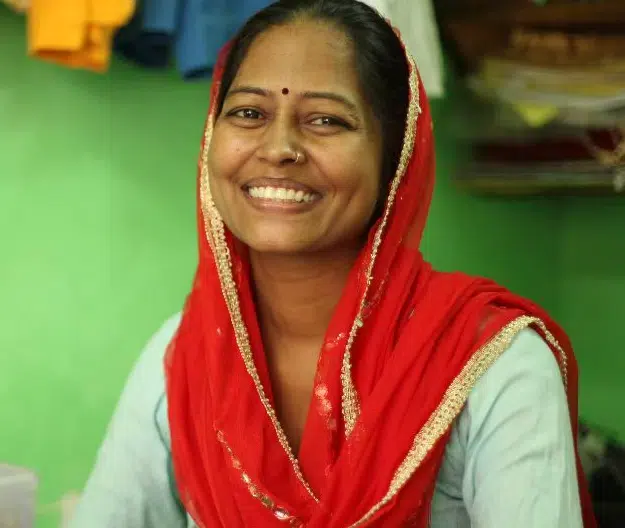
Shyama story - women empowerment - Home-based work for women - tailoring
Home based work for woman – tailoring

How does home-based work expand women’s opportunities? 

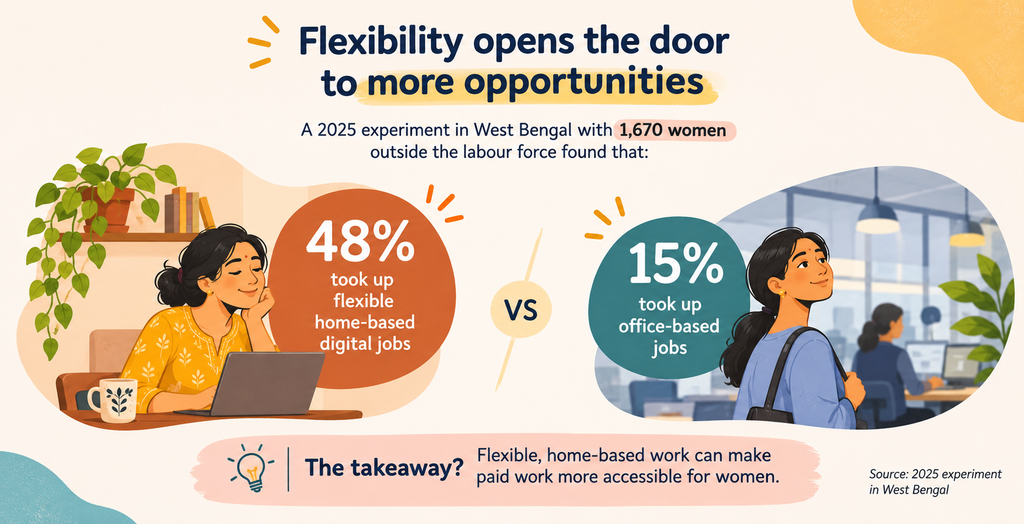
Sometimes, whether a woman can take up a job depends on where and how she is expected to work. A West Bengal experiment presented in 2025, involving 1,670 women outside the labour force, explored this connection. Among women offered the most flexible home-based digital jobs, 48% took up the opportunity, compared with 15% offered office-based jobs.

The difference shows how flexibility can make paid work more accessible to women. For those considering home-based work, the next question is practical: what earning opportunities match their existing skills, and what would they need to learn to explore others?
Turning Everyday Skills into Earning Opportunities 

Home-based work, or paid work carried out in or around a person’s home, offers another route to earning. It allows women to use their existing skills, learn new ones and work while managing responsibilities at home. Depending on their skills, interests and available opportunities, women can take up different kinds of work:

  • Tailoring and embroidery: Stitching clothes, alterations and decorative work.
  • Handicrafts: Making jewellery, home décor, textiles and other handmade products.
  • Food-based work: Preparing snacks, pickles, baked goods and other food products.
  • Small-scale production: Making household items, packaging products or assembling goods.

Women may begin with a skill they already possess or learn something new to start earning. Either way, skills are the backbone of home-based work. But where do women learn these skills, and what kind of training and support do they need to turn them into a source of income?

From Skills to Self-Reliance: Preparing Women to Earn 

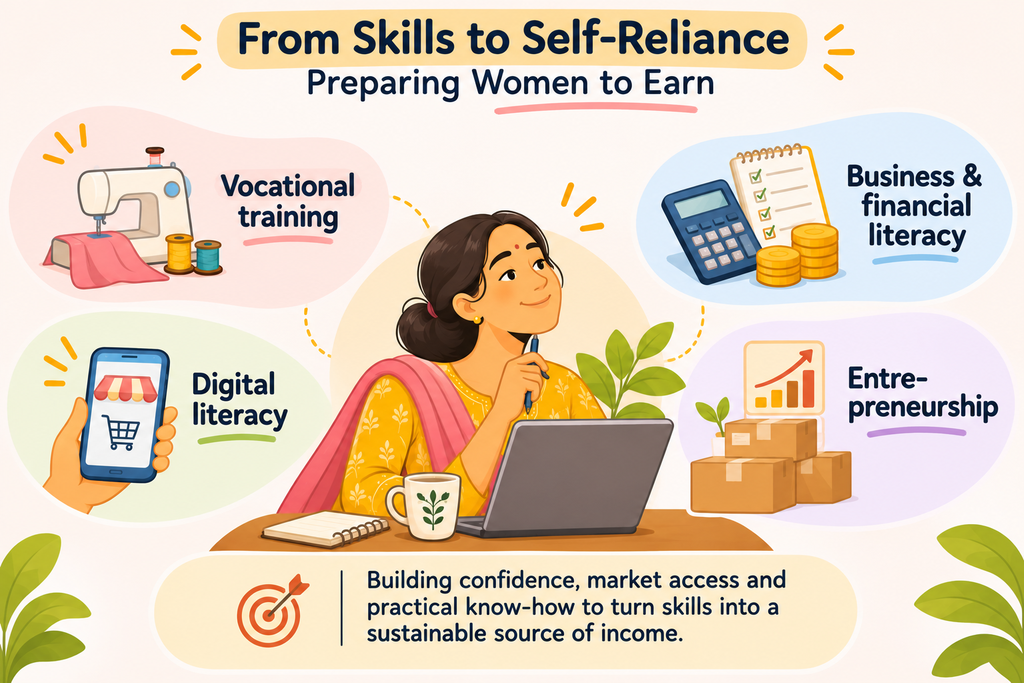
Having a skill is an important first step, but turning it into a livelihood takes more than knowing how to make a product or provide a service. Women also need the confidence, business knowledge and practical support to put their skills to use, reach customers and earn from their work.

Skilling programmes can help women build these capabilities through:

  • Vocational training: Learning practical skills such as tailoring, food processing, beauty and wellness, handicrafts and other trades.
  • Business and financial literacy: Learning to price products, manage expenses, save and handle earnings.
  • Digital literacy: Using smartphones, digital payments and online platforms to promote products and connect with customers.
  • Entrepreneurship: Learning to manage orders, maintain quality and grow a small business.
Smile Foundation’s Swabhiman programme brings several of these elements together through entrepreneurship development, financial and digital literacy, business guidance and networking. The focus is not just on helping women acquire skills, but also on enabling them to apply those skills and strengthen their enterprises.

From First Order to Steady Income: Building a Home-Based Business 

Home-based work can take different forms. Women may work remotely for an employer, take up independent assignments or use their skills to build businesses of their own. While each offers a way to earn, running an enterprise brings its own set of considerations. 

Beyond making a product or providing a service, women need to understand the business side of their work: how to value what they make, reach the right customers and manage the resources. 

These key elements can help women move from practising a skill to running a business:

Understanding the value of the work

Pricing a product involves more than covering its raw materials. Packaging, delivery, time and effort all contribute to its cost. Women also need to understand how to position and market their products so customers recognise their value.

Sneha’s journey offers an example. Having learnt crochet from her grandmother, she turned a childhood hobby into a business with support from Smile Foundation’s Women Entrepreneurship Development Programme. Training in product design, digital marketing, communication and pricing helped her establish The Crochet Lab and reach customers through Meesho and Instagram. Today, she earns over ₹1 lakh in monthly revenue and ₹75,000 in monthly profit.

Finding customers beyond familiar circles

Making a good product is one thing; finding people willing to buy it is another. For a home-based business to grow, women need ways to showcase their products, reach new customers and explore markets beyond their immediate surroundings. Exhibitions, local retailers and e-commerce platforms can all help create these connections.

Swati’s journey with Prakriti Hald Grih Udyog reflects this challenge. After moving to Pune, she struggled to find markets for her turmeric products. Through Smile Foundation’s Women Entrepreneurship Development Programme, she received support with business planning, e-commerce, branding and building her online presence. She also set up a stall to showcase her products and connect with potential customers.

Having resources to keep going

Running a business also means having the resources to fulfil orders and manage day-to-day expenses. Buying raw materials, investing in equipment and meeting production costs can be difficult when money is limited or payments are delayed. Access to the right resources can help women keep their businesses running and take on more orders.

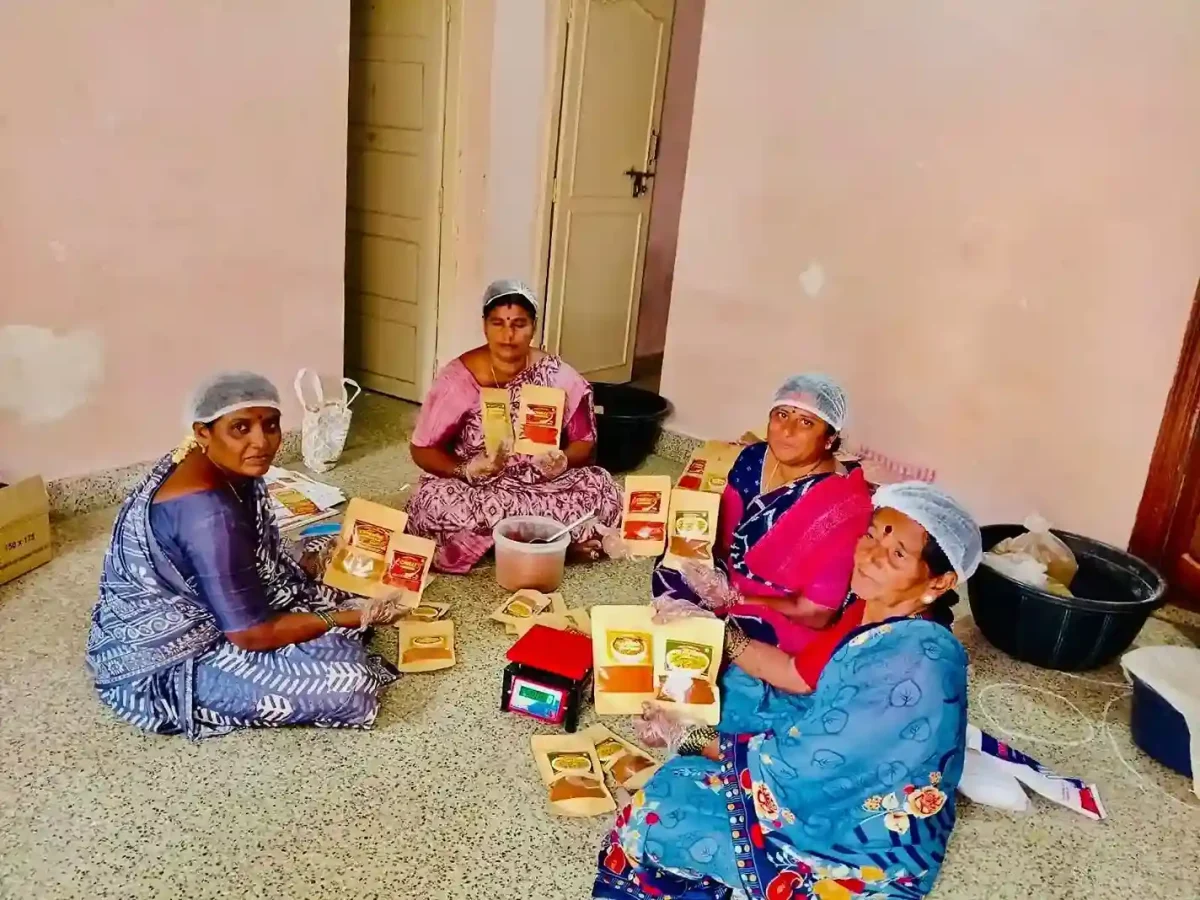
In Khed, Pune, Smile Foundation supported women entrepreneurs through access to machinery and essential equipment, along with guidance on food licensing and online platforms. This support helped them strengthen their small businesses and explore opportunities to reach more customers.

Home-based work = Financial independence?

Having an income creates possibilities. But financial independence also means having a say in how that income is earned, used, saved and invested.

It is worth asking:

  • Are women paid fairly, and do they receive payments on time?
  • Do they have control over their earnings and business decisions?
  • Do they have dependable time and space to focus on their work?
  • Can they negotiate, find new customers and decide whether to expand?

These questions matter because working from home does not make responsibilities disappear. If household tasks continue to fall largely on the same woman, paid work has to fit around everything else. When family members share childcare, cooking and other responsibilities, women have more time and space to give their work the attention it deserves.

The terms of work matter just as much. Women producing goods for contractors, for instance, need clear payment terms and fair rates. Flexibility has limited value if earnings are inadequate, payments are delayed or working conditions are unfair. For home-based work to support financial independence, women need not only the opportunity to earn, but also greater control over their work and income.

Recognising the Value of Work Done at Home

A woman’s place of work does not decide the value of her contribution. An order completed at home involves skill, time and responsibility, just as work carried out elsewhere does.

Home-based work deserves recognition as a pathway to women’s economic participation. With fair earnings, shared responsibilities and access to markets and opportunities, it can give women greater freedom to decide how they want to work, what they want to build and where they want to go next.

Frequently Asked Questions

  1. Why does home-based work matter for women in India?

It makes earning possible for women whose caregiving responsibilities, travel difficulties or social circumstances limit access to employment outside the home.

  1. Can an existing skill become a source of income?

Skills such as stitching, cooking or embroidery offer a starting point. Earning from them also requires customer demand, suitable pricing and resources.

  1. What helps a home-based business earn regularly?

Repeat customers, consistent quality and prices that cover costs and labour help turn occasional orders into a more dependable livelihood.

  1. Is training enough to start a home-based business?

Training builds skills. A viable business also needs customers, appropriate pricing, equipment, working capital and guidance.

  1. How can families support women working from home?

Share household responsibilities, respect working time and support women’s decisions about their earnings and businesses.

  1. What support do women need after skills training?

Access to equipment, working capital, buyers and continued mentorship helps women apply their training and manage challenges as their businesses develop.

  1. How can home-based work support financial independence?

Fair, dependable earnings and control over money help women save, invest and make decisions about their own futures.

Categories
Women Empowerment

Women’s Employment and Staying in Work After It?

Key takeaways

  • Getting women into jobs is only half the challenge: Retention and continuity matter just as much as workforce entry for women’s employment.
  • Marriage can be a major turning point: Women’s labour force participation can decline after marriage, even before children enter the picture.
  • Unpaid care work affects employment: Women continue to carry a disproportionate share of domestic and caregiving responsibilities.
  • Skills alone cannot guarantee economic independence: Women also need safe workplaces, flexibility, mentorship, financial literacy, childcare and opportunities to access or return to work.
  • A career break should not become a permanent exit: Employers and systems need stronger pathways for women to re-enter employment after periods of caregiving or other life transitions.
The dynamics of Women's Employment  

Getting women into the workforce is only one part of the challenge within the workforce and labour participation. The harder question is what pushes them and enables them to stay.

India has seen a substantial rise in women’s participation in economic activity in recent years. According to the Periodic Labour Force Survey (PLFS) 2023–24, the female labour force participation rate for women aged 15 and above rose from 23.3% in 2017–18 to 41.7% in 2023–24. While the increase is encouraging, participation alone does not tell us whether women are entering stable, decent and sustainable employment.

For many women, the problem is not finding the work alone but remaining in it when life keeps changing for them.

Marriage, childbirth, care responsibilities, unsafe transport, inflexible workplaces, poor working conditions and social expectations can all push women out of employment. A woman may enter the workforce after years of education or skills training, only to discover that the structures around her have not changed enough to allow her to remain.

The employment gap does not end with a job 

South Asia has one of the world’s lowest rates of female labour force participation. The World Bank’s South Asia Development Update found that only 32% of working-age women in South Asia were in the labour force in 2023, compared with 77% of men. Importantly, the report found that women’s participation falls by around 12 percentage points after marriage, even before they have children.

This distinction matters. Women’s absence from the workforce is often discussed as though it begins with motherhood. But marriage itself can be a turning point.

Similarly, research discussed by the World Bank in 2026 finds that in Bangladesh, India, Maldives and Nepal, marriage alone reduces women’s labour force participation by around 12 percentage points. In India, the analysis suggests that much of the family-formation penalty comes from marriage rather than motherhood.

This tells us that women’s employment is dictated not only by whether they have children, but by what happens to their social roles and expectations when they marry.

The second shift that women carry home

Even when women remain employed, they often add paid work to responsibilities they continue to carry at home.

The Time Use Survey 2024 found that women aged 15–59 who participated in unpaid domestic services spent about 305 minutes a day on these activities. Women also continued to shoulder a disproportionate share of unpaid caregiving: 41% of women in this age group participated in caregiving for household members, compared with 21.4% of men. Among those who participated, women spent about 140 minutes a day on caregiving, compared with 74 minutes for men.

These figures help explain why staying in employment can become difficult even when women want to work. A job does not replace unpaid work at home, and in many households, it is just added to it.

This creates what can be described as a second shift — the paid working day followed by domestic and caregiving responsibilities that remain largely invisible in economic statistics. When working hours are rigid, commuting is long, or childcare is unavailable, the cumulative burden can make employment difficult to sustain.

Childcare matters, but the problem is bigger than childcare

Affordable and accessible childcare is an important part of keeping women in work. The World Bank has highlighted how disproportionately women carry childcare and eldercare responsibilities, making the care economy an important factor in women’s labour force participation.

But childcare alone cannot explain women’s employment patterns in India.

If marriage itself changes women’s mobility, household responsibilities and freedom to make employment decisions, then a creche at the workplace addresses only one part of the problem.

Women also need workplaces that recognise that workers have lives outside work. Flexible working arrangements, predictable schedules, safe transportation, maternity protections and opportunities to return after a career interruption can all influence whether employment remains viable over the long term.

The question therefore needs to move from “How do we get women into jobs?” to “What would make it possible for women to remain in them?”

The workplace can become another barrier

For women who do enter employment, the quality and location of the job matter.

A job that requires a long commute may become impractical if a woman is also responsible for children or elderly relatives. Unsafe public transport can make certain shifts inaccessible. Lack of toilets, inadequate maternity support and inflexible working hours can create barriers that have little to do with a woman’s skills or willingness to work.

The World Bank’s research on women’s employment in South Asia identifies childcare, mobility, safety, legal restrictions and conservative gender norms among the factors limiting women’s employment.

The result is that women can become concentrated in the kinds of jobs that are considered compatible with domestic responsibilities rather than the jobs that necessarily offer better wages, career progression or security.

Flexibility, in this context, can be valuable but flexibility should not become another word for precariousness. If women are pushed into informal, poorly paid or unstable work because formal employment cannot accommodate their lives, then higher participation figures may not necessarily translate into greater economic security.

Skills alone cannot keep women working

Skill development is often presented as the obvious answer to women’s economic exclusion. While skills training matters, improves employability, opens new occupational possibilities and helps women establish their own enterprises, training does not change the conditions under which women have to use those skills.

Smile Foundation’s work through our Swabhiman programme illustrates a more integrated approach. The programme, which began in 2005, combines women’s health, nutrition, livelihoods and entrepreneurship rather than treating economic empowerment as a standalone issue.

Our recent programme reporting records 1.90 lakh+ women and girls reached, with 5,048 women trained in entrepreneurship and financial literacy and 116 micro-enterprises established in 2024–25.

What is particularly relevant to women’s ability to sustain livelihoods is the programme’s emphasis on more than vocational skills. Swabhiman includes entrepreneurship development, financial and digital literacy, business development, market access and mentorship. Our programme explicitly recognises that women need support not just to start an income-generating activity, but to manage and sustain it.

That broader approach is important because economic participation does not happen in isolation from health, family responsibilities or access to resources.

A career break should not become an exit

For many women, leaving work may not be intended as a permanent decision. A woman may step away during pregnancy, to care for a young child, because of a family illness or because relocation makes her existing job impossible.

A career break can mean lost income, lost experience, reduced professional networks and fewer opportunities for advancement. The longer the interruption, the harder it can become to re-enter at the same level.

This is particularly significant because workplaces often reward continuous employment. A career path designed around uninterrupted availability may work well for someone without substantial care responsibilities, but it can penalise people whose lives involve periods of care.

Creating meaningful pathways back into employment therefore matters as much as preventing women from leaving in the first place.

Making workplaces sustainable for women’s employment

The conversation about women’s employment often begins with access to education, skills, jobs and entrepreneurship opportunities. Hence, the next stage is all about continuity.

Women need the opportunity to enter work, but they also need the conditions to remain economically active through marriage, motherhood, caregiving and other transitions in life.

This is why women’s economic empowerment cannot be reduced to employment numbers. It is also about whether women have control over their income, whether their work is valued, whether they can make choices about their time and whether a temporary interruption has to become a permanent withdrawal from economic life.

The challenge is therefore not simply to create more jobs for women but to build an economy in which women do not have to choose between earning and caring, between professional continuity and family responsibilities, or between flexibility and decent work.

While women are already entering the workforce in greater numbers, the next big question remains as to whether our workplaces, households and public systems are prepared to let them stay.

FAQs

1. Why is retaining women in the workforce important?
Increasing women’s employment is important, but sustained employment is equally critical. Staying in work allows women to build experience, income, professional networks and greater economic independence over time.

2. Why do many women leave the workforce after marriage?
Marriage can bring changes in household responsibilities, mobility, decision-making and expectations around women’s roles. Research cited in the blog suggests that women’s labour force participation can decline after marriage, even before motherhood becomes a factor.

3. How does unpaid care work affect women’s employment?
Women continue to undertake a disproportionate share of unpaid domestic and caregiving work. When paid employment is added to these responsibilities, the combined time burden can make regular employment difficult to sustain.

4. Is childcare enough to keep women in the workforce?
Childcare is an important part of the solution, but it is not the only factor. Women also need safe transport, flexible and predictable working arrangements, maternity protections, supportive workplaces and opportunities to return after career interruptions.

5. Can skill development alone improve women’s economic empowerment?
Skills can improve employability and open new economic opportunities, but training alone cannot remove barriers such as unpaid care work, mobility constraints, lack of market access or inflexible workplaces. A broader ecosystem of support is needed.

6. How can employers support women returning after a career break?
Employers can create structured return-to-work pathways, flexible arrangements, opportunities to refresh skills, mentorship and fair consideration of candidates whose careers include periods of caregiving or other legitimate interruptions.

7. How does Smile Foundation support women’s economic empowerment?
Through its Swabhiman programme, Smile Foundation takes an integrated approach combining women’s health, nutrition, livelihoods and entrepreneurship. The programme includes entrepreneurship development, financial and digital literacy, business development, market access and mentorship, recognising that sustainable economic empowerment requires more than vocational training alone.

0%