
For a young graduate looking for a first job, a degree can sometimes feel like the beginning of the search rather than the end of it. The qualification may be there, but the job market asks for something more: familiarity with the workplace, confidence in an interview, communication skills, digital competence and an understanding of what employers actually expect.
For young people from underserved communities, that gap can be particularly difficult to navigate. Education may provide the foundation, but without access to industry exposure, professional networks or practical training, the transition from college to employment can remain uncertain.
This is the gap that the Smile Twin e-Learning Programme, or STeP Programme, has been trying to address since its launch in 2007.
The programme takes a broader view of skill development. Its premise is that preparing young people for work is not simply about teaching them a technical subject. It is also about helping them communicate, make decisions, handle interviews, understand professional expectations and develop the confidence to enter a workplace.
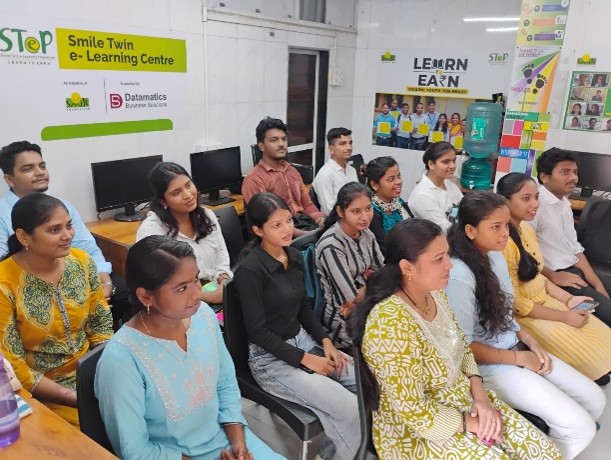
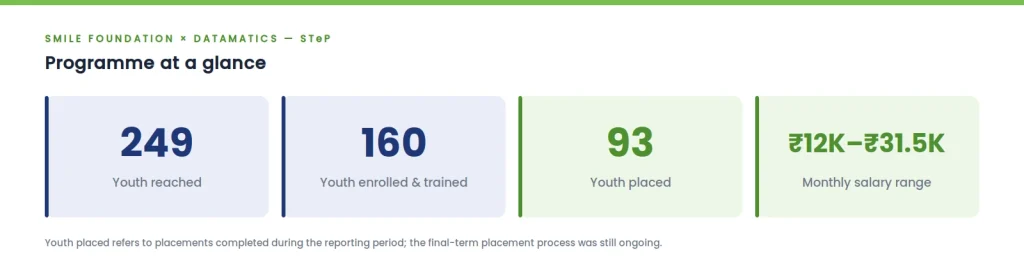
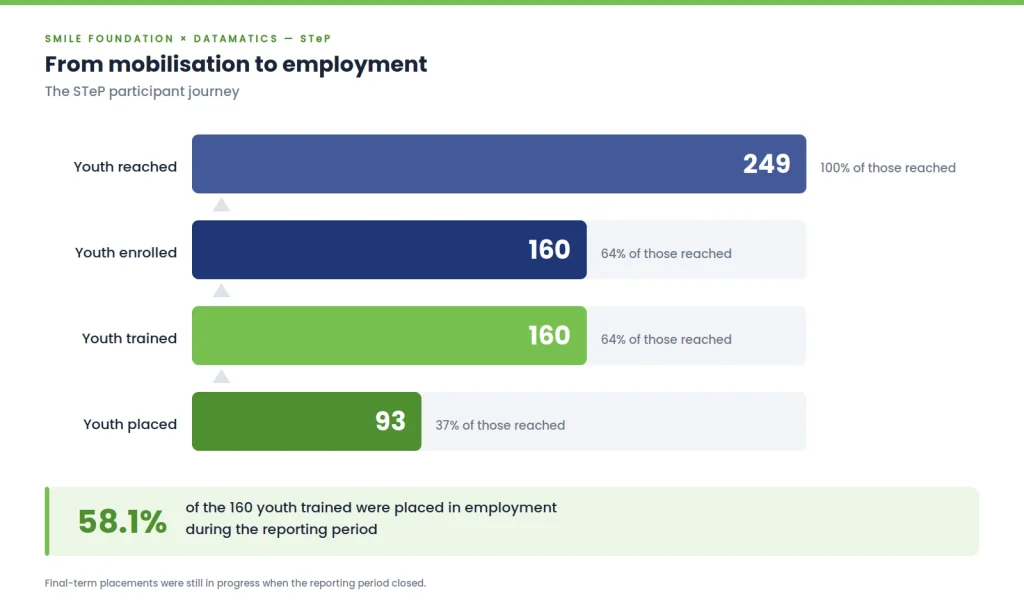
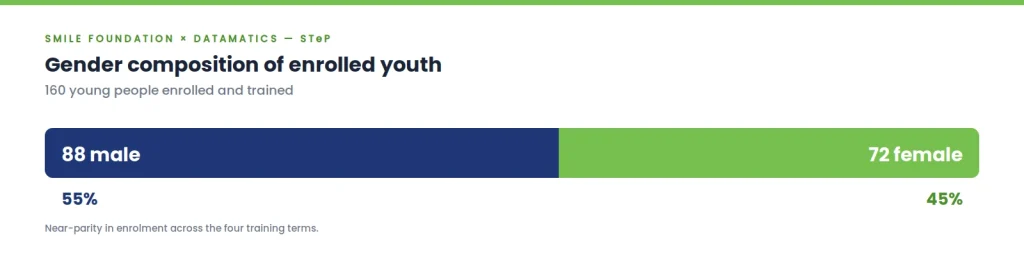
At the STeP Programme centre supported by Datamatics in Mumbai, that approach took shape across four training terms between June 2025 and May 2026. During the reporting period, 249 young people were reached through community mobilisation and outreach. Following screening and counselling, 160 graduates and undergraduates were enrolled and trained in a three-month programme focused primarily on the Banking, Financial Services and Insurance sector.
By the end of the reporting period, 93 young people had secured employment across a range of companies and sectors.
Behind those numbers are young people making a transition that can alter the direction of their working lives.
The first step is finding the right young people
Before training begins, there is another challenge: finding young people who know about the opportunity and are ready to take it up.
Between June 2025 and May 2026, STeP Programme’s mobilisation efforts included community visits, door-to-door campaigns, awareness sessions and targeted WhatsApp outreach. These activities reached 249 young people and introduced them to the programme, its training and the employment opportunities that could follow.
The selection process was structured. Interested applicants were assessed, and candidates scoring 70% or above were shortlisted for one-to-one counselling. These conversations looked beyond test scores to understand candidates’ aspirations, motivation and readiness for the programme.
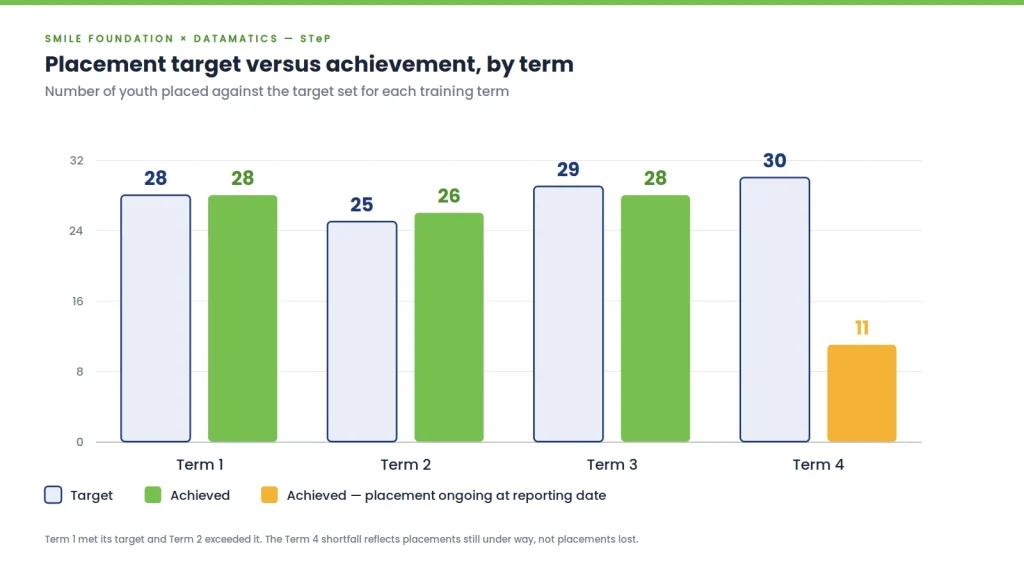
Ultimately, 160 young people enrolled across four terms: 40 in the first term, 35 in the second, 42 in the third and 43 in the fourth.
The consistency of those numbers matters because a skills programme begins long before the first classroom session. It begins by persuading a young person that the opportunity is worth pursuing and that the training can lead somewhere.
For many participants, the destination was employment in a sector they may previously have known little about.
Learning what the workplace demands through STeP Programme
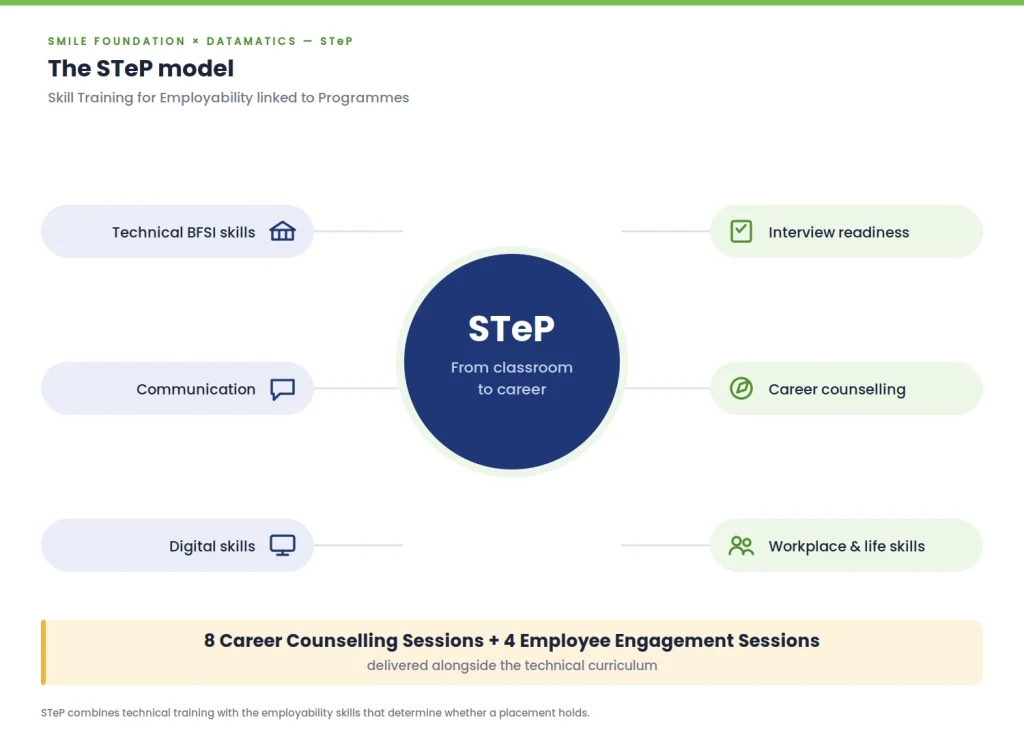
The three-month STeP programme curriculum was designed around the Banking, Financial Services and Insurance sector, one of the programme’s key employment pathways during the reporting period.
But technical knowledge formed only part of the training.
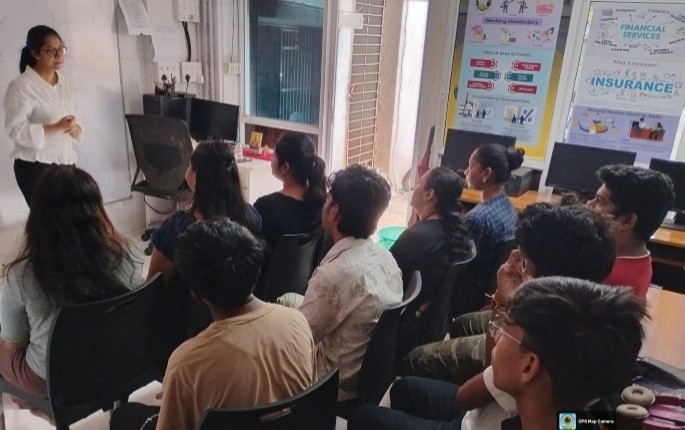
Participants attended classes six days a week, four hours a day. Alongside domain knowledge, they worked on communication, digital literacy, workplace etiquette, problem-solving, teamwork and professional behaviour. Attendance, assignments and assessments were monitored throughout the programme, while trainers provided individual guidance where additional support was needed.
The idea was to make the transition from classroom to workplace less abrupt.
A young person entering a first job may know the theory of a subject but still be unsure about how to speak to a customer, conduct themselves in an interview, prepare a professional CV or communicate with colleagues. These are not necessarily skills that appear on a college transcript, but they can have a direct bearing on whether a candidate gets through an interview and how well they adapt once hired.
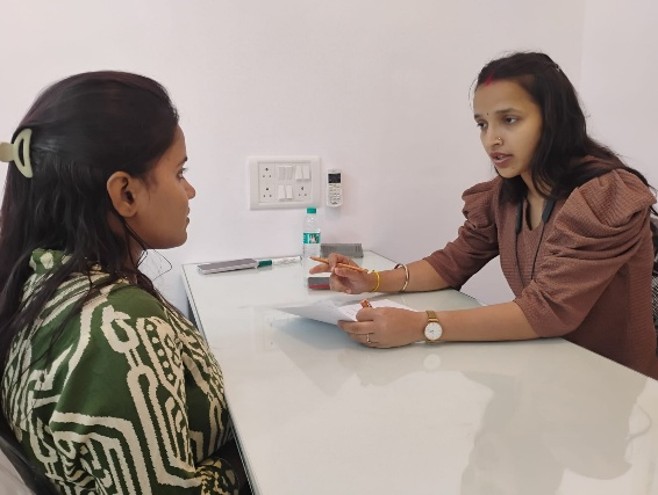
That is why career counselling and industry engagement were built into the programme rather than treated as an afterthought.
During the reporting period, students participated in eight career counselling sessions and four Employee Engagement Programme sessions led by industry professionals.
The subjects ranged widely. There were sessions on interview skills, professional etiquette and public speaking, alongside more technical topics such as Excel formulas and income tax return filing. Students were introduced to careers in the securities market and opportunities in non-banking financial companies. A session on cybercrime and the dark web addressed digital safety and responsible online behaviour.
There were also sessions that dealt with a less measurable but equally important part of entering the workplace: how to manage pressure and uncertainty.
Students learnt about SMART goals, relaxation techniques and mental resilience. The objective was not simply to prepare them for an interview, but to help them think about how they would manage the demands that follow once they get the job.
When training becomes an opportunity with STeP Programme
The measure of a skilling programme ultimately lies beyond the classroom.
During the reporting period, 93 STeP programme participants secured employment across 49 companies. Recruiters came from BFSI, IT and IT-enabled services, retail, hospitality, customer service and business operations.
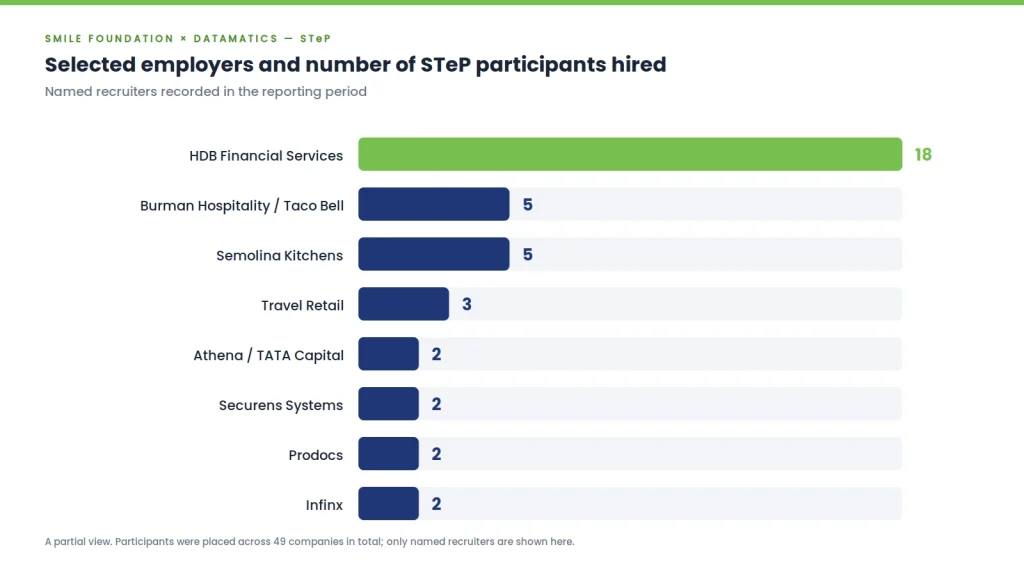
The BFSI sector was the strongest recruiter. HDB Financial Services alone hired 18 candidates for Sales Officer and Collection Officer roles. Other recruiters included Burman Hospitality/Taco Bell, Semolina Kitchens, Travel Retail, Athena (TATA Capital), Securens Systems, Prodocs and Infinx.
The roles were similarly varied. Participants found positions as Sales Officers, Customer Executives, Associate Analysts, Process Executives, Customer Service Executives, MIS Executives, Back Office Executives, Team Members, Cashiers, Accounts Executives, Field Supervisors, Centre Coordinators and Business Development Officers.
Monthly salaries ranged from ₹12,000 to ₹31,500, with most placed candidates earning between ₹15,000 and ₹20,000.
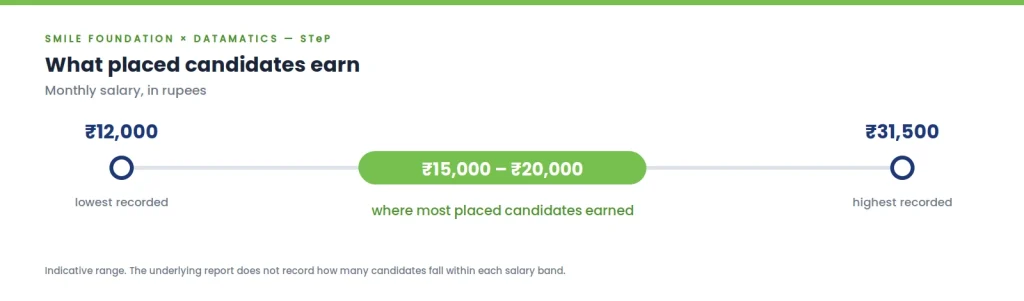
The final-term placement process was still under way at the end of the reporting period, meaning the 93 placements represent an interim outcome rather than the programme’s final placement figure for the entire cohort.
That distinction is important. Impact is not always neatly finished at the end of a reporting cycle. For a young person who completes training at the end of May, the journey into employment may continue into June or July.
The programme’s own placement target was 70%. Against 160 enrolled participants, that represents a target of 112 placements. The 93 placements achieved during the reporting period therefore show substantial progress, while leaving room for the final-term cohort to move through the placement process.
Julie’s first step into the BFSI sector
For Julie Chittaranjan, employment was about more than finding a first job.
She grew up in a family where her mother was the sole breadwinner after the death of her father. Her mother worked as a housekeeping staff while supporting Julie, her elder sister and their grandparents.
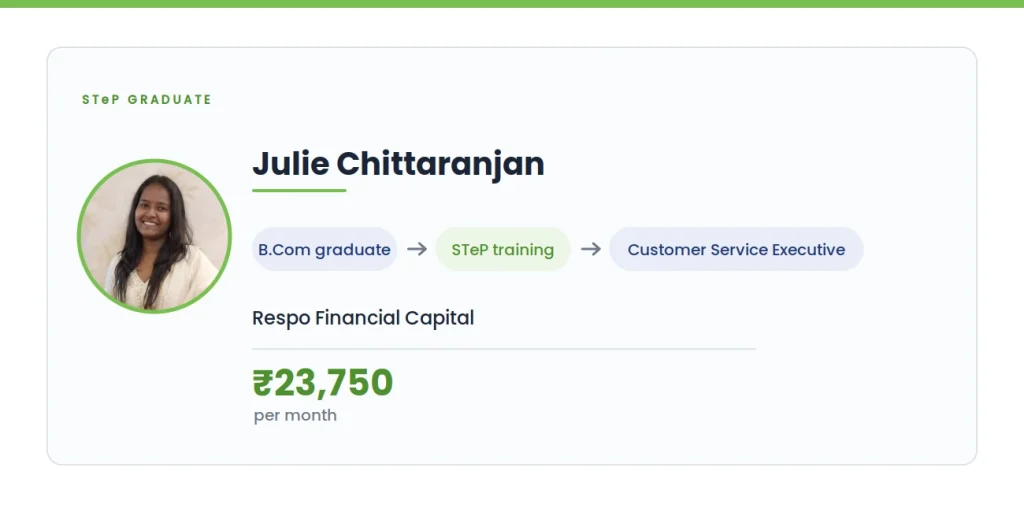
Julie completed a Bachelor of Commerce degree, but she recognised that a degree alone might not give her the industry-specific knowledge or confidence she needed to enter the job market. She joined STeP with an interest in building a career in the BFSI sector.
The programme helped her strengthen her understanding of financial products, customer handling, workplace communication and professional etiquette. It also gave her the opportunity to practise the skills needed to face interviews and work in a corporate environment.
Today, Julie works as a Customer Service Executive in loan selling at Respo Financial Capital Ltd., earning ₹23,750 a month.
Her first job is significant not only because it marks the beginning of a career. It also changes what she can contribute to her family.
As Julie put it: “The course was very detailed and it has helped me gain important knowledge which has helped me kickstart my career in the BFSI industry.”
Shubhi and the meaning of financial independence
Shubhi R. Tiwari entered STeP Programme from a different family situation but with a similar ambition.
While pursuing her third year of B.Com, she wanted to become financially independent and contribute to her family. Her father was the sole earning member, while her mother was a homemaker and her younger siblings were still studying.
Shubhi understood that academic knowledge alone would not necessarily prepare her for a corporate career. She wanted to improve her communication, develop professional skills and gain the confidence to work in a professional environment.
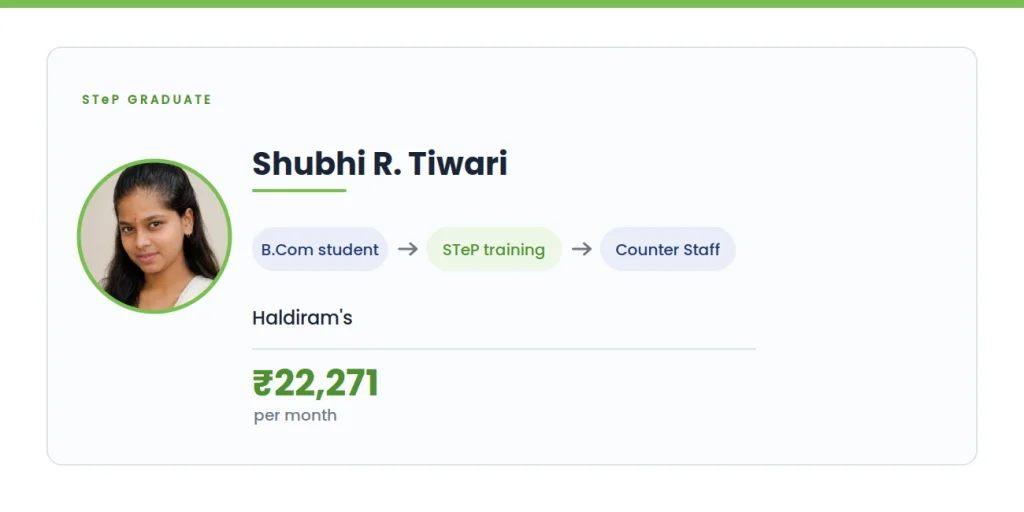
The STeP programme gave her opportunities to practise those skills through classroom learning, practical activities, mock interviews and career guidance.
She is now working as counter staff at Haldiram’s, earning ₹22,271 a month while continuing her graduation.
For Shubhi, employment has already begun to change the role she can play within her family. She is contributing to household income while continuing to build her own education and career.
Her experience captures an important part of what employment-focused skilling can mean. A job is an immediate outcome, but the longer-term change lies in the increased ability to participate in the economic life of a family.
The part that happens outside the classroom
The Datamatics partnership has also added another dimension to STeP Programme through employee engagement and volunteer-led activities.
Participants took part in sessions on SMART goals, relaxation techniques, mental resilience and careers in the finance sector. A Women’s Day session, “Give to Gain”, encouraged young women to recognise their strengths and support one another. Other activities focused on workplace expectations, professional behaviour and managing challenges.
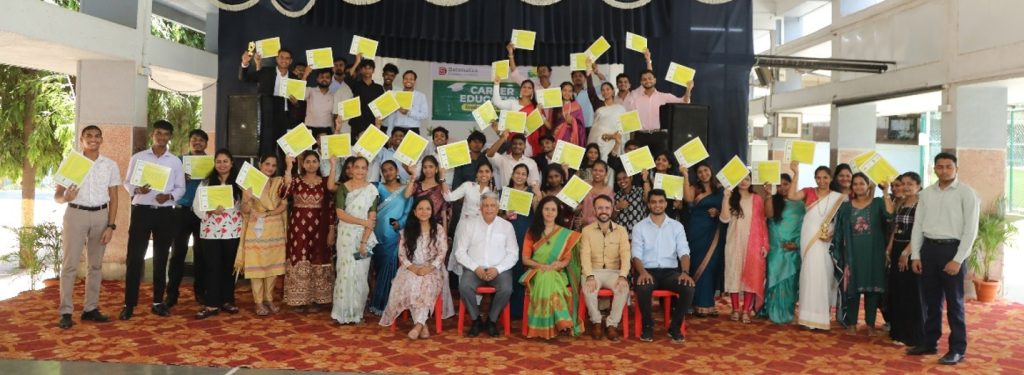
The programme’s graduation ceremony at Datamatics Andheri on 24 May 2026 brought more than 50 young people together, along with Datamatics representatives including its CHRO and CSR manager. Certificates were distributed to participants at the event.
These activities may sit outside the formal curriculum, but they contribute to the same objective: helping young people move from being students to becoming professionals.
What happens when skills meet opportunity
There is a temptation to measure a skilling programme through the number of people trained. That is an important starting point, but it does not tell the whole story.
At the Datamatics-supported STeP Programme centre, 160 young people were enrolled and trained during the reporting period. Ninety-three had secured employment by the end of the period, while placements for the final-term cohort continued.
The numbers tell us about reach and outcomes. The stories of Julie and Shubhi tell us what those outcomes can mean in individual lives.
For one young woman, a first job means entering the BFSI sector after growing up in a household supported by a single mother. For another, it means beginning to contribute financially to her family while continuing her education.
And for the programme itself, the journey does not end with placement.
The aim is to create young professionals who can continue learning, adapt to changing workplace demands and build careers rather than simply secure one job. That is why technical training sits alongside communication, digital skills, career counselling, industry exposure and mentoring.
The partnership between Datamatics and Smile Foundation reflects that broader understanding of employability. Since 2023, the two organisations have worked together to create opportunities for young people from underserved communities through STeP Programme.
The work is practical. A young person is identified, assessed and counselled. Training follows. Industry professionals enter the classroom. Students practise interviews, learn workplace skills and understand different career pathways. Employers then become part of the final stage of the journey.
Some participants are still waiting for their first job. Others have already begun.
For Julie, it is a customer service role in the financial sector. For Shubhi, it is a position at Haldiram’s alongside her studies. For the 93 young people placed during the reporting period, it is the beginning of working lives that will continue to develop long after their three months at STeP have ended.
That is perhaps the most useful way to think about skill development: not as a short course that ends when the certificate is handed over, but as a bridge between what a young person knows and what they can go on to become.
The classroom is only the beginning. The real test is what happens when the young person walks out of it and into the world of work.
FAQs
1. What is the Smile Twin e-Learning Programme (STeP)?
The Smile Twin e-Learning Programme (STeP) is Smile Foundation’s skill development and employability programme for underserved youth. It combines industry-aligned technical training with communication, digital literacy, workplace readiness, career counselling, mentoring and placement support.
2. Who does the STeP programme support?
STeP focuses on young people from underserved communities, including graduates and undergraduates, with particular emphasis on women, first-generation learners and economically disadvantaged families.
3. What skills do young people learn through STeP?
The programme combines technical knowledge with employability and life skills. Training includes areas such as BFSI knowledge, communication, digital proficiency, workplace etiquette, critical thinking, teamwork, interview skills and professional development.
4. How does STeP help young people find jobs?
Alongside classroom training, participants receive career counselling, interview preparation, resume guidance, industry exposure and employer engagement. These activities help participants understand workplace expectations and prepare for employment opportunities.
5. How many young people were trained and placed through the Datamatics-supported STeP programme?
During the June 2025–May 2026 reporting period, 160 young people were enrolled and trained across four terms. By the end of the reporting period, 93 had secured employment, while placements for the final-term participants were still in progress.
6. What kinds of jobs did STeP participants secure?
Participants found employment in roles including Sales Officer, Customer Executive, Associate Analyst, Process Executive, Customer Service Executive, MIS Executive, Back Office Executive, Cashier, Accounts Executive and Business Development Officer. Employers came from sectors including BFSI, IT & ITES, retail, hospitality and customer service.
7. How does the Datamatics partnership support STeP?
Since 2023, Datamatics and Smile Foundation have partnered to create skilling and employment opportunities for underserved youth. The partnership supports a dedicated STeP centre in Mumbai, where participants receive industry-aligned training, mentoring, career guidance, industry exposure and employment support.


