

India’s higher education expansion belies that access remains deeply unequal. Despite dramatic growth in colleges and universities, only a fraction of students make it to campus. The latest government data shows that a staggering 71.6% of Indian youth do not progress from high school to college. This means millions of talented students, especially from low‑income, rural or marginalised backgrounds, never even get a chance. The reasons go beyond tuition fees.
For many, the pathway to college is blocked by a maze of social and institutional barriers like a lack of information and guidance, complex scholarship processes, digital and language divides and entrenched biases around caste, gender and field of study. As one recent survey cautions, “scholarships are essential, [but they] often fall short of addressing the full range of challenges faced by students from marginalised backgrounds,” leaving too many behind.
One young woman’s story captures this gap. Aishwarya, an engineering student from a working‑class family in Bengaluru, dreamed of a science career despite her father’s modest income. “I had always dreamt of pursuing a career in science,” she recalls. Yet even after earning a coveted college seat, she struggled: “The fees, transport, books and even mobile data for online classes started adding up. It became impossible to continue with my studies.” Aishwarya’s predicament shows why affordability alone is a reductive way to see the problem. It wasn’t just money – it was every extra cost and complication that overwhelmed her. Schools and scholarships often focus narrowly on tuition, but students like Aishwarya need a safety net that covers all essentials.
But money isn’t the only missing piece. Many first‑generation college students are also navigating an alien world. Classrooms, career counselling and internship culture can feel utterly foreign to someone from a village or slum. These students may have no one at home to help write a résumé, prepare for an interview or network professionally. In the words of one scholarship advisor, “financial aid is just one piece of the puzzle”. Without guidance, confidence and exposure, even well‑funded students can falter.
Research confirms that bridging “small gaps” in language, transportation and mentorship can dramatically boost a young person’s confidence and sense of belonging. In other words, handing someone a scholarship but dropping them into a strange new environment is unlikely to yield success. As one report bluntly puts it, “without complementary support of this kind, financial aid isn’t likely to result in success.”
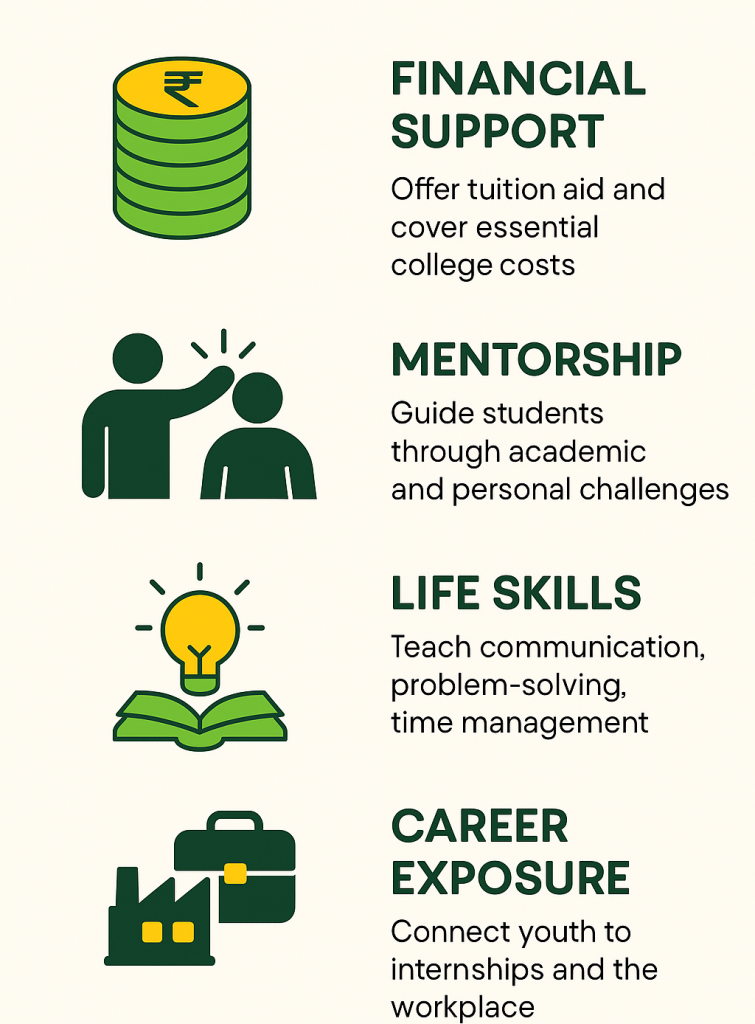
To overcome these hurdles, holistic scholarship models are emerging. Rather than just paying fees, they wrap students in a blanket of support. A leading example is Smile Foundation’s Scholarship programme which pairs financial aid with life‑skills training, English and digital fluency classes, mentorship, career counselling and even mental health support. Our need‑based sponsorships cover not only school fees but also books, uniforms, stationery and transport – ensuring continuity from primary school through higher secondary.
We also run bridge and remedial courses for dropouts, giving out‑of‑school youth a second chance at learning. In partnership with corporate CSR funds, Smile even extends vocational and professional scholarships for nursing, computer training and other career paths so that older students gain employable skills.
Girls receive special attention. Smile Foundation notes that female students face gendered expectations, mobility constraints and lack of access to safe campuses or hostels. To counter this, our scholarships for girls are embedded in a broader strategy providing menstrual hygiene kits, counselling and safe transport arrangements alongside funding. These measures help keep girls in school with dignity and confidence. Indeed, poor infrastructure and social pressure still cause girls in India to drop out in large numbers.
A UNESCO survey found 23 million girls worldwide each year leave school simply for lack of proper menstrual hygiene facilities – a reality Smile’s programmes directly address by providing sanitary supplies and education. By focusing on the whole student, not just the ledger sheet, holistic scholarships help remove the hidden barriers that money alone cannot fix.
From the classroom to the career
Of course, going to college is only the first step. Equally important is what comes after, and here too, India faces an urgent challenge. As industry surveys repeatedly show, there is a growing employability gap. The latest India Skills Report (2025 edition) found that only about 54.81% of Indian graduates are considered job‑ready by industry standards. In other words, nearly half of college grads still lack the soft skills, digital know‑how or career orientation that employers want. This is a dilemma for students and donors alike of a degree that doesn’t lead to a job is a missed opportunity.
Bridging this gap requires purposeful integration of skills and internship opportunities into scholarship programmes. Smile Foundation’s vocational scholars, for example, gain real workplace exposure through internships and industry workshops. One beneficiary, Vaishnavi, speaks for many: working a brief internship in a Mumbai office “changed my self-perception entirely,” she says. “Until then, I never thought someone like me could work in a place like that… Now I know I can.” This transformation, from classroom confidence to career confidence, is exactly the aim.
Smaller initiatives aren’t enough; we need system‑wide change. India’s National Education Policy 2020 (NEP) acknowledges this by calling for stronger links between academia and industry. In practice, NEP mandates that universities experiment with vocational education and include mandatory internships and apprenticeships in their curricula. CSR partnerships can accelerate this by helping align college curricula with real job skills, sponsor laboratory facilities or digital labs, and mentor students. Several Indian CSR guidelines now encourage firms to support educational initiatives and many companies do fund scholarship seats but often without the accompanying training. For true impact, CSR‑funded scholarships should come bundled with career bootcamps, group discussions, mock interviews and internships.
Such public‑private collaboration also builds social capital. When students meet mentors and industry leaders, they learn the norms of professional life – the resume buzzwords, presentation etiquette and networking savvy that others pick up informally. These interactions set realistic expectations and open doors. If a bright rural student sits down with an engineer who once came from a similar village, she gains both inspiration and guidance. As Smile Foundation’s scholarship head emphasises, the goal is to ensure students aren’t just enrolled, but ready for the workplace. With this model, a scholarship becomes a ladder from school all the way into a career.
A new definition of “Access”
At its core, this approach asks us to redefine “access” to higher education. Access isn’t achieved the moment a student steps through the college gate; it is truly realised only when she completes her degree and walks into a job that matches her potential. This shift changes everything. Students who receive wraparound support – mentorship, life skills training and career exposure – have dramatically higher retention and graduation rates. In fact, they build what educators call identity capital: the confidence, connections and self‑understanding that let them convert an education into opportunity. One study of peer‑mentoring camps found that 96% of disadvantaged girls went on to higher education when given comprehensive support.
These success stories ripple outward. A single girl who becomes a professional can transform the aspirations of her whole community. Her siblings see her example and dare to dream; her parents feel vindicated in educating daughters. In the long run, every such scholar is a social mobility agent. In economic terms, investing in holistic scholarships is like investing in a multiplier, one income‑earning graduate can indirectly benefit dozens of others.
For donors and CSR leaders, the implication is clear that funding fees is necessary, but not sufficient. Smart investments target multiple needs simultaneously. For example, Smile Foundation in 2023 reached 120,000 students with educational programmes, supported 44,000 girls with school and vocational training, and funded 2,000 scholarships for higher studies. These efforts are not stand‑alone; they are integrated with teacher training, lab upgrades and health campaigns. An evaluator might not see the tagline “scholarship” on every initiative, but together they form a ladder that keeps students climbing.
Rethinking the scholarship model
There is no one-size-fits-all solution, but certain principles have emerged:
- Simplify and localise the process: Make applications user-friendly, available in regional languages and accessible through a single portal. As YDF researchers note, the current system “often falls short” because students face underused online portals and confusing forms. Providing local outreach and translation can close this gap.
- Provide upfront, comprehensive support: Move away from reimbursement models that force families to front fees. Scholarships should cover tuition and supplies before the semester starts. Even small hidden costs like photocopying certificates or paying for internet access can derail a poor student. Covering uniforms, travel and exam fees up front ensures no one is left waiting or indebted.
- Bundle life skills and mentorship: Accompany funding with regular counseling, communication workshops, and peer mentorship. Smile Foundation encapsulates this by embedding scholarships in life-skills training in a language students understand. Such holistic care from teaching time management to providing psychosocial support boosts resilience.
- Prioritise girls and the most disadvantaged: Design eligibility criteria around socioeconomic need, not just grades. Scholarship programmes must explicitly counter gender and caste bias. Initiatives like Smile’s She Can Fly recognise that for many families, sending a daughter to a distant college is a social challenge as much as a financial one. By including menstrual hygiene kits, counselling and safe lodging in a girls’ scholarship package, one organisation can dramatically improve female retention.
- Partner with industry and education systems: Scholarships should be the bridge between school and the workplace. CSR funding can create scholarship seats tied to internships or apprenticeships. Colleges can work with employers to adapt curriculum and host career fairs. The NEP 2020 envisions incubation centres and vocational tracks in universities – donors can help build these bridges by funding projects, labs and student exchange with industry.
- Track and share success: Document case studies of students who have thrived with holistic support. Anecdotes like Vaishnavi’s success are inspiring, but scaling best practices requires data. If governments and NGOs pool evidence on which combinations of support lead to graduation and jobs, we can replicate what works.
Implementing such a model takes coordination, but the payoff is enormous. For donors and CSR heads, the message is clear: Invest in the whole student, not just the fees. A truly equitable higher education system will not emerge from fee waivers alone. It will be built by understanding students’ lives – their journeys, hurdles and aspirations – and filling every gap along the way.
By closing gaps in both tuition and opportunity, holistic scholarships pave a fairer, more durable path to success. They ensure that a poor student not only gets in, but also moves forward. Only by redefining access in this way can India truly unleash the potential of its youth.
Sources: Government and industry reports on higher education (AISHE, CII), news analyses, and Smile Foundation programme materials.
