There’s a version of this story playing out in millions of households right now. Someone keeps meaning to get that blood pressure check done or the diabetes screening their doctor mentioned two years ago. It could also be a basic health review, nothing that feels necessary or urgent, when you’re not in pain. Life or work gets in the way. And then, one day, it becomes a diagnosis.
That gap is where preventive healthcare loses, over and over again, to everything that feels more pressing in the moment. Everyone agrees that prevention matters. But it’s what actually happens, to a person and to a country, when it keeps landing at the bottom of the list.
Why Preventive Healthcare Keeps Getting Pushed Down the List
Nobody wakes up deciding to neglect their health. It happens by a thousand small deferrals, each one reasonable on its own. For a lot of India’s working population, a health check-up means a day of lost wages. When you’re paid by the day or the shift, you prioritize rent, school fees or dinner that has to be paid for. Moreover, there’s a health literacy gap that runs wide across the country and you get people who aren’t entirely sure what a screening is even checking for, let alone why it should take priority over something that feels urgent right now.
There’s also a deeper instinct at work. Prevention asks you to act before you feel unwell, which runs directly against how most of us are wired. Nobody queues for a check-up when they feel fine, no matter how much sense it makes on paper. And in large parts of rural India, this is an access problem, i.e. the nearest facility offering basic screening might be an hour away, if it exists at all.
Layer onto this India’s lifestyle-driven conditions, such as diabetes, hypertension and cardiovascular disease, which are climbing fast. A health system already stretched managing one crisis has limited bandwidth left to chase people who feel perfectly fine.
The Real Cost of Delay
Medically, the maths on early detection is almost absurdly favourable. A case of diabetes caught through a routine screening is manageable with diet, medication and monitoring. The same condition, left unchecked for years, starts damaging kidneys, eyes, nerves and by then you’re treating organ damage. Hypertension is the same story, which is silent for years, then suddenly not silent at all.
Financially, the gap is just as stark. Screening costs a fraction of what hospitalisation does. A round of routine blood tests is nothing next to dialysis, cardiac intervention or months of chronic disease management. Further, if you count the income lost to time off work or the debt many families take on to cover treatment costs, the public system doesn’t fully absorb.
Further, when a person in their thirties or forties develops a preventable chronic illness, it rarely stays contained to them. Someone else in the household picks up caregiving duties, often stepping back from paid work to do it. Household income drops just as medical expenses rise. Multiply that pattern across a population where a huge proportion of people are under forty. This situation turns into aa dent in the country’s productive capacity from being a single family’s misfortune. India has spoken, with real ambition, about the demographic dividend of a young population. That dividend evaporates fast if a large share of that population is managing preventable illness by the time they’re supposed to be at their most productive.
Who Pays the Price First
This burden doesn’t land evenly. Rural and lower-income communities absorb the worst of it, because the system offers them the least. Screening infrastructure clusters in cities. Awareness campaigns reach educated, urban audiences first and everyone else eventually, if at all. And when money and time are already stretched thin, a preventive check-up is the first thing to lose out to something more immediately pressing.
Women, in particular, tend to absorb this cost quietly. In many households, they’re the ones managing everyone else’s health, while their own screenings and check-ups get pushed indefinitely to ‘later’.
Then there’s the widening split between India’s private and public healthcare tiers. Private hospitals in major cities increasingly offer genetic testing, AI-assisted diagnostics and comprehensive health packages are genuinely impressive advances. But they’re priced for a slim segment of the population. Everyone else relies on a public system doing its best under real constraint.
What’s Changing and What Needs To
None of this is static, and there’s real momentum worth acknowledging. Ayushman Bharat has widened access to treatment for lakhs of families who’d otherwise have gone without. Jan Aushadhi is chipping away at the cost of medicines. Sanitation drives — toilets in schools, cleaner water access — sound unglamorous next to genomic medicine, but they’ve measurably shifted disease patterns at scale. The Genome India Programme signals that policymakers are thinking seriously, and ambitiously, about where prevention goes next. Between 1950 to 2025 the average life expectancy of people living in India has increased from 41.18 to 72.48 years.
But, what’s still missing is reach. Awareness efforts need to speak to people well beyond the urban, educated audiences they currently favour. Screening needs to be affordable and physically accessible in places where it currently isn’t. And some of the most effective interventions will come from workplace health check-ins, community screening camps, local health workers going door to door.
Bringing preventive healthcare closer to people
Prevention cannot work if it exists only on paper. A screening that requires a day’s wages to be sacrificed, a long journey to the nearest facility or an unfamiliar healthcare system to navigate may remain out of reach for the very people who need it most.
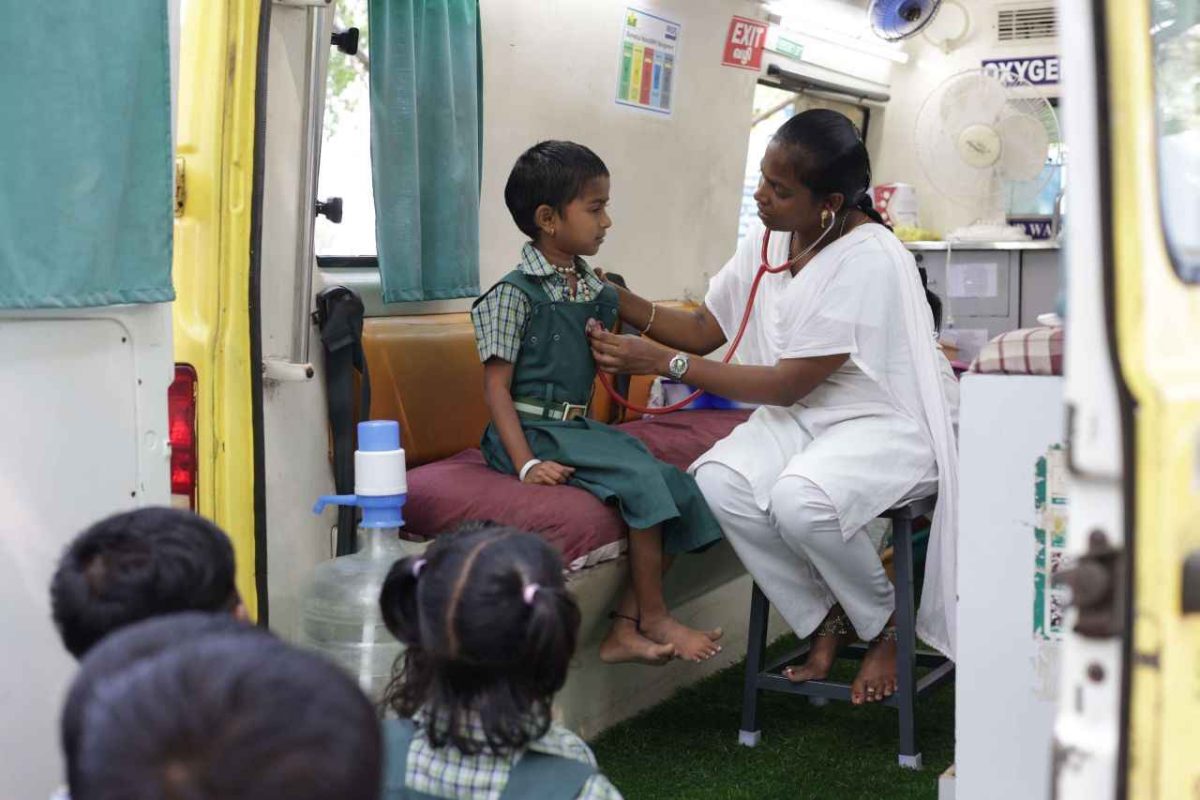
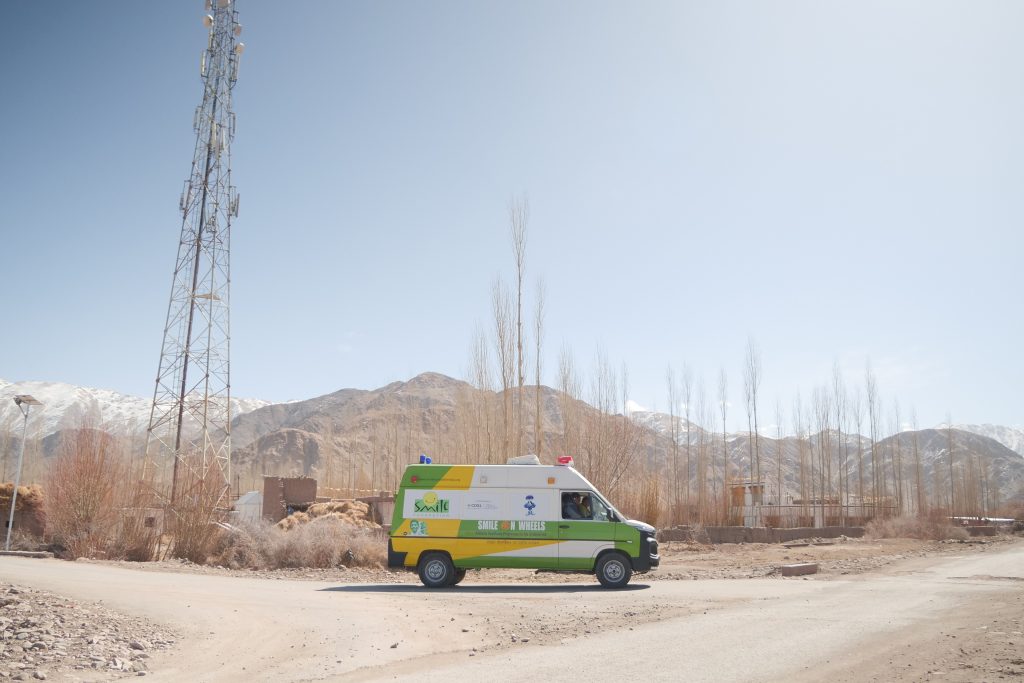
This is where primary healthcare and community-based outreach become critical. Smile Foundation’s healthcare programme takes a last-mile approach, bringing primary healthcare services to underserved communities across rural and urban India. Through initiatives such as Smile on Wheels, mobile medical units provide doorstep access to consultations, basic diagnostics, medicines and referrals, alongside preventive and health-awareness services. The aim is not simply to treat people when they fall sick, but to make healthcare more accessible and encourage communities to seek care earlier.
That distinction is important because prevention is not just about telling people to get a health check-up. It is about making that check-up possible.
For someone who cannot afford to lose a day’s income, bringing healthcare closer to home can remove a barrier that awareness alone cannot. For communities with limited access to health information, conversations about nutrition, hygiene, immunisation, chronic diseases and early symptoms can help turn awareness into health-seeking behaviour.
In 2025–26, Smile Foundation says its integrated community healthcare initiatives delivered 2 million healthcare treatments in a single financial year, with its primary healthcare model combining mobile healthcare delivery, preventive engagement, digital innovations and system-strengthening efforts.
The larger lesson is straightforward: if India wants prevention to become a habit rather than an afterthought, healthcare has to meet people where they are.
The Bigger Picture
Prevention is the cheapest, most effective tool healthcare has and it works best precisely for the people currently least able to access it. Stronger primary care, greater investment in health education, and a shift in mindset so that “staying healthy” is prioritized is how you’re protecting the very thing India is counting on: a young, healthy, productive population capable of carrying the country’s ambitions forward.
FAQs
1. What is preventive healthcare? Preventive healthcare focuses on preventing illness, identifying health risks early and reducing the likelihood of complications. It can include regular health check-ups, screenings, vaccinations, health education, nutrition support and early intervention.
2. Why is preventive healthcare important in India? Preventive healthcare can help identify health problems before they become serious and expensive to treat. It is particularly important in communities where the cost, distance or time involved in accessing healthcare can lead people to delay seeking care.
3. Why do people delay preventive health check-ups? People may postpone check-ups because they feel healthy, cannot afford to lose working hours, lack awareness about screening, face transport barriers or have limited access to nearby healthcare facilities.
4. What are some examples of preventive healthcare? Examples include screening for conditions such as high blood pressure and diabetes, vaccinations, antenatal care, nutrition counselling, health education, regular check-ups and early detection of health risks.
5. Who faces the greatest barriers to preventive healthcare? People living in underserved rural and urban communities can face significant barriers because of limited healthcare infrastructure, affordability challenges, distance and gaps in health awareness. Smile Foundation’s healthcare programme specifically works to address these last-mile gaps.
6. How does early detection help? Early detection can allow health conditions to be identified and managed before they progress or cause complications. This can make treatment more manageable and potentially reduce the financial and social costs associated with advanced illness.
7. How does Smile Foundation support preventive healthcare? Smile Foundation provides primary healthcare services to underserved communities through its community-centric healthcare programme. Its Smile on Wheels mobile medical units bring healthcare closer to people in rural and urban communities and provide preventive, promotive and curative services.
8. What is Smile on Wheels? Smile on Wheels is Smile Foundation’s flagship mobile healthcare programme. It takes healthcare services to the doorsteps of underserved communities, helping address barriers related to accessibility, availability and health-seeking behaviour.
9. Why is primary healthcare important for prevention? Primary healthcare is often the first point at which people can access screening, basic diagnosis, health advice and early treatment. Bringing these services closer to communities can make prevention more practical and accessible.
10. How can India strengthen preventive healthcare? India can strengthen prevention by investing in accessible primary healthcare, community-based screening, health education, frontline health workers, affordable diagnostics and outreach that reaches people beyond major cities.
11. Is preventive healthcare only about avoiding disease? No. Prevention also means supporting people to maintain good health, recognise risks early and make informed decisions about their health. It includes health promotion, awareness, screening, early intervention and appropriate referral.
12. Why does preventive healthcare matter for India’s future? A healthier population is better positioned to work, learn, care for families and participate in the economy. For a country with a large young population, investing in prevention is therefore not only a healthcare priority but also an investment in human and economic potential.
Surge in student suicides in India puts focus on mental health challenges
PC Mahalanobis gave the world a statistical tool that is, by almost any measure, more useful today than when he first proposed it in the 1930s. The Mahalanobis distance — a method for measuring how far a data point lies from a distribution, while accounting for the shape and spread of that data — has become a foundational technique in modern data science, machine learning and anomaly detection.
This blog explains what the Mahalanobis distance is, how it works, where it is used and why the man behind it deserves a more prominent place in the history of data science than he typically receives.
Who is PC Mahalanobis — Life and Legacy
Prasanta Chandra Mahalanobis was born on 29 June 1893 in Calcutta, into a family with deep roots in Bengal’s intellectual and reform traditions. He studied physics at Presidency College, Calcutta, where his teachers included Jagadish Chandra Bose, before travelling to King’s College, Cambridge, to continue his education in mathematics and physics.
It was during this period in England that a passing introduction to statistics changed the course of his life. He returned to India with a new conviction: that rigorous data collection and statistical reasoning could be applied to real, pressing problems in agriculture, anthropology, economics and public policy.
What followed was a career of extraordinary breadth. PC Mahalanobis founded the Indian Statistical Institute in Calcutta in 1931, established India’s first statistical journal and built the survey methods that laid the groundwork for India’s National Sample Survey — systems that continue to inform government policy to this day. He also played a central role in shaping India’s Second Five Year Plan, where his macro-economic model prioritised heavy industry investment as the foundation for long-term growth.
He was elected a Fellow of the Royal Society in 1945, received the Weldon Medal from Oxford University in 1944 and was awarded the Padma Vibhushan in 1968. He died in June 1972, one day before what would have been his seventy-ninth birthday.
Founding of the Indian Statistical Institute
The Indian Statistical Institute began in December 1931, growing out of an informal statistical laboratory that Mahalanobis had set up in his own room at Presidency College. Initially registered as a non-profit learned society in April 1932, it operated on a budget of just 238 rupees in its first year.
Over the following decades, ISI expanded into a globally recognised centre for statistical and quantitative research. In 1933, it launched Sankhya — India’s first academic statistics journal, still published today — which carried many of Mahalanobis’s landmark papers, including the original formulation of what would become the Mahalanobis distance.
ISI’s Kolkata campus became a hub for interdisciplinary research spanning economics, genetics, computer science and sociology. It trained generations of statisticians who went on to shape statistical practice in India and internationally. The Institute remains one of the most rigorous quantitative research institutions in the world.
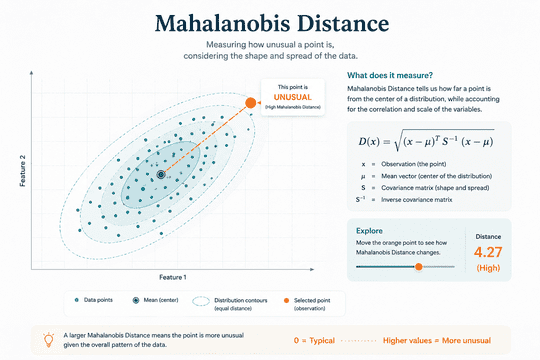
how unusual is this data point, given everything we know about the distribution it comes from?
Imagine you are looking at the heights and weights of a large group of people. You want to know whether a specific individual’s measurements are typical or unusual. The challenge is that height and weight are correlated — taller people tend to weigh more — and they are measured in completely different units. A simple measurement of distance from the average would ignore both of these facts.
The Mahalanobis distance solves this by accounting for the correlation between variables and the scale of each variable simultaneously. It transforms the space in which the measurement exists, stretching and rotating it to reflect the actual shape of the data, and then measures distance within that corrected space. The result is a single number that tells you, in a statistically meaningful way, how far a point lies from the centre of its distribution.
A Mahalanobis distance of zero means the point is exactly at the mean of the distribution. The larger the value, the more unusual the observation — regardless of how many variables are involved.
The Formula and How It Works
The Mahalanobis distance between a point x and a distribution with mean vector mu and covariance matrix S is defined as:
D(x) = sqrt [ (x – mu)^T * S^-1 * (x – mu) ]
Breaking this down:
(x – mu) is the difference between the point and the mean of the distribution, a vector when multiple variables are involved.
S^-1 is the inverse of the covariance matrix — the key term that accounts for how variables are spread and correlated. This is what distinguishes the Mahalanobis distance from simpler distance measures.
The transpose and multiplication combine these to produce a single scalar value.
In practical terms, the covariance matrix describes the shape of the data cloud. If two variables are highly correlated, the data cloud is elongated in a particular direction. The inverse covariance matrix essentially normalises this shape, so that what appears to be a large distance in one direction is correctly recognised as not unusual if it follows the natural spread of the data.
The result is unitless meaning it does not depend on the original scale of any individual variable and can be compared directly across observations, regardless of the number of variables involved.
Mahalanobis Distance vs Euclidean Distance
The Euclidean distance is the straightforward geometric distance between two points — the kind taught in secondary school geometry. It works reliably when variables are uncorrelated and measured on the same scale.
Real-world data almost never meets both conditions simultaneously.
Feature
Euclidean Distance
Mahalanobis Distance
Accounts for correlation
No
Yes
Scale-independent
No
Yes
Works with multiple variables
Partly
Fully
Sensitive to variable units
Yes
No
Handles elongated data clouds
No
Yes
Consider a dataset where one variable ranges from 0 to 1 and another ranges from 0 to 10,000. Euclidean distance would be dominated almost entirely by the larger-scale variable, making the smaller one irrelevant. Mahalanobis distance normalises for this automatically.
Similarly, if two variables are highly correlated, a Euclidean measurement might flag a point as an outlier simply because it deviates from the mean in both variables simultaneously — even if that joint deviation is perfectly consistent with the correlation structure of the data. Mahalanobis distance would correctly identify this as a typical observation.
This is why data scientists prefer Mahalanobis distance for multivariate problems and why it has remained a standard tool more than 85 years after it was first proposed.
Applications of Mahalanobis Distance in Data Science
The Mahalanobis distance has found a wide range of practical applications in modern data science, reflecting both its mathematical rigour and its intuitive logic.
Outlier Detection, Clustering and Machine Learning
Outlier and anomaly detection is perhaps the most common application. In any dataset, an observation with a high Mahalanobis distance from the rest of the data is, by definition, statistically unusual. This makes the measure particularly useful in:
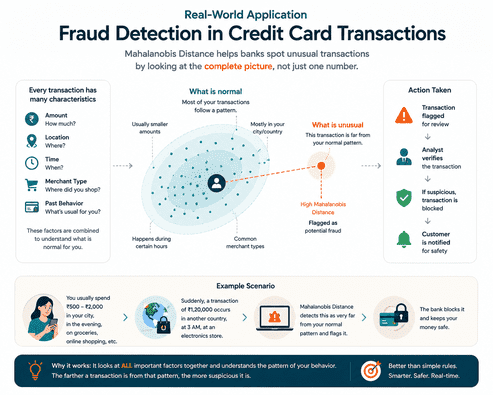
Financial fraud detection — identifying transactions that deviate significantly from a customer’s normal pattern of behaviour, accounting for correlations between transaction amount, time, location and merchant type simultaneously.
Medical diagnostics — detecting patients whose combination of clinical markers falls unusually far from reference population norms, even when each individual marker might appear borderline.
Manufacturing quality control — identifying products whose combination of measurable properties falls outside acceptable limits, even when no single property is individually defective.
Cybersecurity — flagging network activity that deviates from established behavioural baselines in multivariate ways that simple threshold rules would miss.
In machine learning, Mahalanobis distance appears across several core techniques:
In Linear Discriminant Analysis (LDA), classifying a new observation into one of several groups involves comparing its Mahalanobis distance from each group’s centroid. The observation is assigned to the group whose centroid it is closest to, in the Mahalanobis sense.
In k-Nearest Neighbour algorithms, replacing Euclidean distance with Mahalanobis distance often improves classification accuracy on correlated, multi-scale datasets.
In Gaussian mixture models and cluster analysis, Mahalanobis distance is used to assign observations to clusters in a way that respects the shape of each cluster rather than assuming circular symmetry.
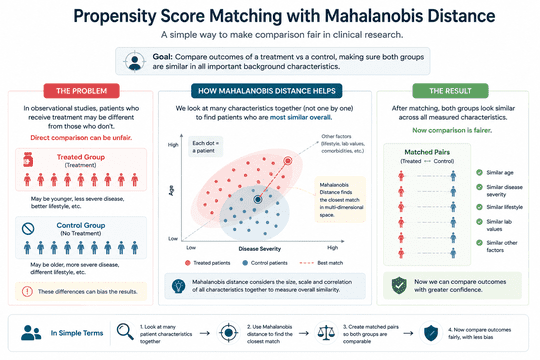
In clinical research, the Mahalanobis distance is used to assess whether individuals or groups are genuinely comparable — a technique called propensity score matching — ensuring that treated and control groups in observational studies are appropriately balanced across multiple background characteristics simultaneously.
PC Mahalanobis and the Second Five-Year Plan
Beyond his statistical contributions, PC Mahalanobis played a defining role in shaping India’s post-independence economic strategy. As a member of the Planning Commission, he developed what became known as the Mahalanobis Model — the strategic framework behind India’s Second Five Year Plan (1956 to 1961).
The model argued that sustained economic growth required prioritising investment in heavy industry and capital goods, rather than concentrating resources on consumer goods production. By building domestic productive capacity — steel mills, machine tools, power generation — India would create the foundation for long-term industrialisation rather than remaining dependent on imported capital equipment.
The model drew on his statistical background in a direct way, that is, built on input-output analysis and aggregate growth accounting, applying quantitative reasoning to economic planning at a national scale. While economic historians have debated its consequences, the model reflected a genuine and sophisticated attempt to apply statistical thinking to one of the most consequential policy decisions of newly independent India.
Why India Celebrates National Statistics Day on His Birthday
In 2006, the Government of India announced that 29 June, the birthday of PC Mahalanobis, would be observed annually as National Statistics Day. The first official celebration took place in 2007.
The choice acknowledges not only his specific contributions — the Mahalanobis distance, the Indian Statistical Institute, the National Sample Survey methodology — but the broader idea he embodied: that rigorous, evidence-based statistical reasoning is essential for good governance, sound policy and equitable development.
National Statistics Day is observed each year with seminars, academic events and policy discussions organised by the Ministry of Statistics and Programme Implementation, typically focused on a theme relevant to current data and development priorities.
As India moves deeper into a data-driven economy where decisions in agriculture, public health, urban planning and financial services increasingly rely on statistical inference, the foundations that PC Mahalanobis built become more relevant, not less.
FAQs — Mahalanobis Distance and PC Mahalanobis
Who is PC Mahalanobis and what is he known for?
Prasanta Chandra Mahalanobis was an Indian statistician who founded the Indian Statistical Institute, developed the Mahalanobis distance and played a central role in India’s post-independence economic planning. He is widely regarded as the father of statistics in India and his birthday is celebrated as National Statistics Day on 29 June each year.
What is Mahalanobis distance in simple terms?
It is a measure of how unusual a data point is relative to a distribution, accounting for the correlation and scale of all variables involved. Unlike simpler distance measures, it correctly handles situations where variables are correlated or measured in different units.
How is Mahalanobis distance different from Euclidean distance?
Euclidean distance measures straight-line distance between points but ignores correlation between variables and differences in scale. Mahalanobis distance corrects for both, making it more accurate and meaningful for multivariate, real-world datasets.
What is the formula for Mahalanobis distance?
D(x) = sqrt [ (x – mu)^T * S^-1 * (x – mu) ], where x is the data point, mu is the mean vector of the distribution, and S^-1 is the inverse of the covariance matrix. The covariance matrix is what accounts for the correlation structure and scale of the data.
How is Mahalanobis distance used in machine learning?
It is used in outlier detection, Linear Discriminant Analysis, k-Nearest Neighbour classification and cluster analysis. In each case, it provides a more accurate measure of statistical distance than Euclidean distance when variables are correlated or on different scales.
What is the Indian Statistical Institute and who founded it?
The Indian Statistical Institute was founded by PC Mahalanobis in Calcutta in 1931. It grew from a small statistical laboratory at Presidency College into a globally recognised centre for statistical and quantitative research, and remains one of the leading such institutions in the world.
How did PC Mahalanobis contribute to India’s economic planning?
He developed the Mahalanobis Model, which shaped India’s Second Five Year Plan (1956 to 1961) by arguing for prioritised investment in heavy industry as the foundation for long-term economic growth. He also pioneered the large-scale sample survey methods used by India’s National Sample Survey to collect economic and demographic data.
Why is National Statistics Day celebrated on June 29?
29 June is the birthday of PC Mahalanobis. The Government of India designated it as National Statistics Day in 2006 to recognise his contributions to statistical science, survey methodology and evidence-based governance.
Where is Mahalanobis distance used in real-world data science?
Applications include financial fraud detection, medical diagnostics, manufacturing quality control, cybersecurity anomaly detection, propensity score matching in clinical research, and classification tasks in machine learning wherever multiple correlated variables need to be assessed jointly.
What is the significance of PC Mahalanobis in modern statistics?
His development of the Mahalanobis distance gave statisticians and data scientists a tool for multivariate analysis that remains widely used nearly 90 years later. His institutional legacies like ISI, Sankhya, the National Sample Survey built the statistical infrastructure that modern India relies on for governance, planning and research.
Entrepreneurship development equips individuals with the skills, knowledge and confidence to start and grow businesses.
Women entrepreneurs contribute significantly to economic growth but continue to face barriers related to finance, markets, skills and mobility.
Effective entrepreneurship development programmes combine training, mentorship, financial literacy, market access and business support.
Digital tools, government schemes, and ecosystem linkages are expanding opportunities for women-led enterprises.
Investing in women entrepreneurs creates ripple effects across families, communities and local economies.
Why Entrepreneurship Development Matters More Than Ever
India could add USD 0.7 trillion to its GDP. The barrier is not ambition — it is access.
Women entrepreneurs reinvest up to 90% of their income back into their families and communities. The evidence for their economic multiplier effect is overwhelming. And yet in India, women account for only 20% of all MSMEs, and the majority of those operate informally, on a micro scale, in low-return sectors.
The McKinsey Global Institute has estimated that closing India’s gender gap in workforce participation could add USD 0.7 trillion to the country’s GDP by 2025. That number represents millions of women who have the drive and the ideas but not the credit history, the digital skills, the market access or the mentorship to turn potential into a sustainable business.
Despite significant policy advances — Skill India, PMKVY, MUDRA Yojana, Stand-Up India and Startup India — systemic barriers persist, especially for women from rural, low-income and marginalised backgrounds. These aren’t individual failures but structural gaps that require structural solutions.
Six barriers Smile Foundation is working to dismantle
THE CHALLENGE
The barriers holding women entrepreneurs back
Entrepreneurship potential exists everywhere. Opportunity does not.
01
Limited Access to Capital
First-generation entrepreneurs often lack collateral,
credit history and formal documentation needed for loans.
02
Low Financial Literacy
Only 24% of women in India are financially literate,
limiting engagement with formal banking systems.
03
Lack of Market Exposure
Women-led enterprises often remain disconnected from
value chains, trade fairs and e-commerce opportunities.
04
Low Digital Skills
Limited digital access restricts growth and participation
in higher-value sectors.
05
Time Poverty
Unpaid care responsibilities reduce time available for
networking, training and enterprise development.
06
Limited Collateral
Informal and home-based businesses often struggle to
qualify for formal lending programmes.
The solution
A funnel-based, four-year-tested model that takes women from mobilisation to market
Since 2005, Smile Foundation’s Swabhiman programme has been building the infrastructure for women’s economic empowerment — reaching over 1,90,000 women across rural villages and urban slums in 26 states. Two complementary programmes now sit at the heart of this work: the Livelihood and Enterprise Development Program (LEDP) and the Women Entrepreneurship Development Program (WEDP).
Both follow a structured, funnel-based approach — beginning with community outreach, moving through intensive training, and culminating in seed-funded enterprise launches with sustained mentorship. The model is not a single intervention but an integrated system. It recognises that a woman who receives entrepreneurship training without access to capital will stall. A woman who receives capital without market linkages will plateau. Only when all the pieces connect does a micro-enterprise become sustainable.
“The programme promotes self-reliance and long-term economic empowerment of women through inclusive and sustainable enterprise development.”
THE APPROACH
From aspiration to enterprise.
A structured pathway designed to help women move from ideas to sustainable businesses.
1
Community Mob
Identifying and enrolling aspiring women entrepreneurs through grassroots networks.
2
Training
Business planning, financial literacy, digital skills and market readiness.
3
Enterprise Setup
Seed capital support and access to MUDRA, PMEGP and Startup India.
4
Market Linkages
Connecting women to trade fairs, buyers and digital marketplaces.
5
Mentorship & Incubation
Ongoing support, peer learning and business growth guidance.
Programme components
What each phase of the programme delivers
PROGRAMME ARCHITECTURE
Six building blocks.
One entrepreneurship ecosystem.
Mobilisation & Baseline Assessment
Community sensitisation, participatory rural appraisal (PRA),
and socio-economic profiling of enrolled women.
Capacity Building & EDP
Entrepreneurship development training, vocational skills,
digital literacy and financial capability building.
Enterprise Setup Support
Business planning workshops, seed capital support,
microfinance and government scheme linkages.
Market & Ecosystem Linkages
Exposure visits, exhibitions, branding, packaging
and marketing communication support.
Mentoring & Handholding
Monthly reviews, peer learning circles and
ongoing advisory support.
Monitoring & Exit Planning
Midline and endline assessments, documentation
and scale-up planning through cooperatives.
Target and outcomes
Who benefits — and what success looks like
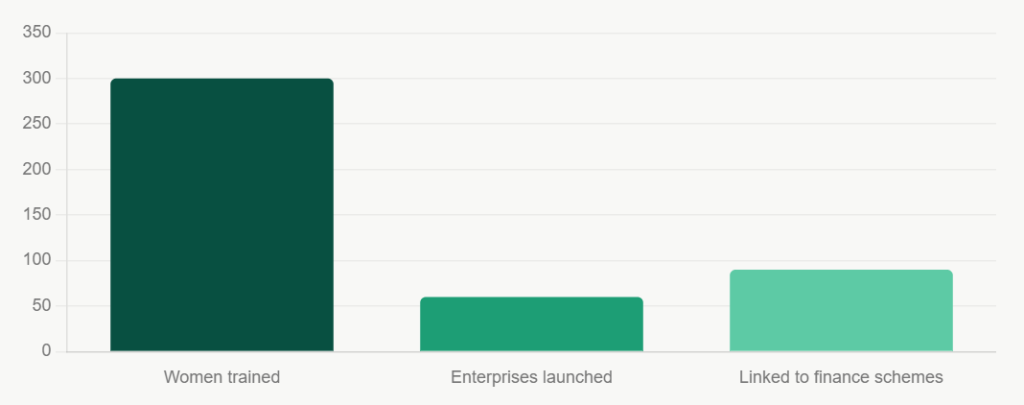
Each programme cycle directly reaches 300 women from low-income and marginalised communities, with an indirect reach of 1,500+ household members and community stakeholders. The outcomes are defined, tracked, and reported — not aspirational.
EXPECTED OUTCOMES
What success looks like.
300 women
trained in entrepreneurship, vocational, digital and financial literacy skills.
60 women
establish or expand enterprises through seed capital support.
30%
linked to formal credit channels, microfinance institutions and government schemes.
Increased household income and reduced dependence on seasonal labour.
Enhanced confidence, leadership and decision-making power among women entrepreneurs.
Stronger revenues, market presence and long-term sustainability of women-led enterprises.
Why this matters
Economic independence is not a women’s issue. It is an economic imperative.
The case for investing in women’s entrepreneurship is both moral and economic. When women control income, they spend it differently — on children’s nutrition, on healthcare, on education. The multiplier effects are documented across decades of development research. India’s MSME sector, which employs over 110 million people, cannot reach its potential while 80% of its enterprises are led by men alone.
LEDP and WEDP are not standalone training programmes. They are an integrated ecosystem — one that addresses capital, skills, market access, mentorship, and digital literacy in a single, sustained engagement. The funnel model is deliberate: not every woman who enters the programme will launch an enterprise, but every woman will emerge more financially literate, more digitally capable, and more connected to formal support systems than when she entered.
That shift — from economic invisibility to recognised participation — is itself transformative. And for the 60 women in each cycle who do launch enterprises, the potential ripple effects into their households and communities make every investment in this programme not just a social good, but a sound one.
“SSP is not only creating industry-ready engineers, but also empowering a generation of leaders who will break down barriers and pave the way for others to follow.”
ABOUT SMILE FOUNDATION
Transforming lives through education, healthcare, livelihoods and women empowerment.
Smile Foundation was set up in 2002 by a group of professionals in New Delhi, India. Today, it directly benefits over 15 lakh children and their families every year through integrated interventions across education, healthcare, livelihood, and women empowerment.
Working in more than 2,000 villages and urban communities across 26 states, the organisation continues to strengthen pathways to sustainable development for underserved populations.
Entrepreneurship development is the process of building entrepreneurial skills, knowledge, and capabilities to help individuals start, manage and grow successful businesses.
2. Why is entrepreneurship development important for women?
It helps women achieve financial independence, access income opportunities, strengthen leadership skills and contribute to household and community development.
3. What skills are taught in entrepreneurship development programmes?
Common areas include business planning, financial literacy, digital marketing, market research, enterprise management and customer engagement.
4. How does entrepreneurship development contribute to economic growth?
It creates new businesses, generates employment, increases incomes and stimulates local economic activity.
5. What are the biggest challenges faced by women entrepreneurs?
Key challenges include limited access to finance, low financial literacy, restricted market access, digital barriers and social or cultural constraints.
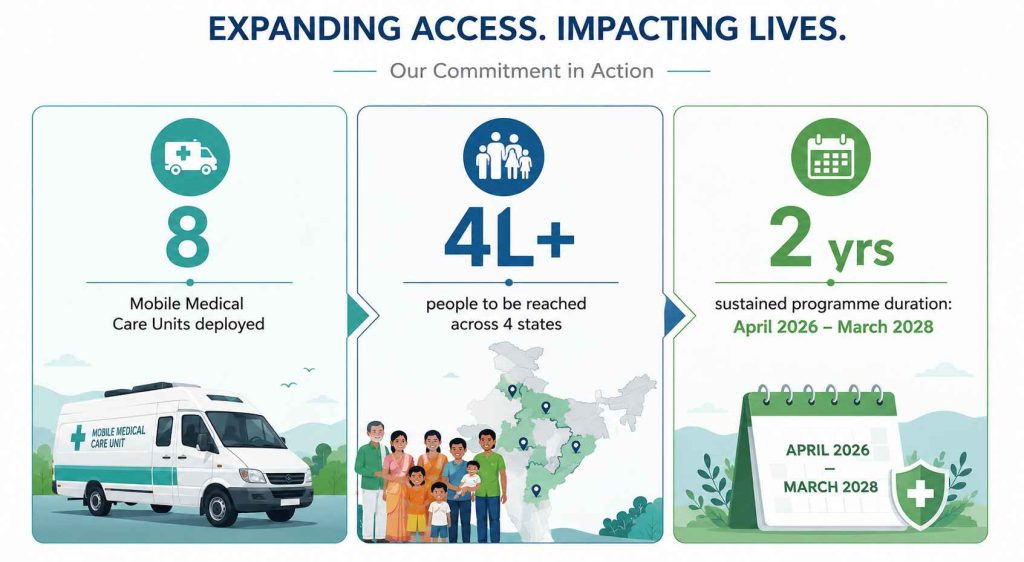
Smile Foundation and HDFC Parivartan launched eight Mobile Medical Care Units (MMCUs) in March 2026, targeting four lakh people in remote communities across J&K, Ladakh, Punjab and Uttarakhand.
The two-year initiative goes beyond treatment — it integrates preventive screenings, maternal and child health, and disease awareness to address health vulnerabilities before they become crises.
The programme is embedded in a wider public health ecosystem, with referral linkages to PHCs, CHCs and government schemes under the National Health Mission, following ICMR protocols.
The partnership reflects a wider shift in CSR from one-time philanthropy to long-term developmental infrastructure — and offers a replicable model for what impact at scale genuinely requires.
Impact at scale
Impact at Scale: Eight vans. Four lakh people. One larger question.
In March 2026, Smile Foundation and HDFC Bank’s CSR initiative, HDFC Parivartan, announced the launch of eight Mobile Medical Care Units (MMCUs) across Jammu & Kashmir, Ladakh, Punjab and Uttarakhand. The programme aims to deliver integrated primary healthcare services to more than four lakh people living in geographically remote communities over the next two years.
The mobile units will provide OPD consultations, diagnostics, medicines, maternal and child healthcare, disease screenings and health awareness programmes delivered directly at the community level, without asking people to travel to institutions that may be hours away or seasonally inaccessible.
At first glance, this may appear like yet another CSR-led healthcare intervention in rural India. There have been many. But the significance of this partnership lies less in the number of vans deployed and more in what the initiative reveals about the realities of delivering impact at scale in a country as vast and unequal as India. Because scale, in development work, is not simply about expansion. It is about systems.
In pursuit of last-mile access
Why These States for Impact at Scale?
🏔️
Mountain & Border Regions
LadakhUttarakhandJammu & Kashmir
Among India’s most geographically challenging terrains.
Extreme altitude, seasonal road closures and long travel
distances make access to healthcare structurally difficult.
🌾
Rural Punjab
Better connected than mountain regions, yet many communities
continue to face barriers to preventive healthcare and early
diagnosis due to distance, awareness and limited healthcare-seeking behaviour.
🚑
Mobile healthcare bridges the distance between vulnerable communities and essential care.
India’s healthcare infrastructure has improved substantially over the last decade. But access remains deeply uneven. In remote terrains such as Ladakh or the hilly districts of Uttarakhand, healthcare facilities are often separated from communities by long travel times, poor road connectivity, seasonal weather conditions and chronic shortages of trained medical personnel.
For vulnerable populations, healthcare is not always absent — it is frequently inaccessible. This distinction matters enormously. Absence implies a gap that more facilities could fill. Inaccessibility implies a structural problem that requires structural solutions — mobile infrastructure, community-embedded care and sustained engagement rather than episodic outreach.
This is where mobile healthcare models become genuinely important. Rather than expecting communities to navigate fragile infrastructure in search of care, the infrastructure itself moves toward them. The MMCUs launched under the Smile Foundation–HDFC Parivartan partnership are designed precisely around this principle of last-mile delivery.
HEALTHCARE ON WHEELS
More than a mobile clinic.
Each MMCU functions as a primary health facility on wheels,
bringing essential healthcare services directly to communities
that are often beyond the reach of conventional systems.
🚑
01
Consultation
Medical consultations, medicines and referrals delivered
closer to communities.
02
Detect
Screening for hypertension, diabetes and anaemia —
conditions that often remain undiagnosed for years.
03
Health Ed
Interactive sessions on hygiene, nutrition and menstrual
health strengthen preventive healthcare among children.
Healthcare does not wait for communities to travel.
It travels to them.
The idea of last-mile access has become central to contemporary development discourse. But implementing it consistently is far more difficult than the phrase suggests. Reaching remote populations reliably requires logistical planning, local partnerships, medical staffing, data systems, and sustained financial commitment. It also requires interventions flexible enough to adapt to geography, culture, and resource limitations without compromising quality of care.
Why collaborations like this one are becoming essential for impact at scale
Corporate social responsibility programmes often possess the financial capacity to fund large-scale interventions. But funding is not the same as execution. This is why collaborations between corporations and implementation-focused nonprofits are increasingly indispensable to achieving impact at scale.
Organisations like Smile Foundation bring what cannot easily be purchased or replicated: operational knowledge of local ecosystems. How communities interact with healthcare systems. What barriers prevent uptake. How trust is built over time. What forms of outreach actually work on the ground as opposed to what looks effective in a programme document.
“Lasting impact requires patient infrastructure. It requires partnerships that combine funding with implementation expertise, mobility with continuity, and service delivery with systems integration.”— Smile Foundation Programme Framework, 2026
This partnership also reflects a growing shift within CSR itself — away from short-term philanthropy and toward long-term developmental infrastructure. The healthcare programme will run from April 2026 to March 2028, indicating a model built on sustained presence rather than one-time visibility.
That distinction is not rhetorical. Healthcare outcomes are rarely immediate. Building preventive health habits, ensuring continuity of treatment, and improving maternal or child health indicators require long-term engagement. A community that receives a health camp once every six months is not the same as one that has reliable access to primary care. The MMCU model is designed around the latter.
Prevention as infrastructure — the underemphasised half of healthcare
India’s public health conversation is dominated by treatment. How many hospital beds, how many doctors per thousand people, how many tertiary care facilities. These are important metrics. But they systematically undervalue the dimension of care that has the highest long-term return: prevention.
In underserved communities, preventive healthcare can significantly reduce both financial distress and health complications. Conditions like anaemia or hypertension frequently remain undiagnosed for years because communities lack regular access to screenings and basic primary care. By the time they are identified, the cost of treatment — personal, economic and social — has multiplied.
The MMCUs address this directly. Adult screenings for hypertension, diabetes, and anaemia are built into every unit’s service delivery. School health sessions extend the model to younger populations. The result is a programme that expands the very ambit of healthcare — from treatment alone to the full spectrum of prevention, early intervention, and awareness.
BEHAVIOUR CHANGE AT SCALE
Healthcare becomes part of life,
not just a response to illness.
01
Crisis-driven engagement
In many underserved communities, people seek medical care
only when symptoms become severe.
02
Regular MMCU visits
Consistent presence brings healthcare closer, reducing
the need for long and costly journeys.
03
A new habit forms
Consulting a doctor becomes routine rather than exceptional.
04
Health outcomes improve
Earlier diagnosis, timely treatment and greater health
awareness strengthen community wellbeing.
❝
The regular presence of healthcare is itself
a public health intervention.
Ecosystem thinking — why integration matters more than coverage
Healthcare delivery often fails not because services are entirely absent, but because systems remain fragmented. A patient diagnosed through a mobile unit still requires continuous care — referrals, access to medicines, institutional follow-up and sometimes hospitalisation. If that pathway is broken, the diagnosis itself provides limited long-term value.
The Smile Foundation–HDFC Parivartan initiative addresses this explicitly. The programme integrates referral linkages with Primary Health Centres, Community Health Centres and government schemes under the National Health Mission, while adhering to protocols set by the Indian Council of Medical Research. This is the architecture that makes impact at scale possible rather than merely impressive.
Effective social interventions depend on how well different systems — nonprofit, corporate and public — work together. The MMCU model is designed as a connector: it reaches communities that public infrastructure struggles to serve consistently, while feeding into the public system rather than operating parallel to it. That integration is what allows individual encounters to become sustained healthcare relationships.
Beyond healthcare, the broader Smile Foundation–HDFC Parivartan partnership also extends into skilling and livelihoods. In Bareilly, Uttar Pradesh, the two organisations recently launched a Parivartan Skilling Centre, training underserved youth for employment in BFSI and retail sectors. This reflects an increasingly important understanding in development practice: social vulnerabilities are interconnected. Healthcare outcomes are linked to livelihoods, nutrition, education, mobility, and financial stability. Addressing one in isolation rarely achieves the depth of change that communities actually need.
The real meaning of impact at scale
What emerges from this partnership, then, is not simply a story about mobile healthcare vans. It is a larger lesson about how change transforms into impact at scale, and why the phrase deserves more scrutiny than it typically receives.
Impact at scale is frequently discussed as if it were a question of reach alone. How many people, how many districts, how many units. But reach without continuity is outreach. Reach without integration is fragmentation. Reach without trust is low uptake. The Smile Foundation–HDFC Parivartan model is notable precisely because it takes all of these seriously, not as afterthoughts, but as foundational design principles.
In a country where millions still remain outside the effective reach of quality healthcare, the systems that enable consistent access matter as much as the services themselves. Transformation — in public health, in poverty reduction, in human development broadly — rarely happens because of one large announcement. More often, it happens through sustained, repetitive acts of access. Through the van that shows up every month. Through the health worker who knows the community. Through the referral that actually connects to the right facility.
“Scale is not only about reaching more people. It is about building systems capable of reaching people consistently — and with dignity.”— Smile Foundation, Programme Philosophy
That, perhaps, is the most important lesson from this initiative: that the ambition to achieve impact at scale must be matched by the patience to build the infrastructure that makes it real — and the humility to recognise that in development work, consistency is a form of excellence.
Frequently asked questions (FAQs)
What exactly are Mobile Medical Care Units and what services do they provide? ▾
Mobile Medical Care Units (MMCUs) are fully equipped vehicles designed to bring primary healthcare directly to communities that lack easy access to health facilities. Each unit provides OPD consultations, basic diagnostics, medicines, maternal and child healthcare, disease screenings — including for hypertension, diabetes, and anaemia — and health awareness sessions covering hygiene, nutrition, and menstrual health. Unlike one-time health camps, MMCUs operate on regular schedules in fixed community locations, making healthcare engagement predictable and routine rather than crisis-driven.
Why were Jammu & Kashmir, Ladakh, Punjab and Uttarakhand chosen for this initiative? ▾
These states represent some of India’s most geographically challenging terrains for healthcare delivery. In Ladakh and the hilly districts of Uttarakhand, extreme altitude, seasonal road closures, and long travel distances make consistent access to health facilities structurally difficult — particularly for elderly, pregnant, or seriously ill community members. Jammu & Kashmir has remote communities where healthcare infrastructure, while present in theory, remains functionally inaccessible to large portions of the population. Punjab, despite better connectivity, has rural pockets where preventive healthcare and early diagnostics remain significantly underutilised.
How does this programme connect to the wider public health system — does it operate independently? ▾
No — integration with the public health system is central to its design. The programme establishes referral linkages with Primary Health Centres (PHCs) and Community Health Centres (CHCs), and connects patients to government health schemes under the National Health Mission. Medical protocols follow ICMR guidelines. This is deliberate: the MMCUs are not a parallel healthcare system but a connector — designed to reach communities that public infrastructure serves inconsistently, while ensuring patients are channelled into public systems for continuous care, follow-up, and hospitalisation where needed.
What makes this different from a typical CSR health camp or outreach programme? ▾
Three things distinguish it from conventional outreach. First, duration: the programme runs for two years (April 2026 – March 2028), not a single day or season. Second, prevention focus: it doesn’t only treat existing illness — it screens for undiagnosed conditions, conducts school health sessions, and builds health literacy in communities over time. Third, systems integration: it is linked to public health infrastructure through referrals and government schemes, ensuring patients can access continuous care beyond what the MMCU itself provides. Together, these features shift the model from outreach to infrastructure.
How does Smile Foundation’s role in this partnership differ from that of HDFC Parivartan? ▾
HDFC Parivartan — HDFC Bank’s CSR initiative — provides the financial capacity that enables the programme to operate at the scale and duration required for meaningful impact. Smile Foundation brings implementation expertise: knowledge of local ecosystems, experience building community trust, understanding of what forms of healthcare outreach actually work on the ground in specific geographies, and the operational infrastructure to manage staffing, logistics, and quality across multiple remote locations simultaneously. This combination — funding with field knowledge — is increasingly recognised as the minimum viable model for impact at scale in development work.
Smile Foundation
Smile Foundation is an Indian development organisation working across health, education and livelihood sectors. This article was produced by the Smile Foundation analysis desk. For partnership enquiries, contact cp@smilefoundationindia.org.
On Mother’s Day, we reach for flowers and gratitude. But somewhere between the sentiment and the system, we keep losing the actual woman — exhausted, resilient and still waiting for something more than applause.
IN THIS ESSAY
Why the myth of effortless motherhood does real harm and who pays the price
The postpartum reality most women experience and almost no one talks about honestly
Invisible labour, mental load and the structural invisibility of care work
Motherhood across India’s stark socio-economic divide and what that gap costs
The paradox of impossible love: joy that coexists with grief, exhaustion and loss of self
Why development programmes must treat maternal health as infrastructure
Redefining womanhood beyond the maternal — the women who choose differently
What a better Mother’s Day actually looks like
There is a photograph that exists in some version in nearly every Indian family album. A woman — young, usually — holding a newborn. She is smiling. She looks, in the photograph, like someone who has just arrived somewhere. Complete. Purposeful. At peace with a decision the universe made for her.
What the photograph does not show: the forty-eight hours before it was taken. The labour that didn’t progress the way anyone said it would. The stitches that made sitting painful for three weeks. The engorgement. The milk that came in too fast and then, for some women, too slow. The night feeds at 2am and 4am and 6am, when the line between exhaustion and hallucination starts to blur. The moment — and almost every new mother has this moment, though few say it aloud — when she looked at the baby and felt, instead of the promised flood of transcendent love, something closer to a flat, bewildered numbness. And the shame that followed. Because she had been told this was supposed to feel like everything.
Mother’s Day, which falls this year on the 10th of May, is built around the photograph. It is not built around what came before it or what has accumulated in the years since.
The first weeks, honestly
Postpartum depression affects an estimated one in five new mothers globally. In India, studies suggest the figure may be higher, closer to one in three in some populations, driven by nutritional depletion, lack of rest, absent support systems and the social expectation that a new mother should be visibly joyful at exactly the moment her body is doing its most demanding reconstruction work.
But the conversation almost never gets that far, because it requires first acknowledging the thing nobody wants to say: that the early weeks of motherhood are, for many women, frightening. Not because they don’t love their child. But because the self they knew — the one with her own rhythms, preferences, private thoughts, career ambitions, a body she recognised — has temporarily dissolved and nobody told her this would happen, or that it was allowed to feel like grief.
“The self she knew has temporarily dissolved, and nobody told her this would happen — or that it was allowed to feel like grief.”
What postpartum reality actually involves, for most women, is a negotiation no one has named for her. It involves the physical: a body that has just done something seismic, now expected to immediately function as a feeding apparatus. It involves the relational: a partnership that changes shape overnight, often without either person knowing quite how to talk about it. And it involves the existential — the disorienting question of who she is now, if not who she was before.
We should be talking about this more plainly. We are not.
The labour that doesn’t count
There is a category of work that economists call unpaid care work. It includes cooking, cleaning, childcare, eldercare, managing appointments, remembering which child needs which form signed by which date, tracking when the paracetamol runs out, noticing when the school shoes are too small. In India, on average, women do 2.6 times more unpaid care work than men, even when both are employed.
This is not a small statistic. It is the architecture of everyday life — invisible, uncounted, and almost entirely borne by women. The mental load — the cognitive work of managing a household — is a particular form of exhaustion that is hard to explain to someone who doesn’t carry it, because it never switches off. It is not work that ends when you stop doing it. It is work that continues in the background of every other thing you do: while you are on a work call, while you are trying to sleep, while you are sitting at your own mother’s table, presumably being celebrated.
What makes this especially acute in India is the near-complete absence of policy infrastructure around care. Maternity leave, where it exists and is actually enforced, covers the newborn period. It does not cover the decade that follows. Creches, after-school care, publicly funded support for new mothers: these remain patchy at best. The assumption, embedded in both policy and culture, is that this work will be done by women, voluntarily, for love. Which it is. But love does not explain why the work is exclusively hers. And it doesn’t explain why, when the work is counted, the woman doing it is not.
The impossible delight
And yet. And yet.
There is also this: the specific, undefended joy of a child’s first word, spoken into the quiet of a morning. The way a toddler reaches for your hand in a crowd not because they are afraid, exactly, but because you are the most solid thing they know. The unreasonable pride of watching someone you made become a person, with their own opinions and preferences and fierce small certainties about the world.
Motherhood is not only its difficulties. It is also this — an attachment so particular and so physical that it defies neat description. Women who would not describe themselves as sentimental find themselves standing outside closed bedroom doors, not wanting to wake their child, just listening to them breathe. This is not romance. It is something older and stranger, something that happens in the body before it happens in the mind.
The honest account of motherhood holds both of these things without resolving them. The exhaustion and the delight are not contradictions. They are the same experience, differently lit.
Which mothers are we talking about?
There is the mother who delivers in a private hospital in South Delhi, with an anaesthetist on standby, a lactation consultant on call the next morning and a cook at home to handle the first two months. Her postpartum difficulties are real. But they exist inside a net of support.
Then there is the woman in a village in Rajasthan or rural Jharkhand who walks four kilometres to reach the nearest health sub-centre, delivers without skilled attendance, returns to agricultural labour within days because stopping work means the family doesn’t eat and has never in her life had a conversation about her own nutritional needs — only about her baby’s. Her maternal mortality risk is not a metaphor. It is a statistic India is still working, urgently, to change.
These two women share the name “mother.” Their experiences share almost nothing else.
Anaemia affects more than half of all pregnant women in India. It is the single largest contributor to maternal mortality in the country, and it is almost entirely preventable with iron supplementation, dietary diversification and the kind of routine antenatal care that remains inaccessible or underfunded in too many districts. Stunting affects one in three Indian children — a direct consequence of maternal malnutrition before and during pregnancy. Girls who grow up malnourished become women who are malnourished in pregnancy, and the cycle, without intervention, continues.
And then there is menstrual health — the entry point to everything else. A girl who misses school every month because of pain and inadequate sanitation or because menstruation is still treated in her home as a condition requiring quarantine, is a girl whose educational trajectory is being shaped not by her ability but by a gap in basic infrastructure. Menstrual health is not a niche women’s issue. It is an education issue, a labour market issue and a maternal health issue because the girl who drops out at fourteen is, often, the woman who has her first child at seventeen.
“Menstrual health is not a niche women’s issue. It is an education issue, a labour market issue and a maternal health issue all at once.”
Programmes like those run by Smile Foundation work at exactly this intersection, combining nutrition counselling, maternal health outreach, menstrual hygiene support and community health education through initiatives like Swabhiman, which has reached hundreds of thousands of women and adolescent girls in underserved communities. The work is not glamorous. It is the work of going house to house, of training ANMs and ASHAs, of sitting with a woman who has never been asked about her own health and asking. It is the work of building the kind of trust that means she actually comes to the antenatal appointment this time.
This is what development work looks like when it takes maternal health seriously — not as a vertical programme, but as the load-bearing column of everything else.
Mothers at the centre of everything
There is evidence — consistent, replicated, difficult to argue with — that a child’s health outcomes are more strongly predicted by the mother’s education level than by almost any other single variable. That when women control household income, nutritional outcomes for children improve. That maternal mental health directly affects child development in the first three years of life. That communities where women are mobile, educated and participating in local governance are more resilient to health shocks and economic disruption.
What this means, practically, is that investing in mothers is not a sentimental choice. It is an infrastructural one. The return on every rupee spent on maternal nutrition, safe delivery, postpartum support, girls’ education, is not measured in gratitude. It is measured in the next generation’s health, cognitive development and life expectancy.
We spend a great deal of time celebrating mothers. We spend considerably less time building the systems that would make motherhood survivable, dignified and genuinely chosen.
The women who choose differently
It is worth naming, plainly and without qualification: there are women who do not want to become mothers. This number is growing — in India as everywhere else — as education levels rise, as women enter the workforce later and in larger numbers, as the cultural equation between womanhood and motherhood slowly, haltingly begins to loosen.
These women are not incomplete. They are not making a mistake they will regret. They are exercising an agency that previous generations of women were not permitted and they deserve to do so without the particular social pressure that comes from relatives at weddings, from medical professionals who ask why not instead of listening to the answer, from a cultural narrative that still treats childlessness in women as a condition rather than a decision.
Expanding the definition of womanhood to include women who are not mothers is not a threat to mothers. It is a form of respect for the actual range of human lives, and for the fact that a society in which motherhood is the only available script is not one in which motherhood is truly free.
What should actually change
A Mother’s Day that meant something would not look like cards and brunches. It would look like universal maternity entitlements enforced across the informal sector, where most women in India actually work. It would look like nutrition supplementation that reaches the last mile — the pregnant woman in the flood-prone hamlet who is not on anyone’s list. It would look like postpartum mental health screening embedded in routine antenatal care, rather than treated as an afterthought or a luxury. It would look like ASHA workers paid properly for the work they do — women who are, themselves, the mothers of India’s public health system and who are still largely unrecognised for it.
It would look like asking: what does this woman need? Not as a mother. As a person.
If you want to do something real this Mother’s Day
Here are some ways to turn sentiment into action
Support maternal health programmes — donate to organisations like Smile Foundation that work on nutrition, safe delivery and community health outreach in underserved communities
Sponsor a girl’s education, especially at the secondary level, where dropout rates spike and early marriage begins because the girl who stays in school becomes the woman with more choices
Visit and support children in care homes or orphanages — not as a gesture, but as a sustained relationship that gives a child what the state cannot adequately provide
Start a fundraiser for a maternal health or menstrual hygiene programme — even small amounts, when pooled, fund the kind of community outreach that changes a family’s trajectory
If you are an employer: examine your own policies — who gets flexible work, who gets genuine parental leave, whether your workplace makes it possible for women to continue existing as full people after they become mothers
Talk about postpartum mental health in your community — honestly, without euphemism — because the woman who knows she is allowed to struggle is the woman who might actually ask for help
None of these are simple. All of them are more useful than a bouquet.
The woman in the photograph is still there, years after it was taken. She is older. She carries more than she did. She has learned things about herself, her own resilience, her own capacity for a love she did not know she had — that she could not have known before. She has also lost things: sleep, certainly, and time, and some particular version of herself that existed before she became responsible for another person.
What she wants — if we ask her, which we mostly don’t — is not more gratitude. It is for the world her child is growing into to be one that takes care of the people who take care of everyone else. For the systems that support her to be as serious as the expectations placed on her. For her labour to be seen, counted and matched with something other than a single Sunday in May.
She is not asking to be celebrated. She is asking to be seen.
That is the harder gift. And the more honest one.
This essay was written in recognition of Mother’s Day 2026. Smile Foundation works across health, education, gender equality and livelihoods in underserved communities across India with a particular focus on women’s and girls’ health, maternal nutrition and menstrual hygiene. To learn more or support their programmes, visit smilefoundationindia.org.
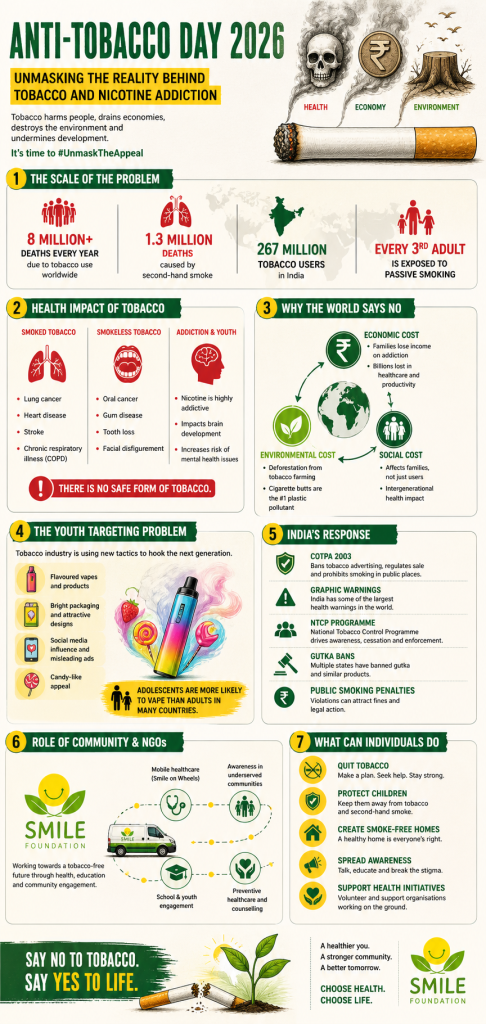
Tobacco kills more than 8 million people every year globally, including approximately 1.3 million non-smokers who die from second-hand smoke exposure, making it one of the largest preventable causes of death in human history
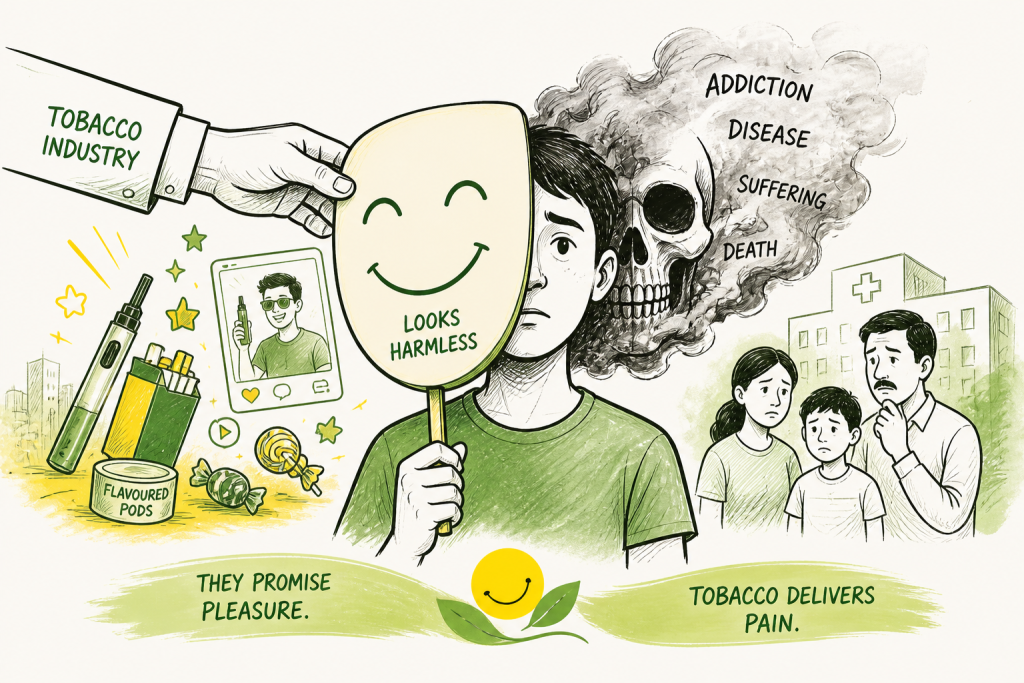
The WHO’s theme for Anti-Tobacco Day 2026 — Unmask the Appeal: Countering Tobacco and Nicotine Addiction — focuses on how the tobacco and nicotine industry continues to make harmful products attractive, particularly to young people, through flavours, packaging and digital marketing
India is home to approximately 267 million tobacco users, with tobacco-attributable deaths exceeding one million per year driven by both smoking and widespread smokeless tobacco use, including gutka, khaini and zarda
India has developed one of the stronger tobacco control frameworks among middle-income countries including COTPA 2003, large pictorial health warnings, the National Tobacco Control Programme, and a ban on e-cigarettes but enforcement gaps and insufficient cessation infrastructure remain significant challenges
The deliberate targeting of youth by tobacco and nicotine companies through e-cigarettes, nicotine pouches, flavoured devices and social media influencer marketing represents one of the most serious emerging threats in global tobacco control
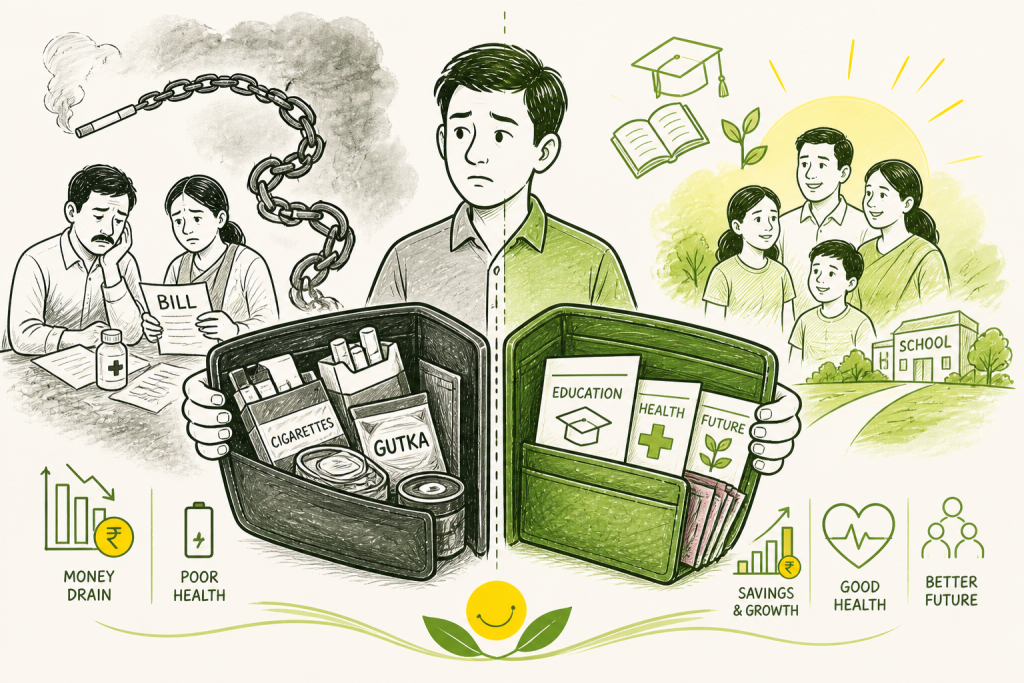
The socio-economic burden of tobacco is particularly acute in low-income households, where spending on tobacco products competes directly with food, education and healthcare creating a cycle of poverty and addiction that policy alone cannot easily break
Community organisations and NGOs including Smile Foundation through its Smile on Wheels mobile healthcare programme play an irreplaceable role in extending tobacco awareness, health education and preventive care to populations that national campaigns do not consistently reach
Quitting tobacco produces measurable health benefits at any age and after any duration of use with cardiovascular risk improving within weeks and cancer risk declining significantly within years making cessation support one of the highest-impact investments in public health
A Habit the World Cannot Afford: Anti-Tobacco Day 2026
Every 31 May, the world pauses to confront one of the most persistent and preventable causes of death in human history. World No Tobacco Day or Anti-Tobacco Day 2026 is not a commemoration. It is a reckoning. A reminder that tobacco, in all its forms, continues to kill at a scale that would be considered a global emergency in any other context.
In 2026, that reckoning feels more urgent than it has in years. Not because tobacco use has surged — in many countries, smoking rates have declined. But because the tobacco and nicotine industry has reinvented itself, found new markets, developed new products and identified a new generation of potential users. The threat has not diminished. It has evolved.
The WHO’s official theme for Anti-Tobacco Day 2026 — Unmask the Appeal: Countering Tobacco and Nicotine Addiction — captures this precisely. It is not enough to warn people about the dangers of smoking. It is necessary to understand how addiction is manufactured, marketed and made to seem normal, and to counter those mechanisms at every level, from national policy to individual conversation.
The Scale of the Problem: What the Numbers Say
Tobacco remains one of the largest preventable causes of death globally. According to the WHO, tobacco kills more than 8 million people every year. Of these, approximately 1.3 million are non-smokers who die from exposure to second-hand smoke — people who made no choice to use tobacco but paid for others’ addiction with their health and their lives.
The economic cost is equally staggering. Global healthcare expenditures attributable to tobacco use run into hundreds of billions of dollars annually. When lost productivity through premature death, chronic illness and disability is factored in, the total economic burden runs far higher. For low- and middle-income countries, which already carry a disproportionate share of the global disease burden, the cost of tobacco is not abstract. It competes directly with investment in education, infrastructure and poverty reduction.
The health consequences of tobacco use are wide-ranging and well-documented. Smoking is strongly associated with lung cancer, chronic obstructive pulmonary disease, cardiovascular disease, stroke and reduced immune function. But the damage is not limited to the lungs or the heart. Tobacco use affects nearly every organ system in the body from the kidneys and the bladder to the bones and the reproductive system. Smokeless tobacco products, which tend to receive less public attention than cigarettes, carry their own serious risks: oral cancer, gum disease, oesophageal cancer and cardiovascular problems. In countries like India, where smokeless tobacco use is widespread, this distinction matters enormously.
India’s Tobacco Landscape: A Complex and Urgent Picture
India’s relationship with tobacco is both large in scale and complex in character. The country is home to approximately 267 million tobacco users — one of the largest tobacco-using populations in the world. What makes India’s situation particularly challenging is the diversity of tobacco consumption patterns. Smoking, in the form of cigarettes and bidis, coexists with a wide variety of smokeless tobacco products, including gutka, khaini, zarda, pan masala mixed with tobacco and snuff. Bidis, which are hand-rolled and typically unfiltered, account for a significant proportion of tobacco consumption and are often perceived, incorrectly, as safer than cigarettes.
The health burden that follows from this is significant. India accounts for a disproportionate share of global oral cancer cases — a direct consequence of high smokeless tobacco use. Cardiovascular disease, chronic respiratory illness and tobacco-related cancers collectively place enormous pressure on a healthcare system that is already stretched. According to estimates, tobacco-attributable deaths in India run to over one million per year. The years of productive life lost to premature death and chronic disability represent a development challenge as much as a health one.
The socio-economic dimension of tobacco use in India deserves more attention than it typically receives. Tobacco consumption is not evenly distributed across income groups. Poorer households spend a higher proportion of their income on tobacco products, creating a cycle in which addiction diverts resources from food, education and healthcare. Research has consistently shown that tobacco expenditure in low-income households competes directly with nutritional spending — a particularly serious concern in a country where malnutrition remains a significant public health challenge.
India has, by the standards of middle-income countries, developed a reasonably robust legislative framework for tobacco control. The Cigarettes and Other Tobacco Products Act — COTPA — enacted in 2003, remains the central legal instrument. It prohibits smoking in public places, restricts advertising across multiple media, bans tobacco sales near educational institutions and requires health warnings on packaging. These are not trivial provisions. Enforced consistently, they have real potential to reduce consumption and protect non-smokers from second-hand smoke exposure.
India’s pictorial health warnings which cover a significant proportion of tobacco packaging are among the largest in the world. Research on health warning effectiveness consistently shows that graphic, image-based warnings are more effective than text alone, particularly in populations with lower literacy levels. For a country as linguistically diverse as India, images that communicate risk without relying on any single language are an especially important policy tool.
The National Tobacco Control Programme, operating through state-level tobacco control cells and district-level implementation, provides the administrative infrastructure for enforcement, cessation services and public awareness. Recent enforcement actions in states including Karnataka have demonstrated that implementation, where it occurs, does produce measurable results — fines for public smoking violations, crackdowns on illegal sales near schools and removal of tobacco advertising from prohibited areas.
The action taken against specific smokeless tobacco products including state-level bans on gutka and restrictions on pan masala with tobacco under food safety regulations represents a recognition that tobacco control cannot focus exclusively on cigarettes. These bans have been uneven in their implementation, and the products have sometimes re-entered markets through reformulation or under different branding. But the regulatory intent reflects a genuine understanding of the breadth of India’s tobacco problem.
Where the gaps remain most significant is in cessation support. India’s quit lines and counselling infrastructure, while growing, remain insufficient relative to the scale of tobacco use. Most tobacco users who want to quit do not have access to evidence-based cessation support — whether pharmacological, behavioural or a combination of both. Building this infrastructure, particularly in rural and underserved areas, is one of the most important unfinished tasks in India’s tobacco control agenda.
The Youth Crisis: A New Generation in the Crosshairs
Perhaps the most concerning development in global tobacco control in recent years has been the deliberate targeting of young people by tobacco and nicotine companies. This is not incidental. It is strategic. The industry understands that most long-term tobacco users begin before the age of 20, and that early nicotine dependence creates customers who are difficult to lose.
The vehicles for this targeting have changed. Traditional cigarette advertising, heavily restricted in most countries, has given way to a more sophisticated playbook. E-cigarettes and vaping devices marketed with bright designs, fruit and dessert flavours, and sleek aesthetics have been positioned as modern, lifestyle-compatible alternatives to traditional tobacco. Nicotine pouches, which are discreet and require no smoking or spitting, have expanded the accessibility of nicotine addiction to settings and populations that were previously harder to reach. Social media platforms where youth spend significant time and where advertising regulations are less consistently enforced have become primary channels for nicotine product promotion, often through influencer partnerships and content that does not look like advertising at all.
The WHO has noted that in countries with available data, adolescents are significantly more likely to vape than adults. It is the outcome of deliberate industry strategy. The flavours that make vaping products appealing — mango, mint, bubblegum, watermelon have no function other than to make nicotine delivery more attractive to people who might not otherwise try it. The packaging that resembles USB drives or makeup items has no function other than to reduce the social visibility of the act of using nicotine.
In India, the Electronic Cigarettes (Prohibition) Act of 2019 banned the production, import, sale and advertisement of e-cigarettes — one of the stronger regulatory responses to vaping in the developing world. But enforcement challenges remain and the products continue to circulate through informal channels and online platforms. The regulatory battle is an ongoing one and it requires consistent vigilance across multiple points of entry.
Anti-Tobacco Day 2026 is, in significant part, a call to protect this generation to ensure that the hard-won reductions in adult tobacco use are not undone by a surge in youth nicotine addiction dressed up in more appealing packaging.
The Environmental Cost of Tobacco: A Dimension Often Overlooked
Public discourse on tobacco tends to focus, understandably, on its health consequences. But the environmental cost of tobacco deserves attention as part of the complete picture.
Tobacco farming is resource-intensive and ecologically damaging. It requires significant quantities of pesticides and fertilisers, contributes to soil degradation, and has been associated with deforestation in tobacco-growing regions across Africa, Asia and Latin America. The curing of tobacco, the process by which harvested leaves are dried, traditionally requires large quantities of firewood, contributing to forest loss in countries where the crop is grown.
Cigarette butts are among the most common forms of litter found in global waste surveys. They are not simply paper and tobacco residue — they contain a plastic acetate filter that does not biodegrade, along with thousands of chemicals including nicotine, arsenic and lead, that leach into soil and waterways. The environmental persistence of cigarette waste is a public health problem in its own right, particularly in communities where water sources are vulnerable to contamination.
Recognising the environmental dimension of tobacco does not diminish the primacy of its health consequences. But it does expand the coalition of people and organisations for whom tobacco control is a relevant concern including environmental advocates, sustainable development practitioners and climate-focused policymakers.
The Role of Community Organisations: Where Policy Meets People
Legislation and enforcement are necessary but not sufficient. The communities most affected by tobacco — low-income households, rural populations, young people in under-resourced schools — are often the ones least likely to be reached by national awareness campaigns or healthcare services. This is where community organisations and NGOs play an irreplaceable role.
Smile Foundation’s Smile on Wheels programme illustrates what this kind of community-level work looks like in practice. Through mobile healthcare units that reach rural and underserved urban populations, the programme brings preventive healthcare, medical consultations, diagnostics, and health education to people who would otherwise have limited access to any of these. In communities where awareness of lifestyle disease risk — including the risks associated with tobacco — is low, this kind of sustained, trust-based engagement produces understanding that no poster campaign can replicate.
The integration of anti-tobacco awareness into existing community health programmes is one of the most effective ways to extend the reach of tobacco control. When a community health worker who is trusted and familiar raises the risks of tobacco use during a maternal health camp or a school health session, the message lands differently than it does from a government advertisement. It is personal, contextual and accompanied by the opportunity for questions and conversation.
Youth programmes that build leadership, critical thinking, and health literacy provide young people with the tools to recognise and resist manipulative marketing. Women’s health initiatives that address tobacco as part of a broader conversation about household well-being and economic security create connections between quitting and tangible benefits that abstract health messaging often fails to make.
The collaborative model — government policy and enforcement, civil society outreach and education, healthcare institutions providing cessation support — is the one that the evidence consistently points toward as most effective for sustained reduction in tobacco use.
The Case for Quitting: What the Evidence Shows
For current tobacco users, the message of Anti-Tobacco Day 2026 carries a specifically hopeful dimension. Quitting works, and the benefits begin sooner than most people expect.
Within 20 minutes of quitting, heart rate and blood pressure begin to normalise. Within 12 hours, carbon monoxide levels in the blood drop to normal. Within a year, the excess risk of coronary heart disease is half that of a continuing smoker. Within five years, stroke risk approaches that of a non-smoker. Within ten years, the risk of dying from lung cancer is approximately half that of a continuing smoker. These are not minor adjustments. They are significant, measurable improvements in health that occur at any age, after any duration of use.
The financial benefits compound these health gains. For a household spending a modest amount daily on tobacco, quitting creates savings that, over months and years, are meaningful — particularly in lower-income contexts where every rupee redirected from tobacco to food or education represents a real improvement in family well-being.
Quitting is difficult. Nicotine dependence is a genuine physiological condition, not simply a matter of willpower. The most effective cessation support combines behavioural counselling with pharmacological assistance — nicotine replacement therapy, prescription medications — and the kind of sustained social support that helps people navigate the periods of difficulty that accompany withdrawal. Expanding access to this kind of support, particularly in rural India, is one of the most high-impact investments that public health systems can make in tobacco control.
Anti-Tobacco Day 2026: What Each of Us Can Do
Anti-Tobacco Day 2026 is not only a policy conversation. It is a personal one.
For current tobacco users, it is an occasion to consider quitting, and to seek the support that makes quitting more likely to succeed. For parents and educators, it is a reminder to talk honestly with young people about nicotine marketing and the nature of addiction, before the industry gets there first. For employers, it is an opportunity to strengthen smoke-free workplace policies and to support employees who want to quit. For policymakers, it is a prompt to review the consistency of enforcement, the adequacy of cessation infrastructure and the regulatory gaps that the nicotine industry is actively exploiting.
For civil society organisations, Anti-Tobacco Day 2026 is a reminder that healthcare and education, delivered consistently and with genuine community engagement, are among the most durable forms of prevention available. The connection between community health programmes and tobacco control is direct, and organisations that already work with underserved populations are uniquely positioned to make it.
And for all of us, as citizens, as members of families and communities, it is a day to recognise that the choice to say no to tobacco, or to support someone else in making that choice, is part of something larger than individual health. It is part of the collective work of building communities, and a country, where health is valued over addiction, and where the industry that profits from harm does not get to set the terms of the conversation.
The Work That Continues
Anti-Tobacco Day 2026 arrives in a moment of genuine complexity. The progress made in tobacco control over the past two decades in legislation, in awareness, in declining smoking rates in many countries is real and worth acknowledging. So is the threat that the tobacco and nicotine industry’s reinvention represents. New products, new markets, new generations of potential users — the industry has not given up, and neither can the public health response.
India’s tobacco challenge is significant, but so is India’s capacity to respond — through law, through enforcement, through community health infrastructure and through the millions of people who have already chosen to quit or who are working to help others do so.
A tobacco-free future is not an abstraction. It is built, as most meaningful things are, through daily choices, sustained effort and the quiet work of education, healthcare and community connection. On 31 May 2026, the world once again makes its position clear. The work of making that position mean something continues every day after.
Frequently Asked Questions (FAQs): Anti-Tobacco Day 2026
What is Anti-Tobacco Day 2026 and when is it observed?
Anti-Tobacco Day 2026, officially known as World No Tobacco Day, is observed on 31 May every year, as an initiative led by the World Health Organisation. The day aims to raise awareness of the health, social, economic and environmental consequences of tobacco use, expose the tactics of the tobacco industry and encourage governments, communities and individuals to work toward a tobacco-free future.
In 2026, the official WHO theme is Unmask the Appeal: Countering Tobacco and Nicotine Addiction, with a particular focus on how the industry markets harmful products to young people.
What is the health impact of tobacco use globally?
Tobacco kills more than 8 million people every year, making it one of the leading causes of preventable death worldwide. This includes approximately 1.3 million non-smokers who die from exposure to second-hand smoke. Tobacco use is strongly associated with lung cancer, cardiovascular disease, stroke, chronic obstructive pulmonary disease and reduced immune function. Smokeless tobacco products carry additional risks including oral cancer, gum disease and oesophageal cancer. The global health burden of tobacco extends across nearly every organ system and affects users, their families and their communities.
How serious is tobacco use in India?
India is home to approximately 267 million tobacco users — one of the largest tobacco-using populations in the world. What makes India’s situation particularly complex is the diversity of consumption patterns, with significant use of both smoked tobacco — including bidis and cigarettes — and a wide range of smokeless tobacco products. Tobacco-attributable deaths in India exceed one million per year, and India accounts for a disproportionate share of global oral cancer cases, a direct consequence of high smokeless tobacco use. The economic burden is equally significant, with low-income households spending a substantial proportion of their income on tobacco at the direct expense of food, healthcare and education.
What laws govern tobacco control in India?
The primary legislative framework for tobacco control in India is the Cigarettes and Other Tobacco Products Act (COTPA) enacted in 2003. COTPA prohibits smoking in public places, restricts tobacco advertising across multiple media, bans sales near educational institutions and mandates health warnings on packaging. India has also implemented some of the world’s largest pictorial health warnings on tobacco packaging. The Electronic Cigarettes (Prohibition) Act of 2019 banned the production, import, sale and advertisement of e-cigarettes. The National Tobacco Control Programme supports enforcement, cessation services and public awareness at the state and district level.
Why is youth tobacco use a particular concern in Anti-Tobacco Day 2026?
The WHO has identified the deliberate targeting of young people by tobacco and nicotine companies as one of the most serious emerging threats in global tobacco control. E-cigarettes, nicotine pouches and flavoured devices — marketed with bright designs, appealing flavours and influencer-style social media promotion — are specifically designed to attract younger users who might not otherwise try tobacco products. In countries with available data, adolescents are significantly more likely to vape than adults. Anti-Tobacco Day 2026’s theme directly addresses this manipulation, calling on schools, families, governments and communities to protect young people from nicotine addiction before it begins.
What is the socio-economic impact of tobacco use?
The socio-economic impact of tobacco is significant at both the household and national level. For low-income families, spending on tobacco products directly competes with essential expenditure on food, education, healthcare and savings. At the national level, countries lose billions in healthcare costs and lost productivity due to tobacco-related illness and premature death. The environmental costs add a further dimension — tobacco farming contributes to deforestation and soil degradation, while cigarette butts are among the most common and environmentally persistent forms of litter globally, releasing toxic chemicals into soil and waterways.
What role do community organisations play in tobacco control?
Community organisations and NGOs play an irreplaceable role in reaching the populations that national awareness campaigns and formal healthcare systems do not consistently serve. Organisations like Smile Foundation, through programmes such as Smile on Wheels, bring preventive healthcare, medical consultations, diagnostics and health education directly to rural and underserved urban communities. Integrating anti-tobacco awareness into community health programmes — school health sessions, maternal health camps, youth leadership initiatives — allows tobacco education to reach people through trusted, familiar channels, making it significantly more likely to be heard and acted upon.
What are the benefits of quitting tobacco and how can people get support?
The health benefits of quitting tobacco begin almost immediately and compound significantly over time. Within 20 minutes of quitting, heart rate and blood pressure begin to normalise. Within a year, the excess risk of coronary heart disease is halved. Within ten years, the risk of dying from lung cancer is approximately half that of a continuing smoker. Financial savings, particularly meaningful for lower-income households, begin from the first day. For those who want to quit, the most effective support combines behavioural counselling with pharmacological assistance such as nicotine replacement therapy. In India, quit lines, hospital-based cessation clinics and community health programmes provide access to this support, though expanding these services, particularly in rural areas, remains an important priority.
India’s education conversation has made significant progress on access, infrastructure and curriculum. What it has been slower to reckon with is the interior life of the child sitting in the classroom.
Mental health, the capacity to regulate emotion, sustain attention and engage with learning, is not a supplementary concern. It is the foundational condition on which all learning rests.
For children in underserved communities, where socio-economic stress enters the classroom alongside the child every morning, this gap is not abstract. It is the reason capable children disengage, capable teachers burn out and well-resourced interventions underperform.
Smile Foundation’s education programmes are built on the understanding that emotional well-being is not an add-on to quality education. It is what makes quality education possible.
The Child Who Is Present but Not There
The teacher has been speaking for ten minutes. The lesson is clear, the pace is reasonable and most of the class is following. But in the third row, a child is staring at a point somewhere beyond the blackboard. She is not asleep. She is not being deliberately disruptive. She is simply somewhere else — unreachable, for reasons that have nothing to do with the quality of the lesson and everything to do with what happened before she walked through the school gate that morning.
This scene, replicated in classrooms across India every day, tends to be read as a behavioural problem. The child is inattentive. She needs to be redirected or disciplined, or kept back after class. What it rarely gets read as — though the evidence is consistent and substantial — is a mental health signal. A child whose emotional system is under strain does not have full access to her cognitive system. Attention, in that state, is not a choice she is failing to make. It is a resource she does not currently have.
This is the invisible barrier at the centre of India’s learning challenge. Not the absence of schools or teachers or textbooks but the absence of the emotional readiness that makes those things usable.
The Problem That Looks Like Something Else
Mental health is difficult to see in a classroom, which is part of why it is so consistently misread. The signs do not announce themselves as distress. They present as restlessness, withdrawal, aggression or a flatness that gets classified as low ability. A child who is emotionally overwhelmed does not raise their hand and say so. They act out or they disappear into themselves or they simply stop trying, and each of these responses tends to trigger a pedagogical or disciplinary reaction rather than an emotional one.
The misreading matters because the response it produces makes things worse. A child who is withdrawn because of anxiety at home does not benefit from being moved to the back of the class. A child whose restlessness is a response to chronic stress does not become more able to learn because they have been told to sit still. When distress is interpreted as defiance, the intervention addresses the symptom and deepens the cause.
This pattern is not unique to India, but it is particularly consequential here — in classrooms that are already stretched, with teachers who are already managing more than any one person can reasonably manage, in communities where the stressors that children carry into school are significant and structural.
What Stress Does to the Learning Brain
The relationship between emotional state and cognitive performance is not intuitive in the way that the relationship between, say, nutrition and concentration tends to be. But it is just as direct, and the neuroscience behind it is well-established.
When a child is under chronic stress — the kind produced not by a single difficult event but by the sustained pressure of poverty, instability, conflict at home or food insecurity — the body’s stress response system remains in a state of low-level activation. Cortisol, the primary stress hormone, is elevated. And elevated cortisol has a specific and measurable effect on the brain’s prefrontal cortex — the region responsible for attention, working memory, impulse control and the capacity to plan and reason.
In simple terms: a stressed brain is a brain that is partially occupied. Its resources are directed, below the level of conscious awareness, toward managing threat. The cognitive bandwidth available for learning, taking in new information, holding it in working memory, connecting it to existing knowledge and retrieving it later, is reduced. Not because the child is less capable but because the brain is doing something else with its resources.
UNESCO and WHO have both identified school mental health as a critical and underinvested dimension of educational quality, noting that emotional well-being is among the strongest predictors of learning outcomes — more consistent, in some analyses, than class size or even teacher qualification. The evidence is not marginal. It is central. And it has not yet been sufficiently integrated into how India thinks about, designs or funds its education system.
When Life Conditions Walk Into the Classroom
For children in underserved communities, the stress that impairs learning is rarely episodic. It is structural and continuous. It is the stress of a household where income is unpredictable and food is sometimes scarce. Imagine the stress of living in overcrowded conditions without privacy or quiet and the stress of being a first-generation learner in a family that cannot support homework, cannot read the school diary and cannot absorb the cost of a child being educated rather than contributing to household income.
For millions of children attending government schools in urban slums and rural districts across India, they are simply the conditions of daily life. And they do not stay outside when the school bell rings. They travel with the child, settle into the seat beside them and compete with the teacher for their attention every period of every day.
First-generation learners face a particular version of this challenge. They are navigating not only the content of the curriculum but the social and cultural codes of an institution that was not designed with their lives in mind. The gap between home culture and school culture — in language, in expectation, in the unspoken rules of classroom behaviour — produces a form of chronic low-level dissonance that is, in itself, a stressor. Children who are spending cognitive and emotional energy managing that gap have less of both available for learning.
The Teacher Who Is Also Running on Empty
Any honest account of mental health in India’s classrooms has to include the teacher. Not as a secondary character, but as someone whose emotional state is as consequential for learning as the child’s, and whose needs are even more thoroughly ignored.
Teaching in an under-resourced government school in India is, by any reasonable measure, an extraordinarily demanding occupation. Class sizes of forty, fifty or more are common. Administrative burdens like data entry, mid-day meal supervision, election duty and census work regularly consume time that should be available for preparation and instruction. Professional development is inconsistent and support for the emotional dimensions of the work is almost entirely absent.
The result is a profession characterised by high rates of burnout and emotional fatigue and a classroom dynamic in which two people who both need support are instead depending on each other without either having enough to give. A teacher who is emotionally depleted cannot create the warm, stable, psychologically safe environment that research consistently identifies as the precondition for effective learning. They can deliver content. But delivery is not the same as teaching, and teaching is not the same as learning.
The mental health of teachers is not a welfare issue separate from educational outcomes. It is directly connected to them.
What Actually Works: Integration, Not Addition
The instinct, when mental health enters the education conversation, is to reach for a specialist solution — a counsellor, a helpline, a dedicated mental health curriculum delivered by a trained professional on Fridays. These things have value. But they are not sufficient, and in many contexts, they are not accessible. What the evidence points toward, consistently, is integration: embedding mental health awareness and emotionally responsive practice into the fabric of how teaching and learning happen every day.
This means teacher sensitisation — not training teachers to be therapists, but equipping them to recognise distress signals, to respond to behaviour with curiosity rather than only consequence, and to understand that a child who is struggling emotionally is not a management problem to be solved but a human being to be understood.
It means creating classroom environments characterised by routine, predictability, and psychological safety — conditions that, for children whose home environments are often chaotic, provide the regulatory stability that makes cognitive engagement possible. Research on trauma-informed education consistently shows that structure and warmth, in combination, are among the most powerful interventions available to a classroom teacher.
It means creating space for expression — not as a therapeutic exercise, but as a routine part of how children are invited to be present in school. Drawing, storytelling, conversation, play — these are not distractions from learning. For children who have limited language for their interior experience, they are the means by which that experience can be processed rather than carried in silence.
How Smile Foundation Approaches This
Smile Foundation’s education programmes are built on the understanding that a child’s capacity to learn is inseparable from their emotional state, and that the classroom environments created through Mission Education need to reflect that understanding in practice, not just in principle.
Teacher capacity building within the programme includes attention to the emotional dimensions of teaching: how to read a classroom, how to respond to a child who is disengaged or distressed and how to create a learning environment that feels safe enough for children to take the risks that learning requires. This is not a separate mental health module. It is woven into the broader understanding of what good teaching involves.
Child-friendly environments designed with attention to warmth, order and the sense that the space belongs to the children in it are a consistent feature of Smile Foundation’s learning centres. The physical and relational environment is understood as a pedagogical tool, not just a backdrop.
Psychosocial awareness informs how programme staff engage with both children and families, recognising that the stressors children carry into classrooms have origins that the school alone cannot address, but that the school can either compound or cushion.
A Shift in One Classroom
In one of Smile Foundation’s learning centres in a peri-urban community near Mumbai, facilitators noticed that a group of older students had become increasingly disengaged over the course of a term. Attendance was inconsistent. Participation in class had dropped. The initial response — more structured instruction, additional practice exercises — produced no improvement.
What shifted the situation was not a change in curriculum but a change in approach. Facilitators began spending the first fifteen minutes of each session in open conversation — not about academic content, but about what was happening in the children’s lives. A routine was established that was predictable and warm. Children were given small responsibilities within the learning space that signalled they were trusted and valued.
Over the following weeks, attendance stabilised. Participation increased — tentatively at first, then more consistently. The content had not changed. The children had not changed. What had changed was the emotional temperature of the room, and with it, the children’s capacity to be present in it.
It is a modest, replicable, evidence-consistent shift, and it is exactly what integration of mental health into education looks like in practice.
Reframing What Learning Requires
There is a model of education that understands learning as content delivery — the teacher has knowledge, the student receives it and the quality of the exchange is determined by the clarity of the transmission. On this model, mental health is peripheral. The lesson either lands or it does not, and the emotional state of the people in the room is a secondary variable.
The evidence does not support this model. Learning is not reception. It is a complex cognitive and emotional process that depends, at every stage, on the learner’s capacity to engage — to attend, to hold information, to connect it to what is already known, to retrieve it later. That capacity is not fixed. It fluctuates with emotional state, with felt safety, with the degree to which the learning environment supports or undermines the learner’s sense of themselves as someone capable of learning.
On this understanding — which is the understanding that the research supports — mental health is not a supplementary concern to be addressed once the academic basics are in place. It is the infrastructure on which academic learning is built. A classroom that ignores the emotional lives of the children in it is a classroom that is, in a very practical sense, working against itself.
Emotional Readiness Is the First Lesson
India’s education system has achieved extraordinary things in the past two decades. The expansion of access, the reduction of dropout rates, the increasing attention to learning quality rather than mere enrolment — these are genuine and hard-won gains. What the system has not yet fully reckoned with is the interior condition of the child who sits in the classroom that has been built, with the teacher who has been trained, reading the textbook that has been printed.
Learning depends on emotional readiness. Not as a precondition that can be assumed and moved past, but as a condition that must be actively created and sustained through the environments schools build, the practices teachers use and the understanding that a child’s capacity to learn is never separable from how that child feels.
Mental health is not an add-on to education. It is what makes education possible. Until that understanding is built into how India designs, funds, and evaluates its schools, the learning crisis will persist — not for lack of schools or teachers or resources, but for lack of attention to the human being at the centre of the enterprise.
Frequently Asked Questions (FAQs)
Why is mental health relevant to learning outcomes in schools?
Mental health directly affects the cognitive functions that learning depends on attention, working memory, the ability to process and retain new information. A child under chronic stress does not have full access to these functions. Addressing mental health in schools is therefore not a welfare concern separate from academic performance. It is a prerequisite for it.
How does stress affect a child’s ability to learn?
Chronic stress keeps the body’s stress response system in a state of low-level activation, elevating cortisol and reducing the cognitive bandwidth available for learning. The prefrontal cortex responsible for attention, reasoning and memory is particularly affected. In simple terms, a stressed brain is a partially occupied brain, with fewer resources available for the work of absorbing and retaining new knowledge.
Which children are most affected by mental health challenges in school?
Children from underserved communities face compounding stressors like poverty, household instability, food insecurity and overcrowding that do not stay outside the classroom. First-generation learners face the additional strain of navigating an institutional culture that was not designed with their lives in mind. These children are not less capable. They are carrying more, with less support.
What is the teacher’s role in supporting student mental health?
Teachers are the primary architects of the classroom environment and their emotional state and relational approach have a direct bearing on whether children feel safe enough to engage with learning. Teacher sensitisation — the capacity to recognise distress signals and respond with curiosity rather than only consequence — is one of the most impactful and underinvested interventions available.
What does integrating mental health into education actually look like?
Classroom routines that provide predictability and warmth
Teacher training that includes the emotional dimensions of the work
Learning environments designed to feel safe and welcoming
Space for children to express themselves as a routine part of the school day
Does not require a specialist in every school
Requires a shift in how teaching and learning are understood and practised
How does Smile Foundation address mental health in its education programmes? Smile Foundation embeds psychosocial awareness into its Mission Education programme through teacher capacity building, child-friendly learning environments, and an understanding of the whole child — not just the academic learner. The approach recognises that the emotional temperature of a classroom is a pedagogical variable, and invests in creating the conditions that allow children to be genuinely present and engaged.
Is there evidence that improving classroom emotional environment improves learning outcomes? Yes — and the evidence is substantial. Research on trauma-informed education, safe learning environments, and teacher-student relational quality consistently shows that children learn more effectively in environments characterised by warmth, routine, and psychological safety. UNESCO and WHO have both identified school mental health as a critical determinant of educational quality, with effects that are measurable and significant.
Can mental health support be delivered at scale in India’s school system?
Scale requires integration rather than addition. A counsellor in every school is neither feasible nor, on its own, sufficient. What is feasible — and what the evidence supports — is building mental health awareness into teacher training, embedding emotionally responsive practice into standard pedagogical approaches, and designing school environments that actively support children’s well-being. These are not expensive interventions. They are design choices, and they are available to any school system willing to make them.
Corporate India and Preventive Physiotherapy for Truck Drivers
India’s highways never sleep. But those who make it happen, what about their health? Healthcare for truckers hasn’t received the spotlight it deserves.
Every day, millions of trucks move across the country carrying food, medicines, raw materials and essential goods that keep the economy running. At the centre of this vast, invisible network is a workforce that is both indispensable and overlooked: truck drivers and the transport community.
They ensure continuity, ensure supply and are the workhorses that make cities function.
Yet, when it comes to healthcare, they are often left behind.
Recognising this gap, Smile Foundation, along with its CSR partners, has been working to bring physiotherapy services closer to transport hubs creating accessible, consistent care for those who spend most of their lives on the road.
But this intervention is not just about healthcare delivery. It reflects a deeper understanding of the structural challenges truckers face, and why targeted, sustained investment in this sector is long overdue.
Life on the road: A profession defined by endurance
To understand why healthcare access is critical, it is important to first understand the nature of a trucker’s life.
Truck drivers in India often spend:
10–14 hours a day driving
Days, sometimes weeks, away from home
Sleeping in their vehicles or roadside stops
Their work is physically and mentally demanding:
Continuous sitting leads to chronic back and joint pain
Irregular meals affect digestion and overall health
Sleep deprivation impacts both physical and cognitive functioning
Add to this the pressure of delivery timelines, traffic conditions, and long-distance travel, and it becomes clear that this is not just a job. It is a high-risk, high-strain occupation.
The hidden health burden
Despite these challenges, healthcare-seeking behaviour among truckers remains low.
This is not due to lack of need, but lack of access.
1. Delayed diagnosis
Truckers often ignore early symptoms:
persistent pain
vision issues
fatigue
These are seen as part of the job rather than indicators of underlying conditions.
By the time they seek care, issues may have progressed significantly.
2. Musculoskeletal disorders
One of the most common health concerns among truckers is:
back pain
neck stiffness
joint problems
These are directly linked to prolonged sitting, poor posture and lack of movement.
Without physiotherapy or early intervention, these conditions can become chronic, affecting both quality of life and ability to work.
3. Limited access to primary care
Unlike urban populations, truckers cannot rely on:
fixed healthcare providers
regular check-ups
continuous treatment
Their mobility becomes a barrier.
Healthcare systems, designed for stationary populations, often fail to accommodate mobile workers.
4. Vision and fatigue-related risks
Long hours of driving make:
eye strain
vision problems
delayed reaction times
a serious concern, not just for truckers, but for road safety overall.
Why traditional healthcare models fall short
The challenge is not just availability, it is alignment.
Conventional healthcare systems assume:
proximity
routine
time flexibility
Truckers have none of these.
A driver cannot:
take a day off easily
travel long distances to a clinic
commit to follow-up appointments
This mismatch means that even when services exist, they remain inaccessible in practice.
Bringing healthcare to the highways
This is where targeted interventions, like the Physiotherapy and Primary Healthcare Clinics supported by Smile Foundation, become critical.
Instead of expecting truckers to adapt to the system, these models adapt the system to truckers’ realities.
Key features of such interventions:
1. Location-based access
Clinics are set up near:
transport hubs
highways
logistics points
This reduces the time and effort required to seek care.
2. Integrated services
Rather than fragmented care, these centres offer:
physiotherapy for pain and mobility
consultations with general physicians
ophthalmology services
access to essential medicines
This ensures that multiple needs are addressed in a single visit.
3. Focus on preventive care
By enabling:
early diagnosis
timely intervention
these clinics shift the focus from reactive to preventive healthcare.
4. Continuity within mobility
Even within a mobile profession, consistent touchpoints create a sense of continuity — encouraging repeat visits and better adherence to treatment.
The impact: Beyond individual health
While the immediate benefit is improved health outcomes for truckers, the ripple effects are far wider.
1. Economic stability
Healthier drivers are able to:
work more consistently
reduce downtime due to illness
maintain productivity
This has direct implications for supply chains and the broader economy.
2. Road safety
Better physical and visual health contributes to:
improved alertness
reduced accident risk
Making roads safer for everyone.
3. Family well-being
Truckers’ health affects entire households.
When health improves:
financial stability increases
caregiving burdens reduce
overall quality of life improves
4. Dignity and recognition
Perhaps most importantly, such initiatives acknowledge that truckers’ health matters — that their well-being is not secondary to the services they provide.
The role of CSR: Bridging systemic gapsin healthcare for truckers
The transport community sits at the intersection of multiple systems:
labour
health
infrastructure
logistics
Yet, it often falls through the cracks of each.
This is where CSR-led partnerships play a crucial role.
By supporting:
infrastructure creation
service delivery
outreach programmes
CSR initiatives can address gaps that are not fully covered by public systems.
More importantly, they can:
pilot innovative models
demonstrate impact
create scalable solutions
Why more investment and research is needed
Despite growing recognition, the transport sector remains under-researched in terms of health.
What models of care work best for mobile populations?
How can technology support continuity of care?
What incentives improve healthcare-seeking behaviour?
4. Policy integration
Evidence from research can inform:
labour policies
health system design
transport regulations
ensuring that truckers are not treated as an afterthought.
A broader shift: From invisibility to inclusion
Truckers are often described as the backbone of the economy. But recognition must go beyond rhetoric.
It must translate into:
access
infrastructure
investment
Healthcare is a critical starting point.
Initiatives like those led by Smile Foundation demonstrate that targeted, context-aware interventions can make a tangible difference. But scaling this impact requires:
stronger partnerships
sustained funding
deeper research
The way forward in healthcare for truckers
Ensuring healthcare for truckers is not just a welfare measure — it is a strategic imperative.
As India continues to expand its logistics and infrastructure networks, the well-being of those who sustain them must be prioritised.
This means:
embedding healthcare into transport ecosystems
designing services around mobility
recognising truckers as a critical workforce deserving of consistent care
Because when those who keep the country moving are supported, the benefits extend far beyond highways.
They reach homes, markets and communities across India.
And they remind us that development is not just about movement of goods but about the well-being of the people who make that movement possible.
India’s corporate sector now disburses roughly ₹27,000 crore annually in CSR. The bulk flows into education, health and environment, in line with national priorities. Top spenders like Reliance (₹2,156 cr in FY25) and TCS (₹960 cr in FY25) set the pace. New patterns are emerging: ESG integration, robust impact measurement and long-term NGO partnerships are reshaping CSR. Millennials-turned-philanthropists (e.g. Nikhil Kamath) are adding fresh capital and ideas. However, challenges persist – underspending by many firms, uneven geographic reach and weak outcome tracking. Bridging these gaps requires action on three fronts: (1) Strategic Alignment (link CSR to Sustainable Development Goals with clear metrics), (2) Incentivising Impact (reward long-term partnerships and innovation) and (3) Transparency & Oversight (strengthen reporting and NGO governance). Clear short- and medium-term targets – from narrowed spending shortfalls to improved CSR-Dashboards – are crucial for making CSR spending in India a true engine of inclusive growth.
Total CSR Expenditure and Sectoral Allocation
India’s mandatory CSR law and recent policy focus have driven a steady rise in corporate giving. According to MCA data, CSR spend in FY2021–22 reached a record ₹26,278.73 crore, a jump from ₹26,210.96 cr the previous year. This surge reflects both higher corporate profits and a maturing compliance regime.
Sector-wise, more than 60% of CSR funds go to three areas:
Healthcare: ~₹7,731.6 cr in FY22 (about 29% of total)
These allocations mirror national priorities (education for skill-building, health for equity, environment for resilience). Other focus areas include sanitation, poverty alleviation, rural development and livelihoods. Overall, CSR spending is now contributing materially to India’s progress on UN Sustainable Development Goals (SDGs).
However, not all sectors receive equal attention. For example, “hunger and malnutrition” is grouped under health or rural development and “Arts & Culture” sees minimal funds. While education and health consistently top the list, commentators note that areas like clean energy, urban poverty and mental health remain underfunded relative to need.
Geographic Distribution
CSR allocations also show geographic skew. Corporate investments cluster in company-linked regions and economically active states. Maharashtra, Delhi, Karnataka and Gujarat (housing many corporate HQs) often report disproportionately high CSR activity. In contrast, some poorer states like Bihar, Jharkhand and Odisha receive far less, per capita, than metrics would suggest.
This urban bias occurs partly because compliance is easier to achieve through local projects and partner NGOs. For genuine inclusivity, there is growing call for incentives to channel CSR into left-behind regions. The MCA CSR Dashboard (launched 2017) has made geographic data available and civil society is pushing for CSR routing to cover “aspirational districts” under NITI Aayog’s framework.
Top Corporate CSR Spenders
Several large firms stand out as CSR leaders, both in spending and in evolving their approach. Table 1 (below) lists the Top 10 CSR Spending Companies (latest reported year) and their key focus areas:
Table 2: Top CSR spenders in India (FY2024/25). Indicates latest data to be updated from sources. Data sources: MCA, company reports, CSR Dashboards.
This table highlights the diversity of CSR portfolios. Reliance’s CSR arm, Reliance Foundation, reported spending ₹2,156 crore in FY2024–25 – among the highest in India – focusing on rural transformation, healthcare access and education. Tata Consultancy Services spent ₹960 crore in FY2024–25, investing heavily in digital education (Ignite My Future, goIT), rural entrepreneurship (BridgeIT) and women’s literacy.
Other companies (Infosys, SBI, ITC, etc.) also cross hundreds of crores annually, with each leveraging core business strengths. For example, ITC’s CSR emphasizes agri-insurance and schools in its rural operational areas. Banks like SBI and HDFC target financial literacy and livelihoods. Oil PSUs (ONGC) often channel CSR into remote areas where they operate, via healthcare camps and school sponsorships.
Notably, these top spenders often partner with professional NGOs or set up their own trust arms, indicating a trend towards institutionalising CSR rather than ad-hoc schemes.
Emerging CSR Spending in India Trends (2026)
ESG Integration and Accountability
One striking shift is the merger of CSR into broader Environmental, Social and Governance (ESG) frameworks. Corporates now frame CSR as part of sustainability goals, aligning projects with global standards. For instance, many companies tie their CSR to specific Sustainable Development Goals (SDGs) and report progress in annual ESG disclosures. Investors and regulators are increasingly demanding ESG data; CSR is now a sub-stream within that.
This trend has two implications:
Impact Measurement: Companies are no longer satisfied with output metrics (e.g. “1000 students taught”). They invest in impact assessment tools – for example, randomized evaluations of education programmes or health outcomes.
Strategic CSR: Rather than scattershot giving, CSR budgets are aligning with company strategy and market presence. Tech firms fund digital literacy; pharma companies focus on preventive health, etc.
Long-term Partnerships with NGOs
The old model of one-off donations is giving way to sustained NGO partnerships. Corporates are co-designing 3–5 year programmes with experienced social organisations. This approach brings depth: NGOs contribute ground knowledge and continuity, while companies bring funding and scalability.
For example, Smile Foundation has maintained multi-year collaborations with numerous companies (over 400 brands so far) to implement education and healthcare projects across 27 states. Other examples include long-term projects like Skill India initiatives and multi-district health campaigns. The aim is to create systemic change rather than temporary relief.
Rise of New-Age Philanthropists
A transformative trend is the entry of new-age billionaires and millennial entrepreneurs into India’s social space. Young funders are bringing fresh capital and perspectives. Notably:
Nikhil Kamath (Zerodha co-founder): By 2025 he became the youngest Indian signer of the Giving Pledge. He and his brother have committed over $100 million to the Rainmatter Foundation (climate action) and spearheaded the Young India Philanthropic Pledge (YIPP) to upgrade 300 schools with digital tools.
Nandan Nilekani (Infosys co-founder): Through philanthropic initiatives, he supports digital ID-based public services (e.g. Aadhaar vision).
Other tech entrepreneurs are also launching funds for social causes (e.g. clean energy, public health).
This surge of privately funded philanthropy complements corporate CSR. These new actors tend to:
Emphasise systems change (e.g. whole school reforms, ecosystem building) over charity.
Be comfortable with risk and innovation (pilot new models).
Leverage networks: creating giving pledges or incubators for social tech startups.
As a result, CSR and philanthropy are starting to converge, with some tech companies co-investing with Rainmatter or similar funds on projects like renewable energy in villages.
Case Study: Impact of CSR-NGO Partnerships
To see this in action, consider Smile Foundation’s collaboration with a big corporate. Over 5 years, we ran an education-boost programme in rural Maharashtra. By mid-2025, attendance in target schools increased from 65% to 90%, while average test scores rose 20%. This partnership combined corporate funding (₹20 lakh annually) with NGO expertise (teacher training), illustrating how strategic CSR can yield measurable results.
In 2023, Smile Foundation expanded its digital learning initiative in partnership with a leading tech firm. The project distributed tablets and local content to 50 village schools. Within a year, student engagement surveys showed a 40% rise in classroom participation. Smile’s monitoring showed 95% attendance and improvements in numeracy among students. This highlights how CSR funds can be deployed through experienced NGOs to enhance learning outcomes.
A large pharma partnered with us to set up telemedicine clinics in tribal Karnataka. Over 3 years, we conducted 30,000 tele-consults and trained 200 community health workers. Malnutrition rates in the project area fell by 15% and immunisation coverage improved to 92%. The long-term engagement (five-year funding pledge) was key to achieving these gains.
Challenges in CSR Spendingin India
Despite progress, significant gaps remain.
Under-spending and Unspent Funds: Recent data shows millions of crores of CSR funds carried forward annually. In FY2021-22, over ₹1,000 crore was unspent (leftover or diverted to a separate fund). This suggests some companies struggle to deploy their full 2% mandate efficiently.
Focus on Compliance: Many CSR reports reveal companies are more focused on “compliance checklists” than impact. Projects are often selected for ease of reporting (e.g. infrastructure projects) rather than strategic fit.
Geographic Skew: As noted, corporate giving often bypasses remote regions. Left-behind districts still miss out on even basic CSR programs.
Measurement Gaps: While large firms publish impact numbers, there is no standard metric across companies. Government disclosures (BRR filings) are often qualitative. Without rigorous tracking, it’s hard to compare outcomes or hold spenders accountable.
These challenges suggest that simply raising the CSR spend is not enough; policy must evolve to incentivise effectiveness.
3-Pillar Reform Framework: Towards Strategic CSRspending in India
To transform CSR spending in India into a high-impact tool, we propose three pillars of reform:
Align CSR with National Goals:
Action: Mandate CSR projects to map to specific SDGs/IMPs (e.g. nutrition, gender equality). Require targets (e.g. reduction in dropout rates, improved learning scores) and track them over 3–5 year horizons.
Metric: Percentage of CSR projects reporting outcome indicators (target: ≥80% by 2028). Inclusion of CSR contributions in SDG progress reports.
Incentivise Long-Term Partnerships and Innovation:
Action: Offer tax incentives or public recognitions for companies that establish ≥3-year funded programmes with registered NGOs. Encourage setting up CSR endowments or venture funds for social innovation.
Metric: Number of accredited NGO-partnerships and funded projects. Year-on-year increase in CSR allocations to climate and innovation sectors (target: double current baseline by 2028).
Enhance Transparency and Oversight:
Action: Upgrade the MCA CSR Dashboard to include outcomes (e.g. verified independent audit of impact) and state/district level breakdowns. Impose penalties for misuse or misreporting. Establish a “CSR Ombudsman” office to address grievances.
Metric: Percentage of high-value CSR projects with third-party audits. Decrease in unspent CSR funds (<5% by 2028).
Under each pillar, the focus is on shifting from spending to impact. For example, instead of saying “built 50 school buildings,” companies would be encouraged to track the percentage of enrolled girls in those schools or improvements in local literacy rates.
Achievements
Gaps
Policy Response
– Legal CSR mandate (2% rule) ensures baseline spending – High total spend (~₹26k cr) on social sectors – Transparent reporting via MCA dashboard (company-level data)
– Concentration in education/health leaves other needs (nutrition, climate) underfunded – Many companies comply formally but under-allocate to impact, or under-spend, leading to unused funds – CSR largely urban-centric; rural/remote areas miss out
– Align CSR to underserved sectors (e.g. mandating a share for environment, nutrition) – Strengthen enforcement to reduce unspent funds (e.g. stricter penalties or roll-over rules) – Incentivise rural projects (e.g. higher tax benefits or grants for projects in aspirational districts)
Table 3: CSR Achievements vs. Gaps and Policy Responses
Timeline of Key CSR Spending in India Milestones
Fusing Purpose with Strategy: The Changing Face of CSR Spending in India
India’s CSR framework has delivered impressive sums to social causes. But as one analyst observed, “India is no longer just about spending 2%. It’s now about making each rupee count.” The transition is already underway – leading firms are recalibrating CSR to be as strategic as their core business investments. Meanwhile, the entry of new-age philanthropists adds momentum, expanding the pool of capital and creativity for social good.
Still, to realise the full potential of this capital flow, stakeholders must insist on results. Companies, regulators and civil society need to move beyond activity-counting toward measuring lives transformed. The suggested reforms – linking CSR spending in India to national development targets, incentivising long-term projects, and bolstering transparency – can ensure that CSR spending in India truly becomes a driver of inclusive growth.
Corporates should view CSR spending in India as an integral part of their strategy, not just a compliance box. NGOs and impact investors must continue to innovate and demand accountability. And citizens can use tools like the MCA CSR Dashboard to track where company donations go. Together, these steps can turn India’s CSR mandate from a statutory obligation into a robust engine for social change.
CSR Spending in India FAQs
Q1: How much do Indian companies spend on CSR each year? Indian firms collectively spent over ₹26,200 crore on CSR in FY2021–22. Spending has continued to grow, approaching ₹35,000 crore soon. This reflects the mandatory 2% norm and rising corporate profits.
Q2: Which sectors receive the most CSR spending in India? Education and healthcare dominate. Education programmes took roughly 25% and health about 30% of total CSR funds in FY22. Environment and sustainability also grew (about 9%). Other areas (rural development, women’s empowerment) share the remaining funds.
Q3: Who are India’s top CSR-spending companies? Major CSR spenders include Reliance Industries (₹2,156 cr in FY24-25), Tata Consultancy Services (₹960 cr in FY24-25), Infosys, ITC, State Bank of India, etc. These companies typically report contributions annually in their regulatory filings.
Q4: Are companies meeting their full CSR obligations? Most large companies comply by spending 2% of profits, but many do not fully utilise their budgets. In FY21-22, around ₹1,000+ crore of allocated CSR funds went unspent and had to be transferred to designated funds. Reasons include project delays and limited NGO capacity.
Q5: How is CSR spending in India monitored and reported? Companies disclose CSR spending in India through annual reports and on the MCA’s CSR portal. The MCA dashboard provides company-wise data. However, reporting often emphasizes activities (e.g. schools built) over outcomes, which is an area regulators are pushing to improve.
Q6: What are the new trends in CSR spending in India? Emerging trends include integration with broader ESG strategies, outcome-based programmes and multi-year NGO partnerships. Notably, young entrepreneurs like Nikhil Kamath are donating heavily to climate and education causes, blurring lines between CSR spending in India and philanthropic funding.
Q7: How can CSR be more impactful? Experts suggest aligning CSR projects with Sustainable Development Goals and tracking specific impact metrics (e.g. exam scores, health indicators). Incentivizing multi-year commitments and capacity building for NGOs can also ensure deeper, lasting change.
Q8: How does Smile Foundation use CSR funds effectively? Smile Foundation partners with corporates to run education, healthcare and nutrition programmes at scale. For example, Smile’s CSR-supported digital classroom initiative saw student attendance rise to 95% in 2025. Its model emphasizes data-driven planning and community involvement, maximizing impact per rupee spent.
Q9: What percentage of CSR funds go to rural vs. urban areas? Precise data varies. Historically, urban areas receive a disproportionate share due to ease of implementation. Recent policy discussions call for incentives to direct more CSR to rural “aspirational” districts. Tracking by location on the CSR portal shows wide disparities.
Q10: How does CSR align with India’s development goals? CSR is explicitly linked to SDGs by government policy. Many companies report how their CSR programmes contribute to goals like Quality Education (SDG4) and Good Health (SDG3). Over time, CSR has become a key instrument in India’s public-private development agenda, complementing government schemes in poverty reduction and human capital building.
India’s education system has achieved remarkable expansion over the past two decades. School enrolment at the elementary level is nearly universal, infrastructure has improved substantially, and gender gaps in participation have narrowed in many states. However, the central challenge facing Indian education today is not access alone. It is learning.
Evidence from national surveys indicates that while children are in school, many are not acquiring foundational skills at expected levels. This gap between schooling and understanding invites renewed attention to an idea that has long circulated in education discourse: contextual education.
Contextual education refers to teaching that connects textbook knowledge to students’ lived realities — their languages, environments, occupations and social contexts. It moves beyond rote memorization and seeks to cultivate understanding, application and relevance.
Learning levels and the limits of rote instruction
The Annual Status of Education Report (ASER) 2022 (Rural) offers a sobering snapshot of foundational learning. According to ASER 2022, only 42.8% of Grade 5 children in rural India could read a Grade 2 level text, and just 25.9% could solve a basic division problem (ASER Centre, 2022). While these figures reflect partial recovery from pandemic-related disruptions, they also underscore a structural issue: progression through grades does not guarantee mastery of foundational skills.
The persistence of learning gaps suggests that classroom instruction often remains disconnected from comprehension. Memorization may help students reproduce answers in examinations, but it does not necessarily enable them to apply concepts to everyday situations. When mathematics is detached from measurement in local markets or agriculture, or when language learning ignores children’s home languages, the classroom can feel distant from lived experience.
Contextual approaches attempt to bridge this gap by situating knowledge within familiar settings. Teaching fractions through food distribution in a mid-day meal setting or environmental science through local water conservation practices, can deepen understanding in ways that abstract instruction cannot.
Access has improved, but engagement varies
India’s progress in schooling infrastructure and enrolment is well documented. According to UDISE+ 2022–23, over 97% of schools have functional girls’ toilet facilities, a critical factor in improving attendance, particularly for adolescent girls (Ministry of Education, UDISE+, 2022–23). Total school enrolment from pre-primary to higher secondary remains above 25 crore students.
At the higher education level, the All India Survey on Higher Education (AISHE) 2022–23 (Provisional) reports total enrolment of 4.46 crore students, with female enrolment reaching approximately 2.18 crore. The Female Gross Enrolment Ratio (GER) in higher education stands at 30.2, reflecting steady growth over the past decade (Ministry of Education, AISHE 2022–23 Provisional).
These indicators demonstrate substantial gains in participation and infrastructure. However, participation alone does not ensure meaningful engagement. India’s linguistic, cultural and regional diversity complicates the assumption that a standardized curriculum will resonate equally across contexts.
Children in rural Maharashtra may encounter agricultural cycles daily; those in the North East may navigate distinct ecological and cultural landscapes; urban students may grow up in dense industrial environments. When curricular examples fail to reflect such contexts, learning risks becoming abstract rather than experiential.
While India does not operate a single uniform curriculum — state boards adapt frameworks from the National Council of Educational Research and Training (NCERT) — classroom practice often relies heavily on prescribed textbooks. Contextual education does not seek to replace curricular standards, but to interpret them through locally meaningful examples.
Policy direction and implementation gaps
The National Education Policy (NEP) 2020 explicitly emphasises experiential learning, competency-based assessments and mother-tongue instruction in early grades. The policy recognises foundational literacy and numeracy (FLN) as a national priority and advocates connecting learning with real-world contexts.
But policy articulation does not automatically translate into classroom practice. Teachers frequently operate within constraints of syllabus completion, examination schedules, and resource limitations. In such environments, textbook-centred teaching remains prevalent.
Contextual education, therefore, is not a new policy innovation but a pedagogical imperative — one that requires systemic support, teacher training and flexibility in implementation.
Inequality, identity and learning
Educational outcomes in India continue to reflect broader social and economic inequalities. While national surveys do not always disaggregate data by caste categories in public summaries, multiple academic and policy analyses have documented persistent disparities across socio-economic groups.
The digital divide during the pandemic further highlighted unequal access to devices and connectivity. ASER’s pandemic-era surveys indicated that while smartphone access increased in rural households, shared device usage and inconsistent internet connectivity remained common (ASER Centre, 2021–22 wave surveys).
Contextual approaches to education acknowledge these realities. They do not assume uniform access to technology or identical cultural references. Instead, they draw on locally available materials, languages and community knowledge.
Gender patterns illustrate a similar complexity. While AISHE 2022–23 shows significant female participation in higher education and near parity at aggregate levels, challenges remain in retention at certain stages and in representation across specific disciplines. Educational engagement is shaped not only by policy but by household expectations, safety concerns and economic pressures.
Recognizing these layered realities is central to contextual education. Teaching that validates identity and incorporates local knowledge can enhance confidence, belonging and participation.
From comprehension to critical thinking
An education system that privileges memorization risks constraining critical inquiry. Contextual learning, by contrast, encourages problem-solving and dialogue.
Measuring rainfall in one’s own village to understand data patterns, analyzing local waste management practices to learn about environmental science or mapping neighbourhood markets to explore economic principles are examples of contextual engagement. Such methods do not dilute academic standards; they reinforce them through application.
The aim is not to reject examinations but to ensure that what is examined reflects comprehension rather than recall.
The role of community-based interventions
Organizations working in underserved communities often attempt to operationalize contextual principles. Smile Foundation’s Mission Education programme, for instance, integrates foundational learning support with community engagement and experiential activities. By aligning instruction with students’ lived environments, such interventions aim to strengthen retention and understanding.
These initiatives operate alongside formal schooling, reinforcing rather than replacing it. Their experience underscores a broader lesson: learning deepens when children recognise themselves in the curriculum.
A matter of relevance
India’s education system stands at a moment of consolidation. Infrastructure and access have expanded significantly. Participation rates at both school and higher education levels have improved, as UDISE+ 2022–23 and AISHE 2022–23 demonstrate. But foundational learning gaps, as documented by ASER 2022, persist.
Contextual education does not claim to be a universal remedy. It is, however, a reminder that relevance is integral to retention and comprehension. When learning connects to lived reality, children are more likely to engage, question and apply.
In a country as diverse as India, recognizing context is not a pedagogical luxury. It is a necessity.
References
ASER Centre. (2022). Annual Status of Education Report (Rural) 2022. New Delhi
Ministry of Education, Government of India. (2022–23). Unified District Information System for Education Plus (UDISE+)
Ministry of Education, Government of India. (2022–23 Provisional)