( 28 January 2021 )
( 28 January 2021 )
( 28 January 2021 )
(28 December 2009)

( 28 January 2021 )
( 28 January 2021 )
(28 January 2021)
( January 23, 2021 )
India CSR Top 10 Impact Leaders of India is annual award for leaders whose work have impacted lives, established by India CSR.
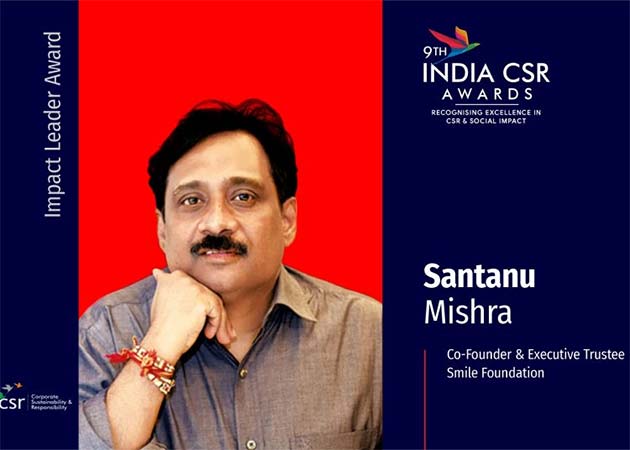
Co-founder of Smile Foundation Santanu Mishra has been honored as one of the ‘India CSR Top 10 Impact Leaders of India’ during the ‘India CSR Leadership Summit – 2021’, organized by India CSR Network on January 16, 2021.
He received the prestigious ‘Impact Leader Award’ for his remarkable contribution in building a Resilient India during COVID-19 pandemic.
Santanu Mishra, also a Executive Trustee of Smile Foundation, under his leadership began its India Shares campaign in April 2020 as a response to the massive crisis emerging due to the first of its kind pandemic of COVID-19.
The campaign used a multi-pronged approach to ensure the vulnerable sections of society were able to receive essential services food and sanitation supplies.
Smile Foundation began its ‘IndiaShares’ campaign on 6th April 2020 as a response to the massive crisis emerging due to the first of its kind pandemic of COVID-19. The campaign used a multi-pronged approach to ensure the vulnerable sections of society were able to receive essential services – food and sanitation supplies.
The summit was attended by dignitaries and representatives from Government, Civil Society, Think Tanks & Corporates. Other awardees felicitated for the contribution in 2020 included- Sonu Sood, actor and philanthropist; Shallu Jindal, Chairperson, JSPL Foundation; Atul Satija, Founder, The Nudge Foundation; Prashant Prakash, Partner at Accel India; Madan Padaki, CEO & MD of Head Held High Services; Kaushlendra, Founder of Kaushalya Foundation; Ankit Kawatra, Zomato Feeding India; Ravindra Sathe, Mentor- CoWin Network, and Ashif Sheikh, Founder, Jan Sahas.
India Shares, an initiative started to combat hunger amongst Smile foundation’s most vulnerable beneficiaries, is running successfully with the contribution of supporters from all walks of life. Smile Foundation has already covered 23 states in the country through a dry ration distribution program and has served more than 25 million meals to over 2.78 lac families so far. A survival kit typically includes: Rice, Dal, Salt, Oil, Sugar, Chilli Powder, Turmeric Powder, Dalia Flour, Liquid Handwash, Disinfectant Soaps, Masks, Sanitary Napkins and Biscuits (for children).
A telephonic and digital Health Awareness Initiative providing counseling on physical as well as mental wellbeing to the most vulnerable during COVID-19 called ‘Batoon Batoon Mein Sehat’ is being executed as part of the campaign.
40,000 people have been counseled and the aim is to reach 200,000 people. The multi-pronged approach also includes #HealthCannotWait – an initiative to take primary healthcare to the doorsteps of the less privileged children and families and promote a health-seeking behavior among them. At present, 1 million people are benefitting from the health services, with an aim to reach 2 million people.
Smile Foundation, is an NGO in India directly benefitting over 15,00,000 children and their families every year, through more than 400 live welfare projects on education for poor children, healthcare, livelihood and women’s empowerment, in over 2,000 remote villages and slums across 25 states of India. Adopting a life cycle approach of development, Smile Foundation focuses its interventions on children, their families and the community.
India CSR Network is a leading media organisation on Sustainable Development, Corporate Social Responsibility (CSR), Sustainability, and related issues in India. The digital platform offers insights on Corporate Governance, Business Responsibility, Human Rights, Sustainability, Sustainable Development, Workplace Safety, Industry 4.0, CSR 2.0 and other Socio-Economic issues.
The ‘India CSR Awards’ is certainly an inspiration to the leaders who are committed to driving transformations in the society with their dedicated service and commitment in the areas of sustainability and CSR.
Such acknowledgement and felicitations are aimed at recognising the industry leaders who are raising benchmarks by bringing transformative change in the society through innovation and excellence.
India CSR wishes him a happy and healthy life ahead to carry on his mission to make a positive contribution to a larger good in India.
Source: https://indiacsr.in/santanu-mishra-honored-with-india-csr-impact-leader-award/
( January 6, 2021 )
Teachers in rural and urban areas had to come up with innovative methods to ensure students did not miss out on an education during the pandemic

At a government school in the Parpada village of Gujarat, Shailesh Raval teaches with the help of 20 loudspeakers installed across the hamlet
Image: Shirishkumar Patel for Forbes India
About 150 kilometres from Ahmedabad in Banaskantha district of Gujarat, every morning when the clock strikes 8, a loud voice booms across loudspeakers in the village of Parpada. It’s 55-year-old Shailesh Raval instructing students to pull out their books and get ready for class. Raval’s daily routine has remained the same as it was before the pandemic—only, as schools across the globe went online, his classroom moved outdoors.
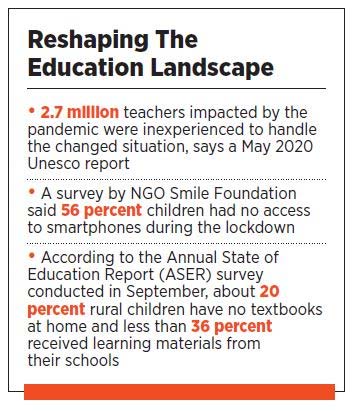
Students in rural areas do not have access to smartphones, tablets, computers or TVs. A study conducted in June by the NGO Smile Foundation surveying 42,831 students across 23 states found that 56 percent of children had no access to smartphones, which became an essential device for e-learning during the Covid-19 lockdown. Existing disparities in education only worsened during the lockdown. Due to the pandemic, a lot of children were in danger of being pushed out of formal education, especially those from marginalised communities.
The teachers at the local government school in Parpada did not want their students’ education to suffer, so with the help of the head of the village, they set up 20 loudspeakers across the hamlet. “We visited each and every house and encouraged the students to join the loudspeaker class. We also requested their parents to sit with them while the class was going on to make sure their child did not get distracted and paid attention. Parents were quite supportive and thankful of this decision,” recalls Raval who is the vice principal of the school and has been teaching the village students for 27 years now. The school has about 200 students.
Classes commenced in June and seven teachers head to the panchayat office one by one to teach the students from classes 3 to 8. They take six classes every day, with each class lasting half an hour. To make sure that the students are on the same page, teachers repeat instructions three times as the students, sitting at home or in a public space, listen.
Raval and the teachers do face some challenges while teaching through loudspeakers. “Teaching without making eye contact with the students becomes difficult at times. We don’t know if the students are able to understand what we’re trying to communicate. I teach mathematics and have to keep trying different ways to teach them, because this subject is tough to teach without a blackboard,” says Raval, who invites the students to come and see him after school hours if they find it difficult to grasp the lessons. “A lot of students come to me to get their queries resolved. Despite all the challenges we are ensuring that the learning continues,” he adds.
To make sure students are paying attention, Raval at times randomly calls out a student’s name, which gets their attention and also makes them feel special since their names are being called out on a loudspeaker with the entire village listening in.
Teachers at schools in urban areas, where the transition from classroom to virtual learning has been more or less smooth, faced other challenges. It was a task to adapt to teaching online given that many of them were new to these technologies. They also had to redesign the teaching structure and syllabus from that of a traditional classroom to online. Keeping students engaged is a task wherever they are, and when they are not in a classroom, it’s a bigger challenge.
“It was a task to design effective teaching material to suit the new way of teaching and successfully implementing it to get the desired results,” says Garima Gupta, 45, an English teacher at a leading school in Noida, Delhi, who has been teaching students online since April. “Students were excited as well as confused, and it was a challenge for us to control these inquisitive minds who aspired to explore and experiment,” she adds.
Where teachers struggled with technology, it became difficult for them to take control of the situation, as students, making the most of the new experience, got up to mischief. “With time I learnt that making the sessions innovative and interactive helps keep the students attentive in my class. Also, one cannot deny the role of parents, who despite their own personal and professional challenges, monitor these kids. Yet at times, making these students switch on their camera is still a Herculean task,” says Gupta, laughing.
(January 12, 2022)
Now is time for the key stakeholders – the government, corporates, and the civil society – to work in greater synergy than ever and devise targeted interventions
National Youth Day 2022 is a good time to acknowledge the contribution of the youth to nation building, especially at the critical juncture when the economy is trying to recover from COVID-19.
The past two years have been trying, to say the least, and it is at this time that the youth of the country have stood up to be counted. They have taken it upon themselves to help with efforts to ease the shock of the pandemic on the population. With the population’s average age 29, India is a young country. Our youth have helped bring about a startup boom in the country. They are the ones responsible for making India the third largest base of Unicorns in the world.
India must now focus on educating and skilling the youth so they can contribute even more to the country’s progress. Governments, both at the centre and the states, must introduce schemes for the young to enable access to education.
Some state governments like those in Odisha, Uttar Pradesh, Madhya Pradesh, Karnataka, and Haryana have gone the extra mile in implementing welfare schemes for the youth. Case in point: the Government of Madhya Pradesh has overseen the implementation of welfare schemes such as the MP Mukhyamantri Kaushalya Yojna, the Kanya Saksharta Protsaahan Yojana, the Ladli Laxmi Yojana, the Mukhyamantri Awas Sahayata Yojana, and the Vimukt Jati Hostel Yojana to improve access of youth to scholarships, food, and shelter, and skill development.
The state administration is organizing employment fairs in every district of Madhya Pradesh on 12 January. which will benefit three lakh people.
But there are limitations to the efforts that governments alone can make, and they must be supported by the civil society in skilling the youth for employment. I would like to take the example of one such initiative – Smile Twin e-learning Program (STeP) – run by Smile Foundation. The livelihood program trains urban underprivileged youth in the 18-32 years age bracket with market-oriented job skills such as English, basic computer use, personality development, retail management, soft skills, and makes them employable in the retail and service sectors of India. The program is operational in 18 cities of 16 states and 65,000 youth have benefitted from it so far.
Role of youth in pandemic mitigation
The role of youth in pandemic mitigation is peerless. They are the ones who have led every initiative from mass vaccination to infection prevention and ensuring access to critical help for millions of Indians. Today, several youth are leading the implementation of the One Health concept across the country. Through this initiative, the Union Government’s Department of Animal Husbandry & Dairying is establishing the One Health approach to leverage human capital and physical capital to prevent future pandemics.
The One Health concept recognizes that animal health, human health and the environment are inter-connected and inter-dependent. And youth are playing a key role in implementing One Health across thousands of farms across India.
What we can do
What we can do for the youth is to ensure access to quality education and healthcare, and to opportunities for learning and upskilling. The pandemic has exacerbated inequality and blocked access for millions of youth to these building blocks. Now is time for the key stakeholders – the government, corporates, and the civil society – to work in greater synergy than ever and devise targeted interventions. These interventions must be geared to bridge the gap in ensuring widespread access to learning and skill development, and opportunities for self-actualization for young people.
All the three key stakeholders have unique strengths that they bring to the table. The government brings with it scale. Corporates being with them financial muscle and planning prowess. And civil society organisations have rich experience of delivering outcomes on the ground by implementing strategy to the T. What these stakeholders must do is to work to eliminate the trust deficit. Together, these stakeholders can deliver population scale change furthering sustainable development.
And here too, youth will be the backbone, driving change for the better.
Dr Abodh Kumar, professor, Department of Economic Studies and Policy, Central University of South Bihar. He is President of India awardee for stellar work in academics and a recipient of Inspired Teacher award .