New Delhi: Smile Foundation has been certified by the Great Place to Work® Institute as a Great Place to Work®. Smile Foundation has been able to build a high-trust and high-performance culture, and the award certification has been accorded in recognition of this, according to the Institute.
Coming during the period of the pandemic, the certification is indicative of the strength of the team at Smile Foundation and the work culture that the organization has been able to create and cultivate.
Speaking about the recognition, Mr. Santanu Mishra, Co-Founder and Executive Trustee, Smile Foundation said, “Individually, we are one drop. Together, we are an ocean. Every journey is driven by the people who undertake it, more so the journey of change – right from the people who initiate it with an idea, to the people who work every day to execute it, and finally to all the people whose lives are being impacted by it. These people, thinking, acting, committed individuals, are the real force behind any successful enterprise and when they work together, they can do miracles.
Smile Foundation’s journey too has been made possible by the painstaking efforts of many such passionate individuals, who have added immense value to the organization, continually striving to bring change at the grassroots. Together, they all make Smile what it is.
Today, our team has given us yet another reason to celebrate, and we would like to share this humble achievement with you.”
Every year, more than 10,000 organizations from 60 countries partner Great Place to Work Institute for assessment and benchmarking. Great Place to Work Institute’s methodology is recognized as rigorous and objective and is considered the gold standard for defining great workplaces across organizations.
International Women’s Day 2021: While the pandemic has impacted almost everybody, women, especially in marginalised rural communities have been hit harder and one of the biggest challenges faced by them during this unprecedented crisis has been ‘access to food’
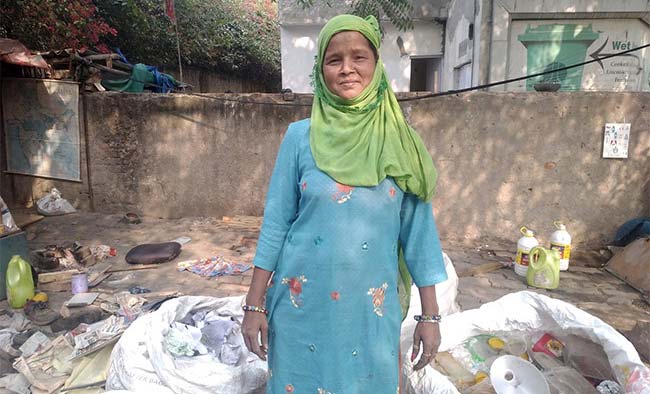
New Delhi: “A mother can do anything to provide the best to her child. I have a seven-month-old grandson and I understand it is essential for his growth to have a nutrient-rich diet. Hum khud nahi khayege ek baar ko, par bache ko jo de sakte hai wo zaroor dege (We adults can skip a meal but we will feed our child for his well-being)”, said 46-year-old Manwara Begum, an informal waste collector from Delhi. Manwara Begum also works as a cleaner at a post office but a salary of Rs. 7,000 and some additional income that she generates by sorting and selling recyclable waste is not sufficient to put food on the table for a family of six. To make ends meet, Manwara, the sole breadwinner of the family either borrows money or cuts down on basic needs like food.
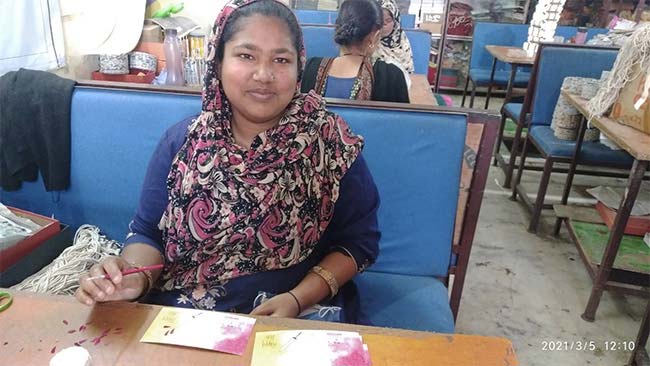
“Pet bharne ke liye khaana to hai hi, chahe roti-namak hi khaaye (Food is needed to fill your stomach, even if it means you eat roti with salt), said 30-year-old Nanhi, waste picker turned artisan and a resident of Ghazipur Dairy Farm in Delhi.
Nanhi works at a Delhi based NGO Gulmeher Green and earns Rs. 6,400 per month. Nanhi’s husband has been out of work for over two years now which means the burden of running the five-member household rests with Nanhi. Talking about how she feeds her family on such a meagre salary, Nanhi said,
“Often children request for a particular food item or dish but there are days when we sleep on an empty stomach, how do we fulfil our children’s demands? We have to turn down their request and if they are adamant, we beat them up.
NDTV reached out to women from different cities, states and circumstances to understand the challenges faced by them on a daily basis to feed their families and how the COVID-19 pandemic affected their lives.
46-year-old Manwara Begum, an informal waste collector from Netaji Nagar in Delhi is the sole breadwinner for a family of six Giving a peek into her family and life, Manwara Begum told NDTV,
“My husband is a drug addict that means whatever little he earns by collecting and selling recyclable waste is spent on buying drugs. I registered him for de-addiction therapy but doctors there said that his body is so used to drugs that he will die if he doesn’t get it. Essentially, now I have to support his addiction. Two years ago, my elder son (22-year-old), who was the sole breadwinner of the family, got a head injury that affected his brain. We have spent Rs. 60,000 on his treatment but all in vain. Now he just sits at home and doesn’t talk to anyone. My daughter-in-law wants to work and support the family but then who will take care of her kid? My younger son (18-year-old) is trying his luck in dancing.
When asked how the family managed during the COVID-19 lockdown when all workplaces were shut, Manwara Begum said she herself was at home for three months and senior officials at the post office supported her family financially by providing some money. The family’s food requirements were met through the free ration initiative – Pradhan Mantri Garib Kalyan Anna Yojana – announced by Prime Minister Narendra Modi as part of the pandemic relief package. Under PMGKAY, foodgrains were distributed to all the 80 crore beneficiaries under Targeted Public Distribution System- those under Antyodaya Anna Yojana (AAY) and Priority Households (PHH). Along with foodgrain each beneficiary household (each ration card no matter how many members) also got 1 kg dal/gram (chana) per month.
“We have a ration card through which we get 16 kg wheat and 4kg rice every month. During the lockdown, the government provided us double ration and one kg of pulses for free, said Manwara Begum.
30-year-old Nanhi, waste picker turned artisan and a resident of Ghazipur Dairy Farm in Delhi is a mother of three children But for women like Nanhi who do not have a ration card to access the government’s support, organisations like Gulmeher Green and Chintan Environmental Research and Action Group came to the rescue.
“I have three daughters aged between 5 and 13. Two of them study in a government school and as part of the mid-day meal, it’s only in February both of them got dry ration, said Nanhi.
As an artisan at NGO Gulmeher Green, Nanhi upcycles waste materials into paintings, poster, wall hangings, among other things. But during the lockdown, since the demand for such products was low, Nanhi and her team were given the task of stitching face masks which brought in some money.
“In 2020 I applied for a ration card and I am yet to receive one. On March 3, I took a day off from work, giving away a day’s salary only to go and check the status of the ration card. They said, come after Diwali, 2021; ration card should be ready by then. I cannot take a leave every other day and the officials are not giving any explanation behind the delay as well, said Nanhi.
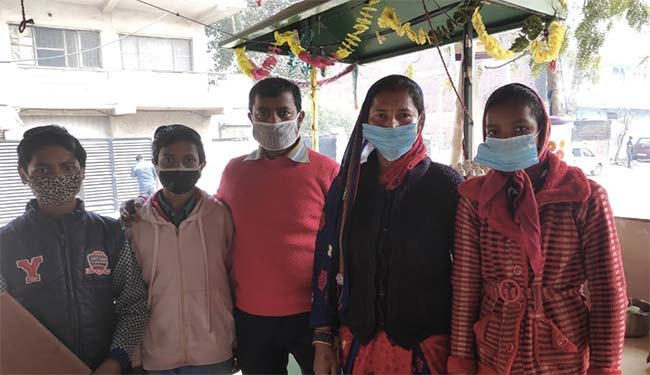
Rudani Devi and her family at their tea shop at Wapcos Road, Sector 18, Gurgaon Just like Nanhi, Rudani Devi from Sarhol village in Gurugram (Gurgaon) is also waiting for her ration card for over a decade now. Rudani Devi hails from Madhubani, Bihar but soon after marriage, she came to Gurugram along with her husband and together they run a small tea stall at Wapcos Road, Sector 18, Gurgaon. Talking about the hardships brought in by the COVID-19 and lockdown, Rudani Devi’s husband K.C. Pandit said,
“Before the lockdown, we used to make Rs. 5,000 to Rs. 7,000 a month. Additionally, I would often take up odd jobs like loading and unloading and bring Rs. 200 to Rs. 400. During the lockdown, all sources of income were shut. We thought of going back home but people around us advised against it because there was no conveyance, we have three children and the disease was spreading like a wildfire. Anand Sir, one of our regular customers, who works in a nearby factory once gave me Rs. 500 and said, you can still survive in a city but you won’t if you try walking back home.
Further talking about how the couple fed their children, Mr Pandit said, they would eat at the government’s food distribution drives and bring home some for their children. He added,
“NGOs like Smile Foundation also stepped up and provided dry ration. We applied for a ration card in May, 2007 on our village address but we don’t know what the status is now.
Mr Pandit said that life is slowly coming back on track as things unlock but what still scares him the most is the lockdown period when the family was petrified of stepping out of the house, contracting the disease and eventually dying.
“We didn’t know what to do, where to go, who to ask for help. We were scared of going to a neighbour’s place also.
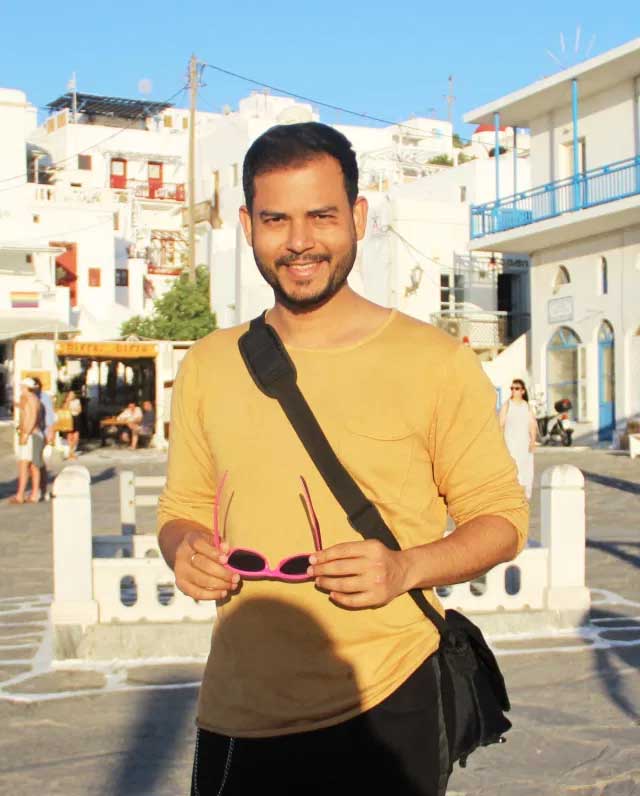
New Delhi: Internationally aclaimed, Odisha born Filmmaker & promoter Jitendra Mishra has been selected Jury for the prestigious ”24th Montreal International Children’s Film Festival – FIFEM” scheduled from 27 Feb-07 March 2021 in Quebec province of Canada. Jitendra is one of the Professional Juror in the six member Jury panel of the fest to select both best film for the “Montreal Grand Prix” Award and “European Children’s Film Association” Award winners of this year.
FIFEM is one of the biggest and most credible festivals for young people across the globe. The festival is held annually with a mission to train the film lovers of tomorrow, by offering them a range of the best global youth cinema. It aims to complement the school career, through educational activities that provide young people with the means to acquire a visual understanding of cultures, traditions and experiences that may be foreign to them. Due to the current pandemic situation the festival will be held online for the first time.
Born in Titilagarh of Bolangir district, Jitendra Mishra is one of the few Indian film Producers & promoters who have been able to create a benchmark in ‘Alternative methods of Film Production, Distribution & Promotion’ at international level. Committed towards meaningful cinema, Jitendra has already been associated with the production, distribution and promotion of more than 110 films in various categories in different capacities. His recent production ‘The Last Color’ directed by Michelin Starred Chef Vikas Khanna, starring Neena Gupta has already been travelled to more than 50 international festivals & won 15 different awards so far. His current Indo-Italian co-production ‘Human OAK’ directed by Italian filmmaker Ulisse Lendaro has been gaining wide global accolades these days; the film was recognized as the only international co-production from India shot during Covid-19 lockdown. Jitendra has also been the festival director of the leading children & youth festival ‘SIFFCY – an initiative of Indian’s leading development organization Smile Foundation’ (Smile Int’l FF for Children & Youth) since it’s inception.
“This year’s first festival as Jury, I am going to watch more than 20 latest films from across the globe that will help me understand the current global trends of filmmaking & industry after pandemic, at the same time it’s an opportunity to learn &, exchange ideas among the global industry leaders & implement them in our own endeavors. I feel honored and thankful to the General & Artistic director Jo-Anne Blouin for this invitation & grateful to the management of Smile Foundation for their continued support, encouragement & guidance,” said Jitendra on this occasion.
As the festival director of SIFFCY Jitendra Mishra is elected President for the most credible and oldest global children & youth media network CIFEJ this year.
Awarded with the prestigious ‘Son of Odisha’, ‘Young Jury, ‘Youth Icon’, ‘Youth inspiration’ and many other national & international awards, he is also an active member of Cannes producers network.
World Day of Social Justice, recognised by the United Nations, is observed every year on February 20. This is in recognition of the fact that while the global economy is progressing due to globalization, increased trade, and technological development, there still exists glaring social inequality. Social justice refers to equal opportunities, fair distribution of wealth, and providing healthcare facilities to all within a society. It also includes human rights and preserving the rights of people who have been subjected to discrimination based on race, religion, or sex. The day also serves as a reminder that countries, governments, corporations, and the civil society organisations need to work together to address this gap.
This year, the theme for World Day Of Social Justice is “A Call for Social Justice in the Digital Economy”.
Social justice in a digital economy has become a necessity. The traditional workforce though have suffered the brunt. Daily wage earners and small businesses are facing challenges due to unfair competition. The access to the digital infrastructure, has therefore, become important for people to be economically sound.
Speaking on the same, Santanu Mishra, Co-founder and Executive Trustee, Smile Foundation said, “Covid-19 has increased participation in the digital economy, but there remains a need to increase access to digital means. Social justice in the digital world encompasses equitable access to digital services for healthcare, education and livelihood.”
According to a global study by UNESCO, Covid-19 pandemic has pushed more than 290 million students out of schools in just 13 countries.
Hence, in such dire circumstances, the World Day of Social Justice 2021 assumes great significance.
The role of civil society organisations have become very critical in easing the shock of the pandemic to millions of Indians. So, on the occasion of World Day of Social Justice, News18 spoke exclusively to members of some leading civil society organisations.
“Social justice is fundamental in solving global poverty. Around 270 million Indians live in extreme poverty, with 65 million of them living in ultra-poverty. On this World Day of Social Justice, all stakeholders including industry, philanthropy, civil society organisations, governments and regulators must re-dedicate themselves to work closer than ever to deliver this justice to millions of our compatriots,” said Sudha Srinivasan, CEO, The/Nudge Centre for Social Innovation.
While some believe that poverty alleviation can be a driving force in achieving social justice, others focus on education. “Education is a vital and effective tool to deliver social justice. The global disruption in learning caused by the pandemic has highlighted the importance of self-learning, and the mindset and habits required for it. Learners should be empowered to build their own learning pathways. Our work in designing scalable learning experiences helps curate those journeys for education institutions and creates enabling environments which foster 21st century skills through self-learning,” Aakash Sethi, CEO, Quest Alliance said, adding “The World Day of Social Justice serves to strengthen our resolve to build more partnerships within the education and skilling ecosystem towards attaining that goal.”
WWF India launched the One Earth One Home movement on September 10, 2020 to inspire children to adopt pro-conservation attitudes and sustainable household practices towards a greener living
The programme has been designed especially for government schools across the country and has been aligned with multiple Sustainable Development Goals
World Wide Fund (WWF) India’s One Earth One Home programme (OEOH), which saw school children building sustainable homes in 16 States and Union Territories of India, has concluded for the session 2020-2021.
This programme was implemented in partnership with State Departments of Education of Jammu & Kashmir, Uttarakhand, Himachal Pradesh, Maharashtra, Chhattisgarh, Assam, Andhra Pradesh, Karnataka, Madhya Pradesh, Rajasthan, Telangana, Himachal Pradesh, Kerala, Tamil Nadu, and Bihar along with Navodaya Vidyalaya Samiti, Smile Foundation and Million Sparks Foundation.
OEOH is a pan-India digital movement for government and government-aided schools to develop knowledge and skills among the primary and middle school students enabling them to steer a change in their household practices and create sustainable homes.
WWF India launched the OEOH movement on September 10, 2020 to inspire children to adopt pro-conservation attitudes and sustainable household practices towards a greener living. Students from Class I-VIII from government or government-aided schools across the country took a well-guided digital journey ensuring that learning, wellness and actions go hand-in-hand.
The programme has been designed especially for government schools across the country and has been aligned with multiple Sustainable Development Goals (SDG) primarily SDG 3: Good health & well-being, SDG 4: Quality education, SDG 6: Clean water & Sanitation, SDG 11: Sustainable cities & communities, SDG 12: Responsible Consumption & production and SDG 13: Climate Action.
The resources are available in 10 languages, English, Hindi, Gujarati, Marathi, Bengali, Assamese, Kannada, Telugu, Tamil and Malayalam, for teachers and students on the National DIKSHA portal and the State Government websites – Government of Assam, Elementary Education Axom Sarba Siksha Abhiyan Mission SSA Website.
OEOH programme in Assam has been adopted by schools impacting students across the state and the closing ceremony was successfully organized virtually on January 29.
The ceremony was graced and addressed by the Dr. Sumona Roy, Joint Director, SCERT and Smti. Suranjana Senapati, Secretary of SEBA. Smti. Krishna Baruah, OSD, SSA & ED RMSA was available through a video message which was screened at the occasion. The closing ceremony also recognized and saluted the efforts of the schools.
Talking about the program, Anuja Bhuyan, Deputy Secretary to Department of Elementary Education Government of Assam said, “The recent disruption caused by the COVID pandemic has really made it imperative to bring about a close contact between life and nature. The One Earth One Home programme which is a very short and flexible program designed by WWF really deserves appreciation in a sense that it is trying to make an effort to steer into the minds of the children the urge to adapt to pro- environmental practices.”
Brojen Borah Headmaster of Lakhiminagar M.E. School said, “The activity books along with the videos of OEOH were enjoyed by learners, teachers, parents and guardians. One Earth One Home programme has helped the students to exhibit good habits like separation of different waste products, conservation of water and learn interesting things about nature. I would like to pay my humble respect to all the WWF Assam members and wish them luck for their future endeavors.”
Talking about the program, Radhika Suri, Director, Environment Education, WWF India said, “It is the need of the hour to educate the present generation toward greener habits and sustainable consumption practices in a playful, creative and engaging manner. With the nationwide closure of the schools, the perfect solution to build a positive environment for children at home is by connecting them to nature. ‘One Earth One Home’ movement did not just inspire children but their families and immediate communities towards the environment and enlighten them to contribute towards a greener, cleaner and healthier India. The support we have received from so many State Departments of Education is a testimony of the importance to impart environment education and take action during this pandemic.”
Food And Night LifeThe Food & Nightlife magazine is a fresh and innovative city magazine that guides the young and spunky Delhiites about their food and party quotient. It is one-of-its kind magazine, a much vaunted marriage of culinary delights and leisure outs, which gives the best deals and steals.
A PlanForMe.com initiative, the Food & Nightlife magazine, is a monthly affair of bringing home an encyclopaedia for the foodies’ and the party mongers in a creative format.
To know more about the Magazine, please visit http://www.foodandnightlife.com/
Food And Night Life
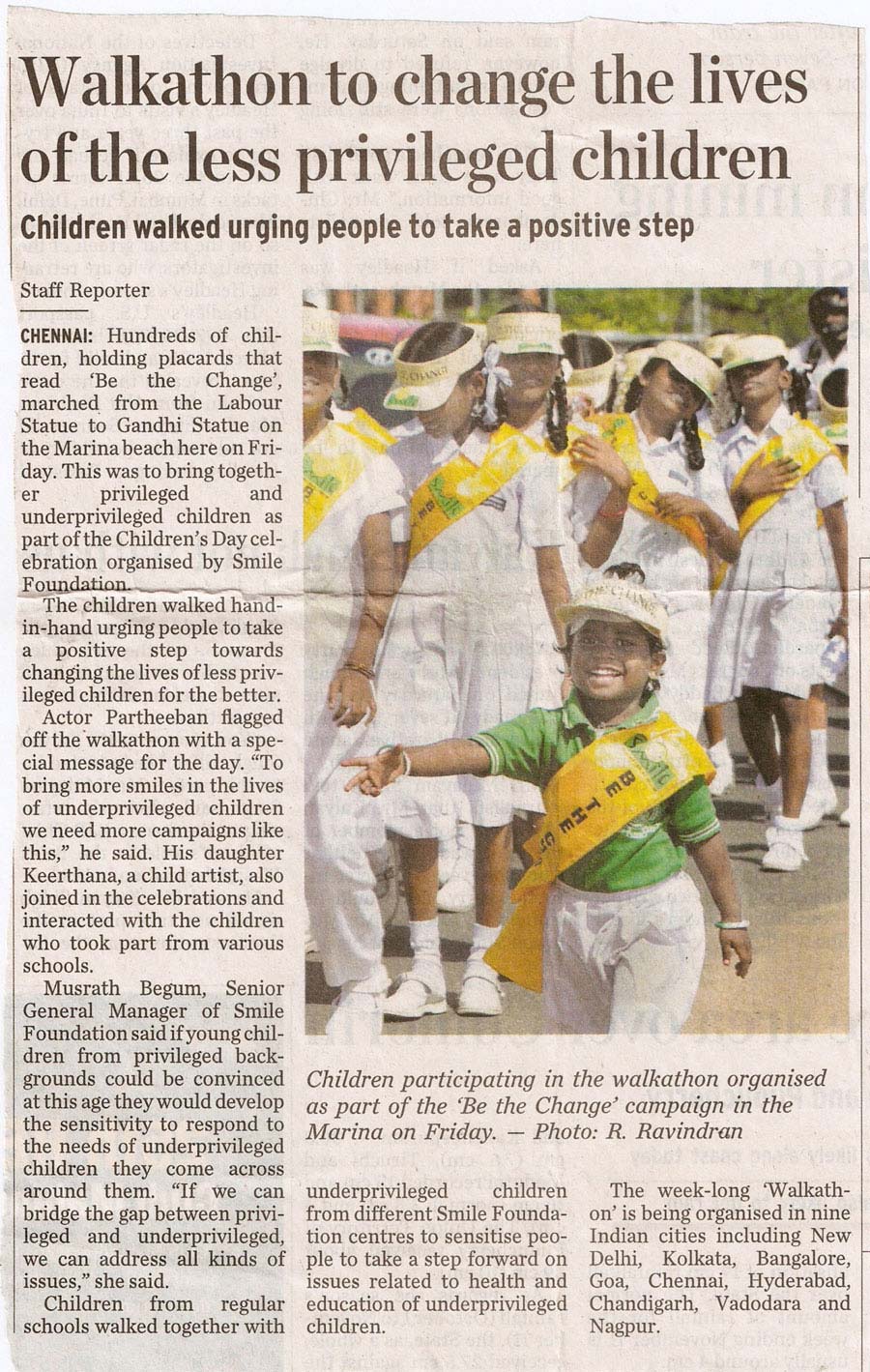
Our association: Smile Foundation has collaborated with Food and Nightlife magazine under ‘Be The Change’ campaign with the aim to sensitise the privileged masses towards the plight of the underprivileged children. The magazine reaches out to the Elite section of the society having the desire and capability to bring a change in the society by actively participating in the development process.
One Earth One Home’, a pan-India digital movement for government and government-aided schools to develop knowledge and skills among the primary and middle school students enabling them to steer a change in their household practices and create sustainable homes. Aligned to the SDGs, the OEOH curriculum is available in 10 languages to all teachers and students on DIKSHA, One Earth One Home website and State education portals.
WWF India launched the One Earth One Home movement on 10 September 2020 to inspire children to adopt pro-conservation attitudes and sustainable household practices towards a greener living. Students from Class I-VIII from government or government-aided schools across the country took a well-guided digital journey ensuring that learning, wellness and actions go hand-in-hand.
The WWF India ‘One Earth One Home’ movement had school children building sustainable homes in 16 States and Union Territories of India. It was implemented in partnership with State Departments of Education (J&K, Uttarakhand, Himachal Pradesh, Maharashtra, Chhattisgarh, Assam, Andhra Pradesh, Karnataka, Madhya Pradesh, Rajasthan, Telangana, Himachal Pradesh, Kerala, Tamil Nadu, Bihar), Navodaya Vidyalaya Samiti, Smile Foundation and Million Sparks Foundation. Chief Education Officers, District Education and Block education officers were engaged at all levels to disseminate the information and resource material to the teachers and students. The PAN India programme concluded with organizing State Level One Earth One Home Closing Ceremonies.
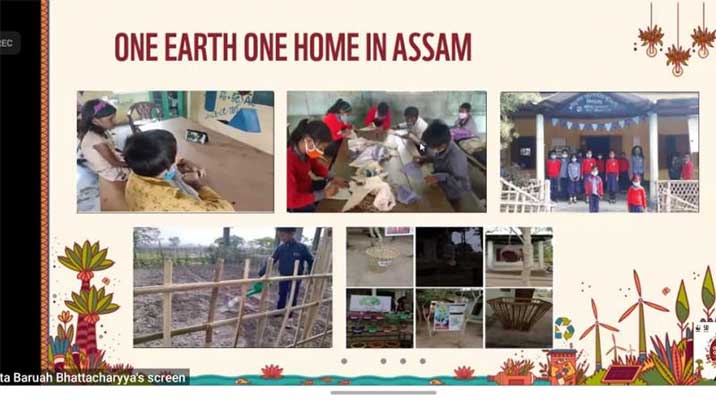
OEOH programme in Assam has been adopted by schools impacting students across the state. Assam OEOH Closing Ceremony was successfully organized virtually on 29thJan.2021 conducted and announced the awards by Archita Baruah Bhattacharya, Coordinator WWF India Assam State Office. The ceremony was graced and addressed by the Dr. Sumona Roy, Joint Director, SCERT and Smti. Suranjana Senapati, Secretary of SEBA. Smti. Krishna Baruah, OSD, SSA & ED RMSA was available through a video message which was screened at the occasion. The closing ceremony also recognized and saluted the efforts of the schools. The Best School & Best Success Story of Change award was given to Lakhiminagar M.E School (Sivasagar District), Best District to Sivasagar District and Best teacher to Faizul Karim of Buraburi Secondary School (Morigaon District). A Special OEOH Award for Teacher announced to Partha Pratim Borkotoky (Majuli District) and special mention Sonitpur District for their exemplary work in implementing the programme in their respective school and district.
Talking about the program, Ms. Anuja Bhuyan, Deputy Secretary to Department of Elementary Education Govt.of Assam said “The recent disruption caused by the COVID pandemic has really made it imperative to bring about a close contact between life and nature. The One Earth One Home programme which is a very short and flexible program designed by WWF really deserves appreciation in a sense that it is trying to make an effort to steer into the minds of the children the urge to adapt to pro- environmental practices”
The programme has been designed especially for government schools across the country and has been aligned with multiple Sustainable Development Goals primarily SDG 3: Good health & well-being, SDG 4: Quality education, SDG 6: Clean water & Sanitation, SDG 11: Sustainable cities & communities, SDG 12: Responsible Consumption & production and SDG 13: Climate Action. The resources are available in 10 languages– English, Hindi, Gujarati, Marathi, Bengali, Assamese, Kannada, Telugu, Tamil and Malayalam, for teachers and students on the National DIKSHA portal and the State Government websites – Government of Assam, Elementary Education Axom Sarba Siksha Abhiyan Mission SSA Website.
Brojen Borah Headmaster of Lakhiminagar M.E. School said “The activity books along with the videos of OEOH were enjoyed by learners, teachers, parents and guardians. One Earth One Home programme has helped the students to exhibit good habits like separation of different waste products, conservation of water and learn interesting things about nature. I would like to pay my humble respect to all the WWF Assam members and wish them luck for their future endeavors”
Talking about the program, Ms. Radhika Suri, Director Environment Education, WWF India said “It is the need of the hour to educate the present generation toward greener habits and sustainable consumption practices in a playful, creative and engaging manner. With the nationwide closure of the schools, the perfect solution to build a positive environment for children at home is by connecting them to nature. ‘One Earth One Home’ movement did not just inspire children but their families and immediate communities towards environment and enlighten them to contribute towards a greener, cleaner and healthier India. The support we have received from so many State Departments of Education is a testimony of the importance to impart environment education and take action during this pandemic.”