
Search
Close this search box.
Categories
Print/ Online Media

Opinion: Prepping The Education Sector For Contingencies

Opinion: Prepping The Education Sector For Contingencies

( July 28, 2020 )

With schools shut and students at home, the COVID-19 pandemic has presented the education sector with a unique challenge.

With schools shut and students at home, the COVID-19 pandemic has presented the education sector with a unique challenge. The sector has shown great adaptability to ensure continued learning. Various e-learning portals and apps have been launched by the government and education bodies such as DIKSHA portal, e-Pathshala, Swayam and so on. National and state education boards cancelled their remaining examinations and announced results for students across the country. The NCERT also issued guidelines recommending a reduction in syllabus, making suggestions on proper implementation of online and offline courses. While the government has shown remarkable alacrity for change, it is essential that more organizations come together to devise creative solutions to problems with online education, since this mode of instruction is likely to be preferred by swathes of students at least in the near future.

Digital learning, e-learning, online classes are broad terms, each with some unique aspects. Classifying them under a single umbrella would not be right. However, one key element of all of the above models of learning is that they require an internet connection and smart devices. Reliable internet connectivity remains an issue for a sizeable student base in India.

A recent pan-India study by Smile Foundation with over 40,000 students from rural areas and urban slums found that 56% of children lacked access to a smartphone. Of these children, 12% had no access to any phone. Only 69% of students surveyed had access to television. Ground realities on access to e- education for children are stark.

The same challenges can also be seen in higher educational institutions.

For instance, a survey by IIT Kanpur revealed that 9.3 % of its 2,789 students were not able to download material sent by the institute or study online. Only 34.1% cent of them had internet connection good enough for streaming real-time lectures.

But the digital divide is not the only challenge.

Studies show remote learning has a bearing on cognitive development. Wholesome cognitive development in children requires human interaction – teacher to student, student to teacher, and student to student.

As countries lockdown, learning outcomes are bound to get affected over the long-term. This being echoed by teachers and education facilitators in the news today, when they are being questioned on the efficacy of online classrooms. The feedback was quite unanimous. They claimed that there have been fewer engagement with students, debates and casual conversations which would lead to an energised learning environment are hard to create and now mostly non-existent, students ability to manage time was a challenge but the most pertinent on was the cutting off of a face to face contact.

Multiple studies have also illustrated the devastating effect of school closures on learning. NGOs from across the country have joined hands to conduct creative classes, run workshops on collaborative learning to ensure students are constantly engaged.

While the challenges of the times are plenty, how do we as a community come together and solve some of these issues? How do we ascertain that education which is a basic right for our youth is afforded to them? If we as a country are to grow, we need our foundations to be firm and the first step for that is education. And to achieve that, we all have to come together and solve for tomorrows problems today. The need of the hour is for government, corporates, NGOs and learning experts to come together to draft a detailed multi-modal learning strategy. 

And we have the ability and intent.

Even in these trying times, we have seen reports in papers of individuals who in their communities have taken the initiative to do more. In a small village in Haryana, Jhamri, to maintain social distancing, the students take notes from their homes as a teacher imparts lessons using the loudspeaker attached to the cart. In Maharshtra, Bhadole village, teachers have identified students who have access to smartphones and have formed groups clubbing them with students without any access.

At state level, the government of Haryana became the first state in the country to instruct the Haryana Institute of Public Administration to use TV for providing distance education during the lockdown period. Almost all the DTH providers and local cable services were roped in for this purpose. As of last month, the Director-General (Higher Education) of the state said that four major AIR radio stations in Haryana would be broadcasting two half-an-hour shows daily at a common time to promote learning from home. Odisha and Telangana have both entered into a partnership with Coursera an online learning platform — to train one lakh unemployed youth during the COVID-19 crisis.

Our solution

We need to as a community collate clear guidelines based on a detailed need-assessment across states and districts that can help devise a model that ensures ‘education for all’ keeping learning outcomes in focus. While we have seen innovations as mentioned above, there is a need to streamline and increase the focus of those innovations to all of India. And this can be done with the following actions

Stakeholder Involvement: Consulting parents on the outcomes they desire from the learning process is an absolute must. The plan must address when schools can be reopened. Schools also need to address infrastructure challenges and must invest in inclusive learning. Putting in place data storage facilities, digitising report cards, or making the premises contagion-free are some steps in this direction.

Rediscovering models: Children with limited access to technology and infrastructure need special attention while devising annual curricula. Alternating between, classroom learning, online education, and televised classes every week could be one of the more effective ways to impart education. Following this approach would require national and state education boards to digitise their entire curriculum, make it digitally accessible, user friendly and replicable for across portals – from textbooks to online videos. Not only will this help over a short duration, it will also improve access for children in less advantaged communities. Increasing the scope of state innovations to other states.

Continuing the momentum: The swiftness of alterations brought about by the government and corporate India is undeniably praiseworthy. They have indeed stepped up to the plate and supported new approaches for continued learning in the pandemic. However, emerging challenges need more collaborative planning, interventions to fill gaps from the pre-COVID era. Infrastructural challenges and teacher-to-student ratios can be addressed through a more complete learning process that guarantees access to education.

The pandemic has provided a great opportunity for all stakeholders to get back on the drawing board and collectively address challenges in the effective delivery of education. This is the ideal time for educational institutions, NGOs and policymakers to realign strategies. What changes can we make to ensure that our students find the time and develop a routine to mentally engage in stress-free exercises thereby honing their skills and feel involved. As mentioned above, we have the ability, we have the innovations and we have the resilience all we need to do is make time. And that surely can be done by all of us for the future of our youth and in turn the future of our country.

(Santanu Mishra, co-founder and executive trustee of Smile Foundation, looks after the overall operations, planning, and strategy of the organization)

Source: https://www.ndtv.com/education/opinion-prepping-education-sector-for-contingencies
Categories
Print/ Online Media

4 NGOs in India educating kids online during COVID-19

4 NGOs in India educating kids online during COVID-19

( July 28, 2020 )

Challenges to education have been exacerbated by restrictions due to COVID-19, especially for those from poorer backgrounds or in remote areas. It has become a challenge for government, caregivers, teachers and parents to ensure in providing quality education in the pandemic.

Educating kids online

The need for physical distancing has suddenly led to most schools resorting to online teaching, for which the country was absolutely unprepared. Several NGOs are taking care of vulnerable children who are unable to meet educational needs. These NGOs are helping them through every possible resource.

Here’s looking at some NGOs in India that are helping vulnerable children through online education:

1. Miracle Foundation

Miracle Foundation India, along with CCI (child care institution) teams, is educating kids at child care institutes since the lockdown started. Through Miracle’s support, all the CCIs have set up computer labs with internet connection and electricity back-up. Now, they are in the process of providing tablets and smartphones to children who have returned home their families and do not have access to any technology.

Miracle Foundation is ensuring connectivity and providing data support for these children. They are educating kids with the existing staff of CCI and remote learning to cover their syllabus.

2. E-Vidyaloka

The Bangalore-based NGO focuses on imparting education to students of rural government schools in India by crowdsourcing volunteer teachers and connecting them to the schools using the power of IT. During the pandemic, the foundation is focusing on provide education through remote learning with the access of internet and electronics. E-Vidyaloka believes educating kids online will be the way forward in the future.

3. Magic Bus

Magic Bus foundation equips children and young people in the age group of 12 to 18, with the skills and knowledge they need, to grow up and move out of poverty. The foundation has partnered with Classplus mobile OS for online education to poor kids enrolled in the Magic Bus Livelihood programme. Through the partnership, they will help over 2,000 youngsters across 22 states.

4. Smile Foundation

Smile Foundation provides education to thousands of children from Class I to Class XII running across 23 states. The foundation found that about 56% of Indian children lack smartphones. In this scenario, amidst Covid-19, they are providing possible solutions to access education.

Source: https://thecsrjournal.in/ngos-educating-children-remote-learning-india/

Categories
Print/ Online Media

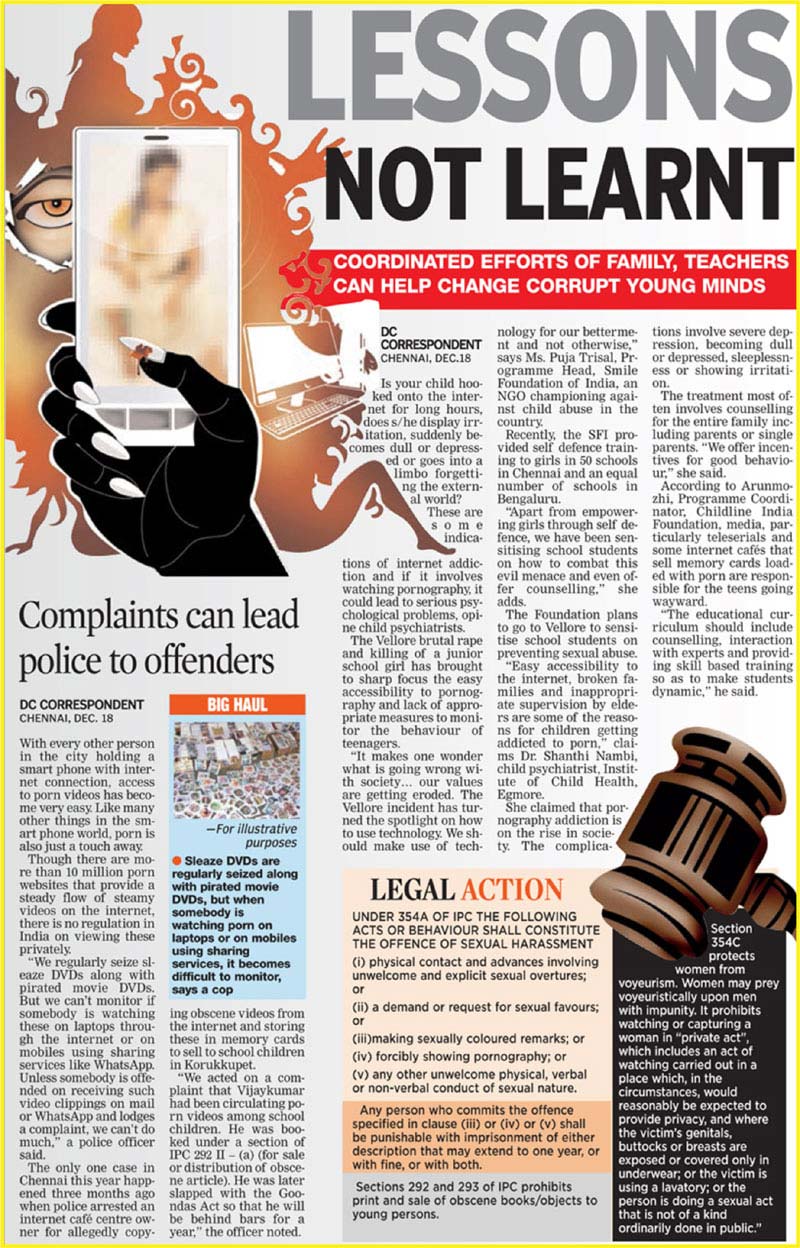
Lessons Not Learnt

Lessons Not Learnt

Deccan Chronicle (18 December 2014 )

Categories
Print/ Online Media

NGOs that are educating children through remote learning in pandemic

NGOs that are educating children through remote learning in pandemic

( July 27, 2020 )

Challenges to education have been exacerbated by restrictions due to COVID-19, especially for those from poorer backgrounds or in remote areas. It has further become a challenge for the government, caregivers, teachers and parents to ensure in providing quality education in the pandemic. Thus, the need for physical distancing has suddenly led to most schools resorting to online teaching. Though, the country was unprepared. And now, several NGOs are taking care of vulnerable children who are unable to meet their educational needs and going through a break. These NGOs are helping them through every possible resource.

Here’s looking at some NGOs in India that are helping vulnerable children with their education:

Miracle Foundation India

Miracle Foundation India, along with CCI teams, has continued to educate kids at child care institutes. Through Miracle’s support, all the CCIs have set up computer labs with internet connection and electricity back-up. Now, they are in the process of providing tablets and smartphones to children who have gone back to their families. These are still students who do not have access to any technology. So, the Foundation is ensuring connectivity and providing support for the internet data for these children. They are educating kids with the existing staff of CCI and remote learning to cover their syllabus with the least impact.

Magic Bus

Magic Bus foundation equips children and young people in the age group of 12 to 18, with the skills and knowledge they need, to grow up and move out of poverty. This takes them from a childhood full of challenges to a life with meaningful livelihoods. The foundation has also partnered with Classplus. It is a mobile OS for online education to poor kids enrolled on the Magic Bus Livelihood programme. Through the partnership, they will help over 2,000 youngsters across 22 states.

E-Vidyaloka

This Bangalore-based NGO focuses on imparting education to students of Rural government schools in India. They further crowdsource volunteer teachers and connect them to the rural government schools using the power of IT. During the pandemic, the foundation is focusing on providing education through remote learning with the access of internet and electronics.

Smile Foundation

NGO Smile Foundation provides education to thousands of children from Class I to Class XII running across 23 states. The foundation also finds that about 56 per cent of Indian children lack smartphones. In this scenario amidst Covid-19, they are providing possible solutions to access education.

Source: https://www.ciol.com/ngos-educating-children-remote-learning-pandemic/

Categories
Print/ Online Media

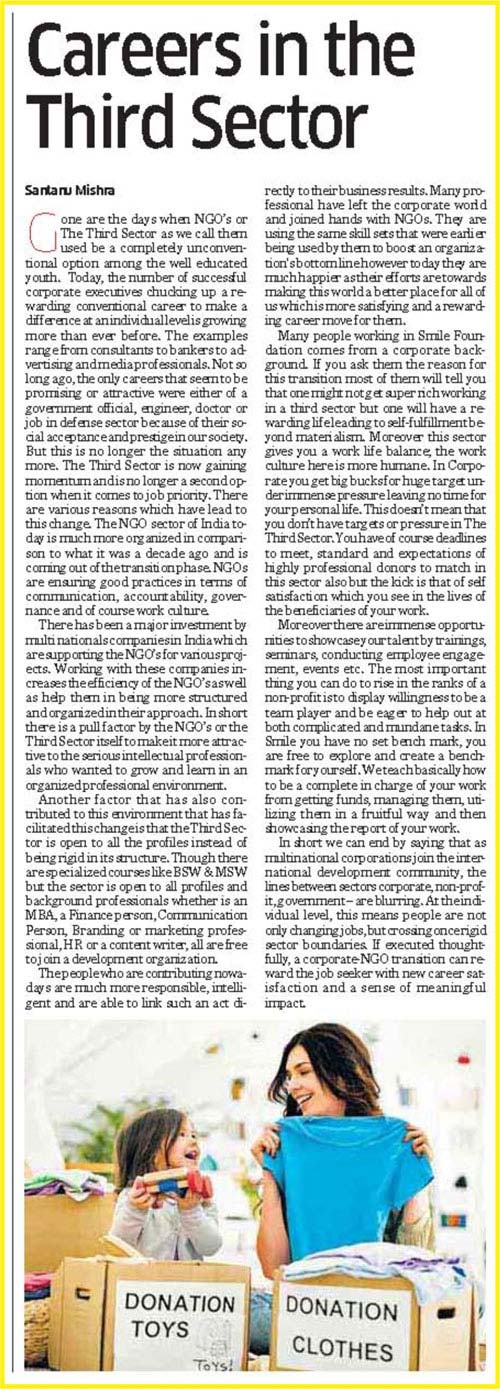
Career in the Third Sector

Career in the Third Sector

Deccan Herald (18 December 2014 )

Categories
Print/ Online Media

Learning in the time of a pandemic: The divide that divides

Learning in the time of a pandemic: The divide that divides

( June 30, 2020 )

It is three months since the first lockdown was announced due to Covid-19. Like all fields, the pandemic has affected the area of education too which has had to take recourse to online learning even from the primary school stage. But lack of universal availability of the electronic tools for learning, has also created a divide between the haves and have-nots. Anju Munshi probes

Recently, a teenage girl from Howrah near Kolkata hanged herself because she was unable to attend her online classes. The phone she shared with her family got damaged and could not be repaired during the lockdown as the mobile repairing shop was shut. A good student in an English medium school, she feared she would not be able to keep up with the others and fail.

In the beginning of June, the daughter of a daily wage labourer in Kerala’s Malappuram district also took her own life for the same reason. A good student, she neither had access to a TV (her father was unable to repair the existing one for lack of money) or a smartphone. Meanwhile, the government’s academic session with online classes had started and she despaired.

Vivan (name changed), son of an auto-rickshaw driver studying in class five in a public school in Kolkata, joined a WhatsApp group created by his school and started online classes. Being dependent on his father for availability of the only smartphone in the family, he lagged behind and after some weeks he lost interest and gave up.

These are only a few instances of how the new mode of learning during this pandemic has affected children from disparate backgrounds thus creating a chasm between the ‘have’s with their individual smartphones/ laptops/ computers and ‘have-not’s who are not lucky enough.

It is not unexpected in a country like India where widely differing economic strata is a reality.

According to the Telecom Regulatory Authority of India, although about 78 per cent of India’s 1.3 billion population have mobile phones, teledensity in rural areas is only around 57 per cent.

A study in April by the child rights NGO Smile Foundation among 40,000 children – from Class I to Class XII running across 23 states, finds that about 56 per cent of Indian children lack smart phones. Titled “Scenario amidst Covid-19: On ground situations and Possible Solutions” it finds that nearly one in eight children lacks access either to smart phones or basic phones.

A recent Unicef report on the impact of Covid-19 on the lives of 600 million children in South Asia says that despite measures to use technology for education a large number of children were likely to miss out on distant learning opportunities as only a quarter of households, that is, 24 per cent is estimated to have access to the internet .It also says that there is a large rural-urban and gender divide in access to internet services .

Lacking access to smartphones, one smartphone per family, usually owned by a working father, unstable network, girls engaged in housework, parents and teachers not well trained to handle the technological part of the exercise, are some other challenges.

For the teachers and schools running online classes, the challenge is no less. “Training, awareness and application are of utmost importance,” says Anjana Saha, principal, Mahadevi Birla World Academy, Kolkata.

“The children need to be reassured by the school that even if a class is missed, content doesn’t disappear and can be accessed later and from anywhere else and that gadgets are not overwhelmingly indispensable. There should not be any panic. A supportive and strategic approach by the school is crucial.”

Meanwhile, the government has engaged multiple channels for continuity of education including web portals, mobile apps, TV channels, radio and podcasts through platforms such as Diksha, Swayam Prabha ,TV channels, E-Pathshala and the National Repository of Open Educational Resources. But experts say that the digital divide among the rural and urban, even urban poor, is a fact and online classes is also an operational nightmare.

Girija Kaul, a parent from Delhi’s Palam Vihar area thinks that without provision for electricity 24×7 these facilities are meaningless.

Dina Rastogi, a parent from Mumbai’s Dharavi, Asia’s biggest slum area, opines that the government should provide handsets to all those who cannot afford to buy one and 3G data services should be provided to the maximum number of schools in the villages.

Besides, most of the parents of such disadvantaged children are not equipped to guide their wards. The logistics of getting families set up with the technology are complicated and there’s likely to be plenty of troubleshooting required.

Meena Kak, director, Lakshmipat Singhania Academy, Kolkata, feels that schools should have separate time slots for children who share one smart phone in the family.

“Difference in one’s learning patterns, uptake skills and gadget access creates an unjust ground. Here we need to customise in a more practical and personal way and then have tailored guidance to home based learning .The most important thing is to maintain a regular contact with students and parents.”

“Schools can be a good linking device. We are trying to train our teachers and make them available by phone, messaging, or email every morning to give an individual and a family-like support to the children. This certainly is not an easy time but we need to empathise with the children and address their insecurities,” she said.

Anjana Saha contends that the problem could be bridged with compassion and good communication. “No one was prepared for this pandemic. The teachers and the administration are trying to offer the best. In fact we need a strong emotional connect that can bridge this gap. It is not a digital divide but a digital challenge’

Then there is another problem that has cropped up. Now that the lockdown has eased up enough for employees to return to their offices they have to leave children behind making them vulnerable to the dangers of electronic devices.

Internet content is unsupervised too. So not only are they unprotected in the absence of parents but can also not resolve a technical glitch in case any arises. Also, not all families have a device to spare and in that case the children have to wait till the parents are home, “If gadget unavailability is a problem, then unsupervised children at home is an equal problem,” says Saha.

In addition to this, teachers also do not possess superfast WiFi service and efficient routers to ensure good connectivity. Says Kavita Sharma, a school teacher from Bengaluru, “Internet subscription is too expensive and complicated to use for many.”

Meanwhile, there are also those who have used their common sense to reach the lessons to their students innovatively. For example, in a village school in Dumka , Jharkhand, the principal (of the Bankathi Upgraded Middle School) has hit upon the idea of using a network of loudspeakers connected with a microphone used by the teacher. The students can hear the lessons, loud and clear, literally, wherever it is convenient for them to study.

The principal, Shyam K. Gandhi, thought of this simple solution while coming to know that 204 out of his 246 students did not have smartphones.

According to reports, attendance has been almost hundred per cent.

Perhaps in these times when online classes seem to stay on for some time to come, and the digital divide is a fact, innovations like these are sorely needed.

Source: https://www.indiablooms.com/life-details/F/5187/learning-in-the-time-of-a-pandemic-the-divide-that-divides.html

Categories
Print/ Online Media

About 56 per cent of children have no access to smartphones for e-learning: Study

About 56 per cent of children have no access to smartphones for e-learning: Study

( June 13, 2020 )

The lockdown induced by the COVID-19 pandemic in March prompted schools and colleges to move to the virtual world for teaching and learning activities.

NEW DELHI: About 56 per cent of children were found to have no access to smartphones which have emerged as essential tools for online learning during the coronavirus-induced lockdown, according to a new study that surveyed 42,831 students at various school levels.

The study ‘Scenario amidst COVID 19 – Onground Situations and Possible Solutions’ was conducted by child rights NGO Smile Foundation with an aim of analysing the access to technology.

The findings of the study showed that 43.99 per cent of surveyed children have access to smartphones and another 43.99 per cent of students have access to basic phones while 12.02 per cent do not have access to either smartphones or basic phones.

A total of 56.01 per cent children were found to have no access to smartphones, the study said.

“Concerning television, it was noted that while 68.99 per cent have access to TV, a major chunk of 31.01 per cent does not.

“Hence suggesting that using smartphone interventions for enhancing learning outcomes is not the only solution,” it said.

At the primary level of education (class 1 to 5) 19,576 children were surveyed while at upper primary level (class 6 to 8) 12,277 children were surveyed.

At secondary level of education (class 9 to 10) 5,537 children were surveyed and at higher secondary level (class 11 to 12) 3,216 children were surveyed.

The survey based on which the study was conducted used two approaches – over the telephone wherein the NGO reached out to the children whose database it already had — students enrolled in various education centres of the NGO — and second was through community mobilization wherein community workers went door to door to get answers.

The survey was conducted in 23 states, including Delhi, Gujarat, Maharashtra, Karnataka, Tamil Nadu, West Bengal, Andhra Pradesh, Telangana, Uttar Pradesh, Haryana, over a period of 12 days from April 16 to April 28.

The lockdown induced by the COVID-19 pandemic in March prompted schools and colleges to move to the virtual world for teaching and learning activities.

However, many experts say the digital divide in the country may turn online classes into an operational nightmare.

As per official statistics, there are over 35 crore students in the country.

However, it is not clear as to how many of them have access to digital devices and Internet.

Santanu Mishra, co-founder and executive trustee, Smile Foundation, said the findings clearly show that the digital divide is a real challenge, and multiple approaches need to be implemented to cater to all across the nation.

“As an exercise before we start any programme, we do a baseline study to understand the on-ground challenges so that our programmes can bring in real work and real change.

“With the onset of the pandemic, following indefinite school closures, it is more important than ever to understand the situation and how can we ensure that children are given quality education.

“Through this, we understand that customized modules need to be built in accordance with the channel of communication,” he said.

Source: https://www.newindianexpress.com/nation/2020/jun/13/about-56-per-cent-of-children-have-no-access-to-smartphones-for-e-learning-study-2156181.html

Categories
Print/ Online Media

Study bares digital divide

Study bares digital divide

( June 13, 2020 )

About 56 per cent of Indian children lack access to smart phones, key to online schooling which has become the norm during the coronavirus-induced lockdown, a survey has found.

The study, titled “Scenario Amidst Covid-19: On-ground Situations and Possible Solutions”, was conducted by the child rights NGO Smile Foundation. It surveyed over 40,000 schoolchildren in 23 states.

According to the study, 43.99 per cent of the children surveyed had access to smart phones and another 43.99 per cent had access only to basic phones. Nearly one in eight —or 12.02 per cent — lacked access to either smart phones or basic phones.

“Concerning television, it was noted that while 68.99 per cent have access to TV, a major chunk of 31.01 per cent do not. Hence suggesting that using smart phone interventions for enhancing learning outcomes is not the only solution,” the study report says.

The study, conducted between April 16 and 28, surveyed children from Class I to Class XII.

It adopted two approaches: talking over the phone with children enrolled in the NGO’s education centres, and sending community workers door to door.

Among the 23 states covered were Bengal, Delhi, Gujarat, Maharashtra, Karnataka, Tamil Nadu, Andhra Pradesh, Telangana, Uttar Pradesh and Haryana.

The lockdown, which began on March 25, has closed schools, colleges and universities, prompting them to switch to online education, an arrangement expected to continue in the near future.

Many experts, however, say the virtual classes are deepening the educational divide in the country because it is difficult for rural and poor children to access them.

According to official statistics, India has over 35 crore school and university students. It remains unclear what proportion of them have access to digital devices and the Internet.

Santanu Mishra, co-founder and executive trustee, Smile Foundation, said the findings underline the challenge posed by the digital divide.

He said multiple approaches to education need to be implemented to cater to all sections of society.

“Before we start any programme, we do a baseline study to understand the on-ground challenges so that our programmes can bring in real work and real change,” he said.

“With the onset of the pandemic, following indefinite school closures, it is more important than ever to understand the situation and how we can ensure that children are given quality education. Through this, we understand that customised modules need to be built in accordance with the channel of communication, he said.”

Source: https://www.telegraphindia.com/india/coronavirus-lockdown-study-bares-digital-divide/cid/178070

Categories
Print/ Online Media

56% children have no access to smartphones for e-learning: study

56% children have no access to smartphones for e-learning: study

( June 13, 2020 )

The survey was conducted in 23 states, including Delhi, Gujarat, Maharashtra, Karnataka, Tamil Nadu, West Bengal, Andhra Pradesh, Telangana, Uttar Pradesh, Haryana, over a period of 12 days from April 16 to April 28

As per official statistics, there are over 35 crore students in the country. However, it is not clear as to how many of them have access to digital devices and Internet

About 56 per cent of children were found to have no access to smartphones which have emerged as essential tools for online learning during the coronavirus-induced lockdown, according to a new study that surveyed 42,831 students at various school levels.

The study ‘Scenario amidst COVID 19 – Onground Situations and Possible Solutions’ was conducted by child rights NGO Smile Foundation with an aim of analysing the access to technology.

The findings of the study showed that 43.99 per cent of surveyed children have access to smartphones and another 43.99 per cent of students have access to basic phones while 12.02 per cent do not have access to either smartphones or basic phones.

A total of 56.01 per cent children were found to have no access to smartphones, the study said.

“Concerning television, it was noted that while 68.99 per cent have access to TV, a major chunk of 31.01 per cent does not. Hence suggesting that using smartphone interventions for enhancing learning outcomes is not the only solution,” it said.

At the primary level of education (class 1 to 5) 19,576 children were surveyed while at upper primary level (class 6 to 8) 12,277 children were surveyed. At secondary level of education (class 9 to 10) 5,537 children were surveyed and at higher secondary level (class 11 to 12) 3,216 children were surveyed.

The survey based on which the study was conducted used two approaches – over the telephone wherein the NGO reached out to the children whose database it already had — students enrolled in various education centres of the NGO — and second was through community mobilization wherein community workers went door to door to get answers.

The survey was conducted in 23 states, including Delhi, Gujarat, Maharashtra, Karnataka, Tamil Nadu, West Bengal, Andhra Pradesh, Telangana, Uttar Pradesh, Haryana, over a period of 12 days from April 16 to April 28.

The lockdown induced by the COVID-19 pandemic in March prompted schools and colleges to move to the virtual world for teaching and learning activities. However, many experts say the digital divide in the country may turn online classes into an operational nightmare.

As per official statistics, there are over 35 crore students in the country. However, it is not clear as to how many of them have access to digital devices and Internet.

Santanu Mishra, co-founder and executive trustee, Smile Foundation, said the findings clearly show that the digital divide is a real challenge, and multiple approaches need to be implemented to cater to all across the nation.

“As an exercise before we start any programme, we do a baseline study to understand the on-ground challenges so that our programmes can bring in real work and real change. With the onset of the pandemic, following indefinite school closures, it is more important than ever to understand the situation and how can we ensure that children are given quality education. Through this, we understand that customized modules need to be built in accordance with the channel of communication,” he said.

Source: https://www.businesstoday.in/current/economy-politics/56-children-have-no-access-to-smartphones-for-e-learning-study/story/406842.html


Categories
Print/ Online Media

About 56% of children have no access to smartphones for e-learning: study

About 56% of children have no access to smartphones for e-learning: study

( June 13, 2020 )

It was noted that while 68.99 per cent have access to TV, a major chunk of 31.01 per cent does not. Hence suggesting that using smartphone interventions for enhancing learning outcomes is not the only solution, as per the study

About 56 per cent of children were found to have no access to smartphones which have emerged as essential tools for online learning during the coronavirus-induced lockdown, according to a new study that surveyed 42,831 students at various school levels.

The study ‘Scenario amidst COVID 19 – Onground Situations and Possible Solutions’ was conducted by child rights NGO Smile Foundation with an aim of analysing the access to technology.

The findings of the study showed that 43.99 per cent of surveyed children have access to smartphones and another 43.99 per cent of students have access to basic phones while 12.02 per cent do not have access to either smartphones or basic phones.

A total of 56.01 per cent children were found to have no access to smartphones, the study said.

“Concerning television, it was noted that while 68.99 per cent have access to TV, a major chunk of 31.01 per cent does not. Hence suggesting that using smartphone interventions for enhancing learning outcomes is not the only solution,” it said.

At the primary level of education (class 1 to 5) 19,576 children were surveyed while at upper primary level (class 6 to 8) 12,277 children were surveyed. At the secondary level of education (class 9 to 10) 5,537 children were surveyed and at higher secondary level (class 11 to 12) 3,216 children were surveyed.

The survey-based on which the study was conducted used two approaches – over the telephone wherein the NGO reached out to the children whose database it already had — students enrolled in various education centres of the NGO — and the second was through community mobilization wherein community workers went door to door to get answers.

The survey was conducted in 23 states, including Delhi, Gujarat, Maharashtra, Karnataka, Tamil Nadu, West Bengal, Andhra Pradesh, Telangana, Uttar Pradesh, Haryana, over a period of 12 days from April 16 to April 28.

The lockdown induced by the COVID-19 pandemic in March prompted schools and colleges to move to the virtual world for teaching and learning activities. However, many experts say the digital divide in the country may turn online classes into an operational nightmare.

As per official statistics, there are over 35 crore students in the country. However, it is not clear as to how many of them have access to digital devices and the Internet.

Santanu Mishra, co-founder and executive trustee, Smile Foundation, said the findings clearly show that the digital divide is a real challenge, and multiple approaches need to be implemented to cater to all across the nation.

“As an exercise before we start any programme, we do a baseline study to understand the on-ground challenges so that our programmes can bring in real work and real change. With the onset of the pandemic, following indefinite school closures, it is more important than ever to understand the situation and how can we ensure that children are given quality education. Through this, we understand that customized modules need to be built in accordance with the channel of communication,” he said.

Source: https://indianexpress.com/article/education/about-56-pc-of-children-have-no-access-to-smartphones-for-e-learning-study-6457247/

Privacy Policy - Smile Foundation

Information Gathering

1. Smile Foundation collects information from the users in a number of ways, for example when the user:

  • Makes a donation
  • Signs up for a campaign
  • Signs up to stay updated

2. While forwarding a donation for Smile Foundation the well-wishers have to submit some personal information as it would help us ensuring genuine contributions:

  • Your name
  • Your email and mailing address
  • Your telephone number
  • Your payment processing details
  • Any other data as required

3. Smile Foundation does not collect or record the user’s personal information unless he/she chooses to provide it.

Use of Personal Information

1. General browsing of Smile Foundation website is anonymous and it does not register the user’spersonal information except the time, date and place of visits and the name of internet service provider. This data is used only for statistics and diagnosis.

2. By signing up for various services offered by Smile Foundation, the user explicitly authorizes us to collect information based on the user’s usage. The information is used to help provide a better experience to the user and is used as per the user’s specified instructions.

3. Smile Foundation keeps the user information strictly confidential and this information is secured safely. All relevant information collected through Smile Foundation website is handled and used by internal and/or authorized officials only. It is nevershared with any external agencies or third party individuals.

4. Smile Foundation uses the information givento it in the following ways:

  • To keep an accurate record of all the donations received
  • To update users about its happenings and developments through bulletins and newsletters, with an option of not to subscribe for the same
  • To make sure the user is receiving the most appropriate and relevant information
  • To find out more about the people who are visiting the Smile Foundationwebsite, donating, or joining its campaigns

5. Usually, Smile Foundation does not store user data. In case of specific sign-ups, the data is stored as per user request. The user can opt to delete all the information he/she has provided by simply requesting such by mail. All information, without exception, will be deleted in two working days.

Privacy of e-mail lists

Individuals who join Smile Foundation’s mailing lists via its website or through its campaigning engagements are added to its email database. Smile Foundation does not sell, rent, loan, trade, or lease the addresses on our lists to anyone.

Cookie Policy

1. Cookies are pieces of electronic information which will be sent by Smile Foundation when a user visitsthe website. These will be placed in the hard disk of the user’s computer and enable Smile Foundation to recognise the user when he/she visits the website again.

2. The user can configure his/her browser so that it responds to cookies the way he/she deems fit. For example, you make want to accept all cookies, reject them all or get notified when a cookie is sent. The users may check their browser’s settings to modify cookie behaviour as per individual behaviour.

3. If a user disables the use of cookies on the web browser, or removes or rejects specific cookies from Smile Foundation’swebsite or linked sites then he/she may not be able to use the website as it is intended.

Payment Gateway

1. SmileFoundation uses well-recognised and proven technology for payments. Payment information is transferred by the use of an SSL connection which offers the highest degree of security that the donor’s browser is able to support.

2. Several layers of built-in security, including an advanced firewall system, encryption of credit card numbers, and use of passwords, protect the collected information.

External Web Services

1. Smile Foundation uses a number of external web services on its site to display content within its web pages. For example, to display video it uses YouTube. As with the social media buttons, Smile Foundation cannot prevent these sites, or external domains, from collecting information on the user’s consumption of the content embedded on its site.

2. The Smile Foundation website contains links to other websites for the benefit of its visitors. This Privacy Policy does not apply to such other websites.

3. Smile Foundation is not expressly or impliedly responsible for, or liable to any loss or damage caused to a user by the collection, use and retention of Personal Information by such website in any manner whatsoever. It is important that the users review the privacy policies of all websites they visit before disclosing any information to such websites.

Changes to Privacy Policy

1. As and when the need arises, Smile Foundation may alter its privacy policy in accordance with the latest technology and trends. It will provide you with timely notice of these changes. The users may reach out to Smile Foundation if they have any queries about any changes made to its practices.

2. If you have any questions at all about Smile Foundation’s privacy policy, please write to us at: info@smilefoundationindia.org

Refund and Cancellation Policy

Welcome to this web-site of SMILE FOUNDATION. We make public our policy on refund and cancellation of donations received for the social cause on payment gateway as under:-

  • No refund/cancellation for the donated amount by any donor will not be entertained, the online donations through the online payment gateway.
  • No cash or refund of money will be allowed.
  • If any in-kind support received by the donor from any where the material will be reached to the poorest of the poorer communities.
  • Once received the donation for a cause will not be refunded to the donor. No cancellation to be made. The donation will be used for the community development, children education or women’s empowerment.
Terms and Conditions

Use of this site is provided by SMILE FOUNDATION subject to the following Terms and Conditions:

SMILE FOUNDATION reserves the rights to change these terms and conditions at any time by posting changes online. Your continued use of this site after changes are posted constitutes your acceptance of this agreement as modified. You agree to use this site only for lawful purposes, and in a manner which does not infringe the rights, or restrict, or inhibit the use and enjoyment of the site by any third party.

This site and the information, names, images, pictures, logos regarding or relating to SMILE FOUNDATION are provided “as is” without any representation or endorsement made and without warranty of any kind whether express or implied. In no event will SMILE FOUNDATION be liable for any damages including, without limitation, indirect or consequential damages, or any damages whatsoever arising from the use or in connection with such use or loss of use of the site, whether in contract or in negligence.

SMILE FOUNDATION does not warrant that the functions contained in the material contained in this site will be uninterrupted or error free, that defects will be corrected, or that this site or the server that makes it available are free of viruses or bugs or represents the full functionality, accuracy and reliability of the materials.

Copyright restrictions:

Commercial use or publication of all or any item displayed is strictly prohibited without prior authorization from SMILE FOUNDATION. Nothing contained herein shall be construed as conferring any license by SMILE FOUNDATION to use any item displayed.

Documents may be copied for personal use only on the condition that copyright and source indications are also copied, no modifications are made and the document is copied entirely. However, some documents and photos have been published on this site with the permission of the relevant copyright owners (who are not SMILE FOUNDATION). All rights are reserved on these documents and permission to copy them must be requested from the copyright owners (the sources are indicated within these documents/photographs).

SMILE FOUNDATION takes no responsibility for the content of external Internet sites. Other websites that we link to are owned and operated by third parties and SMILE FOUNDATION has no control over them. The fact that we include links to other websites does not mean that SMILE FOUNDATION approves of or endorses any other third party website or the content of that website. We accept no liability for any statements, information, products or services that are published on or are accessible through any websites owned or operated by third parties.

Any communication or material that you transmit to, or post on, any public area of the site including any data, questions, comments, suggestions, or the like, is, and will be treated as, non-confidential and nonproprietary information. If there is any conflict between these terms and conditions and rules and/or specific terms of use appearing on this site relating to specific material then the latter shall prevail.

These terms and conditions shall be governed and construed in accordance with the laws of India.

If these terms and conditions are not accepted in full, the use of this site must be terminated immediately. SMILE FOUNDATION for Social Welfare Service is a registered at

161 B/4, 3rd Floor, Gulmohar House
Yusuf Sarai Community Centre
New Delhi-110049
Phone : +91-11-43123700

Supplementing & In Alignment with Government Initiatives

donation for child education in india

EDUCATION

Sarva Shiksha Abhiyan
National Education Policy
Beti Bachao, Beti Padhao
Digital India

donation for child education

lIVELIHOOD

Skill India
Enhancing Formal Skilling


donation for health care

HEALTH

National Rural Health Mission
Universal Health Coverage
National Digital Health Mission
Promotion of Govt. Health Schemes

livelihood skills training programs

WOMEN EMPOWERMENT

Anaemia Mukt Bharat
Poshan Abhiyan
Atmanirbhar Bharat Abhiyan
Anganwadi Strengthening