

Categories
Print/ Online Media

Cotton Council International reaches Chandigarh with the second edition of
‘TeeZing’ – its Pan India T-Shirt design competition

Cotton Council International reaches Chandigarh with the second edition of
‘TeeZing’ – its Pan India T-Shirt design competition

Red Tram Internatioanl (22 July, 2010)

“The hunt for the best cotton design is on…. 8 best designs submitted by the participants of Smile Foundation were awarded and will now be judged on a Pan India level. “

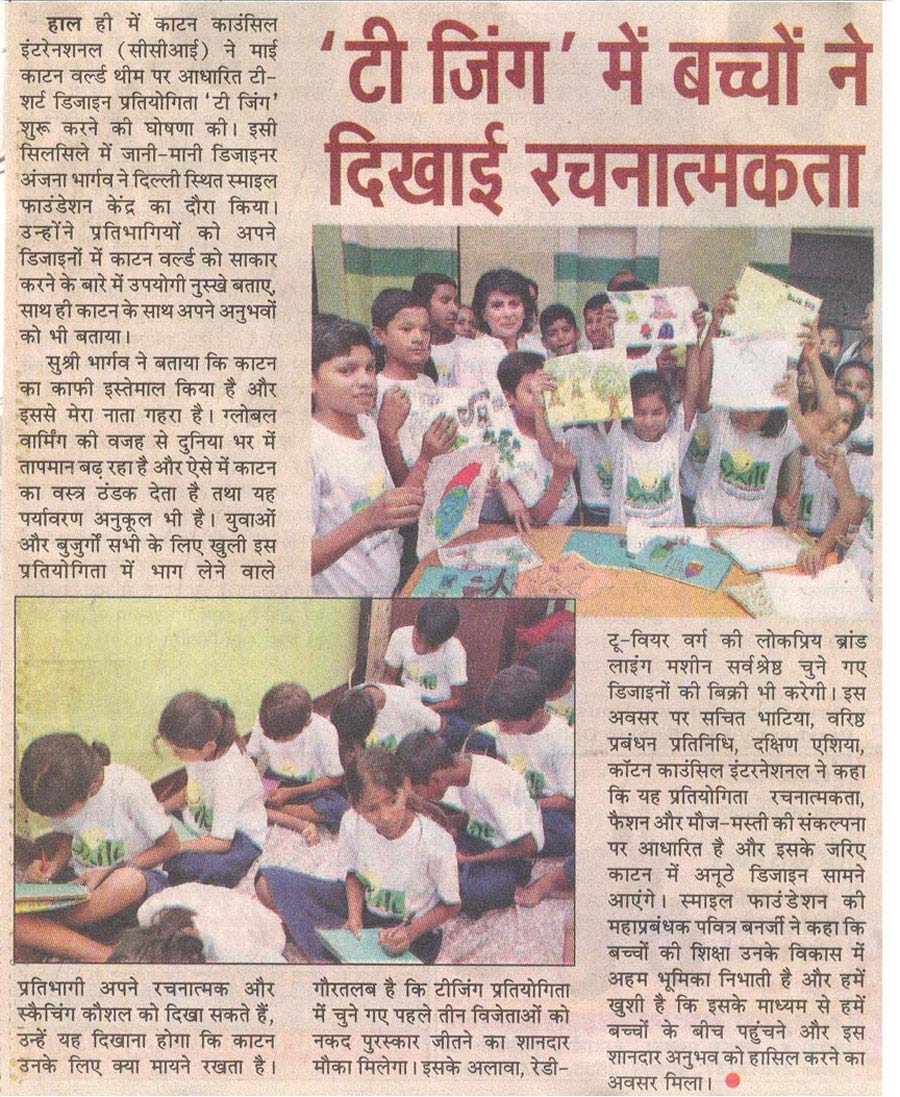
(1888PressRelease) July 21, 2010 – Chandigarh – Cotton Council International (CCI) has announced the second edition of its pan India T-Shirt design competition TeeZing on the theme “My Cotton World”. The competition offers every participant a chance to showcase their creativity and sketching skills. The competition is open to young and old to express what cotton means to them. To inspire participants, CCI organized competition among kids of Smile Foundation – charity partner for the event in Chandigarh today.

Smile foundation is a national level development organization that works towards the education and health of underprivileged children across 21 states in India. The participants were given tips to help them bring their cotton world to life in their designs. 8 best designs submitted by the participants of Smile Foundation were awarded and will now be judged on a Pan India level. The top three designs created by Smile Foundation participants were awarded cash prizes worth Rs. 4,500, Rs.3,000 and Rs. 2,500 respectively. Five additional designs were awarded consolation prizes worth Rs. 1000.

The competition will run from June 28th through July 22, 2010. Entries can be submitted online at www.allaboutcotton.com, via email to teezing2010 ( @ ) gmail dot com or submitted at select Café Coffee Day stores in 9 cities throughout India – Delhi, Kolkata, Bangalore, Mumbai, Chennai, Ahmedabad, Pune, Hyderabad, and Chandigarh dot CCI has assembled a formidable team to judge the contest dot The jury for this season will include leading names from the creative, design and fashion fraternity dot

The top three national winners of TeeZing will be awarded cash prizes of Rs.1,00,000/, Rs. 75,000/- and Rs.50,000/- respectively. In addition, the best designs will be retailed by Flying Machine, a popular brand in the ready-to-wear segment. To increase the chances of winning for each participant, CCI has also allowed multiple entry options.

Speaking on this occasion, Mr. Sachit Bhatia, Senior Manager Representative, South Asia, Cotton Council International, said, “TeeZing is based on the premise of creativity, fashion and fun with cotton. We hope the competition will reignite India’s passion for cotton, showing how it touches every part of our lives. We are hopeful to get a fantastic response across all cities and expect to see a lot of unique designs in cotton.”

Speaking for the Smile Foundation, Mr. Pabitra Banerjee, General Manager, Programmes, Smile Foundation said, “Children are in the core of Smile Foundation’s heart and child education, as we believe, is a panacea for any impactful development. We believe in this and work with the community for underprivileged children to make an impact in their life. We are thankful to Cotton Council International for the opportunity it has given us to reach out to children with another joyful intervention which demonstrates CCI’s commitment to the cause of children.”

The competition was first held in 2009 as part of the International Year of Natural Fibers celebration. The competition was held simultaneously in 10 countries including India, with the objective to develop a positive disposition toward cotton, especially amongst the youth. The theme of the competition in 2009 was “Cotton’s Natural World”. It is one of the many popular outreach activities undertaken by CCI globally.

About Cotton Council International (CCI)
CCI is a non-profit organization devoted to the promotion of cotton in India. It runs a “Generic Cotton Education”‘ program, which strives to increase the demand among end-consumers for products made from 100 percent cotton, so that retailers, manufacturers and spinners could be encouraged to produce a higher percentage of 100 percent cotton products to meet this consumer demand.

CCI launched the campaign in India in 2003 under the Cotton Gold Alliance (CGA) program. The CGA program was launched at the trade level in October 2002 and at the consumer level in May 2003 under the “New Face of Cotton” campaign. In 2006, CCI made some strategic adjustments in the CGA program and renaming it as the “Generic Cotton Education” program in India. Through its education program, CCI reaches out to various stakeholders including consumers of cotton, industry, media and the fashion fraternity.

For its activities in the past, CCI has successfully collaborated with leading fashion designers, trade bodies, Bollywood celebrities, media and design students for effective delivery its messages. The organization carries out these activities in metros and Tier II cities.

About Smile Foundation
Smile Foundation is a national level development organisation reaching out to more than 100,000 underprivileged children & youth across 21 states of India through more than 130 welfare projects on subjects like education, healthcare, livelihood, women empowerment, and advocacy. Following philosophy of Social Venture Philanthropy (SVP), Smile Foundation identifies genuine local grass root initiatives doing exemplary work and empowers them and extends financial support, technical expertise and capacity building of these initiatives.

Source: http://redtram.com/go/241712503/
Categories
Print/ Online Media

More toilets and changing attitudes: India’s bid to eradicate public defecation

More toilets and changing attitudes: India’s bid to eradicate public defecation

(18 Sep 2015)

India’s prime minister went into his election campaign vowing to eradicate defecation in public by 2019. But as Alys Francis reports from New Delhi, providing the facilities has yet to change the culture.

Tania Kumari did not eat last night after spending the day throwing up.

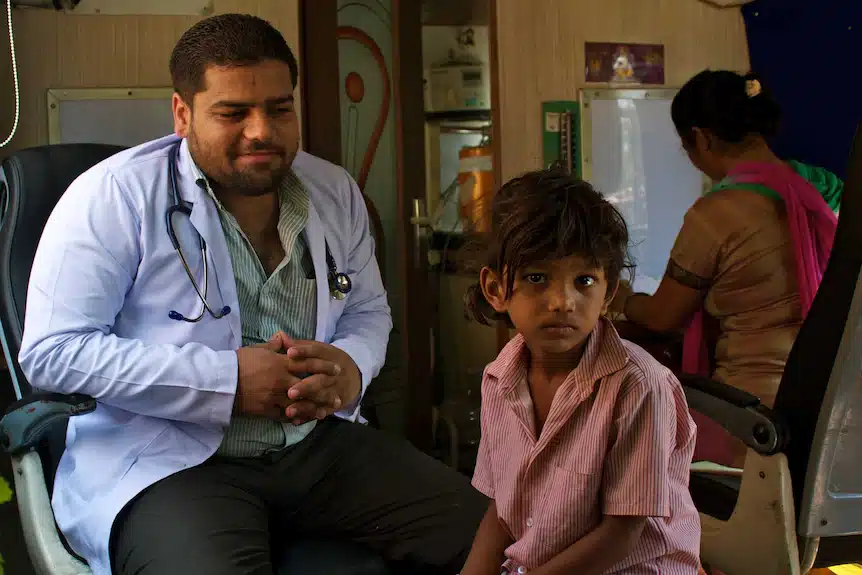
She keeps her skinny arms clamped in her lap as she is examined in a mobile health clinic next to Sanjay slum, wedged between the Nigerian and Singaporean embassies in India’s capital.

“This is a typical case,” Dr Rupesh Dalavi of the NGO Smile Foundation said, gesturing towards the six-year-old.

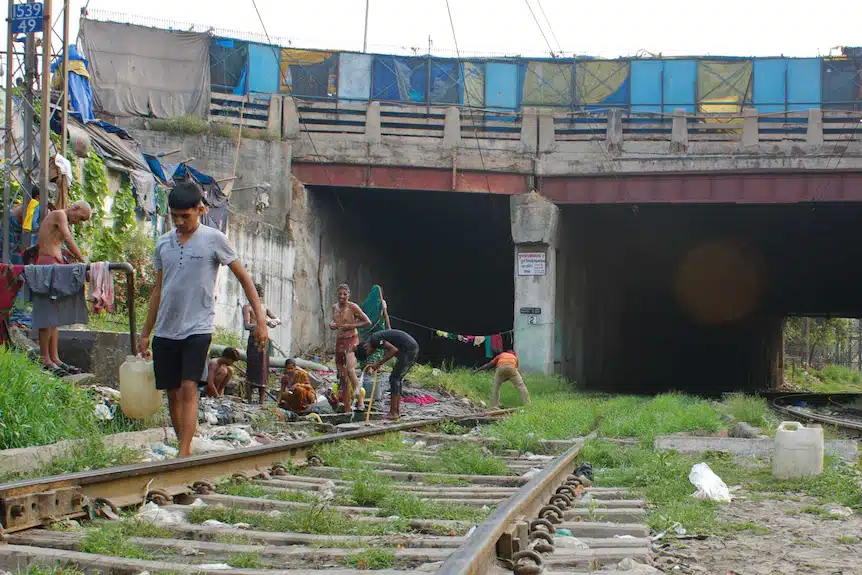
[Facilities are] inadequate, so people go in the open, they go to the railway tracks.

Infections causing vomiting are common and they are linked to bad sanitation.

In under a decade, the Sanjay slum’s population has doubled to 6000.

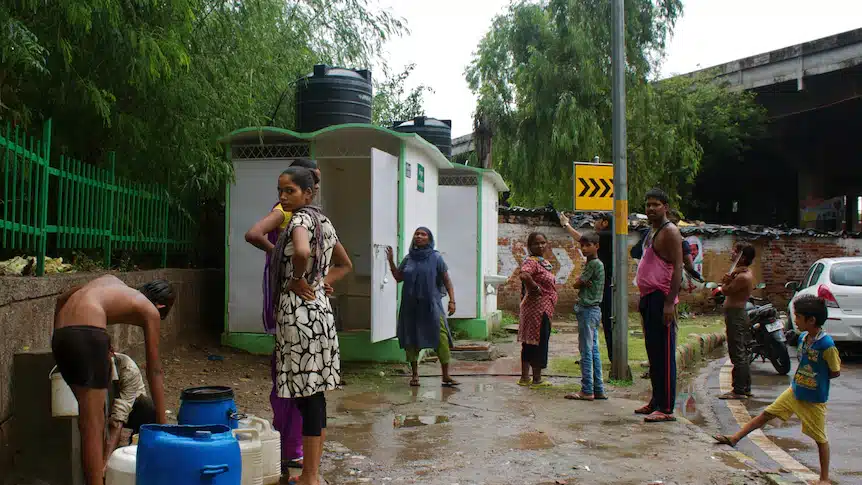
The brick huts rapidly multiply, but there is no space for toilets, and the community block does not meet the demand.

“What’s here is inadequate, so people go in the open, they go to the railway tracks,” community leader Sanjay Singh said.

It is a common problem in India, where more than half the population of 1.3 billion defecate outdoors.

It is the main reason India has the world’s highest number of diarrhoeal deaths in children under five.

India’s prime minister Narendra Modi has recognised open defecation as a major roadblock to development and vowed to wipe it out by 2019 as a tribute to Mahatma Gandhi’s 150th birthday.

Dr Rupesh Dalavi examines Tania Kumari in a mobile health clinic next to Sanjay slum.(Alys Francis)

Mr Modi launched the $44 billion Swachh Bharat (Clean India) program last October, aiming to build more than 110 million toilets. Almost five million were installed last financial year.

But critics fear the mission is in danger of going the same way as past sanitation programs that largely failed.

India’s 2011 census revealed more mobile phones than toilets. And some of those that have been built were reportedly being used to store grain.

“They’re sort of plodding along in the same way, on the ground not much has changed,” said a development worker advising the Modi government. He requested anonymity.

Asked if India would be free from open defecation by 2019, he said: “I don’t think it’s going to happen.”

Residents from the Pullmithai slum in Old Delhi have their morning wash.(Alys Francis)

Calls for better education
NGOs say the program is too focused on constructing toilets, with a 12,000-rupee ($255) household subsidy, and undervalues sanitary education.

But in rural India many do not see the need for toilets.

People tell us they’re ready to spend that much on buying a buffalo or getting a new extension, but a toilet is relegated.

When the Research Institute for Compassionate Economics (RICE) surveyed villages in 2014 it found that of the 43 per cent of homes that had a toilet, 25 per cent of men and 17 per cent of women still defecated outside.

In many parts of India the practice is socially acceptable.

“People tell us they’re ready to spend that much on buying a buffalo or getting a new extension, but a toilet is relegated,” Aga Khan Foundation director of programs Tinni Sawhney said.

Mr Sawhney said it was critical to change behaviour and motivate people to want toilets.

Behavioural change has been in the government’s sanitation plans since 1999. But a UNICEF official said there was no follow-up, meaning many who receive toilets neither want them nor understand the health benefits.

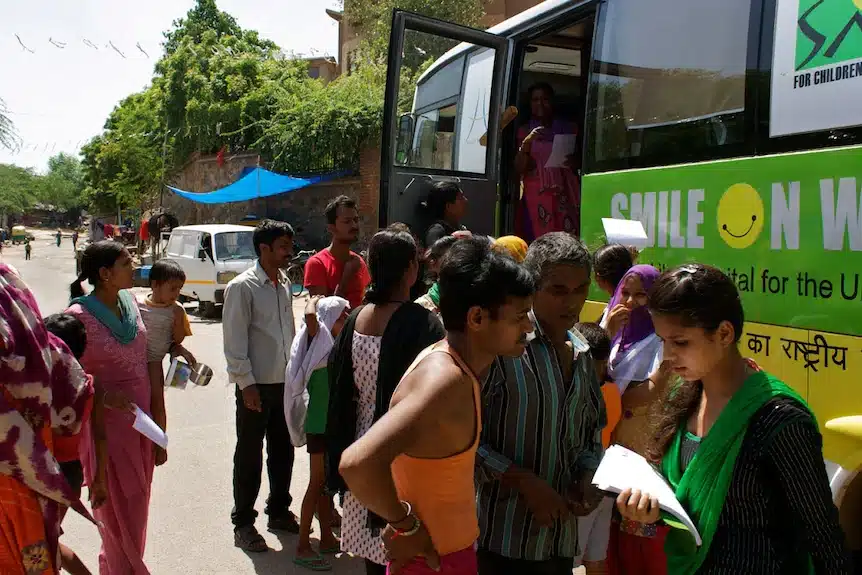
Slum residents line up to see a doctor at the Smile Foundation’s mobile health clinic in New Delhi.(Alys Francis)

Critics also point out that Mr Modi’s government cut the budget for behavioural change from 15 to 8 per cent when it restructured the national program.

And less than six months after it launched the program last year, the funding was cut by more than a third.

In cities, open defecation is seen as a problem caused by a lack of infrastructure rather than behaviour.

Over the past three decades India’s population has grown by more than 512 million, triggering rapid unplanned urbanisation and slums.

To stop open defecation in the 675 official slums housing 1.5 million people in New Delhi, 20,000 community toilet blocks are to be installed in India’s largest city.

But finding the space is difficult as “many slums are too close to the roads or railway tracks”, said VK Jain, the Delhi Urban Shelter Improvement Board’s chief executive officer.

But Mr Jain said the hardest part of his job was ensuring community toilets remain usable, as people often don’t keep them clean.

“That kind of mindset is not there,” he said.

Efforts to encourage community responsibility

New Delhi now plans to get slum residents to manage toilets and monitor cleanliness.

But community-run toilets need a lot of support, according to Jyotsna Lall, senior program officer at the Aga Khan Trust for Culture.

It established a toilet facility in Nizammudin, South Delhi, six years ago where locals operated the toilets.

But NGOs remained deeply involved, providing advice and financing for maintenance.

India’s population has grown by more than 500 million in the last 30 years.(Alys Francis)

“We’re talking about the poorest people,” Mr Lall said. “Many can’t read or write, they need a lot of help.”

Recently there have been media reports of officials fudging figures to meet construction targets.

But Mr Modi’s spotlight on sanitation has won him praise and one district has shown that change is achievable.

Nadia in West Bengal effectively halted open defection by March this year after a bureaucrat heard neighbouring Bangladesh had better sanitation.

Motivated by the Bangladeshi example, Nadia effectively ended open defecation over a 15-month period.

In Sanjay slum, community leader Mr Singh is optimistic open defecation can be eradicated.

But he disputes the official line that it only happens in cities because of a lack of toilets.

“Going in the open is a habit for people here,” he said.

“Only if we promote the health benefits, can we change.”

Source: https://www.abc.net.au/news/2015-09-18/india-bid-to-eradicate-defecation-in-public/6785256

Categories
Print/ Online Media

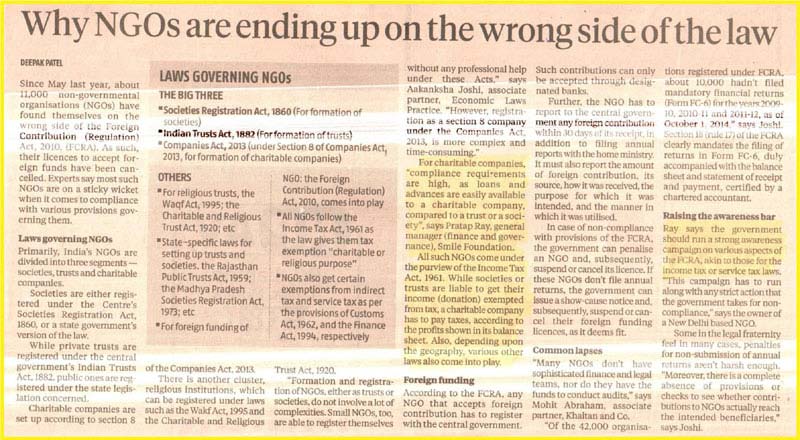
Why NGOs are ending up on the wrong side of the law

Why NGOs are ending up on the wrong side of the law

Business Standard (29 June 2015 )

Categories
Print/ Online Media

Smile kids show creativity in TeeZing

Smile kids show creativity in TeeZing

Punjab Kesari (23 July 2010)

Categories
Print/ Online Media

Is social work worth it?

Is social work worth it?

(March 08, 2015)

Nagpur: It has been around five years since Swati Deshpande (name changed) is working in a city-based NGO for child development but her honorarium remains to be Rs13,000 per month – the same amount with which she started. After completing her Master of Social Work (MSW) degree from a city college, Swati was hired by the NGO during campus placement in 2011 and since then, there has been no turning back for her.

“Initially, when I decided to make a career in social work, I was frowned upon by many but I followed my passion nevertheless. I have no fixed working hours and I am constantly on toes doing my bit for society. However till now, I didn’t get any increment in my pay or significant promotion. I have kids now and find it tough to support them. How will I help the children of society when I don’t have enough money for my own kids,” she asks.

Like her, many social workers are in dire straits as they remain underpaid and without the benefit of promotions or appraisals. This is the main reason why youngsters today are shying away from considering social work as a full-time profession and merely perceive it as a voluntary sector.
Says 21-year-old Jeswin Rajan, founder member of a city-based NGO Take a Step, which works for homeless people, “We are all a bunch of young passionate social workers and there is so much we want to do. But finance is one major hindrance that comes in our way every time. We don’t expect any funds from government, so we brainstorm and try to come up with different methods for fund-raising. Putting up a stall at local food festivals, exhibitions, performing at music concerts or taking photographs are the options left for us.” He adds that some government projects which are allotted to NGOs demand financial investment from the side of social organizations. “Rather than leaving projects incomplete, the government should outsource work to more NGOs as we have a better connect with people and manpower. There should also be a fixed pay-scale for the NGOs concerned so that they can fulfil the tasks,” he suggests.

Principal of Matru Sewa Sangh Institute of Social Work, John Menachery, agrees that the social work sector is highly underpaid when compared to its other counterparts. “Social work is a major profession but unfortunately it is neglected by the government as it just wants cheap labour. There is absolutely no willingness from the government’s side to revise the salary structure in this sector due to which many students don’t consider taking social work as a full-time profession,” he says. He adds that the average package offered to students during campus interviews is between 15,000 to 20,000. “Because of this, the quality of students who are opting for social work course is also affected. Youngsters with calibre do not want to be a part of underpaid jobs,” he points out.

Agrees Shilpa Jibhenkar, assistant professor and placement in-charge of Tirpude College of Social Work. “Social work is not just another 10-to-5 job. To get quality work, proper salaries and funding are needed. Many NGOs which come during placement drives offer honorarium to candidates and not salaries. Social work is a vast field and has immense scope in the present scenario. There should be strategic, well-planned funding from the government’s side so that NGOs are able to sustain and survive.”

However, Suryakant Narvekar, Smile Foundation’s regional director (West), Response, differs and believes that the field of social work is performance-oriented and one needs to prove himself first before demanding a good salary. “If one is truly passionate about his work and has the potential, sky is the limit in this profession. The sector might not have a corporate-like pay scales but holds scope for personal growth. One just needs to prove that he is here to stay and be proactive. Making money won’t be a problem then,” he says.

He also adds that some kind of a monitoring system is needed to ensure accountability and transparency in the working of NGOs. “This will help the government in even distribution of funds and will avoid corruption,” he says.

Source : https://timesofindia.indiatimes.com/city/nagpur/Is-social-work-worth-it/articleshow/46488212.cms

Categories
Print/ Online Media

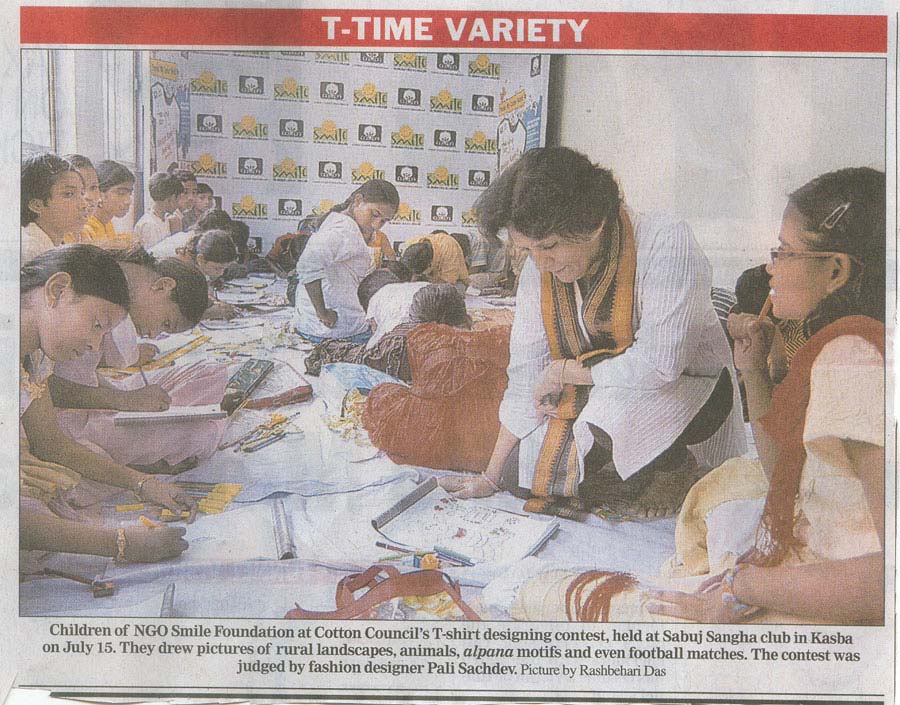
Smile Foundation Kids (ME) in a T-shirt design drawing competition in Kolkata

Smile Foundation Kids (ME) in a T-shirt design drawing competition in Kolkata

The Telegraph (27 July 2010)

Categories
Print/ Online Media

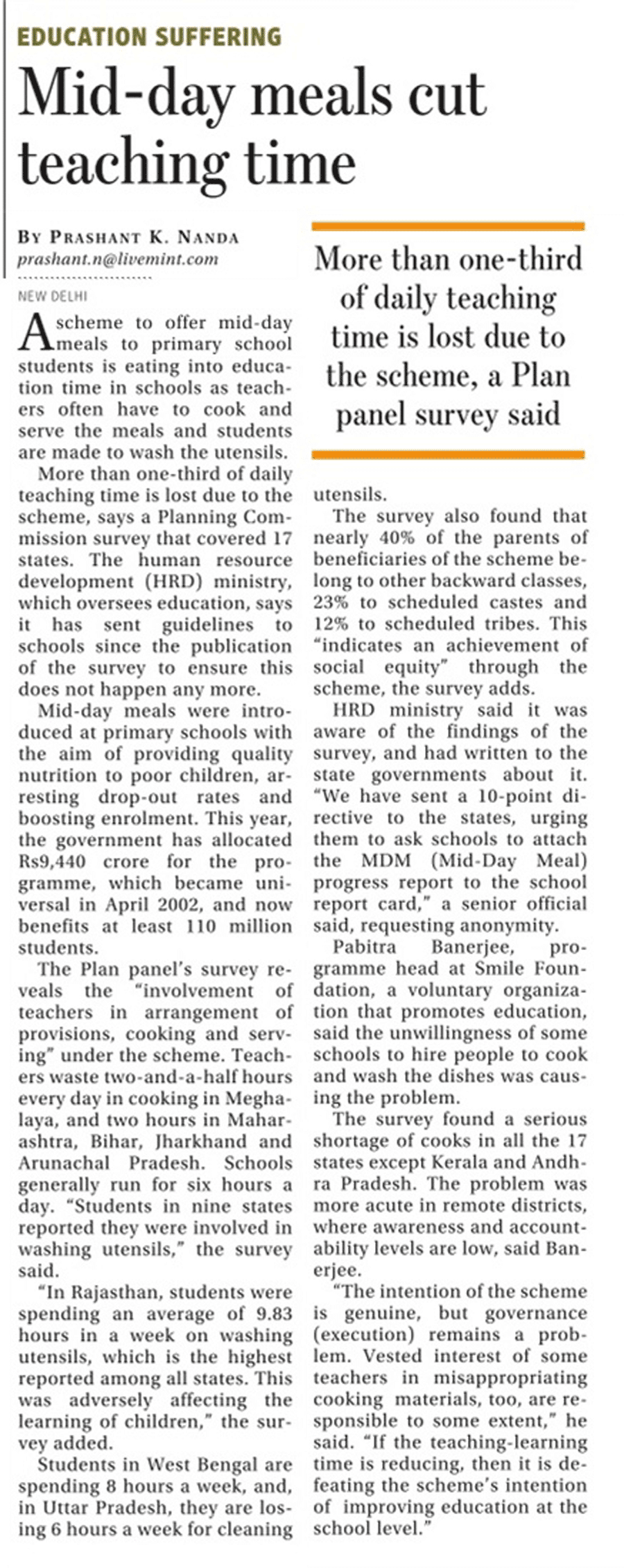
Smile Foundation’s take on Mid – day meals

Smile Foundation’s take on Mid – day meals

Mint (31 July 2010)

Categories
Print/ Online Media

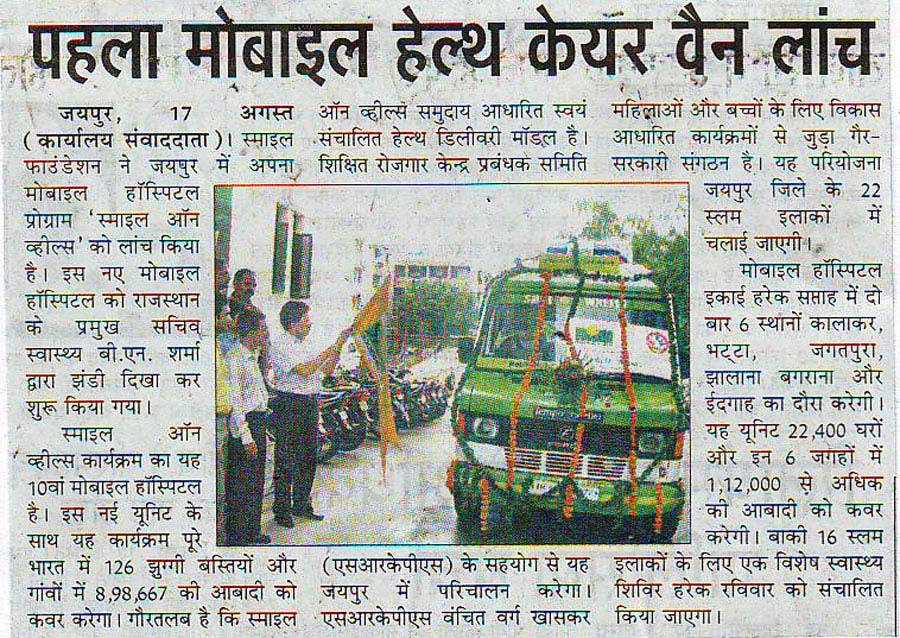
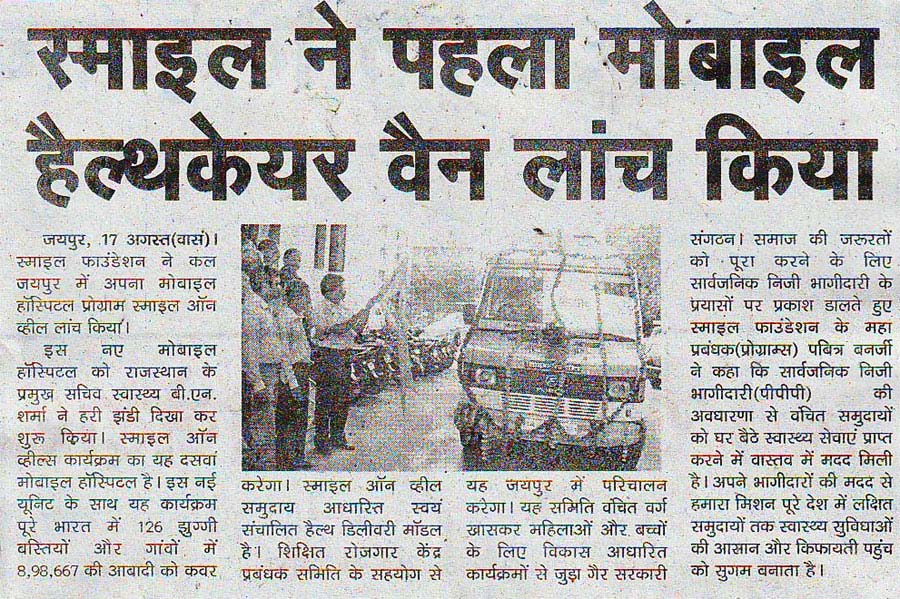
Smile’s first mobile health care van for Jaipur

Smile’s first mobile health care van for Jaipur

Evening Plus (17 August 2010)

Categories
Print/ Online Media

How Indian NGOs are marrying Philanthropy with Social Innovations?

How Indian NGOs are marrying Philanthropy with Social Innovations?

(March 02, 2015)

The challenges that our societies are facing today are varied, starting from high poverty rates to unacceptably high child labour, malnutrition, illiteracy among the underprivileged children, inequality and a raft of other issues. These challenges have triggered interest in social innovation among many NGOs across the country. Challenges, however daunting they are, have precisely offered the right circumstances to philanthropists to look and tackle old problems in new ways.

In trying to understand the realm of social innovation and finding out the best ways to catalyze social innovation, many Indian NGOs have comprehended the fact that the seeds of change are the civil society, community entrepreneurship and public-private collaborations.

A small innovation that brought a paradigm shift to the ongoing efforts in protecting the girl child in Rajasthan is the “Padharo Mahari Lado” campaign. The scale and complexity of the issue on the declining child-sex ration in the state kept on thwarting several attempted reforms for decades. The government of Rajasthan initiated a year-long campaign, known as “Padharo Mahari Lado Campaign”, to prevent the evil practice of female foeticide and sensitize the community towards girl child in October 2012. Smile Foundation has joined hands with the Department of Health, Barmer, NRHM and Cairn India Limited to support this initiative.

Padharo Mahari Lado has brought sizeable acceptance among the stereotype cultural set-up. Today, in the intervened communities, there is an increased participation of the parents both mother and father in providing a protective and secure childhood for their daughters. This is a fine example of channelling change by making collective impact work. When a social innovation is intended through collaboration, it is very necessary that it features a common agenda, unbroken communication, effective measurement systems, and the presence of a core organization.

With philanthropists changing their practices, the speed of change in the areas of need is now faster than before. There is enormous untapped potency in our communities at the grass roots level that are waiting to be harnessed. Many individuals have come up with initiatives at community levels to address issues pertaining to education, health, livelihood, and women empowerment within the community itself. These grassroots level nonprofits work untiringly to make a profound and highly focused impact on a relatively small population. The total number of such organisations across the length and breadth of India is overwhelming. The work done at the gras root level by each of such organisations is an intentional innovation in itself. On the ground, good ideas are constantly being transformed into actionable projects.

But at times, due to lack of critical support, handholding, and training on good governance, project management and relevant areas, these grass roots organisations, though clear in their intentions, fail to sustain. This directly affects the chance of development of those local children and their families who would have otherwise been empowered. Effective handholding of such community based organisations is a proven way of propelling change in communities across the country.

To catalyze and support social innovations, the NGOs acting as social venture philanthropists are more like engines for impact. From identifying a community-based organisation to making an effort to building their capacities, enhancing their efficiencies, communication and process of good governance, the social venture philanthropists provides whatever it takes to help an initiative actualize and broaden its potential. Such innovations have enabled many an Indian NGO to broaden its impact and bring about impressive outcomes that benefit the sector as a whole.

(About the author: This article has been written by Mr Santanu Mishra, Co – Founder and Executive Trustee, Smile Foundation)

Source : https://www.businessinsider.in/How-Indian-NGOs-are-marrying-Philanthropy-with-Social-Innovations/articleshow/46426703.cms

Categories
Print/ Online Media

Smile’s first mobile health care van

Smile’s first mobile health care van

Evening Post (17 August 2010)

Privacy Policy - Smile Foundation

Information Gathering

1. Smile Foundation collects information from the users in a number of ways, for example when the user:

  • Makes a donation
  • Signs up for a campaign
  • Signs up to stay updated

2. While forwarding a donation for Smile Foundation the well-wishers have to submit some personal information as it would help us ensuring genuine contributions:

  • Your name
  • Your email and mailing address
  • Your telephone number
  • Your payment processing details
  • Any other data as required

3. Smile Foundation does not collect or record the user’s personal information unless he/she chooses to provide it.

Use of Personal Information

1. General browsing of Smile Foundation website is anonymous and it does not register the user’spersonal information except the time, date and place of visits and the name of internet service provider. This data is used only for statistics and diagnosis.

2. By signing up for various services offered by Smile Foundation, the user explicitly authorizes us to collect information based on the user’s usage. The information is used to help provide a better experience to the user and is used as per the user’s specified instructions.

3. Smile Foundation keeps the user information strictly confidential and this information is secured safely. All relevant information collected through Smile Foundation website is handled and used by internal and/or authorized officials only. It is nevershared with any external agencies or third party individuals.

4. Smile Foundation uses the information givento it in the following ways:

  • To keep an accurate record of all the donations received
  • To update users about its happenings and developments through bulletins and newsletters, with an option of not to subscribe for the same
  • To make sure the user is receiving the most appropriate and relevant information
  • To find out more about the people who are visiting the Smile Foundationwebsite, donating, or joining its campaigns

5. Usually, Smile Foundation does not store user data. In case of specific sign-ups, the data is stored as per user request. The user can opt to delete all the information he/she has provided by simply requesting such by mail. All information, without exception, will be deleted in two working days.

Privacy of e-mail lists

Individuals who join Smile Foundation’s mailing lists via its website or through its campaigning engagements are added to its email database. Smile Foundation does not sell, rent, loan, trade, or lease the addresses on our lists to anyone.

Cookie Policy

1. Cookies are pieces of electronic information which will be sent by Smile Foundation when a user visitsthe website. These will be placed in the hard disk of the user’s computer and enable Smile Foundation to recognise the user when he/she visits the website again.

2. The user can configure his/her browser so that it responds to cookies the way he/she deems fit. For example, you make want to accept all cookies, reject them all or get notified when a cookie is sent. The users may check their browser’s settings to modify cookie behaviour as per individual behaviour.

3. If a user disables the use of cookies on the web browser, or removes or rejects specific cookies from Smile Foundation’swebsite or linked sites then he/she may not be able to use the website as it is intended.

Payment Gateway

1. SmileFoundation uses well-recognised and proven technology for payments. Payment information is transferred by the use of an SSL connection which offers the highest degree of security that the donor’s browser is able to support.

2. Several layers of built-in security, including an advanced firewall system, encryption of credit card numbers, and use of passwords, protect the collected information.

External Web Services

1. Smile Foundation uses a number of external web services on its site to display content within its web pages. For example, to display video it uses YouTube. As with the social media buttons, Smile Foundation cannot prevent these sites, or external domains, from collecting information on the user’s consumption of the content embedded on its site.

2. The Smile Foundation website contains links to other websites for the benefit of its visitors. This Privacy Policy does not apply to such other websites.

3. Smile Foundation is not expressly or impliedly responsible for, or liable to any loss or damage caused to a user by the collection, use and retention of Personal Information by such website in any manner whatsoever. It is important that the users review the privacy policies of all websites they visit before disclosing any information to such websites.

Changes to Privacy Policy

1. As and when the need arises, Smile Foundation may alter its privacy policy in accordance with the latest technology and trends. It will provide you with timely notice of these changes. The users may reach out to Smile Foundation if they have any queries about any changes made to its practices.

2. If you have any questions at all about Smile Foundation’s privacy policy, please write to us at: info@smilefoundationindia.org

Refund and Cancellation Policy

Welcome to this web-site of SMILE FOUNDATION. We make public our policy on refund and cancellation of donations received for the social cause on payment gateway as under:-

  • No refund/cancellation for the donated amount by any donor will not be entertained, the online donations through the online payment gateway.
  • No cash or refund of money will be allowed.
  • If any in-kind support received by the donor from any where the material will be reached to the poorest of the poorer communities.
  • Once received the donation for a cause will not be refunded to the donor. No cancellation to be made. The donation will be used for the community development, children education or women’s empowerment.
Terms and Conditions

Use of this site is provided by SMILE FOUNDATION subject to the following Terms and Conditions:

SMILE FOUNDATION reserves the rights to change these terms and conditions at any time by posting changes online. Your continued use of this site after changes are posted constitutes your acceptance of this agreement as modified. You agree to use this site only for lawful purposes, and in a manner which does not infringe the rights, or restrict, or inhibit the use and enjoyment of the site by any third party.

This site and the information, names, images, pictures, logos regarding or relating to SMILE FOUNDATION are provided “as is” without any representation or endorsement made and without warranty of any kind whether express or implied. In no event will SMILE FOUNDATION be liable for any damages including, without limitation, indirect or consequential damages, or any damages whatsoever arising from the use or in connection with such use or loss of use of the site, whether in contract or in negligence.

SMILE FOUNDATION does not warrant that the functions contained in the material contained in this site will be uninterrupted or error free, that defects will be corrected, or that this site or the server that makes it available are free of viruses or bugs or represents the full functionality, accuracy and reliability of the materials.

Copyright restrictions:

Commercial use or publication of all or any item displayed is strictly prohibited without prior authorization from SMILE FOUNDATION. Nothing contained herein shall be construed as conferring any license by SMILE FOUNDATION to use any item displayed.

Documents may be copied for personal use only on the condition that copyright and source indications are also copied, no modifications are made and the document is copied entirely. However, some documents and photos have been published on this site with the permission of the relevant copyright owners (who are not SMILE FOUNDATION). All rights are reserved on these documents and permission to copy them must be requested from the copyright owners (the sources are indicated within these documents/photographs).

SMILE FOUNDATION takes no responsibility for the content of external Internet sites. Other websites that we link to are owned and operated by third parties and SMILE FOUNDATION has no control over them. The fact that we include links to other websites does not mean that SMILE FOUNDATION approves of or endorses any other third party website or the content of that website. We accept no liability for any statements, information, products or services that are published on or are accessible through any websites owned or operated by third parties.

Any communication or material that you transmit to, or post on, any public area of the site including any data, questions, comments, suggestions, or the like, is, and will be treated as, non-confidential and nonproprietary information. If there is any conflict between these terms and conditions and rules and/or specific terms of use appearing on this site relating to specific material then the latter shall prevail.

These terms and conditions shall be governed and construed in accordance with the laws of India.

If these terms and conditions are not accepted in full, the use of this site must be terminated immediately. SMILE FOUNDATION for Social Welfare Service is a registered at

161 B/4, 3rd Floor, Gulmohar House
Yusuf Sarai Community Centre
New Delhi-110049
Phone : +91-11-43123700

Supplementing & In Alignment with Government Initiatives

donation for child education in india

EDUCATION

Sarva Shiksha Abhiyan
National Education Policy
Beti Bachao, Beti Padhao
Digital India

donation for child education

lIVELIHOOD

Skill India
Enhancing Formal Skilling


donation for health care

HEALTH

National Rural Health Mission
Universal Health Coverage
National Digital Health Mission
Promotion of Govt. Health Schemes

livelihood skills training programs

WOMEN EMPOWERMENT

Anaemia Mukt Bharat
Poshan Abhiyan
Atmanirbhar Bharat Abhiyan
Anganwadi Strengthening