
A lifecycle approach is a lot like taking care of a house. Imagine your roof starts leaking. You could keep putting buckets under the drip every time it rains and for a little while, that might seem to work, or you might call a professional who would fix the leak with some plumbing material. But over time, the walls begin to stain, the foundation can weaken, the wiring may get ruined and mold can slowly take over. To truly fix the problem, you need to go deeper; you need to find the source of the leak, fix it, then repair the roof, reinforce the structure if required, improve drainage and take care of the whole system together. When one part collapses, the rest often follow. Solving one problem while ignoring the others produces temporary relief, not long-term change.
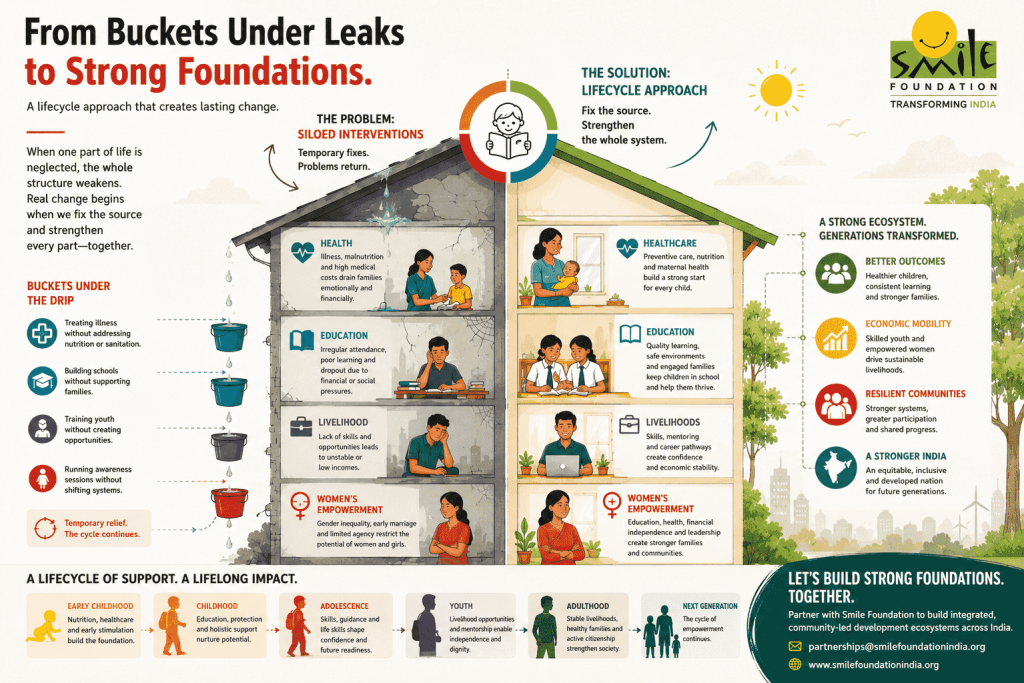
Welfare and development models struggle here. Most interventions still operate in silos, wherein education programmes focus on schooling; healthcare programmes focus on treatment; skill-building initiatives focus on employment; and women’s empowerment becomes a separate vertical altogether.
S&P Global’s “India Forward: Emerging Perspectives” emphasises India’s projection as a leading global economy. The report highlights that India is on track to become the third-largest economy by fiscal 2030-31. This follows an impressive GDP growth of 8.2% in the fiscal year 2024. This statistic is significant because, although the country is positioned for remarkable growth, it also highlights the need to address internal challenges that could hinder its progress.
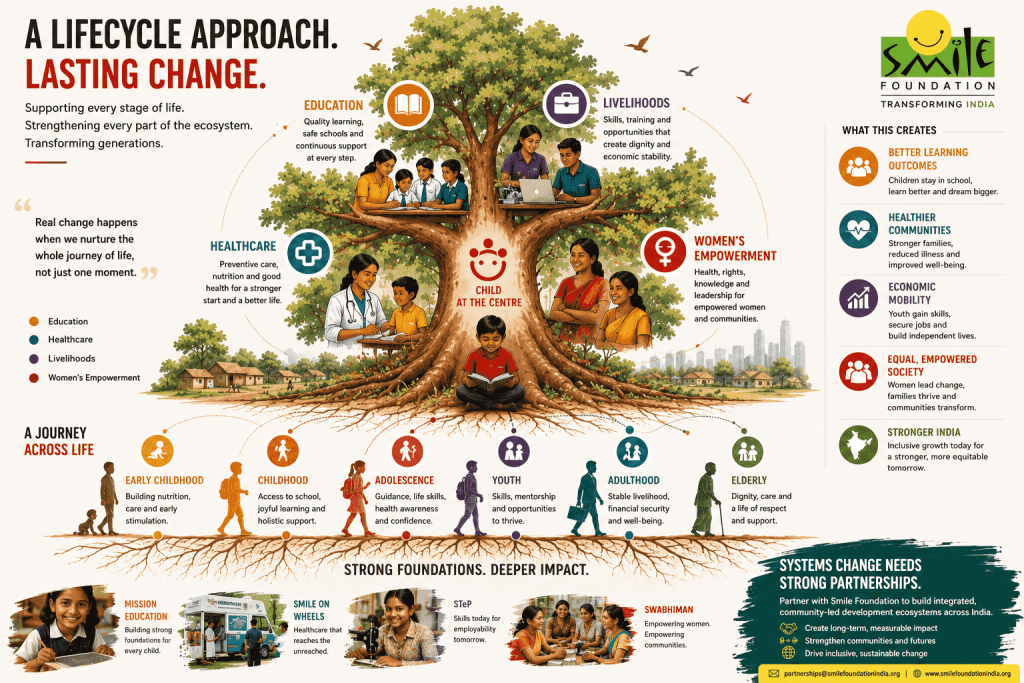
Smile Foundation’s lifecycle approach is built around this reality. While education remains at the core of its efforts, the organisation has expanded into health, livelihoods, skill-building and women’s empowerment to support the full ecosystem around the child. In doing so, it helps create the conditions for children to stay in school, learn well, and thrive, and ultimately drive societal progress.
Why the Lifecycle Approach Matters
The lifecycle approach starts with a straightforward concept: for sustainable change to happen, we need support at various stages of life, rather than just stepping up when and where there’s a need.
This thinking is increasingly backed by global development research. The UNFPA’s people-centred lifecycle framework argues that health, education, gender equality, livelihood and social protection are deeply interconnected across an individual’s life stages. It stresses that disadvantages in childhood often continue into adolescence and adulthood, especially for girls and vulnerable communities, which is a pattern we see across India.
Poor maternal health affects childhood nutrition and cognitive development. Unsafe or unequal environments push adolescent girls out of school. Lack of employable skills leads to unstable incomes later in life. Economic vulnerability then affects the next generation all over again.
This shift reflects a larger global understanding of development, repeatedly emphasising that development must address “the totality of individual needs at different stages in life” across sectors, including health, education and employment. In countries like India, where social vulnerabilities compound each other quickly, that approach becomes even more relevant.
Building an Integrated Development Model
Smile Foundation’s lifecycle approach operates through four interconnected pillars: education, healthcare, livelihood and women’s empowerment.
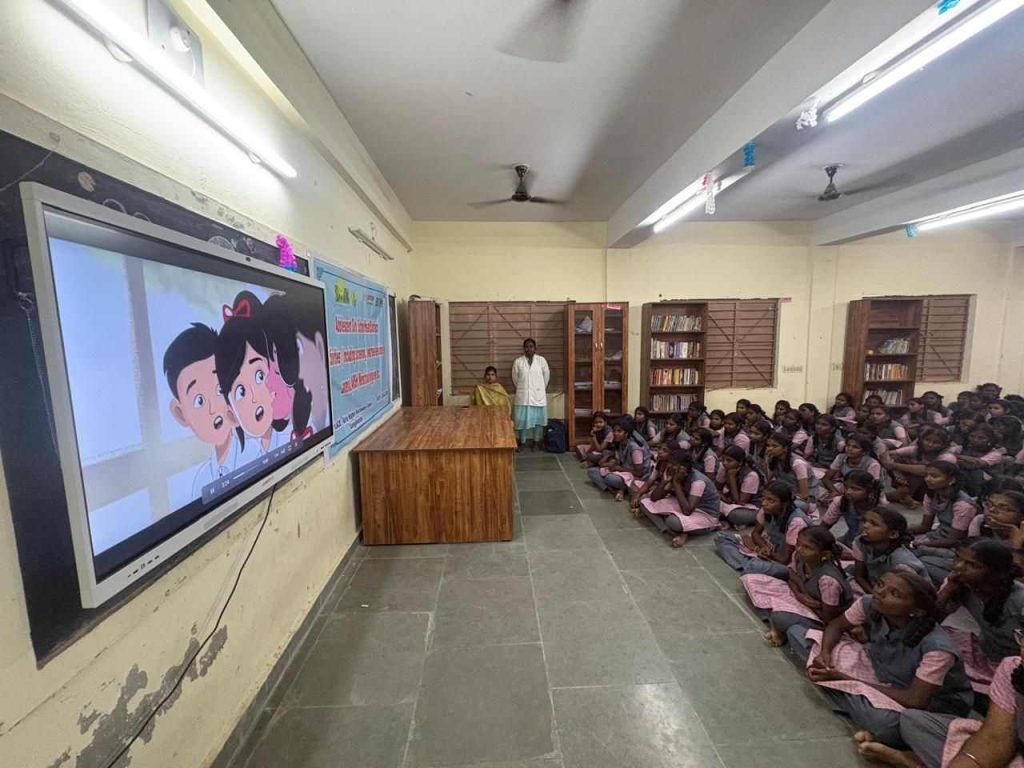
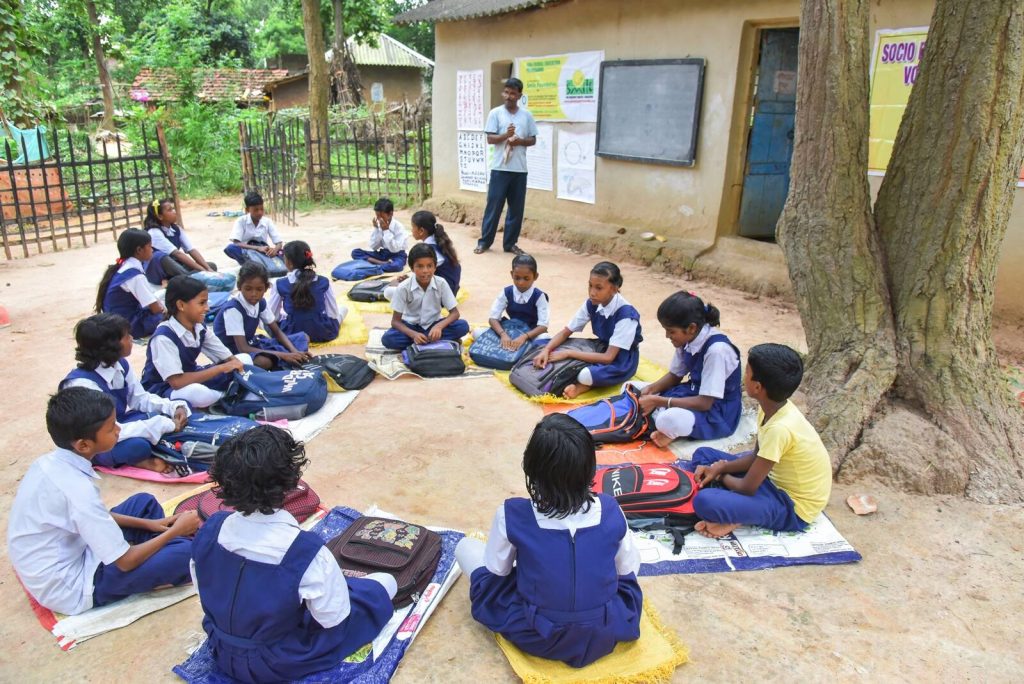
Education remains the starting point. Mission Education works on foundational learning and mainstream school enrolment for underserved children. But the organisation no longer sees classrooms as the complete answer.
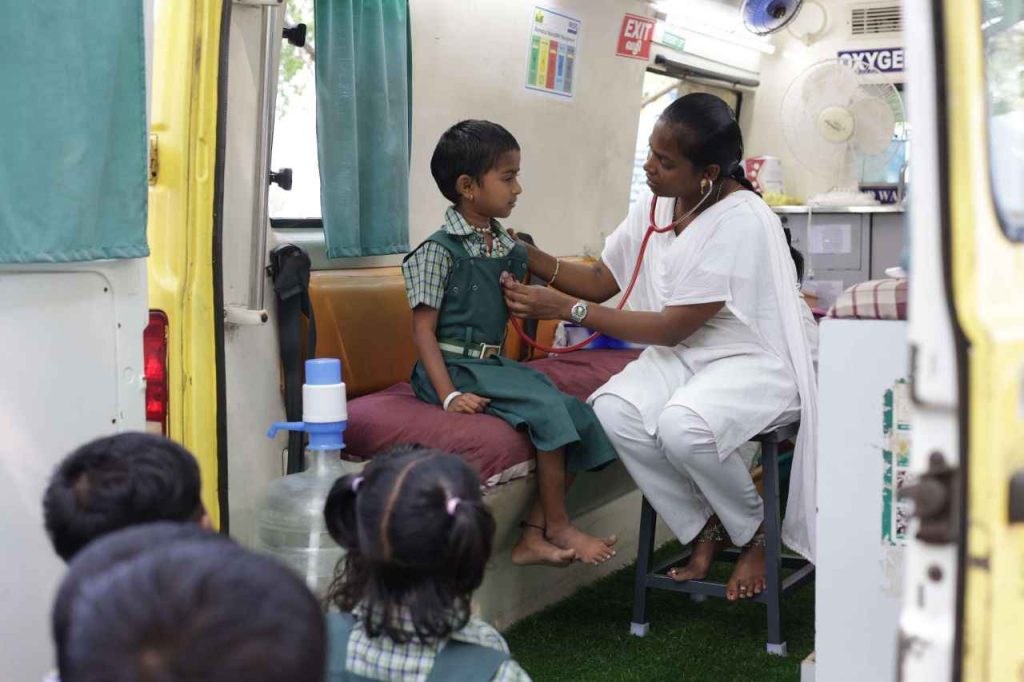
Healthcare became the next layer of intervention through Smile on Wheels, mobile healthcare units that deliver preventive and primary care in underserved rural and urban communities. The reasoning is straightforward. A family dealing with chronic illness or high medical expenses becomes financially unstable very quickly. In such households, education is often the first thing sacrificed.
Livelihood support emerged as another critical component. Through STeP, Smile Foundation focuses on employability and market-linked skills for underserved youth. The programme recognises that education without economic opportunity cannot sustain long-term mobility.
Women’s empowerment is a crucial pillar of progress as well. Through the Swabhiman initiative, Smile Foundation focuses on vital areas like maternal health, menstrual hygiene awareness, reproductive healthcare, education and community involvement. This effort is especially important in India, where gender inequality often dictates access to education, healthcare and financial independence for families.
Numerous studies have shown that issues like gender inequality, limited access to reproductive healthcare, early marriage and violence against women have a direct impact on educational continuity, economic participation and long-term health outcomes.
Why India Needs Integrated Development, Not Fragmented Welfare
India’s social challenges are too interconnected for fragmented welfare systems to work effectively anymore. A scholarship may help a child stay in school temporarily. But if healthcare costs push the family into debt, the child may still drop out. A girl may be forced to stop her education because of early marriage, deep-rooted beliefs that education is not valuable, concerns about her safety, responsibilities at home and the shame often associated with poverty. A skilling initiative may train young people, but without stable support systems or opportunities, employment remains fragile.
The lifecycle approach focuses on continuity in outcomes. It is harder to implement because it requires commitment, long-term investment, coordination across sectors and deeper community engagement. But it reflects how people actually live and how problems seep and accumulate at different stages of life. For that reason, solutions must also be designed to respond holistically, addressing needs, risks and opportunities across the entire course of life.
India’s development story will depend on whether institutions can respond to the complexity of everyday life. Smile Foundation’s lifecycle approach matters because it recognises a truth India can no longer afford to ignore: no social problem exists alone.
Frequently Asked Questions (FAQs)
What is a lifecycle approach to development and why does it matter?
A lifecycle approach to development recognises that an individual’s needs, vulnerabilities and opportunities change across different stages of life, and that these stages are deeply interconnected. Disadvantages experienced in childhood, such as poor nutrition or interrupted schooling, consistently carry forward into later life. Addressing development challenges at one stage while ignoring others produces incomplete solutions. The lifecycle approach designs interventions that respond to this interconnectedness rather than treating each problem in isolation.
Why do siloed welfare programmes fail to produce lasting change?
Siloed programmes address one dimension of a problem while leaving the surrounding conditions unchanged. A scholarship may help a child stay in school, but if healthcare costs push the family into debt, dropout follows. A skilling programme may train a young woman, but without stable support systems or market linkages, employment remains fragile. Fragmented welfare produces temporary relief because it does not engage with the full ecosystem of conditions that determine whether change is sustained. Real change requires coordination across sectors and continuity across time.
How does Smile Foundation’s lifecycle approach differ from conventional development programmes?
Most development programmes focus on a single sector — education, health or skilling — and measure success by outputs within that sector. Smile Foundation’s lifecycle approach is built around the understanding that these sectors are interdependent and that outcomes in one are shaped by conditions in the others. Its four pillars — Mission Education, Smile on Wheels, STeP and Swabhiman — are designed to work together, creating a support ecosystem around children and families rather than addressing isolated dimensions of their circumstances.
What does Mission Education provide beyond classroom instruction?
Mission Education provides structured academic support, bridge learning, early childhood education, nutritional support, health screenings and community engagement with families. It operates across more than 27 states in urban slums, rural villages and remote communities. The programme is aligned with NEP 2020 and SDG Goal 4. Its design is based on the recognition that learning is not possible without the surrounding conditions — health, nutrition, safety and family engagement — that make regular attendance and concentration achievable.
How does Smile on Wheels connect to educational outcomes?
Smile on Wheels provides free mobile primary healthcare to underserved communities. Its connection to education is direct: when a family faces high out-of-pocket health costs or chronic illness, education is typically the first expenditure sacrificed. By delivering preventive care, maternal and child health screenings and basic diagnostics at the community level, Smile on Wheels reduces the health-related financial shocks that consistently interrupt children’s schooling. Healthcare stability is, in this sense, an educational investment.
What is the STeP programme and who does it serve?
STeP is Smile Foundation’s skilling and livelihood programme for underserved youth. It provides market-linked vocational training across sectors including retail, healthcare, IT, hospitality and financial services, alongside career counselling, employer partnerships and post-placement support. STeP serves young people who have completed foundational education but lack the economic pathway to translate it into stable employment. Its design addresses both skills acquisition and the confidence, networks and practical knowledge needed to enter and sustain participation in the formal economy.
Why is women’s empowerment treated as a foundational pillar rather than a separate initiative?
Gender inequality in India compounds every other development challenge. A woman without health agency affects household nutrition. A girl pulled out of school reduces the next generation’s developmental foundation. A woman without economic independence leaves the household without a buffer against crisis. Swabhiman addresses these interconnections through community-based peer education, maternal and reproductive health support and economic participation programmes. Treating women’s empowerment as a separate vertical misses its role as a condition that shapes outcomes across all other development dimensions.
What does India’s development trajectory have to do with the lifecycle approach?
India is projected to become the world’s third-largest economy by 2030-31. But sustained economic growth depends on whether the population driving that growth has the health, education and economic stability to participate in it fully. Social vulnerabilities that compound across generations — poor maternal health feeding into low childhood cognitive development, interrupted schooling feeding into unstable employment — represent a structural drag on the growth story. The lifecycle approach is not only a social development model. It is, in the most practical sense, an economic one.
Sources:
- chrome-extension://efaidnbmnnnibpcajpcglclefindmkaj/https://arabstates.unfpa.org/sites/default/files/pub-pdf/life_cycle_2021-11-30.pdf