

The role of education and literacy in building skills has never been more central to India’s development story than it is today. Education shapes how people think and learn, while literacy gives them the practical tools to act on that knowledge, read a contract, understand a medicine label, apply for a job or simply make an informed decision.
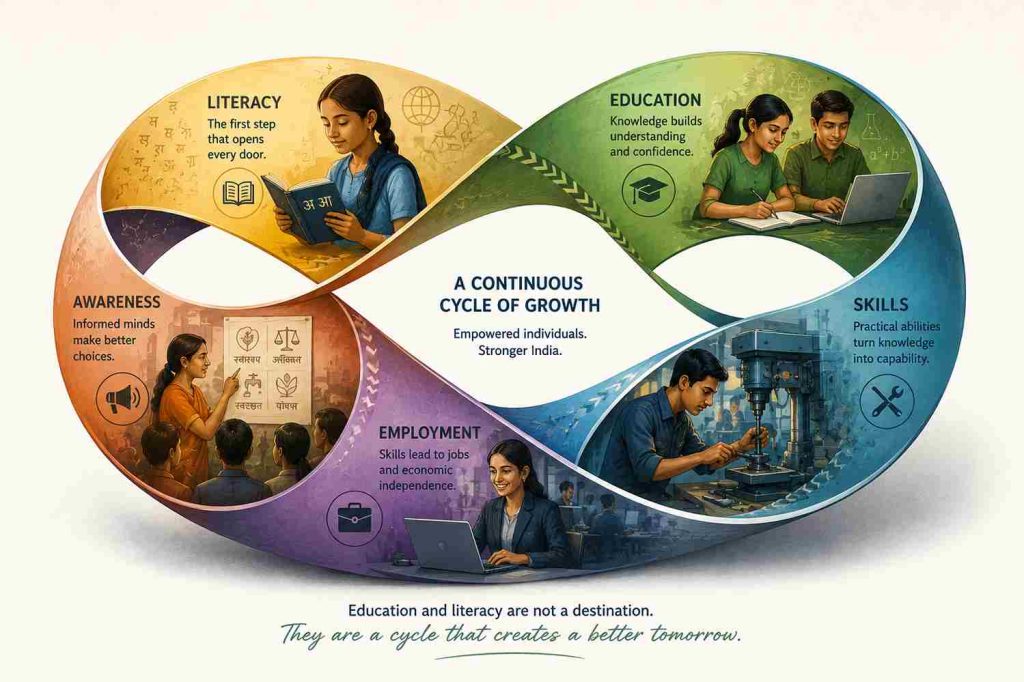
Together, they form the foundation on which skills, awareness and employment are built. Yet in India, the journey from being in school to being genuinely skilled and employable remains incomplete for millions of people.
This blog looks at how education and literacy work together to build real capability and why closing the gap between schooling and skill matters for the country’s future.

How Education Builds Practical Skills for Life and Work
Education’s most obvious function is teaching subjects. Its deeper function is teaching people how to think, solve problems and adapt, skills that outlast any specific curriculum.
A well-designed education system builds capabilities far beyond textbook knowledge: critical thinking, communication, collaboration and the confidence to apply ideas in real situations. These are precisely the qualities that distinguish a person who merely holds a degree from one who can genuinely perform in a workplace.
According to India’s Periodic Labour Force Survey 2023-24, the country’s overall literacy rate among persons aged seven and above stands at 80.9 percent. This is a meaningful improvement over previous decades, yet it also means roughly one in five Indians still cannot read or write a basic sentence with understanding, a gap that directly limits their ability to access formal training or stable employment.
Formal Education vs Skill-Based Learning
Formal education, school, college, degree programmes, builds structured knowledge over time. Skill-based learning, vocational training, apprenticeships, on-the-job mentoring, builds the specific, applied capabilities that employers actually need.
Both matter, but they are not interchangeable. A person can complete years of formal schooling without ever practising the communication, digital or problem-solving skills that modern jobs demand. Conversely, skill-based training without a foundation in literacy and basic reasoning often produces narrow competence that struggles to adapt when industries change.
The strongest outcomes happen when the two are combined, formal education providing the cognitive foundation and skill-based learning translating that foundation into employable capability.

Role of Literacy in Creating Social Awareness
Literacy’s value extends well beyond the classroom or the workplace. It is also one of the most powerful tools for building informed, engaged citizens.
A person who can read understands a vaccination notice, follows news about a government scheme, reads the fine print on a loan agreement or recognises misinformation when it appears online. None of this requires advanced education. It requires functional literacy and the confidence to use it.
This is why literacy is so closely tied to social mobility. It is often the first, smallest step that opens the door to everything that follows, healthcare access, legal awareness, financial inclusion and civic participation.
Health, Rights and Civic Awareness Through Literacy
The connection between literacy and health outcomes is particularly well documented. Adults who can read are better equipped to understand medical instructions, follow public health guidance during disease outbreaks and make informed decisions about nutrition and family planning.
Literacy is also foundational to rights awareness. People who can read are more likely to understand their legal entitlements, whether under labour law, land rights or consumer protection and are better positioned to seek recourse when those rights are violated.
Civic participation follows a similar pattern. Reading local notices, understanding government schemes or following a candidate’s manifesto during elections all depend on basic literacy. Without it, large sections of the population remain dependent on intermediaries to access information that should be directly available to them.
Role of Education as a Gateway to Employment Opportunities
Education’s economic value lies not in the credential itself but in what that credential signals and increasingly, in what skills sit behind it.
India’s labour market data tells a complicated story here. Enrolment in schools and colleges has expanded significantly over the past two decades, yet employability has not kept pace. Many graduates struggle to translate years of formal education into stable, well-paying jobs, largely because the skills employers need, digital literacy, communication, analytical thinking, are not always built effectively within the formal curriculum.
This mismatch is not a reason to deprioritise education. It is a reason to strengthen the bridge between education and employment, through vocational training, internships, industry partnerships and stronger emphasis on applied learning within schools and colleges themselves.
A soft but important point here: organisations working directly with underserved communities often see this gap most clearly and are well placed to design interventions that combine foundational literacy with practical, job-ready skills.
Government Schemes Linking Education to Employment
India has introduced several schemes specifically aimed at connecting education with employment outcomes.
- Skill India Mission, launched to provide vocational training at scale, with its flagship Pradhan Mantri Kaushal Vikas Yojana certifying skills aligned with current industry needs.
- Right to Education Act, 2009, which guarantees free and compulsory elementary education for children aged 6 to 14, building the foundational literacy on which later skill development depends.
- National Education Policy 2020, which emphasises vocational exposure starting from the school level, rather than treating skill training as something that begins only after formal education ends.
- Deendayal Antyodaya Yojana, which supports skill training and livelihood generation specifically for rural and urban poor populations.
- Apprenticeship-linked schemes, including the National Apprenticeship Promotion Scheme, designed to give young people structured, paid, on-the-job experience alongside formal qualifications.
These schemes reflect a growing recognition that education alone does not guarantee employment. The two must be deliberately connected.
How Literacy Empowers Women and Marginalised Communities
The impact of literacy is especially pronounced, and especially uneven, when it comes to gender. According to the Periodic Labour Force Survey 2023-24, India’s effective literacy rate stands at 88 percent for men and 81 percent for women, a gap that has narrowed over time but has not closed.
This gap matters enormously, because the effects of women’s literacy extend well beyond the individual. Research has consistently shown that female literacy is one of the strongest predictors of family planning outcomes and contraceptive use, even independent of a woman’s economic status. Children of literate mothers are also more likely to attend school themselves, creating a generational ripple effect that compounds over time.
For marginalised communities, including Scheduled Castes, Scheduled Tribes and economically disadvantaged groups, literacy rates also remain consistently lower than the national average. These gaps are rarely about ability. They reflect structural barriers, distance to schools, household economic pressure, early marriage and social norms that deprioritise girls’ education in particular.
Closing these gaps requires more than building schools. It requires sustained, community-level engagement, remedial learning support and programmes that actively address the specific barriers keeping women and marginalised groups out of classrooms and out of the workforce.
Challenges in Achieving Quality Education and Literacy in India
Despite genuine progress, several structural challenges continue to limit how effectively education translates into real skills and opportunity.
- Quality gaps in rural schools. Many rural institutions still face shortages of trained teachers, inadequate infrastructure and limited digital access, even where enrolment itself has improved.
- The learning-employment disconnect. Curricula often emphasise rote learning over applied, practical skills, leaving graduates underprepared for actual workplace demands.
- Persistent gender and social gaps. Literacy and enrolment gaps for girls and marginalised communities remain significant, particularly in the transition from primary to secondary education.
- Limited vocational exposure. Vocational and skill-based training is still often treated as a separate track from mainstream education, rather than integrated into it from an early stage.
- Adult illiteracy. A substantial share of India’s illiterate population is concentrated among older adults, a group that formal schooling initiatives rarely reach, requiring dedicated adult literacy programmes instead.
Addressing these challenges requires coordinated effort, government policy, private sector partnership and the grassroots, community-level work that civil society organisations are often best positioned to deliver.
Bringing It Together: Role of Education

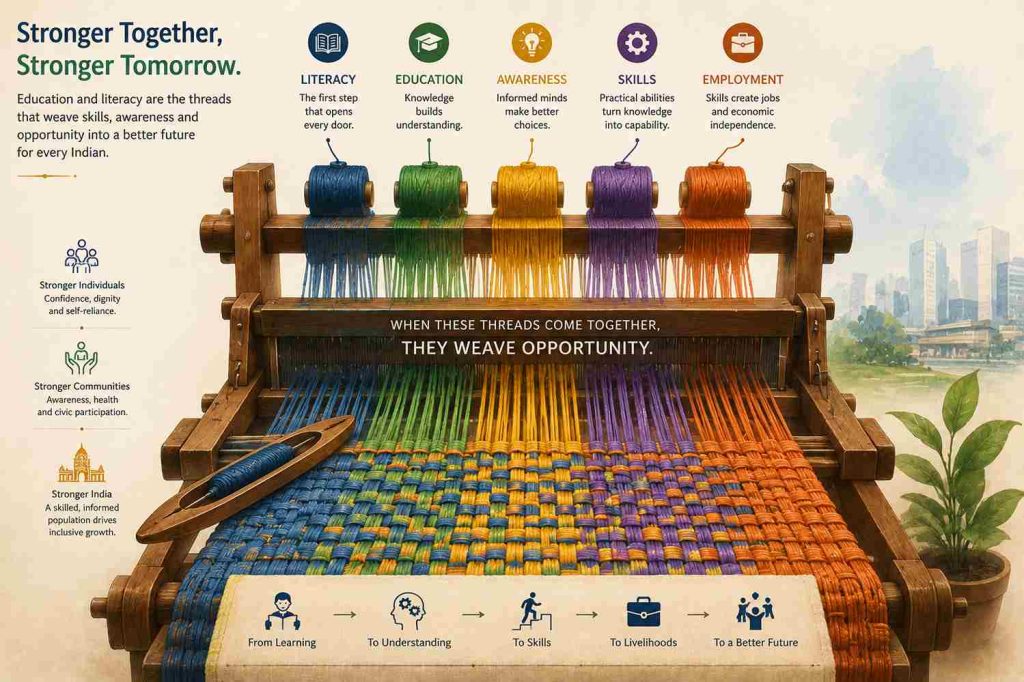
Education and literacy are not separate goals pursued in parallel. They are deeply interconnected, each strengthening the other’s impact. Literacy makes meaningful education possible. Education, in turn, deepens what literacy can achieve, in skills, in awareness, and ultimately, in employment.
For India to fully realise its demographic potential, the focus must extend beyond enrolment numbers toward genuine learning outcomes, stronger links between classrooms and workplaces, and sustained investment in the communities and individuals who have been left furthest behind. The role of education and literacy in building skills, awareness and employment is, in the end, the role of building a more capable, informed and economically secure population, one person at a time.
FAQs — Role of Education, Literacy, Skills and Employment
What is the role of education help in building skills for employment?
Education builds foundational capabilities like critical thinking, communication and problem-solving, which employers value across nearly every sector. When combined with vocational or applied training, education translates more directly into job-ready, employable skills.
What is the role of literacy in creating social awareness?
Literacy enables people to independently access information, on health, rights, government schemes and civic matters, rather than relying on intermediaries. This directly strengthens informed decision-making and community-level awareness.
What is the role of education reduce unemployment in India?
Education reduces unemployment most effectively when paired with practical, industry-relevant skill development. Schemes like Skill India and apprenticeship programmes aim to close the gap between academic qualification and actual employability.
How does literacy empower women in rural India?
Literate women are better equipped to make informed health and family planning decisions and are more likely to ensure their own children attend school, creating positive effects that extend across generations.
What government schemes link education to skill development?
Key schemes include the Skill India Mission, the National Apprenticeship Promotion Scheme, and provisions within the National Education Policy 2020 that integrate vocational exposure into mainstream schooling from an early stage.
What is the connection between role of education and poverty reduction?
Education improves earning potential and access to stable employment, which directly reduces household poverty over time. It also improves health and decision-making capacity, both of which compound to support long-term economic mobility.
How does functional literacy help in finding jobs?
Even basic functional literacy enables a person to read job postings, complete application forms, follow workplace instructions and communicate effectively, all essential steps in securing and retaining formal employment.
What is the right to education and how does it help?
The Right to Education Act, 2009 guarantees free and compulsory education for children aged 6 to 14 in India. It establishes the foundational literacy and learning base on which later skill development and employment opportunities depend.
How do NGOs support role of education and literacy in India?
NGOs often work in underserved communities where government reach is limited, providing remedial learning support, vocational training and community-based literacy programmes that address specific local barriers to education.
What are the biggest barriers to education and literacy in India?
Key barriers include inadequate rural school infrastructure, gender and social inequities, a disconnect between academic curricula and workplace skills, and limited targeted support for adult illiteracy, particularly among older populations.