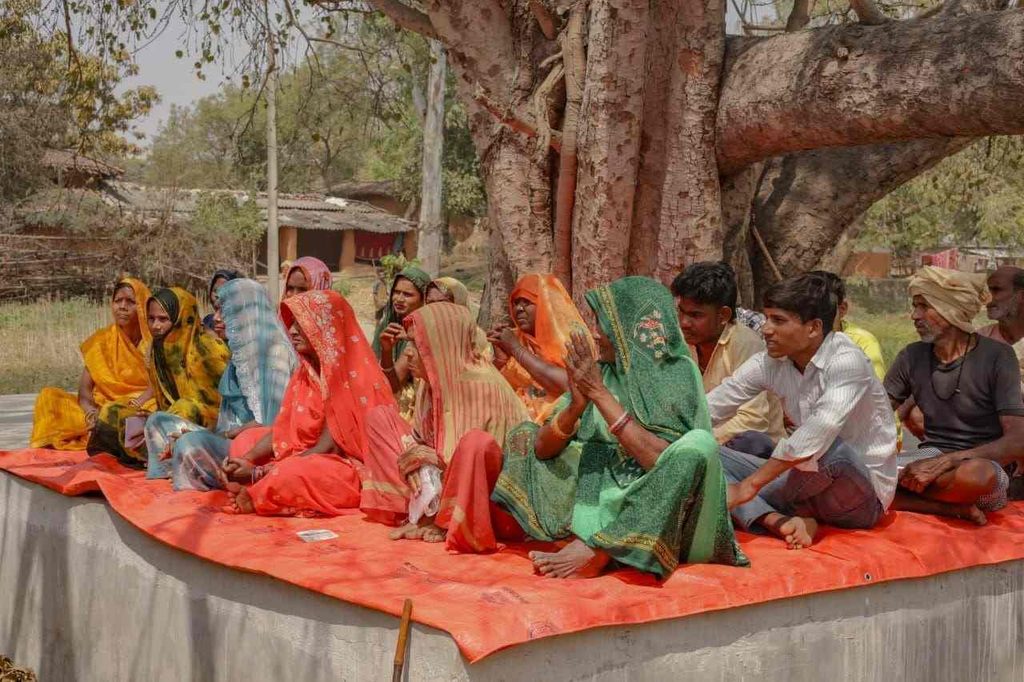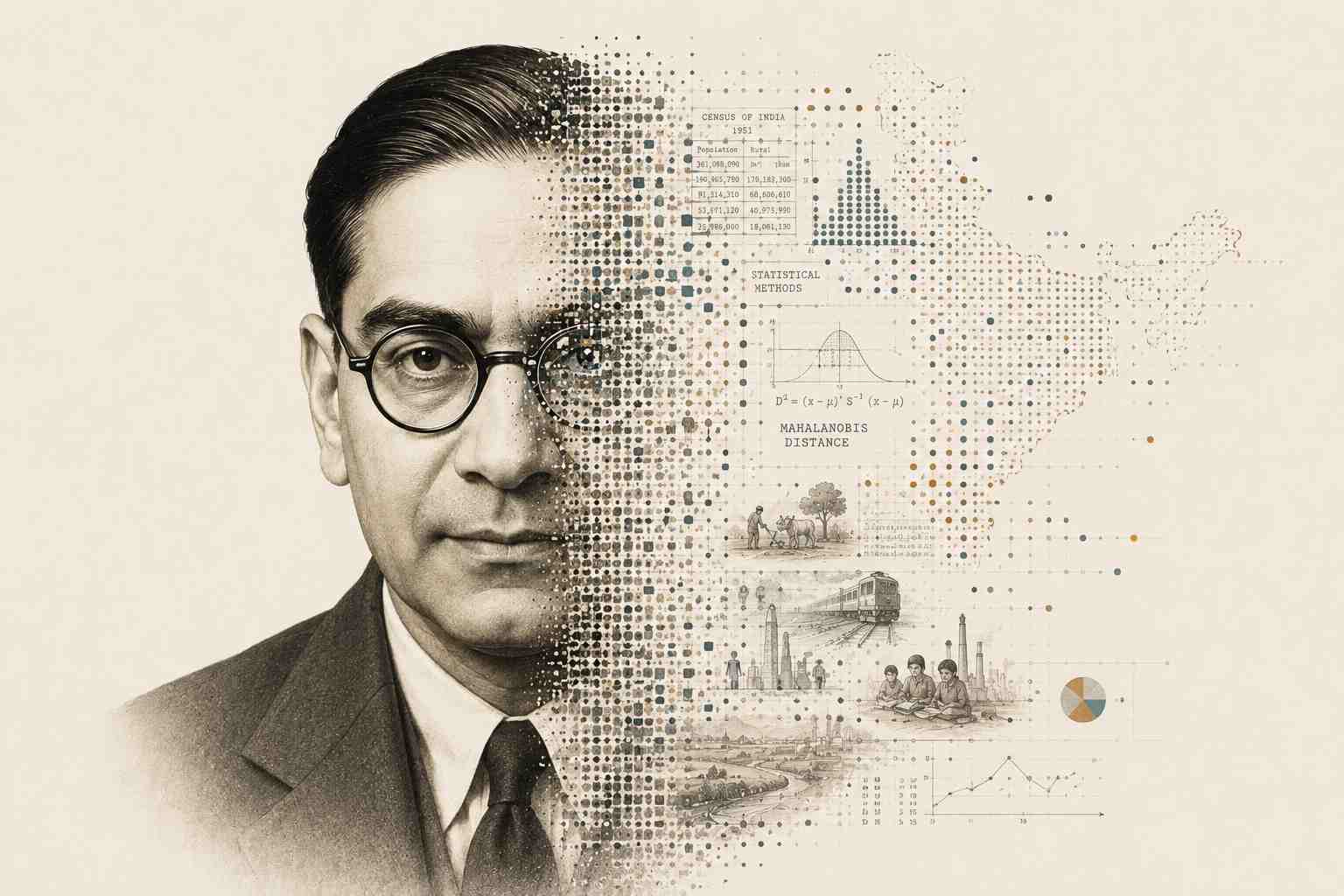

Every year on 29 June, India observes National Statistics Day in honour of one man whose ideas reshaped how the country plans, measures and understands itself. Prasanta Chandra Mahalanobis was a physicist by training, a statistician by instinct and the architect of statistical infrastructure that India still relies on today.
His story is not simply about formulas and institutions. It is about a scientist who believed that numbers, gathered carefully and interpreted rigorously, could genuinely improve people’s lives.
Early Life and Education of PC Mahalanobis
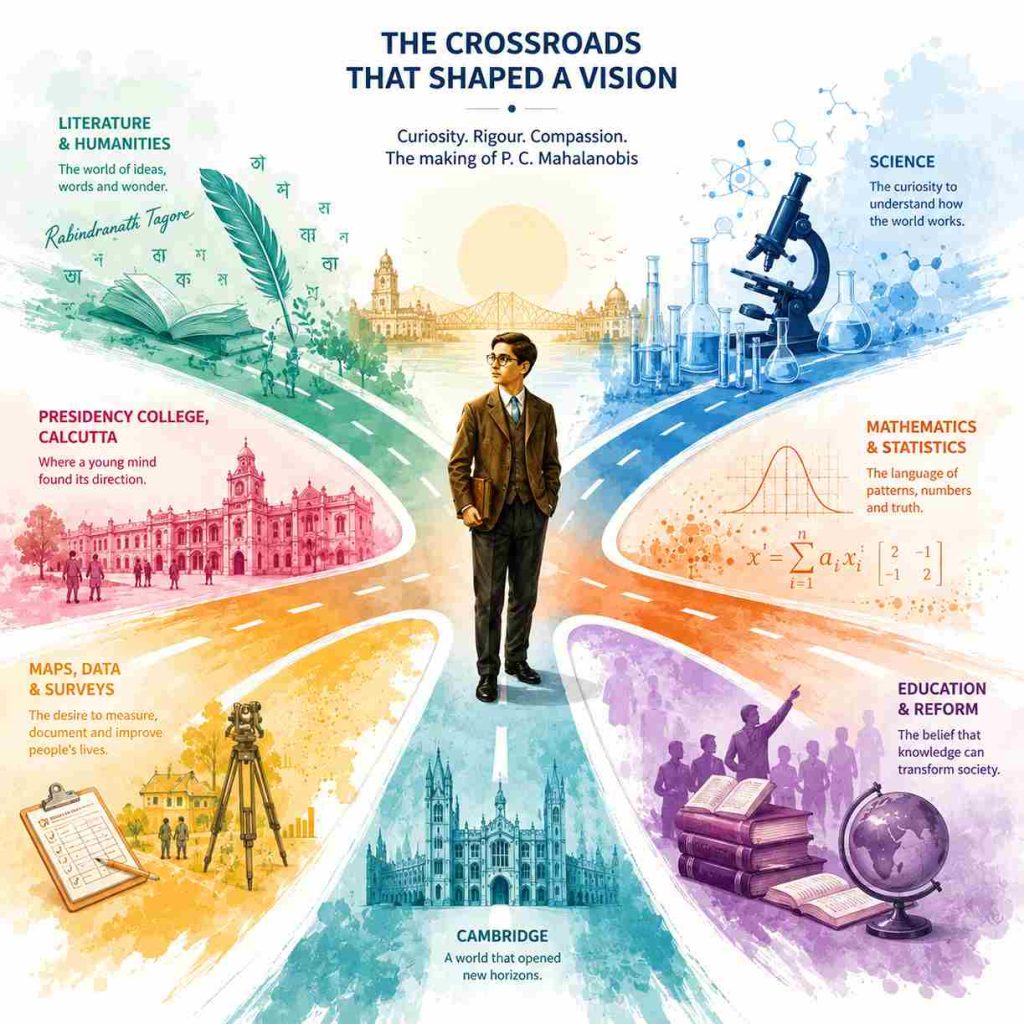
Prasanta Chandra Mahalanobis was born on 29 June 1893 in Calcutta, into a family of considerable intellectual standing. His grandfather, Gurucharan, had been a prominent figure in the Brahmo Samaj reform movement and had founded several well-known educational institutions in the city, including the Brahmo Boys’ School, which Mahalanobis himself attended.
The household he grew up in placed enormous value on learning. The poet Rabindranath Tagore, whose father had been a close friend of Mahalanobis’s grandfather, was a significant early influence on him as a young boy, a connection that would later deepen into a lasting personal friendship.
Mahalanobis went on to study at Presidency College, Calcutta, where his teachers included the physicist Jagadish Chandra Bose and the chemist Prafulla Chandra Ray, two of the most celebrated scientific minds in India at the time. He graduated with honours in physics in 1912.
Academic Background and Influence of Physics and Statistics
Ambitious to study further, Mahalanobis travelled to England and enrolled at King’s College, Cambridge, to continue his studies in physics and mathematics. It was during this period that he met the mathematician Srinivasa Ramanujan, an encounter that left a deep impression on him.
Shortly before he left Cambridge in 1915, one of his tutors introduced him to statistics. What began as a passing academic interest soon became a genuine calling. Mahalanobis grew fascinated by the idea that statistical methods could be applied to real, pressing problems, in meteorology, anthropology and eventually economics.
When he returned to India, he took up a teaching position in physics at Presidency College, becoming a full professor there in 1922. Yet his attention was increasingly drawn elsewhere. By the early 1920s, he had set up an informal “statistical laboratory” in his own room at the college, gathering young colleagues who shared his curiosity about data and measurement.
Founding of the Indian Statistical Institute
The statistical laboratory Mahalanobis built at Presidency College gradually grew into something far more ambitious. On 17 December 1931, he called together a small group of colleagues, including the economist Pramatha Nath Banerji and the mathematician Nikhil Ranjan Sen, to formally establish the Indian Statistical Institute, or ISI.
The Institute was registered the following year, on 28 April 1932, as a non-profit learned society. Its beginnings were modest almost to the point of being humble. The Institute initially occupied a small portion of the Physics Department at Presidency College and its entire expenditure in its first year amounted to just 238 rupees.
What it lacked in resources, it made up for in ambition. In 1933, the Institute launched Sankhya, India’s first academic journal dedicated to statistics, a publication that continues to this day and that carried many of Mahalanobis’s own landmark papers.
How ISI Became a Global Centre for Statistics
Over the following decades, ISI expanded well beyond its original premises, eventually moving to a permanent campus in Baranagar, on the outskirts of Kolkata, during the 1950s. By the time of Mahalanobis’s death in 1972, the Institute had grown into a sprawling research centre spanning disciplines as varied as economics, biochemistry, computer science, human genetics and sociology.
The Institute’s influence reached well beyond India’s borders. It trained generations of statisticians, hosted international scholars and became one of the earliest centres in Asia to work with digital computing, a development Mahalanobis personally championed as part of India’s broader scientific modernisation.
Today, ISI is recognised globally as one of the most rigorous statistical and quantitative research institutions in the world, a legacy that traces directly back to a single room at Presidency College and the ambition of one professor of physics.
The Mahalanobis Distance — His Most Famous Contribution
Among Mahalanobis’s many contributions, none is more widely known in modern data science than the statistical measure that bears his name.
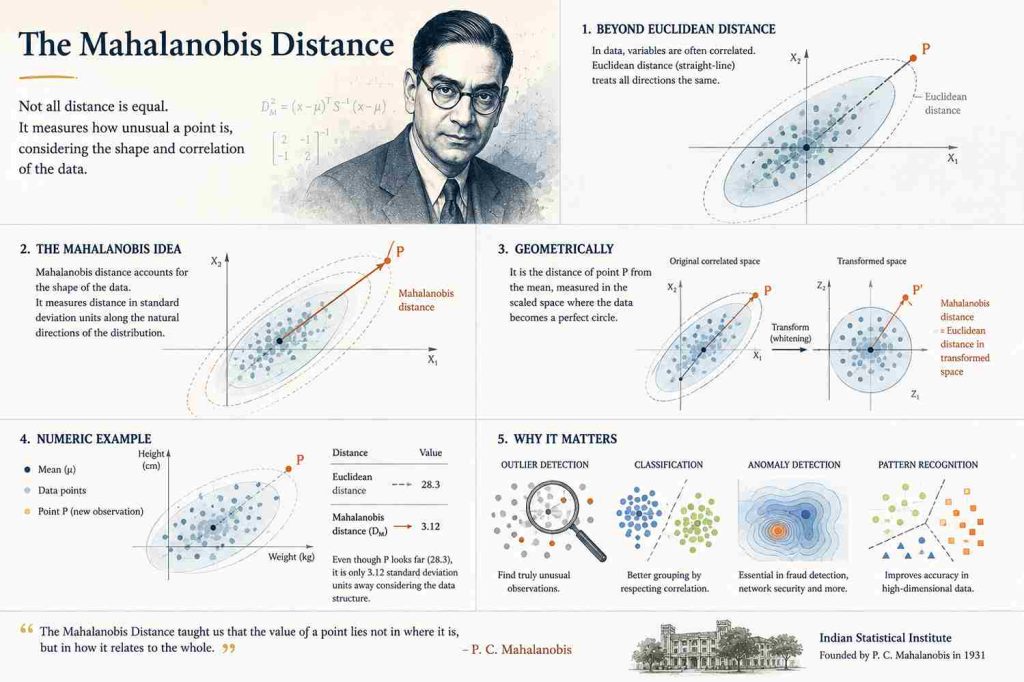
The Mahalanobis distance, first proposed in the early 1930s and formally published in 1936, was developed to solve a specific problem. Traditional distance measures, like the familiar Euclidean distance, work well when comparing simple, uncorrelated data points. But real-world data is rarely so tidy. Variables are often correlated with one another, and they exist on different scales entirely.
Mahalanobis’s solution accounts for both the spread and the correlation structure of a dataset, using its covariance matrix to measure how far a particular data point lies from the centre of a distribution, in a way that respects the data’s actual shape rather than treating every direction as equal.
His original motivation was anthropometric, comparing measurements across different population groups in India. But the renowned statistician Ronald Fisher recognised the broader value of the method and gave it the name by which it is known today, the Mahalanobis distance or the Mahalanobis D-squared statistic.
The applications since have been vast. The Mahalanobis distance is now a standard tool in classification problems, outlier and anomaly detection, pattern recognition and multivariate hypothesis testing, techniques that sit at the core of modern statistics and machine learning.
Role in India’s Economic Planning — The Second Five Year Plan
Mahalanobis’s influence was not confined to academic statistics. He played a defining role in shaping independent India’s economic strategy, serving as a member of the country’s first Planning Commission.
His most consequential contribution came through the Second Five Year Plan (1956 to 1961), where he developed what became known as the Mahalanobis model, a strategy that prioritised investment in heavy industry and capital goods as the foundation for long-term industrialisation. The model reflected his conviction that sustainable economic growth required building domestic productive capacity, rather than relying solely on consumer-goods industries.
Long before this, his statistical instincts had already proven useful in matters of public welfare. Following devastating floods in North Bengal in 1922 and in Orissa in 1926, Mahalanobis conducted extensive statistical studies of rainfall and flood patterns spanning roughly sixty years of historical data, work that directly informed flood control measures in the region.
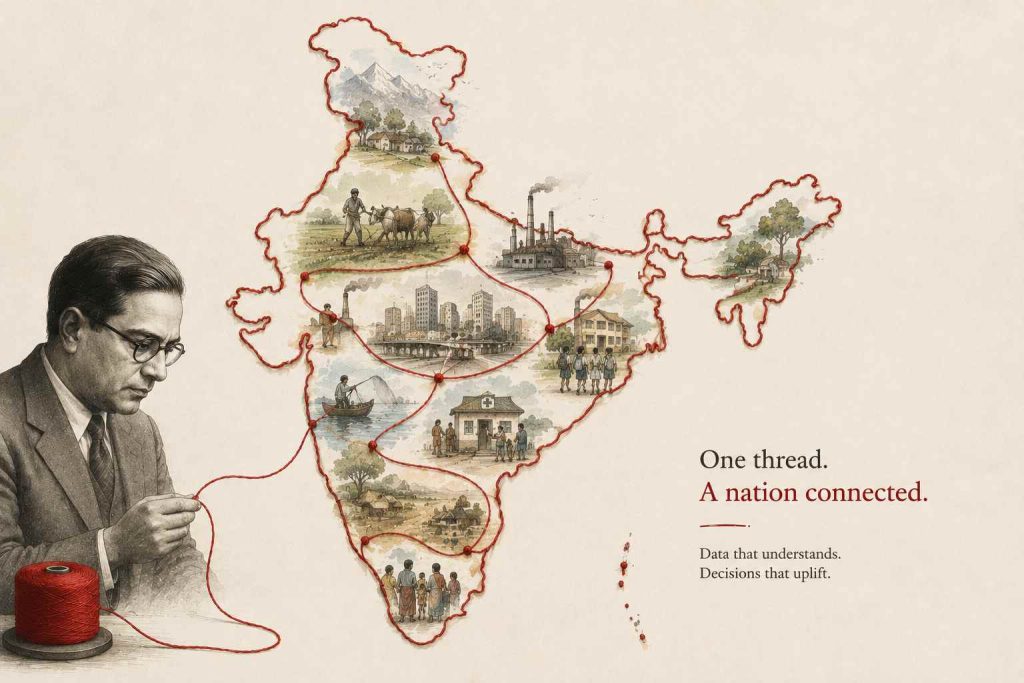
He also pioneered large-scale sample survey techniques in India, an innovation that allowed the government to gather reliable data on agricultural output, employment and living standards without the cost and delay of a full census. This approach laid the groundwork for the National Sample Survey, an institution that continues to shape Indian economic policy today.
Awards, Recognitions and International Legacy
Mahalanobis’s contributions were recognised by some of the most distinguished scientific bodies in the world during his lifetime. He was elected a Fellow of the Royal Society, London, in 1945, and received the Weldon Medal from Oxford University the year before, in 1944.
His later honours included fellowships with the Econometric Society in the United States, the Royal Statistical Society in the United Kingdom, and the Soviet Academy of Sciences. In 1959, King’s College, Cambridge, the very institution where he had first encountered statistics as a young student, made him an Honorary Fellow.
In India, his contributions were formally recognised with the Padma Vibhushan in 1968, one of the country’s highest civilian honours, awarded for his work in science and public service.
Internationally, Mahalanobis also served as chairman of the United Nations Sub-Commission on Sampling between 1947 and 1951, reflecting the global respect his methodological work commanded.
He passed away on 28 June 1972 in Calcutta, just one day before what would have been his seventy-ninth birthday.
Why India Celebrates National Statistics Day on PC Mahalanobis‘s Birthday
In recognition of his foundational role in shaping India’s statistical systems, the Government of India announced in 2006 that 29 June, his birthday, would be observed annually as National Statistics Day. The first official observance took place in 2007.
The choice of date is deliberate and symbolic. It is not simply a tribute to one individual, but a reminder of why rigorous data collection matters for governance. Mahalanobis believed statistics should function as what he called a universal tool of inductive inference, useful not just in academic research but in solving practical problems in agriculture, public health, industry and planning.
National Statistics Day is typically marked with conferences, seminars and public discussions organised by the Ministry of Statistics and Programme Implementation, often centred on a specific theme relevant to that year’s policy priorities. The day serves as an occasion to reflect on the role that accurate, timely data plays in shaping development outcomes across the country.
Relevance of PC Mahalanobis in Modern Data Science
Nearly a century after he first began experimenting with statistics in a small room at Presidency College, Mahalanobis’s ideas remain strikingly relevant to the world of modern data science and artificial intelligence.
The Mahalanobis distance, in particular, continues to be used extensively in machine learning applications, including anomaly detection systems, fraud detection models and clustering algorithms, precisely the kinds of tools now powering everything from financial security systems to recommendation engines.
His broader philosophy also resonates strongly with contemporary thinking. Mahalanobis insisted that statistics was only useful insofar as it served real human needs, whether through better flood control, more efficient industrial planning or more equitable resource allocation. As artificial intelligence and data-driven decision-making increasingly shape governance and business today, his emphasis on rigorous methodology paired with practical purpose feels less like history and more like a guiding principle.
This is, in many ways, the clearest measure of Mahalanobis’s legacy. The institutions he built, the methods he developed and the statistical culture he helped instil in India continue to function exactly as he intended, as tools for understanding the world more clearly, in order to improve it.
FAQs — PC Mahalanobis Life and Legacy
Who is PC Mahalanobis?
PC Mahalanobis was an Indian scientist and statistician, widely regarded as the father of statistics in India. He founded the Indian Statistical Institute and played a central role in shaping the country’s economic planning and statistical systems after independence.
What is PC Mahalanobis famous for in statistics?
He is best known for developing the Mahalanobis distance, a statistical measure used to determine how far a data point lies from a distribution while accounting for correlation between variables. He also pioneered large-scale sample survey methods used widely in India and globally.
When was PC Mahalanobis born and why is his birthday significant?
PC Mahalanobis was born on 29 June 1893 in Calcutta. His birthday is significant because the Government of India designated it as National Statistics Day in 2006, in recognition of his contributions to statistical science and economic planning.
What is the Mahalanobis distance and what problem does it solve?
The Mahalanobis distance measures how far a point is from the centre of a dataset, accounting for the correlation and scale of different variables. Unlike simpler distance measures, it gives an accurate picture of how unusual a data point is within a real, multivariate dataset.
What did PC Mahalanobis contribute to India’s economic planning?
PC Mahalanobis developed the strategic model behind India’s Second Five Year Plan, which emphasised investment in heavy industry as the foundation for long-term economic growth. He also pioneered statistical survey methods that informed agricultural and economic policy.
Why was the Indian Statistical Institute founded?
PC Mahalanobis founded the Indian Statistical Institute in 1931 to create a dedicated centre for statistical research and training in India, building on the informal statistical laboratory he had set up at Presidency College in the 1920s.
What awards did PC Mahalanobis receive?
He received the Weldon Medal from Oxford University, was elected a Fellow of the Royal Society, London, and was awarded the Padma Vibhushan by the Government of India in 1968, among numerous other international fellowships and honours.
How does PC Mahalanobis influence modern data science?
The Mahalanobis distance remains a foundational tool in modern machine learning, used in anomaly detection, classification and clustering algorithms. His broader emphasis on applying rigorous statistics to practical problems also continues to influence data-driven governance and research.
What is the connection between PC Mahalanobis and Rabindranath Tagore?
Rabindranath Tagore was a significant early influence on PC Mahalanobis, a connection rooted in a long-standing friendship between their families, and the two later developed a close personal relationship.
How is National Statistics Day observed in India?
National Statistics Day is marked annually on 29 June with seminars, conferences and public discussions organised by the Ministry of Statistics and Programme Implementation, typically focused on a specific policy theme relevant to that year.