
Summary
- Rabindranath Tagore Jayanti 2026 falls on May 8 or 9 on the Gregorian calendar, corresponding to the 25th of Baishakh in the Bengali calendar — the birth anniversary of Rabindranath Tagore, born May 7, 1861
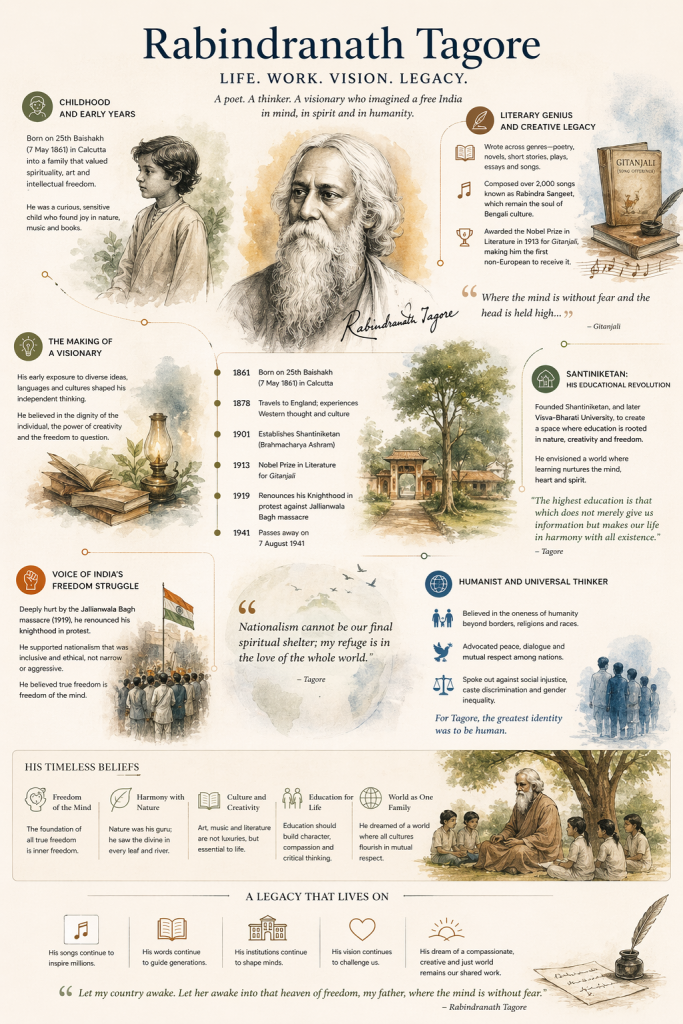
- Tagore was a poet, philosopher, educationist, composer and social reformer — the first non-European to receive the Nobel Prize in Literature, awarded in 1913 for Gitanjali
- He composed over 2,000 songs collectively known as Rabindra Sangeet, and wrote Jana Gana Mana, which became India’s national anthem
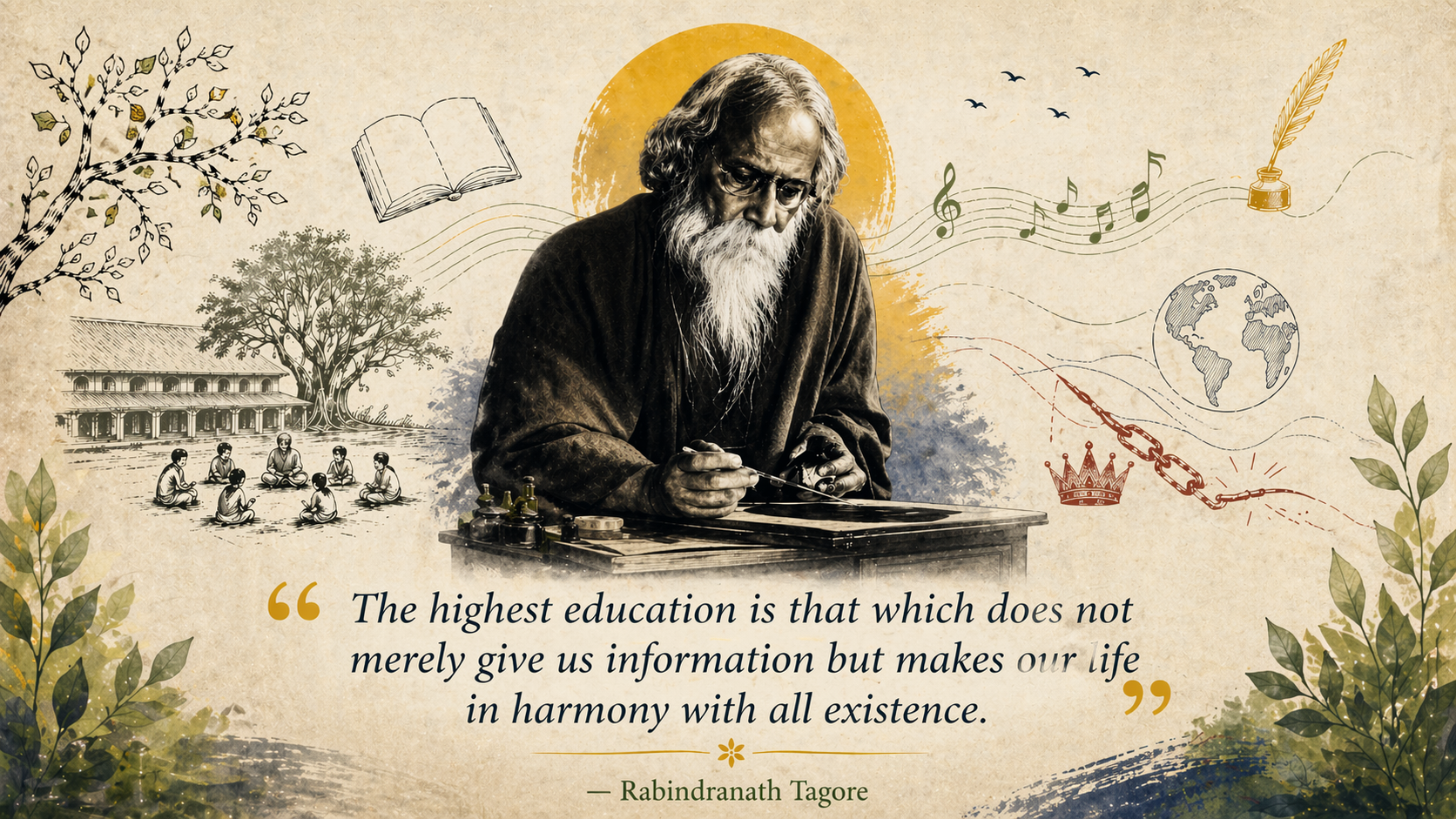
- His establishment of Santiniketan, later Visva-Bharati University, was a direct expression of his revolutionary vision of education rooted in nature, creativity and critical thinking rather than rote learning
- Tagore renounced his knighthood in 1919 in protest against the Jallianwala Bagh massacre, one of the most powerful acts of moral courage in India’s independence movement
- He warned consistently against narrow, aggressive nationalism advocating instead for a humanism that transcended borders and was grounded in ethical responsibility and mutual respect
- His literary work addressed caste discrimination, gender inequality and social injustice — not through direct polemic, but through narrative that made readers feel and question
- In 2026, as India navigates contested questions of identity, nationalism and education, Tagore’s ideas carry an urgency that makes Rabindranath Tagore Jayanti 2026 a moment of reflection as much as celebration
Rabindranath Tagore Jayanti 2026: Life, Legacy and His Vision for India
Rabindranath Tagore Jayanti 2026 arrives at a moment when the questions Tagore spent his life asking feel more pressing than ever. Who are we as a nation? What should education produce? How do we hold onto our roots without closing ourselves to the world? These were not rhetorical questions for Tagore. They were the animating concerns of a lifetime of thought, work and creative output that continues to resonate more than eight decades after his death.
Celebrated annually in early May, Rabindranath Tagore Jayanti — more commonly known as Rabindra Jayanti — marks the birth anniversary of one of India’s most consequential cultural figures. In Bengal, it is observed as Poncheeshe Boishakh, the 25th day of the Baishakh month in the Bengali calendar, which corresponds to either May 8 or May 9 in the Gregorian calendar each year. Rabindranath Tagore Jayanti 2026 falls on May 9, and the occasion invites not just celebration but genuine engagement with the ideas of a man who was, in every sense, ahead of his time.
From a Curious Child to a Literary Genius
Born on May 7, 1861 — or the 25th of Baishakh, 1268, in the Bengali calendar — into a prominent family associated with the Brahmo Samaj reform movement, Tagore was shaped from the beginning by an environment that valued intellectual and spiritual inquiry. His father, Debendranath Tagore, was a religious reformer of considerable influence, and the household Tagore grew up in was one where ideas circulated freely and convention was routinely interrogated.
His formal education was fitful and largely unsuccessful by conventional measures. Schools bored him. Classrooms felt constraining. What educated him, ultimately, was a childhood spent in immersion — in literature, music, philosophy, nature and the rich intellectual culture of his family home. This early, unconventional formation would later become the direct inspiration for his most lasting institutional contribution.
By eight, he was writing poetry. By sixteen, he had published his first collection. The beginning of what would become one of the most prolific literary careers in modern Indian history was already underway.
Tagore’s literary output over the decades that followed was staggering in both volume and range. Poetry, novels, short stories, plays, essays and songs — he worked across every form with equal fluency. His most celebrated work, Gitanjali, a collection of devotional poems, earned him the Nobel Prize in Literature in 1913, making him the first non-European to receive that honour. The award did not arrive as a surprise to those who had followed his work closely. What it did was introduce Tagore to the world, and introduce the world to the possibility of an Indian literary voice that was universal in its reach.
His themes — nature, spirituality, love, freedom, the dignity of the individual — were rendered not in the language of doctrine but in the language of feeling. Through poems like Where the Mind is Without Fear, he articulated a vision of India that was not merely free from colonial rule but free from the internal tyrannies of ignorance, fear and narrow thinking.
And then there was the music. Tagore composed over 2,000 songs, collectively known as Rabindra Sangeet, which remain inseparable from Bengali cultural identity to this day. Among those compositions was Jana Gana Mana — adopted as India’s national anthem — a fact that, on Rabindranath Tagore Jayanti 2026, carries particular weight as a reminder of how deeply one person’s creative imagination can become embedded in a nation’s sense of itself.
Not a Conventional Political Leader
Tagore’s relationship with India’s independence movement was significant, but it was never straightforward. He was not a political organiser or a mass mobiliser in the way that some of his contemporaries were. His contribution to the freedom struggle operated on a different register — moral, philosophical and cultural rather than organisational.
His opposition to British colonial rule was unambiguous. But his approach to nationalism was more complicated, and more prescient, than many of those around him recognised at the time. He warned repeatedly against the kind of aggressive, exclusionary nationalism that he saw taking root not just in India but across the world — a nationalism that defined itself by what it was against rather than what it stood for, that elevated group identity above individual conscience, and that was capable, he believed, of producing violence and fragmentation rather than freedom and cohesion.
His most powerful single political act came in 1919, when he renounced his knighthood in protest against the Jallianwala Bagh massacre. It was a deliberate, principled withdrawal from an honour that could no longer be held without complicity. In the letter he wrote to the Viceroy, he stated simply that he wanted to stand unencumbered beside his countrymen. The words, and the act, carried a moral weight that no speech could have matched.
For Tagore, freedom was never only political. It demanded social reform, intellectual awakening and a transformation of the values that structured everyday life. Political independence was necessary. It was not sufficient.
Reimagining Education: Santiniketan
If there is a single institution that embodies Tagore’s ideas most completely, it is Santiniketan — the experimental school he established in rural Bengal that later became Visva-Bharati University, now a central university of India.
Tagore founded Santiniketan as a direct repudiation of the colonial education system he had experienced and rejected in his own childhood. That system, he believed, produced obedient clerks rather than thinking human beings. It prioritised memorisation over understanding, compliance over creativity and examination performance over genuine learning.
At Santiniketan, classes were held outdoors wherever possible. Students learned through engagement with nature, through art, music and storytelling, through conversation and exploration rather than passive reception. The curriculum brought together Indian classical traditions and global influences, reflecting Tagore’s conviction that India must remain rooted in its own culture while remaining genuinely open to the world.
The model Tagore developed at Santiniketan anticipated ideas that modern pedagogy has only recently begun to take seriously — experiential learning, child-centred education, the importance of emotional and creative development alongside intellectual development. On Rabindranath Tagore Jayanti 2026, as India continues to grapple with questions of educational quality and reform under NEP 2020, his vision feels not like history but like an unfinished instruction.
Imagining India Beyond Borders
At the heart of Tagore’s thought was a commitment to humanism that refused to be contained by national borders. He believed that India’s strength lay not in rigid definitions of identity — religious, linguistic or political — but in its historical capacity to absorb, adapt and synthesise.
He was deeply suspicious of the idea that belonging required exclusion. Patriotism, for him, was an ethical commitment to the well-being of one’s community — not a licence for hostility toward others. He saw the nation-state as a useful but limited framework, and he worried, with considerable foresight, about what would happen when national feeling became the dominant moral language of public life.
His attention to rural India was equally important. He insisted, consistently and practically, that genuine development could not be centred in cities and institutions alone. Through his work in rural Bengal, through projects aimed at improving the lives of farmers and village communities, he demonstrated that his humanism was grounded rather than merely idealistic.
Tagore never saw India in isolation. For him, the country was part of a larger human community — one that must be built on dialogue, peace and shared values rather than competition and domination.
A Voice for Social Change
Tagore’s humanism was grounded in the social realities of a society structured by caste, gender inequality and entrenched hierarchy. Influenced by the reformist tradition of the Brahmo Samaj, he spoke against caste discrimination and the social exclusions that constrained the lives of millions.
His literary work addressed gender inequality and injustice with a subtlety that made it more, not less, powerful. He did not preach. He told stories — and in those stories, he created characters whose dignity, intelligence and inner lives challenged the social arrangements that confined them.
What makes Tagore’s social criticism enduring is precisely this quality of indirection. He trusted his readers to feel the injustice rather than simply being told about it. That trust was itself a form of respect, and it is one reason his work continues to find new readers in new contexts.
Why Tagore Continues to Matter: A Living Cultural Legacy
Rabindranath Tagore Jayanti 2026 is marked, as it is every year, by cultural programmes, music, poetry readings and academic events across schools, universities, and communities in Bengal and beyond. Rabindra Sangeet fills classrooms and concert halls. His poems are recited by children who may not fully understand them yet but who are absorbing something, a way of seeing the world, that will stay with them.
Globally, Tagore stands as a symbol of intellectual and artistic excellence that transcends the specifics of any one culture. His ideas on education, cultural exchange and humanism continue to find resonance in academic and policy discussions that would not immediately seem connected to nineteenth-century Bengal.
In today’s India, where questions of identity, nationalism and education are deeply contested, Tagore’s voice carries an urgency that is sometimes uncomfortable and always necessary. His caution against narrow nationalism is not a historical footnote. It is a living warning. His insistence on the importance of creativity and critical thinking in education is not a romantic ideal. It is a pedagogical argument with substantial evidence behind it. His commitment to the dignity and freedom of every individual, regardless of caste, gender or community, is not a legacy to be admired from a distance. It is a standard to be met.
Rabindranath Tagore Jayanti 2026, then, is more than a commemoration. It is an invitation to revisit a thinker who challenged easy answers and asked deeper questions and to carry forward a vision of freedom, compassion and shared humanity that remains, even now, unfinished.
Frequently Asked Questions (FAQs): Rabindranath Tagore Jayanti 2026
When is Rabindranath Tagore Jayanti 2026?
Rabindranath Tagore Jayanti 2026 falls on May 9, corresponding to the 25th of Baishakh in the Bengali calendar — the birth anniversary of Rabindranath Tagore, who was born on May 7, 1861. The celebration is also known as Rabindra Jayanti or Poncheeshe Boishakh in Bengal.
Why is Rabindranath Tagore Jayanti celebrated?
Rabindranath Tagore Jayanti celebrates the life and legacy of Rabindranath Tagore — poet, philosopher, educationist, composer and social reformer. The occasion honours his extraordinary contributions to Indian literature, music, education and culture, and is marked by cultural programmes, poetry readings and performances of Rabindra Sangeet across India and the Bengali diaspora worldwide.
What is Rabindranath Tagore best known for?
Tagore is best known for Gitanjali, the collection of devotional poems that earned him the Nobel Prize in Literature in 1913 — making him the first non-European to receive the honour. He is also known for composing Jana Gana Mana, India’s national anthem and for creating Rabindra Sangeet, a body of over 2,000 songs that remain central to Bengali cultural identity.
What was Tagore’s contribution to India’s independence movement?
Tagore was a strong opponent of British colonial rule, though his approach to nationalism differed from many of his contemporaries. His most powerful single act was renouncing his knighthood in 1919 following the Jallianwala Bagh massacre. He consistently warned against narrow, aggressive nationalism, advocating instead for a vision of freedom that included social reform, intellectual awakening and genuine human dignity.
What was Tagore’s philosophy of education?
Tagore believed that education should foster creativity, critical thinking and a deep connection with nature — not produce mechanical minds trained for compliance. He put this philosophy into practice through Santiniketan, the experimental school he established in rural Bengal that later became Visva-Bharati University. His ideas anticipated many of the principles that modern progressive and experiential education are built on.
What is Santiniketan and why is it significant?
Santiniketan is the institution Tagore founded in rural Bengal as an alternative to the colonial education system he rejected. Classes were held outdoors, learning was experiential and creative, and the curriculum integrated Indian classical traditions with global influences. It later became Visva-Bharati University, now a central university of India. On Rabindranath Tagore Jayanti 2026, Santiniketan remains a symbol of what education can look like when it prioritises the whole human being.
Why is Tagore’s vision relevant in 2026? What is the importance of Rabindranath Tagore Jayanti 2026?
In 2026, as India navigates contested questions of identity, nationalism and educational reform, Tagore’s ideas carry remarkable contemporary relevance. His warnings against narrow nationalism, his insistence on creativity and critical thinking in education and his commitment to social justice and human dignity all speak directly to ongoing debates. Rabindranath Tagore Jayanti 2026 is as much an occasion for reflection as it is for celebration.
What is Rabindra Sangeet and why does it matter?
Rabindra Sangeet refers to the body of over 2,000 songs composed by Tagore, spanning devotional, romantic, patriotic and seasonal themes. The songs are an integral and living part of Bengali cultural identity — sung at celebrations, in classrooms, at community gatherings and in homes across generations. India’s national anthem, Jana Gana Mana, is itself a Rabindra Sangeet composition, underscoring the depth of Tagore’s imprint on the nation’s sense of itself.