Summary
- Menstrual Hygiene Day, observed globally on 28 May, draws attention to the 500 million women and girls worldwide who lack adequate access to menstrual hygiene products and safe sanitation facilities
- In India, approximately 71% of girls report having no knowledge of menstruation before their first period, and nearly 23 million girls drop out of school annually due in part to inadequate menstrual hygiene facilities
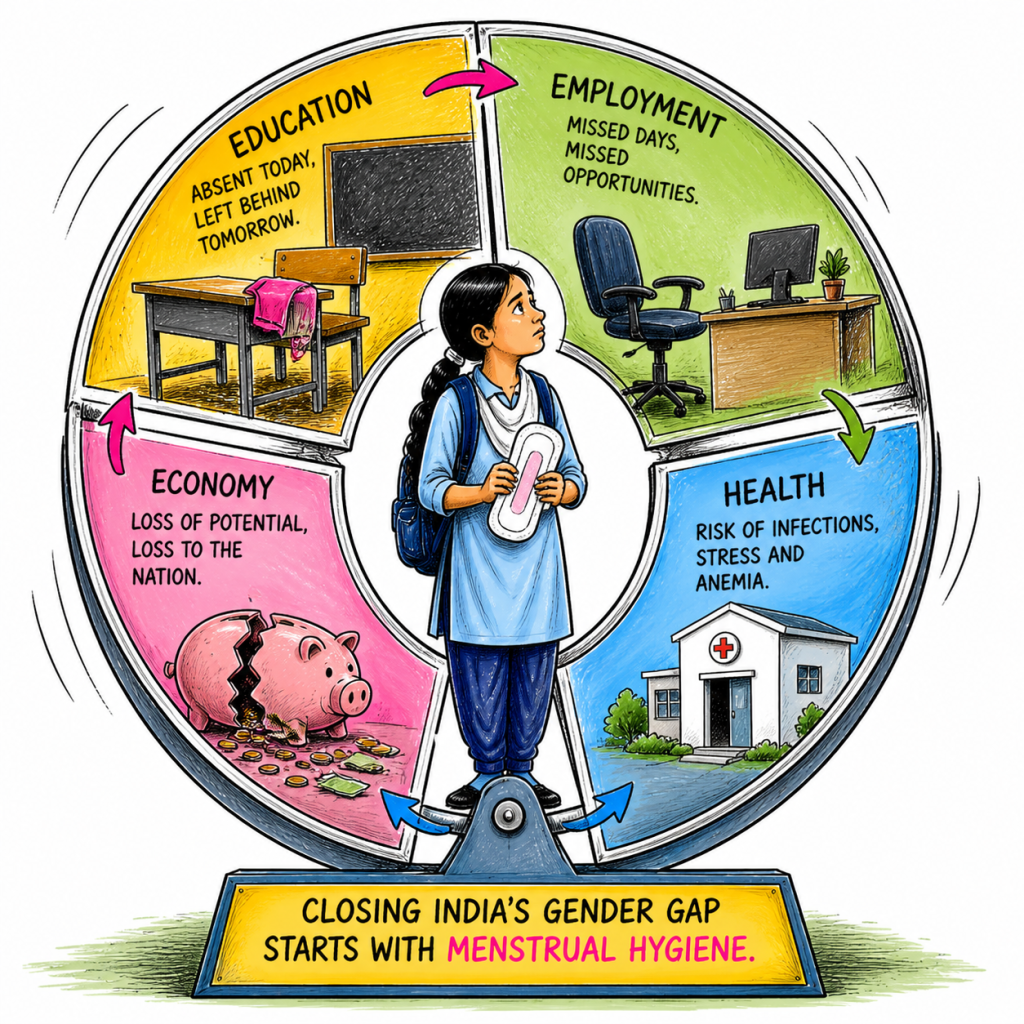
- Cultural stigma, economic barriers and insufficient infrastructure — particularly in rural and low-income communities continue to limit women’s and girls’ participation in education, employment and public life
- India’s National Menstrual Hygiene Policy represents a significant policy step, but implementation gaps, especially in rural areas and informal workplaces, remain a critical challenge
- Grassroots programmes including Smile Foundation’s Swabhiman initiative are demonstrating that community-level awareness, peer education and one-on-one counselling can produce lasting behavioural change where national campaigns have not yet reached
- Menstrual hygiene is directly connected to girls’ education, women’s employment, adolescent mental health and India’s broader gender equity agenda
A Day That Should Not Need to Exist
Every year on 28 May, the global public health community observes Menstrual Hygiene Day — an occasion created in 2014 by the German NGO WASH United to draw attention to the fact that, for hundreds of millions of women and girls, managing menstruation safely and with dignity remains an unresolved challenge.
The date is not arbitrary. May has 28 days, and 28 is the average length of the menstrual cycle — a small but deliberate act of destigmatisation embedded in the calendar itself.
In an ideal world, Menstrual Hygiene Day would not need to exist. Menstruation is a biological function, experienced by roughly half the world’s population for a significant portion of their lives. The infrastructure, products and social norms needed to support it safely and without shame are neither technologically complex nor prohibitively expensive. And yet, globally, an estimated 500 million women and girls lack adequate access to menstrual hygiene products and sanitation facilities. In India, the numbers and the stories behind them make Menstrual Hygiene Day not just relevant but urgent.
The Scale of the Problem: What the Data Says
Period hygiene in India sits at the intersection of several compounding disadvantages — poverty, rural geography, gender inequality and cultural stigma — that make it simultaneously a health issue, an education issue, an economic issue and a human rights issue.
According to the National Family Health Survey, only about 64% of women aged 15–24 in India use hygienic methods of protection during menstruation. The figure masks significant variation: in urban areas, access to and use of sanitary products is considerably higher than in rural communities, where disposable pads may be unavailable, unaffordable or culturally unfamiliar. Cloth, ash, sand and husks are still used in some communities — materials that carry serious risks of infection when not managed carefully.
The knowledge gap compounds the access gap. Research consistently shows that approximately 71% of girls in India have no knowledge of menstruation before their first period. Their first experience is thus not simply biological — it is frequently frightening, confusing and accompanied by restrictions imposed by family and community norms that they have not been prepared to understand or question.
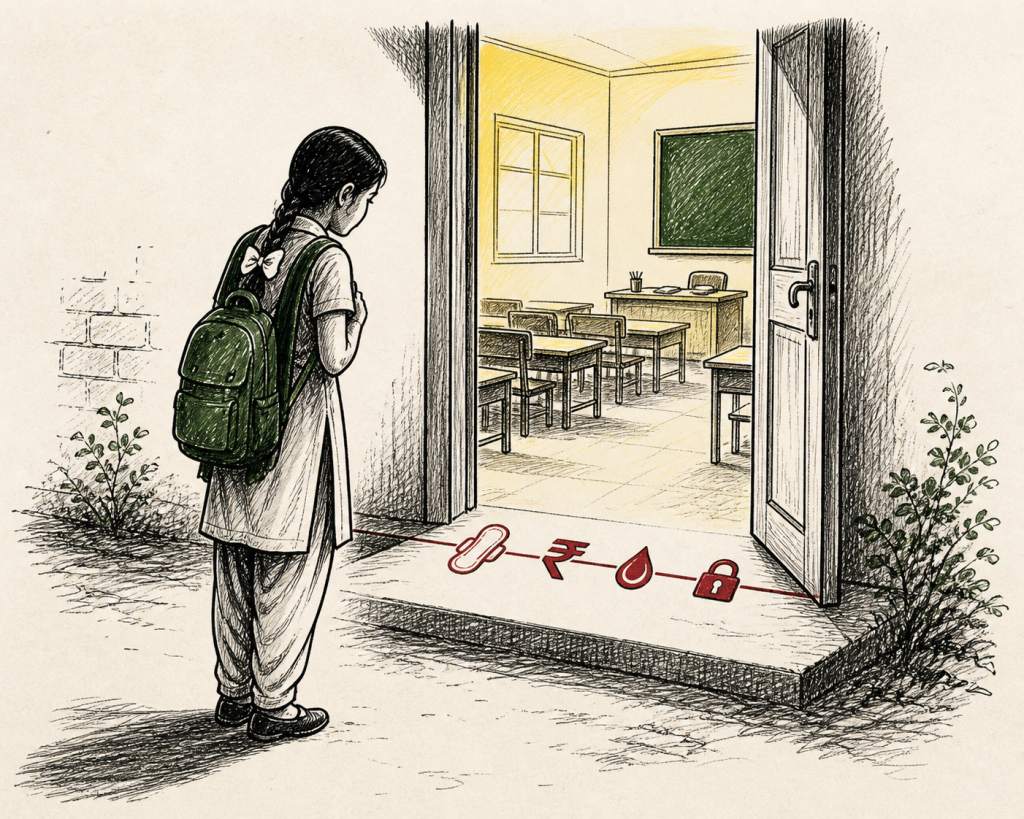
UNICEF estimates that in South Asia, one in ten girls misses school during menstruation. For India specifically, the figure translates into an estimated 23 million girls who drop out of school annually — a number influenced by, though not reducible to, menstrual hygiene factors. When a school does not have a private, clean toilet for girls, when there is no mechanism for disposing of sanitary products, when a girl has no products at all — attendance becomes a choice between dignity and education. Too often, dignity loses.

The Education Dimension: When Periods End Schooling
The connection between menstrual hygiene and girls’ education is one of the most well-documented in the development literature, and one of the most consequential.
Girls who miss school during menstruation fall behind in their studies. Over time, accumulated absences widen the gap between them and their peers, reducing academic confidence and increasing the likelihood of dropout. In contexts where girls are already navigating pressure to prioritise domestic responsibilities or early marriage over schooling, the added disruption of unmanaged menstruation can be the tipping point.
The infrastructure dimension is direct and addressable. A 2019 UNICEF report found that less than half of schools in low- and middle-income countries had adequate single-sex sanitation facilities. In India, while the situation has improved since the Swachh Bharat Mission brought new attention to school sanitation, quality and maintenance remain inconsistent — particularly in rural government schools. A toilet that exists but is broken, dirty or lacks a door does not serve the same function as one that is clean, private and usable.
But infrastructure alone is insufficient. The stigma that surrounds menstruation in many communities means that girls manage their periods not just with inadequate facilities but with shame — afraid to ask for help, afraid to be seen, afraid to acknowledge a biological reality that their bodies impose on them regardless of social permission. This stigma is absorbed in childhood and carried into adulthood, shaping women’s relationship with their own health for decades.
National Menstrual Hygiene Policy
The National Menstrual Hygiene Policy was a ground-breaking initiative in this context. Aimed at addressing the menstrual health needs of women and girls across the country, the policy is expected to promote menstrual hygiene management and break the silence surrounding menstruation.
Furthermore, the policy prioritises the establishment of menstrual hygiene facilities in schools, workplaces and public spaces to ensure that women and girls have access to clean and private facilities for managing their periods with dignity and comfort.
By implementing the National Menstrual Hygiene Policy, India is not only prioritising the health and well-being of its female population but also taking a significant stride towards achieving gender equality and social inclusion.
But…
Employment and Economic Participation: The Workplace Dimension
The consequences of inadequate menstrual hygiene management do not end when a girl leaves school. They follow her into the workplace, and in the informal sector, where the majority of India’s working women are employed, they are particularly acute.
Women working in fields, factories, domestic employment, and construction sites often have no access to private toilets, no mechanism for managing or disposing of sanitary products during working hours, and no cultural space to acknowledge that menstruation affects their ability to work under current conditions. The result is absenteeism, reduced productivity and the kind of quiet health management that involves ignoring physical discomfort for extended periods with long-term health consequences.
The World Bank has estimated that poor menstrual hygiene management costs India approximately 0.4% of GDP annually in lost productivity — a figure that, while difficult to verify precisely, points toward the scale of the economic argument for investing in menstrual health. When women can manage menstruation safely and without disruption, they work more consistently, perform more effectively and are better positioned to advance.
Workplace menstrual leave policies which have been introduced by some Indian companies and have been the subject of significant public debate represent one approach to acknowledging the reality of menstruation in employment contexts. The debate around these policies is itself instructive: it reveals how contested the basic acknowledgement of menstruation as a workplace-relevant reality remains, even in relatively progressive organisational settings.
Cultural Stigma and Social Norms: The Invisible Barrier
No discussion of period hygiene in India is complete without honest engagement with the cultural dimension. Across communities, cutting across religion, region and socioeconomic status, menstruation is surrounded by restrictions, taboos and practices that communicate, to girls and women, that their bodies are sources of impurity during their periods.
These restrictions vary in form: prohibition from entering temples or kitchens, exclusion from family rituals, requirements to sleep separately, prohibitions on touching certain foods. What they share is the underlying message that a menstruating woman is, in some fundamental way, a problem to be managed rather than a person to be supported.
The health consequences of these norms are real. When girls are not permitted to wash during menstruation, or when the cloth they use cannot be dried in sunlight for fear of social stigma, the risk of infection increases. When menstruation is not discussed openly, girls cannot seek help when they experience symptoms that require medical attention. When the subject is taboo, the knowledge needed to manage it safely cannot be transmitted.
Breaking this stigma is not a simple communication challenge. It is a social change process that requires sustained engagement with communities, families, religious leaders and institutions, and it requires that the people doing this engagement are trusted by the communities they are working with.
India’s Policy Response: Progress and Persistent Gaps
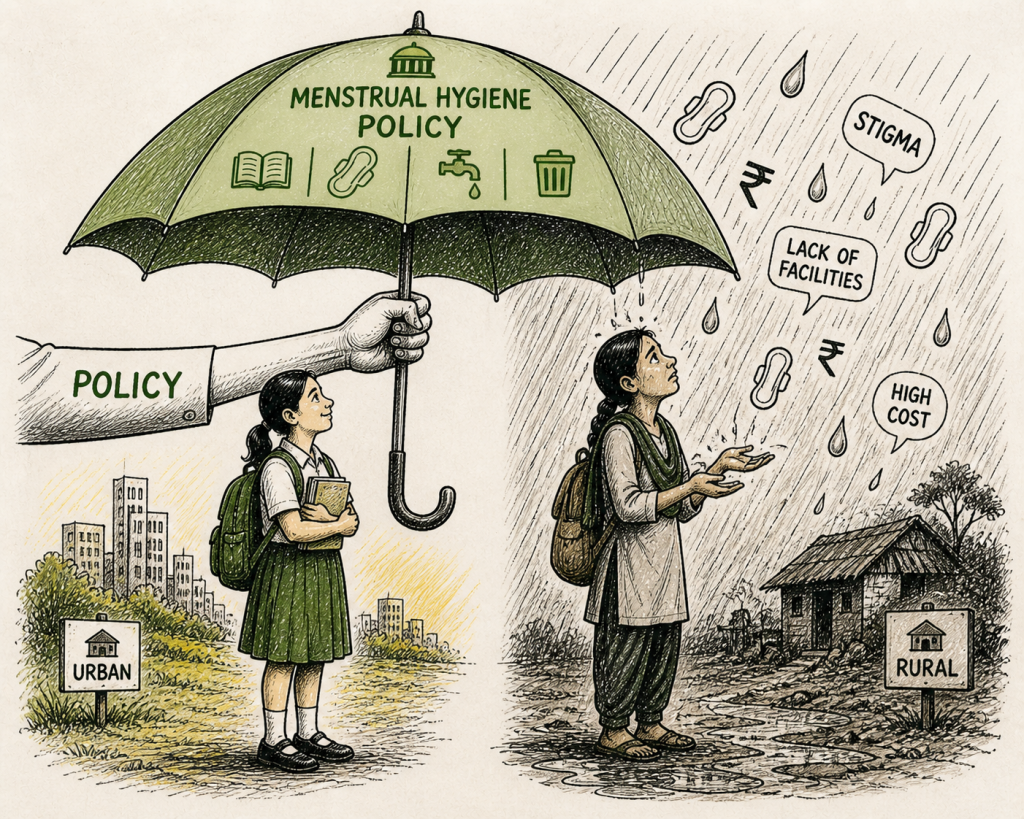
India has taken meaningful policy steps on menstrual health. The National Menstrual Hygiene Policy developed with input from multiple ministries and civil society organisations provides a framework for promoting menstrual hygiene management across education, health and sanitation systems. The Pradhan Mantri Jan Arogya Yojana and various state-level schemes have included provisions for sanitary product access. Some states provide free sanitary napkins to girls in government schools.
These are genuine advances. But implementation gaps which are the consistent challenge of Indian social policy limit their impact significantly. Free sanitary products that do not reach schools, toilet infrastructure that is not maintained, health education that is delivered once and not reinforced, these are the points at which policy intent and lived reality diverge.
The economic barrier to menstrual products also deserves direct attention. While the GST on sanitary napkins was removed in 2018, affordable products remain inaccessible for many low-income women, particularly in rural areas where distribution networks are limited. Biodegradable and reusable alternatives which have environmental advantages alongside their cost advantages are growing in availability, but awareness and acceptance vary considerably.
Grassroots Change: What Smile Foundation’s Swabhiman Initiative Shows
The most sustainable change in menstrual health awareness and practice in India is happening at the community level, and it is being driven by the kinds of trusted, sustained engagement that national programmes cannot replicate.
Smile Foundation’s Swabhiman initiative is built on the understanding that menstrual health awareness requires relationships. Through community engagement, group sessions and one-on-one counselling with adolescent girls and women, the programme creates spaces where menstruation can be discussed openly, questions can be asked without embarrassment, and knowledge can be applied to real lives.
The results of this approach are visible not just in changed behaviour but in changed relationships. Girls who participate in Swabhiman sessions begin talking about menstruation at home and at school — conversations that were previously impossible. Peers influence peers. Communities that were resistant gradually open. The change is slow, but it is deep.
Shivani’s story illustrates what this looks like in practice. When she first attended a Swabhiman group meeting, she was too shy to speak. She had never heard menstruation discussed openly before. The first session changed her understanding of her own body, and when she began applying what she had learned, she found daily life easier to navigate. She started answering questions from friends at school. She became a peer educator, leading awareness sessions in her community. She does not think of herself as a change-maker. She just thinks that important knowledge should be shared.
This peer multiplication effect where one informed girl becomes the entry point for many others is one of the most powerful mechanisms available in menstrual health education, and it is one that Smile Foundation’s model is explicitly designed to activate.
The Environmental Dimension: A Growing Concern
Any comprehensive discussion of menstrual hygiene on Menstrual Hygiene Day must also acknowledge the environmental dimension of menstrual product use.
India generates an estimated 113,000 tonnes of menstrual waste annually, the vast majority of which consists of disposable synthetic sanitary products that take hundreds of years to decompose. Improper disposal — in open drains, water bodies and open land — poses environmental and public health risks. The scaling up of disposable product access, while addressing one dimension of menstrual equity, creates another challenge that requires attention.
The growing availability of reusable options — menstrual cups, cloth pads, and biodegradable products — offers a partial response to this challenge. But uptake requires awareness, cultural acceptance and access to washing facilities that are not universally available. Integrating environmental sustainability into menstrual health programming is an area that deserves more deliberate attention from both policymakers and civil society.
Dignity Is Not Optional
Menstrual Hygiene Day is a reminder that the distance between where India is and where it needs to be on menstrual health is still significant — but that it is being closed, community by community, conversation by conversation, peer educator by peer educator.
The investment required to close it is modest relative to its returns. A girl who can manage her period safely and without shame attends school more regularly, learns more effectively, enters the workforce with greater confidence and navigates her health with more agency. These outcomes compound across a lifetime, and across generations.
Period dignity is not a niche concern. It is a foundational dimension of gender equity and Menstrual Hygiene Day exists to ensure that it is treated as such.
Frequently Asked Questions (FAQs): Menstrual Hygiene Day
What is Menstrual Hygiene Day and when is it observed?
Menstrual Hygiene Day is a global awareness day observed every year on 28 May. It was initiated in 2014 by the German NGO WASH United to highlight the importance of good menstrual hygiene management for the health, dignity and well-being of women and girls worldwide. The date is deliberate — May is the fifth month of the year, and 28 represents the average length of the menstrual cycle. The day brings together governments, NGOs, healthcare organisations and communities to advocate for improved access to menstrual products, sanitation and education.
Why is menstrual hygiene important for girls’ education in India?
Inadequate menstrual hygiene directly affects girls’ school attendance and academic performance. When schools lack clean, private toilet facilities and girls have no access to sanitary products, menstruation becomes a reason to stay home, and repeated absences accumulate into significant educational setbacks. An estimated 23 million girls in India drop out of school annually, with menstrual hygiene being one contributing factor. When proper facilities and products are available and when menstrual health education reduces stigma, girls attend school more consistently and participate more actively in their education.
What are the main barriers to menstrual hygiene access in India?
The barriers are multiple and interconnected. Economic barriers prevent many low-income women and girls from affording commercial sanitary products. Geographic barriers limit product availability in rural and remote areas. Infrastructure barriers, particularly the absence of clean, private toilets in schools and workplaces, make safe management difficult even when products are available. Cultural barriers, including stigma and taboos around menstruation, prevent open discussion, limit knowledge transmission and discourage girls and women from seeking help. Addressing menstrual hygiene in India requires engaging all of these dimensions simultaneously.
What is India’s National Menstrual Hygiene Policy?
India’s National Menstrual Hygiene Policy provides a framework for improving menstrual hygiene management across education, health and sanitation systems. It prioritises the establishment of menstrual hygiene facilities in schools, workplaces and public spaces, and promotes comprehensive menstrual health education. Several state governments have implemented programmes providing free sanitary napkins to girls in government schools. While the policy represents a significant step forward, implementation gaps in infrastructure maintenance, product distribution and sustained education remain a challenge, particularly in rural communities.
How does menstrual stigma affect women’s health and well-being?
Menstrual stigma — the cultural norms and taboos that treat menstruation as impure or shameful — has direct health consequences. When menstruation cannot be discussed openly, girls and women cannot seek medical attention for symptoms that require it. Restrictions on washing, or on drying cloth in sunlight, increase infection risk. The psychological burden of managing a normal biological process with shame and secrecy affects mental health and self-esteem, particularly among adolescents. Breaking menstrual stigma is not only a social good, it is a health intervention.
What role does Smile Foundation play in menstrual health awareness?
Smile Foundation’s Swabhiman initiative works directly with adolescent girls and women in underserved communities to build menstrual health awareness and promote safe menstrual hygiene practices. Through community group sessions and one-on-one counselling, the programme creates spaces where menstruation can be discussed openly and knowledge can be applied practically. The programme’s peer education model — where informed girls become advocates in their own communities — produces a multiplication effect that extends reach beyond direct programme participants and creates lasting community-level change.
What are the environmental concerns associated with menstrual products?
India generates an estimated 113,000 tonnes of menstrual waste annually, primarily from disposable synthetic sanitary products. These products take hundreds of years to decompose and, when improperly disposed of — in drains, water bodies or open land — create environmental and public health risks. Reusable alternatives, including menstrual cups, cloth pads and biodegradable products, offer more sustainable options but require awareness, cultural acceptance and access to washing facilities. Integrating environmental sustainability into menstrual health programming is an increasingly important dimension of menstrual equity advocacy.
How can organisations and individuals support Menstrual Hygiene Day?
Individuals can support Menstrual Hygiene Day by talking openly about menstruation in families, schools and workplaces to reduce stigma and normalise the conversation. Donating menstrual products to organisations working with underserved communities, supporting advocacy for policy improvements and amplifying the work of organisations like Smile Foundation are all meaningful contributions. For organisations, investing in workplace menstrual hygiene facilities, implementing supportive HR policies and partnering with NGOs that deliver menstrual health programming in underserved communities translates institutional support into on-ground impact.