Summary
- Behavioural change is the foundational mechanism through which lasting improvements in public health, education and women’s empowerment are achieved
- Information alone does not produce behaviour change — sustained community engagement, peer-led interventions and trust-building are essential to moving people from awareness to consistent, long-term action
- Maternal health outcomes in India remain deeply unequal, with rural and low-income communities facing the greatest gaps in antenatal care utilisation, institutional delivery, and postnatal follow-up — gaps that are as much behavioural as they are infrastructural
- Menstrual hygiene awareness programmes that rely on one-time information delivery consistently underperform relative to those that embed menstrual health education within ongoing community relationships and peer networks
- Smile Foundation’s behaviour change communication approach — across Mission Education, Swabhiman, Health Cannot Wait and STeP — is built on the understanding that sustained community mobilisation produces measurable shifts in health-seeking behaviour
- Women-centred outreach consistently produces stronger health outcomes for entire families — when women have agency over health decisions, the benefits extend to children’s nutrition, immunisation rates and household well-being
- Peer-led interventions, where trusted community members model and reinforce new behaviours, are among the most evidence-backed mechanisms for producing durable behavioural change in low-resource settings
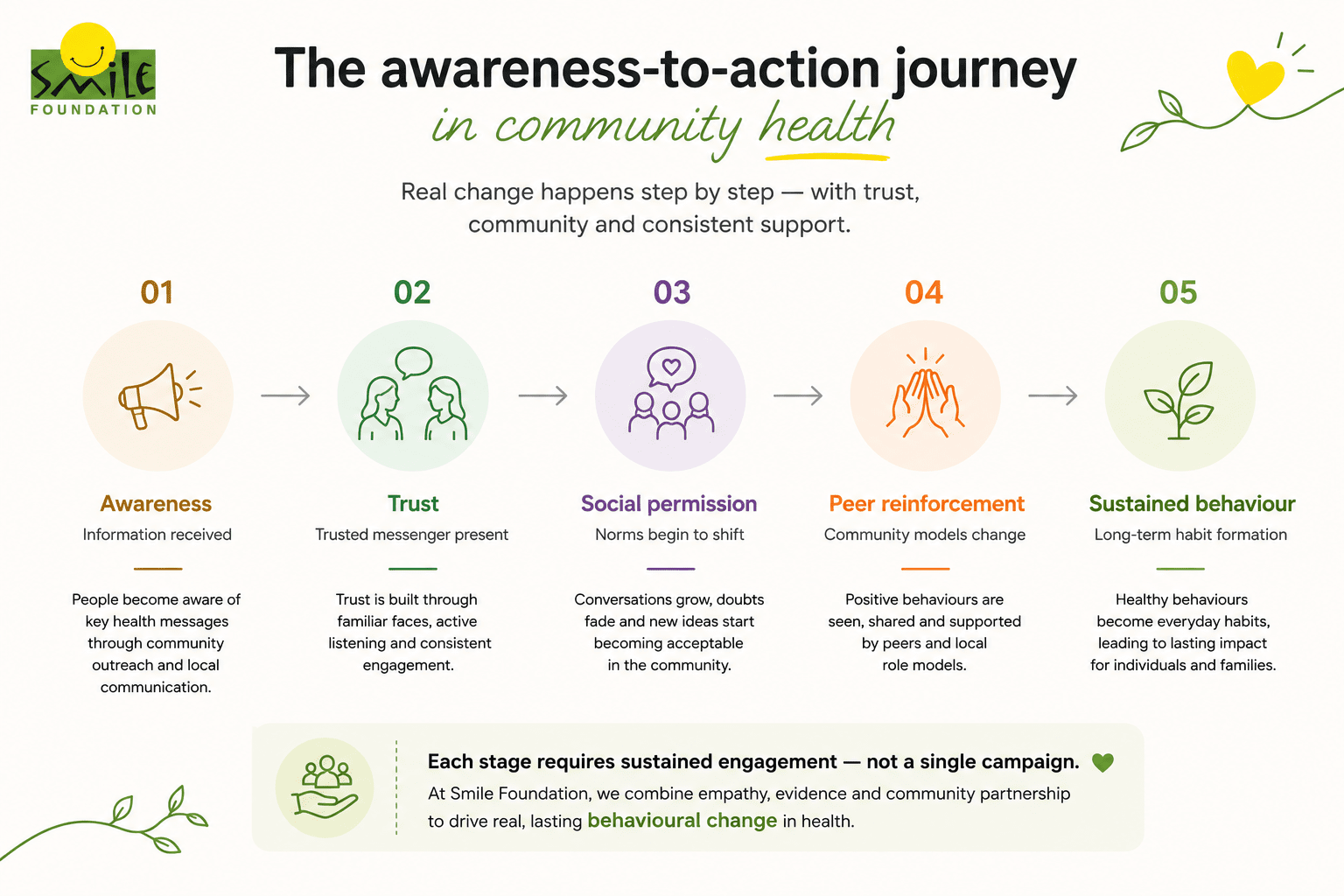
- The awareness-to-action journey in community health is non-linear and requires repeated touchpoints, social permission and the dismantling of deep-rooted stigma
Oprah Winfrey is a media mogul, philanthropist and influential figure known for her television talk show, The Oprah Winfrey Show. Throughout her career, Oprah openly discussed her personal struggles and journey towards self-improvement, demonstrating the power of behavioural change in transforming one’s life.
Oprah’s journey of behavioural change began with her upbringing. Coming from a challenging background marked by poverty, abuse and personal hardships, Oprah recognized the need for transformation and took it upon herself to overcome these obstacles.
One significant aspect of Oprah’s behavioural change was her commitment to personal growth and self-reflection. She actively engaged in self-examination, seeking therapy and participating in personal development workshops. By addressing deep-seated emotional wounds and understanding the root causes of her challenges, Oprah was able to make meaningful changes in her life.
Oprah’s story highlights the transformative power of behavioural change in overcoming personal challenges and achieving success.
Behavioural Change Powering Our Lives
In our journey through life, we constantly seek progress and growth. Whether it’s personal development, professional success or building meaningful relationships, progress is the key to a fulfilling life.
However, progress doesn’t happen in isolation; it begins with a fundamental element: behavioural change. By understanding the power of behavioural change and embracing it, we can pave the way for transformative progress in various aspects of our lives.
Recognizing the Need for Change
The first step towards progress is recognizing the need for change. It requires self-reflection and introspection to identify areas in our behaviour that may be hindering our growth. It could be negative thought patterns, self-limiting beliefs, unhealthy habits or resistance to change itself. By acknowledging these aspects, we open ourselves up to the possibility of transformation.
Embracing Growth Mindset
A growth mindset is crucial for behavioural change. It is the belief that our abilities and intelligence can be developed through dedication and hard work. By adopting a growth mindset, we embrace challenges, seek opportunities for learning and improvement, and are open to feedback. This mindset allows us to break free from fixed notions and fosters a willingness to change and grow.
Setting Clear Goals
To facilitate behavioural change, setting clear and specific goals is essential. These goals act as guiding lights, providing direction and focus. By defining what we want to achieve and breaking it down into actionable steps, we create a roadmap for progress. It is crucial to make these goals realistic, measurable and time-bound to track our progress effectively.
Cultivating Positive Habits
Habits shape our daily lives and have a significant impact on our progress. By consciously cultivating positive habits, we can create a solid foundation for behavioural change. Start small, identifying one habit at a time, and consistently work towards incorporating it into your routine. Whether it’s practicing gratitude, regular exercise or developing effective communication skills, positive habits lay the groundwork for long-term progress.
Seeking Continuous Learning
A thirst for knowledge and continuous learning is vital for progress. Embrace opportunities to expand your skills, gain new perspectives and challenge your existing beliefs. This could include attending workshops, reading books, listening to podcasts or engaging in meaningful conversations. By fostering a mindset of lifelong learning, we remain adaptable, open-minded and receptive to change.
Building a Supportive Network
Surrounding yourself with a supportive network plays a crucial role in behavioural change and progress. Connect with like-minded individuals who share similar goals and aspirations. Seek mentors, coaches or accountability partners who can guide and support you on your journey. Together, you can share experiences, provide encouragement and hold each other accountable, accelerating the pace of progress.
Embracing Resilience and Patience
Behavioural change is a process that requires resilience and patience. It’s important to understand that progress may not happen overnight. There will be setbacks, obstacles and moments of self-doubt. Embracing resilience and maintaining a positive outlook during challenging times is crucial. Remember that progress is a journey and each step forward, no matter how small, is a step closer to your goals.
Behavioural Change and Progress in Life
The behavioural change serves as the stepping stone to progress in life. By recognizing the need for change, embracing a growth mindset, setting clear goals, cultivating positive habits, seeking continuous learning, building a supportive network and embracing resilience, we can pave the way for transformative progress.
It is through these intentional changes that we unlock our true potential, achieve personal and professional growth, and ultimately lead a more fulfilling and purposeful life. Embrace the power of behavioural change and watch as progress unfolds before your eyes.
How Smile Foundation Programmes Drive Lasting Behavioural Change
All of Smile Foundation’s programmes are designed around a central insight: sustainable change in underserved communities does not begin with information. It begins with trust.
This distinction matters enormously in public health. Decades of research on behaviour change communication consistently show that knowledge alone — knowing that antenatal visits are important, that menstrual hygiene matters, that nutrition in the first 1,000 days is critical — does not reliably translate into changed behaviour. What moves people from awareness to action is a combination of social permission, peer reinforcement, repeated engagement and the presence of trusted intermediaries who reflect the community’s own experience.
All our programmes are designed in a manner that promotes and propagates the behavioral change. Be it Mission Education, Health Cannot Wait, Swabhiman and STeP, every initiative serves to bring holistic and sustainable changes into the lives of the underserved communities of India located in urban villages and rural areas of the nation.
Swabhiman: Women’s Health as a Behavioural Change System
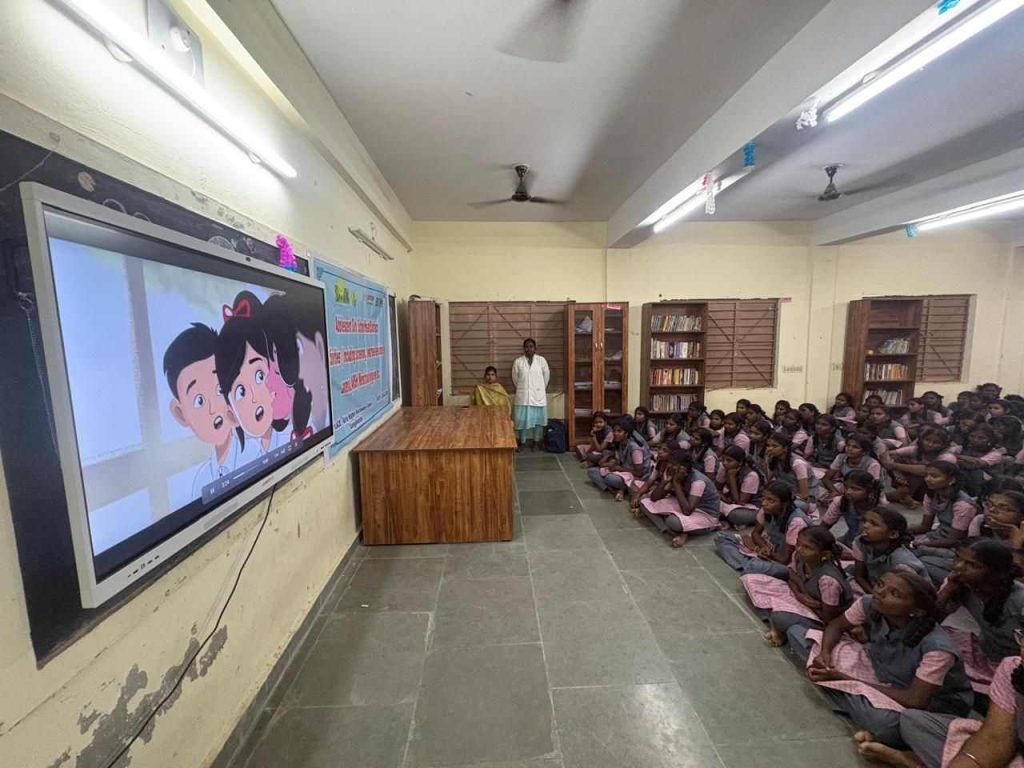
Smile Foundation’s Swabhiman programme operates in one of the most behaviourally complex domains in Indian public health: women’s reproductive health, menstrual hygiene and family planning. These are areas where stigma, cultural taboo and entrenched gender norms actively resist information-only interventions.
Swabhiman’s model is built around community mobilisation and peer-led behaviour change. Women from within the target communities are trained as change agents — not external health educators, but trusted neighbours and peers who carry credibility that no government campaign or NGO field worker can replicate. These change agents conduct door-to-door outreach, facilitate group discussions and build the kind of repeated, relationship-based engagement that gradually shifts social norms as much as individual behaviour.
The focus on menstrual hygiene awareness illustrates this approach clearly. In communities where menstruation is surrounded by restriction and silence, a single awareness session produces almost no lasting behavioural change. What Swabhiman’s model produces instead is a gradual normalisation of open conversation — first among women in group settings, then between mothers and daughters, then within households. The behaviour change is not an event. It is a process that unfolds across multiple interactions, over months and years, as social permission accumulates.
The same logic applies to maternal health. In communities where institutional delivery is avoided due to fear, previous negative experiences or the influence of traditional birth practices, behavioural change requires more than information about the benefits of hospital delivery. It requires women who have delivered in institutional settings speaking to those who have not. It requires ASHA workers and Swabhiman change agents working in coordination, addressing specific fears with specific evidence and accompanying women through the process rather than simply directing them toward it.
Research on community-based maternal health interventions consistently shows that women-centred outreach — where women are engaged as active agents rather than passive recipients of health messaging — produces significantly stronger outcomes in antenatal care utilisation, institutional delivery rates and postnatal follow-up. Swabhiman’s approach reflects this evidence base, positioning behavioural change not as a communication challenge but as a social change process that requires sustained investment in relationships and community trust.
Health Cannot Wait: Behaviour Change at the Point of Care
Smile Foundation’s Health Cannot Wait programme, delivered primarily through the Smile on Wheels mobile healthcare units, addresses a specific and consequential behavioural gap in India’s public health landscape: the gap between the availability of healthcare and its utilisation by underserved communities.
Healthcare underutilisation in rural and low-income urban communities is not primarily a function of physical distance or cost, though both matter. It is also a function of deeply ingrained health-seeking behaviours — patterns of delay, self-medication, reliance on informal providers and avoidance of formal health systems that have roots in past negative experiences, cultural norms and a fundamental lack of trust in institutions.
Health Cannot Wait addresses this not by bringing information to communities, but by bringing healthcare itself, and doing so repeatedly, consistently, and with genuine community engagement built around each visit. When a mobile health unit returns to the same community month after month, when the health worker conducting screenings is recognised and trusted and when the care provided is experienced as dignified and effective, health-seeking behaviour gradually shifts. The mobile clinic becomes a reference point rather than an anomaly, and the behavioural pattern of proactively seeking healthcare becomes, over time, a community norm rather than an exception.
This mechanism repeated positive contact with a trusted health institution is one of the most well-evidenced pathways to sustainable behavioural change in public health. It is also one of the most resource-intensive, which is precisely why it is underinvested in most public health systems and why NGO-led models like Health Cannot Wait play an essential complementary role.
The programme’s focus on maternal and child health, nutrition screening and reproductive health creates reinforcing behaviour change across multiple domains simultaneously. A woman who attends a mobile clinic for anaemia screening may leave not only with treatment, but with nutrition counselling that changes household food practices, with referral information that shifts her utilisation of antenatal services, and with the experience of dignified, respectful care that makes her more likely to return — and to encourage others to attend.
Mission Education: Behavioural Change as a Foundation for Learning
Mission Education operates in a domain where the connection to behaviour change is less immediately visible but no less significant. The barriers to consistent school attendance, learning engagement and educational continuity in underserved communities are not primarily cognitive — they are behavioural and social. They include the normalised expectation that education is less important than economic contribution, the absence of role models who demonstrate educational pathways and the daily practical barriers that erode attendance over time.
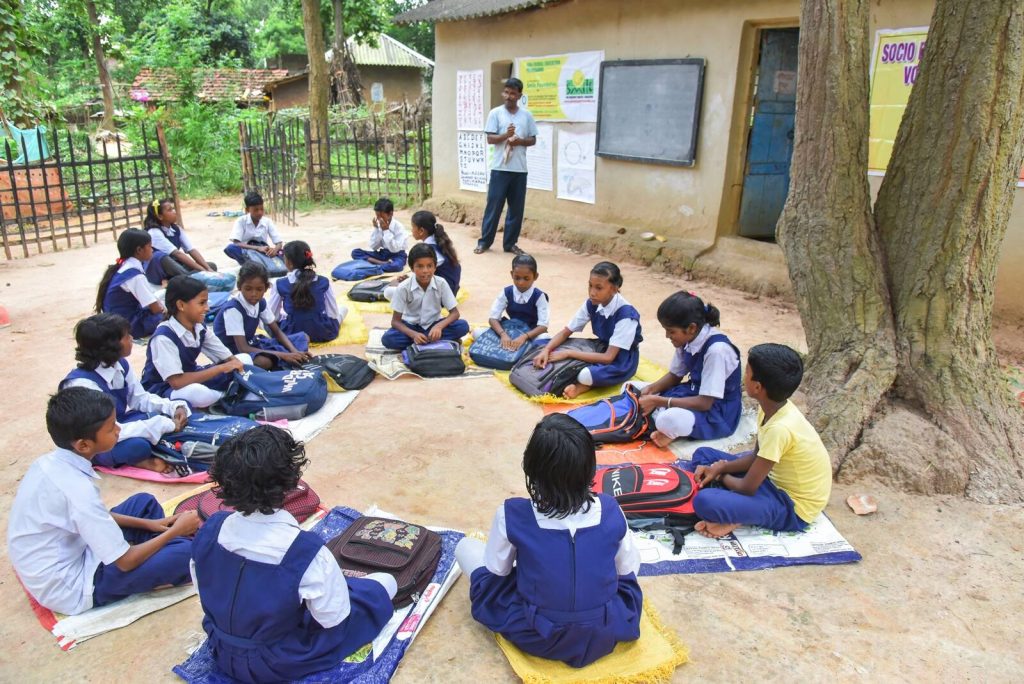
Mission Education’s learning centres address these barriers through a combination of academic support and the creation of environments where learning is consistently experienced as safe, engaging and relevant. The behavioural change goal is not the acquisition of specific academic skills — it is the formation of a durable identity as a learner and the development of the habits, expectations and aspirations that sustain educational engagement over time.
For girls in particular, Mission Education’s impact on behavioural change extends beyond the individual student to the family and community. When a girl’s consistent school attendance and academic engagement are visible in a community, they create social proof that girls’ education is both possible and valuable — a form of community behavioural change that is slower and harder to measure than individual outcomes, but ultimately more durable.
STeP: Behavioural Change and Economic Participation
Smile Foundation’s STeP livelihood programme addresses the behavioural dimensions of economic participation for youth and women from underserved communities. The barriers to formal employment and entrepreneurship in these communities are not only skill-based — they include deeply held beliefs about what kinds of work are appropriate, achievable or safe for people from particular backgrounds.
STeP’s approach to behavioural change in this domain combines skills development with deliberate exposure to role models, workplace environments and peer networks that expand the range of possibilities that participants can genuinely envision for themselves. The aspiration gap — the distance between what a person is capable of and what they believe is available to them — is one of the most significant barriers to economic participation in underserved communities, and it is one that skills training alone cannot close.
By embedding career guidance, self-efficacy building and peer support within vocational training, STeP creates the conditions for the kind of sustained behavioural change that translates into lasting economic outcomes — not just job placement at programme completion, but the development of the agency, confidence and professional identity that sustain economic participation over time.
Frequently Asked Questions (FAQs)
What is behavioural change in the context of public health?
Behavioural change in public health refers to the process through which individuals and communities shift their health-related practices, attitudes and norms in ways that improve health outcomes. This includes changes in health-seeking behaviour such as attending antenatal care, adopting safe menstrual hygiene practices or following vaccination schedules, as well as broader shifts in social norms that enable and sustain individual behaviour change.
Why is community-led behavioural change more effective than information campaigns?
Information campaigns operate on the assumption that people change their behaviour when they have the right knowledge. Research consistently shows this assumption is incomplete. Behaviour is shaped by social norms, peer influence, past experience, trust in institutions and the practical conditions of daily life — factors that information alone does not address. Community-led interventions, which engage trusted community members as change agents and create repeated, relationship-based touchpoints, are significantly more effective because they address these underlying drivers of behaviour rather than simply adding to people’s knowledge base.
How does behavioural change affect maternal health outcomes in India?
Maternal health outcomes in India are significantly influenced by health-seeking behaviour — whether women attend antenatal care, deliver in institutional settings and access postnatal care. These behaviours are shaped by social norms, family dynamics, past experiences with health systems, and trust in healthcare providers. Community-based behaviour change communication programmes that address these factors — through peer-led outreach, mobile health services and sustained community engagement — have been shown to improve antenatal care utilisation, institutional delivery rates and postnatal follow-up, particularly in rural and underserved communities.
What role does menstrual hygiene awareness play in behavioural change for women and girls?
Menstrual hygiene awareness is a critical but insufficient component of behavioural change in this domain. In communities where menstruation is surrounded by stigma and taboo, a single awareness session produces minimal lasting change. Effective menstrual hygiene behaviour change requires sustained community engagement that normalises open conversation, peer-led interventions where trusted community members model safe practices, and the integration of menstrual health education into ongoing community health relationships rather than one-off campaigns.
How do NGOs like Smile Foundation drive behavioural change in underserved communities?
Organisations like Smile Foundation drive behavioural change through sustained, community-rooted engagement that addresses the social, cultural and practical barriers to health-seeking behaviour and positive health practices. This includes training community members as change agents, deploying mobile health services that create repeated positive contact with formal healthcare, integrating peer education into programme design and working across multiple domains simultaneously — education, health, women’s empowerment and livelihoods — to address the interconnected drivers of behaviour in underserved communities.
What is behaviour change communication and how is it used in women’s health programmes?
Behaviour change communication is a systematic approach to promoting positive health behaviours through strategic communication with individuals, communities and systems. In women’s health programmes, it involves using trusted messengers, culturally relevant content and appropriate communication channels to shift attitudes and practices around maternal care, reproductive health, menstrual hygiene and nutrition.
Why does sustained community engagement matter more than one-time awareness events?
One-time awareness events produce short-term knowledge gains but rarely produce lasting behavioural change because they do not address the social, cultural and practical barriers that shape behaviour over time. Sustained community engagement through regular visits, peer networks, ongoing counselling and consistent presence in communities creates the conditions for behaviour change by building trust, normalising new practices through repeated exposure and providing the kind of social support that helps people maintain new behaviours in the face of competing social pressures.
How does women’s empowerment connect to broader public health behavioural change?
Women’s empowerment and public health behavioural change are deeply interconnected. When women have greater agency over health decisions for themselves and their families, the behavioural outcomes extend well beyond individual health. Research consistently shows that women with greater decision-making power invest more in children’s nutrition, immunisation and education; are more likely to seek antenatal and postnatal care; and serve as more effective agents of community-level behaviour change.