Indian children are already living with AI daily, in homework apps, video feeds and chatbots, mostly without anyone explaining how it works. From untrained teachers and unreliable devices to English-only tools and rules no one has set, several gaps stand between them and the understanding they need.

Summary
- AI literacy is a different skill from coding. It teaches children to understand and question what a system is doing when it answers, recommends or predicts something.
- CBSE made Computational Thinking and AI compulsory for Classes 3 to 8 in April 2026, and Punjab has made AI a core subject from Classes 1 to 12.
- What to teach changes with age, from unplugged sorting games at five to Python at fourteen.
- Rural schools face unreliable internet and electricity, untrained teachers and English-only tools, though most of the core ideas can still be taught with paper and cards.
- Only about a quarter of teachers have had any AI training, which affects what they can teach and what they can spot in homework.
- Children who learn to question AI early are better placed to use it well as it spreads further into their schooling and work.
AI literacy for children means teaching them how artificial intelligence works, so they can question its answers instead of simply trusting them. A child in your home has probably asked a chatbot something this week, and almost certainly took the answer at face value. Learning to pause, long enough to wonder how the answer was produced and whether it was fair, is the habit AI literacy builds.
What is AI literacy and why does it matter for children?
AI literacy is often confused with coding, since schools tend to introduce both together. Coding is about building software, while AI literacy is about understanding what a system is doing when it answers a question or recommends a video.
That understanding is what lets a child use these tools safely rather than blindly. A homework helper or a translation app is fine to reach for, as long as the child also knows it can be wrong, that it may carry someone’s bias, and that exam answers do not belong inside it.
That kind of judgement takes time to build, which is why the timing matters.
- Access gaps widen early, and a child in a village school should not start further back than one in a well-funded private school.
- Entry-level work already expects it, with banking, retail and manufacturing roles assuming some comfort with AI tools.
- Deepfakes are harder to spot without practice, and children who have seen these systems fail are less easily fooled.
- Privacy is not obvious to a ten-year-old. Few children know a chat with an AI tool can be stored or used to train it further.
- India needs builders as well as users, and a student who learns this early can build tools that fit an Indian classroom and language.
How are schools in India introducing AI education in 2026?
The National Education Policy of 2020 asked schools to build digital literacy and computational thinking into the middle years. What that looks like in practice varies widely by board and state.
CBSE’s AI Curriculum and beyond
CBSE has moved fastest. In April 2026, the Union Education Minister launched a Computational Thinking and AI curriculum for Classes 3 to 8, developed with IIT Madras. Classes 3 to 5 get about 50 hours a year, folded into maths through puzzles and pattern games rather than screen time, and classes 6 to 8 get 100 hours across computational thinking, AI literacy and small hands-on projects. There is no exam in it yet, and the full framework is available on CBSE’s academic site.
This builds on earlier work. CBSE has offered an AI elective for Classes 9 to 12 since 2019, and 18,839 schools already offer AI as a Class 6 skill subject. CISCE has added Robotics and Artificial Intelligence for Classes 9 to 12, with the first ICSE paper written in 2025.
States setting the pace
Punjab has gone furthest. In July 2026, it launched Sarbat.AI, making AI a core subject from Classes 1 to 12 across 25,172 schools and roughly 31.5 lakh students.
Kerala started earlier. Its Little KITEs programme has run since 2018 across more than 2,000 schools, training lakhs of children in AI, robotics and cyber safety, and a UNICEF study rates it among the strongest student-led digital learning models anywhere. In 2026 its members began teaching AI safety to nearly six lakh parents.
What to teach at each age
Most school programmes break AI teaching into four stages, shaped by what a child can handle at each age.
- Ages 5 to 7: No screens required. Sorting games with animal or shape cards teach children to notice patterns and group things by rules, which is what a model does.
- Ages 8 to 10: Block-based tools like Scratch let children build something simple, run it, and fix it when it does not work.
- Ages 11 to 13: Children start using generative tools themselves, which makes this the stage for questions about how a filter decides what looks good.
- Ages 14 and up: Coding becomes part of it, usually Python, and AI skills for students start to need a real technical foundation.
Teaching responsible and ethical use of AI
Children need the safety rules early, not at the end of the course, especially once they start typing personal details into a chat window. Four habits cover most of it.
- Know the rule on schoolwork. Using AI to check spelling is allowed in most classrooms, however, submitting its writing as your own is not.
- Check before believing. AI answers sound confident whether or not they are correct, so anything important is worth verifying against a textbook or an adult.
- Keep private things private. Addresses, phone numbers and family details should never go into a public AI tool.
- Keep your own voice. A tool can tidy up a sentence, but the thinking behind it should still belong to the child who wrote it.
Challenges in bringing AI education to rural and under-resourced schools
Those habits assume a classroom with a working device in it, which many rural schools do not have. Unreliable internet and electricity are common, teachers have rarely had any AI training, and most tools run in English rather than the language children speak at home. Devices cost more than many families can spend, and parents are often unconvinced the whole thing is useful.
AI can still be taught there. The first thing a child needs to understand is how patterns in data become an answer, and paper works fine for that. A sorting game with picture cards shows how a model groups things. Build a class lunch menu using only the front row’s answers, and children see what bias means before anyone defines it. One shared phone running something like Teachable Machine can serve a whole room.
How teachers can be equipped to teach AI concepts
All of this depends on the teacher, and most have had no preparation for it. Only about a quarter have had any AI training, and confidence is lowest on the practical questions, like how to handle work that may have been AI-assisted or what to do when a tool starts behaving oddly.
The gap shows up first in homework. Teachers who know how these systems produce an answer are much better at spotting AI use in submitted work, and simply having used a chatbot does not give them that skill. Noticing why the sentences run oddly even, or why a confident wrong fact appears where no child in that class would have written one, takes some understanding of how the tool works, and detection software is not reliable enough to settle it either way. A teacher who knows that much can also show the class how to use AI properly, fixing a weak prompt in front of everyone.
Training that works usually has a few things in common.
- Begin with the same unplugged activities the children will do, since teachers who meet AI through sorting games rather than code feel far less anxious about teaching it.
- Explain how the system arrives at an answer. Teachers trust it more when training compares the machine’s reasoning to how an expert would think.
- Show the tool failing. A trainer who types a poor prompt, gets a poor answer and fixes it teaches more than a demonstration that goes perfectly.
- Teachers should get to try AI on their own lesson plans and question papers before they try it in a live classroom.
- Schools that settle their rules early make it easier. Teachers say clear policies on what students can and cannot do with AI would help their confidence as much as more tools would.
How Smile Foundation prepares children for a technology-driven future
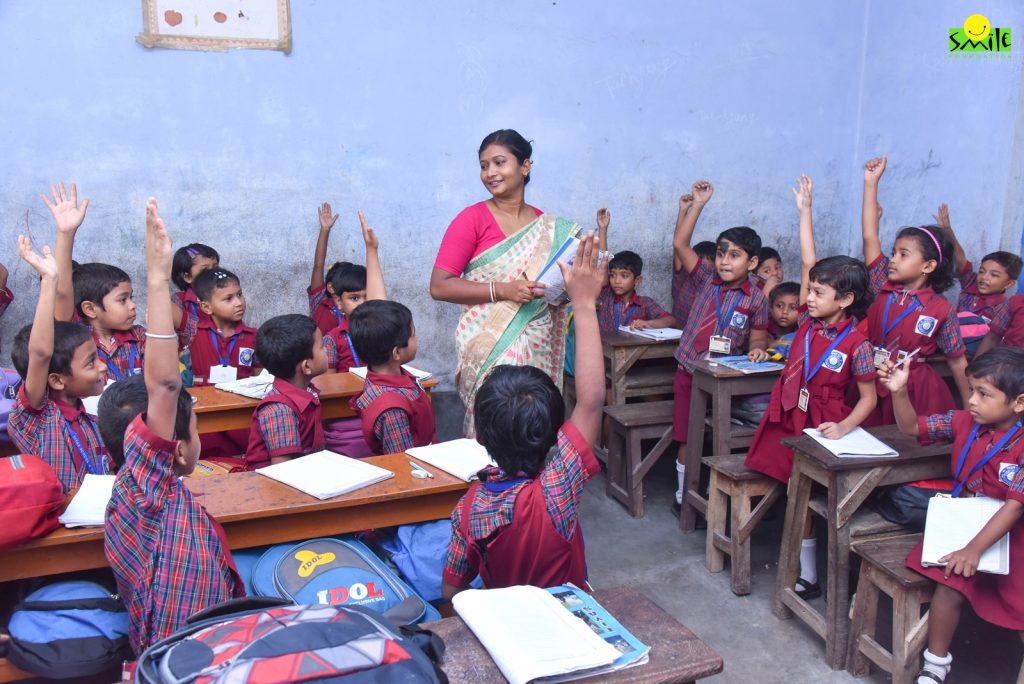
Most government schools are still waiting for trained teachers and properly stocked classrooms, which is the gap Smile Foundation has worked on since long before AI came into the picture. Its Mission Education programme now brings AI powered learning tools into schools that once had only a blackboard, where children try 3D printing and simple robotics in their own mother tongue.
Children in under-resourced schools are the ones this reaches last. Smile Foundation’s education initiatives welcome donors and volunteers, and a classroom’s first set of digital tools is a good place to start.
FAQs
- What is AI literacy and why should children learn about it early?
AI literacy for children means understanding how artificial intelligence gathers data and produces an answer and knowing when that answer is worth checking. Most Indian children already use AI daily with no adult nearby to explain it.
- Which Indian school boards have introduced AI as a subject?
CBSE made Computational Thinking and AI compulsory for Classes 3 to 8 from 2026, on top of an older elective it has run for Classes 9 to 12 since 2019. Punjab has gone furthest of any state, making AI a core subject from Class 1 through 12 under Sarbat.AI.
- At what age should children start learning about AI concepts?
Children can start as early as five to seven, through unplugged games rather than a screen. Structured AI concepts begin from Class 3 in the CBSE curriculum, with actual code arriving closer to fourteen.
- How can schools teach AI literacy without expensive technology?
Pattern, prediction and fairness can all be taught with paper and cards, which covers most of what a young child needs. One shared phone is plenty once a live AI tool needs demonstrating.
- What does responsible use of AI mean for students?
It means using AI as a thinking partner and checking its answers rather than accepting them outright. Whatever ends up on the page should still be the student’s own thought.
- What challenges do rural schools face in introducing AI education?
Electricity and internet come first, since neither can be counted on in many rural schools. Untrained teachers come next, and most AI tools still assume English, which leaves regional languages underserved.
- How can teachers be trained to teach AI concepts confidently?
Training works best when it starts with the same unplugged games their students will see, before any code. Peer coaching helps, and free resources like CIET-NCERT’s training series are already available.
- How does Smile Foundation help prepare children for future-ready careers?
Through Mission Education, which brings AI powered learning tools into schools that need them, including 3D printing and simple robotics taught in children’s own mother tongue.
Sources
- Press Information Bureau, Government of India. Union Minister launches CBSE Curriculum on Computational Thinking and AI for Classes III to VIII, April 1, 2026.
- Ministry of Education, Government of India. National Education Policy 2020.
- CBSE. Computational Thinking and AI Curriculum, Classes 3 to 5.
- UNESCO New Delhi. State of the Education Report for India 2022: Artificial Intelligence in Education.
- UNICEF India. Empowering Adolescents with Future-Ready Skills: A Study of the Little KITEs Programme.
- Punjab School Education Board and Punjab Department of School Education, via official statements from Minister Harjot Singh Bains at the Sarbat.AI launch, July 2026.
- Lok Sabha, unstarred question reply on AI in school education, 2025.
- Traga Philippakos and Rocconi, AI Literacy: Elementary and Secondary Teachers’ Use of AI-Tools, Reported Confidence, and Professional Development Needs, Education Sciences, 2025.
- Tan, Cheng and Ling, Artificial intelligence in teaching and teacher professional development: a systematic review, Computers and Education: Artificial Intelligence, 2025.
- Goyal et al., Thematic insights into the impact of large language models on K-12 education in rural India, Scientific Reports, 2025.