

A newborn in Pune weighs, on average, about 2.7 kg. A newborn in Southampton weighs about 3.5 kg. That 800-gram gap is not a rounding error. It is the single most studied fact about Indian babies, and the explanation behind it has quietly rewritten how doctors think about diabetes, heart disease and school performance in India.
This piece walks through what the numbers say, why food alone does not explain them, what a small start costs a child over a lifetime, and what actually moves the figure.
How many Indian babies are born small?
About 27% of babies born in India in 2020 weighed under 2.5 kg, according to the joint UNICEF-WHO estimates. That is the highest national rate in the world; Bangladesh, the next highest, was at 23%, and the global average was 14.7%.
Low birth weight is defined by WHO as a weight of less than 2,500 grams, measured within the first hour of life. The world had about 19.8 million such babies in 2020. South Asia alone accounted for 8.7 million of them, nearly 44%, at a regional prevalence of 24.9%. India, with the region’s biggest birth cohort and its highest rate, is the largest single contributor on earth.
| Measure | Figure | Source |
|---|---|---|
| India, share of newborns under 2.5 kg (2020, modelled) | 27.4% | UNICEF-WHO joint estimates, via World Population Review |
| Bangladesh, the next highest | 23% | same |
| Global average (2020) | 14.7%, 19.8 million babies | UNICEF |
| South Asia (2020) | 24.9%, 8.7 million babies | UNICEF |
| India, share among babies actually weighed (NFHS-5, 2019-21) | 18%, about 4.2 million a year | Karlsson et al., BMJ Global Health 2025 |
| Fall in that NFHS measure since 1993 | 26% to 18% | same |
| Four states’ share of India’s low-birth-weight babies | 47% (UP 858,000; Bihar 430,000; Maharashtra 399,000; West Bengal 318,000) | same |
Why do two Indian numbers exist, 27% and 18%?

The 18% comes from India’s own household survey and counts only babies who were weighed at birth. In NFHS-5, about 26.5% of births were never weighed, and the unweighed babies are disproportionately born at home, to poorer mothers, in exactly the places where small babies are most common. The UNICEF-WHO model adjusts for that gap and lands near 27%. The honest reading is that the true figure sits between the two, and is almost certainly above 20%.
The trend, though, is real and in the right direction. Among weighed babies, prevalence fell from 26% in 1993 to 18% in 2021. South Asia is the only region in the world that cut its absolute number of low-birth-weight babies over those two decades, by 3.1 million. It is still nowhere near the pace needed for the World Health Assembly’s target of a 30% cut between 2012 and 2030.
Why is it not just about food?
Because the size of a baby is set less by what the mother eats in nine months than by the body she brings to the pregnancy, and that body was built in her own childhood.
In the early 1990s a diabetes doctor in Pune, Chittaranjan Yajnik, and the British epidemiologist David Barker began following pregnant women in six villages near the city. The project became the Pune Maternal Nutrition Study, one of the longest-running birth cohorts in the developing world. Its findings explain most of what you need to know.
The mothers were small before they were pregnant
The average mother in the Pune study was 152 cm tall with a BMI of 18.1, which is underweight by any definition. She gave birth to a baby weighing about 2.7 kg. A short, thin woman has a smaller pelvis, a smaller uterus and a smaller placenta, and her body limits how much it will invest in a foetus. That is not a failure of will or diet. It is biology protecting the mother.
The mother’s own height is one of the strongest predictors of her baby’s weight, and her height was fixed by the time she was about two years old. So the birth weight of a baby born in 2026 was partly decided by how its grandmother fed its mother in the late 1990s and early 2000s.
The “thin-fat” Indian baby
The Pune team’s most surprising finding came when they measured babies, not just weighed them. Compared with babies born in Southampton, UK, Indian newborns were lighter and shorter with far less muscle and smaller abdominal organs. But their skinfolds, the fat under the skin, were nearly the same. The babies were thin and fat at the same time. Yajnik called it the “thin-fat Indian baby”.
The body appears to be making a trade. With limited supply from the mother, the foetus protects the brain and fat stores and sacrifices muscle and organ growth. That makes sense in a world of scarcity. It becomes a liability when the child grows up in a world of rice, sugar and sitting down. Lower-birth-weight children in Pune had higher glucose and insulin levels by age four, and the pattern tracked into adulthood. India is the world capital of low birth weight and a world capital of diabetes, and the Pune work says those are not two facts but one.
It was the micronutrients, not the calories
The mothers’ total calorie and protein intake barely predicted the baby’s size. What did predict it was how often she ate green leafy vegetables, fruit and milk. About 70% of the Pune mothers were low in vitamin B12, a nutrient that comes almost only from animal foods and that a largely vegetarian diet struggles to supply. A later Pune trial, PRIYA, has been testing whether giving B12 to adolescents, years before pregnancy, changes the next generation. The idea that you fix a baby’s weight by feeding the teenager is now mainstream.
The cycle, in one line
A small girl becomes a small, anaemic mother, who has a small baby, who grows into a small girl. Each link is modest. Together they explain why a country can grow richer for thirty years and still have the smallest newborns on earth.
What else makes Indian babies small?
Five things stack on top of the mother’s own size: she is often anaemic, often very young, often pregnant again too soon, often breathing smoke, and often seen late or never by a health worker.
An ICMR analysis of NFHS-5 found that low birth weight in India was most strongly linked to the mother’s age, a birth interval under 24 months, low education, poverty, rural residence, low BMI, anaemia and having no antenatal visits. Each is worth a sentence.
- Anaemia. About 57% of Indian women of reproductive age are anaemic (NFHS-5). Anaemia starves the placenta of oxygen and is tied to both preterm birth and slow foetal growth. It is the most common and most fixable cause on this list.
- Early marriage and early pregnancy. A girl who conceives at 17 is still growing herself. Her body and the foetus compete for the same nutrients, and the foetus usually loses. One in five Indian women aged 20 to 24 was married before 18 (NFHS-6), which keeps this pathway open.
- Short birth spacing. A mother who has not recovered her iron and weight from one pregnancy starts the next from a deficit. Intervals under two years raise the risk sharply.
- Infections and smoke. Malaria, urinary infections and reproductive-tract infections in pregnancy restrict growth. So does cooking over biomass; the smoke does to a foetus roughly what maternal smoking does.
- Late or no antenatal care. Only about 58% of Indian women had four or more antenatal visits in NFHS-5. Antenatal care does not make a baby heavier by itself, but it is where anaemia is caught, blood pressure is checked, infections are treated and the mother is told to rest and eat.
Preterm or just small?

Low birth weight has two causes that look alike on a scale: a baby born too early, and a baby born on time but too small for its age. In high-income countries most low-birth-weight babies are preterm. In India most are born at term but growth-restricted, which is why the story here is about the mother’s body and nutrition rather than about neonatal intensive care. India also has the world’s largest number of preterm births, over 3 million a year, so both pathways matter.
What does a small start cost a child?
A baby born under 2.5 kg is about 20 times more likely to die in its first month than a heavier baby, and the survivors carry the weight into school, work and middle age.
The first cost is survival. Roughly 80% of the newborns who die each year worldwide were low birth weight, whether preterm or growth-restricted. In India, where neonatal deaths still make up the bulk of under-five deaths, this is the single largest lever on child mortality.
The second cost is growth. A small baby is far more likely to become a stunted two-year-old, and stunting at two is one of the best predictors of how far a child will get in school. Low birth weight is tied to lower IQ, poorer attention and later school entry. Economists who studied the babies born in India during the COVID-19 lockdown, when low birth weight rose by about three percentage points, warned that those children “often go on to struggle with school,” with a measurable loss in lifetime earnings.
The third cost arrives at forty. This is the Pune finding again: the thin-fat baby who grows up in a city becomes the adult with central obesity, insulin resistance, type 2 diabetes and heart disease, often at a normal body weight. India’s diabetes epidemic is, in part, a low-birth-weight epidemic that has grown up.
For a company deciding where a health budget goes, this is the arithmetic that matters. Low birth weight is cheap to prevent and ruinously expensive to live with, and the bill comes due over sixty years.
What actually works to fight the peril of lowest birth weight of babies?
The interventions that move birth weight are unglamorous: iron and folic acid for every pregnant woman, treating anaemia before pregnancy, delaying the first birth past 20, spacing births two years apart, and getting women to four antenatal visits. Done together they can lift a population’s average birth weight by 100 to 200 grams, enough to pull millions of babies over the 2.5 kg line.
- Treat the girl, not just the mother. Weekly iron-folic acid for adolescent girls, deworming, and a diet with green leafy vegetables, milk and, where acceptable, eggs. The Pune team’s B12 trial in adolescents is testing exactly this.
- Delay the first pregnancy. Every year a first birth is delayed between 15 and 20 improves the baby’s weight. Keeping girls in school is a birth-weight intervention.
- Antenatal care that finds anaemia and treats it. Four or more visits, haemoglobin tested, iron given and actually taken. Adherence is the weak link, which is why counselling and follow-up matter more than the tablets.
- Space births. Two years between pregnancies lets the mother recover iron and weight.
- Clean cooking and infection control. LPG uptake, malaria prevention in endemic districts, treating urinary and reproductive-tract infections.
- Weigh every baby. A quarter of Indian newborns are never weighed. A baby that is not weighed cannot be flagged for kangaroo care, extra feeding or follow-up, and a district that does not weigh cannot see its own problem.
None of these need new science. They need a woman to be reached early, repeatedly and close to home, which in rural India is the hard part.
Where Smile Foundation comes in to deal with lowest birth weight of babies in the world
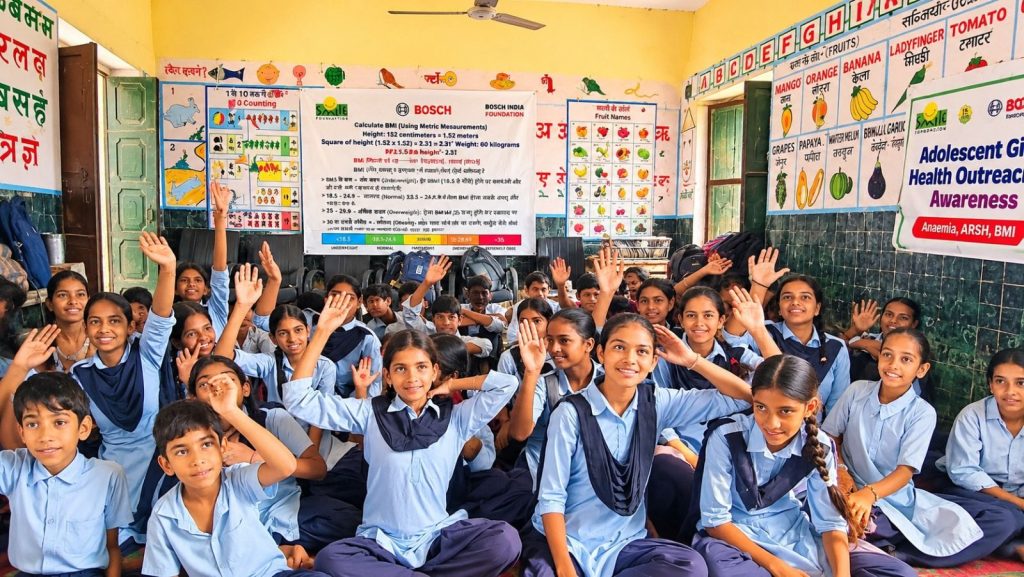
Smile on Wheels, Smile Foundation’s mobile medical unit programme, takes antenatal care, anaemia screening, counselling and follow-up to villages and urban settlements where the nearest clinic is a day’s wages away.
The reason low birth weight persists is distance, not ignorance. A pregnant woman in a village in Sonbhadra or Bahraich knows she should see a doctor. She also knows it costs a day’s income, a bus fare and someone to mind the children. Smile on Wheels removes the trip. The unit comes to her, every week, with a doctor, a nurse, a pharmacist and a haemoglobin test.
In 2025, MSD Pharmaceuticals and Smile Foundation launched four new Smile on Wheels units in Lucknow, Sonbhadra, Prayagraj and Varanasi, serving over 200,000 people across more than 40 villages, with maternal health, antenatal and postnatal care written into the brief. Uttar Pradesh is the state with the largest number of low-birth-weight babies in India, about 858,000 a year, so the geography is not accidental. The Avantor Foundation unit reached about 15,000 people in its first year with pregnant and lactating mothers as a priority group, and KONE’s Delhi unit covers 14 urban colonies with maternal-health awareness built in.
What a mobile unit can do that a poster cannot: find the anaemic 19-year-old in her second trimester, give her iron, come back in two weeks to check she took it, and refer her early when her blood pressure climbs. That is how birth weight moves.
Partner with Smile Foundation
If your company is deciding where its health CSR goes, a mobile medical unit in a high-burden district is one of the few interventions that touches the cause of low birth weight rather than its consequences. Write to our corporate partnerships team at cp@smilefoundationindia.org or visit smilefoundationindia.org.
Frequently asked questions (FAQs): Lowest birth weight of babies in the world
What counts as low birth weight? Any baby weighing less than 2,500 grams (2.5 kg) at birth, measured within the first hour of life, by WHO’s definition. Below 1,500 g is “very low” and below 1,000 g is “extremely low” birth weight.
Does India really have the lowest birth weight of babies in the world? India has the highest share of low-birth-weight babies of any country, about 27% in the 2020 UNICEF-WHO estimates, ahead of Bangladesh at 23%. The global average is 14.7%. India’s own survey of weighed babies gives a lower figure, 18%, because a quarter of births are never weighed.
Why are Indian babies smaller than European babies? Mainly because Indian mothers are shorter, thinner and more often anaemic, which limits how much the body invests in a pregnancy. Indian babies also have a distinctive “thin-fat” body composition, with low muscle but preserved fat, first described in the Pune Maternal Nutrition Study. Diet quality, especially vitamin B12 and iron, matters more than total calories.
Is low birth weight genetic? Largely no. Children of Indian migrants born in well-nourished settings are heavier within a generation or two, and birth weight in India has risen as women’s height and nutrition improved. The pattern is inherited through the mother’s body and environment, not through genes alone.
What is the “thin-fat Indian baby”? A newborn who is light and short with little muscle and small abdominal organs, but with skinfold fat close to that of a European baby. The body protects the brain and fat stores at the cost of muscle. It helps survival in scarcity but raises the risk of diabetes and heart disease later.
Can a low-birth-weight baby catch up? Yes, with early and exclusive breastfeeding, kangaroo mother care, close growth monitoring and timely treatment of infections. Most catch-up growth happens in the first two years, which is why that window is critical.
What can CSR funding do about low birth weight? The highest-return investments are adolescent-girl nutrition (iron, folic acid, deworming), antenatal care that reaches women early and repeatedly, and keeping girls in school to delay first births. Mobile medical units in high-burden districts deliver the first two directly.
Read next: What maternal and child health really looks like in India
Sources
- UNICEF, Low birthweight: global and South Asia estimates, 2000-2020; WHA target; share of newborns not weighed
- UNICEF-WHO joint low birthweight estimates, 2020 country values, via World Population Review
- Karlsson O, Kumar A, Kim R, Subramanian SV. Trends in low birth weight across 36 states and union territories in India, 1993-2021. BMJ Global Health 2025; BMJ Group summary
- Singh D et al. Prevalence and correlates of low birth weight in India: findings from NFHS-5. BMC Pregnancy and Childbirth 2023
- Yajnik CS et al. Neonatal anthropometry: the thin-fat Indian baby. Int J Obesity 2003
- MRC Lifecourse Epidemiology Centre, The Pune Maternal Nutrition Study
- Rao S et al. Intake of micronutrient-rich foods in rural Indian mothers is associated with the size of their babies at birth. J Nutr 2001
- Kumar S et al., COVID-19 and low birth weight in India, Communications Medicine 2024; PTI report
- Smile Foundation press releases: MSD Smile on Wheels, UP, June 2025; Avantor Foundation partnership