
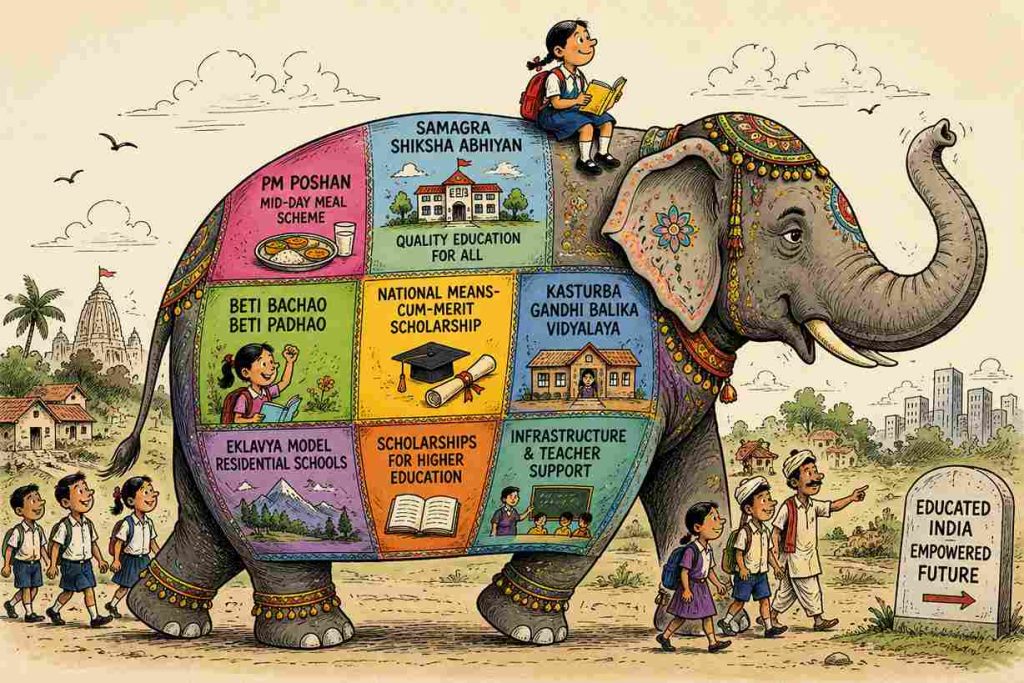
A complete list of government schemes for education in India spans nutrition, scholarships, infrastructure and gender-focused support, each designed to remove a specific barrier standing between a child and a completed education. Together, these schemes form the backbone of India’s effort to make quality education genuinely accessible, not just legally guaranteed.
For 2026-27, the central government has allocated 83,562 crore rupees to school education alone, the highest allocation to date. This guide walks through the major central schemes currently in place, what each one offers, who qualifies, and how to apply.

Why Government Schemes for Education Matter in India
India’s Right to Education Act guarantees free and compulsory schooling for children aged 6 to 14. But legal entitlement and actual access are not the same thing. Many families still face real barriers, school fees beyond tuition, transport costs, malnutrition, gender-based dropout risk, that prevent children from attending or completing school.
Government schemes for education exist specifically to close these gaps. Each targets a different barrier, financial hardship through scholarships, hunger through meal programmes, gender inequity through girl-focused initiatives, and geographic isolation through residential schools for remote and tribal communities.
Understanding this full list of government schemes for education in India matters for parents seeking support, for students applying directly, and for organisations working alongside government efforts to strengthen outcomes on the ground.
List of Central Government Schemes for Education
India’s school education schemes operate under the Department of School Education and Literacy, Ministry of Education, often as Centrally Sponsored Schemes implemented jointly with state governments.
Samagra Shiksha Abhiyan — Objectives and Benefits
Samagra Shiksha is India’s flagship, integrated school education scheme, combining what were previously three separate programmes: Sarva Shiksha Abhiyan, Rashtriya Madhyamik Shiksha Abhiyan and Teacher Education. It covers schooling from the pre-school stage through to senior secondary level under a single, unified framework.
The scheme receives the largest share of any school education programme in India’s budget, with an allocation of 42,100 crore rupees for 2026-27, accounting for roughly half of the entire Department of School Education and Literacy budget.
Its objectives include improving school infrastructure, providing free textbooks and uniforms, supporting children with disabilities through stipends and accessible facilities, strengthening teacher training, and funding residential schools like Kasturba Gandhi Balika Vidyalayas for out-of-school girls. There is no separate individual application for Samagra Shiksha. It functions as an institutional scheme, with benefits delivered through government and government-aided schools directly.
PM POSHAN (Mid-Day Meal) Scheme
PM POSHAN, formerly known as the Mid-Day Meal Scheme, provides one hot cooked meal every school day to children studying in Classes I to VIII in government and government-aided schools, along with pre-school children in Bal Vatika sections. The scheme currently reaches close to 11.8 crore children across 11.2 lakh schools nationwide.
Its dual objective is straightforward but powerful: address hunger and improve school attendance simultaneously. For many children from low-income families, the daily meal is itself a significant incentive to attend school regularly, while also improving nutritional outcomes during critical growth years.
For 2026-27, PM POSHAN has been allocated 12,750 crore rupees. Eligibility is automatic for all children enrolled in Classes I to VIII at participating government and government-aided schools, with no separate application required.
Beti Bachao Beti Padhao — Education Component
Launched in 2015, Beti Bachao Beti Padhao addresses both gender discrimination and girls’ education through a combination of awareness campaigns, community engagement and policy support. While its scope extends beyond education alone, addressing skewed sex ratios and child protection as well, education remains a central pillar.
The scheme works to create conditions that support girls staying in school, partly through community-level advocacy and partly by linking with other education schemes, like Kasturba Gandhi Balika Vidyalaya and the National Scheme of Incentive to Girls for Secondary Education, to reduce dropout among adolescent girls specifically.
There is no individual scholarship payment under Beti Bachao Beti Padhao itself. Its impact works indirectly, through district-level programming, school infrastructure improvements for girls, and sustained public awareness efforts.
National Means-Cum-Merit Scholarship (NMMS)
The NMMS scheme supports meritorious students from economically weaker families to continue their education from Class 9 through Class 12, specifically targeting the dropout risk that often appears right after Class 8.
Selected students receive 12,000 rupees annually, paid as 1,000 rupees per month, directly to their bank accounts. Eligibility requires the student be promoted from Class 8 to Class 9 in a government, government-aided or local body school, with annual family income not exceeding 3,50,000 rupees from all sources. Students typically need a minimum of 55 to 60 percent marks in their Class 8 examination, with a relaxation for SC and ST candidates.
Selection happens through a state-conducted exam consisting of a Mental Ability Test and a Scholastic Aptitude Test, both administered by the respective State Council of Educational Research and Training. Around 1,00,000 scholarships are awarded nationally each year, applied for through the National Scholarship Portal.
Kasturba Gandhi Balika Vidyalaya Scheme
Kasturba Gandhi Balika Vidyalayas, or KGBVs, are residential upper primary and secondary schools specifically for girls from disadvantaged backgrounds in educationally backward blocks. They primarily serve girls belonging to Scheduled Castes, Scheduled Tribes, Other Backward Classes, minority communities and families below the poverty line.
These schools function as a safe, structured alternative for girls who would otherwise struggle to access secondary education due to distance from school, safety concerns or household responsibilities. Operating under Samagra Shiksha, KGBVs provide boarding, meals, and education together, removing several barriers to girls’ education at once.
Admission is managed at the state and district level, generally prioritising girls from the most educationally disadvantaged communities within each block.
Eklavya Model Residential Schools
Eklavya Model Residential Schools, or EMRS, provide quality residential education specifically for Scheduled Tribe students in remote and tribal-dominated areas, modelled on the standards of Jawahar Navodaya Vidyalayas.
The scheme aims to ensure that tribal students, who often face the greatest geographic isolation from quality schooling, have access to a full residential education from upper primary through senior secondary level, without needing to leave their communities for distant, unfamiliar settings.
EMRS has faced real implementation challenges in recent years, including teacher vacancies and delays in opening sanctioned schools, issues that parliamentary review committees have flagged directly. Even so, the scheme remains a significant structural commitment to tribal education access, with admission managed through state tribal welfare departments and individual EMRS institutions.
State Government Schemes for Education — Overview
Beyond central schemes, individual state governments run their own education initiatives, often layered on top of central programmes to address local needs more specifically.
- Free bicycle and uniform schemes, common in states like Bihar and Tamil Nadu, aimed at reducing the distance barrier to school attendance, particularly for girls.
- State-specific scholarship programmes, often targeting Scheduled Caste, Scheduled Tribe or minority students with additional financial support beyond central schemes.
- Laptop and digital device schemes, run by states like Tamil Nadu and Uttar Pradesh, to support digital learning access for secondary and higher secondary students.
- State-level girls’ hostel schemes, complementing KGBVs with additional residential capacity at the district level.
- Mid-day meal supplements, where some states add eggs, milk or additional nutrition beyond the central PM POSHAN framework.
State government schemes for education vary considerably in scope and funding, so checking your specific state education department’s portal is essential to understand what additional support may be available locally.
It is worth noting that state schemes often fill very specific local gaps that central programmes are not designed to address. A state with high rates of seasonal migration, for instance, might run portable scholarship or hostel schemes for migrant workers’ children, while a state with significant tribal populations might supplement EMRS with additional district-level residential capacity. This layered structure, central schemes providing the broad framework and state schemes adding targeted, local depth, is intentional, and understanding both levels gives families the fullest possible picture of what support is actually available to them.
How to Check Eligibility and Apply for Government Schemes for Education
Most central scholarship and benefit schemes in India are now centralised through a single digital platform, which significantly simplifies the application process.
- Visit the National Scholarship Portal at scholarships.gov.in, the primary gateway for most central scholarship schemes, including NMMS.
- Check scheme-specific eligibility criteria, which typically include income ceilings, academic performance thresholds, and school type requirements.
- Gather required documents in advance, including income certificates, caste certificates where applicable, previous mark sheets, and bank account details for direct benefit transfer.
- Apply within the specified window, as most scholarship schemes have fixed annual application periods, often between June and October.
- Track application status directly through the portal, which also handles disbursement via Direct Benefit Transfer to avoid delays or leakage.
For institutional schemes like Samagra Shiksha, PM POSHAN or KGBV, there is typically no individual application. Eligibility is automatic based on school enrolment, and benefits are delivered directly through the institution.
A soft but important note here: many eligible families are simply unaware these schemes exist, or find the application process daunting without support. This is exactly where community-level organisations can play a meaningful role, helping families navigate eligibility and paperwork that might otherwise go unclaimed.
Bringing the Picture Together

India’s list of government schemes for education spans nutrition, scholarships, infrastructure and gender-focused interventions, each addressing a distinct barrier between enrolment and genuine educational achievement. Samagra Shiksha and PM POSHAN form the structural backbone, while targeted schemes like NMMS, KGBV and EMRS reach specific vulnerable groups that broader programmes might otherwise miss.
These schemes represent significant and growing public investment, but their impact ultimately depends on awareness, accessibility and consistent implementation at the ground level. Budget allocations alone do not guarantee outcomes. Parliamentary reviews of schemes like EMRS have repeatedly highlighted gaps between sanctioned infrastructure and what is actually operational, along with persistent teacher vacancies that affect the quality of education students receive even where schools do exist. Closing this gap between funding and delivery is, in many ways, as important as the funding itself.
For families navigating these systems, and for organisations supporting them, understanding exactly what is available, and how to access it, remains the first and most important step. Civil society organisations working directly in underserved communities often play a quiet but essential role here, helping eligible families identify the right schemes, complete documentation correctly, and follow through on applications that might otherwise be abandoned midway due to confusion or lack of guidance.
FAQs — Government Schemes for Education in India
What are the main government schemes for education in India?
Key schemes include Samagra Shiksha Abhiyan, PM POSHAN, the National Means-Cum-Merit Scholarship, Kasturba Gandhi Balika Vidyalaya, Eklavya Model Residential Schools, and Beti Bachao Beti Padhao, each addressing different barriers to school access and retention.
Who is eligible for education schemes by the central government?
Eligibility varies by scheme. Most target specific groups, economically weaker families, girls from disadvantaged communities, Scheduled Tribe students, or all children enrolled in government schools, depending on the scheme’s specific objective.
What is the Samagra Shiksha Abhiyan and its objectives?
Samagra Shiksha is India’s integrated school education scheme, covering pre-school through senior secondary level. It funds infrastructure, free textbooks and uniforms, teacher training and support for children with disabilities, and receives the largest allocation among school education schemes.
What is the NMMS scholarship and how to apply?
NMMS provides 12,000 rupees annually to meritorious students from Class 9 to 12 whose family income does not exceed 3,50,000 rupees. Students apply through a state-conducted exam after Class 8, with applications submitted via the National Scholarship Portal.
How does the Mid-Day Meal Scheme support education?
PM POSHAN provides a free hot cooked meal to children in Classes I to VIII in government and government-aided schools, improving both nutrition and school attendance for nearly 11.8 crore children nationwide.
What government schemes exist specifically for girl child education?
Kasturba Gandhi Balika Vidyalaya offers residential schooling for disadvantaged girls, while Beti Bachao Beti Padhao addresses broader gender equity and dropout prevention through community awareness and linked education support.
How does Beti Bachao Beti Padhao support girls’ education?
The scheme works primarily through awareness campaigns and community engagement, while linking with infrastructure schemes like KGBV to support girls’ continued enrolment, particularly in educationally backward districts.
What are the Eklavya Model Residential Schools?
EMRS are residential schools specifically for Scheduled Tribe students in remote and tribal-dominated areas, providing quality education from upper primary through senior secondary level without requiring students to leave their communities for distant schools.
How do I apply for central government education schemes?
Most scholarship schemes are applied for through the National Scholarship Portal at scholarships.gov.in, where you can check eligibility, submit documents and track application status. Institutional schemes like Samagra Shiksha require no individual application.
What is the education budget allocation in India for 2026?
The Department of School Education and Literacy received 83,562 crore rupees for 2026-27, with Samagra Shiksha allocated 42,100 crore rupees and PM POSHAN allocated 12,750 crore rupees, marking the highest-ever allocation for school education to date.