In India’s development story, adolescents often occupy an uncomfortable middle ground. Too old to be considered children and too young to be treated as adults, their needs frequently remain overlooked in policy implementation and community-level interventions.
For adolescent girls, this gap is even more pronounced.
India is home to nearly 253 million adolescents, accounting for approximately 20% of the world’s adolescent population. Yet, anaemia, malnutrition, school dropout, early marriage, poor menstrual hygiene and limited livelihood opportunities continue to shape the lives of millions of girls.
In Gujarat’s Banaskantha district, these challenges were particularly visible.
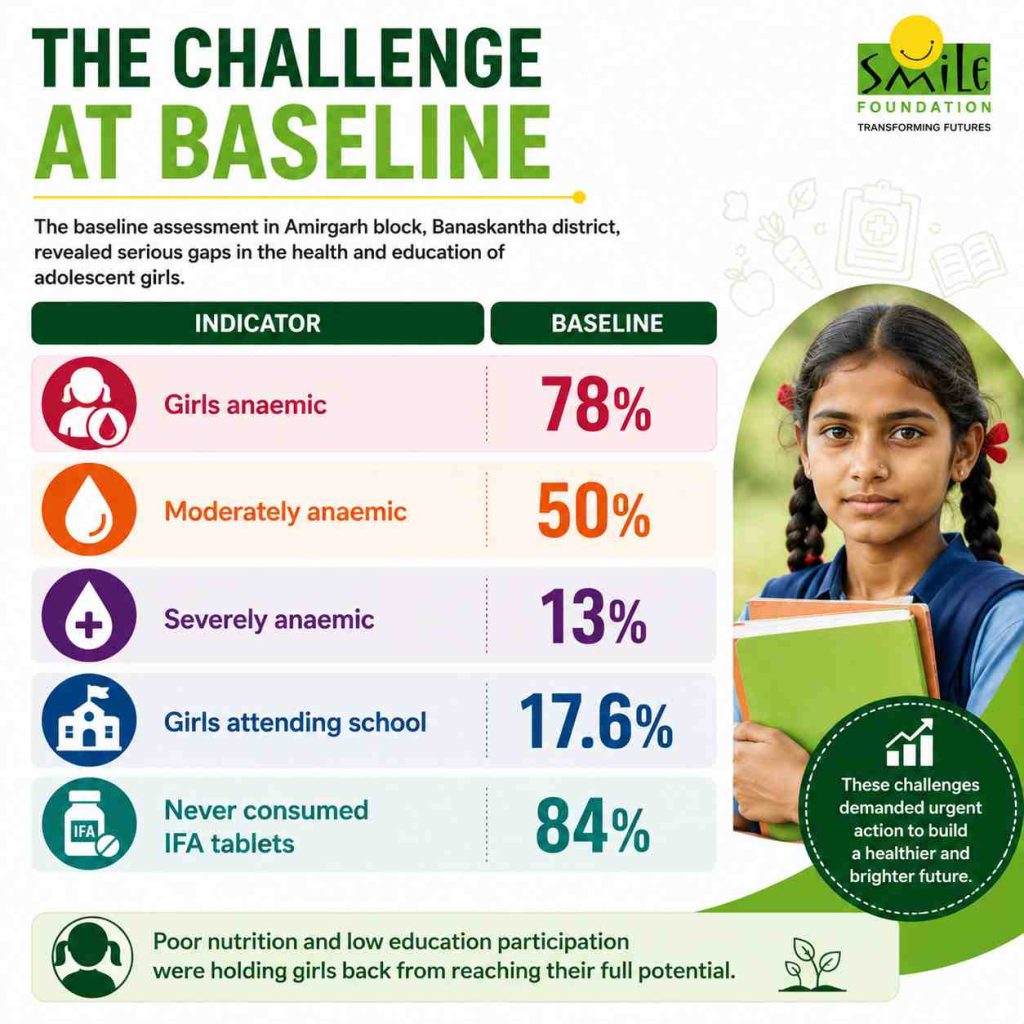
A baseline assessment conducted by Smile Foundation found that:
- 78% of adolescent girls were anaemic
- 50% were moderately anaemic
- 13% were severely anaemic
- Only 17.6% were attending school
- 84% had never consumed Iron Folic Acid (IFA) supplements
- Most girls had little awareness of anaemia or their own health status
These numbers reflected more than a health crisis. They pointed towards a cycle where poor nutrition limited educational participation, reduced opportunities and ultimately affected the wellbeing of future generations.
To address this challenge, Smile Foundation implemented a comprehensive Nutrition Enhancement Programme in Amirgarh block of Banaskantha district, supported by PepsiCo.
The recently completed endline assessment offers important lessons on what it takes to improve adolescent health in rural India.
Why Banaskantha Needed Urgent Action
Banaskantha is Gujarat’s second-largest district with a population exceeding 3.1 million.
The Amirgarh block, where the programme was implemented, presents a particularly challenging development context:
- Female literacy rate: 38.2%
- Nearly 40% of Anganwadi-going children are malnourished
- Girls’ school enrolment remains lower than boys’
- Approximately half of all families fall within economically vulnerable categories
The barriers faced by girls extended beyond food insecurity.
Interviews conducted during the endline assessment identified recurring challenges:
- Early marriage
- Limited access to higher education
- Distance to schools
- Safety concerns
- Poverty
- Restricted livelihood opportunities
- Deep-rooted social norms surrounding girls’ mobility and aspirations
Addressing anaemia alone would not be enough.
A broader approach was required.
A Programme Designed Around the Whole Girl
Rather than focusing exclusively on nutritional supplementation, the programme combined health interventions with behaviour change, community mobilisation and livelihood development.
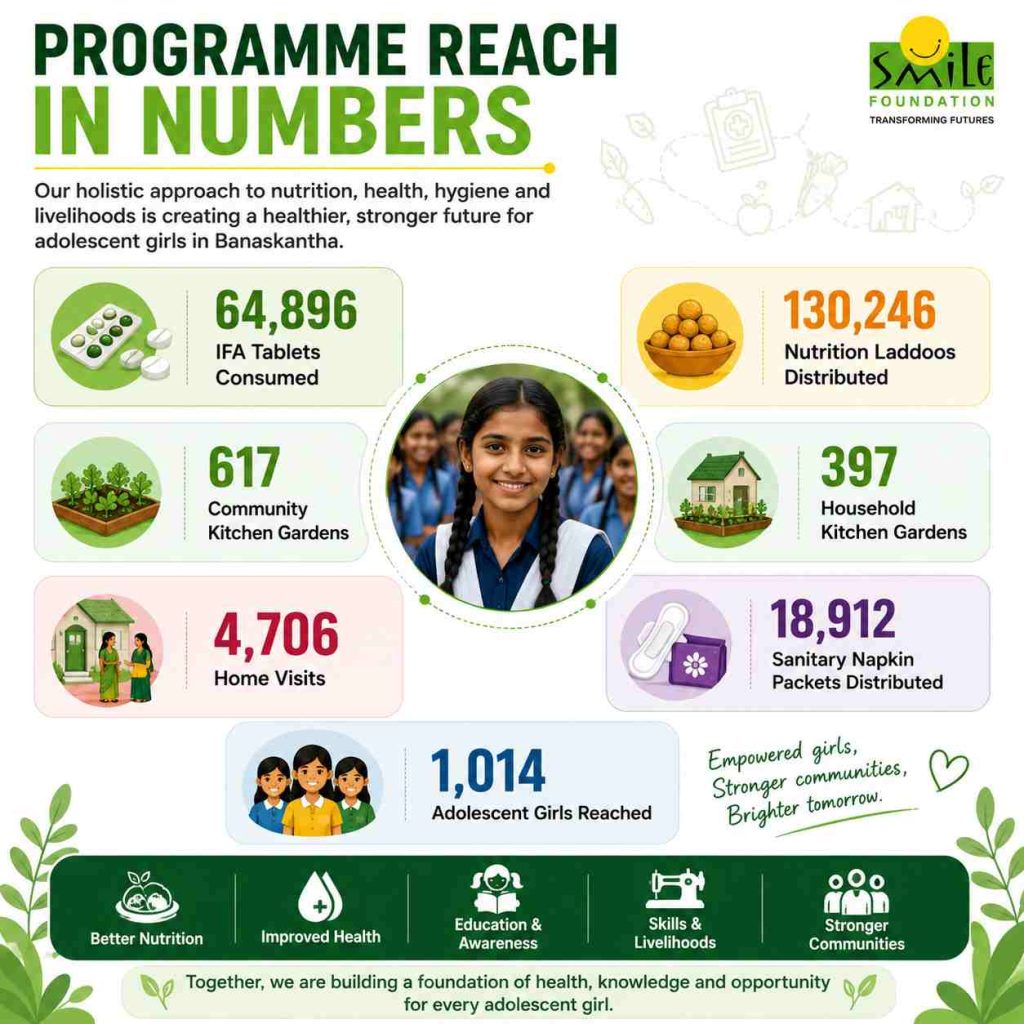
Over the course of implementation, Smile Foundation facilitated:
Nutrition and Health
- 64,896 IFA tablets consumed by 1,014 adolescent girls
- Quarterly haemoglobin testing
- Referral support for severely anaemic girls
- Nutrition education sessions
- Distribution of nutrition-rich laddoos
Community Engagement
- 4,706 home visits
- 1,046 meetings with frontline workers and school principals
- Engagement with mothers and families
- Strengthening of government linkages through Anganwadi centres and Village Health Nutrition Days (VHNDs)
Nutrition-Sensitive Agriculture
- 617 community kitchen gardens
- 397 household kitchen gardens
- Cooking competitions and recipe-sharing activities
Menstrual Hygiene
- 18,912 sanitary napkin packets distributed
- Awareness sessions on menstruation and reproductive health
Livelihood Development
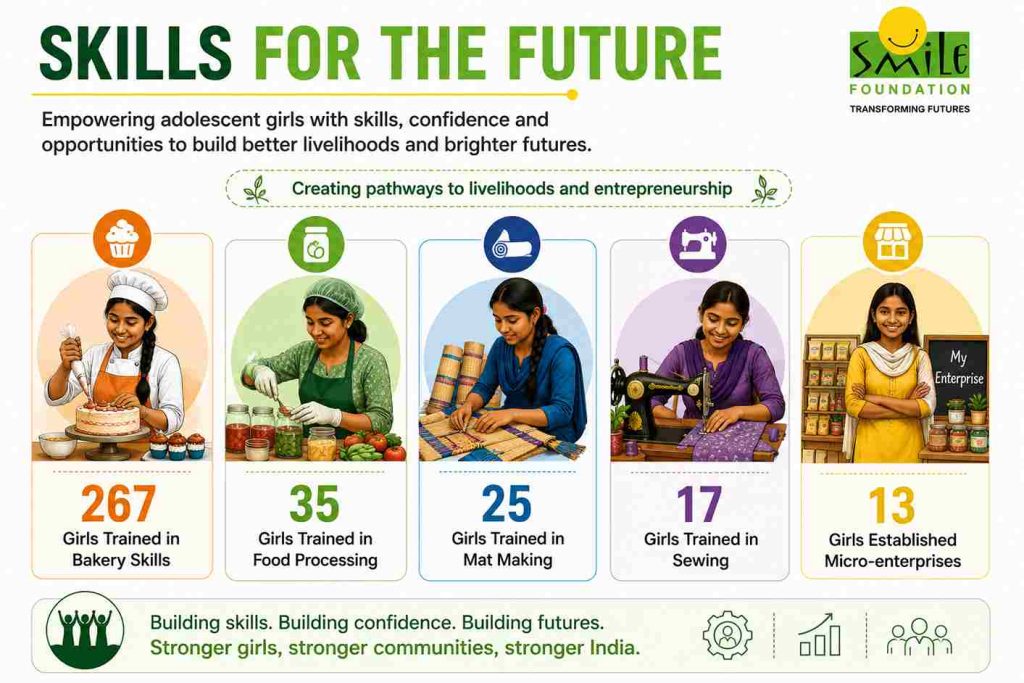
- 17 girls trained in sewing
- 267 girls trained in bakery skills
- 25 girls trained in making mats
- 35 girls trained in food processing
- 13 girls supported to establish micro-enterprises through SCORE Livelihood Foundation
The Shift Towards Better Nutrition
The most encouraging findings emerged in dietary behaviour and supplement consumption.
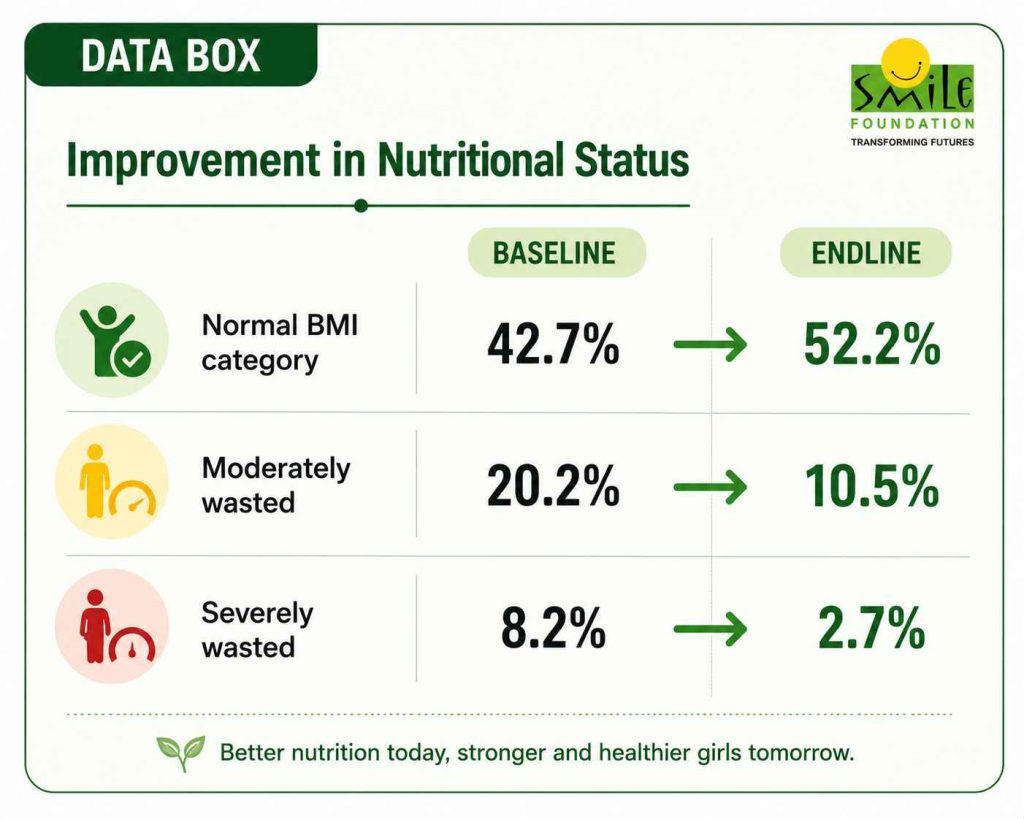
The endline assessment found substantial improvements in key nutrition indicators.
| Indicator | Baseline | Endline |
|---|---|---|
| IFA consumption in previous week | 40.8% | 69.1% |
| Multivitamin consumption | 15.1% | 44.4% |
| Deworming tablet consumption | 7.2% | 14.3% |
| Adequate minimum dietary diversity | 30.9% | 59.1% |
These shifts suggest that girls were not only receiving services but also changing behaviours around food consumption and health.
Interviews with mothers and Anganwadi workers reinforced these findings.
Girls reported greater awareness of:
- Balanced diets
- Anaemia prevention
- Nutritional needs during adolescence
- Importance of green leafy vegetables
- Regular IFA consumption
One intervention emerged as particularly influential: kitchen gardens.
Programme staff observed that girls who previously relied heavily on potato-based diets began growing and consuming a wider variety of vegetables, helping diversify household food consumption patterns.
Hygiene Habits That Last Beyond the Programme
Nutrition outcomes are closely linked with sanitation and hygiene practices.
The assessment found substantial improvements in awareness and adoption of healthy hygiene behaviours.
Among surveyed households:
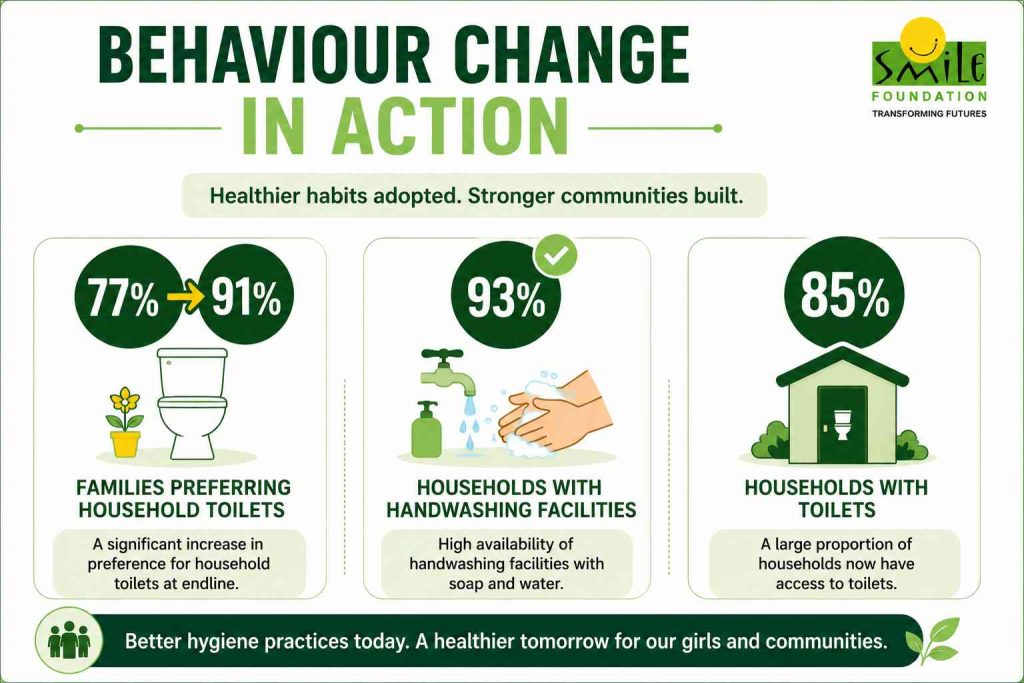
- 85% had toilet facilities
- 93% had designated handwashing spaces with soap and water
- Toilet usage increased significantly compared to baseline levels
The proportion of families preferring individual toilets rose from 77% at baseline to 91% at endline.
Girls also reported stronger handwashing practices before:
- Cooking food
- Eating meals
- Feeding younger siblings
- After using toilets
These improvements reflect the importance of repeated engagement through Anganwadi workers and community-based demonstrations.
Menstrual Hygiene: Breaking Silence and Reducing Barriers
For many adolescent girls, menstruation remains a source of stigma, discomfort and school absenteeism.
The programme attempted to address this through both product access and awareness.
The results were encouraging.
The assessment found:
- Increased use of sanitary napkins
- Reduced dependence on cloth absorbents
- Fewer girls missing school during menstruation
- Reduced participation in physically restrictive practices during menstrual periods
Importantly, mothers reported becoming more comfortable discussing menstrual hygiene after counselling sessions conducted by frontline workers.
This demonstrates how behaviour change efforts are often most effective when they engage not just girls but also the family members who influence daily decisions.
Education and Aspirations: Signs of Progress
Health and education are deeply interconnected.
Girls who are healthier are more likely to stay in school, participate in learning and imagine different futures for themselves.
The assessment found that:
- Nearly 95% of girls had attended school
- 77% aspired to complete secondary education or graduation
- Participation in school health programmes increased
- Awareness of educational opportunities improved
However, challenges remain.
Nearly half of the girls had dropped out due to:
- Household responsibilities
- Distance to schools
- Lack of interest
- Social constraints
Community leaders repeatedly highlighted the need for:
- More secondary schools
- Safe transportation
- Hostel facilities for girls
- Continued awareness campaigns promoting girls’ education
Livelihoods: Expanding the Horizon of Possibilities
A noteworthy outcome of the programme was the emergence of livelihood aspirations among girls.
The assessment found:
- Increased awareness of vocational opportunities
- Participation in skill development programmes
- Growing interest in employment and entrepreneurship
- Greater confidence among girls to discuss their ambitions openly
Programme teams reported that girls who completed training in sewing, bakery skills and small-enterprise development began applying these skills for income generation.
For many participants, this represented their first exposure to livelihood pathways outside traditional agricultural work.
What Made the Programme Work?
The endline assessment highlights several factors that contributed to programme effectiveness.
1. Community Ownership
The programme invested heavily in engaging mothers, community leaders and frontline workers.
2. Government Convergence
Strengthened linkages with Anganwadi centres and health services improved access to existing government programmes.
3. Consistent Reinforcement
Behaviour change was supported through repeated interactions rather than one-time awareness sessions.
4. Addressing Multiple Needs Simultaneously
Nutrition was linked with hygiene, education, livelihoods and social empowerment.
5. Local Solutions
Kitchen gardens, community competitions and peer learning activities made healthy behaviours practical and accessible.
The Road Ahead
Despite encouraging outcomes, the assessment underscores that significant challenges remain.
Early marriage continues to affect girls’ opportunities.
Economic vulnerability limits educational continuity.
Access to higher education remains constrained by distance and safety concerns.
Livelihood opportunities remain limited.
The programme’s own stakeholders identified education infrastructure and safe accommodation for girls as critical priorities for future interventions.
At the same time, the findings offer a powerful reminder that change is possible when adolescent girls receive the information, resources and support they need.
The transformation observed in Banaskantha was not driven by a single intervention.
It emerged through sustained engagement, trusted community relationships and an understanding that adolescent wellbeing extends beyond nutrition alone.
When girls gain knowledge about their health, confidence in their abilities and opportunities to shape their futures, the benefits ripple across households, communities and generations.
And that is precisely where lasting development begins.