
India has more educated young people than at any point in its history. College enrolment has risen sharply, vocational institutions have expanded across states and millions of young people are staying in education far longer than previous generations ever could. By most conventional development indicators, this should have been a success story. But, the transition from education to young workforce in the form of stable employment is becoming increasingly uncertain.
The recently released State of Working India 2026 report by Azim Premji University captures this contradiction clearly. India’s demographic dividend is approaching its peak, with nearly 367 million young people of working age. But beneath the optimism surrounding the world’s largest youth population lies a growing structural concern: education has expanded faster than meaningful economic opportunity.
India is not merely facing a jobs problem. It is facing a transition problem.

The Demographic Window Is Narrowing
India’s demographic dividend has long been treated as an economic inevitability. A young population was expected to drive consumption, productivity and long-term growth. But demographic advantage only matters if young people can move successfully from classrooms into decent, stable and productive work.
That window is beginning to narrow.
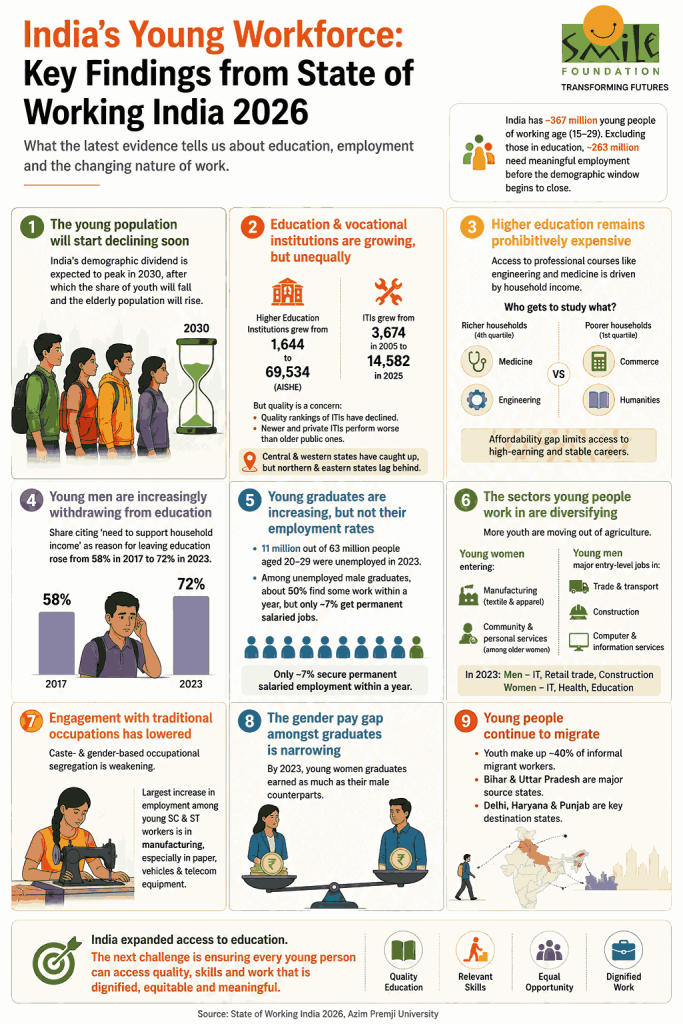
According to the report, India’s youth population is expected to peak around 2030, after which the share of elderly people will begin rising steadily. Out of the country’s 367 million working-age youth, nearly 263 million young people outside formal education require meaningful employment opportunities.
The scale of the challenge is unprecedented.
For decades, India’s policy focus remained centred on increasing access to education. That expansion did happen. School and college enrolment improved significantly across genders and regions. Among young women aged 15–19, enrolment rose from 38% in 1983 to 68% in 2023. For young men, it rose from 49% to 73% over the same period.
But enrolment and employability are not the same thing.
India successfully expanded participation in education. It did not expand young workforce readiness at the same pace.
The Explosion of Institutions Did Not Guarantee Quality for Young Workforce

The scale of institutional expansion over the last three decades has been enormous.
Following liberalisation, India witnessed a rapid growth in higher education and vocational institutions. The number of higher education institutions reportedly increased from around 1,600 to nearly 70,000. Industrial Training Institutes (ITIs) expanded almost fourfold between 2005 and 2025.
Much of this growth came from the private sector. Today, nearly 80% of higher education institutions and ITIs are privately operated.
On paper, this appears transformative. But expansion alone did not guarantee quality.
The report points to a gradual deterioration in vocational training quality across multiple indicators, including enrolment performance, trade diversity and pass percentages. Newer private ITIs, in particular, often rank lower than older public institutions.
This reflects a larger problem in India’s education ecosystem. Infrastructure expanded rapidly, but labour-market alignment remained weak.
Young people are entering educational systems that often remain disconnected from:
- actual industry demand
- emerging technologies
- workplace communication
- problem-solving skills
- digital fluency
Degrees continue to function as signals of aspiration. But increasingly, they are no longer guarantees of stable employment for a young workforce.
India’s Real Crisis Is the Classroom-to-Workforce Transition
The most important finding in the report is not unemployment alone. It is the fragility of the transition between education and work.
Graduate unemployment has risen sharply even as the number of graduates has expanded. In 2023 alone, 11 million graduates between the ages of 20 and 29 were unemployed.
Even more revealing is what happens after unemployment.
Tracking young male graduates for one year after they reported being unemployed showed that roughly half eventually found some form of work. But only a very small percentage secured permanent salaried employment.
This distinction matters.
India’s labour market is not failing to generate all forms of work. It is failing to generate stable, secure and upwardly mobile work at the scale young people expect.
The result is growing underemployment:
- graduates taking low-skilled work
- informal employment despite formal qualifications
- temporary contracts replacing permanent jobs
- prolonged preparation cycles for competitive exams
- increasing dependence on gig and platform work
The issue is no longer simply about whether young people are educated. It is about whether education meaningfully translates into economic mobility.
Access Remains Unequal

Even educational expansion itself remains deeply unequal.
The report highlights continuing caste and income disparities in higher education participation. While enrolment among Scheduled Castes and Scheduled Tribes has improved significantly over the last decade, both groups still remain below the national average.
Professional degrees remain especially inaccessible.
Courses like engineering and medicine continue to be concentrated among wealthier households because of rising educational costs. Students from poorer families are far more likely to enrol in commerce or humanities streams, often linked to lower-paying employment outcomes.
In other words, educational inequality is increasingly becoming stratified by affordability.
Regional inequality also persists sharply.
Southern and western states have expanded institutional access more effectively, while states such as Bihar and Jharkhand continue to lag behind in higher education infrastructure and vocational training access.
The consequence is not merely unequal education. It is unequal access to future opportunity itself for the young workforce.
Young Men Are Leaving Education Earlier
One of the more understated findings in the report concerns young men dropping out of education due to financial pressure.
Between 2017 and 2023, the share of young men citing household income responsibilities as the reason for leaving education rose sharply.
This points to a wider economic anxiety shaping Indian households.
As education becomes more expensive and employment more uncertain, families often cannot afford prolonged educational journeys without immediate economic returns.
For poorer households, education continues to carry opportunity costs:
- delayed income
- migration expenses
- coaching costs
- transport
- digital access
- living expenses in urban centres
Many young people are therefore caught between aspiration and affordability.
Women’s Employment Is Changing — Slowly
The report also captures an important long-term shift in women’s work participation.
Young women are increasingly entering manufacturing and service-sector jobs, especially in textiles, apparel, healthcare, education and information services. At the graduate level, the gender pay gap has also narrowed considerably over time.
These changes matter because they reflect slow but important shifts in occupational segregation.
Younger workers today are less likely to remain trapped within traditional caste- and gender-linked occupations than previous generations.
But structural barriers remain powerful.
Women’s participation in education or skilling programmes does not automatically translate into labour-force participation. Social norms around mobility, safety, caregiving and household responsibilities continue to shape workforce access.
Digital access itself remains unequal. Many young women, especially in rural and low-income households, still face restrictions around internet usage, phone ownership and independent mobility.
Which means employability is shaped by much more than classrooms alone.
The Labour Market Changed Faster Than Institutions Did
Perhaps the most important reality shaping young workers today is that the nature of work itself has changed dramatically.
The economy young people are entering now is fundamentally different from the one previous generations prepared for.
Growth sectors increasingly include:
- AI and automation
- digital services
- e-commerce
- logistics
- renewable energy
- healthcare support
- platform-based work
These sectors demand continuous adaptation rather than static qualifications.
The problem is that institutions evolved more slowly than labour markets did.
Many educational systems still prioritise:
- rote learning
- examination performance
- theoretical instruction
while employers increasingly prioritise:
- communication
- adaptability
- digital literacy
- teamwork
- applied problem-solving
This disconnect is becoming one of India’s biggest development challenges.
Why Young Workforce Development Requires Ecosystems
One of the clearest lessons emerging from workforce-development conversations is that employability cannot be solved through degrees alone.
Young workforce increasingly require:
- mentorship
- digital access
- health continuity
- mobility
- confidence-building
- career exposure
- local support systems
This is where community-based organisations and CSR-led workforce programmes are beginning to play a larger role.
Smile Foundation, for instance, works across multiple stages of the education-to-employment pipeline through programmes such as:
Together, these interventions address not just employability skills, but also the social and structural barriers that interrupt workforce participation.
STeP combines digital learning, communication training and placement support for underserved youth. Mission Education strengthens foundational learning among children vulnerable to dropping out. Swabhiman works on health, confidence and life skills among adolescent girls and women, while Smile on Wheels addresses healthcare disruptions that often push families out of educational continuity.
These programmes matter because workforce readiness is increasingly shaped by ecosystems rather than isolated interventions.
India’s Challenge Is No Longer Access Alone
For decades, India’s development conversation focused on access:
- access to schools
- access to colleges
- access to training
- access to digital tools
Those questions remain important.
But the next phase of India’s development challenge is different.
The question now is whether access translates into agency, employability and stable opportunity.
India’s demographic dividend will not automatically convert itself into economic growth. A young population alone is not enough.
The real challenge lies in ensuring that young people across caste, gender, income and geography can move meaningfully from education into dignified work.
That transition is where India’s young workforce story will ultimately be decided.