

India is on the cusp of a demographic and economic transformation, and one of the most powerful yet underleveraged forces in this shift is rural women entrepreneurs. From bustling cities to remote hamlets, grassroots women are no longer waiting for change, they are creating it. Despite facing formidable challenges, from financial exclusion and gender bias to infrastructural gaps and limited education, many women are forging new paths through women-led micro-enterprises.
The hard-won road to economic participation
The path to entrepreneurship for rural women is strewn with hurdles. Cultural barriers, low digital literacy, and restricted mobility often prevent them from entering or scaling the market. According to a 2024 study by the Bhartiya Yuva Shakti Trust (BYST), over 44% of women entrepreneurs in India struggle to sustain their businesses compared to 36% of men. Only 13% have a presence on e-commerce platforms, and less than half use digital payment systems. Meanwhile, of the 63 million MSMEs in India, only 20% are owned by women.

This disparity should concern a country with ambitious gender parity goals. Active female participation in the economy, particularly in underserved rural regions, is essential not only for equity but also for national productivity. However, low financial confidence and limited social support leave many women isolated, without the tools or trust needed to succeed.
The power of women-led collective micro-enterprises
One proven strategy to overcome these hurdles is collective enterprise. Self-help groups (SHGs) and co-owned business models allow women to share risks, gain confidence, and pool resources. These structures also offer community validation, which is vital in societies where gender roles are rigid.
However, disparities persist even within these collectives. Gender segmentation in business types remains stark. Women are often nudged toward low-margin, low-growth sectors like handicrafts or food processing. There is a pressing need to open male-dominated sectors to women while also elevating the visibility and profitability of female-dominated fields.
Credit Access Challenge
You’re a woman running a small spice business in rural India. You want a ₹50,000 loan to expand. What do you do first?
Barriers that demand systemic redress
The obstacles facing grassroots women entrepreneurs are deeply embedded in India’s social and economic fabric:
- Cultural Stigma: Traditional gender roles, family resistance, and social conservatism still deter many women from pursuing business activities.
- Financial Exclusion: Banks often require collateral that rural women cannot provide. Financial products rarely cater to micro-enterprises run by women.
- Knowledge Gaps: Many women lack formal education or business training. They may be skilled artisans or farmers but have no exposure to cost-pricing, branding, or customer service.
- Infrastructure Deficits: Inadequate roads, power outages, and limited digital connectivity hinder scale-up efforts. Poor local markets force women to rely on intermediaries, eroding profit margins.
- Time Poverty: With the burden of household responsibilities disproportionately falling on women, the time available for business pursuits remains minimal.
Addressing these barriers calls for a nuanced, multilayered approach that combines policy incentives, grassroots engagement, and corporate participation.
Exemplars of grit and innovation
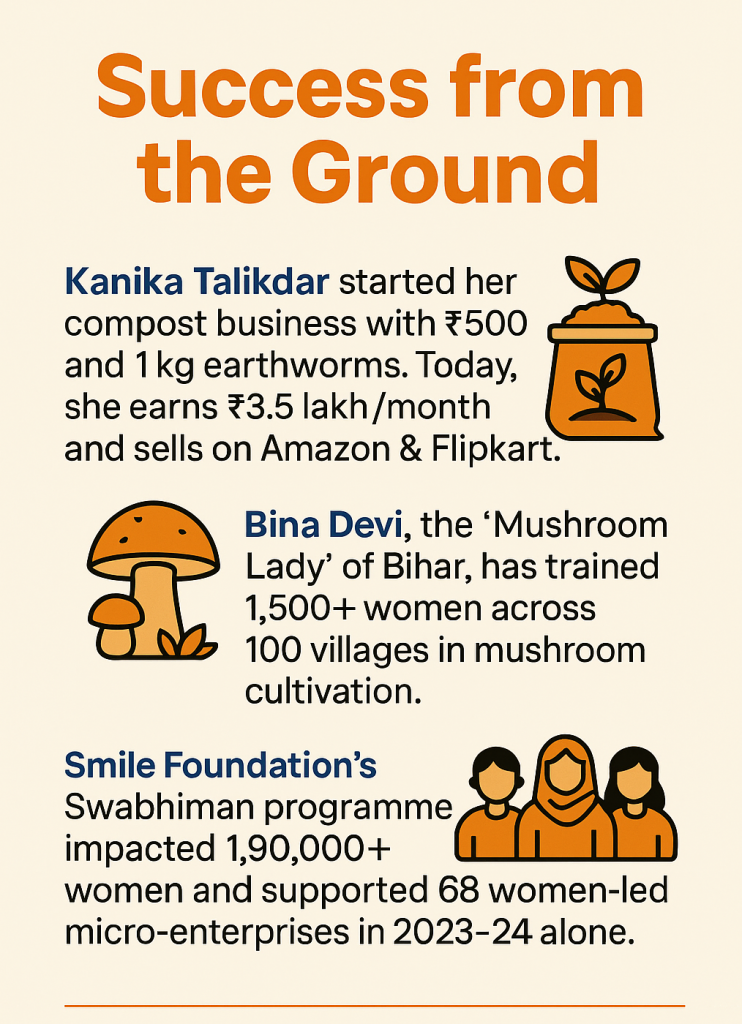
Chetna Sinha, founder of the Mann Deshi Bank and Foundation, epitomises resilience. After her application to start a rural women’s bank was rejected due to the literacy levels of promoting members, she returned to her village to conduct literacy classes. Five months later, she reapplied and succeeded. Today, Mann Deshi Bank has over 100,000 account holders and has disbursed loans worth over ₹780 million. It offers customised products for rural micro-entrepreneurs and delivers training tailored to their evolving needs.
Bina Devi, the 'Mushroom Lady' of Bihar, began mushroom farming beneath her bed due to space constraints. Today, she has trained over 1,500 women across 100 villages in Munger district, democratising access to this high-nutrition, high-value crop. Her work earned her the Nari Shakti Samman from President Ram Nath Kovind.
Kanika Talikdar, a 27-year-old widow from Assam, turned adversity into opportunity by launching Jay Vermi Compost with just ₹500 and 1 kg of earthworms. Today, her organic compost is sold on Amazon and Flipkart, and she earns a monthly revenue of ₹3.5 lakh.
Pabiben Rabari, an artisan from Kutch, invented the "Hari Jari" embroidery technique to adapt to changing norms while preserving cultural aesthetics. Her enterprise, Pabiben.com, now supports over 300 women artisans and has taken her products to Bollywood and Hollywood.
These stories highlight both personal triumphs and also systemic cracks that, if bridged, could lead to large-scale economic inclusion.
The policy landscape: Foundations and fault lines
Several government schemes aim to promote women’s entrepreneurship:
- Stand-Up India Scheme: Offers loans from ₹10 lakh to ₹1 crore to women setting up greenfield enterprises.
- PM MUDRA Yojana: Provides collateral-free loans up to ₹10 lakh.
- PM Employment Generation Programme: Offers higher subsidies to women applicants.
Many women are unaware of these schemes, and financial institutions still exhibit implicit biases. Effective implementation hinges on last-mile connectivity, community mobilisation, and continuous mentorship.
Swabhiman: Building from the ground up for women-led micro-enterprises
Smile Foundation’s Swabhiman serves as a model for scalable, grassroots intervention. Active in over 20 states, it combines health, nutrition, life skills, and entrepreneurship development. In 2023-24 alone, it impacted over 190,000 women and facilitated the creation of 68 women-led micro-enterprises.
Swabhiman offers:
- Business workshops on idea generation, budgeting, and digital literacy
- Training on e-commerce platforms and social media marketing
- Linkages to government schemes and credit networks
- Confidence-building modules and peer support
Beyond training, Swabhiman ensures women have the soft infrastructure of confidence, community, and clarity needed to scale.
Strategies for systemic scale-up
To harness the potential of grassroots women entrepreneurs, a coordinated, multi-stakeholder approach is essential:
- Tailor Financial Products: Develop collateral-free, low-interest credit lines. Train bankers to assess non-traditional enterprises.
- Build Market Access: Create rural-to-urban market bridges via online platforms, cooperatives, and CSR linkages.
- Promote Inclusive Incubation: Rural incubators and startup bootcamps should offer business mentorship and marketing training specifically for women.
- Mobilize CSR: Encourage corporate partners to co-invest in community-based entrepreneurship models. Programmes like ITC Shakti and Swabhiman demonstrate the power of CSR in grassroots development.
- Break Stereotypes: Conduct social campaigns that challenge gender roles and promote success stories. Engage male family members as allies.
- Invest in Infrastructure: Cold storage, transport, and reliable internet access are crucial for scaling.
The way forward
India’s economic narrative cannot remain incomplete by side lining half its population. The grassroots women entrepreneurs profiled here are not outliers; they are flesh and blood of what’s possible.
Investing in rural women’s entrepreneurship yields exponential returns—not just in GDP, but in societal wellbeing. As these women take control of their economic destinies, they uplift entire communities. The challenge is to turn isolated successes into structural shifts. Doing so will not only close the gender gap in entrepreneurship but also craft a more equitable, resilient India.
Sources:
- Bhartiya Yuva Shakti Trust (BYST), 2024 Report on Women Entrepreneurs
- Ministry of MSME, Government of India
- Mann Deshi Foundation Annual Reports
- Ministry of Finance, PMEGP and MUDRA Scheme Guidelines
- Smile Foundation Annual Report 2023-24
- World Bank Gender and Enterprise Analyses
- NITI Aayog Women Entrepreneurship Platform (WEP) Reports