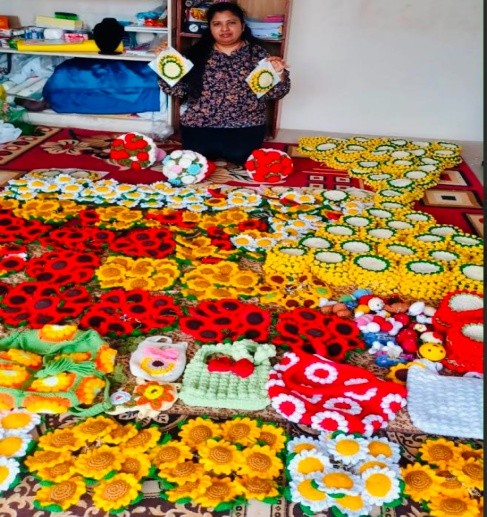

When Shobha Rani first learnt to the crochet skill, she was 12 years old. Her aunt taught her the craft, one loop and one pattern at a time. Like many skills picked up in childhood, crochet became part of her repertoire without necessarily becoming part of her plans. There was no business attached to it, no market to think about and no particular reason to imagine that something she made with yarn might one day become a livelihood.
Then family responsibilities took over.
Years passed, and the crochet work was put aside. The skill did not disappear, but it became dormant, waiting somewhere in the background while Shobha’s attention turned to other demands.
When she eventually returned to it, she found herself in an unfamiliar position. She knew how to crochet. What she did not yet know was how to turn that knowledge into an enterprise.
That distinction would shape the next chapter of her life.
Today, Shobha is the founder of Crochet Haven, an artisan enterprise in Solur village in Hoskote, Karnataka. She participates in exhibitions and melas, accepts bulk and corporate gifting orders and has completed her UDYAM registration. Her application for an Artisan ID is under process.
But the most significant change may not be found in the registration documents or the orders. It is in the way Shobha now understands her own ability.
She no longer sees crochet skill simply as a craft she learnt as a child. She sees it as a business.
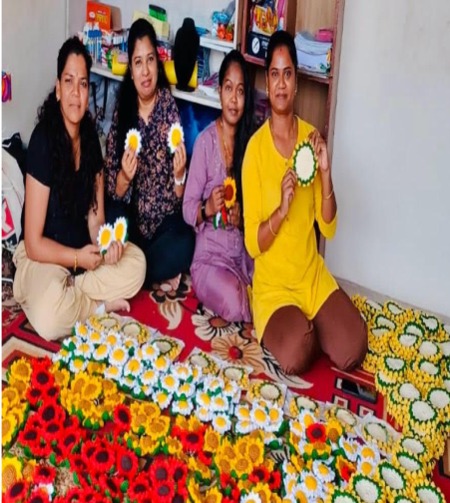
Rediscovering the crochet skill, and seeing it differently
For artisans, the distance between making something and selling it can be surprisingly large.
A person may know how to produce something well but have little experience with pricing, customers, marketing or business planning. A craft can be valuable and still remain confined to the home because its maker does not know how to turn it into a sustainable source of income.
That was the position Shobha found herself in when she rediscovered crochet. She had the technical skill, but she lacked confidence, business knowledge and access to markets.
A Smile Foundation team encountered her work during a home visit and recognised its potential. Rather than treating crochet simply as a hobby or a traditional skill, the team helped Shobha consider what might happen if she approached it as an enterprise.
The support followed an enterprise development pathway. Through EDP training, continuous mentoring, business guidance and market linkages, Shobha began acquiring the knowledge that sits around a craft business but is not necessarily part of learning the craft itself.
There was a practical lesson in that process. Being good at making something is not the same as knowing how to build a business around it.
Shobha began to bridge that gap.
The change was partly commercial and partly psychological. She began to see her own work differently. Crochet was no longer only something she knew how to do. It was something that could be developed, marketed and sold.
That was the beginning of Crochet Haven.
Building a business beyond the craft of crochet skill itself
An artisan enterprise has to operate in two worlds at once.
There is the world of making: the yarn, the patterns, the hours spent producing something by hand and the knowledge that comes from practice. Then there is the world of business, where the same product has to find a buyer.
Shobha has increasingly moved between the two.
Crochet Haven now participates in exhibitions and melas, giving her an opportunity to take her products to customers beyond her immediate surroundings. The enterprise also takes bulk and corporate gifting orders, opening another route to the market and demonstrating that handmade products can find customers beyond individual retail purchases.
The business has also taken steps towards formalisation. Shobha has completed her UDYAM registration, while her Artisan ID application is currently under process.
These details may appear bureaucratic when set against the intimacy of handmade craft of crochet skill, but they represent an important stage in the development of a small enterprise. Formal registration can give an artisan business a clearer identity within the formal economy, while market access can help turn irregular sales into more structured commercial opportunities.
For Shobha, the process has been about learning how to operate a business without losing the skill at its centre.
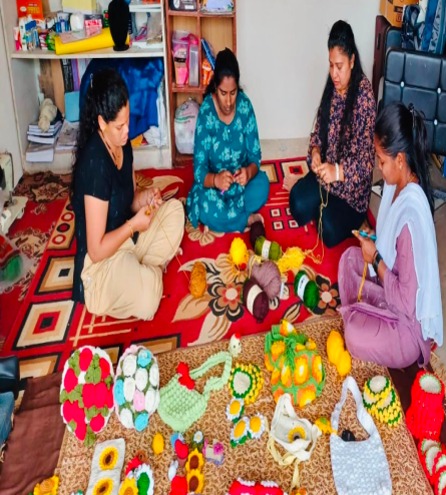
Crochet remains the foundation. What has changed is everything around it.
The moment an entrepreneur becomes a teacher with crochet skill
There is a point in many enterprise stories when the focus shifts from the person building the business to the people who begin gathering around it.
For Shobha, that shift has already happened.
She has trained more than 20 emerging crochet enterprises. She also provides job-work opportunities to women on a work-order basis, creating additional livelihood opportunities connected to her own enterprise.
And she has taken on another role: skill trainer for new crochet entrepreneurs being incubated through Smile Foundation.
This is a significant development in her journey because it changes the nature of the knowledge she has acquired. The business experience she gained is no longer useful only to herself. It can now be passed on.
Shobha knows what it means to have a skill but not yet know what to do with it commercially. She knows what it means to build confidence around an ability that had previously been treated simply as a craft. She has experienced the process of finding markets and taking orders and of moving towards formal recognition as an enterprise.
Those experiences give her something different from technical expertise alone. They give her a perspective on the journey an emerging entrepreneur has to make.
The women she trains are therefore not simply learning crochet skill patterns. They are entering a space where a craft can be considered in relation to a business. The distinction matters because entrepreneurship requires a set of decisions that begin after the product itself has been made.
Who will buy it? Where will it be sold? How can the business take larger orders? What does it mean to formalise the enterprise? How can production expand without compromising the quality of the work?
Shobha has begun to navigate those questions herself. Now she is helping other women navigate them too.
From one enterprise of crochet skill to many
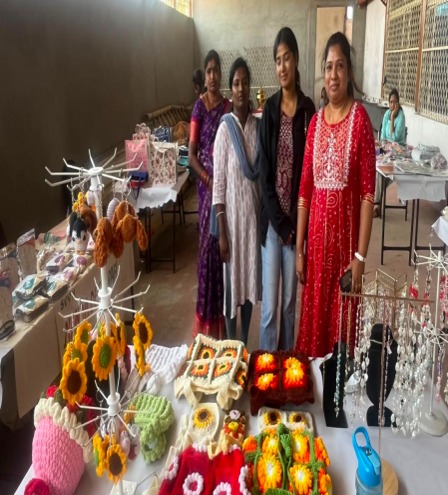
This is where Shobha’s story becomes different from a conventional account of women learning skills for employment.
The outcome is not only that one woman has established a business. Her enterprise has become a point from which other enterprises can develop.
The more than 20 emerging crochet skill enterprises she has trained represent one part of that expansion. The job-work opportunities she provides to women represent another. Her role as a trainer for new entrepreneurs adds a third.
Taken together, these activities suggest a multiplier effect: support that initially helped one entrepreneur develop her own enterprise is now being carried forward through her work with others.
It is an important dimension of livelihood development because economic opportunity does not always have to be created independently for every individual. Sometimes one functioning enterprise can create a small network around itself, through training, production, orders or shared knowledge.
Shobha’s enterprise is beginning to do that.
There is also something noteworthy about the direction of the knowledge. The girl who learnt crochet from her aunt at 12 has become a woman who teaches other aspiring entrepreneurs. What began as knowledge passed within a family has now become professional knowledge that Shobha can use to help other women develop businesses of their own.
The journey from learner to trainer is not simply a change in title. It represents a change in confidence and position.
She is no longer only asking whether her own skill has value.
She is helping other women understand the value of theirs.
What enterprise development can make possible
Stories about livelihoods are often reduced to a simple sequence: training leads to employment, which leads to income. Shobha’s experience is more complicated, and therefore more revealing.
The first resource was something she already possessed: a skill learnt in childhood.
What was missing was the confidence to see that skill as an economic opportunity, along with the knowledge and connections required to develop it into a business. Enterprise development through Smile Foundation’s women-entrepreneurship programme, Swabhiman helped fill those gaps through training, mentoring, business guidance and market linkages.
The result was not simply a return to crochet. It was a new relationship with the craft.
Shobha’s progress also illustrates why market access matters. An artisan can make dozens of beautiful products, but without customers, orders or routes to market, production alone cannot sustain an enterprise. Exhibitions, melas, bulk orders and corporate gifting have given Crochet Haven different ways of reaching buyers.
Formalisation is another part of that journey. UDYAM registration marks a step towards recognising the enterprise within a formal business framework, while the pending Artisan ID application could strengthen Shobha’s recognition as an artisan and potentially widen future opportunities.
None of these developments changes the fact that Crochet Haven is built on handmade work. They make it more possible for that work to function as a business.
A skill that came back with a different purpose
Shobha’s story began long before Crochet Haven had a name.
It began when a 12-year-old girl sat with her aunt and learnt how to crochet. For years afterwards, the skill remained largely unused as family responsibilities took precedence. When Shobha returned to it, she was not simply picking up an old hobby. She was trying to work out whether something she had learnt as a child could become part of her economic life.
With support, she began to answer that question.
She built an enterprise. She found markets. She formalised the business. She began taking larger and corporate orders. And then, perhaps most importantly, she began helping other women do something similar.
More than 20 emerging crochet enterprises have now been trained by her, while job-work arrangements create opportunities for women to participate in production. As a skill trainer for new crochet entrepreneurs being incubated through Smile Foundation, she is also passing on what she has learnt along the way.
That makes Crochet Haven more than the story of a woman returning to a forgotten craft of crochet skill. It is the story of what can happen when an old skill is given a new economic context, and when the person who benefits from that opportunity becomes capable of extending it to others.
For Shobha, the crochet hook has travelled a long way from the hands of the aunt who first taught her. It became something she put away, then something she rediscovered, then the foundation of a business. Now it is also part of how she teaches, trains and creates work for other women.
The enterprise is still growing. There are markets to develop, orders to fulfil and new entrepreneurs to train. But Shobha is no longer at the beginning of the journey, trying to decide whether her skill can become a livelihood.
She has already answered that question for herself.
The more interesting question now is how far that answer can travel.