

Summary
- STEM education in India transforms curiosity into critical thinking through experiential learning.
- Hands-on learning strengthens children’s cognitive, creative and problem-solving skills beyond academics.
- Smile Foundation’s Mission Education creates inclusive STEM ecosystems through labs, DIY kits, teacher training and digital learning.
- Investing in child education prepares future-ready talent while contributing to innovation, employability and lifelong learning.
- Strategic CSR NGO partnerships can scale measurable STEM education outcomes and strengthen ESG impact.
On 14 July 2023, a classroom in Chavakkad, Kerala, was buzzing with questions.
“Will Chandrayaan really reach the Moon?”
“How does a rocket know where to go?”
“Could someone like us build something like that one day?”

Among the students asking these questions was Abhay*, a Class VI student whose excitement about India’s third lunar mission had quietly transformed him into the most enthusiastic learner in the room.
That morning, Smile Foundation’s STEM workshop had begun like many others—with children gathering around simple experiments, everyday materials and practical demonstrations designed to make science less intimidating and more relatable.
No one had planned the workshop around history.
Yet history decided to join the classroom.
At 2:35 p.m., Chandrayaan-3 lifted off from the Satish Dhawan Space Centre. As the live launch appeared on the screen, the room fell silent. Curious conversations gave way to wide-eyed wonder. For many of these children, this was the first time they had witnessed a national scientific milestone unfold in real time.
The launch lasted only a few minutes.
Its impact on the classroom lasted much longer.
In that moment, space exploration stopped being a chapter in a textbook. It became tangible. The questions became more thoughtful, the discussions more animated, and the students began imagining themselves not merely as spectators of India’s scientific achievements but as future contributors to them.
For Abhay, Chandrayaan-3 was no longer just India’s mission to the Moon.
It became a reminder that every scientist, engineer and innovator begins as a curious child asking simple questions.
STEM Education : Curiosity Builds in Classrooms
Children are born curious. They instinctively ask questions, explore their surroundings and learn by observing, experimenting and making connections. The challenge facing STEM education in India is therefore not a lack of curiosity, it is the limited opportunities many children have to develop that curiosity into meaningful knowledge and lifelong skills.
For millions of children studying in government schools and underserved communities, learning continues to be shaped by memorisation rather than exploration. Without access to practical learning environments, science often remains confined to textbooks, examinations and theoretical concepts. As a result, children may learn answers, but they seldom develop the confidence to ask better questions.
Abhay’s experience during Smile Foundation’s STEM workshop demonstrates what happens when this learning environment changes. Watching the launch of Chandrayaan-3 while participating in hands-on STEM activities transformed a national scientific achievement into a personal learning experience. Instead of simply witnessing a rocket launch, he began connecting classroom concepts with real-world innovation.
His story reflects a broader educational insight: children learn best when they experience knowledge rather than merely receive it.
STEM Education as a Foundation for Child Development
Quality child education extends beyond improving examination scores. It equips children with the cognitive, emotional and social competencies required to navigate an increasingly complex world.
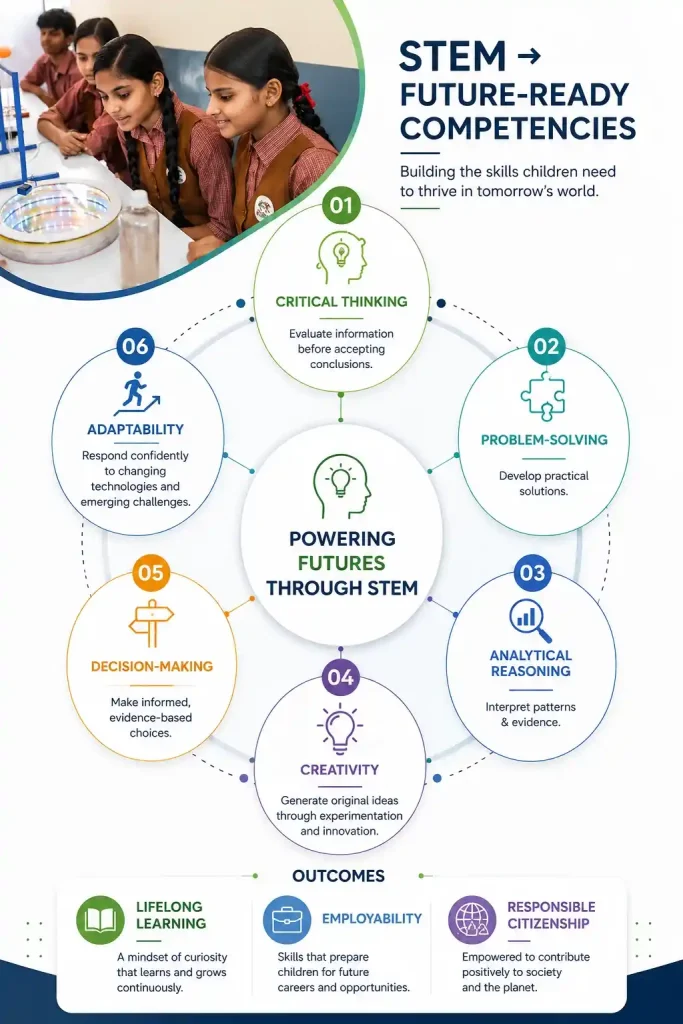
STEM education contributes to holistic child development by strengthening:
Cognitive Skills
- Critical thinking and logical reasoning
- Scientific enquiry and evidence-based decision-making
- Analytical thinking and data interpretation
- Creativity and innovation
- Observation and experimentation
- Curiosity-driven learning
Social and Emotional Skills
- Collaboration and teamwork
- Communication and presentation skills
- Confidence to ask questions
- Resilience through trial and error
- Adaptability in unfamiliar situations
Future-Ready Skills
- Digital literacy
- Design thinking
- Computational thinking
- Problem-solving
- Innovation mindset
Rather than treating science as an isolated academic discipline, STEM learning encourages children to understand how ideas are connected and how knowledge can be applied to solve everyday challenges.
From Memorisation to Meaningful Learning
One of the most significant shifts taking place in education is the movement from rote learning towards experiential learning.
Traditional classrooms often prioritise remembering information for examinations.
This transition is particularly important during a child’s formative years, when cognitive development is shaped through active engagement rather than passive instruction.
When curiosity becomes part of everyday learning, children begin developing the confidence to explore unfamiliar ideas independently.

Smile Foundation- Building Thinkers, Not Just Students
This philosophy lies at the heart of Smile Foundation’s Mission Education programme.
Rather than introducing STEM as an additional classroom subject, the programme integrates experiential learning into children’s educational journeys by creating environments where they can investigate, build, test and discover.
The programme focuses on strengthening both academic learning and cognitive development through:
- Interactive STEM laboratories
- Do-It-Yourself (DIY) STEM learning kits
- Hands-on experiments
- Innovation and science workshops
- Teacher capacity building
- Foundational Literacy and Numeracy (FLN) integration
- Digital learning environments
- Science fairs and model-making activities
These interventions encourage children to become active participants in their own learning rather than passive recipients of information.
The objective is not simply to improve academic performance but to nurture curiosity, creativity and analytical thinking that remain valuable throughout life.
Developing the Cognitive Skills Required for the Future
The future workforce will increasingly be expected to solve complex problems that cannot be addressed through memorised knowledge alone.
Whether designing sustainable cities, developing artificial intelligence, improving healthcare systems or advancing clean energy technologies, future professionals will require strong cognitive capabilities developed during childhood.
ESG Perspective: Why STEM Education Creates Long-Term Social Value
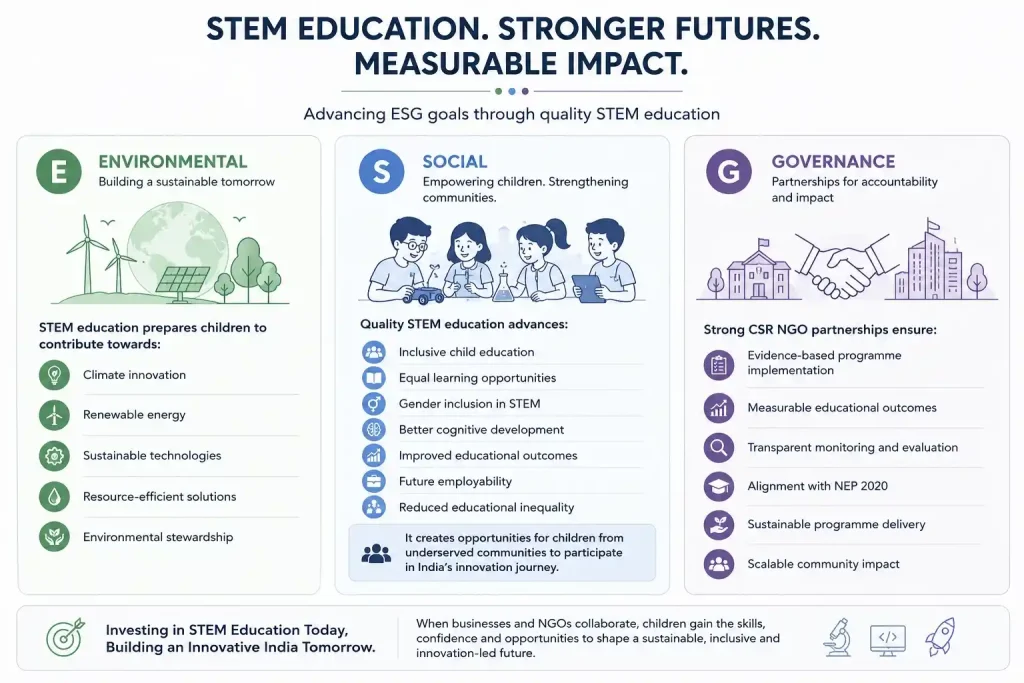
For businesses, investing in STEM education in India is no longer solely an education initiative—it is an ESG investment that strengthens both communities and future economic resilience.
Building the Next Generation of Innovators Requires Collective Action
Abhay’s curiosity during the Chandrayaan-3 launch is a reminder that innovation begins long before a child enters a laboratory or a workplace. It begins in classrooms where children are encouraged to question, experiment and think critically.
The true promise of STEM education in India lies not only in preparing future scientists and engineers but in developing the cognitive, creative and problem-solving capabilities every child needs to thrive in an innovation-driven economy.
Realising this vision requires more than isolated interventions. It calls for long-term investments in child education, teacher capacity, experiential learning and inclusive STEM ecosystems that reach children regardless of geography or socio-economic background.
This is where CSR NGO partnerships can create lasting value. By combining corporate resources with implementation expertise, organisations can build scalable education models that strengthen learning outcomes, contribute to ESG priorities and develop a future-ready workforce.
Partner with Smile Foundation to strengthen STEM education in India and create measurable impact through strategic CSR initiatives that prepare the next generation of innovators.
FAQs
1. Why is STEM education important in India?
STEM education equips children with critical thinking, creativity, problem-solving and digital skills needed to thrive in an innovation-driven economy.
2. How does experiential STEM learning benefit children?
Experiential learning encourages children to observe, experiment, ask questions and apply classroom concepts to real-life situations, improving cognitive development.
3. How does Smile Foundation promote STEM education?
Smile Foundation’s Mission Education programme strengthens STEM education through interactive laboratories, DIY STEM kits, science workshops, teacher capacity building, FLN integration and digital learning.
4. What cognitive skills does STEM education develop?
STEM education develops analytical reasoning, critical thinking, creativity, scientific enquiry, problem-solving, innovation and evidence-based decision-making.
5. Why is child education central to India’s innovation future?
Quality child education nurtures curiosity and future-ready skills that prepare children to become innovators, responsible citizens and contributors to national development.
6. How do CSR NGO partnerships strengthen STEM education in India?
CSR NGO partnerships combine corporate resources with NGO implementation expertise to create scalable STEM ecosystems, improve learning outcomes and deliver measurable social impact.
7. How does STEM education support ESG goals?
STEM education advances ESG by improving educational equity, developing future-ready talent, strengthening communities and creating long-term social value through measurable educational outcomes.
8. How can organisations partner with Smile Foundation for STEM education?
Organisations can collaborate with Smile Foundation to support STEM infrastructure, teacher training, experiential learning and digital classrooms through strategic CSR initiatives.









One reply on “STEM Makes Journey to Moon Possible”
Very well captured the core essence of nurturing the young minds through critical thinking. Great work