Summary
- Development programmes often fail not due to poor design, but weak knowledge transfer
- Importance of trainers is critically felt in turning content into real-world understanding
- Effective training requires communication, adaptability, and contextual relevance
- Investing in “training the trainer” helps scale impact across systems
- Strong trainers improve programme quality, efficiency, and long-term outcomes
- Ignoring trainer capacity leads to poor retention, weak implementation, and lost knowledge
- Building in-house trainers ensures sustainability and cost efficiency
Being well-versed in a subject and teaching it effectively are two very different skills. Knowing your subject is about mastery, while imparting it is about mastery, communication, connection and engagement. A teacher in the classroom can truly teach, guide students to learn and help them grow in a subject only when she has a strong command of it and knows how to deliver lessons and engage effectively. They are much like trainers.
Just as teachers serve as trainers in schools, companies and organisations rely on trainers who are architects of knowledge, skill and growth, fostering continuous learning. But to an extent, a teacher in a school setup is, in most cases, trained to break down complex ideas, adapt to different learning styles and manage a classroom. Strangely, this rigour disappears in adult training environments, where the stakes are often higher.
When we consider development initiatives, companies and organisations spend a great deal on skilling programmes, public health campaigns, workforce development and education reforms. But if the outcomes fall short, then it’s time we understand the importance of trainers in development imperatives.
Knowing the Gap: Importance of Trainers

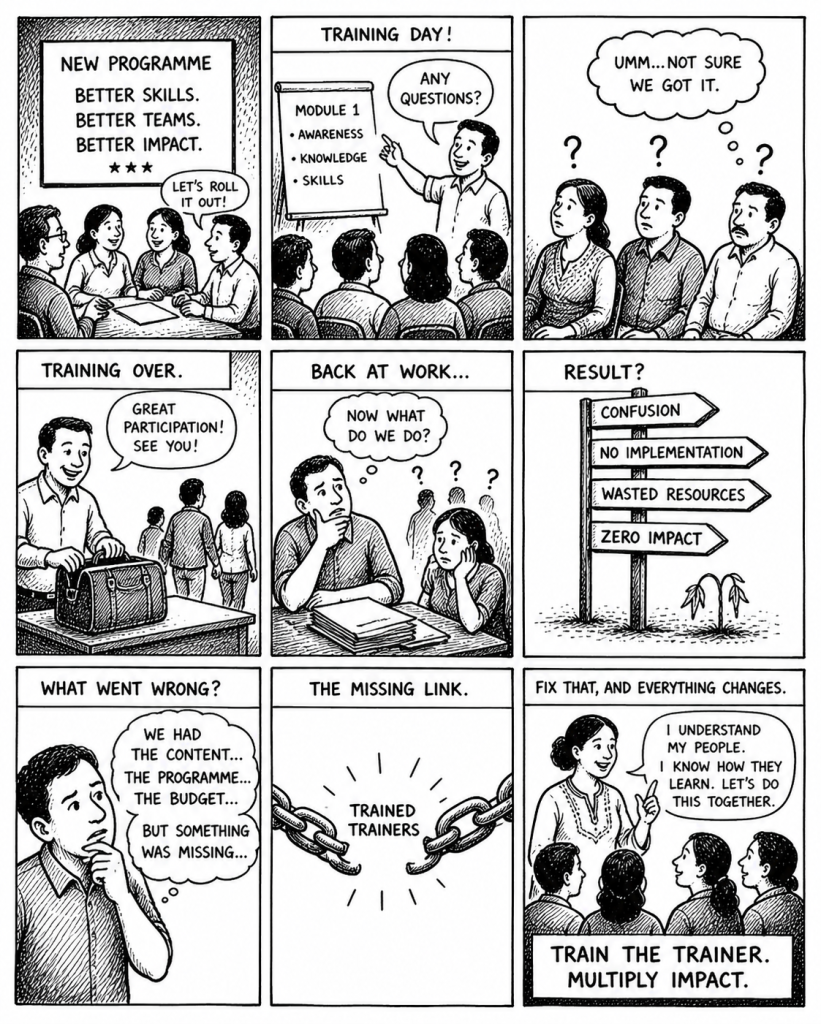
There is a reason for this gap, and it rarely gets attention. We focus on what is being taught. We spend far less time thinking about who is doing the teaching and how well they are equipped to do it. Every development effort, no matter how well designed, eventually comes down to a professional standing in front of people, showing some slides, trying to transfer knowledge and answering questions at the end. If that link is weak, the entire chain breaks.
Effective training requires the ability to organise knowledge in a way that makes sense to the learner. It calls for flexibility in delivery because people do not learn in the same way. A good trainer reads their target audience in advance, adjusts pace and style of presenting, and creates space for interaction. If needed, they may have follow-up sessions.
There is also a psychological layer that is often ignored. People learn better when they feel comfortable asking questions, when they see relevance in the material and when the environment signals and supports participation. This environment is built by a skilled trainer.
Train the Trainer
When you train one individual to become an effective trainer, you expand their impact beyond their own role. They begin to transfer knowledge to others. Those people, in turn, perform better. The effect spreads across teams, organisations and systems.
It is a simple idea, but its implications are significant. Development efforts often struggle with scale. How do you ensure consistent quality when programmes expand across regions, languages and contexts? When organisations invest in structured capacity building, they strengthen their ability to expand impact without losing focus. This depends on developing capable internal trainers who can carry the message forward in ways that feel relevant and relatable. With a strong foundation in place, mission-driven efforts can lead to measurable and lasting progress.

Why Trainers Matter
Let’s see some advantages of trainers for organisations.
- Trainers in the development sector help staff build the skills and knowledge they need to run successful programmes. By sharing what they’ve learned through effective training, they can carry the impact of their work forward into future projects and even the next generation.
- Trainers know the challenges on the ground, the constraints of the system and the realities of the learner. This makes training more useful. People are often more receptive when they learn from someone who truly understands their environment, culture, habits, daily realities, challenges and lived experiences.
- From a cost perspective, the case is equally strong. Relying entirely on external trainers can be expensive and difficult to sustain. Building in-house capability allows organisations to train more people without proportional increases in cost. It also ensures continuity, as training does not end with a single session, but rather becomes an ongoing process.
- Finally, trainers help improve the overall quality of programmes. By strengthening the skills and confidence of teams, they support better planning, more effective use of resources and stronger implementation. They also help organisations adapt their work based on evidence instead of assumptions, leading to initiatives that are more relevant and better aligned with their goals.
The Cost of Neglect
The risks of ignoring this are already visible. Many development programmes invest heavily in content and infrastructure but see limited behavioural change, lack of skill transfer and lack of knowledge retention. The gap between training and real-world application remains wide.
There is another challenge on the horizon. In several sectors, experienced workers are approaching retirement. They carry years of tacit knowledge that is not always documented. If this knowledge is not passed on effectively, it is lost. Training these individuals to become trainers can help capture and transfer that expertise before it disappears.
What Needs to Change
Despite this, trainers rarely receive the attention they deserve. Their role is undervalued, even though they sit at the centre of knowledge transfer. Trainer development must become a core part of any serious development strategy. It should be structured. It should include training in communication, instructional design and adult learning principles. It should also be continuous. As industries evolve, so must the methods of teaching.
Trainers should have practical teaching techniques and strong communication skills so they can create engaging, interactive learning experiences. They also need to explain ideas clearly, adapt to learners’ needs and build an inclusive environment where everyone feels valued.
Technology can support this process through digital tools, hybrid learning models and data-based feedback that help trainers improve their approach. But technology cannot replace human connection. At the same time, organisations and institutions need to recognise trainers as key drivers of growth and treat investment in their development as essential.
The People Who Make Development Work
India does not lack ambition, programmes and policies when it comes to development. What it often lacks is consistent, high-quality delivery at scale. That gap will not be closed by better content alone. It will be closed by better trainers. Nothing works unless someone can carry that knowledge forward in a way that people understand and use. Transformation of this kind comes when mindsets and attitudes change. Capacity building, in the end, is about people enabling other people. And that begins with the ones who stand at the front and teach.
Frequently Asked Questions (FAQs): Importance of Trainers
1. What is the importance of trainers in development programmes?
Trainers ensure that knowledge is not just delivered but understood and applied, making them essential for effective programme outcomes.
2. What is the difference between a subject expert and a trainer?
A subject expert has knowledge, while a trainer has the ability to communicate, adapt and ensure learners understand and apply that knowledge.
3. What does “training the trainer” mean?
It refers to building the capacity of individuals to become effective trainers, enabling them to pass knowledge on to others at scale.
4. Why do many development programmes fail despite good design?
Because the focus is often on content rather than delivery. If trainers are not skilled, knowledge does not translate into action.
5. How do trainers improve programme quality?
They enhance learning retention, adapt content to real-world contexts and ensure better implementation on the ground.
6. What skills make an effective trainer?
Communication, adaptability, audience understanding, instructional design and the ability to create an engaging learning environment.
7. How does investing in trainers help scale impact?
Trained trainers can teach multiple people, creating a multiplier effect across teams, communities and programmes.
8. Are in-house trainers better than external trainers?
In-house trainers often bring contextual understanding and continuity, making training more relevant and sustainable.
9. What role does technology play in training?
Technology supports training through digital tools and feedback systems, but cannot replace human interaction and engagement.
10. How can organisations strengthen trainer capacity?
By investing in continuous training, communication skills, teaching methodologies and creating structured training systems.