
Summary
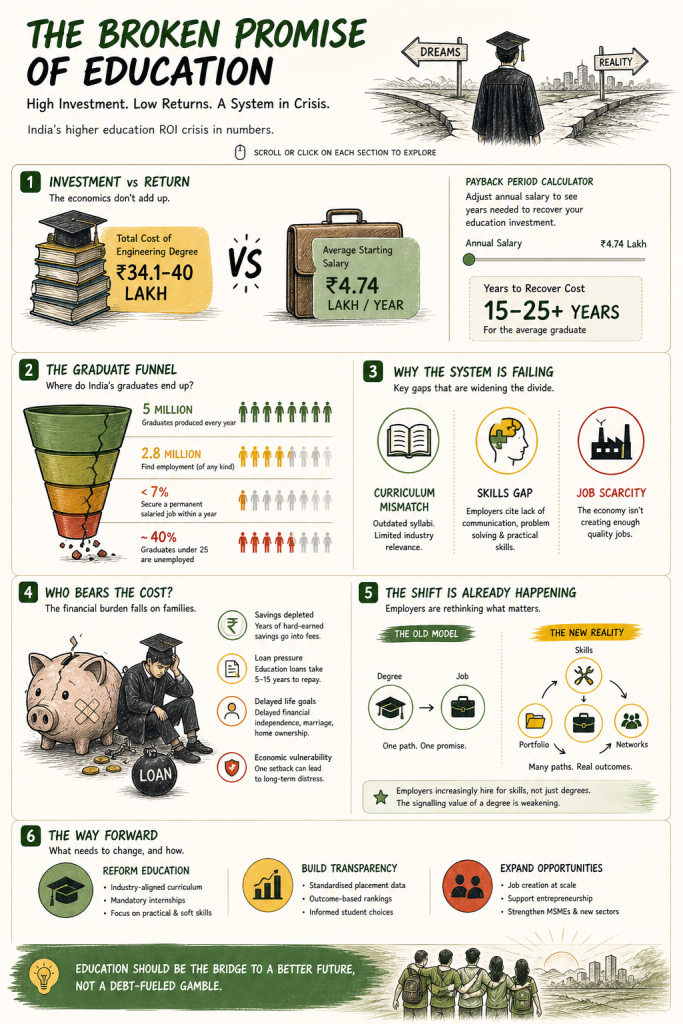
- India produces approximately five million graduates annually, yet only around 2.8 million find employment, and far fewer secure quality, formal-sector jobs that justify the cost of their education
- The total cost of a typical engineering degree in India has risen to approximately ₹34.1 lakh, while average starting salaries hover around ₹4.74 lakh per annum, creating payback periods that stretch across decades
- Under 7% of Indian graduates secure a permanent salaried job within a year of graduating, and nearly 40% of graduates under 25 are unemployed — figures that point to a structural failure rather than an individual one
- The growing disconnect between university curricula and industry requirements — particularly in communication and applied technical skills — has weakened the signalling value of a degree and accelerated a shift toward skills-based hiring
- The financialisation of higher education, driven by declining public funding and the expansion of private providers, has transferred educational risk onto families with consequences that include delayed financial independence, reduced household savings and heightened economic vulnerability
- Addressing the crisis requires curriculum reform, stronger vocational pathways, transparent placement data, and critically demand-side intervention through job creation, entrepreneurship support and labour market expansion
The Morning the Promise Broke
On a humid convocation morning, a newly graduate student walks across a stage to collect a degree that may have cost anywhere between ₹10 lakh and ₹40 lakh. The families seated in the hall celebrate, photographs are taken with this unspoken assumption that this investment will pay off, and will translate into mobility and long-term dignity. However, increasingly, this promise is breaking down.
The numbers are stark. Recent analyses show cases where students spend more than ₹30 to 40 lakh on professional degrees only to enter job markets offering starting salaries of ₹4 to 5 lakh annually. More troubling is not just low pay, but the absence of employment altogether. Under 7 per cent of Indian graduates secure a permanent salaried job within a year of graduating. Meanwhile, nearly 40 per cent of graduates under 25 are unemployed, and only a fraction of those employed enter stable, formal-sector roles. In absolute terms, India produces roughly five million graduates annually, yet only about 2.8 million find employment, and far fewer find quality jobs.
In a nutshell, India’s higher education system, once seen as a reliable pathway to upward mobility, is facing a profound return-on-investment (ROI) crisis. The mismatch between the cost of acquiring a degree and its economic outcomes is not just anecdotal but structural.
The Arithmetic of Disillusionment
To illustrate the scale of the problem, undergraduate engineering programmes offer a useful case study. According to the 1 Finance Global Economic Outlook 2026, the total cost of a typical engineering degree in India has risen to around ₹34.1 lakh, while the average starting salary for graduates is approximately ₹4.74 lakh per annum, pointing to a clear mismatch between investment and returns. MBA programmes—especially from private universities—can range from ₹15 lakh to upwards of ₹40 lakh. Even in non-elite institutions, fees have risen steadily due to declining public funding and the expansion of private providers.
On the other hand, for management degrees, one of most sought after ones in the country, students end up paying anywhere between ₹15 lakh to upwards of ₹40 lakh. In non-elite institutions, fees have risen steadily due to declining public funding. Even when the number of MBA institutes have increased in the country (as of 2025-26, we have about 3,095 institutes) job creation has failed to keep pace. As a result, placement outcomes are also weakening, with several top B-schools reporting declines in average salaries, including a 15 per cent drop at IIM Indore.
This mismatch produces long payback periods. A graduate who spends ₹20 to 30 lakh on education but earns ₹4 to 5 lakh annually may years to recover the initial investment, assuming continuous employment and minimal additional expenses. For those earning at the lower end or facing constant periods of unemployment the financial returns become even more uncertain.
The comparison with global peers is instructive. In the United States, a well-documented student debt crisis has produced significant policy response and public debate. India’s version of the same problem is less visible — in part because education loans are less universally used, and in part because the burden falls disproportionately on families rather than on individual graduates but it is no less real in its consequences.
What Is Driving the Disconnect
The higher education ROI crisis has multiple causes, and understanding them separately matters for designing effective responses.
The curriculum-industry gap is perhaps the most immediately visible. Employers across sectors have consistently reported that fresh graduates lack job-ready skills — particularly in communication, applied problem-solving, and the kind of practical technical competency that comes from doing rather than studying. A 2023 report by the India Skills Report found that fewer than half of graduates were considered employable in the roles for which they had trained. This is not a new finding, and it has persisted across years of policy attention without meaningful resolution — partly because curriculum reform in higher education is slow, contested, and constrained by regulatory frameworks that privilege compliance over innovation.
The shift to skills-based hiring is an industry response to this gap, and it is reshaping the labour market in ways that further undermine the value of traditional degrees. Employers are increasingly using certifications, portfolio evidence, internships, and skills assessments to evaluate candidates, rather than treating a degree as the primary signal of employability. For graduates who have invested significantly in formal qualifications, this shift is disorienting — and for those whose degrees come from institutions with limited brand recognition, it can be practically devastating.
The decline of public funding has driven the expansion of private higher education, which now accounts for a substantial majority of India’s higher education capacity. In 1990, public institutions provided the bulk of higher education. By 2023, more than 65% of higher education institutions in India were privately managed. This shift has transferred the cost of education from the state to families, and with it, the financial risk of educational investment. Families who spend their savings or take loans on the assumption that a degree will produce commensurate returns are exposed to significant financial harm when that assumption proves incorrect.
The demand-side failure is the most structurally significant driver. India’s economy has grown considerably in recent decades, but this growth has been concentrated in sectors — technology, finance, services — that employ a relatively small proportion of the labour force. Labour-intensive sectors that have historically absorbed large numbers of graduates — manufacturing, construction, retail — have not grown at a pace commensurate with the expansion of the graduate population. The result is a structural oversupply of graduates relative to the formal-sector jobs available to receive them.
The Human Cost Behind the Data
What the aggregate data does not fully capture is the human dimension of the higher education ROI crisis — the ways in which it reshapes individual lives and household trajectories.
For the families who take loans to finance a child’s degree, a poor employment outcome does not just produce disappointment. It produces financial vulnerability that can persist across years. Education loans in India typically carry interest rates of 8–12%, and for graduates earning ₹4–5 lakh annually, the margin available for repayment after living expenses is thin. Delayed loan repayment accumulates interest, and the pressure of debt can constrain the kinds of career and life choices that graduates would otherwise make — limiting geographic mobility, forcing early acceptance of unsatisfying employment, and reducing the risk tolerance needed for entrepreneurship.
The psychological dimension is also significant. Research on graduate unemployment consistently links sustained joblessness or underemployment to reduced self-esteem, increased anxiety and a sense of betrayal by institutions that promised more than they delivered. For first-generation graduates, students whose families sacrificed significantly on the expectation of social mobility, the gap between investment and outcome carries a weight that is not only financial.
Women graduates face compounding barriers. Despite comprising a growing share of India’s graduate population, women are less likely to find formal-sector employment constrained by gender norms, safety considerations around commuting and hiring biases that persist in many industries. The higher education ROI crisis, for women, intersects with a labour market that was already less accessible.
What Global Experience Tells Us
India is not unique in facing this challenge, and the responses developed in other contexts offer useful reference points.
Germany’s dual education system which integrates vocational training with academic learning and embeds students in workplace settings throughout their education produces graduates who are practically competent and employer-ready in ways that purely classroom-based systems rarely achieve. The system is built on structured partnerships between educational institutions and industry, with employers actively shaping curriculum and providing training placements. Adaptation to India’s scale and diversity would require significant institutional innovation, but the underlying logic that education designed with employment in mind produces better employment outcomes is well-established.
South Korea has invested heavily in shifting its higher education system toward skills and competency-based assessment, and in expanding the social recognition of vocational pathways so that they represent genuine alternatives rather than fallback options. The cultural dimension of this shift — reducing the social stigma associated with non-degree education — is perhaps as important as the structural one.
Singapore’s SkillsFuture initiative, which provides citizens with credits to pursue skills upgrading throughout their working lives, offers a model for continuous skills development that supplements rather than replaces formal education. For a country like India, where the pace of technological change is rapidly altering the skills required for employment, a similar lifelong learning infrastructure could meaningfully improve graduate outcomes.
What Needs to Change
The higher education ROI crisis in India will not be resolved by any single intervention. It requires coordinated action across multiple dimensions simultaneously.
Curriculum reform is necessary but insufficient on its own. Aligning degree programmes more closely with industry requirements through employer input into curriculum design, mandatory internship components and a greater emphasis on applied learning can improve graduate employability at the margins. But curriculum reform cannot, by itself, create the jobs needed to absorb India’s graduate output.
Vocational and skills-based pathways need to be genuinely strengthened — not just expanded in scale, but elevated in social recognition. India’s National Skill Development Corporation has made progress in building vocational training infrastructure, but the social stigma associated with non-degree education remains a significant barrier to uptake, particularly in communities where a degree is seen as a marker of family status as much as an economic investment.
Transparency in placement data is a necessary precondition for informed decision-making. Students choosing where and what to study have limited access to reliable information about the employment outcomes of graduates from specific institutions and programmes. Mandating transparent, standardised placement reporting, and making it publicly accessible, would allow families to make investment decisions based on evidence rather than institutional marketing.
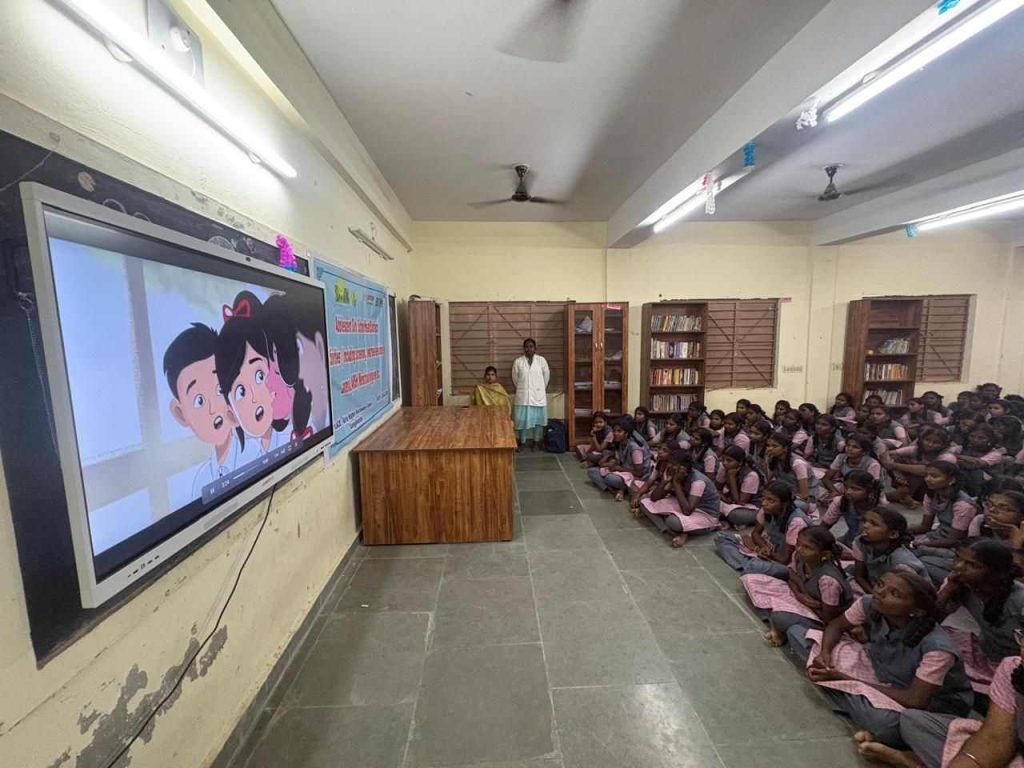
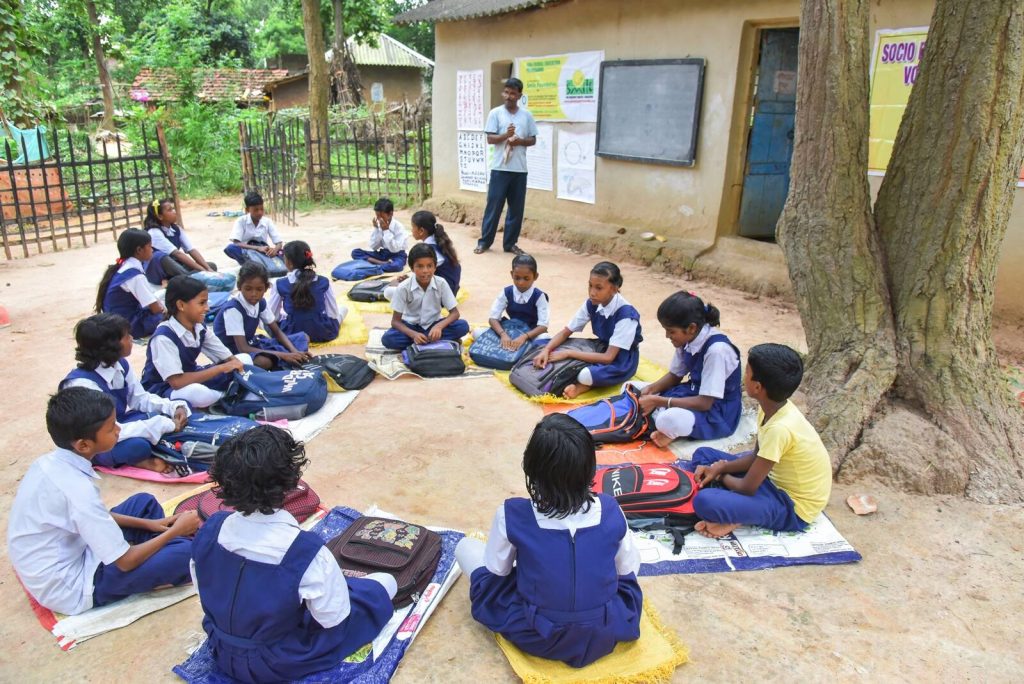
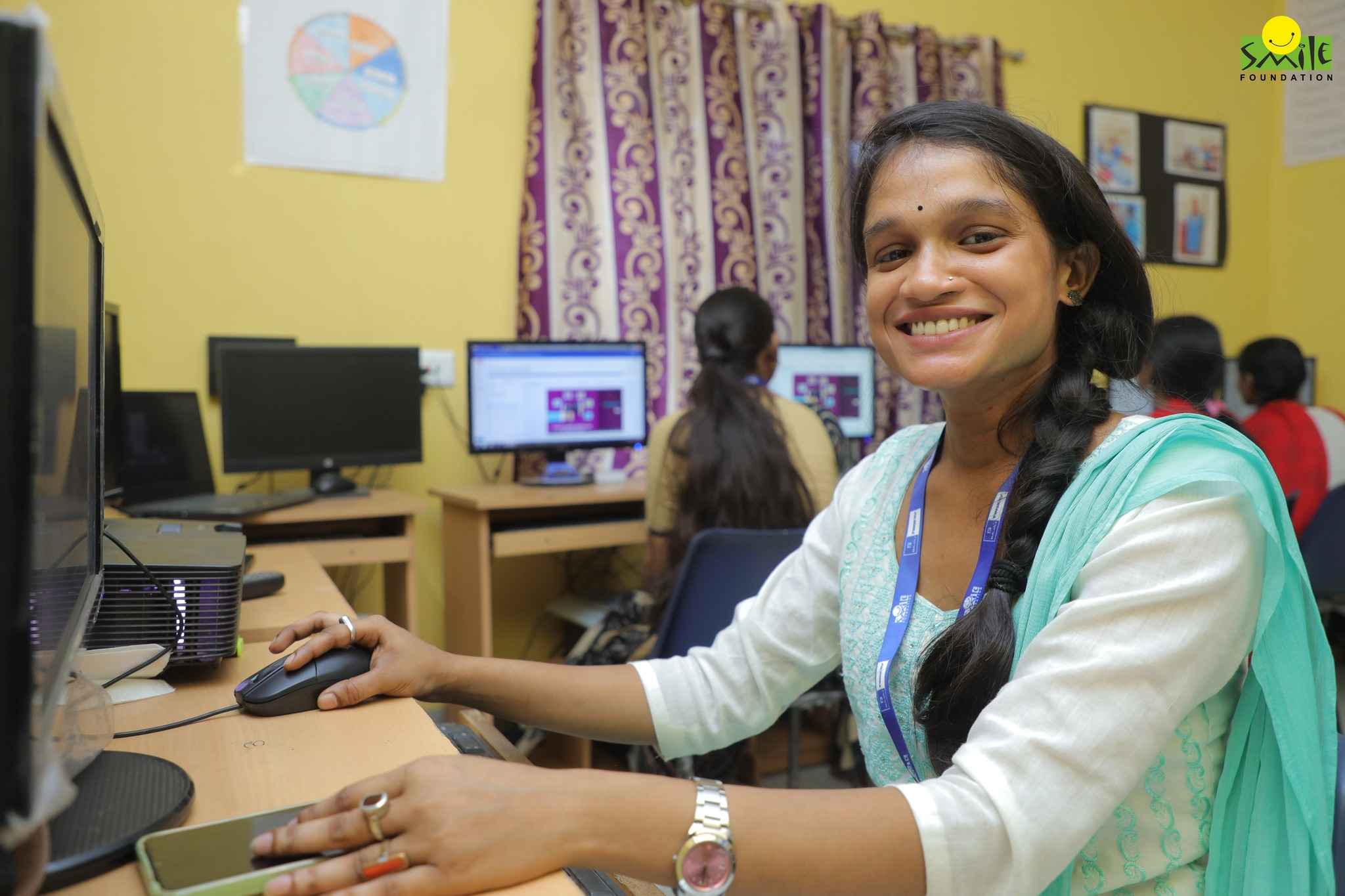
Smile Foundation’s approach to employability and livelihoods illustrates what ground-level intervention can look like. By combining STEM and experiential learning with digital literacy and offering vocational training across sectors including retail, healthcare, IT, digital marketing and skilled trades, the organisation works to build pathways to employment that do not depend on the traditional degree route. This kind of targeted, sector-specific skills development delivered to young people who might not otherwise access formal higher education is one of the most direct ways to address the gap between education and employment at the community level.
Demand-side intervention is ultimately the most significant lever available. Expanding access to higher education without corresponding job creation will continue to produce the imbalances that define the current crisis. Policy that actively supports growth in labour-intensive sectors, lowers barriers to entrepreneurship, strengthens the small and medium enterprise ecosystem and creates formal employment opportunities in underserved regions is not ancillary to education reform, it is integral to it.
Reimagining What Education Is For
The higher education ROI crisis in India reflects something deeper than a mismatch between supply and demand. It reflects a set of assumptions — about what education is for, who should pay for it and what it should deliver — that have not kept pace with the realities of a changing economy.
A degree remains meaningful. Knowledge, critical thinking and the networks formed during higher education carry real value that salary figures do not fully capture. But the promise that a degree — any degree, from any institution — will produce commensurate economic returns is one that India’s higher education system can no longer credibly make. And the consequences of continuing to make it fall most heavily on the families who can least afford to be wrong.
Rebuilding the relationship between education and economic opportunity in India requires honesty about this failure, structural reform across the supply and demand sides of the labour market, and a genuine expansion of the pathways through which young people can build productive, dignified working lives. The convocation photograph will continue to be taken. What needs to change is what it reliably represents.
Frequently Asked Questions (FAQs)
What is the higher education ROI crisis in India?
The higher education ROI crisis refers to the growing mismatch between the cost of obtaining a degree in India and its economic returns in the form of employment and salary. With engineering degrees costing upwards of ₹34 lakh and average starting salaries around ₹4.74 lakh per annum, graduates face payback periods that stretch across years and many face unemployment altogether. The crisis is structural rather than cyclical, reflecting misalignments between curriculum, industry requirements and labour market capacity.
How many graduates in India are unemployed?
India produces approximately five million graduates annually, of which only around 2.8 million find employment of any kind. Under 7% of Indian graduates secure a permanent salaried job within a year of graduating, and nearly 40% of graduates under 25 are unemployed. These figures reflect not a temporary labour market disruption but a persistent structural gap between the supply of graduates and the availability of quality formal-sector employment.
Why is the cost of higher education rising in India?
The cost of higher education in India has risen significantly due to the decline of public funding and the corresponding expansion of private higher education providers. More than 65% of India’s higher education institutions are now privately managed and these institutions charge fees that reflect the cost of delivery without the subsidy that public institutions historically provided. As a result, families bear an increasing share of educational cost and the financial risk of educational investment has shifted from the state to households.
What is the skills mismatch in India’s graduate labour market?
The skills mismatch refers to the gap between the competencies that India’s graduates possess and those that employers require. Surveys of employers consistently identify deficiencies in communication, applied technical skills and practical problem-solving among fresh graduates. This mismatch has led to a shift in hiring practices, with employers increasingly prioritising certifications, internships and demonstrable competencies over formal degree qualifications weakening the labour market value of a degree as a signal of employability.
How does the higher education ROI crisis affect low-income families?
For low-income families, the consequences of the higher education ROI crisis are particularly severe. Families who take loans or spend savings to finance a child’s degree on the expectation of future returns face significant financial vulnerability when employment outcomes fall short. Education loan repayment on a ₹4–5 lakh annual salary leaves little margin and debt can accumulate over years. The crisis also produces delayed financial independence, reduced household savings and the kind of economic vulnerability that limits future choices including the ability to invest in the next generation’s education.
What are vocational education alternatives in India?
India has made progress in building vocational education infrastructure through the National Skill Development Corporation and sector-specific skill councils. Programmes across sectors including retail, healthcare, IT, construction and financial services provide training pathways that do not depend on traditional degree routes. Organisations like Smile Foundation supplement this with targeted vocational training in areas including digital marketing, banking, electrical work and painting that connects young people with practical, employment-ready skills and specific sector opportunities. The challenge is not availability but social recognition — changing the perception that vocational pathways are fallback options rather than genuine career routes.
What policy changes are needed to address the higher education ROI crisis?
Effective policy responses need to address both the supply and demand sides of the problem. On the supply side, curriculum reform that aligns university programmes with industry requirements, mandatory internship components and transparent placement data reporting are all necessary. On the demand side, which is ultimately the most significant lever, policies that support growth in labour-intensive sectors, lower barriers to entrepreneurship, strengthen the small and medium enterprise ecosystem, and create formal employment in underserved regions are essential. Education reform alone cannot produce the employment that an expanding graduate population requires.
How can transparency in placement data help students make better decisions?
Currently, students choosing where and what to study have limited access to reliable, standardised information about the employment outcomes of graduates from specific institutions and programmes. Institutional marketing, which emphasises selective placement success stories is a poor substitute for systematic data. Mandating transparent, standardised reporting of placement rates, salary ranges and employment outcomes and making this information publicly accessible would allow students and families to make educational investment decisions based on evidence rather than aspiration. This kind of transparency is a necessary precondition for a more rational market in higher education and for reducing the information asymmetry that currently disadvantages students relative to institutions.