
Summary
- Many girls in India still drop out of school due to financial, social and infrastructural barriers. That’s why government schemes are important.
- The Right to Education Act guarantees free, compulsory education for children aged 6 to 14.
- Schemes like Samagra Shiksha, NPEGEL and KGBV target retention and access for disadvantaged girls.
- Scholarship programmes like AICTE Pragati and CBSE Udaan support girls in technical education.
- Smile Foundation’s Mission Education complements these efforts for marginalised communities.

With all the progress we’ve made in education and empowering women, it’s disheartening to see that many girls are still kept from getting an education or end up dropping out for various reasons. Education has consistently been one of the most potent instruments for transforming lives, and its importance, particularly for the girl child through government schemes, cannot be overstated. However, the transition from school to higher education remains uncertain for millions of girls in India. Their learning experiences are still being influenced by financial struggles, social obstacles, inadequate infrastructure and limited access to quality education, particularly in rural and underserved areas.
Despite the swift expansion of digital learning in recent years, access remains uneven. Schools in remote regions frequently encounter shortages of teachers, technology and fundamental facilities, while numerous families continue to struggle to afford school-related expenses.
The state has implemented numerous government schemes to enhance the learning outcomes, retention and accessibility of girls in response to these challenges. The objective of these government initiatives for girl child education is to guarantee that financial constraints do not impede the academic pursuits of young girls.
The Significance of Government Schemes
India has made significant progress in enhancing access to education since achieving independence. Several government schemes for girl child education have been initiated. A critical step toward greater inclusion, the Right to Education Act of 2009 was a game-changer, guaranteeing that every child between the ages of six and fourteen receives free and compulsory education.
However, having access to education alone cannot guarantee success. Many girls still drop out of their secondary school as a result of financial issues, family duties, safety issues or lack of educational support.
This is when government schemes come into play. They are crucial in helping families cover the costs of education, encouraging consistent school attendance, upgrading infrastructure and creating opportunities for girls to continue their education beyond the classroom.

Government Schemes for Girl Child Education
Samagra Shiksha
Samagra Shiksha, which commenced in 2018-19, is one of India’s most ambitious education initiatives. It integrates the previous Sarva Shiksha Abhiyan, Rashtriya Madhyamik Shiksha Abhiyan and Teacher Education programmes into a unified framework that encompasses infancy through senior secondary education.
Out of all the government schemes, this improves the infrastructure of schools by constructing classrooms, establishing residential schools, and offering complimentary textbooks, uniforms and transportation services. In addition, it provides support for children with disabilities, including stipends for girls with special needs, strengthens Kasturba Gandhi Balika Vidyalayas and includes special measures for out-of-school children.
Sarva Shiksha Abhiyan (SSA)
Sarva Shiksha Abhiyan was launched in 2001 to ensure the provision of elementary education to all children in the age group of 6-14 years.
The programme sought to boost enrolment, improve learning outcomes, reduce gender inequities and improve school infrastructure. It was crucial to broaden access to basic education throughout the country.
National Programme for the Education of Girls at the Elementary Level (NPEGEL)
NPEGEL was developed to assist girls who were at risk of being excluded from the education system, particularly those from Scheduled Castes, Scheduled Tribes, minority communities and regions with educational disadvantages. This initiative provided additional assistance to enhance the learning opportunities, retention and enrolment of girls who were confronted with a variety of obstacles.
Beti Bachao, Beti Padhao
In 2015, Beti Bachao, Beti Padhao was established with the objective of promoting the education and empowerment of girls, as well as addressing gender discrimination.
The project out of all the government schemes supports the development of conditions that are conducive to the growth of girls, supports their education and values daughters. It has helped raise awareness about the importance of educating girls throughout the country.
National Scheme of Incentive to Girls for Secondary Education
The National Scheme of Incentive to Girls for Secondary Education promotes the girl child’s enrolment of 14-18 years age group at secondary stage, who passes class 8th and subsequently drops out for various socio-economic reasons. The proposed scheme is further intended to retain such girl children up to class 12th.
Rashtriya Madhyamik Shiksha Abhiyan (RMSA)
In 2009, RMSA was established with the objective of enhancing the availability of high-quality secondary education.
Strengthening school infrastructure, extending educational opportunities in underserved areas and guaranteeing that secondary schools were accessible to children from marginalised communities were the primary objectives of the initiative.
Kasturba Gandhi Balika Vidyalaya (KGBV)
The initiative provides residential schooling for girls from disadvantaged households in educationally disadvantaged areas. These institutions offer a safe and enabling environment for girls who otherwise face difficulties to education such as poverty, remoteness or societal barriers.
Sukanya Samriddhi Yojana
Sukanya Samriddhi Yojana, despite its primary function as a savings scheme, is committed to the long-term educational aspirations of girls. A financial cushion that can be used to cover future requirements and higher education expenses can be established by parents who invest in a dedicated account for their daughters.
Scholarships to Advance the Education of Women
The government has implemented targeted scholarship programmes in addition to broader education initiatives to motivate girls to pursue technical careers and higher education.

AICTE Pragati Scholarship for Women
The AICTE Pragati Scholarship is designed to encourage technical education among girl students who are pursuing engineering, architecture, pharmacy and related fields. The programmes provides financial support to 4,000 female students annually, enabling them to pursue professional education without an undue financial burden, with a maximum of ₹30,000.
CBSE Udaan Programme
The CBSE Udaan Programme is designed to resolve the under-representation of girls in technical and engineering institutions. It offers academic support, mentoring, virtual classes and free online learning resources to aid girls in the preparation of competitive entrance examinations for Physics, Chemistry and Mathematics in Classes 11 and 12.
How Smile Foundation is contributing to educational equity?
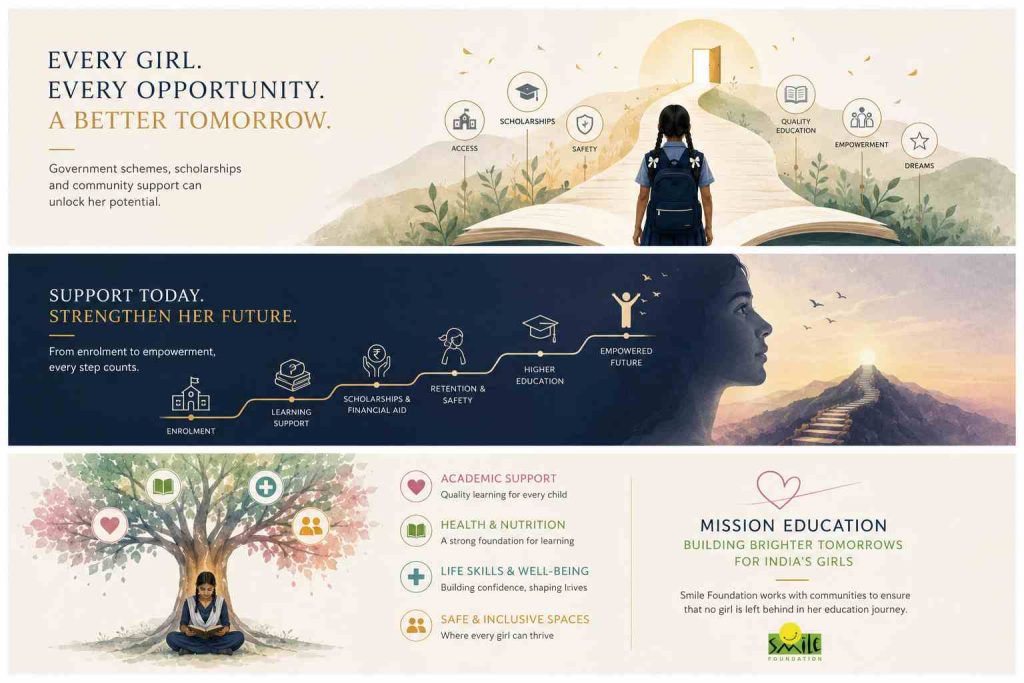
Collaboration beyond government initiatives is necessary to address these disparities. Mission Education, the flagship programme of the Smile Foundation, is dedicated to guaranteeing that children from marginalised communities have access to inclusive, high-quality education. The programme acknowledges that learning outcomes are influenced by a variety of factors, integrating academic support, healthcare, nutrition, life skills and emotional well-being.
Mission Education is designed to assist students from low-income families, tribal communities, remote villages, disaster-affected regions, conflict zones and other underserved populations, in accordance with the National Education Policy 2020 and Sustainable Development Goal 4.
The programme assists in the establishment of pathways for long-term educational success and social mobility by confronting the barriers that frequently result in children dropping out of school.
The journey is still in progress. In order to make a deeper impact, we must continue to allocate resources to quality education, improve our implementation efforts, keep the communities informed, facilitate in accessing these programmes and garner community support. This approach ensures that every girl, regardless of her circumstances, has the opportunity to develop, learn and give direction to her own future. When girls receive the education they deserve, the families, communities and entire generations move forward with them.
Frequently Asked Questions (FAQs)
1. What is the Right to Education Act?
It guarantees free and compulsory education for all children aged 6 to 14 in India.
2. What is Samagra Shiksha?
It’s a unified government scheme covering education from preschool to senior secondary level.
3. Who benefits from Kasturba Gandhi Balika Vidyalayas?
Girls from disadvantaged backgrounds in educationally backward areas get safe, residential schooling.
4. What does the AICTE Pragati Scholarship support?
It funds technical education for 4,000 female students annually, up to ₹30,000 each.
5. How does Smile Foundation support girl child education?
Through Mission Education, it provides academic, health, nutrition and emotional support to marginalised children.
Sources