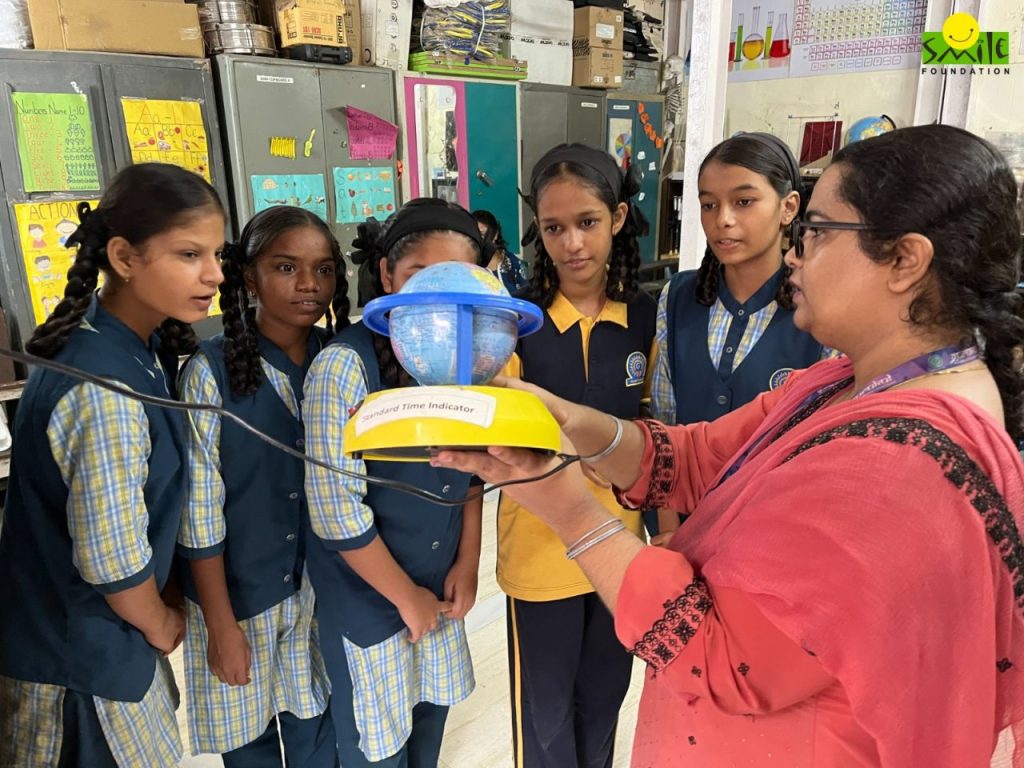
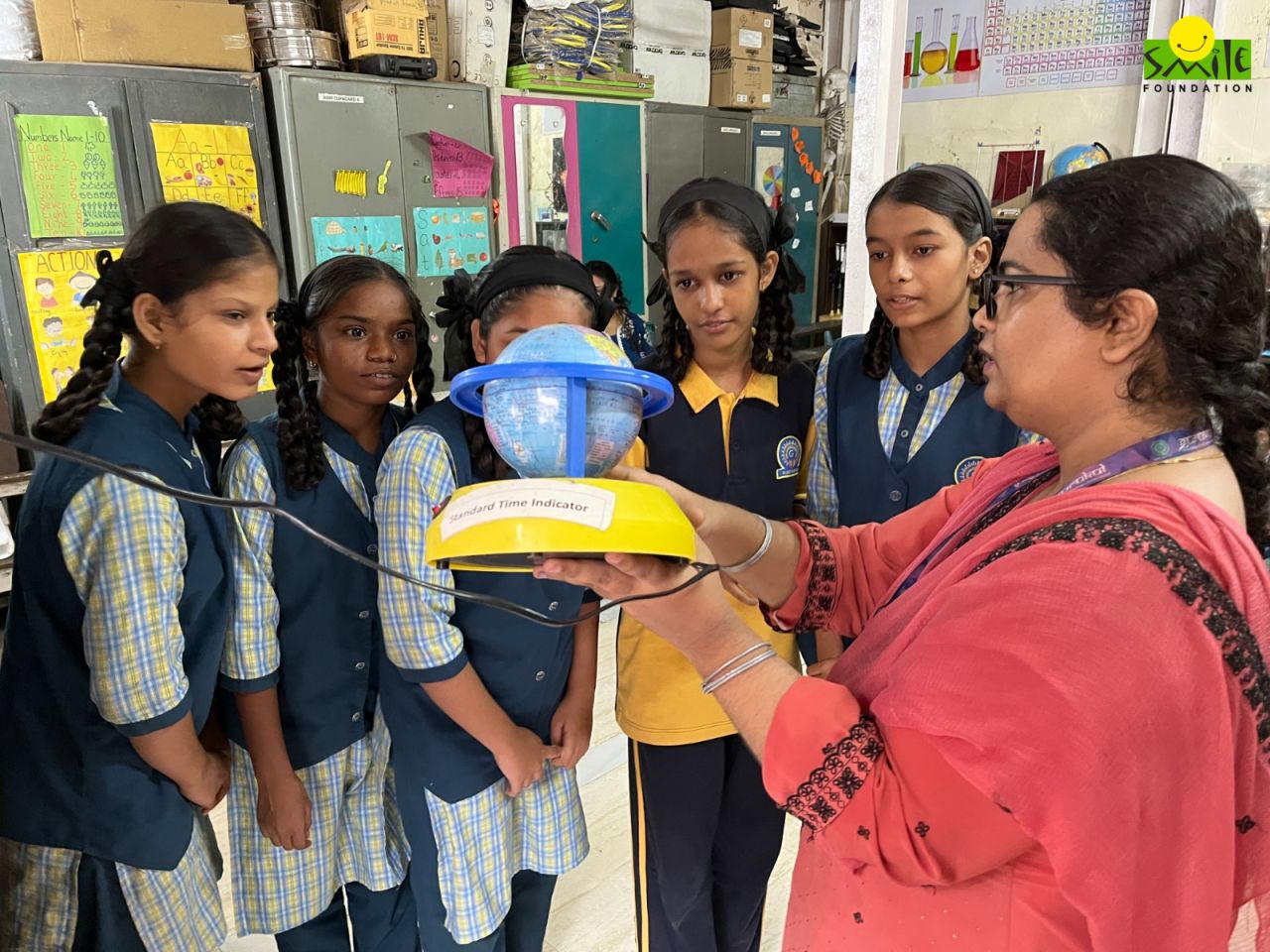

The ribbon is cut, the photographs are taken and the new science lab looks wonderful. Six months later the door is locked. Nobody trained the teacher. Nobody budgeted for chemicals and batteries. One microscope broke in the first month and was never repaired, and the girls in Class 8 have hardly been inside.
Anyone who has worked around school labs will recognise some part of that picture. The lab was never the problem. What went missing was everything that makes a lab useful: a confident teacher, a slot in the timetable, a repair budget and a reason for every child to walk in.
The short answer. CSR STEM education programs are corporate-funded efforts to improve how science, technology, engineering and maths are taught in schools. They work best when the money goes beyond building a lab and pays for what keeps it in use: continuing teacher training, activities tied to the textbook, access for girls, upkeep, links to careers and a way to measure results.
Key takeaways
- India is not short of labs. The government has set up 10,000 Atal Tinkering Labs and plans 50,000 more in government schools. One more lab adds less than it used to.
- Learning drops as children move up. In state government schools, average maths scores fall from 61% in Class 3 to 33% in Class 9, according to the national PARAKH survey.
- Girls keep pace in school, then thin out later. Girls and boys score almost the same in maths and science. The gap opens afterwards, in STEM jobs and leadership.
- Equipment fails without upkeep. More than one lakh schools have computers that no longer work for teaching.
- The best use of CSR money is the unglamorous part: teachers, timetables, repairs, parents and follow-up.
Why is a school lab alone not enough?
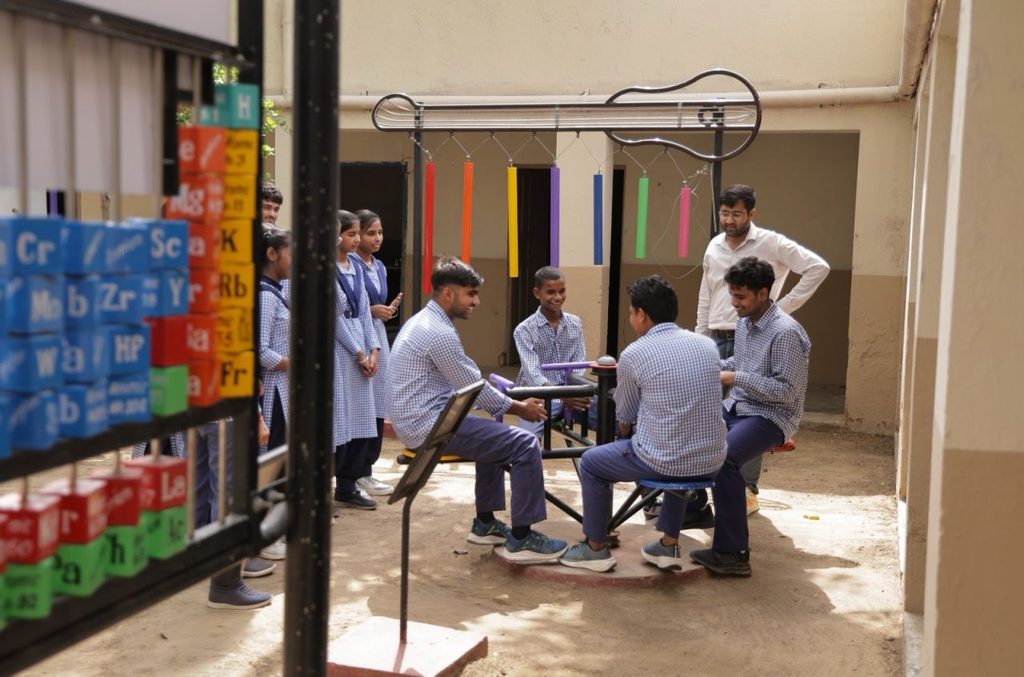
A lab is not enough because equipment does not teach. Children learn science from a teacher who uses that equipment in regular lessons, and most lab grants pay for the room and stop there.
India already has plenty of labs. The government has set up 10,000 Atal Tinkering Labs since 2016, and the 2025-26 Union Budget announced 50,000 more in government schools over five years. A company that simply adds another one joins a long queue.
Corporate teams often sense this. But annual reports reward what a camera can capture, so the lab keeps winning.
Meanwhile, the basics wobble. UDISE+ 2025-26 shows that 69.9% of schools have computers but only 63.1% have ones that work for teaching, and 67.4% have internet. That gap is more than one lakh schools holding equipment nobody maintains.
Learning tells the same story. The government’s PARAKH Rashtriya Sarvekshan 2024 tested 21 lakh students in 74,229 schools. Children in state government schools start level with everyone else and fall behind as the subjects get harder.
| Average maths score | State government schools | Private schools | Central government schools |
|---|---|---|---|
| Class 3 | 61% | 60% | 57% |
| Class 6 | 43% | 49% | 61% |
| Class 9 | 33% | 39% | 48% |
Science follows the same pattern. By Class 9, state government schools average 37% against 44% in private schools.
The drop happens in exactly the years when science turns from stories into experiments. That is where a well-used lab, and a well-supported teacher, can make the difference.
Seven ways CSR STEM education programs can go beyond labs
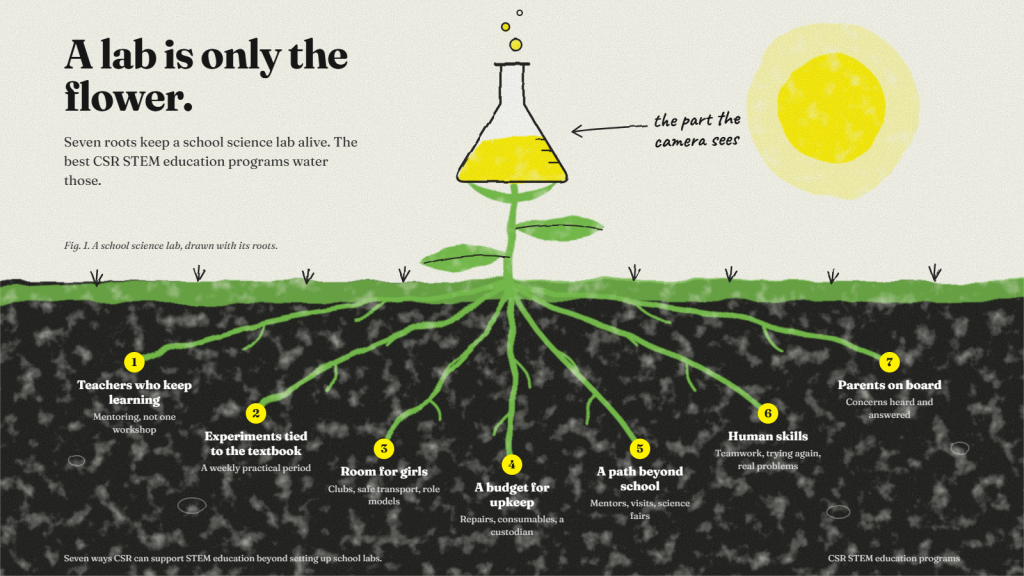
CSR money does its real work when it reaches the people and routines around the lab. These seven areas are where to point it, roughly in order of impact.
1. Pay for teachers to keep learning
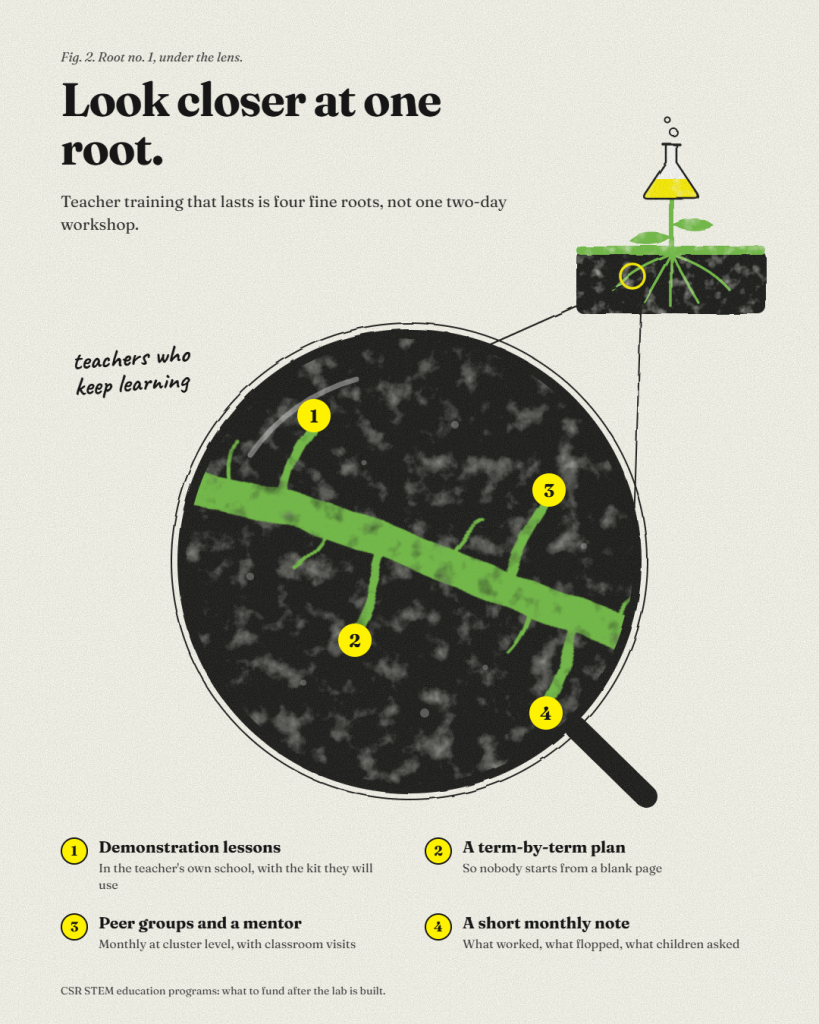
A two-day workshop will not change how a science teacher works. Teachers who feel supported experiment more, and those left alone retreat to the textbook. Fund training that keeps going, and build it in parts:
- Demonstration lessons in the teacher’s own school, with the kit they will actually use, so they try every experiment before they teach it.
- A term-by-term plan of activities, so nobody starts from a blank page.
- Monthly peer groups at cluster level, plus a mentor who visits the classroom and gives honest feedback.
- A short monthly note from each teacher. A few lines on what worked, what flopped and what children asked will show you where to help next.
Good training leaves a teacher able to do four things:
- Run simple experiments with low-cost, local materials, so a chapter becomes something children do and not something they copy off the board.
- Pose a problem and let the class work towards the answer.
- Tie chapters to the handpump, the family farm, the monsoon or the mobile phone, so science feels close to home.
- Use what the school already has, from free digital content to basic coding on a shared computer.
A teacher who knows the topic well teaches it boldly. A class that sees its teacher enjoy science is more likely to join in.
2. Tie every experiment to the textbook
An activity that does not match the syllabus gets dropped the week before exams. Match each one to a chapter, write the instructions in the regional language and let teachers help draft them.
Talk to the headteacher about a weekly practical period before you buy anything. The test is simple: does the lab get used in timetabled lessons, or only on visitor days?
3. Make room for girls
Girls do not fall behind in school science. In the PARAKH survey, girls and boys in Class 9 scored within one percentage point of each other in both maths and science. Women also make up nearly 43% of India’s STEM graduates. The losses come later, on the way into STEM jobs and leadership.
So the task in school is to keep the door open. Ask girls what stops them. The answer is often practical: a long walk, a late bus, chores at home. Money can fix practical problems.
- Start girls’ science clubs and give them real lab time.
- Bring in women scientists and engineers, in person or on a call.
- Arrange safe transport to district science fairs.
- Talk to parents, and track who joins and who stays.
4. Budget for upkeep
Equipment breaks, kits run out and the power fails. Plan for all three in the grant itself:
- Set aside money each year for repairs and consumables.
- Name one custodian in every school.
- Ask your partner how the lab will run when the electricity does not. Power cuts and dust are ordinary hazards in village schools.
- Check every few months how many kits still work.
A lab with a repair budget in year three is worth more than two labs without one.
5. Build a path beyond the school gate
A child in a village may never have met an engineer. Employees can change that at almost no cost:
- Mentor a group of students through a term.
- Host a visit to a plant, a lab or an office.
- Judge the school science fair.
Local industries and ITIs can show children where a physics lesson leads. A single visit can widen what a child thinks is possible. Ask students what they plan to study next, once at the start of the program and once at the end.
6. Teach the human skills alongside the science
Good scientists argue, fail, try again and listen. Children need practice at all four, and a lab rarely supplies it by accident. Build it into how the activities run:
- Rotate the roles. In every experiment, one child measures, one records and one reports. Change the roles each week so quieter children, and girls in particular, get their turn to lead.
- Praise the attempt. Train teachers to say “not yet” where they would have said “wrong”, and to ask what the child will try next. That keeps maths from becoming a place to give up.
- Talk about what failed. End each practical by asking what went wrong and what it taught. Failure becomes information.
- Solve a real problem. Ask children to fix the school’s leaking tap or dusty playground, and to talk to the people affected before they build anything. That is empathy and responsibility in practice.
7. Bring parents in
Parents decide whether a child stays for the science club, takes the bus to the fair or chooses science in Class 11. Explain what STEM learning is and what it can lead to, and listen to their worries.
You will not have an answer to every concern on the spot. Promising to look into it, and then doing so, builds trust. Write each concern down, work on it and tell parents what happened.
What can you do, whoever you are?
You do not need a CSR budget to move any of this forward. Each person around a school has one step that costs little and matters a lot.
| If you are | One thing to do first |
|---|---|
| A CSR or sustainability head | Split the grant before you sign it: a share for the lab, and a ring-fenced share for training, consumables and repairs across at least three years |
| A school head | Put a weekly practical period on the timetable and name one teacher as lab custodian |
| A science or maths teacher | Try one low-cost experiment a week, and write three lines on how it went |
| A parent | Ask your child what they did in the lab this week, and say yes to the science club |
| An employee volunteer | Offer one hour a month: a talk, a mentoring call or a seat on the science fair jury |
| An NGO or implementing partner | Report how often the lab is used, not only that it was built |
How do you choose the right implementing partner?
Choose the partner on what it has already achieved in schools like yours, because the partner decides most of the outcome. A good proposal is easy to write. A finished project that still works is harder to fake.
Take time over these questions:
- Which districts have you worked in, and for how long?
- How exactly do you train teachers, and how often do you go back?
- Can you share an impact report from a project that has ended?
- Who answers the phone when a school reports a fault?
- How do you make sure girls get equal time in the lab?
- What happens in the school after our funding stops?
A vague answer on teacher training tells you most of what you need to know. If you can, visit two of the partner’s earlier schools without warning. A good partner will welcome that.
How do you know a STEM program is working?
A STEM program is working when the lab is used every week and children can do things they could not do before. Counting labs built or kits delivered tells you what was bought, not what changed.
Record a baseline before the program starts, then track a handful of measures each term.
| What to track | How to record it |
|---|---|
| Lab use | Timetabled practical periods actually held each week |
| Teacher confidence | Experiments each teacher ran this term, from their monthly notes |
| Girls’ participation | Share of girls in practicals, clubs and science fairs |
| Working equipment | Kits and computers that function at each check |
| Learning | A short before-and-after test on the chapters covered |
| Aspirations | What students say they plan to study next, at the start and end |
Share the results with the school and the funder, including the numbers that disappoint. A program that reports its failures is usually one that fixes them.
Frequently asked questions (FAQs): CSR STEM education programs
What are CSR STEM education programs?
CSR STEM education programs are those funded from a company’s corporate social responsibility budget to improve how science, technology, engineering and maths are taught, usually in government or low-income schools. It can include labs, teacher training, learning materials, clubs, mentoring and career exposure.
Can CSR funds be used for STEM education in India?
Yes. Promoting education is listed in Schedule VII of the Companies Act, which sets out the activities eligible for CSR spending. Under Section 135, eligible companies spend 2% of their average net profit on such activities. Companies should confirm the details with their own CSR and compliance teams.
Why do school STEM labs go unused?
The usual reasons are an untrained or unsupported teacher, no slot in the timetable, no money for consumables and repairs, unreliable power, and activities that do not match the syllabus. All of them can be fixed in the grant design.
What should a CSR STEM budget cover besides the lab?
Continuing teacher training, classroom mentoring, consumables, repairs, teaching materials in the regional language, transport and clubs for girls, parent meetings, and measurement. Plan for at least three years of support.
How can CSR programs support girls in STEM?
By removing the practical barriers that keep girls out of the lab: safe transport, timings that work around home duties, girls’ science clubs, women role models and conversations with parents. Then track who joins and who stays.
How is a STEM lab different from an Atal Tinkering Lab?
An Atal Tinkering Lab is a government-funded makerspace set up under the Atal Innovation Mission, with tools such as electronics kits and 3D printers. A STEM lab is a broader term for any space equipped for hands-on science and maths. Both depend on the same things to succeed: a trained teacher, regular use and upkeep.
The lab is the start
Labs matter. A child who has wired a circuit or watched a seed split under a lens remembers it for years. But the lab is where a program begins, and the returns come from what surrounds it: a teacher who is not left alone, a period on the timetable, a girl who is expected to be there, a parent who understands why, and a repair that happens within a week.
The next time a proposal arrives with a photograph of a new lab on the cover, turn to the budget page. If training, upkeep and follow-up are on it, the program is worth a closer look.
To see how we combine labs with teacher training, girls’ participation and regular reporting, read about our STEM work or talk to our CSR partnerships team.
Sources
- UDISE+ 2025-26 school infrastructure analysis, Education for All in India (primary data: Ministry of Education, UDISE+ 2025-26)
- PARAKH Rashtriya Sarvekshan 2024 results, Careers360 (primary data: NCERT PARAKH)
- India crosses 10,000 Atal Tinkering Labs, government plans 50,000 more, TICE News
- Over 40% of Indian STEM graduates are women, The Quint
- STEM-focused teacher training, Smile Foundation
- STEM education, ATS Club
- STEM education: more than robotics, Chitti