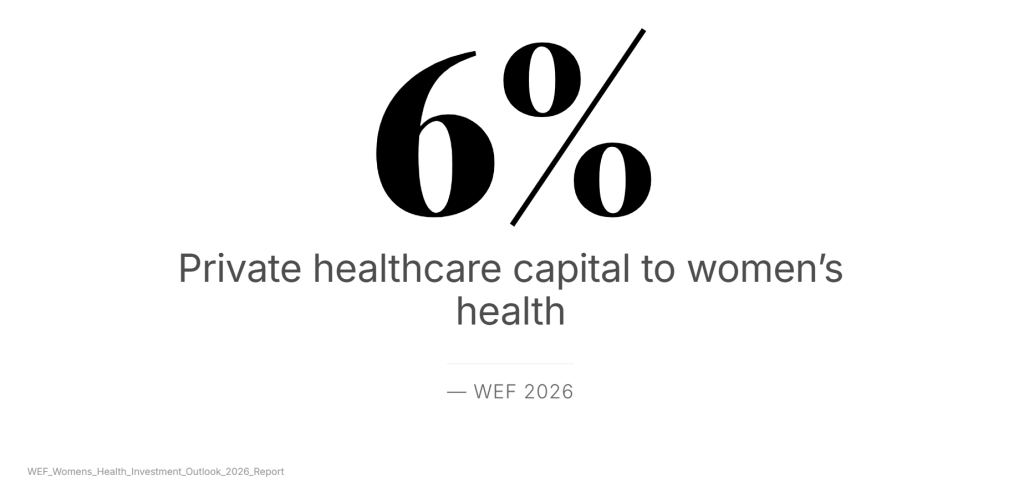
Globally, women’s health receives only 6% of private healthcare investment . Much of that funding is concentrated in reproductive health, maternal care and women’s cancers. But women’s health extends far beyond childbirth. In India, national data reveals how structural neglect translates into measurable risk.
Anaemia: The Silent Normal
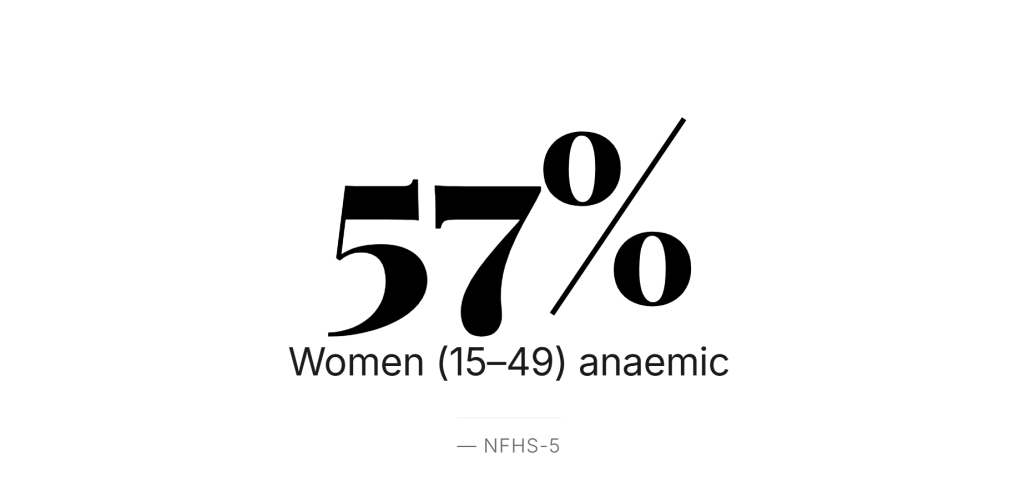
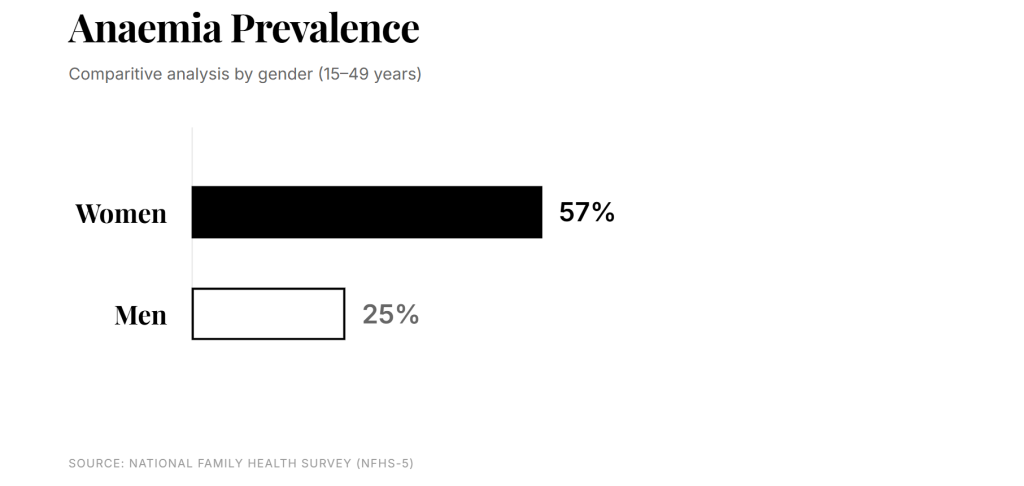
The National Family Health Survey (NFHS-5, 2019–21) reports that 57% of women aged 15–49 in India are anaemic. Among adolescent girls (15–19 years), the rate exceeds 59%.
Anaemia is not a minor condition. It affects cognitive functioning, work capacity, pregnancy outcomes and long-term cardiovascular health. Yet in many communities, it is so common that it is perceived as inevitable.
The cost is not only medical. It is educational and economic. Fatigue impairs concentration. Repeated illness disrupts schooling. Maternal anaemia increases the likelihood of low birth weight, perpetuating intergenerational disadvantage.
The Rising Burden of Non-Communicable Diseases
While maternal mortality has declined significantly over the past two decades, India now faces a growing epidemic of non-communicable diseases (NCDs) among women.
According to NFHS-5:
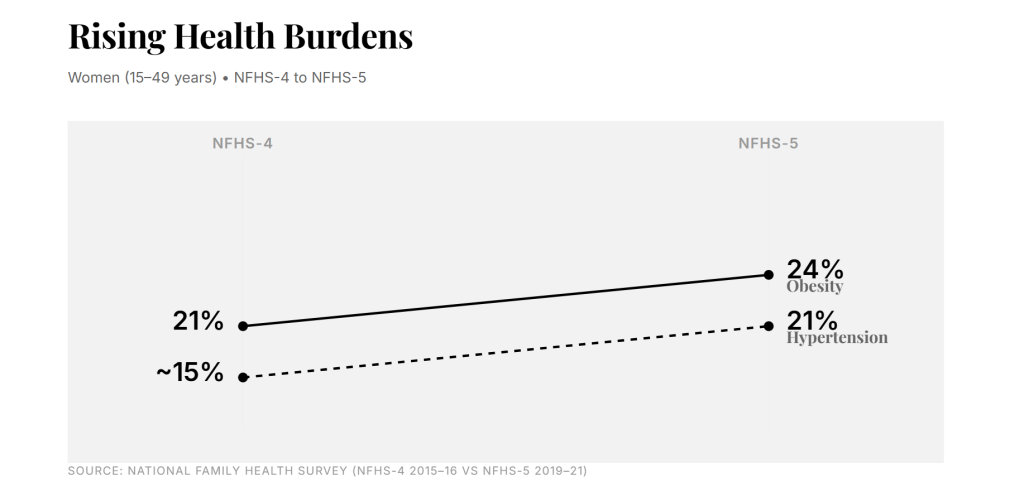
21% of women aged 15–49 are overweight or obese, up sharply from NFHS-4.
Nearly 11% of women have high blood sugar levels, indicating rising diabetes risk.
Hypertension prevalence among women has steadily increased, particularly in urban and peri-urban regions.
Cardiovascular disease is now one of the leading causes of death among women in India. But awareness remains low, and symptoms are frequently misinterpreted.
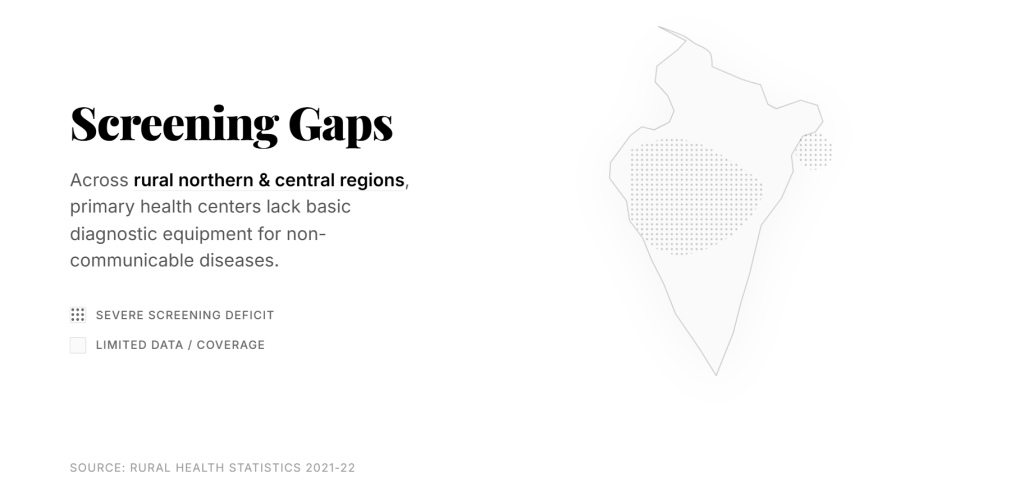
Under the National Programme for Prevention and Control of Cancer, Diabetes, Cardiovascular Diseases and Stroke (NPCDCS), the National Health Mission has expanded screening initiatives at the primary care level. Millions of individuals have been screened for hypertension and diabetes. However, screening coverage remains uneven, particularly in underserved rural and informal urban settlements.
The gap lies not only in availability but in continuity. Screening must translate into sustained management, follow-up, and awareness — especially for women who often prioritise family health over their own.
Maternal Health Gains and Persistent Gaps
India has made measurable progress in maternal health. According to the Sample Registration System (SRS), the Maternal Mortality Ratio (MMR) declined to 97 per 100,000 live births (2018–20). Institutional deliveries now exceed 88% nationally (NFHS-5).
Yet improved survival does not equate to comprehensive health.
Postnatal care, mental health screening and long-term metabolic monitoring remain limited. Postpartum depression remains underdiagnosed. Women with gestational diabetes often receive little follow-up, despite increased lifetime risk of Type 2 diabetes.
The policy architecture has strengthened. The life-course support system has not kept pace.
Mental Health: Data and Silence
National surveys indicate that women are more likely than men to report symptoms of anxiety and depression. However, mental health service utilisation remains low due to stigma, limited availability and cultural barriers.
In low-resource communities, psychosocial stress is compounded by economic precarity, domestic responsibilities and restricted mobility. Yet mental health remains marginal in women’s health conversations.
This silence has consequences — for parenting, productivity and long-term wellbeing.
Adolescent Health: The Overlooked Window
The adolescent period is a critical intervention point.
NFHS-5 shows persistent high anaemia levels among adolescent girls. Early marriage, though declining, continues in several states. Nutrition gaps during adolescence affect not only immediate cognitive development but also maternal health later in life.
Programmes under the National Health Mission and POSHAN Abhiyaan aim to address these deficits. But effective change requires sustained community engagement, accurate health literacy and access to screening — not only policy announcements.
Environmental and Socioeconomic Risk
Health burdens are not evenly distributed.
Lower-income households are more likely to reside in areas with poor air quality, limited sanitation and constrained healthcare access. Women in such environments face compounded exposure — indoor air pollution from cooking fuels, inadequate nutrition and limited preventive care.
These overlapping risks magnify vulnerability.
Community-Level Interventions: Bridging Immediate Gapsfor Underinvestment in Women’s Health
In underserved communities, non-governmental initiatives often function as the first line of access.
Mobile healthcare units — such as those operated under Smile Foundation’s Smile on Wheels programme — conduct:
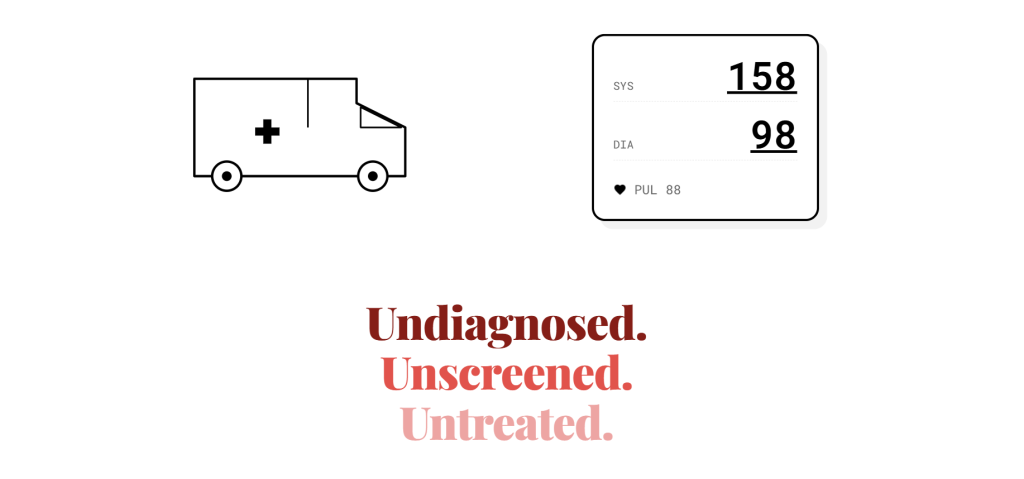
Blood pressure and blood sugar screening
Anaemia detection
Antenatal check-ups
Nutrition counselling
Referral support
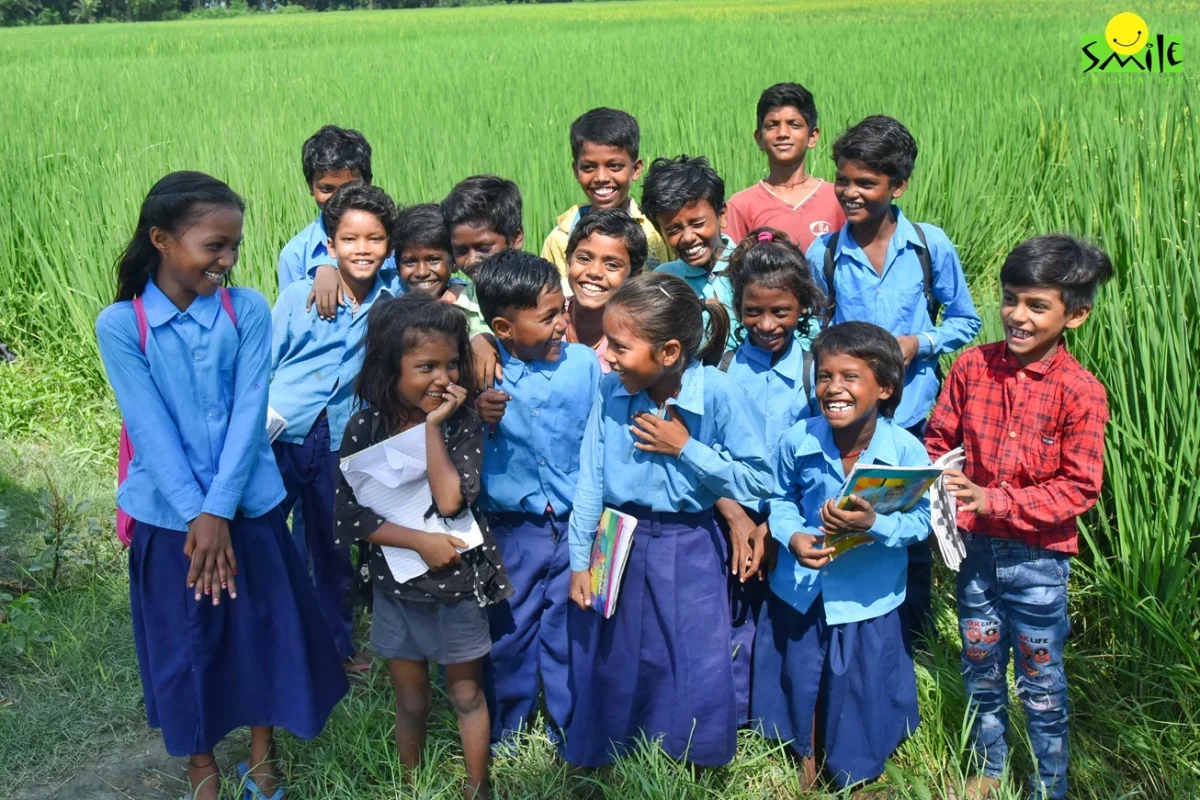
School-based programmes address menstrual hygiene, adolescent nutrition and early health awareness. Community sessions create safe spaces to discuss symptoms that might otherwise remain hidden.
These interventions do not replace systemic reform. But they address immediate diagnostic gaps and strengthen health literacy.
The Economic Argument
The World Economic Forum’s 2026 analysis argues that women’s health is not only a social imperative but an economic one . Healthier women participate more consistently in the workforce, reduce healthcare shocks and support stronger educational outcomes for children.
In India, where women’s labour force participation remains comparatively low, health barriers represent a structural constraint.
Preventive investment yields compound returns.
The Structural Question
India’s public health infrastructure has expanded screening and institutional delivery rates. Yet preventive, life-cycle-based women’s healthcare remains fragmented.
Underinvestment — globally and nationally — shapes what is prioritised. When funding and innovation focus narrowly on maternal care, broader metabolic, cardiovascular and mental health conditions receive less systematic attention.
The result is not absence of care. It is partial care.
Reframing Women’s Health
Women’s health is not confined to reproductive years. It spans adolescence, early adulthood, mid-life metabolic risk and ageing-related conditions.
If anaemia affects more than half of reproductive-age women, if obesity and hypertension are rising, and if mental health remains marginalised, then the issue is not niche.
It is foundational.
The invisible epidemic is not defined by a single disease. It is defined by cumulative neglect — of screening, awareness, and preventive continuity.
Correcting this imbalance requires:
Stronger primary healthcare integration
Gender-sensitive NCD screening protocols
Mental health inclusion
Community-based health literacy
Public-private collaboration
Women’s health is infrastructure. It underpins education, economic stability, and intergenerational resilience.
The data already exists. The question is whether investment and implementation will follow.
The Union Budget 2026–27 makes an unambiguous statement: India’s human capital strategy is being recalibrated. Education is no longer framed as an isolated social sector; it is positioned as economic infrastructure directly linked to employment, enterprise and global competitiveness.
For decades, policy discussions have oscillated between access and quality. This year’s Budget attempts something more structural. It moves beyond expanding degrees to creating employment pathways. It signals a shift from “education for education’s sake” to education as labour market alignment.
Whether this pivot succeeds will depend less on announcements and more on execution, particularly for those who remain outside formal opportunity networks.
From Institutions to Ecosystems
The Budget’s allocations and announcements reflect a strategic alignment with labour-intensive sectors such as agriculture, textiles, leather, toys and MSMEs, alongside growth sectors such as healthcare, pharmaceuticals, hospitality, and creative technologies.
The ₹10,000 crore Biopharma SHAKTI Mission, expansion of clinical trial sites and establishment of new NIPERs indicate a deliberate push toward higher-value innovation in pharmaceuticals. Simultaneously, the target to train one lakh allied health professionals and 1.5 lakh multi-skilled caregivers suggests recognition of both domestic shortages and global demand.
These measures reflect a broader understanding: skilling must move beyond generic certification toward job-role specificity.
However, India’s employment challenge has rarely been one of aspiration. It has been one of transition. The gap between schooling and employability persists, particularly for first-generation learners.
Bridging that gap requires more than sectoral expansion. It demands foundational strengthening.
The Question of Foundational Readiness
The success of industry-integrated pathways depends on the preparedness of the student base. Without strong literacy, numeracy and digital fluency, advanced skill ecosystems remain inaccessible.
India has made measurable gains in enrolment. However, learning outcomes continue to reveal uneven readiness across regions and socio-economic groups. For students from rural or low-income urban communities, the barriers are cumulative: language gaps, limited exposure to industry environments, financial constraints and health vulnerabilities.
Budget 2026’s emphasis on AI integration and digital capability is forward-looking. But technological embedding without equity safeguards risks widening divides. Advanced sectors reward foundational competence; they do not compensate for its absence.
Healthcare as Employment Strategy
The Budget’s expansion of medical education hubs and allied health training reflects an understanding of healthcare as both a social necessity and an economic opportunity.
India’s demographic advantage can translate into a global healthcare workforce, particularly as ageing populations in developed economies increase demand for skilled caregivers and technicians.
However, such ambition must be anchored in primary health stability. Young people cannot enter or sustain employment pathways if untreated health conditions disrupt continuity. Preventive healthcare access, particularly for women and adolescent girls, becomes not only a welfare priority but a labour market enabler.
Community-based interventions including mobile healthcare units and school-linked health programmes illustrate how health and employability are intertwined at the ground level.
Creative Economies and Regional Inclusion
The establishment of institutions such as the Indian Institute of Creative Technologies and the proposed National Institute of Design in the North-East reflects an attempt to diversify opportunity beyond conventional engineering and medicine tracks.
Such initiatives acknowledge that India’s growth sectors include entertainment, digital media, design, and hospitality. Importantly, they also signal regional inclusion integrating local cultural traditions into mainstream economic pathways.
Yet regional institutions must ensure that access is not limited to those already positioned advantageously. Scholarship mechanisms, hostel infrastructure and mentoring ecosystems will determine whether inclusion is substantive or symbolic.
Women’s Workforce Participation
One of the more consequential aspects of the Budget is its targeted intervention for women’s participation. The proposal to establish girls’ hostels in every district addresses a structural barrier to STEM education: mobility and safety.
Simultaneously, mechanisms such as the SME Growth Fund, Corporate Mitra programme and SHE Marts aim to strengthen women-led enterprises and self-help groups.
India’s female labour force participation remains lower than many comparable economies. Education gains have not fully translated into economic participation. Bridging this gap requires integrated support — health access, financial literacy, capital, market linkage and safe mobility.
Policy intent is visible. The challenge will lie in convergence.
University Townships and Industry Proximity
Perhaps the most ambitious structural proposal is the creation of university townships near industrial corridors integrated Knowledge-Industrial-Economic Zones designed to foster collaboration between academia and industry.
If implemented effectively, such ecosystems could reduce curriculum obsolescence and strengthen applied learning. Students exposed to real-time production environments are more likely to transition smoothly into employment.
However, proximity does not guarantee participation. Students from disadvantaged backgrounds often require mentorship, preparatory training and social capital to navigate such spaces confidently.
Industry-academia integration must therefore be accompanied by social inclusion frameworks.
The Demographic Window
India’s demographic dividend remains both an opportunity and a constraint. The window for translating youth population into productive capital is finite.
Budget 2026 articulates a coherent framework linking education, skilling, enterprise, and employment. It reflects alignment with the philosophy of the National Education Policy 2020, particularly in embedding multidisciplinary learning, industry integration and entrepreneurship.
Yet structural reform at scale requires sustained coordination across ministries, state governments, institutions and private partners.
It also requires attention to foundational inequities.
From Allocation to Access
Policy announcements set direction. Transformation depends on access.
For communities on the margins, the path from classroom to career remains fragile. Health disruptions, financial stress and lack of mentorship frequently interrupt trajectories.
Organizations working at the community level through education support, skill development, women’s empowerment and preventive healthcare — often operate at the hinge point between policy ambition and lived reality.
The Budget’s decisive shift toward employment-linked education is welcome. But its success will be measured not by institutional expansion alone, but by whether the pathways it creates are navigable for all segments of India’s youth.
Education, framed as infrastructure, must serve inclusion as much as competitiveness.
Only then will the promise of human capital translate into equitable growth.
Every March 8, organisations across India mark International Women’s Day with cakes, banners, and one-hour panel discussions. By March 9, the conversation is over. The gender gap is not.
India now ranks 131st out of 148 countries on the WEF Global Gender Gap Index 2025 — two places lower than the previous year — with a gender parity score of just 64.4%. At the current global pace, full gender parity will take 123 more years. And within India’s own corporate boardrooms, women hold only 20% of board seats in the top 200 NSE-listed companies, with a mere 9% serving as board chairs (Russell Reynolds Associates, 2025).
Women’s Day employee engagement activities — when designed with intention — can change that. Not through symbolism, but through direct, measurable connection between your workforce and women who need structural support the most.
This guide outlines how corporates can use International Women’s Day 2026 to create employee engagement experiences that go beyond the office — reaching women beneficiaries of Smile Foundation’s Swabhiman programme, building lasting CSR impact, and contributing to workplace gender equality in a way that is visible, reportable, and real.
Why Women’s Day Corporate Engagement Matters in 2026
India’s Gender Gap: The 2025–26 Data
International Women’s Day is observed globally, but in India the scale of the gender equality challenge makes corporate participation structurally necessary. Here is where India stands as of 2025–26:
Global Gender Gap Index 2025: India ranks 131st out of 148 countries with a parity score of 64.4% — below the global average of 68.8%. India dropped two places from 129th in 2024. Source: WEF Global Gender Gap Report 2025.
Female Labour Force Participation (FLFPR): Rose from 23.3% in 2017–18 to 41.7% in 2023–24 (PLFS Annual Report). The Economic Survey 2025–26 calls expanding female workforce participation ‘a key driver of India’s long-term economic transformation.’
Women on Corporate Boards: Women hold only 20% of board seats in India’s top 200 NSE-listed companies in 2025 — a dip from 21% the previous year — with just 9% serving as board chairs. Source: Russell Reynolds Associates India Board Analytics 2025.
Women in Parliament: Women’s representation in Parliament fell from 14.7% in 2024 to 13.8% in 2025, despite the Nari Shakti Vandan Adhiniyam guaranteeing one-third reservation. Source: WEF Gender Gap Report 2025.
Time to Full Parity: 123 years at the current global pace — the longest forecast in recent years. Source: WEF 2025.
Barriers to Women’s Work: 31% of Indian women cite commuting as a barrier to work; care responsibilities and social norms remain the top constraints (World Bank study, cited in Economic Survey 2025–26).
These numbers do not exist outside your workplace. They exist inside the families and communities your employees come from — and they persist because structural change requires sustained, organised effort.
The Business Case for Women’s Day Employee Engagement
Corporates that move beyond internal celebrations to community-connected engagement activities gain measurable business returns:
Organisations with above-average gender diversity are 21% more likely to outperform peers on profitability (McKinsey Diversity Wins — the foundational benchmark used across Indian and global boardrooms).
Under SEBI’s BRSR framework, Women’s Day engagement activities conducted through registered NGOs generate reportable social capital metrics — critical for ESG investor disclosure.
Schedule VII of the Companies Act 2013 classifies women empowerment as eligible CSR expenditure — making NGO partnership programmes financially structured and tax-effective.
The Economic Survey 2025–26 directly states that corporate engagement in women’s skilling and workforce integration is essential to India’s growth story.
“Women’s Day employee engagement — when structured as an NGO partnership — is not a celebration. It is a documented, auditable social impact event.”
Swabhiman: Smile Foundation’s Women Empowerment Programme
Who Are the Swabhiman Beneficiaries?
Smile Foundation’s Swabhiman is a structured women empowerment programme supporting women from marginalised communities through vocational skill training, financial literacy, health awareness, and livelihood creation.
As India’s Economic Survey 2025–26 highlights, the share of female-headed proprietary establishments rose from 24.2% to 26.2% in 2023–24 — Swabhiman directly supports this national direction by equipping women with skills, resources, and community networks to build sustainable livelihoods.
Swabhiman beneficiaries are women who have navigated economic, social, and educational barriers to access skills and livelihood pathways. When your employees engage with them directly — through workshops, panels, or collaborative activities — the exchange is not charity. It is peer connection between two groups of women navigating different versions of the same system.
This is what separates a Swabhiman engagement from a generic Women’s Day office activity: it connects corporate employees to the ground reality of gender inequality in India — and gives them a direct role in changing it.
10 Women’s Day Employee Engagement Activities with Swabhiman
The following activities are available through Smile Foundation’s structured corporate engagement model in formats suitable for in-person, virtual, and hybrid teams of any size.
1. Interactive Skill-Building Workshops
Arrange co-facilitated workshops on entrepreneurship, financial literacy, or vocational skills for Swabhiman beneficiaries — with your employees as co-facilitators. Sessions create genuine knowledge exchange and generate authentic ESG storytelling content.
Outcome: Documented volunteer hours, skill transfer metrics, co-branded impact report.
2. Career Guidance Panels with Women Beneficiaries
Organise panels where women from your organisation share career journeys alongside Swabhiman beneficiaries. Your employees gain perspective on structural barriers; beneficiaries gain exposure to professional pathways. India’s FLFPR rise to 41.7% shows more women are entering the workforce — guidance panels accelerate that momentum.
Collaborate with Swabhiman beneficiaries for sessions showcasing their vocational skills. Employees participate in product creation alongside beneficiaries — making the session an experience of economic empowerment, not performance.
Outcome: Livelihood support for beneficiaries, employee wellbeing activity, organic social content.
4. Health and Wellness Camps for Beneficiary Communities
Conduct health awareness camps in partnership with Smile Foundation’s health programme — covering menstrual hygiene, nutrition, and preventive care. Employees with medical or wellness expertise can co-facilitate.
Outcome: Community health impact data, volunteer hours, Schedule VII health expenditure documentation.
5. Networking and Mentorship Events
Facilitate structured networking events where employees interact with Swabhiman beneficiaries as peers — not as ‘benefactors.’ These sessions consistently produce the strongest employee feedback scores of any engagement format.
Outcome: Long-term mentorship pairs, community integration metric, employee NPS improvement.
6. Fundraising Drives and Payroll Giving Campaigns
Outcome: Documented CSR donation, employee participation rate, BRSR Social Capital metric.
7. Virtual Engagement Sessions for Remote and Hybrid Teams
Smile Foundation facilitates virtual sessions where Swabhiman beneficiaries share their journeys and skills via video — scalable for hundreds of employees across multiple cities simultaneously. Particularly relevant in 2026 with India’s evolving hybrid work culture.
Outcome: High employee reach, low logistical overhead, digital engagement documentation.
8. Financial Literacy Workshops
Employees with finance or banking backgrounds co-facilitate practical sessions for Swabhiman beneficiaries — covering savings, UPI, banking access, and micro-enterprise basics. The Economic Survey 2025–26 identifies financial literacy as a key driver of women’s economic participation in India.
Outcome: Beneficiary financial capability improvement, volunteer hours, BRSR Human Rights metric.
9. Employee Volunteering in Field Communities
For teams near Smile Foundation’s programme locations, structured volunteer days offer the most experiential form of engagement — digital literacy sessions, community kitchen support, and health awareness camps that generate authentic CSR content.
Outcome: Highest employee engagement score format, field impact documentation, authentic ESG storytelling.
10. Documentary Screening and Panel Discussion
Curate a Women’s Day documentary screening on women empowerment in India, followed by a moderated panel with Smile Foundation staff or Swabhiman beneficiaries — connecting your team directly to ground-level impact.
Outcome: Awareness impact, employee purpose score uplift, organic social sharing.
▶ Book Your Women’s Day Activity →Contact Smile Foundation’s CSR team before March 8 | smilefoundationindia.org/employee-engagement
CSR and BRSR: How Women’s Day Engagement Becomes Reportable Impact
Women’s Day activities conducted through a registered NGO partner like Smile Foundation produce outcomes directly reportable under SEBI’s BRSR framework and qualify as Schedule VII CSR expenditure under the Companies Act 2013.
What Is Reportable Under BRSR 2026
Employee volunteer hours contributed to Swabhiman activities
Number of women beneficiaries reached through corporate engagement
Skills training sessions co-facilitated by employee volunteers
CSR funds donated to the Swabhiman or She Can Fly programmes
Health camps or wellness activities delivered to beneficiary communities
Mentorship hours documented between employees and beneficiaries
Smile Foundation provides co-branded impact documentation, employee engagement certificates, and CSR audit-ready reports — making your Women’s Day activity a creditable, verifiable ESG event. Under BRSR, these activities generate metrics under Social Capital, Human Rights, and Employee Well-being — three separate disclosure categories from one programme.
The Economic Survey 2025–26 explicitly identifies corporate engagement in women’s skilling and financial inclusion as a national priority. CSR investment in Women’s Day programmes directly aligns with this policy direction.
How to Partner with Smile Foundation for Women’s Day
What are the best Women’s Day employee engagement activities in India?
The most impactful Women’s Day employee engagement activities connect corporate employees directly with women beneficiaries through skill workshops, career panels, health camps, and fundraising drives. Partnering with a women empowerment NGO like Smile Foundation ensures activities are structured, measurable, and CSR-reportable. Activities through the Swabhiman programme are available in in-person, virtual, and hybrid formats — scalable for teams of any size.
How can corporates celebrate Women’s Day meaningfully in 2026?
Corporates can go beyond internal celebrations by partnering with women empowerment organisations to create direct, measurable impact. India’s rank of 131st on the WEF Gender Gap Index 2025 — down from 129th in 2024 — underscores the urgency of going beyond symbolic gestures. Smile Foundation’s Swabhiman programme offers structured activities including skill workshops, networking events, and fundraising campaigns — all BRSR-reportable and Schedule VII eligible.
What is Smile Foundation’s Swabhiman programme?
Swabhiman is Smile Foundation India’s women empowerment programme supporting women from marginalised communities with vocational training, financial literacy, health awareness, and livelihood creation. It operates across multiple Indian states and has reached thousands of women beneficiaries. Corporate partners can engage Swabhiman beneficiaries through structured employee engagement activities on Women’s Day and year-round.
How does a Women’s Day CSR activity qualify under BRSR reporting?
Employee volunteering hours, skill training sessions, and CSR donations made through registered NGO partners are reportable under SEBI’s BRSR framework under Social Capital and Human Rights categories. Smile Foundation provides co-branded impact documentation and audit-ready CSR reports. Activities also qualify as Schedule VII women empowerment expenditure under the Companies Act 2013.
Why should companies partner with NGOs for Women’s Day employee activities?
Partnering with an NGO converts a one-day office celebration into a documented, measurable social impact event. NGO partnerships provide structured programme access, trained facilitators, beneficiary networks, and impact reporting — things internal HR teams cannot create independently. Smile Foundation’s employee engagement model has been used by multiple corporates across India and offers formats suitable for all workforce sizes.
Conclusion
International Women’s Day is one date. But India’s rank of 131st on the WEF Gender Gap Index 2025 — and the projection that full parity is 123 years away — makes clear that symbolic gestures are insufficient.
The Economic Survey 2025–26 is explicit: expanding women’s economic participation is not merely a social objective — it is India’s most important growth lever. Female FLFPR has risen to 41.7% (PLFS 2023–24), but structural barriers in commuting, care responsibilities, and workplace inclusion persist. Corporate action, at scale, is the missing link.
Smile Foundation’s Swabhiman programme offers a structured, auditable, impact-documented way to act — on Women’s Day and beyond. Connect with our CSR team to build an engagement programme your employees will remember — and your auditors can verify.
KEY TAKEAWAYS
✔ India ranks 131st on the WEF Gender Gap Index 2025 — full parity is 123 years away at current pace
✔ Female LFPR rose to 41.7% (PLFS 2023-24) but barriers in commuting, care & workplace culture persist
✔ Women hold only 20% of board seats in India’s top 200 NSE companies (RRA, 2025)
✔ Swabhiman by Smile Foundation connects corporate employees with women beneficiaries across India
✔ 10 structured engagement formats available: workshops, panels, health camps, virtual sessions & more
✔ All activities qualify as Schedule VII CSR and generate BRSR-reportable social capital metrics
✔ Smile Foundation provides audit-ready impact documentation and co-branded reports for every engagement
▶ Support Women’s Empowerment This March 8 →Donate | CSR Partner | Volunteer | smilefoundationindia.org
Smile Foundation India is FCRA-registered and 80G certified. All donations are tax-deductible. Impact data drawn from Smile Foundation’s published annual reports and programme documentation.
“The future is female” has become a familiar refrain in boardrooms and policy forums. It signals optimism and long-term correction. But for India — a country navigating demographic transition, labour market volatility and growth recalibration — the argument is no longer about the future.
It is about the present.
The Participation Gap
India has over 63 million micro, small and medium enterprises (MSMEs), which contribute roughly 30% to GDP and nearly half of exports. But only about one-fifth of these enterprises are owned by women. When examined more closely, the disparity deepens: most women-led enterprises remain micro in scale, informal in structure and constrained in growth.
Female labour force participation in India remains among the lowest for large economies, hovering around 20–25% in recent surveys. This statistic is often cited as a sign of exclusion. However, it obscures the fact that many women are economically active — in agriculture, home-based production, informal services and unpaid family enterprises — without formal recognition.
Entrepreneurship frequently becomes the most viable pathway for women navigating mobility constraints, caregiving responsibilities and limited access to formal employment.
The gap, therefore, is not in aspiration but is in structural support.
Credit and Capital Constraints
Access to capital remains the most significant barrier facing women entrepreneurs. Women are less likely to own property, reducing collateral eligibility. They are less likely to have established credit histories. Formal lending institutions often require documentation and guarantees that are harder to secure.
While government initiatives such as MUDRA Yojana and Stand-Up India have improved access to microcredit, scaling beyond subsistence-level enterprises remains difficult. Women-led businesses are heavily concentrated in low-margin sectors — retail, beauty services, tailoring, food processing — where entry barriers are low but growth ceilings are limited.
At the higher end of the spectrum, the imbalance is stark. A small proportion of startups have women founders and venture capital allocation to all-women founding teams remains minimal. The issue is not talent; it is network access and risk perception.
Informality and Its Consequences
Nearly nine out of ten women-owned enterprises in India operate informally. Informality restricts access to institutional credit, digital marketplaces and government procurement opportunities. Formalisation demands digital literacy, regulatory familiarity and time — resources that many women entrepreneurs lack without structured support.
This informality trap keeps enterprises small and vulnerable.
The pandemic underscored these vulnerabilities. Women-led enterprises were more likely to shut down permanently during lockdowns, as caregiving burdens intensified and working capital dried up. Recovery has been uneven, though digital adoption — including use of messaging platforms and digital payments — demonstrated adaptability.
Resilience, however, should not substitute for reform.
Build Her Business
Can you help a woman entrepreneur grow her enterprise?
Capital: ₹50000
Growth:0
Stability:50
The Macroeconomic Argument for Female Entrepreneurship
The economic case for female entrepreneurship is well established. Closing gender gaps in labour force participation and enterprise ownership could add substantially to India’s GDP. Estimates by international research institutions suggest that increasing women’s economic participation could contribute several percentage points to national output.
For a country seeking sustained high growth, underutilising half its working-age population is fiscally imprudent.
Moreover, the impact extends beyond aggregate growth. Women’s income participation is associated with improved household spending on education, nutrition and healthcare. Entrepreneurship thus carries intergenerational implications.
Structural Barriers Beyond Finance
Capital is only one dimension. Women entrepreneurs face layered constraints:
Social expectations that prioritize domestic roles
High prevalence of anaemia and uneven healthcare access further affect continuity. Enterprise sustainability is inseparable from health stability.
Policy frameworks must therefore integrate credit reform with social infrastructure — safe transport, digital inclusion, skill training and healthcare access.
Community-Level Implementation
While macroeconomic arguments dominate national discourse, meaningful change often begins at the community level.
Smile Foundation’s Women Empowerment Programme situates female entrepreneurship within a broader ecosystem. Skill training is paired with financial literacy, health awareness and market linkage support. Group-based learning builds social capital, while mentoring reduces entry anxiety.
The objective is not merely to create income-generating activity but to enable economic agency.
Such interventions recognise that entrepreneurship does not flourish in isolation. It requires an enabling environment.
From Slogan to Strategy
“The future is female” risks remaining rhetorical if institutional systems do not adapt. Gender-sensitive credit models, procurement incentives for women-led enterprises, digital onboarding support and affordable childcare infrastructure are not peripheral reforms. They are central to growth strategy.
India’s demographic window is narrowing. Labour expansion through women’s participation is not optional.
The present must be female not as a slogan, but as policy.
When women build enterprises, they diversify household income streams, stabilise local economies and contribute to national output. Enabling their scale is not charity; it is economic logic.
The question, therefore, is not whether women will lead. It is whether systems will evolve quickly enough to recognise that the case for inclusion is no longer aspirational.
Artificial intelligence has moved with unusual speed from technological novelty to institutional infrastructure. What was, until recently, a tool for experimentation is now embedded in media houses, universities, corporations and public administration systems. For development organizations, the question is no longer whether AI exists, but whether it should be incorporated into their work — particularly in communication and storytelling.
The instinctive response within much of the development sector has been caution. NGOs operate on trust. They represent vulnerable communities. Their stories carry ethical weight. A misstep in communication can erode credibility built over decades. In that context, hesitation is understandable.
However, the communications environment has changed. Donors demand data-backed narratives. Policymakers expect clarity and timeliness. Social media compresses attention spans. Field teams generate volumes of programme data that often remain under-communicated due to capacity constraints. The development sector now competes in a crowded information ecosystem.
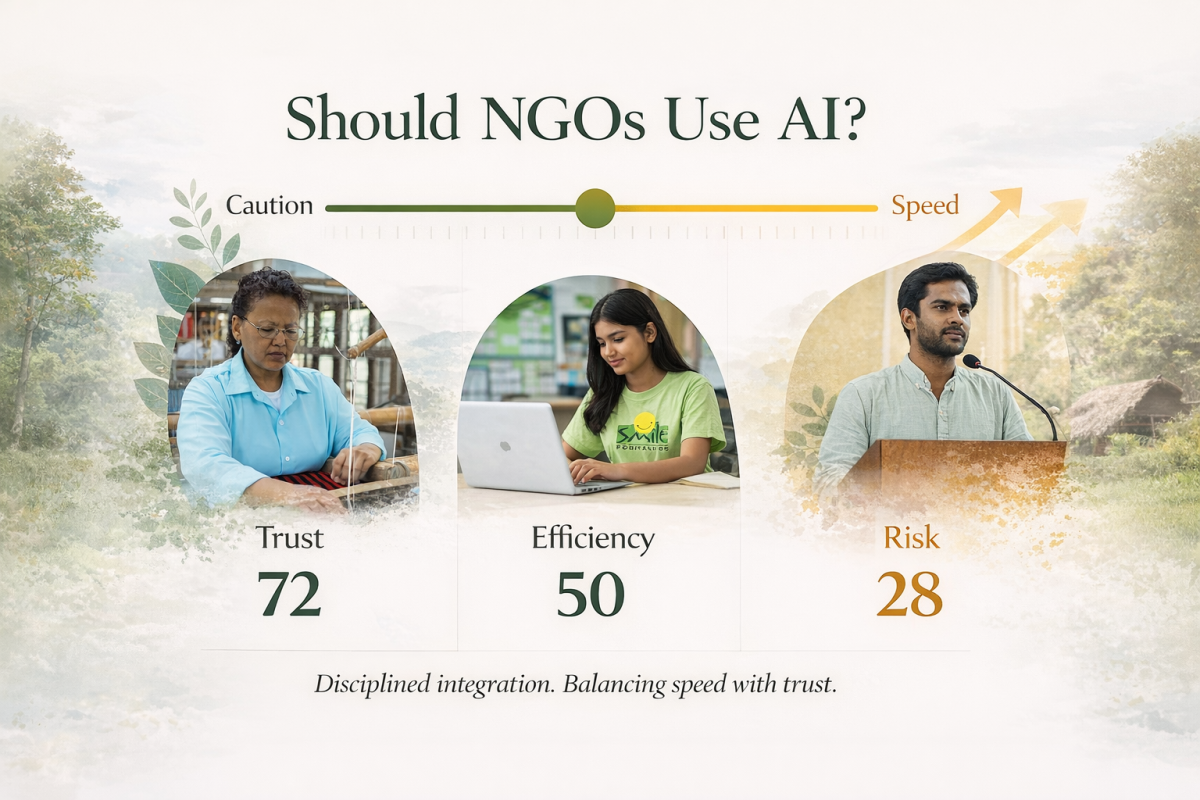
The more productive question, therefore, is not whether NGOs should use AI, but how they should do so without compromising integrity.
NGO AI Decision Simulator
You are the Communications Head. Make careful decisions.
Trust:50
Efficiency:50
Credibility:50
Risk Level:20
The Case for Adoption
Most NGOs operate with small communications teams and limited budgets. Translating monitoring and evaluation reports into readable narratives requires time. Converting technical research into public-facing analysis demands specialised skill. Producing multilingual content stretches already thin resources.
AI systems can assist in drafting articles, summarising research, structuring impact reports and translating material into accessible formats. Used responsibly, they can reduce mechanical workload and allow communications teams to focus on strategy, nuance and ethical oversight.
In this sense, AI becomes an efficiency tool rather than a creative replacement. It supports clarity; it does not generate authenticity.
For organizations engaged in sectors such as education, health, skill development, women’s empowerment and more (all with heavy data reliance), the ability to synthesise data quickly and communicate consistently can strengthen advocacy and fundraising efforts alike.
However, efficiency cannot become the sole metric of value.
The Risks of Uncritical Use
AI systems are probabilistic. They generate responses based on patterns, not lived experience. They can produce plausible but inaccurate statistics. They may oversimplify complex social realities. In some instances, they replicate biases embedded in training data.
For NGOs, the risks are specific and consequential.
First, data integrity. Publishing AI-generated statistics without verification can undermine credibility. Development communication depends on evidence; errors are costly.
Second, narrative authenticity. Beneficiary stories cannot be fabricated, embellished or reconstructed through automated systems. The dignity of communities requires consent, accuracy and human engagement.
Third, confidentiality. Field documentation may contain sensitive personal information. Uploading such material to unsecured platforms carries privacy risks.
These concerns do not argue for abstention. They argue for governance.
Tools and Their Appropriate Use
Several AI tools have emerged as particularly useful in communications workflows, though each carries limitations.
Large language models such as ChatGPT or Claude can assist in drafting blogs, summarising policy documents and restructuring technical material. Their strength lies in linguistic clarity and structural coherence. Their weakness lies in potential factual inaccuracy. All outputs must be independently verified before publication.
Design platforms such as Canva’s AI features or Adobe Firefly can accelerate the production of infographics and campaign creatives. They democratise design capacity. Yet there is a risk of visual genericism and oversimplification. Visual storytelling must preserve context and seriousness.
Data visualisation platforms such as Datawrapper or Flourish allow NGOs to present impact metrics interactively. These tools strengthen credibility when used carefully. However, visual distortion of data (intentional or accidental), can mislead audiences if context is omitted.
Video-editing tools such as Descript simplify transcription and editing, making multimedia storytelling more accessible. The caution here lies in overuse of synthetic voiceovers or excessive editing that alters meaning.
Finally, documentation tools such as Notion AI or Otter.ai can streamline internal operations by summarising meetings and reports. While efficient, they require careful handling of sensitive information and human review to ensure accuracy.
The common thread across these tools is assistance, not substitution.
Establishing Ethical Guardrails
If NGOs are to integrate AI responsibly, certain principles must be institutionalised.
Verification should be mandatory. No statistic generated through AI should appear in public communication without cross-checking against primary sources.
Transparency should guide internal practice. Teams must understand when and how AI is being used. While public disclosure may not always be required, internal accountability prevents misuse.
Dignity must remain central. AI should not simulate community voices or recreate experiences of trauma. Human engagement remains indispensable.
In essence, AI can support the articulation of impact, but it cannot replace proximity to the field.
The Strategic Imperative
The development sector increasingly competes not only for funding but for narrative authority. Think tanks, consulting firms and multilateral agencies produce rapid, data-driven commentary. NGOs risk marginalisation if they cannot match the pace of discourse.
Responsible AI adoption can help close that gap. It enables faster response to policy developments, clearer reporting to donors and broader dissemination of programme learnings.
However, speed without scrutiny is dangerous.
The challenge before NGOs is to define the terms of engagement before technological momentum defines them. This requires capacity building, internal guidelines and a commitment to ethical communication standards.
A Balanced Conclusion
Artificial intelligence is neither a threat to NGO storytelling nor a panacea for communications challenges. It is a tool. Like any tool, its impact depends on how it is wielded.
The development sector’s comparative advantage has always been credibility grounded in lived engagement. If AI is integrated with discipline meaning verified, transparent and dignity-centred, it can enhance that credibility.
If adopted uncritically, it can weaken it.
The choice is not between tradition and technology. It is between governance and drift.
For NGOs navigating a rapidly evolving information landscape, the prudent course is not avoidance, but thoughtful integration.
When Tuberculosis Goes Undiagnosed: The Cost of Missed Cases
For much of modern history Tuberculosis (TB) was the archetype of a killer disease. In the 19th and early 20th centuries, the condition was a leading cause of death in Europe and North America, driven by urban crowding, poor living conditions, along with limited biomedical understanding. It was only in 1882, when Robert Koch identified ‘Mycobacterium tuberculosis’ as the causative agent, that science began to unravel the biological basis of the disease. In the decades that followed, public health interventions such as sanatoria, the Bacille Calmette-Guérin (BCG) vaccine, and eventually effective antibiotics transformed TB outcomes in high-income countries.
Yet, despite all these advances, tuberculosis cases never disappeared. It persists in contexts of poverty, inequality and weak health systems. In fact, while significant progress has been made in reducing TB deaths and cases in high-income countries, it remains one of the world’s deadliest infectious diseases till date.
In 1993, the World Health Organization declared TB a global health emergency, a recognition indicating that despite scientific tools to control it, TB continued to exact an enormous toll globally. Epidemiological data illustrates the persistence and expanse of the epidemic: an estimated 10.7 million people fell ill with TB in 2024, with Southeast Asia, the Western Pacific and Africa being regions reporting major cases.
A look at the numbers
India bears the world’s highest burden of tuberculosis cases, accounting for approximately 26 to 27 per cent of all global cases. As of 2024, the estimated TB incidence in the country is around 2.7 million cases. Despite gradual improvements and a decline in mortality to 21 deaths per lakh population, tuberculosis remains a major public health challenge, with an estimated two deaths occurring every three minutes.
Globally, about 1.23 million died from the disease, making TB the top infectious cause of death worldwide. Yet, the number of people officially diagnosed, represent only a portion of estimated cases. While estimated diagnoses increased in recent years, the gap between actual and detected cases persists; in 2024, only 78 per cent of TB cases were diagnosed and reported, leaving a substantial proportion undetected.
Analyses indicate that around 25 to 40 per cent of people who develop active TB may remain undiagnosed each year, particularly in high-burden countries with limited access to quality healthcare. Moreover, in India, which accounts for about 25 per cent of global TB cases, even with expanded diagnostic coverage, approximately 100,000 cases remain missing from official statistics, contributing to ongoing transmission. This enduring burden is in part driven by a stubborn disparity between actual disease and diagnosed cases.
The diagnostic gap in tuberculosis cases
One of the defining challenges in global TB control is the diagnostic gap: the difference between the number of people who develop active TB and those who are diagnosed. In 2024, about 8.3 million people were newly diagnosed and treated, representing roughly 78 per cent of estimated cases. That leaves over 20 per cent of cases undetected or unreported, a gap that carries serious implications.
The reasons for this diagnostic deficit are several. First, there are technical limitations in widely used diagnostic methods. Traditional smear microscopy, still common in many low and middle-income countries, has low sensitivity, especially in patients with low bacterial loads. In one Indian study, classic smear microscopy identified TB in only 4.3 per cent of samples, whereas more sensitive molecular methods detected it in 13.7 per cent. The persistence of suboptimal tools in resource-limited settings deepens the risk of missed diagnoses.
Research into the economic consequences in India illustrates that the failure to detect and treat TB escalates costs not just for the patient but for the broader healthcare system and society, as continued transmission generates additional cases and treatment demands. Moreover, TB disproportionately affects people in their most productive years. Loss of productivity due to illness and death translates into reduced economic output for communities and nations. Many households face catastrophic costs even when treatment is free, due to indirect costs such as transportation, lost wages, and caregiving.
Furthermore, undiagnosed TB perpetuates cycles of poverty and vulnerability. In communities with limited access to healthcare, this burden is compounded by stigma and lack of awareness, delaying diagnosis. Intersecting vulnerabilities highlight how TB operates not just as a medical condition but as a marker of deep societal inequities.
The Indian context
In the Indian context, there is a strong gender dimension to the burden of undiagnosed tuberculosis. Evidence suggests that more than one-third of tuberculosis cases in India go undiagnosed each year, with this gap being more pronounced among women. Social norms, stigma, gendered expectations often discourage women from seeking timely medical care, especially for symptoms such as chronic cough or weight loss, which are frequently overlooked. Limited autonomy and financial dependence reduce women’s access to diagnostic services, particularly in rural and low-income settings. As a result, many female patients remain invisible within the health system, leading to delayed treatment and continued transmission within households.
The way forward
This can be addressed in India by adopting a more people-centred and equity-driven approach to TB care. The focus needs to shift from waiting for patients to seek care to proactively reaching those who are most likely to be missed by the health system. This means strengthening community-based screening, improving early and affordable access to diagnostics, and ensuring that primary healthcare facilities are equipped to identify TB at the first point of contact.
Through its ‘Smile on Wheels’ programme, Smile Foundation delivers medical services directly to communities with limited access to hospitals, helping reduce the burden of preventable diseases on families. These efforts when combined with overall public health awareness can help reduce the number of undiagnosed cases and create a more effective TB response in the country.
Your child is using YouTube videos to study, and as a parent, you may wonder if that’s the right way to learn or worry about their safety. Take a step back and try to see the other side of the coin. There’s no denying the importance of tech skills for children. Your child may have their sights set on a STEM-based career or may use technology to access learning and information for school. As a modern parent, you should not deprive them of it; rather, it makes sense to provide the right tools they need to explore and navigate the digital world with curiosity and safety. Preparing children for a technology-driven future means unlocking their potential from a young age.
In the past, reading and numeracy were the cornerstones of educational progress. Now, computing literacy has joined their ranks. However, not everyone has the luxury of a computer at home or even at school. Children from rural areas, low-income households, or those with less-educated parents are often less likely to access the internet. The need is to make sure every child has early access, learns effectively and benefits equally from these opportunities.
Computing Skills Matter Beyond Tech Careers
Often, parents think that learning about computers is just for those who want to work in software jobs. But the truth is, the influence of computing goes way beyond just the tech world. For instance, healthcare, agriculture, manufacturing, management are increasingly using computerised tools for various tasks.
Besides, computing skills help kids develop structured thinking, learn how to break down complex problems into pieces, and test out solutions and fine-tune their results. These abilities boost their performance in school, and also set them up for success in various careers.
The Data
India has made impressive strides towards improving digital access, but the latest National Sample Survey-based analysis shows that only 38% of Indian households are digitally literate, with a significant gap between urban and rural regions. Only 12% of individuals above the age of 15 possess basic ICT skills. This widening digital literacy gap becomes even more pressing as India moves towards a $5 trillion economy and given that the country is experiencing a unique demographic opportunity, where approximately 65% of its total population accounts for individuals under the age of 35.
This highlights a significant need to teach kids how to navigate technology and develop digital skills early on through their formal education. For stronger digital skills today, children need to grow up in a tech-savvy environment, and not miss out on opportunities to cultivate digital skills from a young age, which could jeopardise their future prospects and safety.
Interestingly, while more screen time can sometimes correlate with a higher risk of encountering harmful content or negative experiences, the connection is pretty weak. This indicates that the risk of facing online dangers isn’t mainly about how much time kids spend online.
What Effective Computer Education Looks Like
Project-based learning is all about encouraging kids to experiment. Whether they’re building simple games, crafting digital stories or creating automation models, when they see the results of their efforts, their motivation really takes off.
Bringing together different subjects enhances the learning experience. For instance, Maths can incorporate algorithmic thinking through problem sequencing, language lessons can embrace digital storytelling and the logical structuring of narratives.
Age-appropriate learning experiences with visual programming tools and unplugged activities help younger students thrive. Early childhood is a crucial time for cognitive growth. During these formative years, kids pick up on patterns, sequences and logical connections through play and exploration. While older students can move on to text-based coding and data analysis. The key is to ensure that learning progresses gradually.
In India, making learning relevant to the local context is vital. Students are more engaged when examples resonate with their surroundings. Projects that involve local farming data, traffic patterns or community issues foster meaningful connections. Additionally, using regional language tools enhances accessibility.
Low-cost maker spaces offer a great learning model. With simple robotics kits, recycled electronics and open-source software, students can experiment without breaking the bank.
Barriers to Computer Education
Many teachers don’t feel confident teaching computers. With good training and support, they teach much better. To address these challenges, school systems schools should introduce continuous professional development of the existing teacher workforce to fill the needs for special skills.
There’s really no universal computer curriculum that fits every education system, school or classroom perfectly. It’s important to consider the local context, the school’s resources and the students’ previous exposure to computer science when creating curricula and competencies.
Computing content must be available in regional languages so more students can learn comfortably.
Long-term support in teacher training builds confidence and ongoing maintenance of devices keeps them.
The government sets rules and funds, schools implement and industry/NGOs bring innovation and opportunities. Working together speeds progress.
Rebooting Computer Education
It is important to remember that computers have shifted from being a luxury to a necessity for children—it is essential for playing, staying connected with friends and family, learning and developing skills for their future.
Smile Foundation is working to bridge the digital divide, ensuring that children from all backgrounds have the opportunity to have computer education and pursue future opportunities in these fields.
India’s labour market does not resemble the diagrams often used to describe it. It is not neatly divided into formal and informal sectors, nor does it progress along predictable ladders from training to employment. Instead, it is mobile, fragmented and deeply shaped by proximity—to worksites, markets and opportunity.
More than 90 percent of India’s workforce operates in informal settings. These workers build homes, paint walls, lay tiles, wire buildings and keep cities functional. But they remain largely invisible in policy execution even if they are visualized in its imagination—uncredentialed, uninsured and excluded from conventional upskilling systems that assume stable jobs, fixed locations and the ability to step away from daily wages.
The question facing India today is whether upskilling systems are designed for the workforce that actually exists.
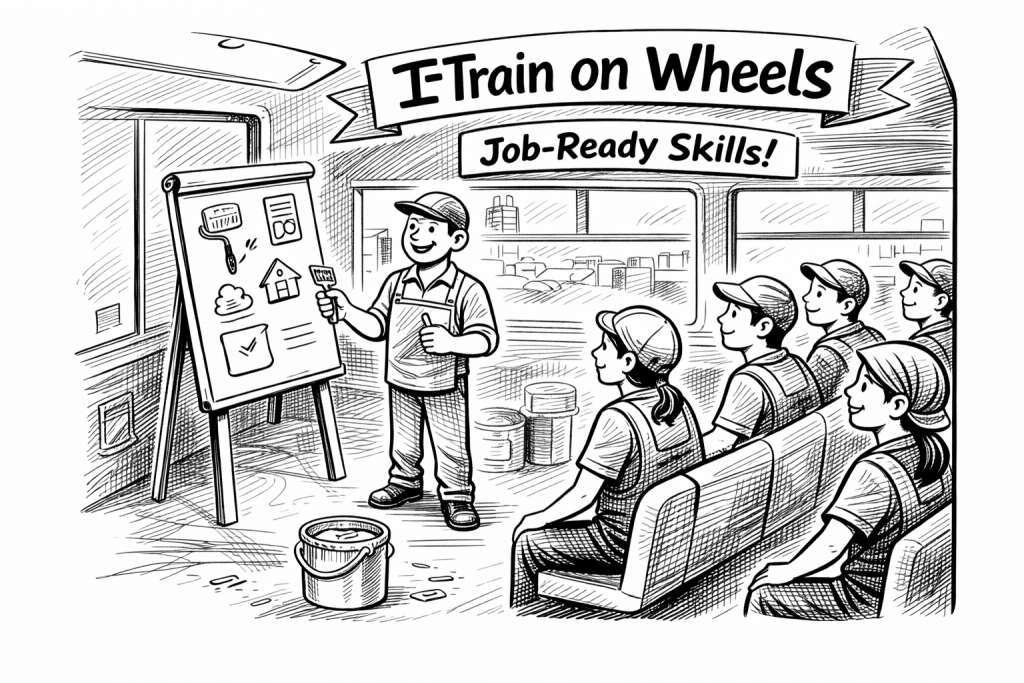
Over the last three years, Smile Foundation’s iTrain on Wheels initiative has offered a practical answer.
The core challenge: Upskilling without exclusion
Most upskilling programmes are built on assumptions that informal workers cannot meet. They require travel to centralised centres, time away from work, documentation and familiarity with institutional processes. For a daily-wage worker, these requirements are not inconveniences; they are barriers.
As a result, upskilling has often failed precisely where it is needed most.
iTrain on Wheels reverses this logic. Instead of asking workers to enter the system, it takes the system to where workers already are. Training is delivered through mobile units, free of cost, near worksites and communities. This single design choice—mobility over centralisation—is the programme’s most important innovation.
It recognises a simple truth: for informal workers, time is income and access determines participation.
Scale that reflects reality, not dilution
Since its inception, iTrain on Wheelshas trained 2.98 lakh household paint applicators across 443 districts in 25 states and 3 Union Territories, including 51 Aspirational Districts. In 2024–25 alone, 135,493 workers were trained through 5,924 training sessions, with the programme growing at a 20 percent annual rate.
These numbers matter not because they are large, but because they are coherent. Scale has been achieved without thinning the intervention. Training quality, curriculum consistency and on-ground delivery have been maintained even as geographic coverage expanded.
This is rare in informal labour skilling, where rapid expansion often weakens outcomes.
From skills to incomes: Measuring what matters
Upskilling programmes frequently struggle to demonstrate post-training impact. Certificates are issued, attendance is recorded, but income outcomes remain unclear.
iTrain on Wheels is an exception.
A third-party evaluation conducted for the programme reports that:
97.11 percent of trained applicators experienced income improvement
51.58 percent reported that their income at least doubled
95.05 percent expanded their client base
90.38 percent received formal certification, improving market credibility
These outcomes point to something critical: the market is validating the skills. Workers are not merely trained but are securing more work, commanding higher wages and building reputational capital.
In informal labour markets, where trust and word-of-mouth determine opportunity, this credibility is transformative.
Upskilling as livelihood acceleration, not placement
Unlike formal employment pipelines, informal labour does not culminate in placement letters. Progress looks different: a larger client base, repeat work, the ability to negotiate rates or the capacity to hire others.
The programme’s entrepreneurship orientation recognizes this reality. Training includes soft skills, customer interaction, financial awareness and professionalism—capabilities often absent from technical skilling but essential for income mobility.
Case studies illustrate this clearly. Workers who began as individual applicators now employ small teams. Others have entered stable monthly earning ranges previously inaccessible in the trade. These are not anomalies, instead they reflect a design that treats workers as economic agents.
In this sense, iTrain on Wheels functions as a livelihood accelerator, not a short-term training intervention.
The innovation behind the model
Beyond outcomes, the programme embeds a set of operational innovations that are often overlooked but critical for sustainability:
GPS-enabled vehicle optimisation improves route planning, cost efficiency and accountability.
Health and safety capsules, including first-aid training, address occupational risk—an essential but neglected aspect of informal work.
Trainer soft-skills development ensures consistent delivery quality at scale.
Standardized yet adaptable curricula allow relevance across diverse regions while maintaining core competencies.
Policy alignment without dependency
iTrain on Wheels aligns with national priorities such as Skill India, PMKVY, PM Vishwakarma, NSDC frameworks and Sector Skill Councils. This alignment ensures relevance, recognition and credibility.
At the same time, the programme does not rely on government delivery infrastructure to function. This independence provides resilience allowing continuity across policy cycles, funding shifts and administrative change.
In a skilling ecosystem often vulnerable to fragmentation, this balance between alignment and autonomy is strategic.
Formalizing work without erasing informality
A persistent policy tension in India is the assumption that informality must be eliminated rather than strengthened. iTrain on Wheels offers a different approach.
By providing certification, safety awareness and market-aligned skills, the programme formalizes outcomes without dismantling informal work structures. Workers retain flexibility while gaining stability and credibility replaces invisibility.
This is particularly important in sectors like construction and home improvement, where informality is not transitional but structural.
Gender inclusion: Early, realistic and necessary
The construction and painting trades remain male-dominated and the programme does not overstate its progress here. Women’s participation is still limited, but intentional.
Female painters have already been trained in states such as Gujarat, Andhra Pradesh, Meghalaya and Rajasthan. Plans for remaining of the 2025–26 include women-centric skill drives, recognizing that even modest female entry into these sectors carries structural significance.
The programme’s realism here is a strength. Inclusion is being built incrementally, not inflated rhetorically.
Why this matters beyond upskilling
Income stability is not an isolated outcome. It underpins education retention, healthcare access, nutrition and dignity.
By strengthening informal livelihoods, iTrain on Wheels complements Smile Foundation’s work in education and health. Families with predictable incomes are better able to keep children in school, seek timely healthcare and absorb shocks without cascading loss.
In this sense, skilling becomes social protection.
Rethinking the future of work for the informal majority
As India navigates technological change, urbanization and demographic transition, informal labour will not disappear. It will adapt.
The question is whether institutions will adapt with it.
iTrain on Wheels suggests that the future of skilling lies not in credential accumulation, but in contextual capability building designed around how people work, move and earn.
For policymakers, corporates and development actors, the lesson is clear: Skilling works best when it reduces uncertainty for workers, meets them where they are and delivers outcomes the market recognizes.
From last mile to learning system
What distinguishes iTrain on Wheels is not novelty but coherence. Design, delivery, outcomes and scale reinforce one another.
It positions Smile Foundation not only as an implementing partner, but as a last-mile economic institution capable of translating industrial capability into human outcomes.
As India’s informal workforce seeks formal futures, the path forward will not be linear. But it can be reliable.
Skilling and upskilling, when designed for reality rather than assumption, can be that bridge.
Menstrual hygiene management (MHM) is increasingly recognized as a critical issue at the intersection of public health, gender equality, education and human dignity. But for millions of women and girls, managing menstruation safely and with dignity remains a daily challenge. This reality—often described as period poverty—extends far beyond the inability to afford menstrual products. It reflects deeper structural inequalities linked to sanitation, education, stigma and access to reliable information.
According to UN Women, period poverty is not merely an issue of cost. It is a manifestation of exclusion—one that limits participation in school, work and public life. Girls miss classrooms. Women withdraw from economic activity. Silence and shame take the place of support and care.
This understanding has recently received powerful constitutional recognition. In a landmark observation, the Supreme Court of India affirmed that menstrual health is integral to the right to life and dignity under Article 21 of the Constitution. By framing menstrual hygiene as a matter of dignity, equality and access—the Court signalled a fundamental shift: menstruation is no longer a private inconvenience but a public responsibility.
But even as this recognition marks a critical step forward, it also exposes a persistent gap in how menstrual health is addressed on the ground—one that lies between access and adaptability.
Access is necessary but not sufficientfor Menstrual Health in India
Over the past decade, conversations around menstruation have expanded, particularly in low- and middle-income countries. Governments, civil society organizations and private actors have focused on improving access to menstrual hygiene products—especially disposable sanitary napkins. While this has helped normalize menstruation in public discourse, access alone does not guarantee use, comfort or sustained adoption.
Access to menstrual hygiene products includes:
Availability of safe and affordable products
Privacy and clean water for washing
Functional toilets and disposal mechanisms
The World Health Organization has repeatedly highlighted that inadequate menstrual hygiene facilities in schools and communities are linked to absenteeism, discomfort and health risks. The Supreme Court echoed this concern, directing states to ensure not only the provision of sanitary products but also functional, gender-sensitive sanitation facilities in schools.
However, even where products and facilities exist, usage often remains inconsistent. This is where adaptability becomes central.
What Adaptability Really Means
Adaptability refers to how well menstrual hygiene solutions fit into women’s and girls’ social, cultural, economic and infrastructural realities. A product may be hygienic, affordable over time and widely available, but if it clashes with cultural norms, requires facilities that do not exist or is introduced without adequate education, it is unlikely to be adopted.
Adaptability includes:
Cultural acceptance and bodily autonomy
Awareness and practical knowledge
Infrastructure compatibility
Supportive social environments
Understanding menstrual health through both access and adaptability explains why progress remains uneven despite innovation and policy attention.
Persistent Barriers to Access
Economic constraints
For many low-income households, particularly in rural areas and informal urban settlements, the recurring cost of disposable menstrual products competes with essential expenses such as food, healthcare and education. While tax reductions and free distribution schemes have helped, affordability remains a barrier, reinforcing gendered economic inequality.
Inadequate sanitation infrastructure
Without private toilets, running water or safe disposal systems, menstrual hygiene becomes difficult regardless of product availability. These infrastructural gaps disproportionately affect government schools, urban slums and remote rural areas—directly influencing girls’ attendance and comfort.
Stigma and silence
Deep-rooted taboos continue to frame menstruation as impure or shameful. This discourages open conversation, delays care-seeking and perpetuates unsafe practices. The Supreme Court explicitly acknowledged this silence, emphasizing that menstrual health education must include boys, teachers, families and communities to dismantle stigma.
Geographic inequality
Supply chains rarely reach the last mile consistently. Remote villages face irregular availability, while dense informal settlements struggle with overcrowding and poor sanitation—further compounding access challenges.
When Products Don’t Fit Lives: The Adaptability Challengefor Menstrual Health in India
Improving access does not automatically lead to sustained or effective use. Adaptability determines whether products align with lived realities.
Awareness and product suitability
Disposable pads remain the most commonly used products due to familiarity and ease. Reusable options—such as cloth pads or menstrual cups—offer long-term cost and environmental benefits but require greater awareness, privacy and water access.
A recent analysis highlighted that while awareness of menstrual cups is high, adoption remains strikingly low. Despite nearly 80% awareness in some surveys, fewer than 5% of women reported actual use—underscoring the gap between information and confidence.
Cultural acceptance and bodily autonomy
Norms around virginity, bodily purity and internal products significantly influence acceptance. Menstrual cups, which require vaginal insertion, are often viewed with suspicion, especially for adolescents and unmarried women. Without addressing these beliefs, choice remains constrained, even when products are available.
Infrastructure–product Mismatch
Reusable products require clean water and private spaces for washing and sterilisation. In settings where these are absent, such products become impractical. Adaptability, therefore, is not a feature of the product alone—it is shaped by the environment in which women live.
Menstrual Cups: Innovation with Limits
Menstrual cups illustrate the tension between innovation and lived reality. From a public health and sustainability perspective, they are compelling—long-lasting, cost-effective and environmentally friendly. But for many women, the initial cost, lack of hands-on guidance, health misconceptions and cultural discomfort remain significant barriers.
Without community-led education, demonstrations and supportive dialogue, menstrual cups risk becoming symbols of choice without agency—available in theory, inaccessible in practice.
Bridging Access and Adaptability: Smile Foundation’s Approach
At Smile Foundation, menstrual health initiatives are designed with this dual lens in mind. The focus extends beyond distribution to include awareness, education and community engagement recognizing that dignity cannot be delivered through products alone.
Through school-based programmes and community outreach, Smile Foundation:
Distributes sanitary napkins to address immediate access gaps
Conducts menstrual health education sessions in local languages
Trains community workers and engages parents to build supportive environments
Encourages open conversation to challenge stigma and misinformation
This integrated approach aligns closely with the Supreme Court’s emphasis on dignity, education and inclusion. By combining material access with knowledge and cultural engagement, Smile Foundation works to ensure that menstrual health interventions are not only available but usable, acceptable and empowering.
Evolution of Menstrual Health in India: From Provision to Rights-based Equity
The Supreme Court’s recognition of menstrual health as a constitutional concern creates an opportunity to rethink how menstrual hygiene is addressed in India.
What is needed now is convergence:
Policy that treats menstrual health as a rights issue, not a welfare add-on
Infrastructure investment in WASH facilities across schools, workplaces and public spaces
Education integrated into curricula to normalize menstruation early
Community-led approaches that respect local contexts and choices
Encouraging product diversity, rather than promoting a single solution, allows women and girls to decide what works best for their bodies and circumstances. Innovations must be accompanied by education, infrastructure and trust.
Menstrual dignity cannot be achieved through access alone. It requires adaptability, agency and social acceptance. When menstruation is recognized not as a private inconvenience but as a public issue—linked to dignity, equality and participation—real change becomes possible.
At Smile Foundation, we believe that combining access with education and community engagement is key to advancing menstrual health equity. The goal is not just to manage menstruation, but to ensure that no girl or woman is held back because of it.
India has reached an important inflection point in its development journey. In education and health—two pillars of human capital—the question is no longer whether systems exist. It is whether they hold, especially for those closest to uncertainty.
Over the last two decades, India has built scale at an extraordinary pace. Schools, hospitals, schemes and platforms now reach millions. But as recent policy thinking makes clear, scale alone does not guarantee outcomes. The next phase of progress depends on quality, continuity and trust—and on whether systems can absorb everyday shocks without losing people along the way.
For organizations working at the last mile, this shift is what reflects what communities experience every day.
Education: When Enrolment is No Longer the Problem
India today operates one of the largest school systems in the world, serving 24.69 crore students across 14.71 lakh schools, supported by over 1 crore teachers. Nearly 27 percent of India’s population is in the school-going age group. This demographic advantage will persist well into the next two decades.
And yet, learning outcomes and educational continuity tell a more complicated story.
While enrolment remains high through the middle grades, the system begins to leak at precisely the moment when education becomes most consequential. At the secondary level, the Gross Enrolment Ratio drops to 68.5 percent, with sharp declines after Grade 8. Grade-wise data show a steady thinning of the cohort as students move toward higher grades.
The implication is clear: access has expanded faster than assurance.
Many students enter school. Fewer complete it. And even fewer transition smoothly into higher education, skills or stable work. Financial stress, household responsibilities, health shocks, migration and lack of local support combine to push adolescents, especially girls, out of the system.
This is why India’s Expected Years of Schooling stands at 13, well below global peers, despite near-universal enrolment in early years. It is not aspiration that is missing but system resilience.
What Improves Learning and What Doesn’t
Encouragingly, recent learning assessments show that progress is possible when systems focus on foundations. The PARAKH Rashtriya Sarvekshan 2024, covering over 21 lakh students across 74,000 schools, shows a strong recovery in foundational learning post-pandemic. Sixty-five percent of Grade III students are now proficient in mathematics, up sharply from 2021 levels.
Perhaps more tellingly, state government schools and rural students performed as well as, or better than, their urban peers. This challenges the assumption that learning outcomes are determined primarily by school type or geography. Instead, it points to the importance of teacher support, consistent engagement and community participation.
At Smile Foundation, this insight resonates deeply. Our education programmes work with the understanding that learning does not happen in isolation. It is shaped by nutrition, health, safety, household stability and parental confidence. A child who is unwell, hungry or anxious about school costs cannot learn consistently—no matter how good the curriculum.
Education systems work best when they are designed around the child’s full reality, not just the classroom.
Health: From Treatment to Prevention, from Episodes to Relationships
India’s health system has also made undeniable gains. Infant and maternal mortality have declined and immunization coverage has expanded. Primary care infrastructure has grown. Yet new challenges are emerging—particularly non-communicable diseases, lifestyle-related conditions and mental health risks among young people.
Health costs are rising faster than incomes for many families. In FY25 alone, health-related insurance claims contributed to nearly ₹1.9 lakh crore in non-life claims, reflecting both increased access and increasing financial strain. At the same time, insurance penetration remains uneven, leaving large sections of the population exposed to health shocks.
But the deeper challenge is not only financial but behavioural and relational.
Clinical advice does not automatically translate into healthy practices. Preventive care depends on what happens after the doctor leaves—inside homes, kitchens and family conversations. Delayed care-seeking, misinformation, social norms and fear often undermine the best-designed health services.
This is why public and preventive healthcare must be community-centred.
Through programmes like Smile on Wheels, Smile Foundation’s mobile medical units bring doctors, diagnostics, medicines and counselling directly into underserved communities. But equally important is what accompanies the clinical service: repeated conversations on nutrition, hygiene, chronic disease management and maternal and child care. Trust is built not in one visit, but over time.
Health outcomes improve when care is predictable, proximate and personal.
Employment, Skills and the Cost of Discontinuity
The transition from education to employment reveals how deeply interconnected these systems are.
India’s labour market has shown improvement, but quality and security remain uneven. Over the last decade, employment growth has been stronger in larger factories, which pay higher wages and show greater productivity. But a majority of workers remain in informal arrangements.
The e-Shram portal, which has registered over 31 crore unorganized workers, reflects both progress and precarity. More than half of these registrants are women. Their livelihoods are mobile, uncertain and highly sensitive to disruption.
Here again, continuity matters. Skill training that is episodic or disconnected from real work pathways does little to improve long-term outcomes. The future of work increasingly rewards adaptability, judgement and foundational skills—not just certificates.
This reinforces a critical lesson: education and skilling must be treated as social protection, not one-time interventions. When learning is interrupted, the consequences compound across health, income and dignity.
From Access to Assurance: What the Next Phase Demands
Across education, health and employment, a common thread emerges. India’s systems perform best when they reduce uncertainty for individuals.
Children stay in school when families can rely on consistent support. Mothers follow health advice when systems respect their realities. Young people build skills when pathways are clear and protected from sudden shocks.
For Smile Foundation, this is not a new insight. Our integrated approach—spanning education, healthcare, nutrition and livelihoods—rests on the belief that human development is cumulative. Gaps at one stage weaken outcomes at the next.
What’s needed now is a broader shift in thinking:
From enrolment to retention
From treatment to prevention
From information to behaviour
From schemes to systems that people can trust
India’s development challenge today is not a lack of ambition. It is ensuring that progress holds for those living closest to risk.
As the country looks toward a future shaped by demographic change, technological disruption and climate uncertainty, the measure of success will lie not only in how many are reached, but in how many are carried forward, without falling through the cracks.