Executive Summary
- Menstrual Hygiene Day (May 28) is a global call-to-action on menstrual health. India’s NFHS-5 shows ~77% of young women now use hygienic menstrual products (up from 58% in NFHS-4), but urban–rural gaps remain (68% urban vs 43% rural).
- Lack of awareness, stigma and access drive menstrual challenges. Behaviour change communication – sustained community education and peer-led outreach – is key to normalising menstruation and improving outcomes.
- Government schemes (e.g. NHM’s menstrual hygiene scheme) provide subsidised pads (₹6 for 6 pads) via ASHAs, plus subsidised “Suvidha” pads at ₹1 through Jan Aushadhi. A draft National Menstrual Hygiene Policy (2024) aims to standardise menstrual health support across India.
- Smile Foundation’s Swabhiman programme exemplifies community-led intervention: training local women as health educators and peer counselors. Swabhiman’s one-on-one sessions empower girls to break silence about periods, creating a “butterfly effect” of shared learning.
- Menstrual hygiene health education affects education and gender equity: about 1 in 5 Indian girls drop out of school over menstruation-related issues. New educational curricula, male engagement campaigns and eco-friendly products (biodegradable pads, menstrual cups) are recent trends helping to sustain behaviour change.
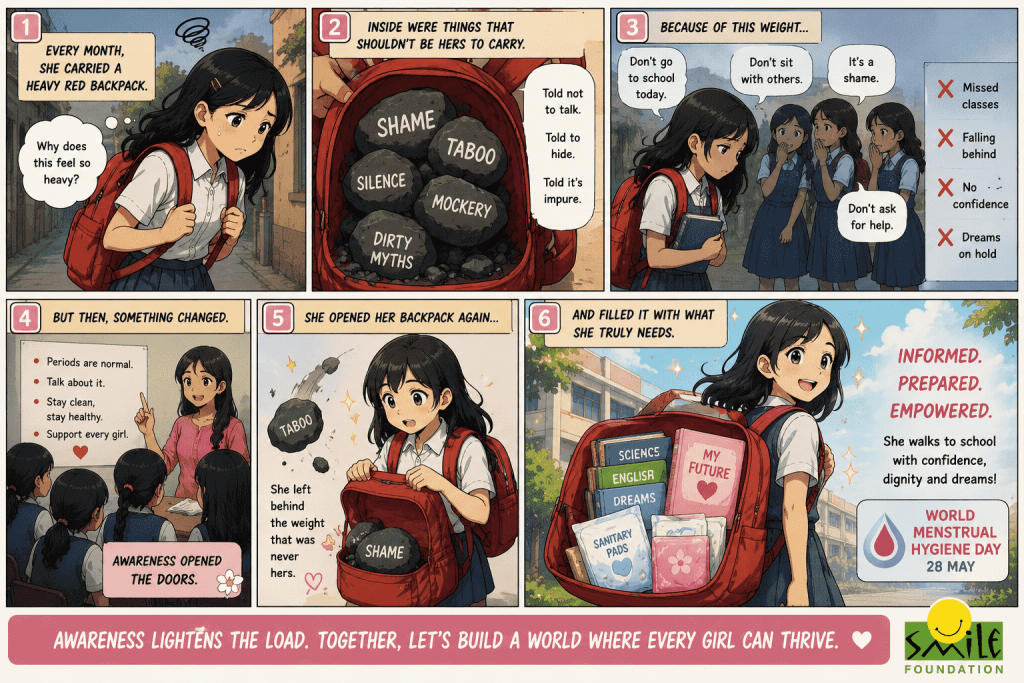
Adolescence is a phase of significant physiological, psychological and social transformation, bridging the gap between childhood and adulthood. During this crucial period, many young girls in India encounter menstrual difficulties, making reproductive health education essential. Unfortunately, a majority of teenage girls in India lack adequate knowledge about menstruation, reproduction and sexuality, largely due to sociocultural barriers and prevailing taboos.
Menstruation remains a taboo topic in Indian society, often associated with myths and prohibitions. The cultural perception of menstruation as a curse or illness contributes to the lack of open discussions about menstruation. This inhibits young girls’ ability to understand their bodies and cope with the changes during menstruation effectively. As a result, they might develop feelings of shame and discomfort during their menstrual cycles, impacting their overall well-being.
Through menstrual hygiene health education, young girls can gain confidence in managing their health.
Educating communities about menstrual hygiene health education encourages open discussions.
Comprehensive menstrual hygiene health education improves the overall quality of life for girls.
Challenges in Menstrual Hygiene Management
The lack of proper menstrual hygiene management can lead to adverse health consequences for adolescent girls. Poor personal cleanliness and unhygienic sanitary conditions increase the risk of reproductive tract infections (RTIs) and gynaecological issues. In resource-poor environments, where access to basic facilities such as water, bathrooms and privacy is limited, maintaining adequate hygiene becomes challenging.
Moreover, the affordability and availability of menstrual hygiene products pose significant obstacles. Many young girls cannot afford sanitary pads, leading them to rely on unhygienic alternatives, such as old cloth or rags, further exacerbating the risk of infections. Providing affordable and accessible sanitary pads is essential to ensure menstrual hygiene for all girls.
To bridge the gap in menstrual hygiene knowledge and practices, there is a pressing need for comprehensive menstrual hygiene education programmes targeted at adolescent girls in India. Such programmes must be implemented at multiple levels, including national, state and community levels, to create a conducive environment for open discussions and positive change. Our women empowerment programme, Swabhiman constitutes of menstrual hygiene awareness sessions and sanitary napkins distribution among adolescent girls and women of underserved families.
Menstrual hygiene health education is vital in creating awareness about menstrual health.
Promoting menstrual hygiene health education can help dispel myths and stigma.
Girls who in the past talked about menstruation in hushed voices, now have the confidence to talk in detail about it in school assemblies and home conversations. This created a ripple effect with many adolescent girls joining the sessions influenced by the learnings of their school peers and friends from the community.

Educational Initiatives and Sensitization
At the school level, integrating menstrual hygiene health education into the curriculum is crucial. Comprehensive modules covering various aspects of menstruation, including biology, hygiene practices, myths debunking and coping with menstrual discomfort, should be developed and implemented. These initiatives equip girls with essential knowledge and foster an environment where menstruation is normalized and free from stigma.
Incorporating menstrual hygiene health education into schools is essential for sustainable change.
Adolescent gynaecological clinics should also focus on menstrual hygiene health education for young girls.
Media campaigns highlighting menstrual hygiene health education can help change societal attitudes.
Creating awareness through menstrual hygiene health education is crucial for girls’ empowerment.
Families can support menstrual hygiene health education by facilitating open conversations.
Establishing dedicated “adolescent gynaecological clinics” is imperative. These clinics will focus on addressing menstrual morbidities, offering timely diagnosis and treatment for menstrual disorders and related issues. Adolescent gynaecology should receive more attention from researchers, clinicians, and society to improve the overall health and well-being of young girls.
Role of Media and Community in Menstrual Hygiene Health Education
The media, including print and social media, can play a vital role in breaking the menstrual taboo and promoting menstrual hygiene education. By featuring positive narratives, success stories and factual information about menstruation, media can contribute to changing societal attitudes and promoting open discussions about menstruation.
Additionally, community leaders, teachers, self-help groups and families must collaborate positively to support women and adolescent girls. By challenging harmful taboos and beliefs and encouraging open communication, families can create a supportive environment for adolescent girls to manage their menstrual health confidently.

Collaborative efforts in menstrual hygiene health education can enhance community resilience.
The #YesIBleed campaign, launched by the Ministry of Women and Child Development, aims to normalize conversations about menstruation and combat the stigma surrounding it. The campaign uses social media platforms to spread awareness, engage with young girls and encourage open discussions about menstrual health.
Government Initiatives to Promote Menstrual Hygiene Health Education
To encourage and promote menstrual hygiene practices, the Government of India (GoI) has launched several programmes and schemes aimed at providing access to menstrual hygiene products and education. One of the significant initiatives is the National Menstrual Hygiene Scheme (NMHS), which emphasizes the importance of menstrual hygiene education and awareness among young girls.
Under NMHS, the GoI has implemented various strategies, including subsidized sanitary napkin distribution through Accredited Social Health Activists (ASHA) and self-help groups (SHGs). This ensures that affordable and hygienic menstrual products reach women and adolescent girls in both rural and urban areas.
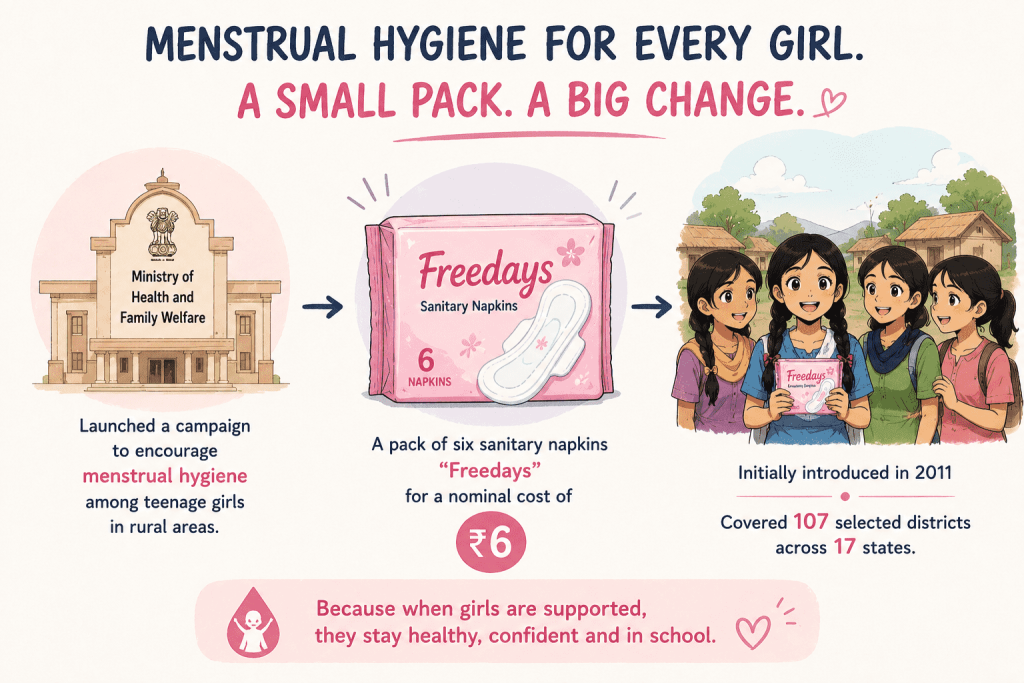
To encourage menstrual hygiene among teenage girls in rural areas, the Ministry of Health and Family Welfare launched a campaign. As part of the campaign, rural adolescent girls were provided with a pack of six sanitary napkins called “Freedays” for a nominal cost of Rs 6. This initiative was initially introduced in 2011 and covered 107 selected districts across 17 states.
Furthermore, Tamil Nadu has been running a free sanitary pad program since 2011 for females residing in rural regions. Participants are eligible to receive three packs of pads every two months, along with iron supplements and information about menstruation, through the assistance of “anganwadi” (female community health worker) workers.

Over time, India has witnessed an improvement in women’s standing, with an increasing focus on education, independence and empowerment. As a result, the use of sanitary napkins has gained popularity. According to recent data, the level of sanitary napkin usage among young women (15–24 years) has risen from 58% in 2015–16 to 78% in 2019–20.
Breaking The Shame Cycle
Menstrual hygiene health education campaigns should include targeted messaging for rural areas.
Effective menstrual hygiene health education can empower girls to break the stigma surrounding menstruation.
Menstrual hygiene health education is not just about hygiene but also about empowering women and girls to embrace their bodies, take charge of their health and pursue their dreams without any hindrance. By breaking the barriers of silence and shame, we can create a society that celebrates menstruation as a natural and essential part of life.
Improving menstrual hygiene health education is essential for ending period poverty.
Engaging boys in menstrual hygiene health education is crucial for fostering empathy and understanding.
Let us join hands in the journey towards a world where every woman and girl can experience their menstrual cycles with pride, confidence and good health. Together, we can make menstrual hygiene health education a global priority and a catalyst for positive change in the lives of millions of women and girls worldwide.
Menstrual hygiene health education is critical in shaping the future of young women.
Addressing menstrual hygiene health education helps tackle challenges faced by girls in schools.
FAQs
1. What is World Menstrual Hygiene Day and why is it celebrated?
World Menstrual Hygiene Day is observed every year on 28 May. It’s a global initiative to break the silence around periods and advocate for menstrual health for all. On this day, NGOs, governments and individuals highlight the importance of good menstrual hygiene management and support behaviour change to end stigma.
2. How has menstrual hygiene in India improved recently?
According to NFHS-5 (2019–21), about 77% of young Indian women now use hygienic menstrual products (up from ~58% in NFHS-4). This jump reflects wider pad availability and education. Programmes like the National Health Mission’s menstrual hygiene scheme and campaigns like #YesIBleed have raised awareness. However, use remains much lower in rural areas, pointing to ongoing gaps.
3. Why is behavioural change important for menstrual health?
Knowledge alone doesn’t change habits overnight. Social taboos make many girls ashamed or uninformed. Behaviour change communication (BCC) uses repeated education, peer discussions and community influencers to shift attitudes. For example, Smile Foundation’s workshops show that when girls and communities talk openly about periods, hygienic practices spread by word-of-mouth. Sustained BCC normalises menstruation and encourages lasting hygiene habits.
4. What challenges do Indian girls face in menstrual hygiene?
Girls face multiple barriers: stigma and secrecy (families may ban normal activities during periods), limited access to products (especially in poor or rural areas) and poor sanitation (no private toilets or water at schools). These can cause absenteeism, infections or dropping out. For instance, one study found ~20% of Indian girls leave school because they lack menstrual support. Overcoming these requires both products and community support.
5. How do government programs support menstrual hygiene?
The Indian government’s NHM Scheme for Promotion of Menstrual Hygiene (since 2011) aims to increase awareness, access to pads and safe disposal of waste. Under it, ASHA health workers distribute subsidized pad packs door-to-door (currently ₹6 for a pack of 6). Separately, the PMBJP initiative sells biodegradable pads (‘Suvidha’) at ₹1 each in Jan Aushadhi stores. A draft National Menstrual Hygiene Policy is also in progress to standardise menstrual facilities in schools and public places, and foster behaviour change at scale.
6. How does menstrual hygiene impact girls’ education?
Menstrual hygiene and education are tightly linked. Lack of proper pads or toilets leads many girls to skip classes. Reports show roughly 1 in 5 girls drops out of school after menarche due to menstrual issues. Improving school WASH facilities, providing pads and period education (so girls know what to expect) greatly reduces absences. When girls feel supported during their periods, attendance and performance improve, helping to close the gender gap in education.
7. What are some effective community-led interventions?
Community-led interventions involve training local educators and volunteers. Peer education is key: girls are more comfortable learning from trained peers or relatable women. For example, Smile Foundation’s Swabhiman program mobilizes women in villages to host group sessions on menstrual health. These grassroots workshops, integrated into existing community and health structures, build trust. They often include interactive talks, demonstrations, and Q&A – a classic behaviour-change approach. By contrast with one-off camps, such sustained engagement (community behavioural change programs) embeds new norms in daily life.
8. What innovations and trends are emerging in menstrual hygiene?
Innovations include new sustainable products and policies. Biodegradable pads (e.g. PLA-based pads) and menstrual cups are becoming more available in urban India. Start-ups like Saathi sell compostable pads to raise awareness. Educationally, NGOs and companies are co-creating period curricula for schools (e.g. a UNICEF/P&G project launched menstrual modules for teachers). Social media and men’s movements (like #Men4Periods) are gaining ground to break taboos. Finally, global focus on “period equity” ties menstrual health to gender equality and sustainable development goals, accelerating policy action worldwide.
Sources: National surveys (NFHS-5) and UNICEF/NGO reports; Indian government releases on menstrual hygiene programs; Smile Foundation reports; educational campaign data.