
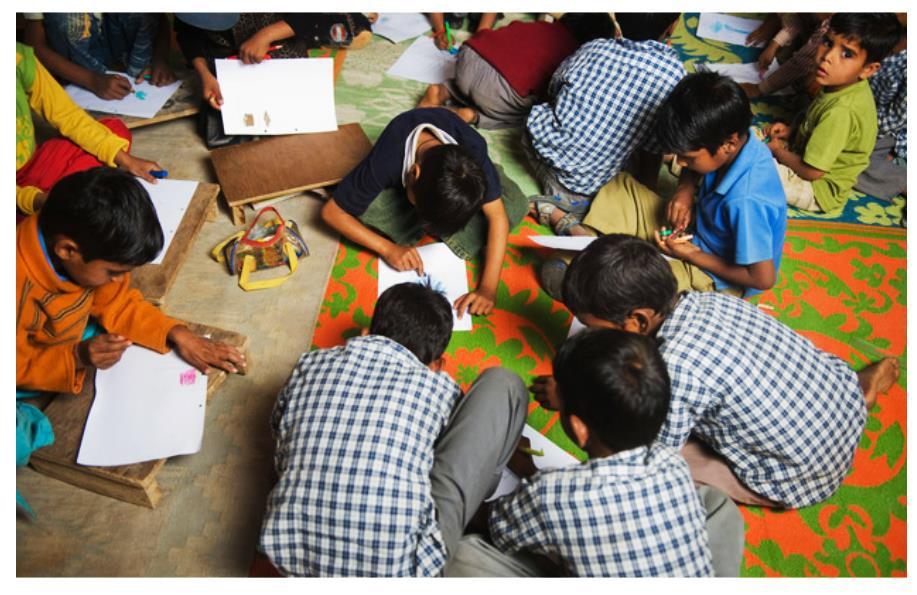

Parent engagement in education is the missing piece in India’s learning story. Schools in urban and rural areas are bustling with children, yet going to school and learning are not the same, and children quietly lose ground in the gap between them. Particularly in rural areas, schools see high dropout rates. One primary factor is a lack of understanding of lessons and support at home. Schools cannot close this gap alone. Families can help, whatever their own schooling looked like.

What Is Parent Engagement in Education?
The US Centers for Disease Control and Prevention (CDC) defines it as parents and school staff working together to support children’s learning, development and health. The key word is together. It is a shared responsibility, not a favour parents do for teachers.
“Family” also stretches beyond mothers and fathers. Grandparents, guardians and older siblings often carry the load. And engagement means small, regular actions that tell a child learning matters at home.
Why Parent Engagement Matters Now
ASER data show that Class 5 reading proficiency in rural India has remained below 55 per cent from 2010 to 2024, dipping in 2022 and recovering only slightly since. These children are not dropouts. They turn up, copy from the blackboard and sit their exams, and still miss the basics.
The pandemic sharpened the divide. Schools stayed shut for more than 500 days, and children without smartphones or educated parents fell furthest behind. That is why parent engagement in education matters more now than ever. The CDC links it to better attendance and higher grades. Research from the University of Leeds adds that thinner support in poorer homes reflects limited time and unfamiliarity with formal schooling, rather than lack of care.
The Barriers Families Face
Most parents want their children to learn. Wanting is rarely the problem. A father on a building site cannot attend a 10 am meeting. A mother who left school after Grade 5 may feel unable to check a Class 6 maths book. Chores eat into study time, teachers speak a language the family does not use at home, and one phone serves five people. The stakes rise with age: free education ends at Class 8, and dropout climbs to 11.5 per cent at the secondary level.
Six Skills Families Can Support
You do not need a degree for any of these. Pick one skill, and keep it small and regular.
- Reading aloud. Reading unlocks every other subject. Ask your child to read aloud for ten minutes a day, in any language, and listen without correcting every slip. If you cannot read, ask them to describe the pictures or retell the story. That builds vocabulary and confidence.
- Numbers in daily life. Many upper-primary children struggle with two-digit sums. Let them count change at the market, work out bus fares or halve a recipe. Then ask, “How did you work that out?” Explaining builds understanding.
- Writing with a purpose. A shopping list, a note to a grandparent or three lines about their day will do more than pages of copying. Praise the ideas first and fix spellings later.
- Talking and questioning. Use the home language for stories, songs and chats. Children who think and speak well in one language learn others more easily. Welcome “why” questions, even the awkward ones.
- Routine and wellbeing. Fix homework time and a quiet corner, even a mat by a window. Make sure your child eats and sleeps well, because a tired, hungry child cannot focus.
- Contact with teachers. Ask two questions: “What is my child doing well?” and “What should we practise at home?” Check attendance too, and celebrate effort, not just marks.
How Schools Can Help Families Engage

Schools should connect with families, engage them in varied ways, then sustain that engagement by removing obstacles. But parent engagement in education assumes someone is at home to engage. For many children, nobody is. Their parents cannot read, work long hours or live far away. Here the school must become the support the home cannot provide.
- A class 3 child who has not mastered class 1 skills gains little from Class 3 content. Bridge and remedial classes, grouped by skill rather than by grade, help children catch up in reading and arithmetic.
- Homework could be done at school. Supervised study hours, homework clubs, and library access give children a place and a person to help them. A quiet room and a midday meal matter as much as the lesson.
- Recruit substitute helpers. Older students, local volunteers and community mentors can act as study buddies and fill the gap parents cannot.
- Reach out to parents who cannot read. Voice notes, phone calls and pictorial report cards in the home language beat a printed circular. Short parent sessions should teach routines, not subjects: checking a notebook, setting a study time, praising effort. Hold them in the evening or on weekends.
- Track attendance and reading levels simply, and call home when either slips. Trim the hidden costs of books and uniforms that push poor families towards pulling children out.
China offers a useful parallel, though in higher education. It raised enrolment while maintaining high completion, with a Gross Graduation Ratio of 53 per cent, compared with 38 per cent in upper-middle-income countries. Strict quality standards, sustained public funding and targeted admissions for disadvantaged students made the difference. The lesson: build equity into the system instead of leaving it to each family’s circumstances.
Conclusion
Enrolment was never the destination. Learning is, and families are partners on the way, whether or not they can read the textbook. Tonight, ask your child one question about their day, then listen to the answer.
Frequently Asked Questions (FAQs): Parent engagement in education
1. What is parent engagement in education?
Parent engagement in education is the partnership between families and schools to support a child’s learning, development and wellbeing. It includes everyday activities such as reading together, discussing schoolwork, encouraging questions and staying in touch with teachers.
2. Why is parent engagement important for children’s learning?
Parent engagement helps children build confidence, improve attendance, strengthen foundational skills and perform better academically. Regular support at home can also help identify learning difficulties before children fall further behind.
3. How can parents support their child’s education if they are not educated themselves?
Parents do not need formal education to support learning. They can listen to their children read, discuss everyday experiences, practise counting through household activities, encourage questions and help establish a regular study routine. Showing interest in a child’s education matters.
4. What are some simple ways to improve parent engagement in education?
Families can support learning through six everyday activities: reading aloud, practising numbers in daily life, encouraging writing, having conversations, establishing healthy routines and communicating regularly with teachers.
5. What are the biggest barriers to parent engagement in India?
Common barriers include parents’ limited literacy, long working hours, household responsibilities, language differences, limited access to smartphones and unfamiliarity with school curricula. These challenges can make participation difficult even when families value education.
6. How can schools encourage greater parent involvement in education?
Schools can organise flexible parent meetings, communicate through local-language voice notes and phone calls, use pictorial report cards, offer practical guidance to families and provide supervised study sessions. Remedial classes, community mentors and accessible learning spaces can also help children who lack academic support at home.
7. What is the difference between school enrolment and actual learning?
Enrolment means a child is registered and attends school, but it does not guarantee that they understand what is being taught. Actual learning requires children to develop foundational reading, writing and numeracy skills. Families and schools must work together to ensure children progress beyond classroom attendance.
Sources
- https://www.apa.org/pi/lgbt/programs/safe-supportive/parental-engagement
- https://www.researchgate.net/publication/393784340_Parental_involvement_in_children’s_learning_in_India_during_the_COVID-19_pandemic
- https://www.impriindia.com/insights/learning-crisis-in-indian-education/
- https://www.orfonline.org/expert-speak/beyond-enrolment-india-s-higher-education-completion-gap –
- chrome-extension://efaidnbmnnnibpcajpcglclefindmkaj/https://asercentre.org/wp-content/uploads/2022/12/ASER_2024_Final-Report_13_2_24-1.pdf