
Summary: 5 Key Points
- Mission Indradhanush was launched in 2014 to improve child immunisation coverage.
- It focuses on children who are unvaccinated or have missed doses.
- The programme targets underserved and hard-to-reach communities.
- Intensified Mission Indradhanush strengthened efforts in areas with low coverage.
- Reaching the last mile is essential to ensuring no child is left unprotected.
The first few years of a child’s life largely determine their health and development for the rest of their years. During this time, vaccines become significant to protect children from diseases that can cause serious illness, disability and even death throughout their entire journey. Yet getting every child vaccinated is not as simple as making vaccines available. Some children live far from health centres. Some families move frequently for work. Some children miss a dose because their parents are unaware of the schedule, while others may start vaccination but not complete it.
This is where Mission Indradhanush comes in. Launched by the Government of India in December 2014, the programme was created to reach children left out of, or who had dropped out of, the routine vaccination system. Its larger goal was to take India closer to full immunisation, particularly in communities where vaccination coverage was low.
The National Health Mission explains Mission Indradhanush as a special effort focused on low-coverage and hard-to-reach areas. More than a decade later, Mission Indradhanush offers an important lesson in public health, that it is not enough for a vaccine to exist but the vaccine has to reach the child who needs it.
Why does Child Immunisation Matter?
Vaccination is one of the simplest and most effective ways of protecting children from infectious diseases. A vaccine prepares the body’s immune system to recognise and fight a particular disease before a child is exposed to it. Without the right vaccination, these diseases can have devastating consequences on a lifetime. Depending on the vaccine and national schedule, childhood immunisation protects against diseases such as measles, polio, diphtheria, tetanus, pertussis, hepatitis B and other serious infections.
India’s vaccination programme is part of the Universal Immunisation Programme (UIP), one of the country’s largest public health programmes. Through the UIP, vaccines are provided free of cost to eligible children and pregnant women through government health facilities and outreach sessions.
The scale of the programme is enormous. According to the Government of India’s 2025 update on immunisation, India’s Universal Immunisation Programme provides free vaccination every year to around 2.6 crore infants and 2.9 crore pregnant women and currently, over 1.3 crore immunisation sessions are conducted across the country by healthcare workers, including ASHAs and ANMs.
The benefit is not limited to one child. When a large proportion of a population is vaccinated, diseases find it harder to spread. This provides some protection to people who cannot be vaccinated for medical reasons and helps prevent outbreaks.
So, What Exactly is Mission Indradhanush?
The word “Indradhanush” means rainbow. Mission Indradhanush was given this name to represent the government’s effort to cover children with the full range of vaccines they need.
The programme was launched in December 2014 to increase full immunisation coverage to more than 90%. Rather than replacing routine vaccination, Mission Indradhanush acts as a catch-up campaign. It looks for children who have missed vaccines or have not completed their vaccination schedule and tries to bring them back into the system.
This distinction is important.
A child may receive the first few vaccines but miss later doses. Another child may never receive a vaccine at all. These children are sometimes described as “zero-dose” or partially immunised, depending on their vaccination status.
Mission Indradhanush focuses particularly on finding these children.
According to theMinistry of Health and Family Welfare’s 2024–25 Annual Report, 12 phases of Mission Indradhanush had been completed, covering 3,777 districts. Across these phases, 5.46 crore children and 1.32 crore pregnant women had been vaccinated.
Why do Some Children Miss Vaccines?
A simple question would be, if vaccines are available for free, why would a child remain unvaccinated? The answer is more complicated than simply saying that parents do not understand the importance of vaccines.
India is a huge country with very different living conditions. Some families live in remote rural or forest areas where health facilities are difficult to reach. Others live in urban settlements but face different challenges, such as migration, overcrowding and unstable employment.
In other instances, for a daily-wage worker, taking a child to a health centre may mean losing a day’s income. A migrant family may move to another city before the child’s next vaccination date. A family may also simply lose track of which vaccine is due and when.
There can also be fear or misinformation around vaccines.
This is why Mission Indradhanush does not simply wait for families to come to health centres. Its approach focuses on identifying, reaching and vaccinating children who have been missed. The government’s Mission Indradhanush guidelines specifically describe the programme as an effort to address gaps among underserved and hard-to-reach populations.
From Mission Indradhanush to Intensified Mission Indradhanush
A few years after the launch of the mission, the government realised and recognised that an even stronger push was needed. In 2017, it launched the Intensified Mission Indradhanush (IMI). The idea was to take the programme further by concentrating on districts and areas with particularly low immunisation coverage.
The focus remained on children who had been missed or had dropped out of the routine immunisation system, along with pregnant women who had not received the required vaccinations.
The programme was designed to be more targeted. Instead of treating the country as one large area, health authorities could identify specific districts, villages, urban pockets or communities where vaccination gaps were larger.
According to the Ministry of Health and Family Welfare’s 2024–25 Annual Report, Intensified Mission Indradhanush contributed to a 14.4 percentage-point increase in full immunisation coverage, with national full immunisation coverage rising from 62% in NFHS-4 to 76.4% in NFHS-5. The early results of Mission Indradhanush were also encouraging. Government data reported that the first two phases resulted in a 6.7% increase in full immunisation coverage within one year, compared with an earlier average annual increase of around 1%. (Ministry of Health and Family Welfare)
India has Made Significant Progress
India’s vaccination story has changed considerably over the past decade. The Government of India reported that national full immunisation coverage reached 93.5% in financial year 2023–24, according to its Health Management Information System. This means that India has moved much closer to the goal of ensuring that almost every child receives the vaccines included in the national schedule.
There has also been progress in reducing the number of children who receive no vaccines at all. According to the WHO’s 2025 regional immunisation update, India reduced its estimated number of zero-dose children from 1.6 million in 2023 to about 0.9 million in 2024, a reduction of around 43%.
These numbers are important because they show that India’s challenge is no longer simply about increasing vaccination everywhere. It is increasingly about finding the children who remain outside the system.
The Last Mile is the Hardest Mile
When we talk about vaccination, it is easy to focus on the vaccine itself. But a vaccine has to travel through a complicated system before it reaches a child’s arm.
Then, it has to be stored at the right temperature, transported safely, delivered to health workers and made available at the right place and time. Families then need to know about the vaccination session and be able to reach it. And this is often known as the last-mile challenge.
For a family living close to a health centre, vaccination may be relatively easy. For a family living in a remote village or frequently moving for work, it can be much harder.
This is why community health workers are so important. ASHAs, ANMs and other frontline workers often know which families have young children, which children have missed doses and which households need additional support. Mission Indradhanush therefore represents more than a vaccination drive. It is also an exercise in finding people who are easy to miss.
Smile Foundation’s Role in Child Healthcare
At Smile Foundation, we work across healthcare, education, livelihoods and women’s empowerment, with programmes reaching communities in villages and urban slums across India. Our healthcare programme focuses on taking primary healthcare and health awareness closer to underserved communities.
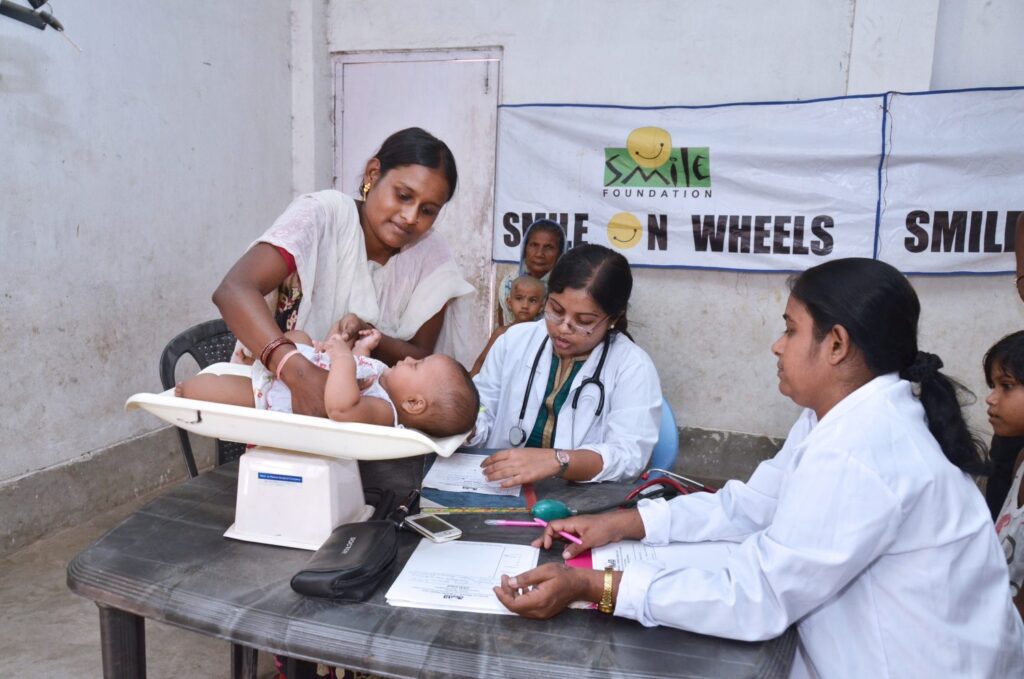
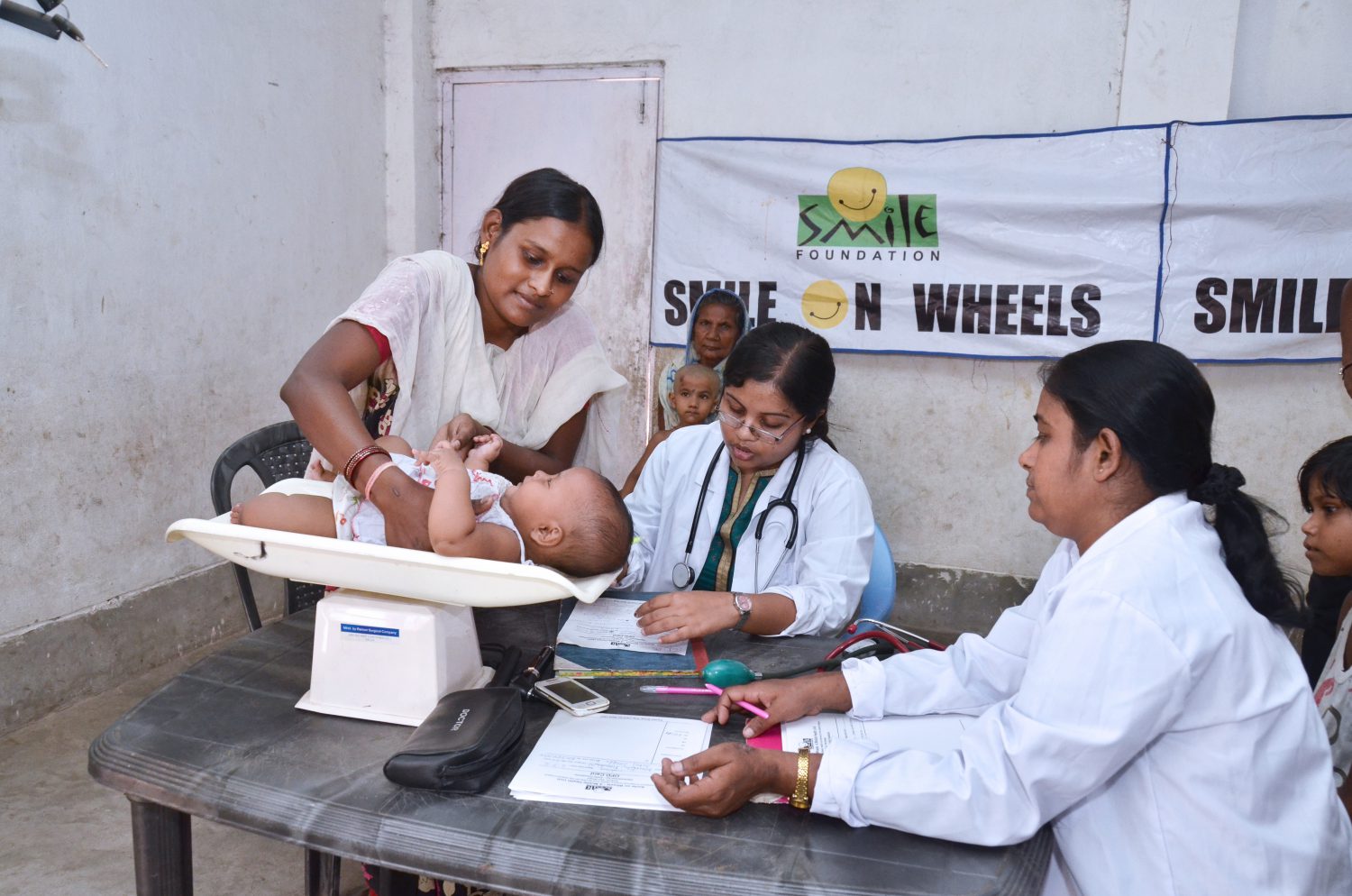
Our Smile on Wheels programme is particularly relevant to the idea of last-mile healthcare. Mobile healthcare units take basic health services to communities that may face barriers in accessing conventional health facilities, and our programmes combine healthcare delivery with health awareness, helping families understand illnesses and make better use of available services.
For child health, this kind of community-level engagement matters because immunisation is not an isolated event. It is part of a child’s wider health journey. Our broader approach also reflects an important principle — a child cannot be viewed separately from the family and community in which they grow up. Hence, we are always working towards a lifecycle approach that connects education, healthcare, livelihoods and empowerment.
The Goal is Not Just More Vaccines, but Fewer Missed Children
Mission Indradhanush represents a shift in how India approaches immunisation.
Instead of simply asking whether vaccines are available, the programme asks a more important question — Which children are still being missed, and why? That question takes public health closer to the realities of people’s lives and ensures that full immunisation is ultimately about equity.
Mission Indradhanush is important because it recognises this reality. It takes vaccination beyond the assumption that families will always be able to come to the health system. Instead, it asks the health system to go looking for those who have been left behind. The rainbow in Mission Indradhanush is therefore more than a name and goes on to represent a simple public health promise — no child should be left unprotected simply because they were difficult to reach.
FAQs
1. What is Mission Indradhanush?
Mission Indradhanush is a Government of India initiative launched in December 2014 to improve immunisation coverage by reaching children who have been left out of or dropped out of the routine vaccination system.
2. Why was Mission Indradhanush launched?
The programme was launched to address gaps in routine immunisation, particularly among children living in low-coverage, underserved and hard-to-reach communities.
3. Who does Mission Indradhanush target?
The programme focuses on children who have missed vaccinations or have not completed their vaccination schedule, particularly those in communities where access to routine immunisation is limited.
4. What is Intensified Mission Indradhanush?
Intensified Mission Indradhanush (IMI) was launched in 2017 to strengthen immunisation efforts in districts and areas with particularly low vaccination coverage. It uses a more targeted approach to identify and reach children who have been missed.
5. Why do some children miss their vaccinations?
Children may miss vaccines because of distance from health facilities, migration, unstable livelihoods, lack of awareness, difficulty keeping track of vaccination schedules, or concerns and misinformation about vaccines.
6. What is the last-mile challenge in child immunisation?
The last-mile challenge refers to the practical difficulties of ensuring vaccines reach children who live in remote areas, frequently migrate or face other barriers to accessing health services. It involves not only vaccine delivery but also reaching families at the right place and time.
7. How does Smile Foundation contribute to last-mile healthcare?
Smile Foundation’s healthcare programmes, including Smile on Wheels, take primary healthcare and health awareness closer to underserved communities. This community-level approach helps address barriers to accessing conventional health facilities and supports families in making better use of available health services.