
Summary
- Women entrepreneurs in India are driving inclusive economic growth by creating livelihoods, strengthening local economies and improving household resilience.
- While technical expertise is abundant, sustainable business growth depends on access to finance, business mentorship, advisory, digital capabilities and market linkages.
- Strategic entrepreneurship development CSR initiatives can bridge critical ecosystem gaps by enabling enterprise readiness rather than supporting livelihoods alone.
- Government initiatives and corporate partnerships are creating stronger pathways for women-led enterprises to access formal markets, finance and business opportunities.
- Investing in women entrepreneurship in India generates a multiplier effect, advancing gender equality, decent work, poverty reduction and sustainable community development.
While access to finance remains one of the most discussed barriers to entrepreneurship, research increasingly suggests that capital alone cannot sustain a business. Enterprises flourish when entrepreneurs have access to knowledge, mentorship, networks and market intelligence. For many women entrepreneurs in India, these support systems remain fragmented or inaccessible.
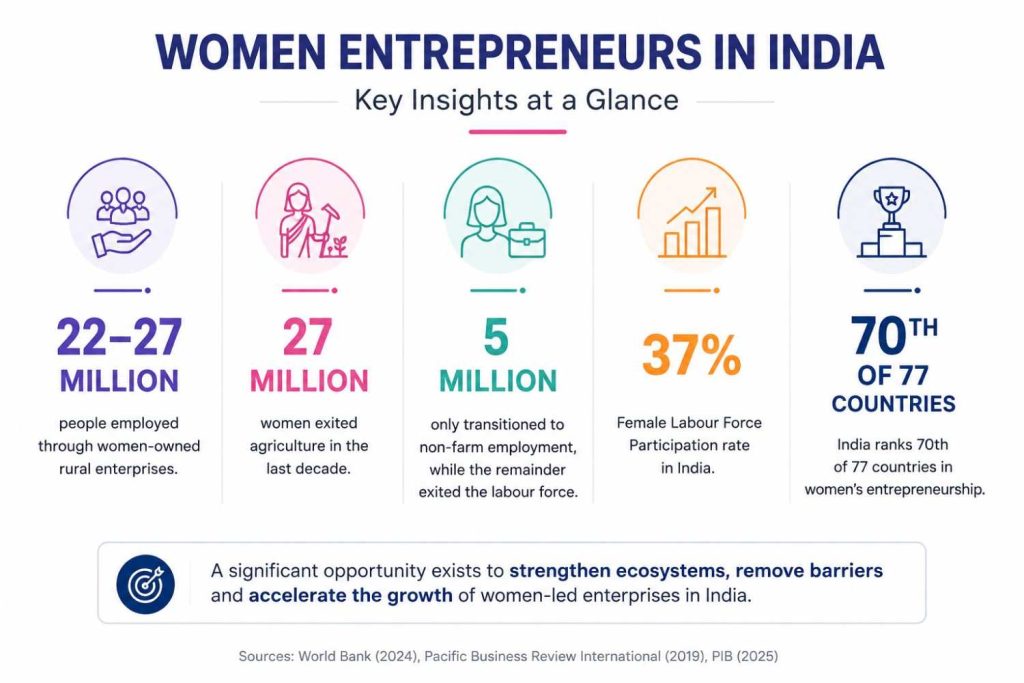
The World Bank’s study on Growth-Oriented Women-Owned Enterprises (GOWEs) identifies inadequate business advisory services as one of the primary reasons why promising enterprises struggle to expand beyond the micro-enterprise stage.
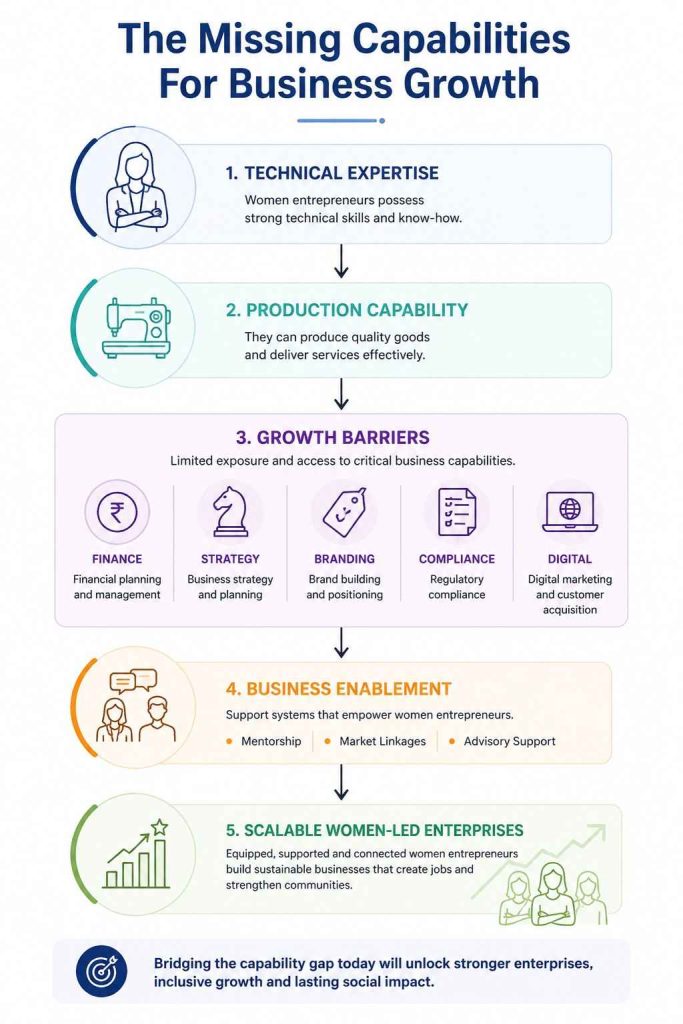
Many women possess technical skills in production but have limited exposure to
- financial planning
- business strategy
- branding
- compliance
- digital marketing
- customer acquisition.
For first-generation entrepreneurs, the challenge is even greater. Unlike business owners from entrepreneurial families, they often lack informal guidance on navigating markets, managing risks or scaling operations. Academic research reinforces this observation, concluding that while family support and education encourage women to establish enterprises, long-term success is strongly influenced by self-confidence, leadership and continuous mentoring.
Confidence, therefore, is not an innate quality but one that develops through sustained guidance and opportunities for learning.
This highlights an important shift in how entrepreneurship programmes should be designed.
Capacity-building initiatives must move beyond one-time training workshops to long-term ecosystem support that includes
- business incubation
- peer-learning networks
- market exposure visits
- digital literacy
- access to experienced mentors
Entrepreneurship is not a single milestone but an evolving journey, and women require support at every stage from ideation to enterprise expansion.
Government Initiatives Supporting Women Entrepreneurs
India has made significant progress in recognising women-led enterprises as contributors to economic growth rather than beneficiaries of welfare. Several government initiatives are working to improve women’s access to markets, finance and institutional support, creating a stronger enabling environment for entrepreneurship.
Among the most notable initiatives is the Government e-Marketplace (GeM) Womaniya programme, which enables women-led Micro and Small Enterprises (MSEs) and Self-Help Groups (SHGs) to participate directly in government procurement. By connecting women entrepreneurs with institutional buyers, the initiative enhances transparency, expands market access and creates opportunities for sustainable business growth.
Such policy interventions demonstrate that entrepreneurship development initiatives can achieve greater impact when aligned with national development priorities. Government programmes create enabling frameworks, which can be amplified through ngo csr partnerships and financial institutions that can ensure entrepreneurial opportunities reach women at the grassroots.
NGOs and CSR: Critical to Entrepreneurship Development
Policy alone cannot eliminate the structural barriers that women entrepreneurs continue to face. Access to opportunity is often determined by local realities : social norms, educational attainment, digital access and community support.
This is where development organisations and Corporate Social Responsibility (CSR) initiatives become indispensable. For organisations like Smile Foundation, women’s entrepreneurship is not viewed solely as an economic intervention but as a pathway to holistic community development.
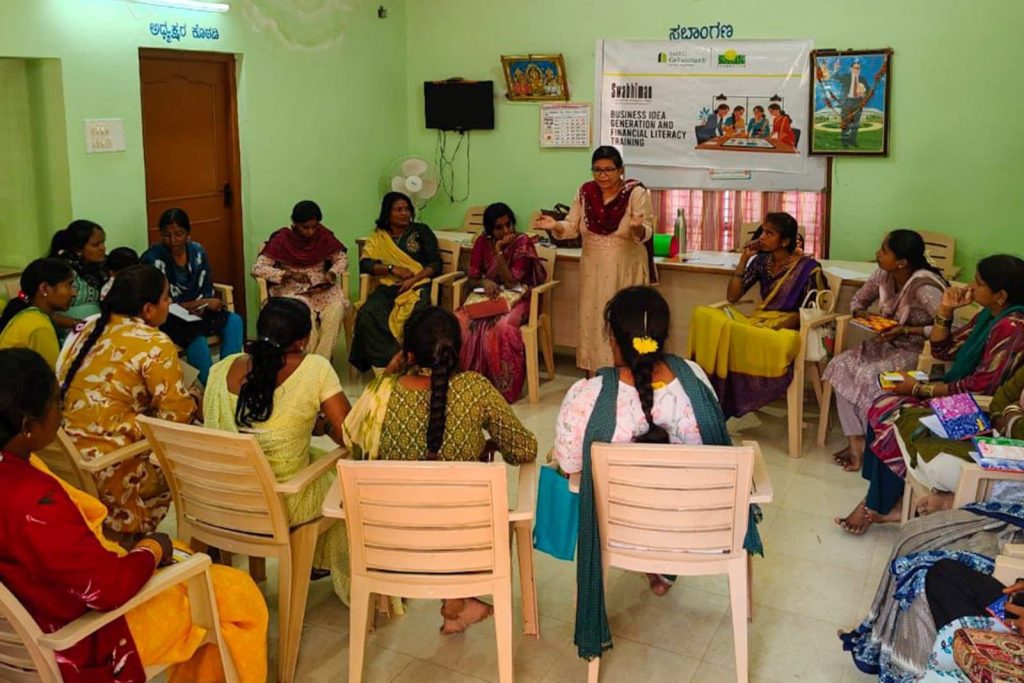
Livelihood initiatives under Swabhiman programm combine vocational training with financial literacy, entrepreneurship education, market exposure and mentoring enable women to build enterprises that are both sustainable and resilient.
CSR partnerships further strengthen this ecosystem by bringing together financial resources, technical expertise and market opportunities. Collaborative efforts through Swabhiman, support women entrepreneurs through:
- Entrepreneurship and leadership training aligned with local economic opportunities.
- Financial literacy and access to formal banking systems.
- Business incubation and enterprise mentoring.
- Digital literacy and e-commerce readiness.
- Market linkages through corporate value chains and procurement opportunities.
- Networking platforms that connect women entrepreneurs with industry experts and successful business leaders.
Such interventions create long-term value because they address both economic and social barriers.
Research indicates that entrepreneurship programmes focusing only on technical skills often overlook the importance of confidence-building, leadership development and psychosocial empowerment. Effective CSR initiatives recognise that successful enterprises require both business capability and personal agency.
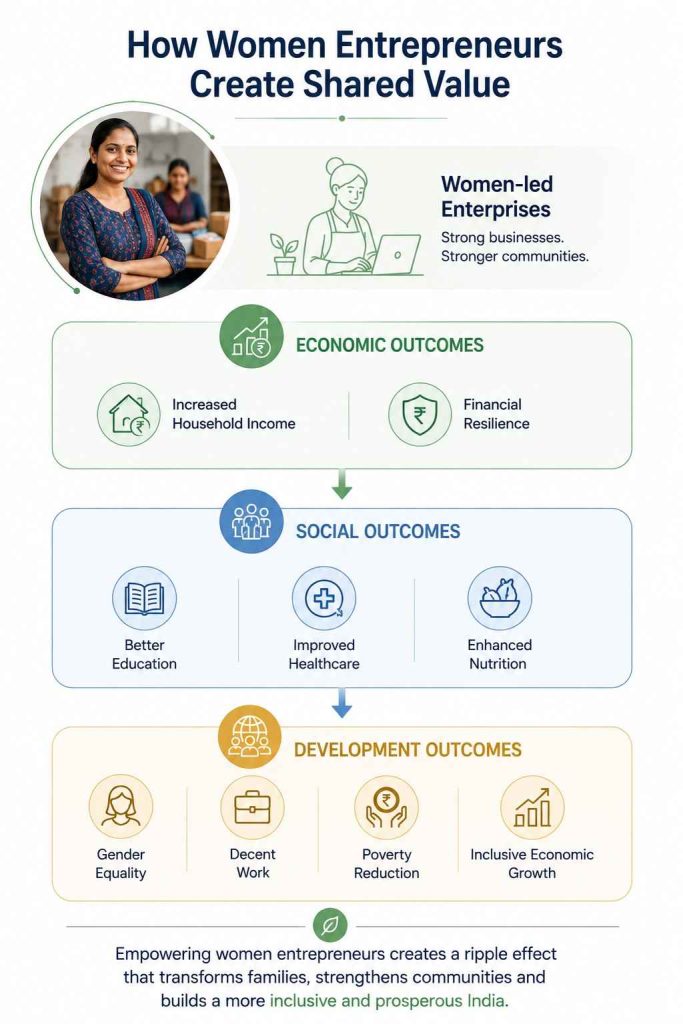
Moreover, women’s entrepreneurship generates multiplier effects that extend beyond individual enterprises. Increased household incomes often lead to improved educational opportunities for children, better healthcare utilisation, enhanced nutrition and greater financial resilience. Supporting women entrepreneurs therefore contributes directly to multiple Sustainable Development Goals, including gender equality, decent work, poverty reduction and inclusive economic growth.
Recommendations for Strengthening the Entrepreneurial Ecosystem
Building a thriving ecosystem for women entrepreneurs in India requires coordinated action across government, businesses, financial institutions and civil society. Based on current research and policy recommendations, several priorities emerge.
- Improve access to growth-stage finance. Financial institutions should design customised credit products that respond to the needs of expanding women-led enterprises rather than limiting support to microfinance alone.
- Strengthen business development services. Continuous mentoring, market intelligence, branding support and digital capacity-building should become integral components of entrepreneurship programmes.
- Promote market integration. Women-led enterprises should be connected with government procurement systems, corporate supply chains and digital marketplaces to enable sustainable business growth.
- Invest in leadership development. Entrepreneurship programmes should combine technical training with confidence-building, communication, negotiation and decision-making skills.
- Encourage collaborative partnerships. Greater collaboration between governments, corporates, NGOs, academic institutions and financial organisations can create stronger support systems that address multiple barriers simultaneously.
The World Bank also recommends recognising Growth-Oriented Women-Owned Enterprises as a distinct policy category, ensuring that enterprises with demonstrated growth potential receive targeted financial and institutional support.
Investing in Women Entrepreneurs Is Investing in India’s Future
The story of women entrepreneurs in India is ultimately a story of possibility. It is the story of women who transform adversity into enterprise, ideas into livelihoods and local opportunities into community development. Their success demonstrates that entrepreneurship is not merely about creating businesses it is about creating pathways towards dignity, resilience and shared prosperity.
Yet ambition alone cannot overcome structural inequality. Women require ecosystems that recognise their potential, invest in their capabilities and remove the barriers that continue to restrict enterprise growth. Finance, mentorship, market access and policy support must work together rather than in isolation.
As India advances towards becoming a more inclusive and resilient economy, entrepreneurship development CSR initiatives offer an opportunity to accelerate this transformation. By aligning corporate resources with community aspirations, CSR can help bridge persistent gaps in skills, finance and market access while strengthening local economies.
At Smile Foundation, women are viewed not merely as beneficiaries of development but as partners in nation-building. Every woman who gains the confidence to establish an enterprise contributes to something far greater than economic growth. She creates opportunities for her family, employment within her community and inspiration for future generations.
Partner with Smile Foundation to empower women entrepreneurs not only an investment in individual success, but as an investment that supports stronger communities, inclusive development and a future where economic progress is both equitable and sustainable.
Frequently Asked Questions (FAQs)
1. Why are women entrepreneurs in India important for economic development?
Women entrepreneurs in India contribute significantly to employment generation, household income, community resilience and local economic development. Their enterprises create shared social and economic value by improving education, healthcare and financial security while strengthening inclusive growth.
2. What are the biggest challenges faced by women entrepreneurs in India?
The primary challenges include limited access to formal finance, inadequate business advisory services, restricted market linkages, digital capability gaps, compliance support and professional mentoring. These barriers often prevent women-led enterprises from scaling despite strong entrepreneurial potential.
3. What is women entrepreneurship in India?
Women entrepreneurship in India refers to businesses established, owned and managed by women across rural, semi-urban and urban regions. These enterprises span sectors such as manufacturing, retail, food processing, handicrafts, services and digital businesses, contributing to employment and inclusive economic development.
4. How can entrepreneurship development CSR initiatives support women entrepreneurs?
Effective entrepreneurship development CSR initiatives go beyond skill development by providing financial literacy, business mentoring, market access, digital enablement, enterprise incubation and leadership development. These interventions help women-led enterprises become sustainable and scalable businesses.
5. Why is mentorship essential for women entrepreneurs in India?
Mentorship equips women entrepreneurs with strategic guidance, industry insights and professional networks that enable informed decision-making, business expansion and long-term sustainability. Research shows that continuous mentoring significantly improves entrepreneurial confidence and enterprise growth.
6. How do women entrepreneurs contribute to the Sustainable Development Goals (SDGs)?
Supporting women entrepreneurs in India advances multiple Sustainable Development Goals, including:
- Gender Equality (SDG 5)
- Decent Work and Economic Growth (SDG 8)
- Reduced Inequalities (SDG 10)
- No Poverty (SDG 1)
- Sustainable Communities (SDG 11)
By creating employment and improving household well-being, women-led enterprises generate long-term social impact.
7. What role do NGOs play in strengthening women entrepreneurship in India?
NGOs strengthen women entrepreneurship in India by providing entrepreneurship training, financial literacy, mentoring, market linkages, digital skills and community mobilisation. They also connect women entrepreneurs with government schemes and CSR-supported opportunities to build resilient enterprises.
8. Why should businesses invest in women entrepreneurs in India through CSR?
Supporting women entrepreneurs in India enables businesses to create measurable social impact while strengthening inclusive supply chains, advancing ESG commitments and contributing to sustainable economic growth. Strategic CSR partnerships help build resilient enterprises that benefit communities, industries and the broader economy.
Sources:
Factor Analysis of ‘First Generation Women Entrepreneurs’ leading to
Entrepreneurship as a Career, Pacific Business Review International
Volume 12 issue 5, November 2019