
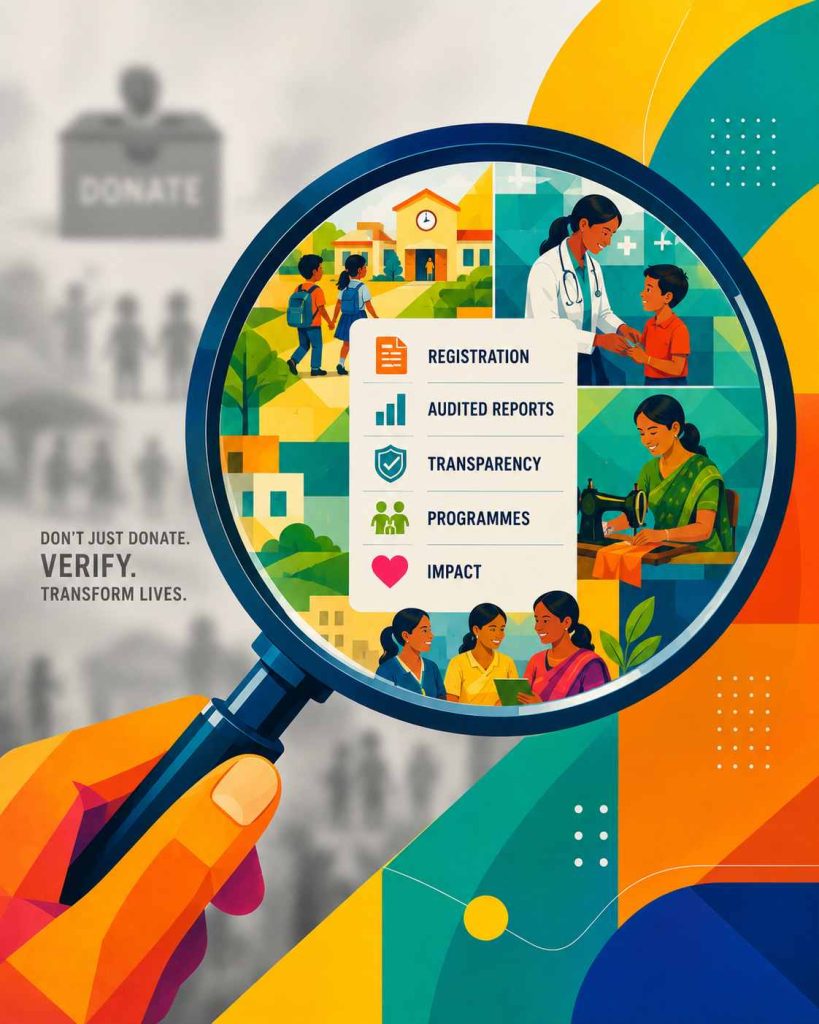
If you want to know how to verify an NGO before donating, the short answer is this. Check three things: legal registration (Darpan ID, 12A, 80G), financial transparency (audited annual reports) and ground presence (verifiable programmes and beneficiary stories). If an NGO cannot show you all three within a few minutes, treat that as a warning sign.
India has thousands of organisations doing genuine, life-changing work. It also has a small but real number of fraudulent operators who exploit people’s goodwill, especially during disasters, festivals and year-end giving seasons. The good news is that verifying an NGO does not require legal training or hours of research. It requires knowing where to look and what to look for.
This guide walks you through exactly how to verify NGO before donating, using government databases, financial records and on-ground evidence, so your generosity reaches the people it is meant for.

Verify an NGO Before Donating Is So Important
Every year, well-meaning donors lose money to organisations that either do not exist as claimed or do not use funds the way they promise. This is not about distrust. It is about due diligence, the same kind you would apply before any financial decision.
A genuine NGO will never be offended by your questions. It will have nothing to hide.
Verification protects you in a few concrete ways. It confirms your donation is tax-deductible under Section 80G. It ensures the organisation is legally accountable to a regulator, not just to its own claims. And it gives you confidence that your contribution funds real programmes, not administrative overheads or, worse, personal accounts.
In India, NGOs operate under multiple layers of oversight, the Income Tax Department, the Ministry of Home Affairs for foreign funding, and state-level registrars. Each layer leaves a paper trail you can check.
Step 1: Check the NGO’s Legal Registrations
Every legitimate NGO in India holds a basic set of legal registrations. Think of these as the equivalent of a business license. If an organisation cannot produce them, that alone should give you pause.
80G and 12A Registration
Section 12A of the Income Tax Act exempts an NGO’s income from taxation, provided that income is used solely for charitable purposes. Section 80G is different. It allows you, the donor, to claim a tax deduction on your contribution. Without 80G registration, individuals or organisations donating will not receive a deduction from their taxable income.
If an NGO was registered under the old 12A, 12AA, or 80G provisions before April 2021, it must have re-registered under the newer Section 12AB framework following the Finance Act amendments. Registrations granted since 2020 are typically provisional for three years, after which the NGO must apply for renewal.
This means an NGO’s 80G certificate is not a one-time stamp. It expires and must be renewed. Always ask for the current validity period, not just a certificate number.
FCRA Status
If an NGO accepts donations from outside India, including from NRIs holding foreign passports, it needs separate authorisation under the Foreign Contribution (Regulation) Act, 2010. No Indian NGO, trust, society, or Section 8 company can legally receive any foreign donation, even a single rupee, without FCRA registration or prior permission.
The eligibility bar is meaningfully high. An NGO must be registered for at least three years and have spent a minimum of ₹15 lakh on genuine charitable activities during that period, in addition to holding a valid NGO Darpan registration and a clean compliance record. All foreign contributions must flow through a single designated FCRA account at the State Bank of India’s New Delhi branch, a rule introduced in the 2020 amendment.
As of 2026, only around 16,000 NGOs hold active FCRA registration in India, a sharp decline from over 40,000 before the stricter 2020 compliance requirements took effect. This narrowing is worth knowing. It means FCRA status today is a meaningfully stronger credibility signal than it was a few years ago. If you are donating internationally or your NGO claims overseas partnerships, ask to see the FCRA registration number and cross-check it on the official portal.
Darpan Portal — Government NGO Database
The NGO Darpan portal, run by NITI Aayog, is your single most useful verification tool. It is accessible at ngodarpan.gov.in. Launched in 2015, it functions as a centralised, national database of NGOs and voluntary organisations across India.
Registration is not technically compulsory for every NGO, but it is practically essential. Darpan registration is mandatory for any NGO seeking foreign contributions under FCRA or government grants under various schemes. It is also a precondition for 80G registration, since NGOs applying for 80G must provide their Darpan registration details.
A genuine NGO will readily share its Darpan Unique ID. You can search this ID directly on the portal to confirm the organisation’s registered name, sector of work and registration status match what they have told you.
One practical tip from due-diligence researchers is worth repeating here. Take a screenshot of the NGO’s Darpan profile page before donating, so you have a record of their listed credentials in case anything is disputed later. The official Darpan certificate carries a QR code that should redirect to the live ngodarpan.gov.in profile when scanned; certificates where the QR code instead links to the NGO’s own website are a red flag worth investigating further.
Step 2: Review Their Annual Reports and Audit Statements
Legal registration tells you an NGO exists on paper. Financial transparency tells you what it actually does with money.
A credible NGO publishes audited annual reports, ideally certified by a chartered accountant, showing income, expenditure and programme spending. Look specifically for the breakdown between programme costs and administrative overhead. Under FCRA rules, organisations cannot spend more than 20% of foreign contributions on administrative expenses, a cap that was reduced from 50% in the 2020 amendment. While this rule technically applies to foreign funds, it is a useful benchmark for domestic donations too. An NGO spending the bulk of its budget on staff salaries, travel and overhead, with little reaching actual beneficiaries, deserves closer scrutiny.
Also check whether the NGO files its returns on time. FCRA-registered organisations must file annual FC-4 returns by December 31 each year. A pattern of late or missing filings, visible on the Darpan portal or the FCRA website, is worth noting.
A word of caution here. A significant share of Darpan-registered NGOs do not upload current audited financial statements, and this kind of non-compliance can itself be a sign of operational issues, even without outright fraud. If an NGO’s most recent published report is several years old, ask why.
Step 3: Check Their Work on the Ground
Paperwork alone does not prove impact. The strongest verification combines documentation with visible, real-world activity.
Field Presence and Beneficiary Stories
Genuine NGOs can usually point to specific locations, schools, health centres or community programmes you can verify independently. Look for named project sites, partner institutions or government bodies they work alongside. Organisations with a long operating history typically have a digital trail, news coverage, government acknowledgements, partnership announcements, stretching back years, not just a recently created website.
If possible, ask the NGO directly for references, case studies with verifiable details, or an opportunity to speak with field staff. Legitimate organisations respond promptly to due-diligence questions, while defensive responses such as questioning why you are asking, or implying that other donors do not ask such questions, are themselves red flags.
Media Coverage and Awards
Independent media coverage, government recognition or third-party evaluations add another layer of confidence. This does not mean every credible NGO will have press coverage, smaller, grassroots organisations often do not. But for larger NGOs claiming national reach, an absence of any independent verification of their work is worth noting.
Red Flags That Indicate a Fake or Untrustworthy NGO
Watch for these warning signs before making any donation.
- The organisation cannot or will not provide a Darpan Unique ID, PAN or 80G certificate number when asked.
- Pressure tactics, urgency, emotional manipulation or refusal to answer basic questions about registration.
- Donation requests made only through personal UPI IDs, WhatsApp links, or unofficial payment channels rather than a verified institutional account.
- No published, dated annual report or audited financial statement.
- A website or social media presence created very recently, with no verifiable history of work.
- Vague descriptions of programmes with no specific locations, partner institutions, or measurable outcomes.
- Registration certificates with QR codes that do not link back to the official government portal.
- Claims of FCRA eligibility or foreign-funded projects that cannot be verified against the Ministry of Home Affairs database.
If you encounter several of these together, it is reasonable to walk away from the donation, regardless of how compelling the appeal sounds.
Trusted Platforms to Verify an NGO before donating in India
Beyond the government’s own databases, a few independent platforms exist specifically to help donors assess NGO credibility.
NGO Darpan (ngodarpan.gov.in) remains your primary government source for registration status and basic organisational details. The Income Tax Department’s e-filing portal allows you to verify 80G and 12A registration numbers directly. The Ministry of Home Affairs FCRA portal lets you confirm whether an NGO is currently authorised to receive foreign contributions.
Independent assessment platforms such as GuideStar India and Credibility Alliance evaluate NGOs against governance, financial transparency and accountability standards, offering a useful second opinion beyond government registration alone. These platforms typically require NGOs to proactively disclose detailed financial and governance information, which itself filters out organisations unwilling to be transparent.
Using two or three of these sources together, rather than relying on just one, gives you a far more complete picture than any single check.
Why Smile Foundation Is a Verified and Trusted NGO
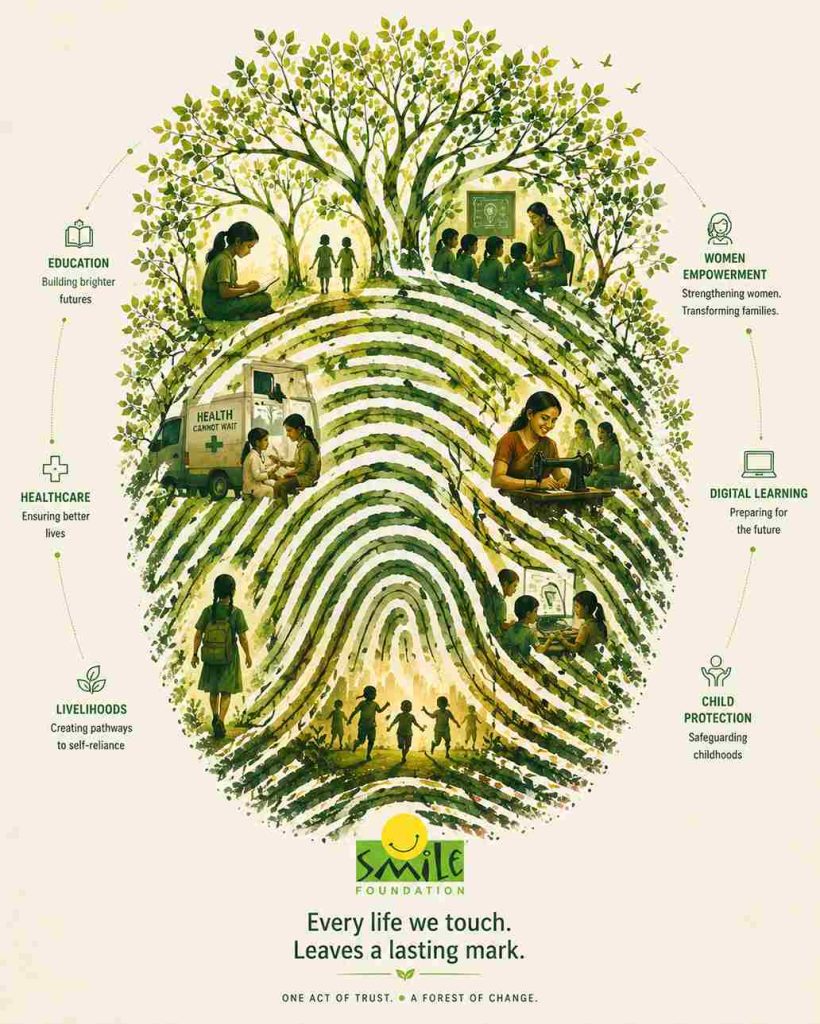
Smile Foundation has worked with underserved communities across India for over two decades, with programmes spanning education, healthcare, livelihoods and women’s empowerment. The organisation maintains its registration on the NGO Darpan portal, holds valid 12A and 80G certification and publishes audited annual reports detailing how donations are used.
Its flagship initiatives, including Mission Education, Health Cannot Wait and the Smile Twin e-Learning Programme, operate across multiple states with documented, verifiable reach. This is the same standard of transparency this guide encourages you to look for in any organisation before you give.
If you are looking to support genuine, accountable work, you can review Smile Foundation’s programmes and registration details directly and choose to donate or partner with confidence.
FAQs — How to Verify an NGO Before Donating
How to verify an NGO before donating if it is registered and genuine in India?
Start with the NGO Darpan portal to confirm its Unique ID, then cross-check its 80G and 12A registration on the Income Tax Department’s portal. Genuine NGOs will readily share these details without hesitation.
What is the Darpan portal and how does it help verify NGOs?
NGO Darpan is a government portal run by NITI Aayog that maintains a centralised database of NGOs across India, giving each registered organisation a Unique ID. You can search this ID to confirm an NGO’s legal status and basic details.
What registrations should a legitimate NGO have in India?
At minimum, look for Darpan registration, 12A registration for tax-exempt status, and 80G registration if you want your donation to be tax-deductible. NGOs accepting foreign funds should also hold valid FCRA registration.
How do I check an NGO’s financial transparency?
Ask for their most recent audited annual report and review the split between programme spending and administrative costs. Reputable NGOs publish this information publicly, often on their own websites.
What are the warning signs of a fake NGO in India?
Reluctance to share registration numbers, pressure to donate immediately, requests routed only through personal payment apps, and an absence of any verifiable track record are all significant warning signs.
Can I verify an NGO’s 80G registration on the income tax website?
Yes. The Income Tax Department’s e-filing portal allows you to search registration status using the organisation’s PAN or registration number.
What is FCRA and which NGOs have it? FCRA is the Foreign
Contribution (Regulation) Act, which legally permits NGOs to receive donations from outside India. Only about 16,000 NGOs in India currently hold active FCRA registration, a meaningful credibility marker given how few qualify.
How do I read an NGO’s annual report to assess credibility?
Look for an independent chartered accountant’s audit certification, a clear breakdown of income and expenditure and details of specific programmes funded during the year.
Which platforms help verify NGOs in India?
NGO Darpan, the Income Tax e-filing portal, the MHA’s FCRA portal and independent assessment platforms like GuideStar India and Credibility Alliance together offer a thorough verification picture.
Is Smile Foundation a registered and verified NGO?
Yes. Smile Foundation holds valid Darpan, 12A and 80G registration and publishes audited annual reports detailing its programme spending across education, healthcare and livelihood initiatives nationwide.
Your generosity deserves to reach people who genuinely need it. Take a few minutes to verify before you give and consider supporting an organisation like Smile Foundation, where transparency and accountability are built into how we work, not added as an afterthought.