
Summary
- India’s paint and coatings industry is projected to grow at 10–12% annually, yet a chronic shortage of formally trained painters continues to limit both worker earnings and industry quality standards
- The iTrain Programme, launched by Berger Paints India Limited in partnership with Smile Foundation, operates across 31 fixed training centres and 23 mobile units, reaching painters in remote and underserved communities across 20 Indian states
- 97% of surveyed participants reported higher incomes following iTrain training, with 62% stating their earnings had doubled — and 84.24% reporting increased savings that went toward assets including vehicles, homes, and land
- Entrepreneurial skill development saw the most dramatic year-on-year growth, rising from 54.78% in 2024 to 80.94% in 2025 — signalling a significant shift from wage employment toward independent contracting and small business ownership
- Soft skills proved as transformative as technical ones — 96.75% of participants reported improved communication and interpersonal skills, directly contributing to expanded client bases and stronger professional networks
- 73.65% of participants were first-generation painters, making iTrain one of the few structured pathways available for workers whose families had no prior access to formal industry training
- The programme’s mobile units play a distinct role in reaching rural communities where fixed infrastructure does not exist, with peer-driven referral emerging as a stronger recruitment mechanism in these settings
- The impact assessment, conducted independently by Social Lens across 12 cities and 425 respondents, provides rigorous evidence that sustained, industry-aligned skilling produces measurable and lasting economic change
When a Paintbrush Becomes a Pathway: How the iTrain Skill Training Programme Is Transforming Livelihoods in India
There is a version of skill development that arrives in a community once, delivers a certificate and disappears. Participants gain a document but not necessarily a livelihood. The gap between training and outcome remains wide and the promise of economic mobility stays just out of reach.
The iTrain Programme is something different. Launched by Berger Paints India Limited in 2014 and significantly expanded in 2021 through a strategic partnership with Smile Foundation, iTrain is built on a more honest understanding of what it takes to change the trajectory of a working person’s life. Technical knowledge matters. So does confidence, communication, client management and the belief that one’s work has professional value. The programme invests in all of it, and the evidence, gathered through a rigorous third-party impact assessment by Social Lens Consulting in 2025, shows what that investment produces.
The Industry Behind the Programme
India’s paint and coatings industry is growing fast. Currently valued at approximately INR 70,000 crore, it is projected to expand at a compound annual growth rate of 10–12% over the next five years, driven by construction, infrastructure development and rising demand for home improvement. The sector is, by any measure, a significant part of India’s economic story.
But that story has a gap running through it. The majority of painters working in India today learned their trade informally, on the job, without access to structured training, safety protocols or the kind of professional standards that clients in a growing market increasingly expect. The result is a workforce that is large but unevenly skilled and a sector that struggles to meet quality demand at scale.
This is the problem iTrain was designed to address by teaching painting techniques and equipping them with the full range of competencies — technical, interpersonal and entrepreneurial — that allow them to compete, grow and sustain their livelihoods in a changing market.
What the Programme Does Through Skill Training
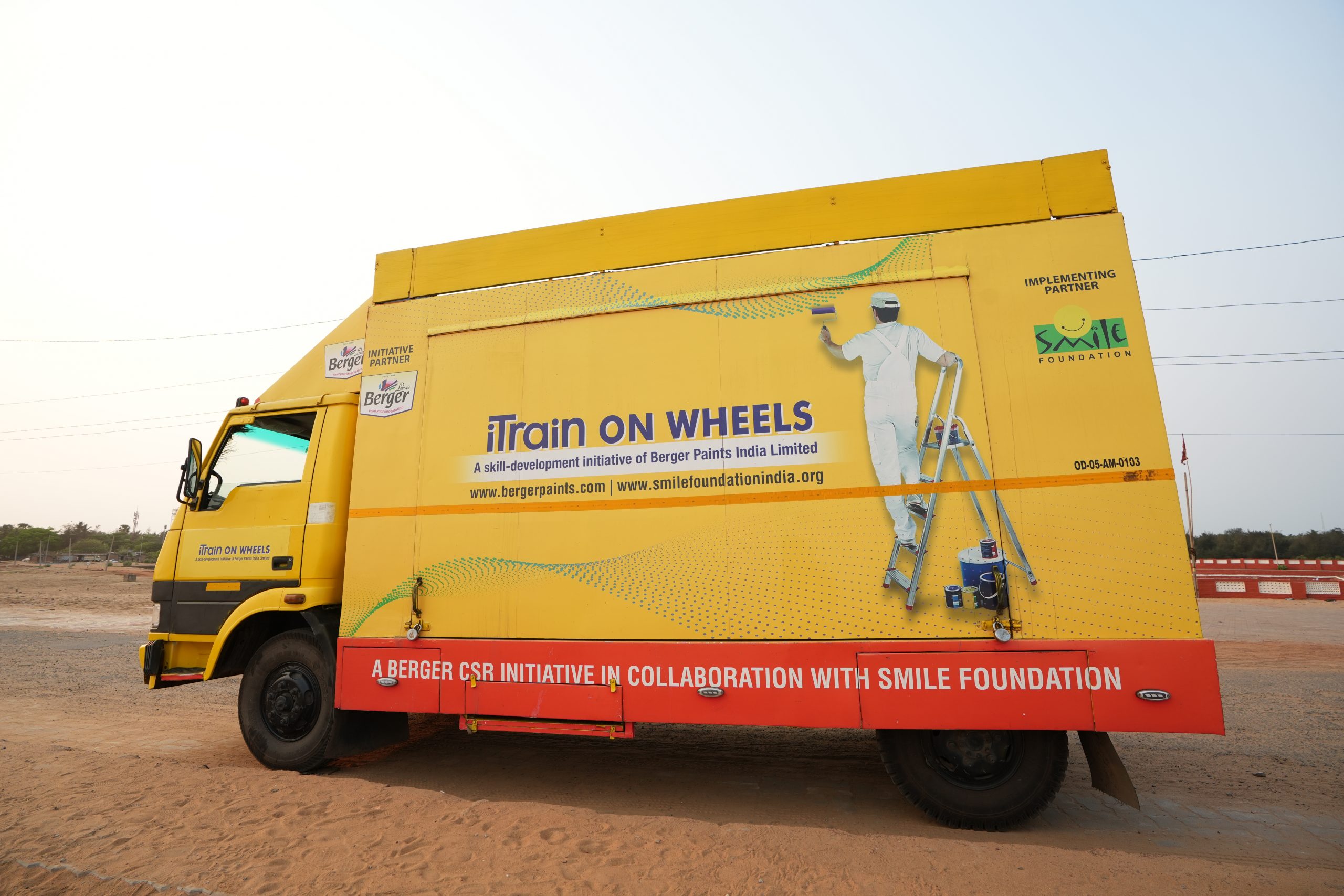
iTrain operates through two complementary delivery models. Thirty-one fixed training centres, established across India, provide structured theoretical and hands-on instruction in a consistent, well-equipped environment. Twenty-three mobile training units extend the programme’s reach into rural and remote areas where painters may have no other access to formal skilling. Together, they cover 20 Indian states and thousands of painters and contractors.
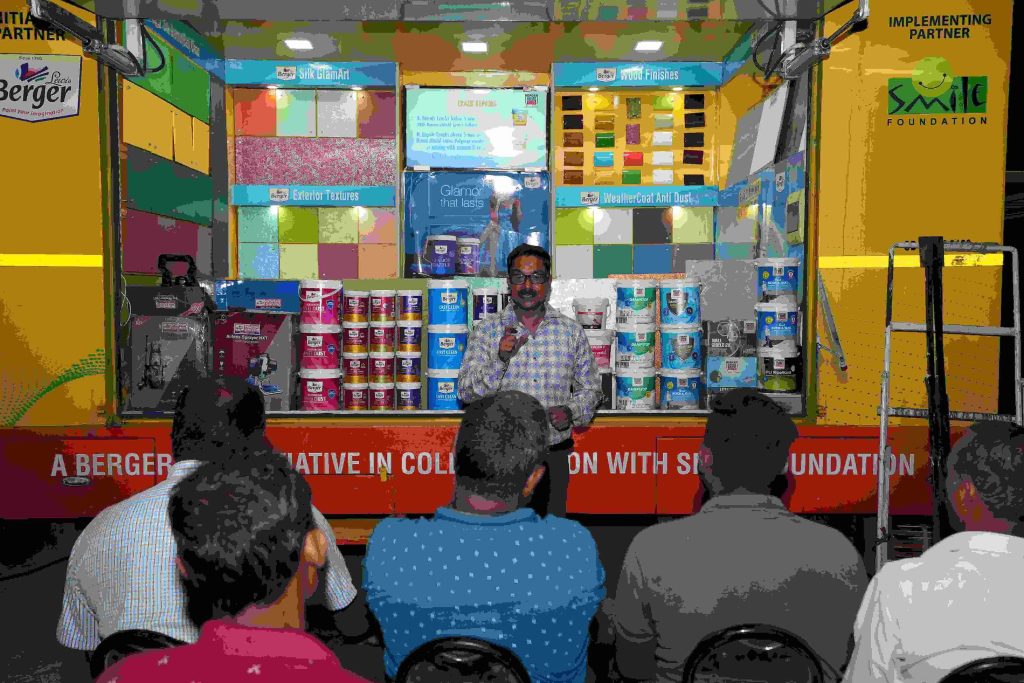
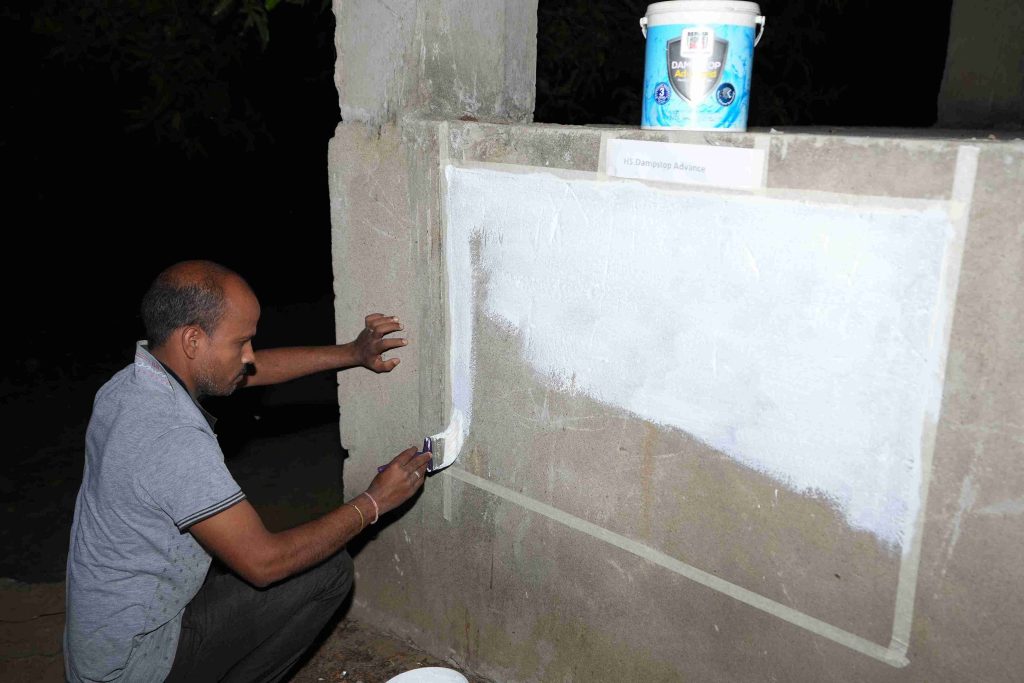
The curriculum is deliberately holistic. Technical modules cover paint surfaces, waterproofing, working with wood, moisture meters, textures and product types — the practical knowledge that determines work quality and professional credibility. But the programme does not stop there. Sessions on communication, client management, time management, financial literacy, project planning and entrepreneurship reflect a clear-eyed understanding that what limits most painters in the informal economy is not only technical skill but the professional infrastructure around it.
Smile Foundation’s role in the partnership, particularly through the mobile unit deployment, brings deep community engagement experience and the implementation infrastructure needed to reach workers who would otherwise remain outside any formal development programme. The collaboration reflects both organisations’ shared understanding that skill development is most effective when it is accessible, consistent and embedded in the communities it is designed to serve.
The People iTrain Reaches
The 2025 impact assessment surveyed 425 painters and contractors across 12 cities — Bhubaneshwar, Cochin, Delhi, Faridabad, Ghaziabad, Guwahati, Jalandhar, Kolkata, Kollam, Pune, Tirunelveli and Vijayawada. The profile of respondents tells a story that is worth pausing on.
The average participant was approximately 40 years old. Nearly half had worked in the painting profession for between 11 and 20 years. A significant 30.6% had never attended school. Most started working around Grade 8, well before completing their formal education.
These are not people who lack commitment or capability. They are people who entered the workforce early, often out of economic necessity, and built careers through experience alone, without the formal validation or professional development that might have accelerated their growth. For 73.65% of respondents, this is the first generation of their family to work in painting. iTrain, for many of them, is the first time anyone has invested in their professional development.
That context matters for understanding what the programme’s outcomes actually represent. A painter who doubles his income after training is not simply a data point. He is someone who without formal skilling infrastructure might have spent a career earning a fraction of what his skills, once developed and recognised, can command.
What Changes After Skill Training
The 2025 findings, independently assessed by Social Lens Consulting with a 95% confidence level and 5% margin of error, are consistent and substantial across multiple dimensions.
Income and economic mobility are the most immediately visible outcomes. 97% of respondents reported a positive change in income following iTrain participation. 62% stated their earnings had at least doubled. A further 17% reported income growth between 50 and 75%. Only 3% reported no income change. These are not marginal gains — they represent a genuine transformation in the economic lives of working people.
The financial benefits extend beyond income. 84.24% of participants reported increased savings. Those savings are being invested in ways that signal a shift in economic status and long-term planning: 62.35% purchased a vehicle, 52.94% bought a mobile phone, 41.18% invested in a home and 35.53% acquired land. These are not luxury purchases. They are the building blocks of household stability and intergenerational security.
Confidence and career progression show similarly strong gains. 84.25% of respondents reported increased confidence in their professional abilities — up from 77.2% in 2024. 77.5% reported career advancement. 71.75% noted an expanded professional network. The year-on-year improvement across these indicators is not incidental. It reflects a programme that is deepening in its impact over time, not plateauing.
Soft skills, often undervalued in workforce development programmes, proved among the most consequential outcomes. 96.75% of participants reported improved communication and interpersonal skills — a figure that reflects both the programme’s curriculum emphasis and the community dimension of the training centres themselves. Participants described the centres not just as places to learn techniques, but as spaces where peer relationships form, informal mentoring happens and professional identity develops. 82.25% reported stronger time management skills. 69.25% improved their client expectation management.
Entrepreneurial ambition represents perhaps the most striking shift in the 2025 data. 80.94% of participants valued the entrepreneurial skills component of the programme — a dramatic rise from 54.78% in 2024. First-generation painters, in particular, described iTrain as a stepping stone toward growing their own businesses and building contractor networks. The programme is producing not just better employees, but the foundations of small business ownership in a sector where that transition has historically been difficult without formal support.
What the Mobile Units Do Differently
The data from fixed and mobile training centres reveals distinct but complementary patterns. Mobile units slightly outperformed fixed centres in technical skill development — 84.38% versus 79.94% — likely because the hands-on, accessible format resonates particularly well with participants who may be engaging with formal training for the first time.
Mobile centres also showed stronger peer-driven recruitment. 11.22% of mobile centre participants were referred by fellow painters, compared to 5.5% at fixed sites. This matters because peer referral is one of the most reliable indicators of genuine community trust — people recommend things that have worked for them.
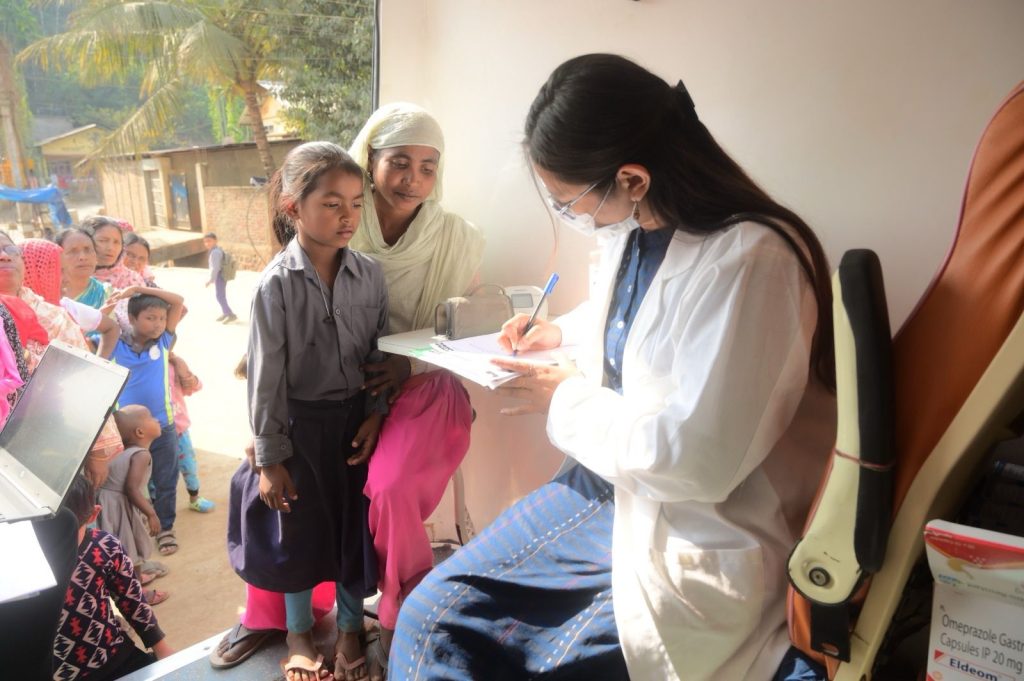
The mobile units serve a population that fixed infrastructure cannot reach. In communities where a painter might not have the means or the time to travel to a training centre, the programme coming to him is not a convenience feature. It is the difference between access and exclusion. Smile Foundation’s experience in community mobilisation and remote programme delivery is what makes this possible.
The Difference Sustained Engagement Makes
One of the clearest findings in the assessment is the relationship between continued participation and outcome quality. Participants who attended more sessions consistently showed stronger skill development and higher satisfaction with the programme’s relevance. Several reported returning for sessions they had already attended — not for revision, but to stay current as new tools and techniques entered the market.
This points to something important about what effective skilling actually requires. A single training cycle, however well-designed, has limits. The workers who benefit most from iTrain are those who engage with it as an ongoing professional resource — returning as the industry evolves, building relationships with trainers and peers over time and using the training centre as a community of practice rather than a one-time event.
The data on centre maturity reinforces this. Mid-stage centres, those operating between seven and nine years, consistently produced the strongest business outcomes across client acquisition, contract growth and network expansion. These are centres that have built real relationships with local painting communities, developed experienced trainers and adapted their delivery over time. They represent what a long-term investment in skilling infrastructure looks like when it matures.
Why This Matters for CSR in India
The iTrain Programme is, among other things, a case study in what CSR investment in workforce development can produce when it is designed with genuine rigour, sustained over time and implemented through partners with deep community presence.
India’s skill development landscape includes many programmes that measure success by enrolment and certification. iTrain measures something harder and more honest: whether participants earn more, grow their businesses, gain clients, and invest in their futures. The independent impact assessment commissioned by Berger Paints reflects an accountability standard that more CSR-funded skill programmes should aspire to.
Smile Foundation’s partnership role demonstrates the value of implementation expertise in translating corporate investment into community-level impact. The mobile units, the community engagement, the reach into underserved geographies — these are not features that a corporate programme can build overnight. They are the product of years of trust-building and operational depth that purpose-driven NGOs bring to the table.
What Comes Next
The 2025 assessment also identifies where the programme can grow. Participants are asking for more specialised modules on epoxy applications, damp proofing, and advanced textures; more real-time training as new products enter the market; more space for iterative learning that does not overwhelm in dense sessions.
The absence of women in contractor-level roles at surveyed sites points to a structural gap in the sector that the programme has an opportunity to address more deliberately as it scales. Trainers noted that women do participate in iTrain as daily wage painters in other locations — the question is how to build the pathway from participation to leadership.
These are not critiques of what iTrain has achieved. They are the natural next questions that a programme producing real results earns the right to ask.
Dignity Through Craft
A painter who completes iTrain and doubles his income has not simply learned new techniques. He has been recognised as a professional whose knowledge has value, whose craft is worth investing in, and whose ambitions — to grow a business, to own a home, to give his children better options — are legitimate and reachable.
That recognition is as important as any certificate. And it is what Smile Foundation, in partnership with Berger Paints India Limited, is working to extend — one training session, one mobile unit visit, one first-generation painter at a time.
The data is compelling. But the story it tells is a human one: that when investment in working people is sustained, rigorous and genuinely respectful of their potential, the outcomes speak for themselves.