
Summary
School infrastructure — water, sanitation, classrooms — directly determines whether children can attend, stay and learn. In India, millions of students attend schools where basic facilities remain inadequate, creating invisible but consequential barriers to participation. Smile Foundation’s work with Branch International in schools in and around Mumbai addresses these foundational gaps as a systemic investment in the conditions that make learning possible. The evidence is consistent: when schools become healthier, safer and more welcoming environments, children come more often, stay longer and engage more fully.
What a Glass of Water Has to Do With Education
Picture a classroom in the late morning. The teacher is mid-lesson. Half the children are paying attention. The others are restless — not because the lesson is uninteresting, but because they are thirsty, or because they have been holding off a toilet visit since early morning or because the heat in the room has become difficult to bear.
This is not an unusual scene in many government and low-cost private schools across India. It is, in fact, a routine one. And it illustrates something that education policy has been slow to fully reckon with: that the quality of learning inside a classroom is inseparable from the quality of the environment that surrounds it.
Infrastructure — water, sanitation, ventilation, functional classrooms — tends to be discussed in the language of logistics. It is treated as a precondition to be ticked off before the real work of education begins. But this framing misses something important. Infrastructure is not separate from learning. It shapes it, constrains it or enables it, every single day.
When Basics Become Barriers
India has made genuine progress on school enrolment over the past two decades. Getting children into school is no longer the primary challenge it once was. The harder, less visible challenge is keeping them there, and ensuring that being there actually results in learning.
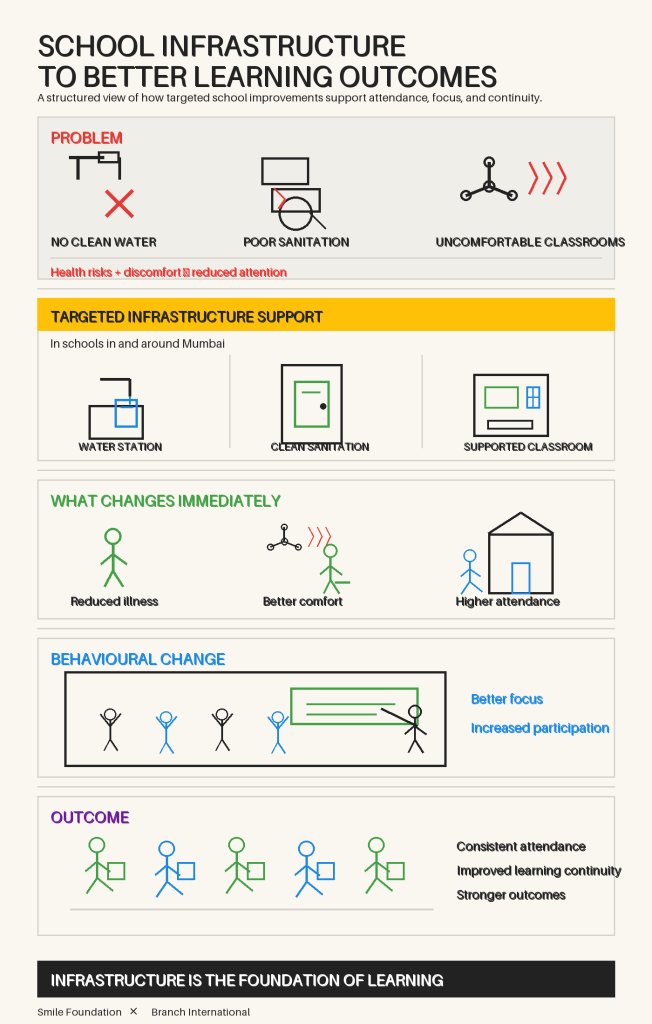
Infrastructure deficits are among the most consistent contributors to both dropout and disengagement. The links are not complicated, but they are worth tracing carefully.
Clean drinking water is the most fundamental. A child who does not have access to safe water during the school day faces a straightforward physiological problem: dehydration impairs concentration, recall and the capacity to sustain attention. Research on cognitive function consistently shows that even mild dehydration — the kind produced by a few hours without adequate fluid intake — measurably reduces performance on tasks requiring focus and short-term memory. For a child already navigating the challenges of a crowded classroom, an undertrained teacher or a curriculum delivered in a language that is not their first, this is not a marginal disadvantage. It compounds everything else.
Sanitation is the second critical variable and one that carries particular weight for girls. Schools without functional, private toilet facilities see higher rates of absenteeism among adolescent girls — a pattern so well-documented that it has become a standard consideration in school infrastructure planning. The decision to stay home rather than navigate an inadequate or unsafe sanitation environment is not irrational. It is a reasonable response to a real problem. And it accumulates, absence by absence, into gaps in learning that are difficult to recover.
Beyond water and sanitation, the physical condition of the classroom itself matters more than it is given credit for. A room that is structurally unsound, poorly ventilated or simply overcrowded produces a learning environment in which sustained engagement is physiologically difficult. Children are not failing to pay attention because they lack motivation. They are struggling to learn in conditions that make learning hard.
The Invisible Architecture of Education
The relationship between physical environment and cognitive performance is well-established in the literature, even if it remains underweighted in education policy conversations. Studies across low- and middle-income countries have consistently found that improvements in school infrastructure — particularly water and sanitation — correlate with measurable improvements in attendance, particularly for girls, and with reductions in school-related illness that further drive absenteeism.
There is also a dimension of dignity that deserves more direct attention. A school that communicates, through its physical state, that the children who attend it are not worth basic investment, sends a message that children receive and internalise. The relationship between a student and their school is partly emotional — a sense of belonging, of being valued, of occupying a space that was designed with their needs in mind. When that relationship is undermined by an environment that is neglected or inadequate, the effects on engagement and motivation are real, even if they are harder to quantify than attendance rates.
Conversely, when a school environment is improved — when children have access to clean water, functional sanitation and classrooms that are safe and reasonably comfortable — something shifts in how they relate to the act of attending. School becomes a place worth coming to. And that shift has consequences that ripple through learning outcomes over time.
Smile Foundation and Branch International
In schools in and around Mumbai, Smile Foundation’s education initiative — supported by Branch International — has been addressing these foundational gaps through need-based infrastructural improvements. The focus has been deliberate: clean drinking water access, improved sanitation facilities and classroom environments that create the basic conditions for engagement.
The approach is grounded in a straightforward but important insight. Educational interventions that focus exclusively on curriculum, pedagogy or teacher training, however well-designed, operate at a disadvantage when the physical environment they are being delivered in is working against them. Strengthening infrastructure is not a distraction from the work of improving education. It is part of that work.
Branch International’s support has enabled Smile Foundation to address the specific gaps identified in partner schools — moving from assessment of need to implementation with the kind of focus and accountability that distinguishes infrastructure investment from cosmetic improvement.
What Changes When the Basics Like School Infrastructure Work
The changes produced by improved school infrastructure are not dramatic in the way that educational interventions are sometimes portrayed. There is no single transformative moment. What there is, instead, is a gradual and cumulative shift in how children experience school.
Attendance improves as the practical and dignity-related barriers to coming to school are reduced. Children who previously stayed home due to illness related to contaminated water, or girls who avoided school during certain periods due to inadequate facilities, find fewer reasons to be absent.
Classroom engagement follows. A child who is physically comfortable, adequately hydrated and present in a space that feels safe and functional is a child who is better positioned to learn. Teachers, too, operate differently in environments that are functional — the energy spent managing the consequences of poor infrastructure is energy that can be redirected toward instruction.
Over time, these changes compound. Improved attendance means fewer gaps in learning. Better engagement means more of what is taught is retained. And the cumulative effect — children spending more time in better conditions, with more capacity to absorb what they are being taught — is what educational outcomes are actually built from.
The CSR Lens: From Charity to Systems Strengthening
Partnerships like the one between Smile Foundation and Branch International represent a particular and important model of CSR engagement — one that is worth distinguishing from more transactional forms of corporate giving.
The investment here is not in a visible, singular output. There is no building with a plaque. What there is, instead, is a set of conditions — water that is safe to drink, toilets that function, classrooms that are sound — that enable an entire educational environment to work better. The beneficiary is not one child or one cohort. It is every child who attends that school and every child who will attend it in the years to come.
This is what systems strengthening looks like in practice. It is less photogenic than handing over a cheque and harder to capture in a single impact metric. But it is also more durable, more honest about what actually drives educational outcomes and more aligned with what the evidence says about how change in education happens.
For CSR investment to produce genuine impact in education, it needs to be willing to fund the unglamorous, foundational work — the water points, the toilet blocks, the structural repairs — that makes everything else possible. Branch International’s support for this work reflects exactly that understanding.
The Foundation Beneath the Foundation
Education reform in India tends to generate the most energy around things that are visible and measurable in the short term — learning levels, digital tools, teacher training programmes, curriculum redesign. These matter. But they rest on a foundation that is more literal than it is often acknowledged to be.
A child cannot learn well if she is unwell, uncomfortable, or absent. A school cannot function as a learning environment if its most basic physical requirements are unmet. The relationship between infrastructure and educational quality is not a footnote. It is a first principle.
Getting this right — consistently, at scale, across the schools that serve India’s most underserved children — requires the kind of committed, unglamorous, sustained investment that partnerships like Smile Foundation and Branch International represent. It is not the whole answer to the challenge of education quality in India. But without it, the rest of the answers struggle to take hold.
Frequently Asked Questions (FAQs)
Why does school infrastructure matter for learning outcomes?
School infrastructure directly shapes the conditions in which learning takes place. Access to clean water affects concentration and health. Functional sanitation reduces absenteeism, particularly among girls. Safe, well-maintained classrooms support sustained engagement. When these basics are absent, even well-designed educational interventions face significant headwinds.
How does clean drinking water affect student performance?
Research on cognitive function shows that even mild dehydration measurably impairs concentration, short-term memory and the ability to sustain attention — all of which are essential to classroom learning. For children already navigating challenging learning environments, this is a compounding disadvantage rather than a minor inconvenience.
Why are girls disproportionately affected by poor sanitation in schools?
Inadequate or unsafe toilet facilities are consistently associated with higher rates of absenteeism among adolescent girls, particularly during menstruation. The decision to stay home rather than attend a school without private, functional facilities is a rational response to a real barrier — one that accumulates into significant gaps in learning over time.
What is Smile Foundation’s approach to school infrastructure?
Smile Foundation conducts need-based assessments of partner schools and addresses identified gaps in a focused, accountable way. The work is grounded in the understanding that infrastructure improvement is not separate from educational improvement — it is a precondition for it. Support from corporate partners like Branch International enables this work to be implemented at meaningful scale.
What role does CSR play in addressing school infrastructure gaps?
Government investment in school infrastructure, while significant, has not been sufficient to address the scale of need — particularly in schools serving low-income urban and peri-urban communities. CSR partnerships fill critical gaps, but their impact depends on being directed toward foundational, systemic needs rather than visible, one-off outputs. The most effective CSR investments in education are those that strengthen the conditions in which learning happens, not just the content of what is taught.
How does improved infrastructure reduce absenteeism?
By removing the practical and dignity-related barriers that lead children and their families to choose absence over attendance. When schools have clean water, functional sanitation and safe learning environments, the reasons to stay home diminish. The result is not just better attendance data, but more continuous learning and stronger outcomes over time.