

If you’ve ever tried elbowing your way through India’s college admission season, you know the feeling. Application portals crash, cut-off percentages soar into the stratosphere and social media fills up with stories of students who scored 99% yet are still scrambling for a seat. Welcome to the rat race of Indian higher education, where aspiration outpaces opportunity and affordability remains a nagging wall many cannot climb.
Delhi University, for instance, has around 70,000 undergraduate seats across 91 colleges. Sounds decent until you realise that over 2.6 million students apply each year. Even if you’re among the select few to secure admission, another hurdle stares you down: the cost. Parents dip into savings, take out loans or swallow their pride and borrow from relatives. For millions of others, even that isn’t an option.

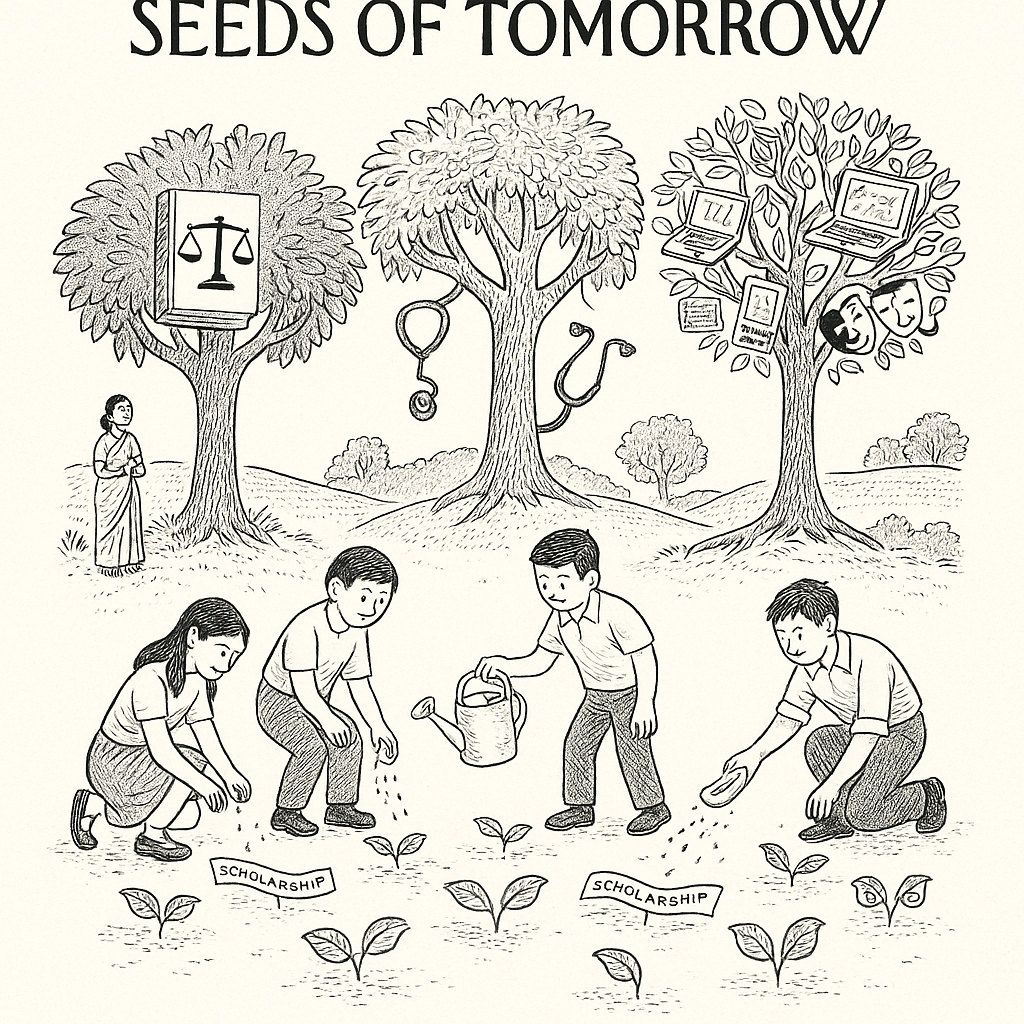
Scholarships as equalisers
For a child from a tea-estate in Assam or a Dalit family in Bundelkhand, a scholarship is validation that their hard work matters, that talent can trump circumstance. Scholarships level the playing field, ensuring that higher education is not just a privilege of the wealthy but a right accessible to all.
And the need is acute. Seats in government-funded universities with low fees are limited, while private institutions charge in lakhs. Without scholarships, thousands of brilliant students simply disappear from the education pipeline.
Smile Foundation, for instance, runs a scholarship programme that doesn’t just stop at tuition — it covers books, mentorship and skill-building. That extra layer matters. Imagine being the first in your family to enter a university. The culture shock, the academic rigor, the peer pressure — these can all derail you. Scholarships that provide both money and mentorship act as scaffolding, helping students stay the course.
A quick detour: Where did scholarships come from?
Scholarships have a surprisingly dramatic backstory. Ancient Greece revered learning but reserved it mostly for the elite. Every so often, though, acts of generosity opened doors — Alexander the Great famously funded a school under Aristotle. Rome followed suit, with wealthy patrons occasionally supporting poor but bright students.
By the Middle Ages, as universities like Oxford, Bologna and Sorbonne emerged, scholarships became more structured. Churches and monasteries established charitable endowments. Some students even entered early versions of work-study programmes — labouring in return for tuition.

Fast forward to the Enlightenment, when Europe’s wealthy and royalty began pouring money into scholarship funds as a way to promote knowledge and, frankly, legacy. The U.S. took things further: Harvard offered early scholarships, while the G.I. Bill of 1944 revolutionised access by enabling millions of returning soldiers to study.
Today, scholarships worldwide are a multibillion-dollar enterprise. From global giants like the Rhodes Scholarship to grassroots community grants, they remain the bridge between potential and opportunity.
India’s story
India has always had a tradition of patronage in education. Nalanda and Takshashila attracted scholars from Asia, often supported by royal or monastic assistance. Later, during colonial times, structured systems evolved. Philanthropists like Jamsetji Tata (1892) funded Indian students abroad. By 1944, the government had launched the Post-Matric Scholarship for Scheduled Castes, a ground breaking move to counter entrenched caste barriers.

Post-independence, the challenge was clear. While India promised universal education, economic disparities and caste inequities created walls. To tackle this, the state and UGC (University Grants Commission) built extensive scholarship frameworks — targeting Dalits, OBCs, tribal communities, women and the poor.
Some milestones:
- 1998: Post-Matric Scholarships for OBCs.
- 2008: National Means-cum-Merit Scholarship Scheme (NMMSS).
- 2009 onwards: A proliferation of state-specific and minority-focused scholarships.
Despite gaps in awareness and accessibility, scholarships in India have undeniably been engines of social mobility.
Why do they matter in today’s India
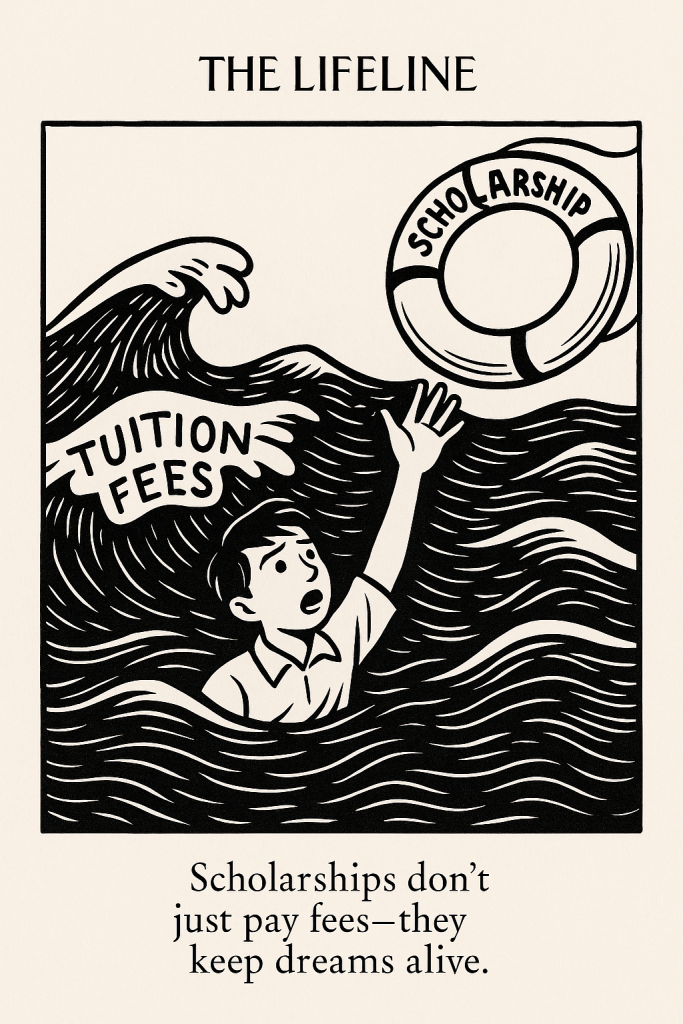
Let’s zoom in on the present. Scholarships are investment multipliers.
- Breaking poverty cycles: When a student gets a degree, their family income potential often triples within a generation.
- Equity for marginalised groups: Women, Dalits and Adivasis — long excluded — are offered a fair shot.
- Regional balance: Scholarships enable students from remote or rural areas to access top institutions.
- Human capital: As India races to be a $5 trillion economy, it needs skilled graduates — not just in engineering or medicine but across humanities, social sciences and emerging industries.
Invest in a child’s education today and you’re not just lifting them — you’re strengthening the economy and democracy itself.
The personal face of scholarships
Numbers are important, but the true weight of scholarships lies in stories.
- Radhika Yadav, Madhya Pradesh: The daughter of a farmer, she dreamt of studying law. A scholarship covered her tuition and hostel fees. Today, she’s a practicing lawyer fighting for land rights of small farmers — people like her father.
- Amit, Bihar: His mother works as a domestic helper. Without a scholarship, he would’ve dropped out after Class 12. Instead, he pursued computer science and now teaches coding to kids from low-resource settings..
- Seema, Delhi slum cluster: With a scholarship, she studied nursing. During COVID-19, she was on the frontlines, saving lives, proving the ripple effect of that one intervention years earlier.
Every scholarship awarded is, in effect, an investment in a human story — one that often pays back many times over.
But the system isn’t perfect

Here’s the tricky part: scholarships can be riddled with bureaucracy. Application forms are long, documentation requirements absurd (imagine asking a daily wage worker for notarised income certificates) and disbursement often delayed. Awareness is another issue — thousands of scholarships go unclaimed each year because students simply don’t know they exist.
There’s also a mismatch between where scholarships exist and where they’re needed most. Urban students with internet access and coaching often corner opportunities, while rural or first-generation learners miss out.
The New Frontier: Digital & data-driven scholarships
Thankfully, things are changing. The National Scholarship Portal (NSP) now aggregates thousands of schemes in one place. AI-driven platforms are helping match students with scholarships suited to their profiles. Corporates are stepping in too — linking CSR funds to education initiatives.
Imagine a near-future scenario:
- A student logs into a portal, fills a single profile.
- AI scans their background, grades, location,\ and interests.
- Instantly, it generates a personalised list of scholarships they qualify for.
- Applications are auto-filled, verified digitally and funds disbursed directly into their bank account.
It’s already happening in parts of India. The challenge is scaling it to every village and town.
The Gender Dividend
Scholarships for women are particularly powerful. Educated women marry later, have healthier children and participate more in the workforce. Each of these outcomes boosts GDP. A UNICEF study found that every additional year of schooling for girls increases their future earnings by 10-20%.
Targeted scholarships for women in STEM, medicine or even vocational training are game-changers. Imagine if India doubled its female laboUr force participation — it could add $770 billion to GDP by 2025 (McKinsey). Scholarships are one of the most cost-effective levers to make that happen.
Beyond access, towards innovation
As India positions itself as a knowledge economy, scholarships must go beyond funding access. They must incentivise research, innovation and entrepreneurship. Imagine scholarships tied to climate solutions, rural health innovations or AI ethics. These would not only empower individuals but also align education with national and global priorities.
Equally, scholarships should nurture soft skills — communication, leadership, resilience—often the missing pieces between a degree and employability. Smile Foundation’s model of pairing financial aid with mentorship is precisely the kind of holistic approach India needs.
If we want to reap our much-touted demographic dividend, we need to ensure no bright child is forced to drop out because of money. If we want innovation, we need scholarships that push research. If we want equality, we need targeted scholarships for women, Dalits and marginalised groups.
Invest a rupee in scholarships today and watch it multiply in the form of stronger families, healthier communities and a more competitive nation tomorrow.
Scholarships are about recognising that brilliance is universal —e ven if opportunity is not. They are about saying to every child: your dreams are valid and we will help you chase them.
India is at a tipping point. We can either let financial barriers waste the potential of millions or we can turn scholarships into rocket fuel for our nation’s growth story.