

A child does not need to hear 30 million words. She needs to be talked with, hundreds of times a day, by someone who waits for her to answer. The “30 million word gap” came from a small 1995 American study that counted words. The research that followed found something simpler and more useful: it is the back-and-forth that builds a child’s brain, and any family, in any language, with no money at all, can give it.
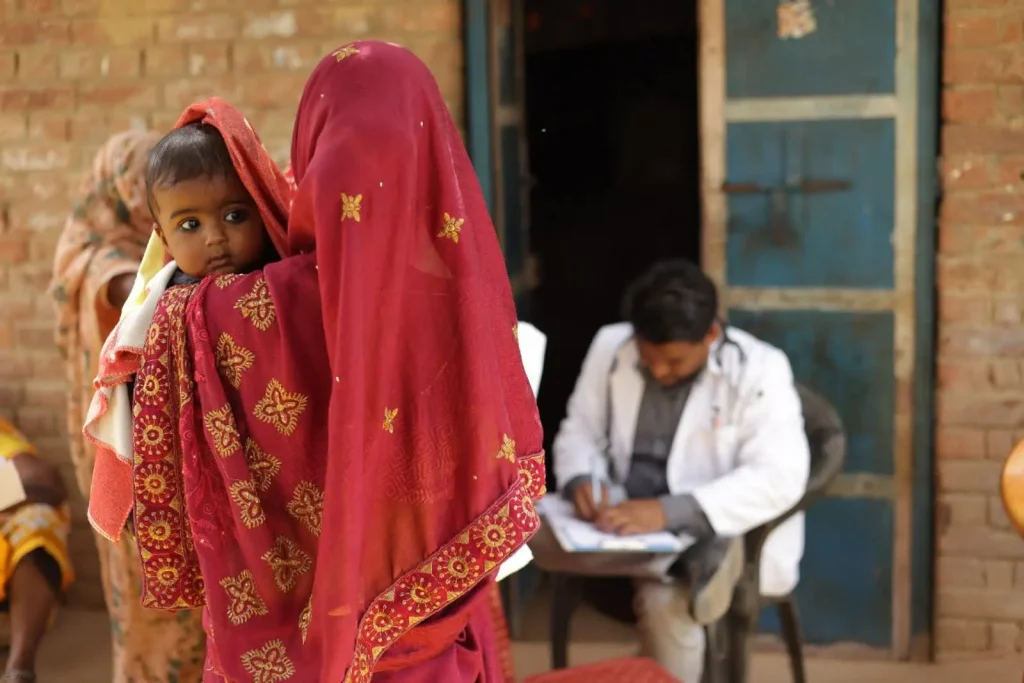
In the courtyards of villages across India, there are some gurgling sounds you hear in the late afternoon. A grandmother sits on a step with a child who cannot yet walk. She says something. The child makes a noise and she answers the noise as if it were a sentence. The child makes another noise. This goes on for a long time, and to anyone passing it looks like nothing at all.
It is, as far as neuroscience can tell, the most important thing happening in that village.

Where the number came from
In the early 1980s, two psychologists in Kansas, Betty Hart and Todd Risley, did something no one had done before. They went into 42 homes once a month for two and a half years, with a tape recorder, and wrote down every word spoken to a child between the ages of seven months and three years.
The families were not alike. Some were professors. Some were on welfare. When Hart and Risley added up the tapes, the difference was enormous. Children in the professional families heard about 2,100 words an hour. Children in the welfare families heard about 600. Stretch that over four years of waking hours and you arrive at the number that made the study famous: by the age of four, the wealthiest children had heard roughly 30 million more words than the poorest.
The number travelled the way numbers do by appearing in policy papers, in speeches, in the name of a city programme in Providence, Rhode Island, that gave parents word-counting devices. For twenty years, “the 30 million word gap” was the shorthand for why poor children arrive at school behind.
What was wrong with it
The trouble started with the sample. Forty-two families is not many. Six of them were on welfare, and all six were Black families in one city, which made the study as much about race and place as about money. Hart and Risley also counted only words spoken to the child, not words spoken around the child.
In 2019 a team led by Douglas Sperry went back to the question with recordings from five poor and working-class communities, including rural ones. When they counted everything a child could hear, not just what was aimed at her, the gap between richer and poorer households disappeared. Some of the poorest homes were among the most talkative. Children in those homes were surrounded by speech: siblings, aunts, neighbours, the radio, the market.
The defenders of the original study, led by the developmental psychologists Roberta Golinkoff and Kathy Hirsh-Pasek, answered that overheard speech is not the same as speech directed at a child, and that children learn language best from words meant for them. Both sides were partly right. And while they argued, a different kind of study was changing the question.
The thing that actually matters
In 2018, Rachel Romeo and colleagues at MIT and Harvard put 36 children between the ages of four and six into an MRI scanner and played them stories. Before that, each child had spent a weekend wearing a small recorder that counted two things: how many adult words they heard, and how many conversational turns they took, the number of times an adult said something, the child responded within five seconds, and the adult responded back.
The number of words made no difference to the brain scans. None.
The number of turns did. Children who had more back-and-forth exchanges at home showed more activity in Broca’s area, the part of the brain that handles language, when they listened to stories. Every eleven extra turns an hour was worth about one extra point on a verbal test. The effect was the same for rich and poor children. What differed was how many turns they got: in a busy hour, a high-income child had fifty more exchanges than a low-income child.
So the 30 million words were a proxy for something else all along. What a child needs is not to be bathed in language. She needs to be answered.
Why the first three years
The reason the window matters is physical. A baby is born with nearly all the neurons she will ever have, but very few of the connections between them. In the first three years, the brain forms those connections at a rate of about a million a second, and it forms them in response to what happens to it. Every time a child’s babble gets a reply, the circuit that produced the babble gets stronger. Every time it gets nothing, the circuit is a little less likely to fire next time.
By the age of three, the brain has begun to prune the connections it is not using. This is not a tragedy; it is how a brain becomes efficient at the particular world it finds itself in. But it means the architecture of language, attention and the ability to take turns in a conversation is largely laid down before a child ever sees a classroom.
In India, this is where it gets uncomfortable. The Annual Status of Education Report for 2024 found that about 77% of rural three-year-olds and 83% of four-year-olds are enrolled in some kind of pre-school, most of them in anganwadis. Enrolment is not the problem. What happens before that, and in the hours outside it, is where the quiet gap opens: a toddler left with a phone in a house where everyone is working, a grandmother who has been told that talking to a baby is foolishness because the baby cannot understand, a mother who was never spoken to as a child and does not know what it sounds like.
What a conversation looks like before a child can talk
It is easier than it sounds. The researchers call it “serve and return”, after tennis. The child serves: she points, grunts, stares at something, drops a spoon. The adult returns: names the thing, picks up the spoon, says “again?” The child serves again.
It does not require books, or English, or a quiet house. It works in Santali and Bhojpuri and Gondi. It works while shelling peas. A mother who narrates what she is doing (“now I am putting the rice, see, white rice, hot”) and waits a second for her child to respond is doing exactly what the MRI scanner measured in Boston.
Three things get in the way, and none of them is poverty itself. The first is the belief that a baby who cannot speak cannot be spoken to. The second is a screen, which talks at a child without ever waiting for her. The third is exhaustion, which is real and which no blog post can fix, and which is why this cannot only be a message to mothers.
What this means for how we work with young children

At Smile Foundation’s early-childhood and anganwadi programmes, this research has changed what we count, and what we teach. We call the practice Teen Jawab, three answers. It is simple enough to explain in a minute, which is the point.
When a child under three makes a sound, points, or holds something up, the adult answers three times before moving on. First, name it: “Haan, matar.” Second, add one thing: “Hara matar, thanda hai.” Third, hand it back as a question and wait: “Ek aur?” Then stop talking and count to three in your head. The wait is the part people find hardest, and it is the part that matters, because the child’s reply is the turn the brain is built on.
Anganwadi workers and our home-visit teams learn it in a single afternoon, mostly by practising on each other. Each centre opens its day with a five-minute baat-cheet circle where the worker does nothing but answer, and families get a palm-sized card in their own language with one picture of a child’s “serve” and the three answers written under it. We ask that at least one card go to a father or a grandparent, because the research is clear that the child does not care who answers, and because mothers are tired.
We have stopped treating a child’s vocabulary at age five as the first thing to measure, because by then much of the work is done. We look earlier, at whether the adults around a two-year-old know that her babble is a question, and whether they have the habit of answering it.
In the 22 states where Mission Education works, the best early-learning centres are not the ones with the most charts on the wall. They are the ones where you walk in and the room is loud with small conversations.
The courtyard again
Go back to the grandmother on the step. She has never heard of Kansas or MIT. She is not trying to close a gap. She is doing what people have done with babies for as long as there have been babies, before anyone told her it was foolish: treating a child’s noise as speech, and speech as something that deserves an answer.
The 30 million words were never the point. The answer was.
FAQs: The 30 million word gap
What is the 30 million word gap? A finding from a 1995 study by Betty Hart and Todd Risley, who recorded 42 American families and estimated that by age four, children in professional households had heard about 30 million more words than children in households on welfare. The number became shorthand for early language inequality.
Is the 30 million word gap real? Partly. The original sample was small and counted only words spoken directly to the child. A 2019 study by Douglas Sperry found no income gap when all speech around a child was counted. The gap in child-directed talk is real in some communities; the exact number is not reliable.
What matters more than the number of words? Conversational turns. A 2018 MIT and Harvard study found that the number of back-and-forth exchanges between adult and child predicted language-related brain activity and verbal scores, while the total number of words heard did not.
Why are the first three years so important for language? The brain forms connections fastest in the first three years, in response to experience, and begins pruning unused ones around age three. The circuits for language, attention and turn-taking are largely shaped before formal schooling begins.
Can a parent who cannot read help their child’s language? Yes. The research shows that responding to a child’s sounds, gestures and questions, in any language, builds language skills. Reading helps, but conversation is the foundation, and it needs no books or literacy.
Does screen time count as hearing words? No. A screen talks at a child but never waits for a reply, so it produces no conversational turns. Studies consistently find that children under two learn little language from video, and that screens often replace the adult conversation that would have happened instead.
How does Smile Foundation apply this? [PROGRAMME LEAD: one or two sentences on the specific early-childhood or anganwadi practice, with reach.]
Read next:
- High returns on early childhood care and education (ECCE)
- How early should STEM exposure begin?
- FLN: the root of employability and STEM readiness
- The AI divide in education: will AI widen India’s learning gap?
- Importance of child-centred education
- First-generation learners and education investment
Sources
- Word gap, Wikipedia (overview of Hart & Risley 1995, the Providence programme, and critiques)
- Brookings: Defending the 30 million word gap, Golinkoff and Hirsh-Pasek
- Hechinger Report on the MIT/Harvard conversational-turns study (Romeo et al., 2018)
- Quartz: the free and easy way to help kids develop language skills, MIT research
- New America: Relying on the 30 million word gap to shape early childhood policy
- ASER 2024 all-India presentation: pre-school enrolment by age
- Harvard Center on the Developing Child, “Serve and return” and brain architecture (writer to link the page)
- Sperry, Sperry and Miller (2019), Child Development, “Reexamining the verbal environments of children from different socioeconomic backgrounds” (writer to link the journal page)