
India has reduced its maternal mortality ratio to 97 per 100,000 live births, according to the Sample Registration System 2018–20 released by the Registrar General of India. Infant mortality has declined to 28 per 1,000 live births as per SRS 2020. Institutional deliveries now account for 88.6 percent of births, according to NFHS-5 (2019–21).
These are statistics that experts cite with justified confidence and they represent substantial progress in a country where childbirth was once one of the most dangerous events in a woman’s life.
But averages are polite. They summarise and smooth over edges but rarely linger long enough to show where the fractures remain.
Because beneath these national improvements lies a more complex reality. Fifty-seven percent of women aged 15–49 are anaemic and 67.1 percent of children under five are anaemic, according to NFHS-5. Only 58.1 percent of pregnant women receive four or more antenatal care visits and nearly 18 percent of babies are born with low birth weight. More than 35.5 percent of children under five remain stunted. Under-five mortality stands at 41 per 1,000 live births (NFHS-5).
The gap between access and actual health is where the deeper crisis resides.
Smile Foundation’s intervention for maternal and child health
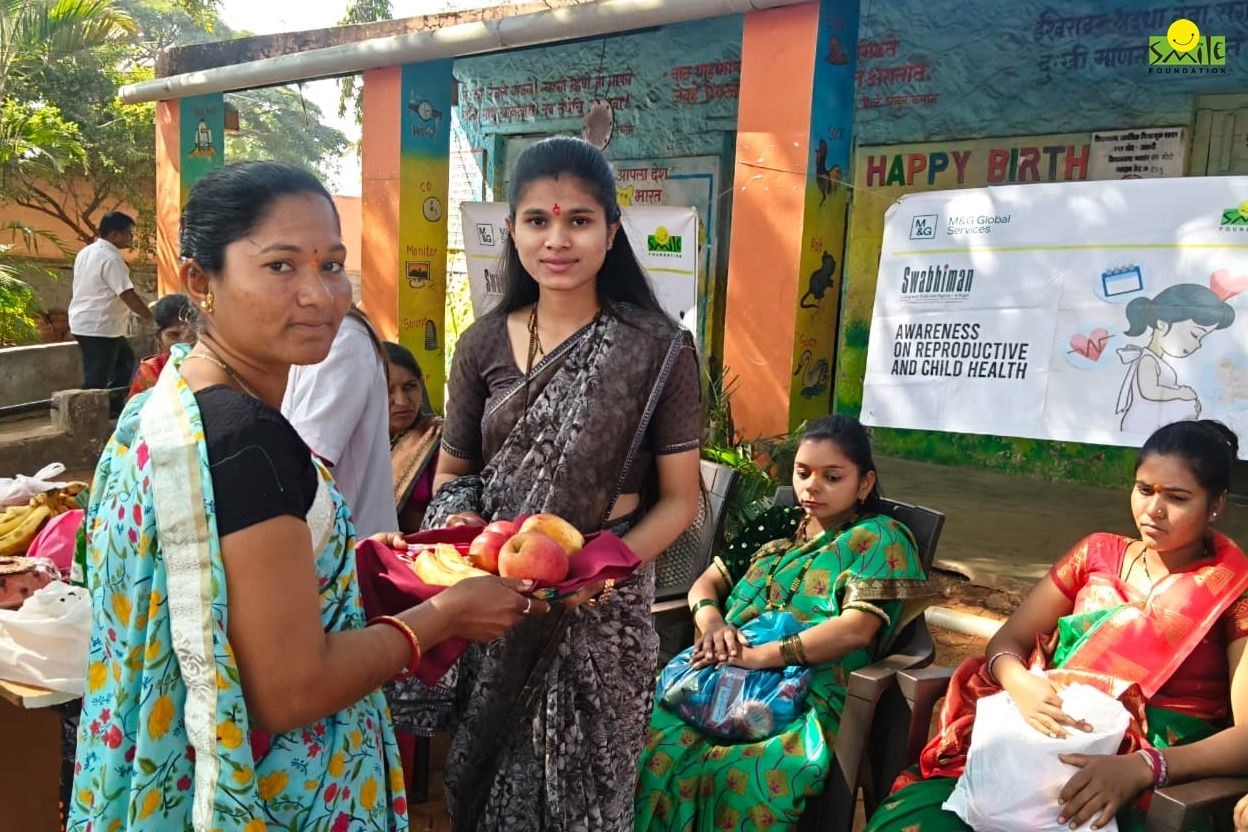
In Koye village in Maharashtra, maternal health is a daily negotiation between tradition, access and information. Advice circulates within families. Pregnant women are told what to eat, when to rest and how to manage discomfort. Public health systems exist, but utilisation depends on awareness, proximity and household decision-making.
Smile Foundation’s community-based maternal health awareness initiative in Koye did not begin with a lecture. It began with dialogue. The sessions focused on antenatal care schedules, balanced nutrition, rest during pregnancy and the importance of regular check-ups. But the most important shift was social. Husbands and elders were involved deliberately, because pregnancy decisions are rarely made by women alone in many rural households.
Health experts increasingly agree that maternal health outcomes are shaped as much by social context as by clinical access. NFHS-5 shows dramatic improvement in institutional deliveries, rising from 78.9 percent in NFHS-4 to 88.6 percent in NFHS-5. Yet antenatal continuity remains uneven. When 57 percent of women are anaemic, the issue is not merely the availability of iron supplements. It is sustained adherence, dietary diversity, and follow-up.
Mobile healthcare addresses this continuity challenge.
Smile on Wheels delivers antenatal and postnatal care, anaemia screening, counselling and follow-up services directly to underserved communities. The relevance of this model becomes sharper when examined alongside state disparities in maternal mortality. While India’s national MMR is 97 (SRS 2018–20), certain states such as Assam report substantially higher ratios, while Kerala has achieved rates below 30. National averages conceal district-level vulnerability.
The devil called distance
Distance remains one of the most persistent health inequities in India.
When a mobile unit enters a village, it reduces physical and psychological barriers simultaneously. Women who might delay visits to distant primary health centres are more likely to attend doorstep clinics. Anaemia screening becomes routine rather than reactive. Postnatal care becomes structured rather than incidental.
Continuity of care is rarely celebrated in public discourse. Survival rates make headlines. Dignity does not.
In Chakan, Pune, the Pink Smile Initiative, implemented in partnership with Thermo Fisher Scientific India, expands this continuity model. Through a Mobile Medical Unit, the programme integrates maternal and child health services with anaemia prevention, nutrition counselling, non-communicable disease screening, and teleconsultations.
This integration reflects India’s epidemiological transition. Maternal health is no longer solely about managing haemorrhage and infection. It increasingly intersects with chronic conditions such as hypertension and diabetes. The World Health Organization has emphasised the importance of integrating reproductive health with broader preventive care systems. The Pink Smile model aligns with that understanding by embedding NCD screening within maternal services.
Anaemia illustrates the intergenerational stakes. NFHS-5 data shows that two-thirds of young children are anaemic. Maternal anaemia during pregnancy is linked to low birth weight, which in turn correlates with neonatal mortality, impaired immunity and developmental delays. Low birth weight affects nearly one in five Indian newborns. This is not a sequence of isolated risks. It is a systemic loop.
Breaking that loop requires more than supplementation drives. It requires counselling, dietary awareness, immunisation adherence and community support.
NFHS-5 also shows that 76.4 percent of children aged 12–23 months are fully immunised, an improvement from 62 percent in NFHS-4. However, full immunisation coverage still leaves nearly one quarter of children without complete protection. Community-level engagement plays a decisive role in closing this gap.
In Koye, involving husbands and elders addressed a structural truth. In many households, resource allocation and health decisions are collective. By expanding maternal health conversations beyond women alone, the programme redistributed responsibility.
The last-mile enforcement for maternal and child healthcare
India’s policy frameworks are extensive. The National Health Mission has strengthened rural infrastructure. Janani Suraksha Yojana incentivised institutional deliveries. Pradhan Mantri Surakshit Matritva Abhiyan promotes routine antenatal care. Anaemia Mukt Bharat targets iron deficiency across life stages. The gains are visible in declining mortality indicators.
But policy success is uneven without last-mile reinforcement.
Under-five mortality has declined significantly over the past three decades, from 88 per 1,000 live births in 1990 to 41 today. Maternal mortality has fallen from over 500 in the early 1990s to below 100. These achievements are substantial. But persistent stunting at 35.5 percent indicates that nutritional deprivation remains entrenched. Anaemia’s rise between NFHS-4 and NFHS-5 signals fragility in dietary adequacy and micronutrient interventions.
Mobile medical models are not substitutes for systemic reform. They are adaptive mechanisms within complex realities. They respond to terrain, poverty, gender norms and information asymmetry.
The economic dimension is often understated. Maternal complications impose catastrophic expenditure on low-income households. Preventive care, therefore, is both a health intervention and a poverty mitigation strategy.
The Pink Smile Initiative’s teleconsultation feature reflects an important shift toward longitudinal care. A single check-up does not secure a healthy pregnancy. Digital follow-up strengthens adherence and allows risk stratification.
Health experts recognise maternal and child health as composite indicators of governance quality. Every anaemia statistic reflects agricultural diversity and dietary access, every stunting percentage reveals long-term deprivation and every antenatal care gap reveals structural distance.
The distance between survival and dignity is often measured in kilometres, but sometimes it is measured in silence. When maternal health becomes a shared conversation, silence weakens.
We are close but the fight isn’t over for maternal and child healthcare
India is closer to achieving the Sustainable Development Goal target of reducing MMR to 70 by 2030, but acceleration is required, particularly in high-burden districts. The progress is real. The unfinished work is equally real.
The ultimate measure of success will not only be how many women survive childbirth, but how many experience pregnancy with continuity of care, informed choice and collective support.
Because a healthy mother does not simply deliver a child. She shapes the trajectory of human development itself.
Reduce the Risk
India’s Maternal Mortality Ratio: 97 (SRS 2018–20)
57% of women are anaemic (NFHS-5).
Build a safer pregnancy journey.
Sources
• National Family Health Survey-5 (2019–21), Ministry of Health and Family Welfare, Government of India
• Sample Registration System (SRS) 2018–20 and SRS 2020, Registrar General of India
• National Health Mission programme data
• World Health Organization maternal health frameworks