In India’s crowded cities, the story of aspiration often begins in narrow lanes where dreams are bigger than the means to chase them. Young people across these spaces are ready to work, to learn to earn their way forward. What they often lack is not determination, but direction.
That’s where India’s vast skilling ecosystem comes in — a mix of large government programmes and targeted, community-led models. On one hand, national initiatives like Skill India, PMKVY and DDU-GKY aim to train millions across the country. On the other, smaller but focused programmes like Smile Foundation’s STeP (Smile Twin e-Learning Programme) take a ground-up approach, turning individual stories of struggle into stories of progress.
Both are essential. But the difference lies in how they reach people, and what they leave behind.
The Landscape of Government Skilling
India’s government skilling ecosystem is among the largest in the world. Through dedicated frameworks like the National Skills Qualifications Framework (NSQF), these schemes deliver training, certification and financial support across states and sectors.
Their scale is their strength — building national capacity, promoting employability and reaching rural and urban youth alike. Yet, scale can also create distance. The deeper a system goes, the harder it becomes to keep it human, flexible and context-driven.
That’s where smaller, more responsive models can make a difference.
From Promise to Possibility: The Birth of STeP
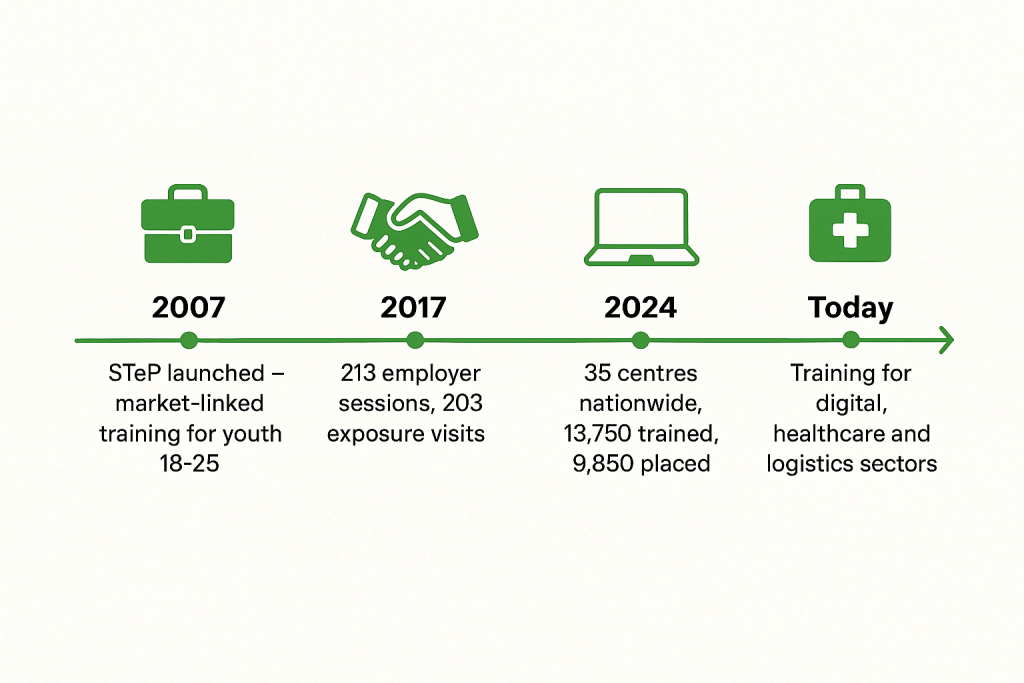
When Smile Foundation launched STeP in 2007, the idea was not to compete with government initiatives, but to fill the spaces between them — to work with youth who might otherwise fall through the cracks.
Targeting those aged 18–25, STeP offers market-aligned training in English, computers, communication and service-sector skills. But the real difference lies in its approach combining technical learning with confidence-building, mentorship and placement support.
What began with a few centres has now grown into a national network, training tens of thousands of young people and helping many secure employment in respected brands.
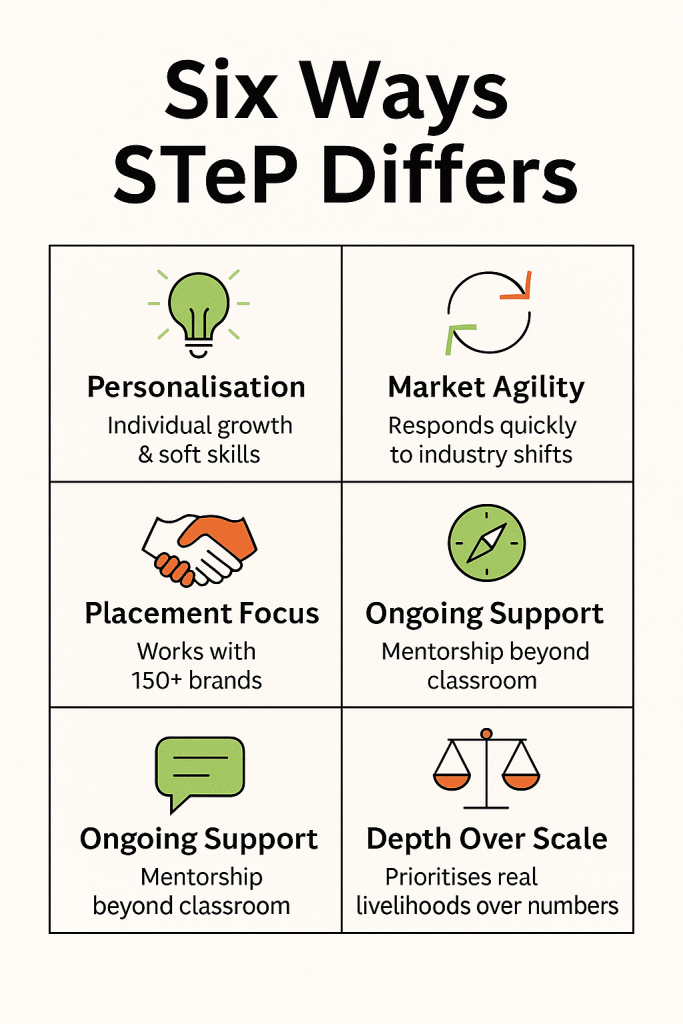
Six Ways STeP Differentiates Itself
1️⃣ Personalisation and Holistic Development
Government schemes include soft-skill modules, but large-scale delivery often limits how personal training can get.
STeP fills that gap by investing in communication, personality development and English proficiency, alongside technical skills.
In its 2017 assessment, STeP conducted 213 employer engagement sessions and 203 industry visits, giving participants both exposure and confidence — something no classroom alone can teach.
2️⃣ Agility and Market Relevance
STeP’s curriculum isn’t static. It adapts to emerging market needs, introducing modules in digital marketing, healthcare assistance, e-logistics and supply chain management.
While policy frameworks in government schemes can take time to evolve, STeP’s flexibility allows it to respond quickly to what employers actually need.
3️⃣ Reaching Marginalised Urban Youth
Unlike many government schemes that struggle with documentation or outreach barriers, STeP works directly within urban slums and low-income communities.
Its mobilisation teams identify young people who have dropped out of school or lack access to formal skill training — ensuring opportunities reach those most likely to be left out.
4️⃣ Placement and Industry Partnerships
STeP doesn’t end with training; it follows through with employment linkages.
With a Centralised Placement Cell and over 150 partner brands — including Airtel, HDFC, Reliance and Burger King — nearly 70% of trainees have found employment. Feedback from these employers continuously refines training modules, keeping them aligned with real-world expectations.
5️⃣ Support Beyond the Classroom
Training at STeP continues beyond the certificate.
Students receive mentoring, career guidance and even financial literacy sessions to navigate their first jobs. For women, especially, STeP offers a safe space to build self-confidence and balance social challenges with professional aspirations.
6️⃣ Scale vs. Depth — Complementary Strengths
While government programmes achieve extraordinary reach, STeP focuses on depth and quality.
Its certifications, developed with International Management Institute (IMI) and Microsoft, ensure credibility and relevance.
Rather than scale for its own sake, STeP measures success in real livelihoods created — trading breadth for depth, and uniformity for impact.
New Horizons: STeP at Medahally
In 2024, Smile Foundation inaugurated its 35th STeP centre — and its second in Bengaluru — at Medahally, in partnership with Vidyaranya and supported by Bosch India Foundation.
Since inception, STeP has trained over 13,750 youth and placed 9,850 across 140 brands. The new centre, the seventh in southern India, reflects the programme’s purpose: bridging aspiration and opportunity with targeted, human-centred learning.
Stories That Bring the Difference Home
Behind every statistic, there’s a story.
Neha, a commerce graduate from a low-income family, joined STeP’s digital marketing course and now earns ₹13,000 a month.
Mohammad Ibrahim, who had dropped out of school, now works in the service sector after completing his training.
Women like Shivani, Priyanka and Nisha overcame social and financial barriers, built confidence, and found employment in sectors like banking and customer service.
These are not isolated successes — they’re proof that the right combination of training, mentorship and opportunity can transform entire families’ futures.
The Difference That Makes a Difference
STeP is not an alternative to government skilling schemes — it’s a complement. It reaches those who remain invisible to larger systems, providing them with not only employability but dignity.
As India works to turn its demographic dividend into real social progress, STeP offers a reminder: scale matters, but human connection matters more.