
Innovation doesn’t always wear a lab coat. Sometimes it lives in a classroom, a hospital or a workshop. Below are ten inventions — some ancient, some modern — that have left a lasting imprint on India’s social, health, scientific and educational landscapes. After them, we’ll see how Smile Foundation is working to spark the next wave of changemakers.
1. The Concept of Zero & Positional Numeral System
One cannot overstate the impact of zero. While not a “device,” the invention of zero (and the positional base-10 numeral system) in ancient India transformed mathematics globally. It made arithmetic, algebra and computer science possible.
In everyday life in India, zero underpins digital billing, financial systems, data storage, computer programming — virtually every modern STEM system.
2. Cataract Surgery (Ancient and Modern Continuity)
Ancient Indian medicine documented cataract removal (couching) as early as centuries ago. Over time, that seed evolved into modern ophthalmic techniques. India today is a global hub for cataract surgery, performing millions of operations annually, reducing blindness across rural areas.
In many rural clinics, these techniques restore sight to people who would otherwise live in darkness — re-opening opportunities for work, education, dignity.
3. Jaipur Foot — Prosthetic for All
In 1968, orthopaedic surgeon P.K. Sethi and craftsman Ram Chander Sharma developed the Jaipur Foot, a low-cost prosthetic leg tailored for India’s terrain, affordability and cultural habits (cross-legged sitting, squatting).
This invention has changed thousands of lives, letting amputees walk, farm, work — and participate in community life. Its adaptability and low cost make it especially life-changing in rural India.
4. Avaz & FreeSpeech App (Augmentative Communication)
Ajit Narayanan, an Indian innovator, invented Avaz, India’s first augmentative and alternative communication (AAC) app, which helps children with speech impairment communicate using symbols and images.
Combined with his FreeSpeech engine, these tools are particularly valuable in special education settings and inclusive classrooms. They allow non-verbal children to express ideas, learn and engage socially — a STEM creation with deep human impact.
5. “TALK” — Breath-to-Speech Device
A younger innovator, Arsh Shah Dilbagi, created TALK, a device that converts breath patterns into speech.
For individuals with speech impairment due to paralysis or other conditions, such a device can restore voice, independence and dignity in everyday life.
6. 3D-Printed Humanoid Robot “Manav” & Brain-Controlled Wheelchair
Roboticist Diwakar Vaish built Manav, India’s first fully 3D-printed humanoid robot, and also developed a brain-controlled wheelchair — which enables people with locked-in syndrome or paralysis to move using thoughts.
These inventions push boundaries in accessibility robotics, assistive tech, and inclusive design — showing that India is innovating at the intersection of mind, machine and care.
7. GEM Detector Foils Made in India
In advanced physics and nuclear instrumentation, GEM (Gas Electron Multiplier) detectors are widely used in particle physics experiments. India’s Micropack Pvt. Ltd. started manufacturing GEM foils domestically, enabling research labs to build detectors locally rather than relying entirely on imports.
This not only strengthens India’s research infrastructure but reduces cost and dependence, boosting homegrown science capabilities.
8. GROWTH-India Robotic Telescope
Astronomers launched the GROWTH-India robotic telescope, a 0.7 m telescope dedicated to time-domain astronomy (such as supernovae tracking) with remote operations and automated scheduling.
This invention empowers India’s astrophysics community to contribute to global observational astronomy — letting students and scientists across India engage with frontier science.
9. Avionics & Satellite Missions (StudSat2)
Undergraduate student teams across India designed StudSat2, a twin nanosatellite mission with propulsion systems and orbital control, contributing to India’s increasing capacity in space tech.
When students in India build satellites, they engage deeply with systems engineering, electronics, software — raising the STEM bar at grassroots level.
10. ANAHITA Underwater Vehicle
A team at IIT Kanpur built ANAHITA, an autonomous underwater vehicle, integrating sensors, power systems, modular design, and data processing.
This vehicle advances India’s ability to explore marine environments, research aquatic ecosystems, and contribute to ocean tech.
Why These Inventions Matter
These ten inventions share some common threads:
- Contextual design — Many were built to address Indian or local constraints (cost sensitivity, environmental conditions, cultural habits).
- Accessibility & inclusion — From prosthetics to speech devices, many inventions bridge barriers for underserved people.
- Capacity building — Local manufacturing (GEM foils, robots, satellites) strengthens India’s scientific ecosystem.
- Education & aspiration — These serve as role models: kids see that Indians can invent, not just import.
- Multiplicative impact — The zero digit, for instance, unlocked the entire edifice of digital systems.
Together, they form a technological backbone that supports health, inclusion, innovation and national pride.
Smile Foundation & STEM: Nurturing the Next Wave of Inventors
While inventions change lives, the seeds of future innovation need nurturing. That’s where STEM education comes in — and Smile Foundation is planting those seeds across underserved communities.
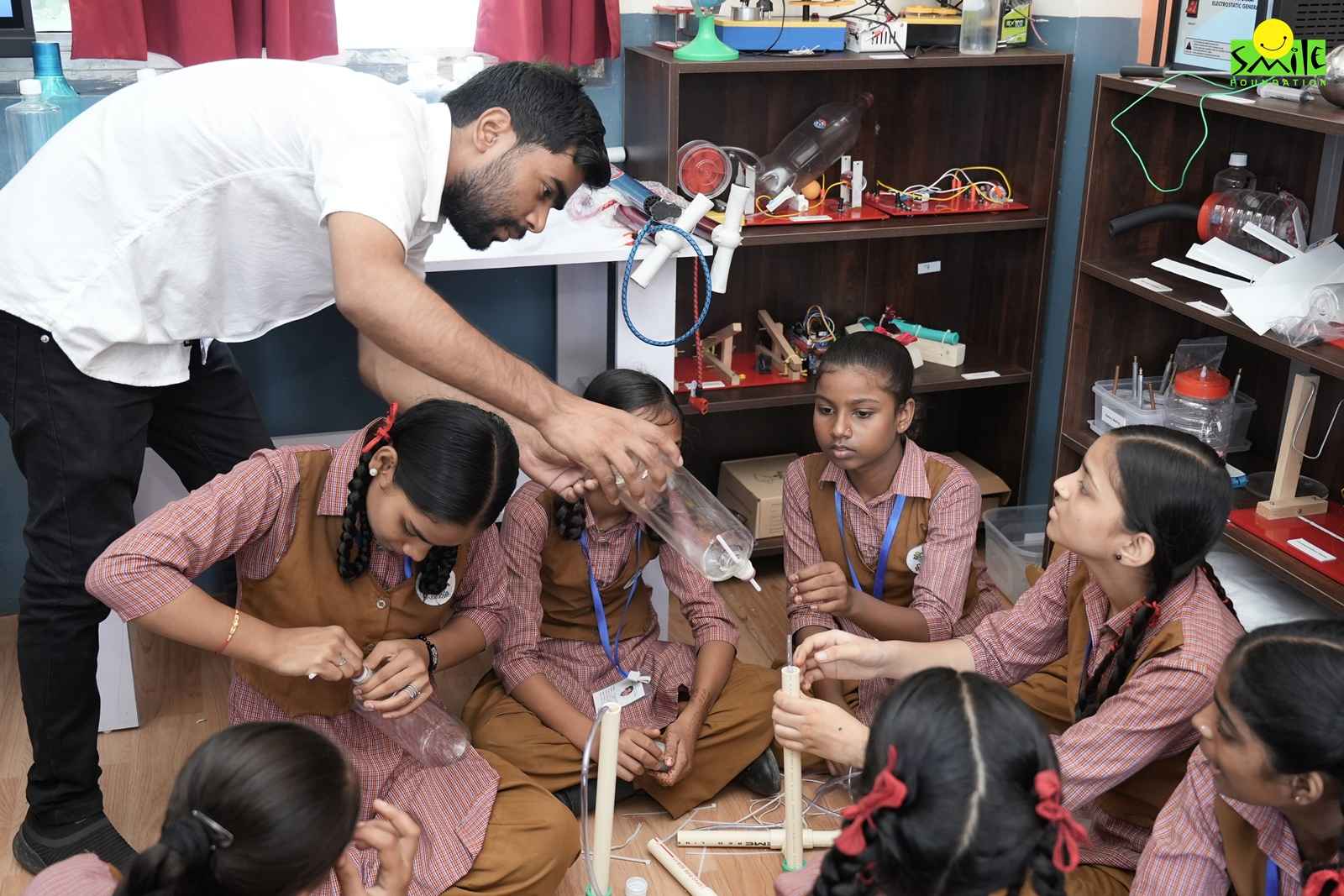
- Mini Science Centres and DIY Kits: Smile equips government schools with hands-on resources, moving beyond rote learning toward discovery and experimentation.
- Workshops, Labs & Training: Through partnerships (for example, with IIT Bombay), Smile has provided STEM workshops in robotics, 3D printing, aeromodelling, and more, reaching hundreds of children in low-resource areas.
- Teacher Capacity Building: Smile trains educators in inquiry-based pedagogy, STEM content and inclusive classroom methods so that teachers can guide students beyond textbook exercises.
- Institutional Collaborations: A recent initiative in Delhi NCR, in collaboration with BMW India Foundation, is creating STEM labs across 25 schools to benefit over 2,500 students annually.
- Technology Integration: Smile pilots tech-enabled learning, even in remote areas, bringing computer science, sensors and digital tools into classrooms.
Through these interventions, Smile is helping to democratise access to STEM, particularly for children who might never otherwise get such exposure.
Why This Matters
- Inspiration & identity: When children from slums or rural areas build a simple robot or understand the logic of sensors, they see themselves as creators, not just consumers.
- Bridging inequality: STEM education provides a route to future careers in engineering, data, robotics — fields that command higher incomes and influence.
- Local problem-solving: Tomorrow’s inventors will be better placed to solve local problems — from water purification to accessible health devices — because they understand context.
- Sustainability of impact: A person trained in STEM can innovate, teach, mentor — creating a multiplier effect.
Invention, Education and Inclusive Futures
When India first conceived of zero, it set a trajectory for mathematics, computing and every digital device we touch today. The Jaipur Foot restored mobility to thousands. Avaz gave voice to children. Robots and telescopes stretch the frontier of possibility. These inventions are not relics; they are beacons pointing forward.
But our capacity to invent tomorrow depends on how we educate today. In making STEM accessible in districts, urban slums, government schools — Smile Foundation is helping shape a future when the next TALK device or device to purify water with nanotech comes from a child who grew up with a maker kit in her hand.
The world doesn’t need another list of inventions. It needs more inventors. And organisations like Smile are working to turn dreams into tools — so that in every corner of India, children can reach for the stars they build.