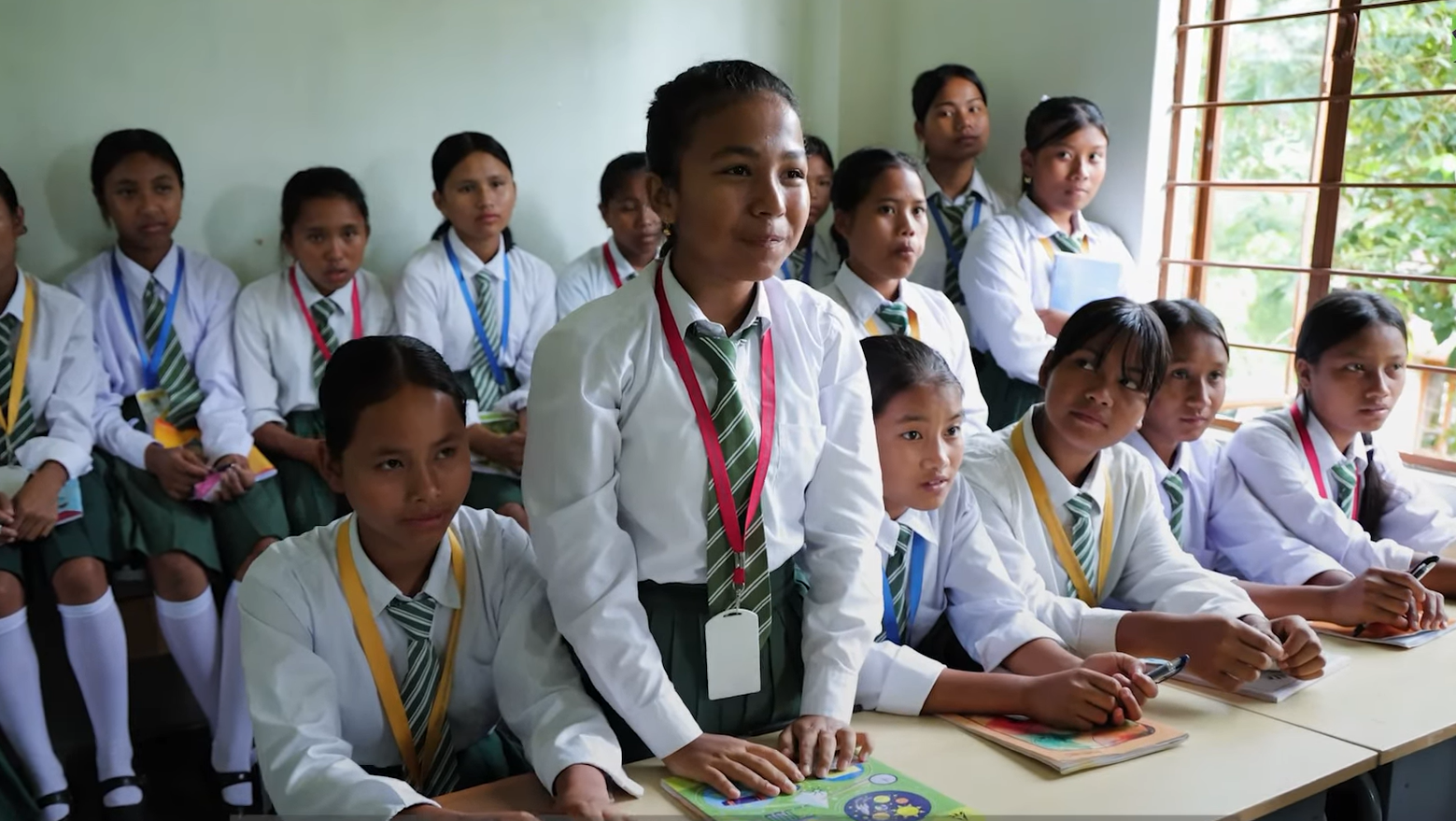

India’s villages are bursting with youthful promise, but chronic infrastructure gaps keep many rural children in the dark—literally and figuratively. A recent Parliamentary report notes that only about 56.5% of government schools have electricity. This leaves nearly half of rural learners studying by daylight or kerosene lamp, cut off from the smart education the world now offers.
Government data show that barely 57% of schools even have computers and 54% have any Internet access. The result is inequality in urban and rural space. For example, in Delhi a vast majority of schools are digitally equipped, but in Bihar only 18.5% have Internet. In this setting, blending solar-powered infrastructure and digital classrooms can be a game-changer enabling round-the-clock electricity and internet even off the grid.
One Smile Foundation case study reports, in Odisha’s remote Kalahandi district schools once lacking desks and often even teachers have been transformed under Digital India. Today they boast internet connectivity, smart boards, and e-learning platforms. Lessons that once felt abstract now come alive on screens. These quiet revolutions show how renewable-energy upgrades and EdTech can leapfrog rural schools over decades of neglect.
Solar classrooms are more than a modern convenience. They are vital green infrastructure for the future. A 2022 expert study of Madhya Pradesh’s Harda district found that electrifying four rural schools and anganwadis with rooftop solar (and simple battery backups) boosted student attendance and enabled evening study sessions. Children could finally use smart classes, computers and the internet once there was light. Measured outcomes were impressive.
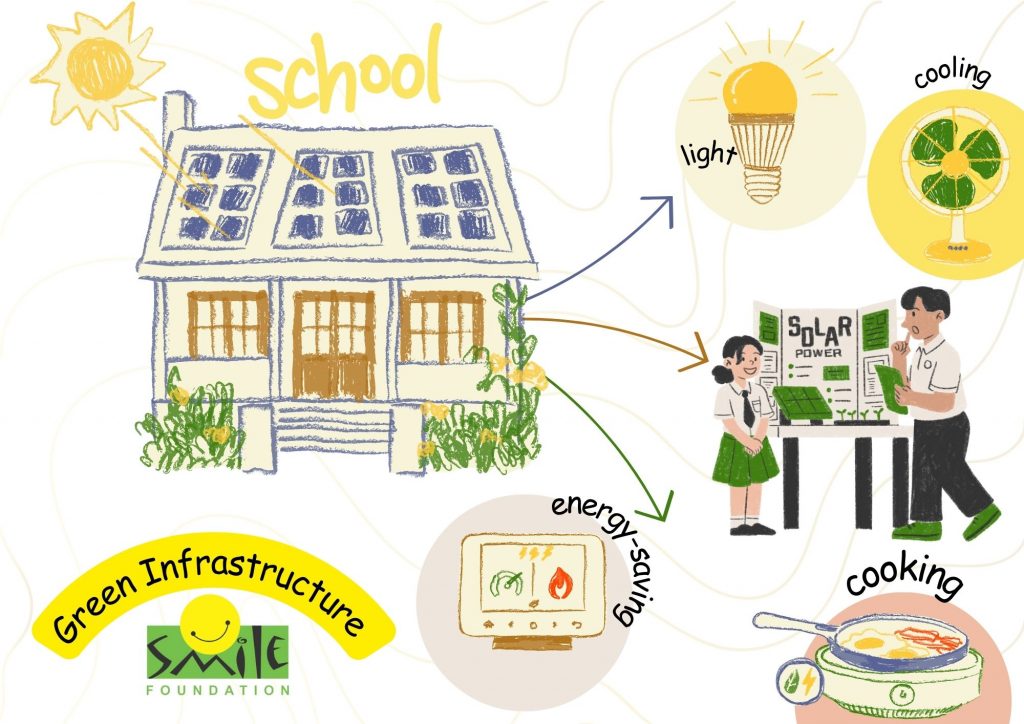
Over a year the PV systems generated ~2,250 kWh of clean energy, saved ₹18,000 in utility costs, cut carbon emissions by 47 tonnes (equivalent to planting 74 mature teak trees), and unlocked water-pumping for clean drinking water. In the words of the implementers, the quality of light from electricity, often LEDs, is much better and more efficient, directly improving learning conditions. Such results echo global evidence. UNESCO’s new Green School Quality Standard explicitly calls for solar panels to provide a reliable energy source during electrical blackouts and drive climate action in schools.
Together, solar roofs and digital classrooms form a powerful green infrastructure ecosystem. Solar panels on school roofs provide clean, off-grid power for ICT labs, water pumps, and safe lights. Classrooms become living labs where children literally plug into sustainability. Smile Foundation has facilitated solar panel installations in several partner education centres across nine states. These panels not only save energy costs, they are teaching tools with students learning first hand how renewable energy works and why it matters. The result is improved schooling today and a generation fluent in climate resilience.
As one Smile-backed Smart Classroom project found, solarisation plus tablets and interactive boards made learning interactive, engaging, and empowering in places long marked by deprivation.
Critically, these green education initiatives align with India’s development schemes and global goals. The Union Government’s Samagra Shiksha programme (the integrated school education scheme) now explicitly lets states use school electricity budgets to invest in solar/hybrid systems to ensure sustainability. Likewise, flagship campaigns like Digital India and the National Education Policy 2020 call for 24×7 schooling facilities and universal connectivity, which require steady power.
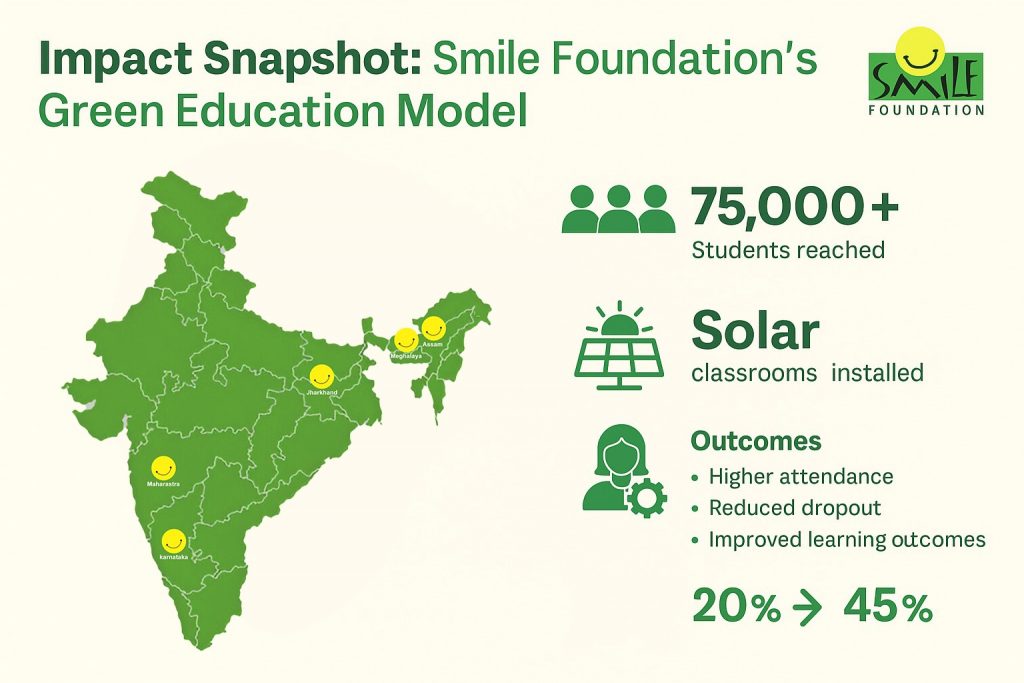
On the global front, UNESCO’s Education for Sustainable Development (ESD) agenda and the Greening Education Partnership stress climate-informed pedagogy and school infrastructure. UNESCO highlights that schools must walk the talk by greening learning environments. In fact, the UN’s 2030 Agenda for Sustainable Development ties these threads neatly. SDG 4 (quality education) and SDG 7 (affordable clean energy) intersect in solar classrooms, while SDG 13 (climate action) is advanced when students adopt renewable power. Smile Foundation’s work is a microcosm of this synergy. Our projects are mapped to multiple SDGs, and indeed they now benefit 75,000+ students across 500+ schools in 9 states with these green-learning investments.
Smile Foundation has long championed rural education and gender equity. In recent years, we have brought solar and digital tech to the fore. Our Mission Education centres now include Smart Classrooms equipped with projectors, tablets, and offline e-content – all powered by rooftop solar. This has enriched learning for thousands of underserved children.
For example, in 2024 Smile and partners installed solar-powered digital classrooms in government schools across Assam, Meghalaya, Jharkhand, Karnataka, Maharashtra, and Haryana. These six states were chosen specifically for their high need of both electrification and digital access. By incorporating solar energy, the project emphasises sustainable practices within the educational sector while fostering an atmosphere conducive to 21st-century learning. Students no longer struggle with power cuts or mobile blackouts; instead, they use laptops and projectors every day.
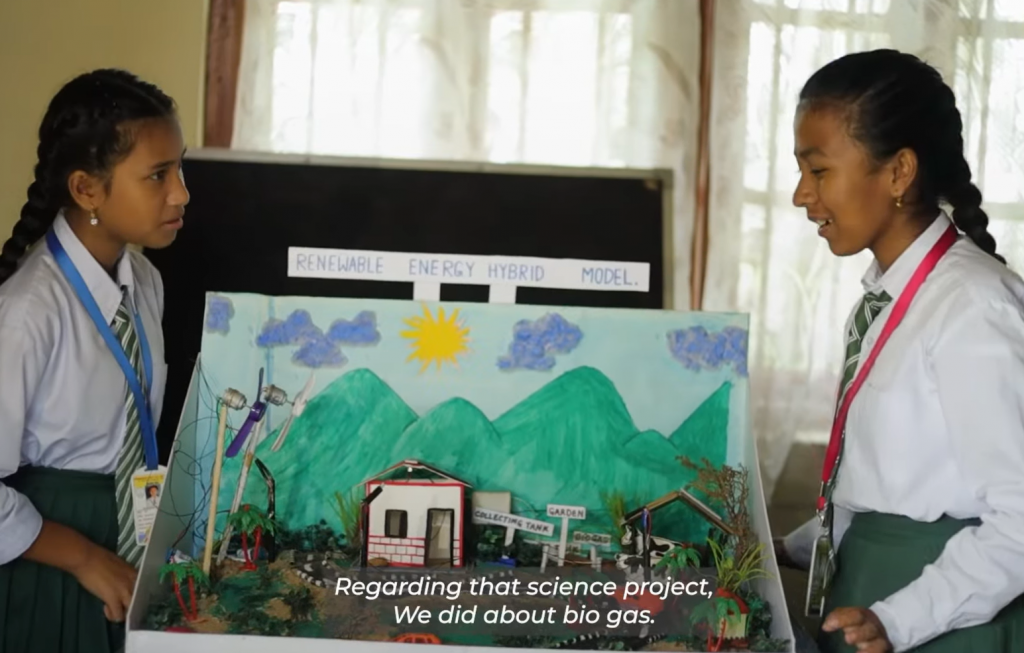
The outcomes are measurable and inspiring. Smile reports that its tech upgrades have directly impacted 75,000 children in 2024, turning classrooms into hubs of climate action. Teachers now integrate interactive climate content into all subjects. Students at a Smile centre designed water rockets and roller coasters to learn physics, linking science to sustainability. Girls in these programmes are especially empowered.
Earlier girls’ education campaigns (She Can Fly) and career fairs have built momentum, and now girls in rural classrooms actively engage with digital learning and STEM through Smile’s OJT and STEM labs. Parents and community elders also notice a change. In places with solar classrooms, villagers report longer school hours, higher attendance, and a revived respect for education. Children who previously trudged home after noon now stay back for evening classes under electric lights, boosting study time and retention. In tribal Harda district, officials saw attendance rise immediately after panels went up with energy access driving higher enrolment and retention in school.
Quantitative gains are evident in learning metrics too. After technology interventions, tests scores and digital literacy jump. One study by Smile’s team showed rural students exposed to tablets and e-lessons bridged about 60-70% of the learning gap compared to urban peers, particularly in maths and English. Computer education classes, once rare in small schools, are now routine. Perhaps most telling, Smile reports that anecdotally girls’s participation in STEM doubled in schools with solar-powered labs (from 20% to over 45% of STEM club members). Young women on the solar-team become role models, saying if these panels can power our classroom, surely I can power my future.
Policy and partnership levers
These on-the-ground results didn’t happen by accident. We leveraged multiple policy and funding streams. Samagra Shiksha has earmarked funds for ICT labs and even suggests solar in the recurring budget. The Digital India and PM eVidya campaigns, launched during Covid, have built nationwide e-learning content (DIKSHA, SWAYAM, etc.) but their impact depends on power.
Clearly, electrification and solar schemes must align with education budgets. Initiatives like Saubhagya (universal household electrification) and PM-KUSUM (solar pumps for farmers) exemplify the government’s rural solar push; extending similar focus to schools is logical. In fact, MPs on the HRD Committee have urged a Green Schools Fund to install solar everywhere.
Beyond government, corporate CSR is a huge enabler. India’s Companies Act mandates ~2% of profits go to CSR. Many corporations now target that money at education and sustainability. We have successfully partnered with firms to our education programme to fund tech labs and solar kits.
Climate-resilient impact
Importantly, solarised schools promote more than literacy; they build climate resilience. Rural areas face increasing heatwaves and storms – governments and UNESCO urge adaptation in education. UNESCO’s Green Schools framework even calls for flood-resistant classrooms and reliable off-grid power. Solar roofs, rainwater harvesting, and shade trees become part of green infrastructure on campus.
When Smile students plant native saplings and monitor their survival, they live SDG 13 by converting learning spaces into green belts around school. One Smile tree-planting initiative in Maharashtra engaged 2,000 kids in planting 30,000 saplings – these not only sequester carbon but teach stewardship. Such projects forge a virtuous cycle: greener campuses reduce heat inside classrooms and lower energy needs. And with solar panels, a school’s carbon footprint plummets – as the Harda case shows, just a few panels offset tens of tonnes of CO₂.
What the data shows
Multiple surveys underscore these benefits. The UDISE+ (national school census) data cited by Smile reveal that millions of Indian children lack access to even basic digital infrastructure. But recent upticks are promising. For example, Education For All in India’s analysis of UDISE 2021–22 found that in some states like Uttar Pradesh solar adoption is rising (8.8% of schools had panels, up sharply in aided vs. govt schools), though many states still lag (e.g. only 3–4% in WB or Assam). This means huge potential remains untapped. Every percentage point of schools solarised could reach hundreds of thousands of students. Modeling studies show that increasing solar in schools directly correlates with improved learning outcomes. For instance, UDISE data cited in research suggest that schools with reliable lighting see 10–15% higher enrolment and exam pass rates compared to dark schools.
Another key metric is digital literacy. India’s National ICT Literacy Index (2023) shows rural-urban gaps of 20 percentage points, with girls trailing boys by 10 points in connectivity. In Smile-supported villages, mobile-computer literacy camps have pushed up women’s digital skills by ~30%. Anecdotally, girls in solar classrooms report newfound confidence: one 14-year-old girl from Jharkhand said, “I can now use a laptop confidently to help my siblings with homework without fear of grid failure.”
Scaling up with policy action
To ensure every child benefits, we need smarter policy coordination:
- Integrate Solar into All School Schemes: Samagra Shiksha and state education budgets should mandate solar kits as part of new school buildings and retrofits, just as they mandate toilets and ramps. States can issue dedicated guidelines (like the clause in Samagra allowing solar for sustainability). The Centre could create a Solar Schools component in national programmes, similar to how smart classrooms were funded.
- Link Education and Energy Planning: Renewable-energy schemes (PM-KUSUM, rooftop solar missions) should explicitly include schools and Anganwadis as priority installations. For example, Rural Development funds or CSR solar pumps might co-finance schools’ microgrids. Similarly, rural electrification efforts (e.g. Saubhagya or BharatNet connectivity) should be coordinated with Samagra districts, ensuring simultaneous rollout of power, net, and smart-boards.
- Finance via CSR and Philanthropy: The government can incentivise greater CSR in this sector by recognising climate-and-education projects as doubly impactful. Tax breaks or matching grants could reward companies that fund solar-education collabs. Impact bonds and blended finance could also be used. For instance, a green bond for rural education infrastructure, with pay outs tied to metrics like enrolment or test scores.
- Cross-Sector Partnerships: NGOs, corporates, and local governments must co-design solutions. Smile’s digital-cum-solar classroom in Haryana, done with state education officers’ buy-in, is a model. National bodies (like the NITI Aayog’s Atal Innovation Mission or the CSR Research Foundation) could convene task forces to replicate best practices across states. Teacher-training institutes should include modules on using solar/ICT tools. Universities (like IITs) could donate expertise in low-cost solar tech for schools.
- Promote Climate Education: The curriculum itself should reflect this infrastructure. If a school has solar panels, students should use them as teaching aids in math and science. Textbooks and online courses must highlight renewable tech projects happening locally. UNESCO’s Education for Sustainable Development framework emphasises learning by doing – school solar projects are tailor-made for such pedagogy.
Challenges and sustainability
Of course, hurdles remain. Maintenance of solar kits, digital hardware, and connectivity can be tricky in remote areas. Govt schools often lack IT technicians, and panels require periodic cleaning. Here too, solutions exist. Solar vendors now often offer 5-year maintenance contracts. Rural youth clubs can be trained (perhaps under the “Skill India” umbrella) to service school systems, creating local jobs. Internet backhaul can piggyback on village panchayat networks or BharatNet. Importantly, communities must co-own these assets. Smile’s model involves School Management Committees in each phase, ensuring parents and local leaders invest in upkeep.
Financially, the long-term gains justify the costs. Solar installations have a 10–15 year payback from bill savings. Economic analyses show that every rupee invested in rural education yields ~₹4–5 in lifetime economic benefits from higher productivity. With green infrastructure, the environmental externalities (avoided pollution, climate resilience) stack on top. Thus multilateral agencies like the World Bank and ADB are increasingly funding “green schools”. India should tap such funds and align them with domestic CSR/ADB projects (note ADB’s own support for off-grid solar schools).
Equity through green education
In the 21st century, green infrastructure is as essential to education as desks and books. Solar-powered digital classrooms embody a perfect synergy. They deliver electricity, clean energy, and global knowledge to doorstep villages. By merging renewable energy and EdTech, India can ensure that being born in a far-flung panchayat no longer means a second-tier schooling. Instead, it can be a stepping stone in the Equitable, Sustainable Education envisioned by the SDGs.
Smile Foundation experience shows it’s doable. Hundreds of schools across nine states, thousands of lives changed, and children inspired to be “eco-warriors”. Now, the task is to scale up rapidly through policy, partnerships, and funding. By embedding solar into every rural school and coupling it with quality digital content, India advances toward Samagra Shiksha for real – not just brick-and-mortar, but a full spectrum of facilities. This cross-sector approach – government norms, private CSR, civil-society innovation – can finally make electricity and internet as commonplace in rural India’s classrooms as pencils and notebooks. In doing so, we do more than light up blackboards. We ignite young minds to become the green leaders India needs.
Sources: Government and development reports on solar in schools; Smile Foundation’s impact and project blogs; UNESCO guidelines and SDG frameworks; academic and expert analyses on rural education and energy.