At 7:30 am, nine-year-old Rafiq is already awake in a narrow lane of a Delhi slum. The room he shares with five family members doubles as a bedroom, kitchen and storage space. There is no desk. His schoolbag rests on a nail hammered into the wall. Before leaving for school, he fetches water, watches his younger sibling and eats whatever is available. Homework, if completed at all, is squeezed into late evenings or stolen moments during the day.
For millions of children living in India’s urban slums, schooling begins long before they enter a classroom. It is shaped by overcrowded homes, unreliable access to electricity and water, frequent migration and the constant pressure to contribute to household survival. Learning, in this context, is not just an academic challenge. It is a logistical and emotional one.
India’s cities are home to an estimated 65 million people living in slums, according to Census projections and urban development reports. A significant proportion of them are children. While urban areas are often assumed to offer better access to schools, the reality for slum-dwelling children is far more complicated.
Access does not equal learning
Over the past two decades, India has made substantial progress in school enrolment. Urban enrolment rates are high, and slum settlements are usually located near government or low-cost private schools. But proximity has not translated into quality learning.
Data from ASER and other learning assessments consistently show that many children in urban poor communities struggle with basic reading and arithmetic well into upper primary grades. In some urban slums, learning outcomes are comparable to or worse than those in rural areas.
The reasons are layered. Schools serving slum populations are often overcrowded. Teacher turnover is high. Instruction is rigid and syllabus-driven, leaving little room to address foundational gaps. Children who miss school due to illness, migration or household responsibilities fall behind quickly and few systems exist to help them catch up.
When early gaps go unaddressed, they widen over time. For slum-dwelling children, interruptions are frequent, making continuity especially fragile.
The classroom is only one learning environment
For children in slums, the home environment rarely supports school learning. Many families live in one-room dwellings. Noise, lack of space and shared responsibilities make quiet study difficult. Parents, often working long hours in informal jobs, may value education deeply but lack the time or confidence to support homework.
Research on cognitive load shows that stress, hunger and sleep deprivation significantly impair attention and memory. Children who come to school hungry or exhausted are expected to perform at the same pace as peers with vastly different living conditions.
This mismatch is rarely acknowledged in curriculum design or classroom expectations. When children struggle, the assumption is often a lack of effort rather than a lack of support.
Language, migration and belonging
Urban slums are sites of constant movement. Families migrate seasonally for work. Children shift between schools, languages and curricula. A child may speak Bhojpuri or Bengali at home, attend a Hindi-medium school, and be assessed in English by upper grades.
Language transitions, when unsupported, slow comprehension and erode confidence. So many education organizations and stakeholders have highlighted how belonging and identity are central to learning. When children feel out of place linguistically or culturally, engagement drops.
For migrant children, schooling is often discontinuous. Documents required for admission may be missing. Transfer certificates are delayed. Some children remain out of school for months during transitions, increasing the likelihood of permanent dropout.
Attendance is fragile
In slum communities, attendance fluctuates. Illness, eviction threats, water shortages or caregiving duties can pull children out of school without warning. Girls are particularly affected, often tasked with household work or sibling care.
Urban poverty also intersects with safety concerns. Long commutes, unsafe sanitation facilities and harassment deter regular attendance, especially for adolescent girls. When schools feel unwelcoming or unsafe, learning suffers regardless of curriculum quality.
The emotional weight children carry
Perhaps the most overlooked aspect of schooling in slums is emotional load. Children navigate adult anxieties daily: unstable income, illness, housing insecurity. This constant vigilance affects how they learn.
Learning sciences increasingly recognise that emotional regulation and safety are prerequisites for cognition. A child preoccupied with uncertainty cannot easily focus on fractions or grammar. Yet emotional well-being rarely features in conversations about urban education.
Teachers, themselves under pressure, are often not trained to recognise trauma or stress responses. Behavioural issues are punished rather than understood, reinforcing cycles of disengagement.
When schools adapt, learning improves
Despite these challenges, there are classrooms where slum-dwelling children thrive. What distinguishes them is not technology or resources alone, but flexibility.
Schools that:
- group children by learning level rather than age
- allow time to rebuild foundational skills
- use activity-based and contextual learning
- create predictable, caring environments
consistently show better engagement.
Research from Pratham’s “Teaching at the Right Level” approach demonstrates that when instruction meets children where they are, learning accelerates—even in low-resource settings.
The role of community-based learning spaces
In many slum areas, learning does not happen only in schools. Community centres, NGO-run classrooms and informal learning spaces fill critical gaps.
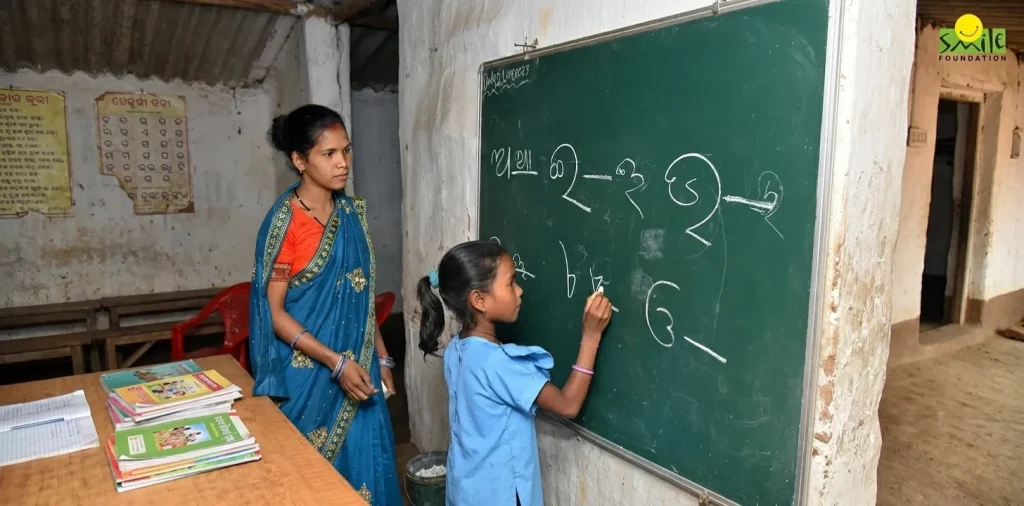
Smile Foundation’s Mission Education programme operates in several urban slums, offering remedial education alongside formal schooling. These centres provide small-group instruction, allowing children to rebuild reading and numeracy skills without the stigma of “failure.”
Beyond academics, Smile Foundation integrates nutrition support, health check-ups and psychosocial care. This matters. A child who is healthy, fed and emotionally supported is more ready to learn.
Teachers in these centres often come from similar communities, strengthening trust and communication with families. Parents are engaged as partners, not judged for constraints beyond their control.
Digital learning tools are used selectively, not as replacements for teachers but as supplements that allow children to learn at their own pace. For children who have missed months of schooling, this flexibility is critical.
Why remediation is not a deficit approach
There is a tendency to view remedial education as a temporary fix or a sign of failure. Learning science suggests the opposite. Remediation, when done well, acknowledges that learning is non-linear.
Children living in slums are not less capable. They have had fewer uninterrupted opportunities to learn. Programmes that rebuild foundations respect this reality rather than punishing it.
Smile Foundation’s approach reflects this philosophy. By combining academic reinforcement with life skills, creative activities and counselling, these programmes help children regain confidence, not just competence.
What schools and systems can learn
If schooling for slum-dwelling children is to improve at scale, systems must adapt to reality rather than idealised assumptions.
This means:
- designing curricula that allow for catch-up
- investing in teacher training on trauma-informed pedagogy
- integrating health and nutrition with education
- supporting migrant children with flexible admission policies
- recognising that attendance gaps are structural, not moral
Urban education cannot rely on enrolment metrics alone. Learning outcomes depend on whether schools acknowledge the full context of children’s lives.
Rethinking what “schooling” means
For children in slums, schooling is not confined to textbooks or classrooms. It is shaped by daily negotiations with space, time and responsibility. When education systems fail to account for this, children disengage—not because they lack ambition, but because the system demands more than it supports.
Our core insight is that learning is human. It is shaped by relationships, safety and relevance. When schools and communities align around these principles, children living in the most difficult circumstances can and do learn.
Programmes like those run by Smile Foundation offer a glimpse of what is possible when education meets children where they are. They remind us that improving schooling in slums is not about lowering standards, but about widening the pathways to reach them.
If India’s cities are to be engines of opportunity rather than inequality, schooling for slum-dwelling children must be redesigned with empathy, evidence and imagination.