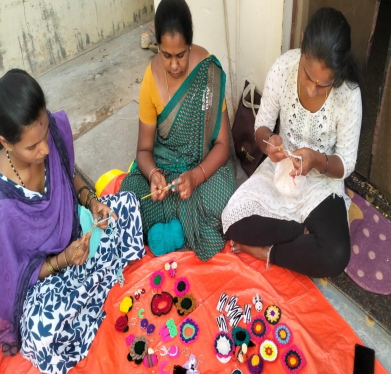
In a narrow lane of northeast Delhi, 17-year-old Anjali balances her textbooks on a small desk wedged between a sewing machine and a pile of laundry. Her mother, who left school after Class 6, runs the sewing machine late into the night while Anjali studies by the dim light of a single bulb. She is one of more than 100,000 students supported by Smile Foundation’s Scholarships@Smile programme — an initiative reshaping how India thinks about education, gender,and opportunity .
Across India, it is no longer news that girls are in school. Over two decades, enrolment has soared. What remains less visible are the fault lines that appear after enrolment. The distance between schooling and success, between learning and livelihood, is where most girls still stumble.
The dropout dilemma
The latest Unified District Information System for Education (UDISE+) data show that the secondary-level dropout rate for girls is about 12.3 per cent, with household work and early marriage among the most common causes . For every hundred girls who enter middle school, too many never reach college gates.
While boys often leave school seeking work, girls’ exit is a quiet retreat dictated by circumstance: sibling care, household duties or a family’s financial crisis. These are not isolated choices but symptoms of a deeper social arithmetic, one that still discounts a girl’s potential return on education.
India’s Economic Survey notes that although women’s labour-force participation is inching upward, much of it remains in informal, unpaid or agricultural work.
STEM: The great unfinished revolution
Nowhere is the gender gap starker than in the fields shaping the future — science, technology, engineering and mathematics (STEM).
Government data show that women constitute roughly 43 per cent of enrolments in STEMM disciplines (PIB 2024), yet only about 14 per cent of India’s scientists and engineers are women (Forbes India, 2021)
The imbalance begins early. In the JEE Main 2024 exams, about 406,900 female candidates registered, roughly 33 per cent of total applicants (Jagran Josh, 2024) . And according to AISHE 2020-21, women make up around 19 per cent of engineering students (AISHE Report 2020-21) .
These figures underscore that the barriers are not academic alone but cultural and structural. For many young women, the path from school to STEM is strewn with unseen obstacles like limited exposure, scarce role models and social expectations that quietly steer them away from technical fields.
Where policy meets lived reality
India’s National Education Policy (NEP) 2020 sets a bold target: to raise the Gross Enrolment Ratio in higher and vocational education from 26.3 per cent (2018) to 50 per cent by 2035 . On paper, this ambition is visionary. Yet without addressing the frictions that keep girls from completing secondary school, the pipeline feeding that goal remains fragile.
Government efforts like Beti Bachao Beti Padhao and start-up schemes for women entrepreneurs have opened doors. Still, for millions of girls, the real question is simpler: who will pay the fees, buy the books or convince the family that education is worth the wait?
This is where interventions such as Scholarships@Smile step in.
Beyond tuition: A new grammar of opportunity
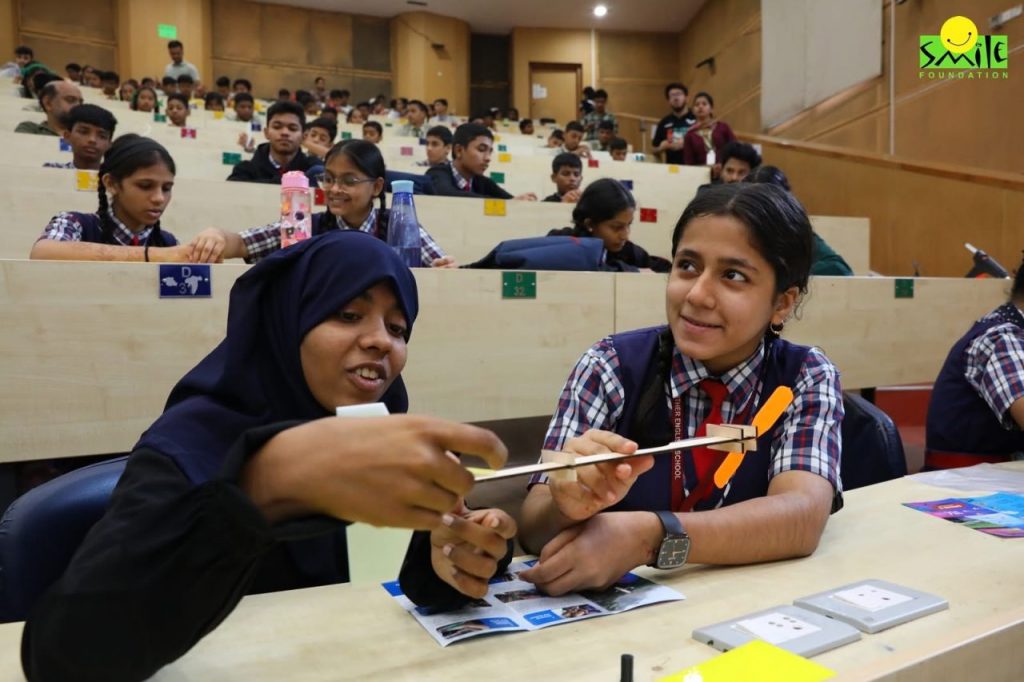
Launched in 2006, Smile Foundation‘s Scholarships@Smile has reached more than 100,000 students across 22 states . Its model combines financial and academic support, life-skills training, mentorship and employability coaching. Few initiatives in India link education so directly to empowerment.
The programme operates through three major pillars:
- School Scholarships (Grades 8–12): Targeting girls from families earning below ₹2 lakh annually, these have supported around 3,000 girls across Delhi-NCR, Maharashtra, Uttar Pradesh, Bihar, Odisha, Telangana, Tamil Nadu and Karnataka .
- Vocational Scholarships: Aimed at employability, this track has enabled over 1,394 young women to pursue degrees in management, IT, design, finance and pharmacy .
- Engineering Scholarships: Supporting more than 2,831 students in B.Tech and B.E. courses nationwide, the programme prepares “industry-ready” engineers through training and mentorship .
Together, these pathways make education a continuum, from school to skill to success, rather than a disconnected series of stages.
The social dividend of inclusion
Each scholar represents more than individual success; she becomes a multiplier. Educated girls delay marriage, participate more in the economy and invest in their families’ health and education. The World Bank estimates that each additional year of secondary education raises a woman’s future earnings by 10–20 per cent.
Scholars report increased confidence, improved decision-making and a clearer sense of career direction. The ripple effect extends to their communities, where younger girls see proof that education can lead to independence.
The corporate link
Corporate Social Responsibility (CSR) has become a key driver of educational equity. Scholarships@Smile aligns with Schedule VII, Items 2 and 3 of the Companies Act 2013, covering education, gender equality and skill development .
It also aligns with Sustainable Development Goals 4 (Quality Education) and 5 (Gender Equality), ensuring that corporate partnerships translate into measurable social impact . In an era when ESG frameworks define accountability, such alignment offers both moral and strategic value.
The next frontier: Bridging aspiration and access
India’s challenge is not a shortage of ambition but of bridges. Each statistic hides a geography of constraint, between rural and urban, English-medium and vernacular, privilege and poverty.
Scholarships help, but the next phase must build a broader ecosystem: mentoring networks, exposure to professional role models, digital access and family sensitisation. It also requires challenging social norms that quietly limit girls’ educational trajectories.
Industry analyses suggest that India produces roughly 1.5 million engineering graduates annually, but only about 250,000 secure core-engineering jobs (NASSCOM 2019, media analyses) . The inefficiency is a disconnect between education and employability that hits women hardest.
At the same time, a TeamLease report projects around 12 million new jobs across engineering, telecom and healthcare sectors over the next five years (The Hindu, 2 May 2022; TeamLease Digital 2022) . To close this gap, interventions must move from access to agency, ensuring not only that girls study, but that they thrive and lead.
A moment of reckoning
The coming decade will decide whether India’s demographic dividend translates into development or disappointment. With one of the youngest populations globally, India’s growth narrative depends not only on how many young people it educates but how well.
For girls, the stakes are existential. Education is not just a ticket to a job; it is a claim to citizenship, safety and self-worth.
As India expands higher education, private and civil-society actors will be indispensable in filling gaps that government policy alone cannot. Scholarships@Smile shows what such partnerships can achieve — scalable, data-backed and deeply human.
The faces behind the figures
When Anjali talks about her scholarship, she doesn’t mention percentages or policy frameworks. She talks about the dignity of not having to ask her mother for fees, about learning to speak confidently and about her dream of becoming a software engineer.
Her confidence is no accident; it is the product of deliberate investment — in her mind, her voice and her future. In a country where so many girls still drop out before finishing school, her story feels both extraordinary and quietly ordinary — a glimpse of the India that could be, if opportunity were not rationed by birth.
The way forward
The future of education equity in India lies in deepening, not diluting, such models. That means:
- Expanding partnerships with CSR and public institutions for sustained scholarships.
- Integrating mentorship and job-linkage more tightly with academic support.
- Increasing focus on STEM pathways for girls through targeted exposure, internships and confidence-building.
- Using digital tools to scale access and reduce geographic disparity.
Above all, it means changing how we talk about girls’ education — not as a favour extended, but as an investment returned many times over.
A conclusion in continuity
Anjali will take her Class 12 exams next year. Her younger sister already says she wants to study “like Didi.” For their mother, that dream once seemed unaffordable. Today, it feels achievable.
That shift, from resignation to resolve, is the truest measure of success for any scholarship programme. In every girl who studies by a sewing machine, in every mother who learns to dream again, lies the answer to India’s unfinished promise: not just Beti Padhao, but Beti Udaao — let her soar.
Citations
- Scholarships@Smile July’25 PPT (Smile Foundation internal presentation).
- UDISE+ 2021-22 secondary education data (Govt of India).
- Forbes India (2021): “43 per cent of Indian STEM graduates are women, but only 14 per cent work as scientists/engineers.”
- Press Information Bureau (2024): Government briefing on STEMM enrolment.
- Jagran Josh (2024): JEE Main 2024 gender distribution.
- AISHE 2020-21 Report (Ministry of Education).
- Industry analyses summarising NASSCOM 2019 engineering employment data.
- The Hindu (2 May 2022) and TeamLease Digital 2022 report on 12 million new jobs across engineering, telecom and healthcare.