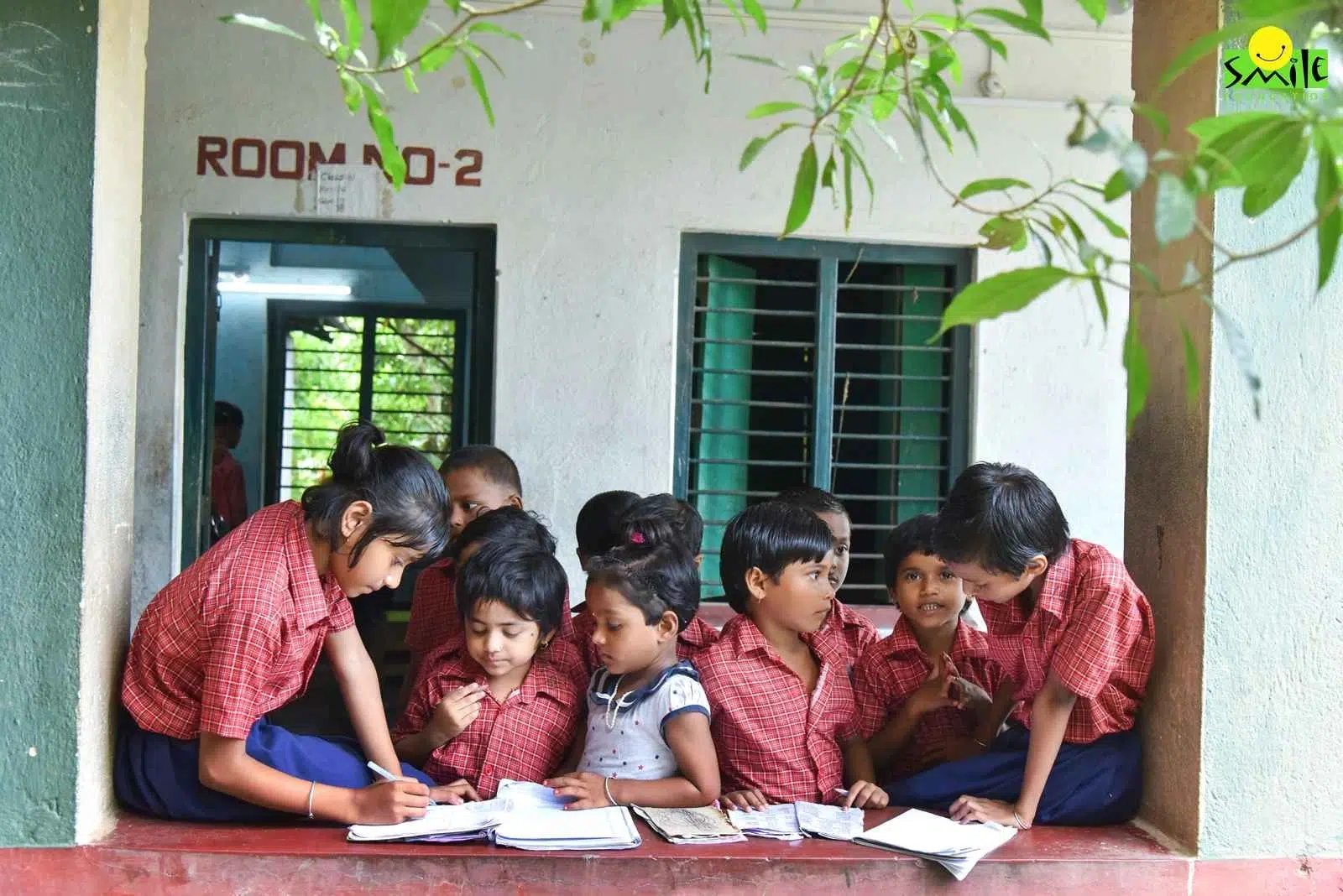

In 2010, India enshrined the Right to Education into law. Yet, more than a decade later, for millions of children, especially those in marginalised communities, education remains a promise deferred. The law guarantees a seat in the classroom, but it does not ensure what happens inside it — nor does it address the ecosystem that surrounds the child.
Smile Foundation working across 27 states in India has taken a systems-level view to bridge this gap. Through our Mission Education initiative, it reaches over 160,000 children annually — not just enrolling them in school, but investing in the constellation of factors that enable true learning: infrastructure, pedagogy, nutrition, community, and digital equity. The result is one of India’s most scaled, holistic, and evidence-informed education programmes in the development space.
At its core, the initiative is driven by a belief that access alone is not equity. Without a shift in how India delivers and supports education, vulnerable children risk being left behind — in learning outcomes, in life opportunities, and in the promise of economic mobility.
A systems problem, not just a school problem
India’s National Education Policy (NEP) of 2020 made bold moves by calling for universal foundational literacy and numeracy, reformed curriculum design, and emphasised experiential learning. But implementation, especially in government schools, has been uneven. Foundational gaps in literacy and numeracy persist. According to ASER 2023, only 50% of Class 5 students can read a Class 2-level text. This is a signal of systemic failure.
What holds children back is not just the quality of teaching but the world around them: a school without toilets, a home without electricity, a mother too burdened to attend a PTA meeting, or a teacher untrained in how to help a first-generation learner cope with trauma. Smile Foundation’s work is rooted in recognising this complexity.
A four-pronged model
Rather than pursue scale in the Indian education space through replication alone, Smile Foundation has adopted a four-pronged strategy that adapts to local contexts while keeping children at the centre:
- Child-Centric Support: From early childhood education through senior secondary school, the Foundation supports children aged 3 to 18. The emphasis is on socio-emotional well-being alongside academic success — a crucial element in high-poverty settings. Students receive counseling, nutritious meals, hygiene sessions, and health interventions to foster readiness for learning.
- Teacher Empowerment: In 2023–24, 86 training sessions were conducted for 482 teachers and 116 principals. These sessions covered activity-based learning, classroom management, lesson planning, and use of digital tools. It’s both professional development and a pipeline for pedagogical resilience.
- Learning Environments: The programme invests in green infrastructure (solar panels, drinking water facilities), visual learning through BaLA (Building as Learning Aid) artwork, and safe campuses with CCTV and repaired plumbing. STEM and language labs have been established across centres, complemented by the distribution of math toolkits, DIY kits, and educational tablets.
- Community Engagement: Through mothers’ groups, school management committees, and local leadership, Smile Foundation anchors its centres in community ownership. When parents feel part of their child’s education journey, dropout rates decline and aspirations rise.
Rewiring equity through innovation in Indian education system
The Foundation’s partnerships reflect a commitment to pushing boundaries. In collaboration with Symbiosis Institute of Management, children have been exposed to coding, mechanics, and bot-making. IIT Mumbai facilitated workshops in robotics and energy. Entecres and Elements brought DIY kits and digital video libraries into classrooms. And with iDream Education and BYJU’S, students gained access to customised digital learning resources that extend beyond textbooks.
These are not one-off CSR interventions. They are structured knowledge partnerships that speak to a new model of social innovation — one that bridges the nonprofit, academic, and private sectors to serve public good.
Girls in focus: From vocational learning to leadership in the story of Indian education
Gender remains one of the most persistent axes of inequality in the Indian education landscape. Smile Foundation has gone beyond parity in enrollment by supporting over 44,000 girls through in-school vocational education programmes in 15 states. These programmes cover trades like organic farming, recycling, basic electronics, and repair — skills often overlooked in formal curricula but crucial for local employment.
Such training not only builds confidence but enables girls to envision futures outside the limitations of early marriage or unpaid domestic labour. Vocational exposure is a bridge to dignity.
From scholarship to social mobility
The Foundation also manages a merit-based scholarship programme to support higher education, especially in technical and engineering streams. In 2023 alone, over 2,000 students were provided with multi-year scholarships, laptops, employability skills, and industry exposure.
These are not just financial awards. The programme ensures that scholars receive domain-specific skills, placement readiness training, and mentoring — creating a scaffold for transformation. Scholars like Sneha from Karnataka and Sakshi from Mumbai speak of a deep personal shift: from survival to ambition, from subsistence to contribution.
“My father is an electrician, and my mother manages the household with impossible grace,” says Sneha, now a second-year engineering student. “The scholarship makes me feel that I’m not alone in this journey.”
Outcomes, not optics
The scale of operations — 735 education centres, 660+ government schools supported, over 44,000 girls in vocational programmes — is significant. But the Foundation resists the temptation of impact-washing. Instead, we place faith in longitudinal tracking, school assessments, and third-party evaluations.
In collaboration with Erewhon Innovation Consulting, a study was conducted to identify gaps in Atal Tinkering Labs, and how best to train teachers to leverage them. This kind of reflective loop, from program delivery to systems diagnosis, is what separates Smile Foundation from transactional service providers.
Rethinking what it means to “Scale”
One of the most critical insights from Smile Foundation’s work is that scale does not mean homogeneity. Instead, it means deep localisation with systemic intelligence. A classroom in Kalahandi, Odisha, has different realities than one in Mumbai’s Dharavi. Yet, what connects them is a framework of dignity, inclusion, and possibility.
This is where traditional education interventions often falter. They push for scalability at the cost of relevance. By contrast, Smile Foundation’s model has found a way to scale without flattening diversity by anchoring deeply in local needs while embedding global best practices.
The way forward
The Indian education landscape is at a pivotal moment. On one hand, digital inclusion is accelerating. On the other, foundational learning remains precarious. AI-based English reading software might coexist with first-generation learners still struggling to grasp basic numeracy. The bridge between these two Indias will not be built by technology or policy alone but by practice, perseverance, and proximity.
Smile Foundation’s model is not perfect. It is not simple. But it is intentional, and that is what systemic change demands.
As the world looks at India — home to the largest youth population on the planet — the question is no longer whether we can get every child into school. The question is: What happens after the child gets there?